Stan Freeda
Information Updated 
2 
•Welcome 
•Workshop Wiki Space and Back Channeling 
•Goals and Targets 
•NH Frameworks for Science Literacy 
•Activity 1: Broad Goals for Science Education 
•Next Generation Science Standards 
•Discussion 1: Conceptual Shifts 
•Examining the Next Generation Science Standards 
•Review of Backward Design 
•Activity 2: Lesson Planning 
•Convergence at the Core 
•New Ways of Teaching and Learning 
•Conclusions and Reflections 
•Final Thoughts and Questions 
7 October 2014
3 
Workshop Wiki Space 
PB Works 
http://mssle09/pbworks.com 
Presentation and resources are available on the wiki space. 
Backchanneling 
Padlet (Wallwisher) 
http://padlet.com/wall/nhnextgenscience 
Use the wall on the wiki space to share comments, reflections, ideas, or questions for consideration. 
Return anytime you want to revisit the workshop content. 
Information Updated 
7 October 2014
4 
•Understand how the Next Generation Science Standards fit into the NH College and Career Ready Standards. 
•Identify the goals for science education in New Hampshire. 
•Understand the conceptual shifts necessary for effective next generation teaching and learning. 
•Understand the basic structure and content of the Next Generation Science Standards. 
•Understand the relationship between the Next Generation Science Standards and the Common Core State Standards for English Language Arts and Mathematics. 
•Realize that new ways of teaching are needed to promote the next generation learning needed to master the Next Generation Science and Common Core State Standards 
7 October 2014 
Information Updated
5 
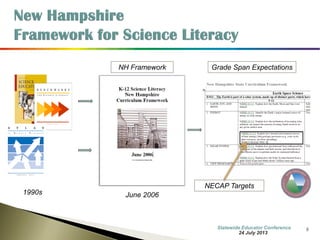
June 2006 
1990s 
NECAP Targets 
NH Framework 
Grade Span Expectations 
7 October 2014 
Information Updated
6 
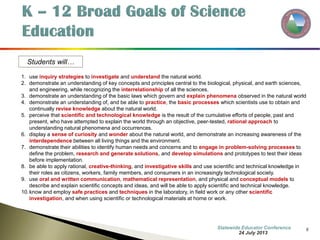
Students will… 
1.use inquiry strategies to investigate and understand the natural world. 
2.demonstrate an understanding of key concepts and principles central to the biological, physical, and earth sciences, and engineering, while recognizing the interrelationship of all the sciences. 
3.demonstrate an understanding of the basic laws which govern and explain phenomena observed in the natural world 
4.demonstrate an understanding of, and be able to practice, the basic processes which scientists use to obtain and continually revise knowledge about the natural world. 
5.perceive that scientific and technological knowledge is the result of the cumulative efforts of people, past and present, who have attempted to explain the world through an objective, peer-tested, rational approach to understanding natural phenomena and occurrences. 
6.display a sense of curiosity and wonder about the natural world, and demonstrate an increasing awareness of the interdependence between all living things and the environment. 
7.demonstrate their abilities to identify human needs and concerns and to engage in problem-solving processes to define the problem, research and generate solutions, and develop simulations and prototypes to test their ideas before implementation. 
8.be able to apply rational, creative-thinking, and investigative skills and use scientific and technical knowledge in their roles as citizens, workers, family members, and consumers in an increasingly technological society. 
9.use oral and written communication, mathematical representation, and physical and conceptual models to describe and explain scientific concepts and ideas, and will be able to apply scientific and technical knowledge. 
10.know and employ safe practices and techniques in the laboratory, in field work or any other scientific investigation, and when using scientific or technological materials at home or work. 
7 October 2014 
Information Updated
7 
Tool: Wordle 
1. Go to the NH Framework for Science Literacy on the web. 
•http://www.education.nh.gov/instruction/curriculum/science/index.htm 
•Education.nh.gov  S  Science in NH Schools 
2.Select K-12 Curriculum Frameworks (Word document). 
3.Grab the text for the K-12 Broad Goals (found on Page 6). 
4.Go to www.Wordle.net 
5.Create your own. 
6.Paste the text into the text box. 
7.Make a Wordle. 
8.Limit the words to 25. 
9.Discuss. Reflect. Conclude. 
Activity 1 
10 minutes 
7 October 2014 
Information Updated
8 
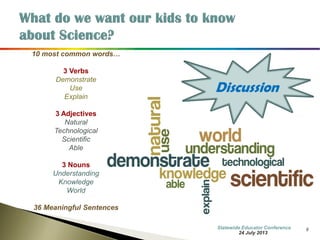
10 most common words… 
3 Verbs 
Demonstrate 
Use 
Explain 
4 Adjectives 
Natural 
Technological 
Scientific 
Able 
3 Nouns 
Understanding 
Knowledge 
World 
36 Meaningful Sentences 
Discussion 
7 October 2014 
Information Updated
9 
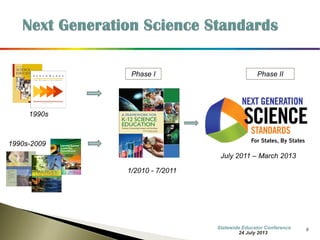
July 2011 – March 2013 
1/2010 - 7/2011 
1990s 
1990s-2009 
Phase II 
Phase I 
7 October 2014 
Information Updated
10 
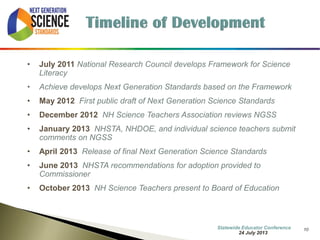
•July 2011 National Research Council develops Framework for Science Literacy 
•Achieve develops Next Generation Standards based on the Framework 
•May 2012 First public draft of Next Generation Science Standards 
•December 2012 NH Science Teachers Association reviews NGSS 
•January 2013 NHSTA, NHDOE, and individual science teachers submit comments on NGSS 
•April 2013 Release of final Next Generation Science Standards 
•Events – New Minimum Standards, Science NECAP to 2016, Common Core negativity, etc… 
•April 2014 Governor’s Task Force on Science Technology Engineering and Math in NH www.stemnh.org 
7 October 2014 
Information Updated
11 
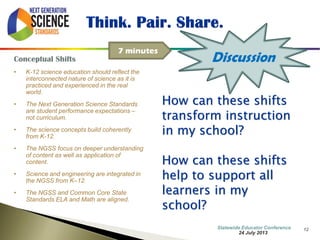
•K-12 science education should reflect the interconnected nature of science as it is practiced and experienced in the real world. 
•The Next Generation Science Standards are student performance expectations – not curriculum. 
•The science concepts build coherently from K-12. 
•The NGSS focus on deeper understanding of content as well as application of content. 
•Science and engineering are integrated in the NGSS from K–12. 
•The Next Generation Science Standards and Common Core State Standards for English Language Arts and Mathematics are aligned. 
7 October 2014 
Information Updated
12 
Conceptual Shifts 
•K-12 science education should reflect the interconnected nature of science as it is practiced and experienced in the real world. 
•The Next Generation Science Standards are student performance expectations – not curriculum. 
•The science concepts build coherently from K-12. 
•The NGSS focus on deeper understanding of content as well as application of content. 
•Science and engineering are integrated in the NGSS from K–12. 
•The NGSS and Common Core State Standards ELA and Math are aligned. 
How can these shifts transform instruction in my school? 
How can these shifts help to support all learners in my school? 
Discussion 
7 minutes 
7 October 2014 
Information Updated
13 
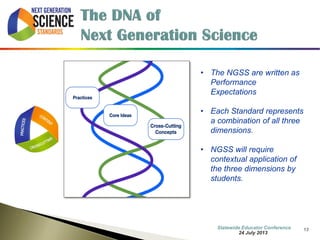
•The NGSS are written as Performance Expectations 
•Each Standard represents a combination of all three dimensions. 
•NGSS will require contextual application of the three dimensions by students. 
7 October 2014 
Information Updated
14 
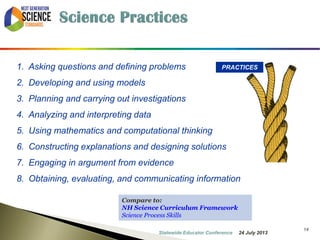
PRACTICES 
1.Asking questions and defining problems 
2.Developing and using models 
3.Planning and carrying out investigations 
4.Analyzing and interpreting data 
5.Using mathematics and computational thinking 
6.Constructing explanations and designing solutions 
7.Engaging in argument from evidence 
8.Obtaining, evaluating, and communicating information 
Compare to: 
NH Science Curriculum Framework 
Science Process Skills 
7 October 2014 
Information Updated
15 
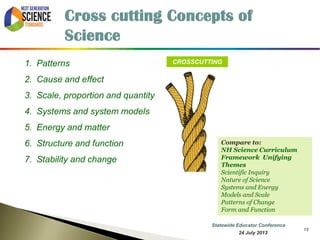
CROSSCUTTING 
1.Patterns 
2.Cause and effect 
3.Scale, proportion and quantity 
4.Systems and system models 
5.Energy and matter 
6.Structure and function 
7.Stability and change 
Compare to: NH Science Curriculum Framework Unifying Themes Scientific Inquiry Nature of Science Systems and Energy Models and Scale Patterns of Change Form and Function 
7 October 2014 
Information Updated
16 
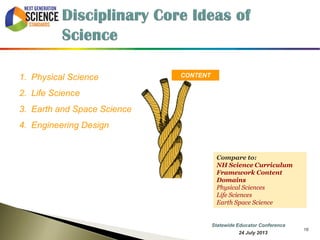
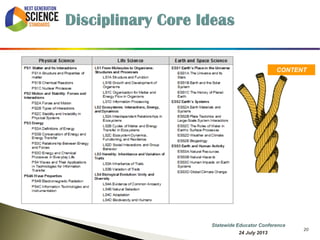
CONTENT 
Compare to: 
NH Science Curriculum Framework Content Domains 
Physical Sciences 
Life Sciences 
Earth Space Science 
1.Physical Science 
2.Life Science 
3.Earth and Space Science 
4.Engineering Design 
7 October 2014 
Information Updated
17 
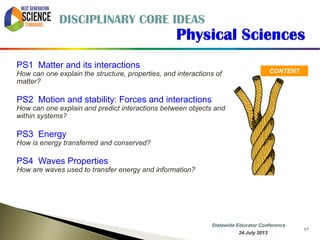
CONTENT 
PS1 Matter and its interactions How can one explain the structure, properties, and interactions of matter? 
PS2 Motion and stability: Forces and interactions How can one explain and predict interactions between objects and within systems? 
PS3 Energy How is energy transferred and conserved? 
PS4 Waves Properties How are waves used to transfer energy and information? 
DISCIPLINARY CORE IDEAS 
7 October 2014 
Information Updated
18 
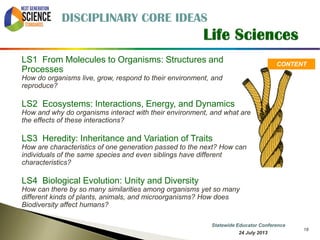
CONTENT 
LS1 From Molecules to Organisms: Structures and Processes How do organisms live, grow, respond to their environment, and reproduce? 
LS2 Ecosystems: Interactions, Energy, and Dynamics How and why do organisms interact with their environment, and what are the effects of these interactions? 
LS3 Heredity: Inheritance and Variation of Traits How are characteristics of one generation passed to the next? How can individuals of the same species and even siblings have different characteristics? 
LS4 Biological Evolution: Unity and Diversity How can there by so many similarities among organisms yet so many different kinds of plants, animals, and microorganisms? How does Biodiversity affect humans? 
DISCIPLINARY CORE IDEAS 
7 October 2014 
Information Updated
19 
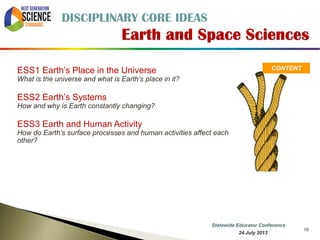
CONTENT 
ESS1 Earth’s Place in the Universe What is the universe and what is Earth’s place in it? 
ESS2 Earth’s Systems How and why is Earth constantly changing? 
ESS3 Earth and Human Activity How do Earth’s surface processes and human activities affect each other? 
DISCIPLINARY CORE IDEAS 
7 October 2014 
Information Updated
20 
CONTENT 
7 October 2014 
Information Updated
21 
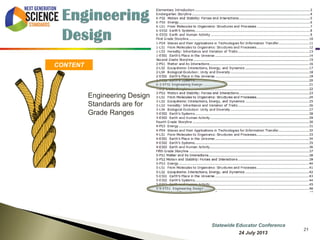
CONTENT 
Engineering Design Standards are for Grade Ranges 
7 October 2014 
Information Updated
22 
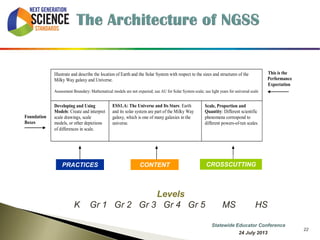
This is the 
Performance 
Expectation 
Foundation 
Boxes 
Practice Disciplinary Core Idea Crosscutting Concept 
Illustrate and describe the location of Earth and the Solar System with respect to the sizes and structures of the 
Milky Way galaxy and Universe. 
Assessment Boundary: Mathematical models are not expected; use AU for Solar System scale; use light years for universal scale 
Developing and Using 
Models: Create and interpret 
scale drawings, scale 
models, or other depictions 
of differences in scale. 
ESS1.A: The Universe and Its Stars: Earth 
and its solar system are part of the Milky Way 
galaxy, which is one of many galaxies in the 
universe. 
Scale, Proportion and 
Quantity: Different scientific 
phenomena correspond to 
different powers-of-ten scales. 
PRACTICES CONTENT CROSSCUTTING 
Levels 
K Gr 1 Gr 2 Gr 3 Gr 4 Gr 5 MS HS 
Information Updated 7 October 2014
23 
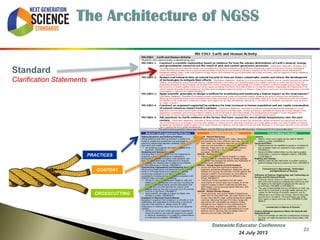
PRACTICES 
CONTENT 
CROSSCUTTING 
Standard 
Clarification Statements 
7 October 2014 
Information Updated
24 
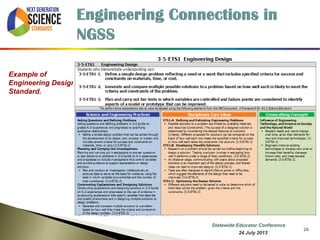
Example of Engineering Design Standard. 
7 October 2014 
Information Updated
25 
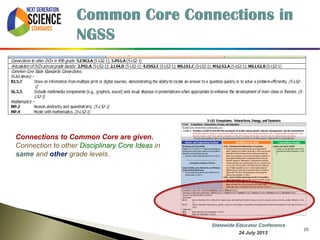
Connections to Common Core are given. 
Connection to other Disciplinary Core Ideas in same and other grade levels. 
7 October 2014 
Information Updated
26 
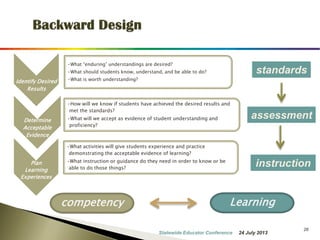
Identify Desired Results 
•What “enduring” understandings are desired? 
•What should students know, understand, and be able to do? 
•What is worth understanding? 
Determine Acceptable Evidence 
•How will we know if students have achieved the desired results and met the standards? 
•What will we accept as evidence of student understanding and proficiency? 
Plan 
Learning 
Experiences 
•What activities will give students experience and practice demonstrating the acceptable evidence of learning? 
•What instruction or guidance do they need in order to know or be able to do those things? 
assessment 
standards 
instruction 
competency 
Learning 
7 October 2014 
Information Updated
27 
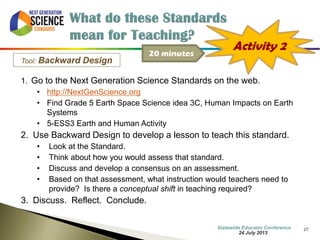
Tool: Backward Design 
1. Go to the Next Generation Science Standards on the web. 
•http://NextGenScience.org 
•Find Grade 5 Earth Space Science idea 3C, Human Impacts on Earth Systems 
•5-ESS3 Earth and Human Activity 
2.Use Backward Design to develop a lesson to teach this standard. 
•Look at the Standard. 
•Think about how you would assess that standard. 
•Discuss and develop a consensus on an assessment. 
•Based on that assessment, what instruction would teachers need to provide? Is there a conceptual shift in teaching required? 
3.Discuss. Reflect. Conclude. 
Activity 2 
20 minutes 
7 October 2014 
Information Updated
28 
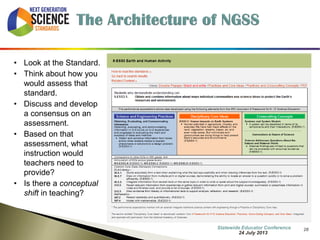
•Look at the Standard. 
•Think about how you would assess that standard. 
•Discuss and develop a consensus on an assessment. 
•Based on that assessment, what instruction would teachers need to provide? 
•Is there a conceptual shift in teaching? 
7 October 2014 
Information Updated
29 
Common Core State Standards English Language Arts 
The Common Core asks students to read stories and literature, as well as more complex texts that provide facts and background knowledge in areas such as science and social studies. Students will be challenged and asked questions that push them to refer back to what they’ve read. This stresses critical-thinking, problem-solving, and analytical skills that are required for success in college, career, and life. 
Key Shifts in English Language Arts 
1.Regular practice with complex texts and their academic language 
2.Reading, writing, and speaking grounded in evidence from texts, both literary and informational 
3.Building knowledge through content-rich nonfiction 
7 October 2014 
Information Updated
30 
Minimum Standards for School Approval 
Ed 306.371 English Language Arts and Reading applies on July 1, 2015 
(b) (1) Provide students with teaching and instructional practices that: 
a. Prepare students to comprehend and evaluate complex texts across a range of types and disciplines, and to construct effective arguments and convey intricate 
or multifaceted information; 
b. Establish a base of knowledge across a wide range of subject matter by engaging with works of quality and substance; 
c. Prepare students to adapt communication in relation to audience, task, purpose, and discipline; 
d. Establish students as engaged and open-minded, but discerning, readers and listeners; 
e. Prepare students to cite specific evidence when offering an oral or written interpretation of a text; 
7 October 2014 
Information Updated 
Key Shifts in English Language Arts
31 
Common Core State Standards Mathematics 
The Common Core concentrates on a clear set of math skills and concepts. Students will learn concepts in a more organized way both during the school year and across grades. The standards encourage students to solve real-world problems. 
Key Shifts in Mathematics 
1.Greater focus on fewer topics 
2.Coherence: Linking topics and thinking across grades 
3.Rigor: Pursue conceptual understanding, procedural skills and fluency, and application with equal intensity 
7 October 2014 
Information Updated
32 
Minimum Standards for School Approval 
Ed 306.431 Mathematics Program applies on July 1, 2015 
(a)(1) Solve problems by: 
a. Using multiple strategies; 
b. Communicating mathematical ideas through speaking and writing; 
c. Reading and interpreting mathematics; 
d. Making logical connections between different mathematical concepts and representations; and 
e. Applying good reasoning in developing solutions and to affirm or disprove statements; 
(a)(3) Use authentic tasks that: 
a. Promote student decision making and questioning; 
b. Encourage students to develop and defend unique problem-solving strategies and conjectures made and analyzed from patterns and data collected; and 
c. Encourage the use of inductive reasoning, deductive reasoning at middle and high school levels, and proof at high school level; 
7 October 2014 
Information Updated
33 
Minimum Standards for School Approval 
Ed 306.451 Science Program applies on July 1, 2015 
(b) Science programs in each school shall prepare both technologically and environmentally literate students, by including planned learning strategies and opportunities that: 
(1) Provide students with teaching and instructional practices that: 
a. Reflect on the interconnectedness of the nature and practice of science in the real world; 
b. Perform science through the development of practices that are integrated with core ideas and crosscutting concepts; 
d. Focus on deeper understanding of science content as well as application of that content; 
g. Connect science to mathematics, language arts, and other content areas; 
…more  
7 October 2014 
Information Updated
34 
Minimum Standards for School Approval 
Ed 306.451 Science Program applies on July 1, 2015 
(2) Provide students with knowledge and experience of the following science practices, integrated with cross cutting science concepts and core disciplinary principles: 
a. Asking questions and defining problems; 
c. Planning and carrying out investigations; 
d. Analyzing and interpreting data; 
e. Using mathematics and computational thinking; 
f. Constructing explanations and designing solutions; 
g. Engaging in argument from evidence; and 
(3) Provide students with knowledge and experience of the following cross cutting science concepts, integrated with science practices and core disciplinary principles which include the 
following: 
b. Cause and effect with respect to mechanism and explanation; 
7 October 2014 
Information Updated
35 
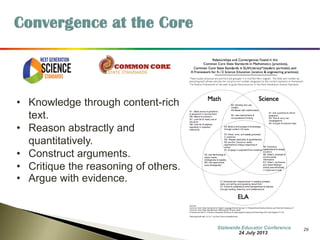
•Knowledge through content-rich text. 
•Reason abstractly and quantitatively. 
•Construct arguments. 
•Critique the reasoning of others. 
•Argue with evidence. 
7 October 2014 
Information Updated
36 
AT THE CORE OF ALL MODERN STANDARDS IS: 
•REASONING WITH EVIDENCE. 
•BUILDING ARGUMENTS AND CRITIQUING THE ARGUMENTS OF OTHERS. 
•DEVELOPING RIGOROUS, CONCEPTUALLY STRONG, EVIDENCE-BASED THINKING PRACTICES. 
•PARTICIPATING IN REASONING-ORIENTED PRACTICES, WITH OTHERS. 
A FEW MORE OF THESE PRACTICES SEEM TO RELATE EXPLICITLY TO SENSE-MAKING AND DISCUSSION: REASONING, IN THE SERVICE OF MAKING ARGUMENTS. 
7 October 2014 
Information Updated
7 October 2014 
Information Updated 
37 
TEACHERS WILL HAVE TO HELP ALL STUDENTS: 
•EXTERNALIZE THEIR THINKING; 
•LISTEN CAREFULLY TO ONE ANOTHER AND TAKE ONE ANOTHER SERIOUSLY; 
•DIG DEEPER INTO THE DATA AND EVIDENCE FOR THEIR POSITIONS; 
•WORK WITH THE REASONING OF OTHERS.
38 
•REQUIRE THAT TEACHERS FOCUS MORE ATTENTION ON REASONING AND “THINKING PRACTICES.” 
•REQUIRE STUDENTS TO PARTICIPATE IN MAKING THEIR THINKING PUBLIC AND COGENT. 
•STUDENTS WILL NEED GUIDANCE TO MAKING THEIR THINKING… 
•Visible 
•Public 
•Available to others …IN SPEAKING AND WRITING! 
7 October 2014 
Information Updated
39 
Points to Consider: 
•“Reasoning practices” in all content areas have to be enacted, and for learners, most are enacted socially, through talk and writing. 
•“Social” does not just mean student-led group work. Well- structured social interaction builds in time to think as an individual – making thinking available - metacognition. 
7 October 2014 
Information Updated
40 
“Reasoning” practices are common to all modern sets of standards. That means big bang for the buck. 
The practices of discussion transfer from one content domain to another. 
We now know a great deal about how to induct students, from all backgrounds, into these reasoning practices, through rigorous, content-rich, teacher-guided discussions. 
Good teaching has always supported these practices. 
7 October 2014 
Information Updated
7 October 2014 
Information Updated 
41 
The dominant forms of talk in classrooms — recitation and direct instruction — do NOT support reasoning, building arguments with evidence, explaining, critiquing, and building common ground. 
Teachers are often not well-prepared to lead academically productive, reasoning- oriented discussions. 
Teachers often rely on group work, hoping that the hands-on activities, in small groups, will teach the students what they need to learn. 
Teachers have a hard time running deeper discussions. Because of limitations, deep discussions are often skipped. “…We just didn’t have time.”
42 
ASSESSING NEW LEARNING 
A Comment about Assessment Practices 
We cannot effectively assess kids on the Common Core and Next Generation Science Standards using technology and an online assessment unless we effectively learn how to teach kids using technologies and the learning models supported by the Common Core and Next Generation Science Standards. 
7 October 2014 
Information Updated
43 
•Understand how the Next Generation Science Standards fit into the NH College and Career Ready Standards. 
•Identify the goals for science education in New Hampshire. 
•Understand the conceptual shifts necessary for effective next generation teaching and learning. 
•Understand the basic structure and content of the Next Generation Science Standards. 
•Understand the relationship between the Next Generation Science Standards and the Common Core State Standards for English Language Arts and Mathematics. 
•Realize that new ways of teaching are needed to promote the next generation learning needed to master the Next Generation Science and Common Core State Standards 
7 October 2014 
Information Updated
44 
FINAL THOUGHTS AND QUESTIONS 
7 October 2014 
Information Updated
45 
WHAT’S COMMON CORE ABOUT THE 
NEXT GENERATION SCIENCE STANDARDS? 
Contact Information 
Stan Freeda 
Office of Educational Technology 
New Hampshire Department of Education 
Stanley.Freeda@doe.nh.gov 603.271.5132 
www.education.nh.gov www.nheon.org www.opennh.org 
@ 
7 October 2014 
Information Updated

NH Next Gen Science Workshop

  • 1.
  • 2.
    Information Updated 2 •Welcome •Workshop Wiki Space and Back Channeling •Goals and Targets •NH Frameworks for Science Literacy •Activity 1: Broad Goals for Science Education •Next Generation Science Standards •Discussion 1: Conceptual Shifts •Examining the Next Generation Science Standards •Review of Backward Design •Activity 2: Lesson Planning •Convergence at the Core •New Ways of Teaching and Learning •Conclusions and Reflections •Final Thoughts and Questions 7 October 2014
  • 3.
    3 Workshop WikiSpace PB Works http://mssle09/pbworks.com Presentation and resources are available on the wiki space. Backchanneling Padlet (Wallwisher) http://padlet.com/wall/nhnextgenscience Use the wall on the wiki space to share comments, reflections, ideas, or questions for consideration. Return anytime you want to revisit the workshop content. Information Updated 7 October 2014
  • 4.
    4 •Understand howthe Next Generation Science Standards fit into the NH College and Career Ready Standards. •Identify the goals for science education in New Hampshire. •Understand the conceptual shifts necessary for effective next generation teaching and learning. •Understand the basic structure and content of the Next Generation Science Standards. •Understand the relationship between the Next Generation Science Standards and the Common Core State Standards for English Language Arts and Mathematics. •Realize that new ways of teaching are needed to promote the next generation learning needed to master the Next Generation Science and Common Core State Standards 7 October 2014 Information Updated
  • 5.
    5 June 2006 1990s NECAP Targets NH Framework Grade Span Expectations 7 October 2014 Information Updated
  • 6.
    6 Students will… 1.use inquiry strategies to investigate and understand the natural world. 2.demonstrate an understanding of key concepts and principles central to the biological, physical, and earth sciences, and engineering, while recognizing the interrelationship of all the sciences. 3.demonstrate an understanding of the basic laws which govern and explain phenomena observed in the natural world 4.demonstrate an understanding of, and be able to practice, the basic processes which scientists use to obtain and continually revise knowledge about the natural world. 5.perceive that scientific and technological knowledge is the result of the cumulative efforts of people, past and present, who have attempted to explain the world through an objective, peer-tested, rational approach to understanding natural phenomena and occurrences. 6.display a sense of curiosity and wonder about the natural world, and demonstrate an increasing awareness of the interdependence between all living things and the environment. 7.demonstrate their abilities to identify human needs and concerns and to engage in problem-solving processes to define the problem, research and generate solutions, and develop simulations and prototypes to test their ideas before implementation. 8.be able to apply rational, creative-thinking, and investigative skills and use scientific and technical knowledge in their roles as citizens, workers, family members, and consumers in an increasingly technological society. 9.use oral and written communication, mathematical representation, and physical and conceptual models to describe and explain scientific concepts and ideas, and will be able to apply scientific and technical knowledge. 10.know and employ safe practices and techniques in the laboratory, in field work or any other scientific investigation, and when using scientific or technological materials at home or work. 7 October 2014 Information Updated
  • 7.
    7 Tool: Wordle 1. Go to the NH Framework for Science Literacy on the web. •http://www.education.nh.gov/instruction/curriculum/science/index.htm •Education.nh.gov  S  Science in NH Schools 2.Select K-12 Curriculum Frameworks (Word document). 3.Grab the text for the K-12 Broad Goals (found on Page 6). 4.Go to www.Wordle.net 5.Create your own. 6.Paste the text into the text box. 7.Make a Wordle. 8.Limit the words to 25. 9.Discuss. Reflect. Conclude. Activity 1 10 minutes 7 October 2014 Information Updated
  • 8.
    8 10 mostcommon words… 3 Verbs Demonstrate Use Explain 4 Adjectives Natural Technological Scientific Able 3 Nouns Understanding Knowledge World 36 Meaningful Sentences Discussion 7 October 2014 Information Updated
  • 9.
    9 July 2011– March 2013 1/2010 - 7/2011 1990s 1990s-2009 Phase II Phase I 7 October 2014 Information Updated
  • 10.
    10 •July 2011National Research Council develops Framework for Science Literacy •Achieve develops Next Generation Standards based on the Framework •May 2012 First public draft of Next Generation Science Standards •December 2012 NH Science Teachers Association reviews NGSS •January 2013 NHSTA, NHDOE, and individual science teachers submit comments on NGSS •April 2013 Release of final Next Generation Science Standards •Events – New Minimum Standards, Science NECAP to 2016, Common Core negativity, etc… •April 2014 Governor’s Task Force on Science Technology Engineering and Math in NH www.stemnh.org 7 October 2014 Information Updated
  • 11.
    11 •K-12 scienceeducation should reflect the interconnected nature of science as it is practiced and experienced in the real world. •The Next Generation Science Standards are student performance expectations – not curriculum. •The science concepts build coherently from K-12. •The NGSS focus on deeper understanding of content as well as application of content. •Science and engineering are integrated in the NGSS from K–12. •The Next Generation Science Standards and Common Core State Standards for English Language Arts and Mathematics are aligned. 7 October 2014 Information Updated
  • 12.
    12 Conceptual Shifts •K-12 science education should reflect the interconnected nature of science as it is practiced and experienced in the real world. •The Next Generation Science Standards are student performance expectations – not curriculum. •The science concepts build coherently from K-12. •The NGSS focus on deeper understanding of content as well as application of content. •Science and engineering are integrated in the NGSS from K–12. •The NGSS and Common Core State Standards ELA and Math are aligned. How can these shifts transform instruction in my school? How can these shifts help to support all learners in my school? Discussion 7 minutes 7 October 2014 Information Updated
  • 13.
    13 •The NGSSare written as Performance Expectations •Each Standard represents a combination of all three dimensions. •NGSS will require contextual application of the three dimensions by students. 7 October 2014 Information Updated
  • 14.
    14 PRACTICES 1.Askingquestions and defining problems 2.Developing and using models 3.Planning and carrying out investigations 4.Analyzing and interpreting data 5.Using mathematics and computational thinking 6.Constructing explanations and designing solutions 7.Engaging in argument from evidence 8.Obtaining, evaluating, and communicating information Compare to: NH Science Curriculum Framework Science Process Skills 7 October 2014 Information Updated
  • 15.
    15 CROSSCUTTING 1.Patterns 2.Cause and effect 3.Scale, proportion and quantity 4.Systems and system models 5.Energy and matter 6.Structure and function 7.Stability and change Compare to: NH Science Curriculum Framework Unifying Themes Scientific Inquiry Nature of Science Systems and Energy Models and Scale Patterns of Change Form and Function 7 October 2014 Information Updated
  • 16.
    16 CONTENT Compareto: NH Science Curriculum Framework Content Domains Physical Sciences Life Sciences Earth Space Science 1.Physical Science 2.Life Science 3.Earth and Space Science 4.Engineering Design 7 October 2014 Information Updated
  • 17.
    17 CONTENT PS1Matter and its interactions How can one explain the structure, properties, and interactions of matter? PS2 Motion and stability: Forces and interactions How can one explain and predict interactions between objects and within systems? PS3 Energy How is energy transferred and conserved? PS4 Waves Properties How are waves used to transfer energy and information? DISCIPLINARY CORE IDEAS 7 October 2014 Information Updated
  • 18.
    18 CONTENT LS1From Molecules to Organisms: Structures and Processes How do organisms live, grow, respond to their environment, and reproduce? LS2 Ecosystems: Interactions, Energy, and Dynamics How and why do organisms interact with their environment, and what are the effects of these interactions? LS3 Heredity: Inheritance and Variation of Traits How are characteristics of one generation passed to the next? How can individuals of the same species and even siblings have different characteristics? LS4 Biological Evolution: Unity and Diversity How can there by so many similarities among organisms yet so many different kinds of plants, animals, and microorganisms? How does Biodiversity affect humans? DISCIPLINARY CORE IDEAS 7 October 2014 Information Updated
  • 19.
    19 CONTENT ESS1Earth’s Place in the Universe What is the universe and what is Earth’s place in it? ESS2 Earth’s Systems How and why is Earth constantly changing? ESS3 Earth and Human Activity How do Earth’s surface processes and human activities affect each other? DISCIPLINARY CORE IDEAS 7 October 2014 Information Updated
  • 20.
    20 CONTENT 7October 2014 Information Updated
  • 21.
    21 CONTENT EngineeringDesign Standards are for Grade Ranges 7 October 2014 Information Updated
  • 22.
    22 This isthe Performance Expectation Foundation Boxes Practice Disciplinary Core Idea Crosscutting Concept Illustrate and describe the location of Earth and the Solar System with respect to the sizes and structures of the Milky Way galaxy and Universe. Assessment Boundary: Mathematical models are not expected; use AU for Solar System scale; use light years for universal scale Developing and Using Models: Create and interpret scale drawings, scale models, or other depictions of differences in scale. ESS1.A: The Universe and Its Stars: Earth and its solar system are part of the Milky Way galaxy, which is one of many galaxies in the universe. Scale, Proportion and Quantity: Different scientific phenomena correspond to different powers-of-ten scales. PRACTICES CONTENT CROSSCUTTING Levels K Gr 1 Gr 2 Gr 3 Gr 4 Gr 5 MS HS Information Updated 7 October 2014
  • 23.
    23 PRACTICES CONTENT CROSSCUTTING Standard Clarification Statements 7 October 2014 Information Updated
  • 24.
    24 Example ofEngineering Design Standard. 7 October 2014 Information Updated
  • 25.
    25 Connections toCommon Core are given. Connection to other Disciplinary Core Ideas in same and other grade levels. 7 October 2014 Information Updated
  • 26.
    26 Identify DesiredResults •What “enduring” understandings are desired? •What should students know, understand, and be able to do? •What is worth understanding? Determine Acceptable Evidence •How will we know if students have achieved the desired results and met the standards? •What will we accept as evidence of student understanding and proficiency? Plan Learning Experiences •What activities will give students experience and practice demonstrating the acceptable evidence of learning? •What instruction or guidance do they need in order to know or be able to do those things? assessment standards instruction competency Learning 7 October 2014 Information Updated
  • 27.
    27 Tool: BackwardDesign 1. Go to the Next Generation Science Standards on the web. •http://NextGenScience.org •Find Grade 5 Earth Space Science idea 3C, Human Impacts on Earth Systems •5-ESS3 Earth and Human Activity 2.Use Backward Design to develop a lesson to teach this standard. •Look at the Standard. •Think about how you would assess that standard. •Discuss and develop a consensus on an assessment. •Based on that assessment, what instruction would teachers need to provide? Is there a conceptual shift in teaching required? 3.Discuss. Reflect. Conclude. Activity 2 20 minutes 7 October 2014 Information Updated
  • 28.
    28 •Look atthe Standard. •Think about how you would assess that standard. •Discuss and develop a consensus on an assessment. •Based on that assessment, what instruction would teachers need to provide? •Is there a conceptual shift in teaching? 7 October 2014 Information Updated
  • 29.
    29 Common CoreState Standards English Language Arts The Common Core asks students to read stories and literature, as well as more complex texts that provide facts and background knowledge in areas such as science and social studies. Students will be challenged and asked questions that push them to refer back to what they’ve read. This stresses critical-thinking, problem-solving, and analytical skills that are required for success in college, career, and life. Key Shifts in English Language Arts 1.Regular practice with complex texts and their academic language 2.Reading, writing, and speaking grounded in evidence from texts, both literary and informational 3.Building knowledge through content-rich nonfiction 7 October 2014 Information Updated
  • 30.
    30 Minimum Standardsfor School Approval Ed 306.371 English Language Arts and Reading applies on July 1, 2015 (b) (1) Provide students with teaching and instructional practices that: a. Prepare students to comprehend and evaluate complex texts across a range of types and disciplines, and to construct effective arguments and convey intricate or multifaceted information; b. Establish a base of knowledge across a wide range of subject matter by engaging with works of quality and substance; c. Prepare students to adapt communication in relation to audience, task, purpose, and discipline; d. Establish students as engaged and open-minded, but discerning, readers and listeners; e. Prepare students to cite specific evidence when offering an oral or written interpretation of a text; 7 October 2014 Information Updated Key Shifts in English Language Arts
  • 31.
    31 Common CoreState Standards Mathematics The Common Core concentrates on a clear set of math skills and concepts. Students will learn concepts in a more organized way both during the school year and across grades. The standards encourage students to solve real-world problems. Key Shifts in Mathematics 1.Greater focus on fewer topics 2.Coherence: Linking topics and thinking across grades 3.Rigor: Pursue conceptual understanding, procedural skills and fluency, and application with equal intensity 7 October 2014 Information Updated
  • 32.
    32 Minimum Standardsfor School Approval Ed 306.431 Mathematics Program applies on July 1, 2015 (a)(1) Solve problems by: a. Using multiple strategies; b. Communicating mathematical ideas through speaking and writing; c. Reading and interpreting mathematics; d. Making logical connections between different mathematical concepts and representations; and e. Applying good reasoning in developing solutions and to affirm or disprove statements; (a)(3) Use authentic tasks that: a. Promote student decision making and questioning; b. Encourage students to develop and defend unique problem-solving strategies and conjectures made and analyzed from patterns and data collected; and c. Encourage the use of inductive reasoning, deductive reasoning at middle and high school levels, and proof at high school level; 7 October 2014 Information Updated
  • 33.
    33 Minimum Standardsfor School Approval Ed 306.451 Science Program applies on July 1, 2015 (b) Science programs in each school shall prepare both technologically and environmentally literate students, by including planned learning strategies and opportunities that: (1) Provide students with teaching and instructional practices that: a. Reflect on the interconnectedness of the nature and practice of science in the real world; b. Perform science through the development of practices that are integrated with core ideas and crosscutting concepts; d. Focus on deeper understanding of science content as well as application of that content; g. Connect science to mathematics, language arts, and other content areas; …more  7 October 2014 Information Updated
  • 34.
    34 Minimum Standardsfor School Approval Ed 306.451 Science Program applies on July 1, 2015 (2) Provide students with knowledge and experience of the following science practices, integrated with cross cutting science concepts and core disciplinary principles: a. Asking questions and defining problems; c. Planning and carrying out investigations; d. Analyzing and interpreting data; e. Using mathematics and computational thinking; f. Constructing explanations and designing solutions; g. Engaging in argument from evidence; and (3) Provide students with knowledge and experience of the following cross cutting science concepts, integrated with science practices and core disciplinary principles which include the following: b. Cause and effect with respect to mechanism and explanation; 7 October 2014 Information Updated
  • 35.
    35 •Knowledge throughcontent-rich text. •Reason abstractly and quantitatively. •Construct arguments. •Critique the reasoning of others. •Argue with evidence. 7 October 2014 Information Updated
  • 36.
    36 AT THECORE OF ALL MODERN STANDARDS IS: •REASONING WITH EVIDENCE. •BUILDING ARGUMENTS AND CRITIQUING THE ARGUMENTS OF OTHERS. •DEVELOPING RIGOROUS, CONCEPTUALLY STRONG, EVIDENCE-BASED THINKING PRACTICES. •PARTICIPATING IN REASONING-ORIENTED PRACTICES, WITH OTHERS. A FEW MORE OF THESE PRACTICES SEEM TO RELATE EXPLICITLY TO SENSE-MAKING AND DISCUSSION: REASONING, IN THE SERVICE OF MAKING ARGUMENTS. 7 October 2014 Information Updated
  • 37.
    7 October 2014 Information Updated 37 TEACHERS WILL HAVE TO HELP ALL STUDENTS: •EXTERNALIZE THEIR THINKING; •LISTEN CAREFULLY TO ONE ANOTHER AND TAKE ONE ANOTHER SERIOUSLY; •DIG DEEPER INTO THE DATA AND EVIDENCE FOR THEIR POSITIONS; •WORK WITH THE REASONING OF OTHERS.
  • 38.
    38 •REQUIRE THATTEACHERS FOCUS MORE ATTENTION ON REASONING AND “THINKING PRACTICES.” •REQUIRE STUDENTS TO PARTICIPATE IN MAKING THEIR THINKING PUBLIC AND COGENT. •STUDENTS WILL NEED GUIDANCE TO MAKING THEIR THINKING… •Visible •Public •Available to others …IN SPEAKING AND WRITING! 7 October 2014 Information Updated
  • 39.
    39 Points toConsider: •“Reasoning practices” in all content areas have to be enacted, and for learners, most are enacted socially, through talk and writing. •“Social” does not just mean student-led group work. Well- structured social interaction builds in time to think as an individual – making thinking available - metacognition. 7 October 2014 Information Updated
  • 40.
    40 “Reasoning” practicesare common to all modern sets of standards. That means big bang for the buck. The practices of discussion transfer from one content domain to another. We now know a great deal about how to induct students, from all backgrounds, into these reasoning practices, through rigorous, content-rich, teacher-guided discussions. Good teaching has always supported these practices. 7 October 2014 Information Updated
  • 41.
    7 October 2014 Information Updated 41 The dominant forms of talk in classrooms — recitation and direct instruction — do NOT support reasoning, building arguments with evidence, explaining, critiquing, and building common ground. Teachers are often not well-prepared to lead academically productive, reasoning- oriented discussions. Teachers often rely on group work, hoping that the hands-on activities, in small groups, will teach the students what they need to learn. Teachers have a hard time running deeper discussions. Because of limitations, deep discussions are often skipped. “…We just didn’t have time.”
  • 42.
    42 ASSESSING NEWLEARNING A Comment about Assessment Practices We cannot effectively assess kids on the Common Core and Next Generation Science Standards using technology and an online assessment unless we effectively learn how to teach kids using technologies and the learning models supported by the Common Core and Next Generation Science Standards. 7 October 2014 Information Updated
  • 43.
    43 •Understand howthe Next Generation Science Standards fit into the NH College and Career Ready Standards. •Identify the goals for science education in New Hampshire. •Understand the conceptual shifts necessary for effective next generation teaching and learning. •Understand the basic structure and content of the Next Generation Science Standards. •Understand the relationship between the Next Generation Science Standards and the Common Core State Standards for English Language Arts and Mathematics. •Realize that new ways of teaching are needed to promote the next generation learning needed to master the Next Generation Science and Common Core State Standards 7 October 2014 Information Updated
  • 44.
    44 FINAL THOUGHTSAND QUESTIONS 7 October 2014 Information Updated
  • 45.
    45 WHAT’S COMMONCORE ABOUT THE NEXT GENERATION SCIENCE STANDARDS? Contact Information Stan Freeda Office of Educational Technology New Hampshire Department of Education Stanley.Freeda@doe.nh.gov 603.271.5132 www.education.nh.gov www.nheon.org www.opennh.org @ 7 October 2014 Information Updated