
MARKETING THE
LIBRARY
P r e s e n t e d b y
P h i l i p B l a k e
Australian School Library
Association Inc.
Housekeeping
Australian School Library Association Inc.
Sue Johnston
ASLA Board Director
Chair ASLA Professional
Learning Project Team
Facilitator for this webinar
Housekeeping:
 Participation options
 Attendee control panel
 Question facility
 Post-webinar
information
 Future PL events
2
Questions
Australian School Library Association Inc.
3
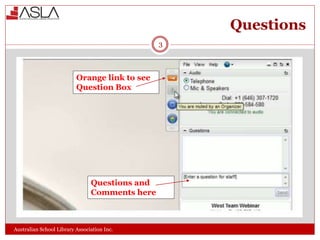
Orange link to see
Question Box
Questions and
Comments here
 ‘I trust a good deal to common fame, as we all must.
If a man has good corn or wood, or boards, or pigs,
to sell, or can make better chairs or knives, crucibles
or church organs, than anybody else, you will find a
broad hard-beaten road to his house, though it be in
the woods.’—Ralph Waldo Emerson
A better mousetrap
 ‘Build a better mousetrap and the world will beat a
path to your door.’
‘The world will beat a path to your door…’
No it won’t.
 The only way the world will beat a path to your door
is if you tell them about the better mousetrap behind
the door.
 This applies to libraries too.
 It doesn’t matter how good you are, or how
innovative the library is; if you don’t tell people
about it, nobody except the regular users will know
or care.
How to tell the world
 Your library needs to be in the public eye. There are
plenty of ways to get it in the public eye:
 Send out a regular newsletter
 Find out what themes the teachers are working on,
and talk to them about how the library can help.
 Set up displays and advertise them.
 Organise competitions
 Get guests or speakers into the library
How to tell the world (2)
 Keep up with current affairs, make the library topical
– and advertise it.
 Have a ‘library opinion’ about everything in the
school – and publicise it.
 Offer the library as a venue for school events
 Take the library on the road – go with kids on
excursions, or put together an outdoor library event.
 If nothing is happening –
 Make something happen.
You need to be creative
 You need to be creative
How to tell the world (3)
 If you’re not creative, get the help of people who are.
(Lots of kids are creative.)
 When you want to do something different, don’t
listen to people who say either:
 ‘That won’t work – it’s never been done before’ (and
they do say things like that) OR
 ‘We tried that and it didn’t work’.
Key facts
F E A T U R E S A N D B E N E F I T S , P R O B L E M S A N D
O P P O R T U N I T I E S , C O M P E T I T I V E
A D V A N T A G E S A N D D I S A D V A N T A G E S
Ask yourself these questions
 What are the library’s main resources?
 What can the library do for its users? (WIIFM)
 What is the library’s main problem?
 Can you turn that problem into an opportunity?
 Where is the library ahead of the competition, and
where is it behind them?
 Who or what is the library’s competition?
Positioning
V E R S U S A T L E A S T T W O M A J O R
C O M P E T I T O R S
Positioning: ‘The one that…’
 Positioning simply means placing yourself in relation
to major competitors.
 So first you need to find out who or what your
competition is.
 If people aren’t using the library, what are they
doing? That activity is your competition.
 It’s not your library versus another library.
Who or what is the competition?
 If people are not coming to the library, what are they
doing?
The competition
Are they doing nothing?
And can you provide them with a more comfortable
environment to do nothing?
The competition
Are they texting or playing games?
And can you text to them?
The competition
Are they being too busy?
Note the difference between ‘Are they too busy?’ and ‘Are
they being too busy?’
Positioning
 Whatever they are doing instead of using the library,
you need to tell them that
 ‘The library is the place where…’(for example)
 You get the answers
 It’s warm
 You will be safe
 It’s fun
 We can do some of the work for you
 That’s positioning. Decide on your own positioning
statement.
Key communication
I F Y O U C O U L D O N L Y S A Y O N E T H I N G , W H A T
W O U L D I T B E ?
One thing
 If you only had ten seconds in which to tell someone
why they should use the library, what would you say?
 (N.B. This is one of the most important questions
you need to ask yourself. From this comes a
consistent message that you can hammer home with
every communication.)
Target audience
 Who are your targets?
 Students?
 Teachers?
 Heads of department?
 Parents?
 The Principal?
 Visiting specialists?
 Others?
 All of the above?
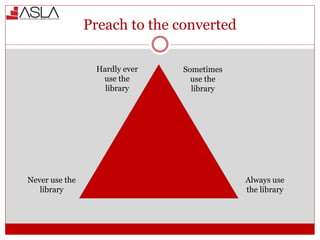
Preach to the converted
Never use the
library
Always use
the library
Hardly ever
use the
library
Sometimes
use the
library
Target Audience
 Your audience is different people at different times.
But don’t forget that you are really only speaking to
one person at a time. Others will see your message,
but they only read it one at a time. So be personal, be
direct, as if they were in the room with you (which is
what you want to achieve anyway.)
 And the principal is a primary target. Because the
principal has the power of life and death over the
library. So whatever you’re doing, make sure the
principal knows about it. Unless something goes
wrong, in which case create a diversion.
Promise
W H A T W I L L T H E L I B R A R Y D O F O R I T S
C O N S U M E R B E T T E R / M O R E T H A N I T S
C O M P E T I T O R S ?
Promise
‘Promise, large promise, is the soul of advertising.’ Samuel
Johnson
Promise
 What can you promise? It isn’t just a library. It’s
what the library can do. Make a list of what the
library can do for its visitors – both the regulars and
those who are not using it at the moment.
 Remember also that it does different things for
different people.
Promise
‘We are not here to sell a parcel of boilers and vats, but the
potentiality of growing rich beyond the dreams of avarice.’
Samuel Johnson
Examples of promises
It can get you out of the rain; it’s warm, cosy,
comfortable…
Examples of promises
You should be able to find what you want
Examples of promises
It’s fun
Examples of promises
The school pets like it here.
(If you haven’t read Dewey the Library Cat I suggest you
do. I’m not a cat lover but I found it an enchanting story.)
Supporting evidence
W H A T P R O O F C A N Y O U O F F E R T H A T Y O U
C A N D E L I V E R W H A T Y O U A R E P R O M I S I N G ?
Supporting evidence examples
 Take surveys from people you have helped. Ask them
what the library has done for them, and then use
their responses as testimonials.
Supporting Evidence
‘He wasn’t interested in
South America – but he
had a one-track mind
about soccer. The library
showed him the other
sides of both soccer and
South America!’
Supporting evidence
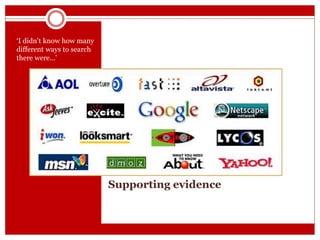
‘I didn't know how many
different ways to search
there were…’
Supporting evidence
‘In the last month, the library has had 1000 visitors. There
must be something here worth doing! ’
Tone and style
H O W D O Y O U W A N T T H E L I B R A R Y T O C O M E
A C R O S S ? I S I T F R I E N D L Y A N D W E L C O M I N G ?
I S T H E R E A L O T O F L A U G H T E R ? I S I T A
P L A C E F O R S E R I O U S S T U D Y O N L Y ?
W H A T E V E R I T I S , T H A T ’ S H O W Y O U W R I T E
A B O U T I T .
Net take-out
H O W O R W H A T D O Y O U W A N T P E O P L E T O
T H I N K A B O U T T H E L I B R A R Y ?
Net take-out
 Examples:
 ‘I didn’t know you could do that in a library.’
 ‘That’s cool.’
 ‘Not just for nerds, then.’
 Well, if they’re going, I’ll go.’
 ‘That looks interesting.’
 ‘What they do on Tuesdays at lunchtime looks like fun.’
Desired consumer response
W H A T D O Y O U W A N T T H E M T O D O A S A
R E S U L T O F Y O U R C O M M U N I C A T I O N ?
Desired consumer response
 Examples:
 Make the library the first port of call
 Attend an event
 Take a tour
 See a display
 Hear a speaker
 Enjoy what you send them
 Or even: Stay out of the library while it’s being
repainted
AIDA
 When writing advertisements, the simple formula is
‘AIDA.’
 Attract Attention
 Arouse Interest
 Create Desire
 Ask for Action
 And everything you send out of the library by any
medium is an advertisement for the library. A side issue
is that the most effective advertising of all is word of
mouth. So make sure you are delivering what you
promise.
Attract attention
R E M E M B E R T H E M O U S E T R A P , A N D
R E M E M B E R Y O U R C O M P E T I T I O N . B E F O R E
Y O U C A N D O A N Y T H I N G W I T H P E O P L E ’ S
A T T E N T I O N , Y O U H A V E T O A T T R A C T I T .
Arouse interest
 Now that you have their attention, give them a
reason to read on.
Create desire
 You’re trying to sell something. Make them want it.
Ask for action
 It’s incredible how frequently advertising writers
forget to tell people what they want them to do.
People are very much more likely to do what you
want if you ask them to do it.
 (Salesmen call this ‘closing the sale’; it’s the moment
when you ask them to commit.) We may not be able
to ‘close the sale’, but we can open the way.
And if you get stuck…
 If you are scratching around for ideas and coming up
with nothing
 If you’re getting fed up
 If you’re feeling lost
 If you think the library is becoming a poor relation…
Read your way out of trouble!
 The internet is full of advice about how to market
your library.
Post-webinar information
Australian School Library Association Inc.
Certificate of attendance
will be emailed
Membership information is available at
http://www.asla.org.au/membership.aspx
Future Webinars
http://www.asla.org.au/Professional-learning/webinars.aspx
Follow ASLA on Twitter
https://twitter.com/aslanational
Like us on Facebook
https://www.facebook.com/ASLAOnline
51

Marketing the library

  • 1.
    MARKETING THE LIBRARY P re s e n t e d b y P h i l i p B l a k e Australian School Library Association Inc.
  • 2.
    Housekeeping Australian School LibraryAssociation Inc. Sue Johnston ASLA Board Director Chair ASLA Professional Learning Project Team Facilitator for this webinar Housekeeping:  Participation options  Attendee control panel  Question facility  Post-webinar information  Future PL events 2
  • 3.
    Questions Australian School LibraryAssociation Inc. 3 Orange link to see Question Box Questions and Comments here
  • 4.
     ‘I trusta good deal to common fame, as we all must. If a man has good corn or wood, or boards, or pigs, to sell, or can make better chairs or knives, crucibles or church organs, than anybody else, you will find a broad hard-beaten road to his house, though it be in the woods.’—Ralph Waldo Emerson
  • 5.
    A better mousetrap ‘Build a better mousetrap and the world will beat a path to your door.’
  • 6.
    ‘The world willbeat a path to your door…’
  • 7.
    No it won’t. The only way the world will beat a path to your door is if you tell them about the better mousetrap behind the door.  This applies to libraries too.  It doesn’t matter how good you are, or how innovative the library is; if you don’t tell people about it, nobody except the regular users will know or care.
  • 8.
    How to tellthe world  Your library needs to be in the public eye. There are plenty of ways to get it in the public eye:  Send out a regular newsletter  Find out what themes the teachers are working on, and talk to them about how the library can help.  Set up displays and advertise them.  Organise competitions  Get guests or speakers into the library
  • 9.
    How to tellthe world (2)  Keep up with current affairs, make the library topical – and advertise it.  Have a ‘library opinion’ about everything in the school – and publicise it.  Offer the library as a venue for school events  Take the library on the road – go with kids on excursions, or put together an outdoor library event.  If nothing is happening –  Make something happen.
  • 10.
    You need tobe creative  You need to be creative
  • 11.
    How to tellthe world (3)  If you’re not creative, get the help of people who are. (Lots of kids are creative.)  When you want to do something different, don’t listen to people who say either:  ‘That won’t work – it’s never been done before’ (and they do say things like that) OR  ‘We tried that and it didn’t work’.
  • 12.
    Key facts F EA T U R E S A N D B E N E F I T S , P R O B L E M S A N D O P P O R T U N I T I E S , C O M P E T I T I V E A D V A N T A G E S A N D D I S A D V A N T A G E S
  • 13.
    Ask yourself thesequestions  What are the library’s main resources?  What can the library do for its users? (WIIFM)  What is the library’s main problem?  Can you turn that problem into an opportunity?  Where is the library ahead of the competition, and where is it behind them?  Who or what is the library’s competition?
  • 14.
    Positioning V E RS U S A T L E A S T T W O M A J O R C O M P E T I T O R S
  • 15.
    Positioning: ‘The onethat…’  Positioning simply means placing yourself in relation to major competitors.  So first you need to find out who or what your competition is.  If people aren’t using the library, what are they doing? That activity is your competition.  It’s not your library versus another library.
  • 16.
    Who or whatis the competition?  If people are not coming to the library, what are they doing?
  • 17.
    The competition Are theydoing nothing? And can you provide them with a more comfortable environment to do nothing?
  • 18.
    The competition Are theytexting or playing games? And can you text to them?
  • 19.
    The competition Are theybeing too busy? Note the difference between ‘Are they too busy?’ and ‘Are they being too busy?’
  • 20.
    Positioning  Whatever theyare doing instead of using the library, you need to tell them that  ‘The library is the place where…’(for example)  You get the answers  It’s warm  You will be safe  It’s fun  We can do some of the work for you  That’s positioning. Decide on your own positioning statement.
  • 21.
    Key communication I FY O U C O U L D O N L Y S A Y O N E T H I N G , W H A T W O U L D I T B E ?
  • 22.
    One thing  Ifyou only had ten seconds in which to tell someone why they should use the library, what would you say?  (N.B. This is one of the most important questions you need to ask yourself. From this comes a consistent message that you can hammer home with every communication.)
  • 23.
    Target audience  Whoare your targets?  Students?  Teachers?  Heads of department?  Parents?  The Principal?  Visiting specialists?  Others?  All of the above?
  • 24.
    Preach to theconverted Never use the library Always use the library Hardly ever use the library Sometimes use the library
  • 25.
    Target Audience  Youraudience is different people at different times. But don’t forget that you are really only speaking to one person at a time. Others will see your message, but they only read it one at a time. So be personal, be direct, as if they were in the room with you (which is what you want to achieve anyway.)  And the principal is a primary target. Because the principal has the power of life and death over the library. So whatever you’re doing, make sure the principal knows about it. Unless something goes wrong, in which case create a diversion.
  • 26.
    Promise W H AT W I L L T H E L I B R A R Y D O F O R I T S C O N S U M E R B E T T E R / M O R E T H A N I T S C O M P E T I T O R S ?
  • 27.
    Promise ‘Promise, large promise,is the soul of advertising.’ Samuel Johnson
  • 28.
    Promise  What canyou promise? It isn’t just a library. It’s what the library can do. Make a list of what the library can do for its visitors – both the regulars and those who are not using it at the moment.  Remember also that it does different things for different people.
  • 29.
    Promise ‘We are nothere to sell a parcel of boilers and vats, but the potentiality of growing rich beyond the dreams of avarice.’ Samuel Johnson
  • 30.
    Examples of promises Itcan get you out of the rain; it’s warm, cosy, comfortable…
  • 31.
    Examples of promises Youshould be able to find what you want
  • 32.
  • 33.
    Examples of promises Theschool pets like it here. (If you haven’t read Dewey the Library Cat I suggest you do. I’m not a cat lover but I found it an enchanting story.)
  • 34.
    Supporting evidence W HA T P R O O F C A N Y O U O F F E R T H A T Y O U C A N D E L I V E R W H A T Y O U A R E P R O M I S I N G ?
  • 35.
    Supporting evidence examples Take surveys from people you have helped. Ask them what the library has done for them, and then use their responses as testimonials.
  • 36.
    Supporting Evidence ‘He wasn’tinterested in South America – but he had a one-track mind about soccer. The library showed him the other sides of both soccer and South America!’
  • 37.
    Supporting evidence ‘I didn'tknow how many different ways to search there were…’
  • 38.
    Supporting evidence ‘In thelast month, the library has had 1000 visitors. There must be something here worth doing! ’
  • 39.
    Tone and style HO W D O Y O U W A N T T H E L I B R A R Y T O C O M E A C R O S S ? I S I T F R I E N D L Y A N D W E L C O M I N G ? I S T H E R E A L O T O F L A U G H T E R ? I S I T A P L A C E F O R S E R I O U S S T U D Y O N L Y ? W H A T E V E R I T I S , T H A T ’ S H O W Y O U W R I T E A B O U T I T .
  • 40.
    Net take-out H OW O R W H A T D O Y O U W A N T P E O P L E T O T H I N K A B O U T T H E L I B R A R Y ?
  • 41.
    Net take-out  Examples: ‘I didn’t know you could do that in a library.’  ‘That’s cool.’  ‘Not just for nerds, then.’  Well, if they’re going, I’ll go.’  ‘That looks interesting.’  ‘What they do on Tuesdays at lunchtime looks like fun.’
  • 42.
    Desired consumer response WH A T D O Y O U W A N T T H E M T O D O A S A R E S U L T O F Y O U R C O M M U N I C A T I O N ?
  • 43.
    Desired consumer response Examples:  Make the library the first port of call  Attend an event  Take a tour  See a display  Hear a speaker  Enjoy what you send them  Or even: Stay out of the library while it’s being repainted
  • 44.
    AIDA  When writingadvertisements, the simple formula is ‘AIDA.’  Attract Attention  Arouse Interest  Create Desire  Ask for Action  And everything you send out of the library by any medium is an advertisement for the library. A side issue is that the most effective advertising of all is word of mouth. So make sure you are delivering what you promise.
  • 45.
    Attract attention R EM E M B E R T H E M O U S E T R A P , A N D R E M E M B E R Y O U R C O M P E T I T I O N . B E F O R E Y O U C A N D O A N Y T H I N G W I T H P E O P L E ’ S A T T E N T I O N , Y O U H A V E T O A T T R A C T I T .
  • 46.
    Arouse interest  Nowthat you have their attention, give them a reason to read on.
  • 47.
    Create desire  You’retrying to sell something. Make them want it.
  • 48.
    Ask for action It’s incredible how frequently advertising writers forget to tell people what they want them to do. People are very much more likely to do what you want if you ask them to do it.  (Salesmen call this ‘closing the sale’; it’s the moment when you ask them to commit.) We may not be able to ‘close the sale’, but we can open the way.
  • 49.
    And if youget stuck…  If you are scratching around for ideas and coming up with nothing  If you’re getting fed up  If you’re feeling lost  If you think the library is becoming a poor relation…
  • 50.
    Read your wayout of trouble!  The internet is full of advice about how to market your library.
  • 51.
    Post-webinar information Australian SchoolLibrary Association Inc. Certificate of attendance will be emailed Membership information is available at http://www.asla.org.au/membership.aspx Future Webinars http://www.asla.org.au/Professional-learning/webinars.aspx Follow ASLA on Twitter https://twitter.com/aslanational Like us on Facebook https://www.facebook.com/ASLAOnline 51

Editor's Notes

  • #5 150 years ago
  • #6 Let’s examine this.
  • #7 Given the famous cunning of certain types of rodent, we need to think about this statement.
  • #9 – and they don’t have to be celebrities. Just people – possibly students or teachers – with a story to tell.
  • #12 What they mean is that they did something like that once and made a complete mess of it.
  • #13 What’s the difference between a feature and a benefit? A feature is something like a very large motor in a washing machine. That’s interesting to some people, but it’s not a benefit. The benefit is that the washing machine will not break down. 40,000 items in a library is a feature. The benefit is that you WILL find something here that interests you.
  • #25 Easier to push downhill than uphill
  • #28 No coincidence that I’m quoting from something said 150 years ago and then from something said 230 years ago. Everything else may have changed, but human beings haven’t. and librarians are in the people business.
  • #29 If you give someone a camera, what are you actually giving them? Samuel Johnson was the executor of the will of a brewery owner, and he got the job of selling the brewery at auction.