The Importance of Science Education  Welcome to Science in 5sp Miss Sarah Peters  W0101628
What is Science? Science provides an important contribution  to a child’s: Intellectual Development  Decision Making  Critical Thinking  Ability to work in groups
The Impact of Science Without science : The world we live in will struggle to advance.  Technology could not improve. Humans rely on science on a daily basis.
The Impact on Students  Science gives students: A basic understanding of how things work Ability to critically think and problem solve  Ability to make decisions based on critical thinking Ability to work in groups Helps to construct important skills away from the classroom
QSA and Science QSA is the Queensland Studies Authority Determines the content that is taught through the Essential Learnings i.e.  Life and living  Earth and Beyond  Energy and Change  Natural and Processed Materials  Science as a Human Endeavors
The Five Strands of Science  Life and living  Earth and Beyond  Energy and Change  Natural and Processed Materials  Science as a Human Endeavors
Unit Plan  Whole term outlook on what students will be learning  Learning focus extracted from the Essential Learnings Year 5 Main Activities have been researched and developed specifically Assessment will take form of a research PowerPoint
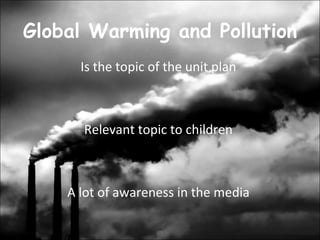
Global Warming and Pollution  Is the topic of the unit plan  Relevant topic to children  A lot of awareness in the media
Essential Learnings  Out of the Five Strands the Unit Plan will focus on: Earth and Beyond  Science as a Human Endeavour
Some Activities  Classroom Earth Hour  Carbon Footprint  Clean Up Australia day
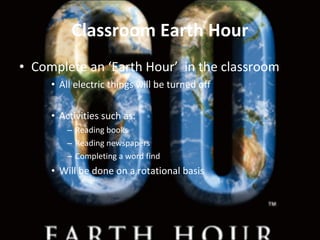
Classroom Earth Hour Complete an ‘Earth Hour’  in the classroom  All electric things will be turned off Activities such as: Reading books Reading newspapers  Completing a word find  Will be done on a rotational basis
Carbon Footprint  Students will research their own Carbon Footprint Ways to decrease footprint  Why it is important  How the footprint is calculated ( http://wwf.org.au/footprint/?gclid=CJ60iZac4qACFQQupAodnFZrDA )
Clean Up Australia Day Students will be asked to create their own ‘Clean Up Australia Day’ advertisement  They will use posters  These posters when completed will be placed on walls around the school  Students will research pollution and the effects that it has on the environment
Assessment   After completing community awareness activities  Students will research one activity at length  Present their findings in an oral and PowerPoint
Nature of Teaching Science  All science should be Student related  Includes: Hands on Activities  Conceptual understanding  Engage all Students  Develop Meaning for students
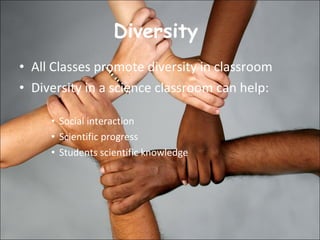
Diversity  All Classes promote diversity in classroom  Diversity in a science classroom can help: Social interaction Scientific progress  Students scientific knowledge
Importance of Science  Science enables students:  To become life-long learners  To develop questioning abilities  To question what is around them  The ability to look at the world in more ways than one To identify importance of change on the environment  To develop researching and concluding skills  To accept diversity and promote equality
References  (2010). "Footprint Calculator ". Retrieved 31st March 2010, from  http://wwf.org.au/footprint/?gclid=CJ60iZac4qACFQQupAodnFZrDA. (2010). "60 Earth Hour ". Retrieved 31st March 2010, from http://www.earthhour.org.au/. (2010). "Clean Up." Retrieved 31st March 2010 from http://www.cleanup.org.au/au/. Eady, S. (2008). "What is the Purpose of Learning Science? An Analysis in the Primary School "  British Journal of Educational Studies  56(1). Intemann, K. (2009 ). "Why Dicersity Matters: Understanding and Applying the Diversity Component of the National Science Foundation's Broader Impacts Criterion "  Social Epistimology  23(3 & 4): 249-266  Queensland Studies Authority. (2007). Science Essential Learnings. Retrieved March 5, 2010, from http://www.qsa.qld.edu.au/p-9/7297.html Skamp, K., Ed. (2006 ).  Teaching Primary Science Constructively Teaching Primary Science Constructively Cengage Learning  VERSPAGEN, O. N. B. (2008). "Knowledge Flows, Patent Citations and the Impact of Science on Technology."  Economic Systems Research  Vilches, D. G.-P. A. (2005). "The Contribution of science and technology education to citizen's culture "  Cnadaian Journal of Science, Mathematics and Teachnology Education  5(2).

Sarahpetersw0101628edx2260

  • 1.
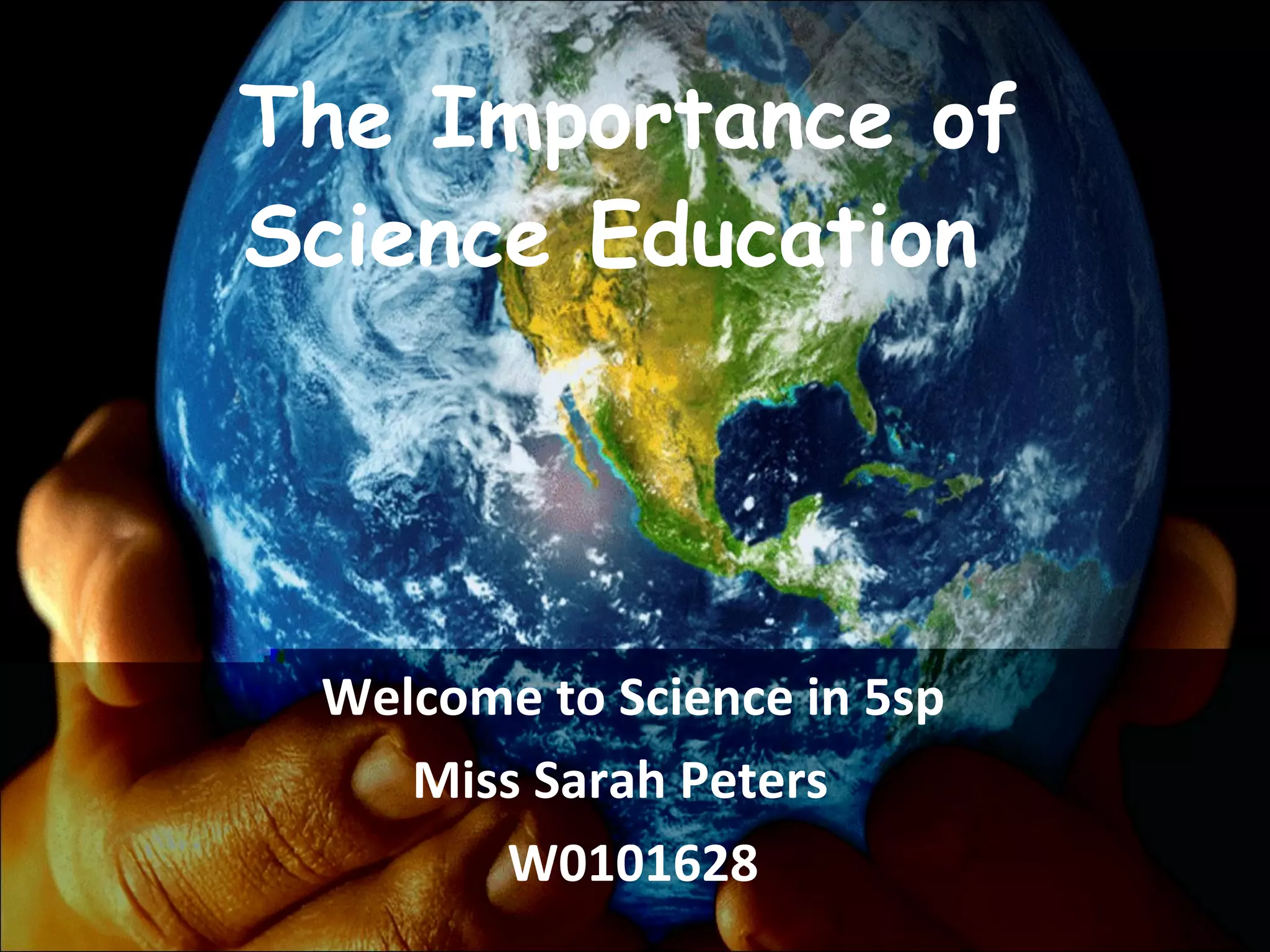
    The Importance ofScience Education Welcome to Science in 5sp Miss Sarah Peters W0101628
  • 2.
    What is Science?Science provides an important contribution to a child’s: Intellectual Development Decision Making Critical Thinking Ability to work in groups
  • 3.
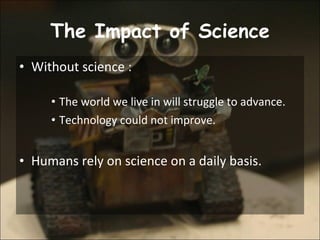
    The Impact ofScience Without science : The world we live in will struggle to advance. Technology could not improve. Humans rely on science on a daily basis.
  • 4.
    The Impact onStudents Science gives students: A basic understanding of how things work Ability to critically think and problem solve Ability to make decisions based on critical thinking Ability to work in groups Helps to construct important skills away from the classroom
  • 5.
    QSA and ScienceQSA is the Queensland Studies Authority Determines the content that is taught through the Essential Learnings i.e. Life and living Earth and Beyond Energy and Change Natural and Processed Materials Science as a Human Endeavors
  • 6.
    The Five Strandsof Science Life and living Earth and Beyond Energy and Change Natural and Processed Materials Science as a Human Endeavors
  • 7.
    Unit Plan Whole term outlook on what students will be learning Learning focus extracted from the Essential Learnings Year 5 Main Activities have been researched and developed specifically Assessment will take form of a research PowerPoint
  • 8.
    Global Warming andPollution Is the topic of the unit plan Relevant topic to children A lot of awareness in the media
  • 9.
    Essential Learnings Out of the Five Strands the Unit Plan will focus on: Earth and Beyond Science as a Human Endeavour
  • 10.
    Some Activities Classroom Earth Hour Carbon Footprint Clean Up Australia day
  • 11.
    Classroom Earth HourComplete an ‘Earth Hour’ in the classroom All electric things will be turned off Activities such as: Reading books Reading newspapers Completing a word find Will be done on a rotational basis
  • 12.
    Carbon Footprint Students will research their own Carbon Footprint Ways to decrease footprint Why it is important How the footprint is calculated ( http://wwf.org.au/footprint/?gclid=CJ60iZac4qACFQQupAodnFZrDA )
  • 13.
    Clean Up AustraliaDay Students will be asked to create their own ‘Clean Up Australia Day’ advertisement They will use posters These posters when completed will be placed on walls around the school Students will research pollution and the effects that it has on the environment
  • 14.
    Assessment After completing community awareness activities Students will research one activity at length Present their findings in an oral and PowerPoint
  • 15.
    Nature of TeachingScience All science should be Student related Includes: Hands on Activities Conceptual understanding Engage all Students Develop Meaning for students
  • 16.
    Diversity AllClasses promote diversity in classroom Diversity in a science classroom can help: Social interaction Scientific progress Students scientific knowledge
  • 17.
    Importance of Science Science enables students: To become life-long learners To develop questioning abilities To question what is around them The ability to look at the world in more ways than one To identify importance of change on the environment To develop researching and concluding skills To accept diversity and promote equality
  • 18.
    References (2010)."Footprint Calculator ". Retrieved 31st March 2010, from http://wwf.org.au/footprint/?gclid=CJ60iZac4qACFQQupAodnFZrDA. (2010). "60 Earth Hour ". Retrieved 31st March 2010, from http://www.earthhour.org.au/. (2010). "Clean Up." Retrieved 31st March 2010 from http://www.cleanup.org.au/au/. Eady, S. (2008). "What is the Purpose of Learning Science? An Analysis in the Primary School " British Journal of Educational Studies 56(1). Intemann, K. (2009 ). "Why Dicersity Matters: Understanding and Applying the Diversity Component of the National Science Foundation's Broader Impacts Criterion " Social Epistimology 23(3 & 4): 249-266 Queensland Studies Authority. (2007). Science Essential Learnings. Retrieved March 5, 2010, from http://www.qsa.qld.edu.au/p-9/7297.html Skamp, K., Ed. (2006 ). Teaching Primary Science Constructively Teaching Primary Science Constructively Cengage Learning VERSPAGEN, O. N. B. (2008). "Knowledge Flows, Patent Citations and the Impact of Science on Technology." Economic Systems Research Vilches, D. G.-P. A. (2005). "The Contribution of science and technology education to citizen's culture " Cnadaian Journal of Science, Mathematics and Teachnology Education 5(2).