
Digital Literacies
Fiona Harvey and Lisa Harris
7th November 2012
LLAS Workshop
Fiona Harvey
• Fiona Harvey is an Educational Development and
Learning Advisor with the Centre for Technology in
Educational Innovation at the University of
Southampton. She is Chair of the Digital Literacies
Special Interest group.
• www.elearning.soton.ac.uk
• www.twitter.com/fionajharvey
• www.linkedin.com/fionaharvey
Lisa Harris
• Lisa is a Senior Lecturer in Marketing, Director of the
MSc programme in Digital Marketing and Co-Chair of
the Digital Economy USRG at the University of
Southampton. She is also an accredited tutor for the
University of Liverpool online MBA programme.
• www.digitaleconomy.soton.ac.uk
• http://lisaharrismarketing.com
• www.twitter.com/lisaharris
• www.slideshare.net/lisaharris
• www.delicious.com/lisaharris1
Plan
• Quick overview of the ‘big picture’
• What is “digital literacy”?
• Digital Literacy activities at Southampton:
– Conference 2012 (even bigger and better for
2013)
– Student Digital Champions
– Curriculum Innovation
– Social Media in Live Events (SMiLE) research
project #SXSC2 #Creative Digifest
Exercise 1:
What technologies are being discussed here?
• “The modern world overwhelms people with data and this is
confusing and harmful to the mind” (Conrad Gessner, 1565)
• “It will create forgetfulness in the learners' souls, because
they will not use their memories.“ (Socrates, 469-399BC)
• “It socially isolates readers and detracts from the spiritually
uplifting group practice of getting news from the pulpit”
(Malesherbes, 1787)
• “It might hurt radio, conversation, reading, and the patterns
of family living and result in the further vulgarisation of
American culture“ (Ellen Wartella, 1962)
• “It’s making us stupid” (Nicholas Carr, 2008)
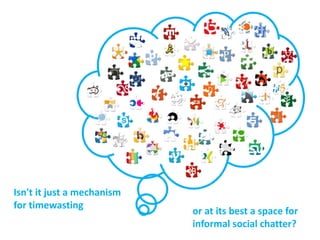
Isn't it just a mechanism
for timewasting
or at its best a space for
informal social chatter?
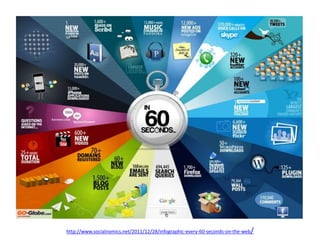
http://www.socialnomics.net/2011/12/28/infographic-every-60-seconds-on-the-web/
The world is changing…
• Educators are no longer the ‘gatekeepers’ of
knowledge
• The vast majority of graduate jobs require
effective communication skills, both online and
offline
• Acquiring information is no longer the issue –
critical evaluation of an abundance of data is a
key skill
• Contributing effectively to your community builds
your profile and ‘social capital’
21st Century Careers (JISC, 2009)
• Competition for employment in a global knowledge
economy
• increased levels of self-employment and portfolio
working
• growth of multi-disciplinary teams focused on specific
tasks whose members might be physically located
anywhere in the world
• life within a networked society
• blurring of boundaries between ‘real’ and ‘virtual’,
public and private
• increasingly ubiquitous use of digital technologies.
Definitions
• “Digital literacy is the ability to locate, organise,
understand, evaluate, and analyse information using
digital technology. It involves a working knowledge of
current tools and an understanding of how they can be
used”
• “The active management of online activities such as
collaboration, networking , content creation and
curation in order to “stand out from the crowd” in
today’s job market”
• “an ability to respond positively to change”
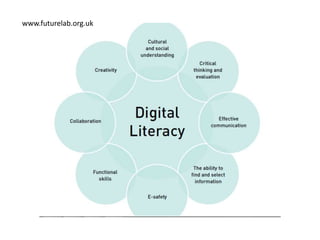
www.futurelab.org.uk
What do we mean by Digital Literacy?
• Collecting, managing and evaluating online
information
• Building an online brand for personal or career
development
• Creating and curating content in written, audio
and visual media
• Communicating effectively online for networking
and collaboration purposes
• Managing digital identity/ies with due awareness
of privacy and security issues
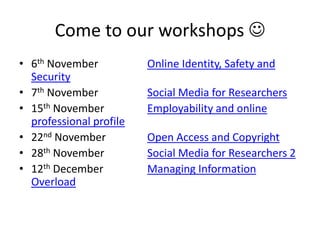
Come to our workshops 
• 6th November Online Identity, Safety and
Security
• 7th November Social Media for Researchers
• 15th November Employability and online
professional profile
• 22nd November Open Access and Copyright
• 28th November Social Media for Researchers 2
• 12th December Managing Information
Overload
Student Digital Champions
• Help staff and students to learn new tools, build
their online profiles, and manage social media for
live events
• Champs to be attached to each USRG
• Digital Economy USRG is funding students to
participate in relevant events, report back at
monthly networking lunches and collaborate in
research/teaching projects
• Supported by Social Media in Live Events (SMiLE)
project
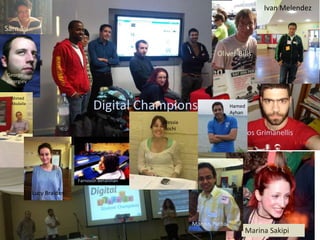
Digital Champions
Sam Su
Oliver Bills
Marina Sakipi
Panos Grimanellis
George
Georgiev
Hamed Ayhan
Hamed
Ayhan
Farnoosh Berahman
Manish Pathak
Ivan Melendez
Ahmed
Abulaila
Lucy Braiden
Alessia
Fiochi
Digital Champion Activities
• PianoHAWK launch in London, May 2012
• Digital Literacies Conference
• Support for informal workshops
• One to one training as required
• Helped set up a Chinese Social Network
account for Modern Languages
• Creative Digifest #SXSC2
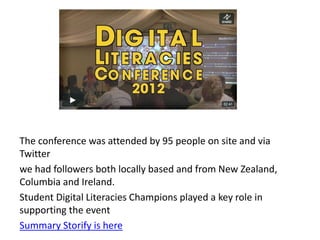
The conference was attended by 95 people on site and via
Twitter
we had followers both locally based and from New Zealand,
Columbia and Ireland.
Student Digital Literacies Champions played a key role in
supporting the event
Summary Storify is here
Feedback
“More like
this please”
“The workshop was very inspiring and
generated some very good insights. It
was wonderful having international
students attending, as they were able to
contribute with a different perspective,
specifically those coming from totalitarian
regimes. Their concerns and priorities in
regards to protecting their own identity
are very different from those in UK.”
“Hearing from such a diverse
range or people on the subject
was really inspirational. I would
recommend this to anyone with
even a remote interest in the
area.”
“Lots of interesting
discussion inspired by some
pretty open questions.”
“I thought this was a brilliantly organised, and immersive
experience, and in that latter respect corresponded exactly
to one of the stages of digital literacy mentioned by one of
the speakers. I learned huge amounts and felt by about 3.30
that my brain was full!”
“Great to get big names
to Southampton.
*** It was a really great
day. Thank you.*** ”
“…the whole event was a
real eye-opener in more
ways than I can mention
here. It was kept under
control through a nice blend
of more discursive talks
with shorter introductions
to key advances or
resources. This was very
clever and helped a new-
comer like me to manage it
all.”
Looking forward
to next one!
“I liked the openness
and contributions
from almost
everyone.”
Plans for this year (1)
• Allocation of #digichamps to Research and
Innovation Services for each USRG and to assist with
Multi-disciplinary Week
• #Digichamps booked to assist with promotion of a
number of events and conferences
• Develop and deliver CIP module – Working and Living
on the Web (also included in Web Science BSc)
• #digichamps requested to be part of other CIP
modules (Intercultural Communications)
Plans for this year (2)
• Work with SUSU VP Ed to train all sabbaticals
• Graduate Passport – develop closer links for
recognition of contributions by SDLCs
• Full programme of DL workshops and one to one
training
• Graduate Attributes – ensure our graduates are
recognised as being ‘digitally literate’ and enhance
employability
• Developing links to student support – DL input to
personal tutoring system
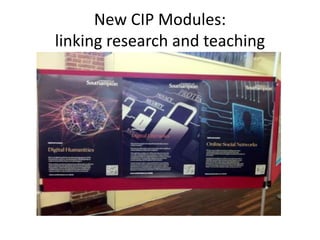
New CIP Modules:
linking research and teaching
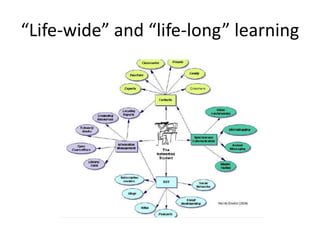
“Life-wide” and “life-long” learning
Living and Working on the Web
This module focuses on the development of online identities and networks to
enhance your employability in the digital age.
Specifically, it investigates how the digital world is influencing how we:
• collect, manage and evaluate online information – ideal preparation for
dissertations
• build an effective online identity for personal or career development
• create and curate content via blogging and video production
• interact with others for networking, team-building and project management
purposes
• deal with online privacy, safety and security issues
• participate remotely in live events
Working in small groups, you will develop and deliver your own online
seminars for assessment purposes, and engage in real time with a ‘real’ and
‘virtual’ audience at the University Digital Literacies Conference in May 2013.
For more information check out the module webpage and video or contact:
The “digitally literate” student
• be proactive, confident and flexible adopters of a range of
technologies for personal, academic and professional use
• use appropriate technology effectively to search for and store high-
quality information
• curate, reflect and critically evaluate the information obtained
• engage creatively and productively in relevant online communities
• be familiar with the use of collaboration tools to facilitate
groupwork and project management
• be aware of the challenges inherent in ensuring online privacy and
security
• Have developed appropriate communication skills for peer and
tutor interaction within an ‘always on’ environment
• Parody Video (very funny, rather bad language!)
SMiLE Project
• a University-wide system and procedure for
archiving tweets.
• investigating new ways of expressing context
through timelines and network visualisations
• Code of conduct for ethical storage and curation
of social media (with Oxford E-research Centre)
• Case study for JISC Datapool project
• Digital inclusion/exclusion
• Supporting the development of communities of
practice before/after major live events
Useful links
• The Networked Student (5 mins)
• Eric Qualmann (video, 2 mins)
• A vision of students today (video, 5 mins)
• Rethinking Education (video, 7 mins)
• Assessed student wikipedia contributions
(Keynote, LLAS 2011)
More useful links
• Digital Literacies for EFL teachers (useful
definitions
here)http://www.slideshare.net/EvelynIzquier
do/digital-literacy-1515057

Digital Literacy Projects

  • 1.
    Digital Literacies Fiona Harveyand Lisa Harris 7th November 2012 LLAS Workshop
  • 2.
    Fiona Harvey • FionaHarvey is an Educational Development and Learning Advisor with the Centre for Technology in Educational Innovation at the University of Southampton. She is Chair of the Digital Literacies Special Interest group. • www.elearning.soton.ac.uk • www.twitter.com/fionajharvey • www.linkedin.com/fionaharvey
  • 3.
    Lisa Harris • Lisais a Senior Lecturer in Marketing, Director of the MSc programme in Digital Marketing and Co-Chair of the Digital Economy USRG at the University of Southampton. She is also an accredited tutor for the University of Liverpool online MBA programme. • www.digitaleconomy.soton.ac.uk • http://lisaharrismarketing.com • www.twitter.com/lisaharris • www.slideshare.net/lisaharris • www.delicious.com/lisaharris1
  • 4.
    Plan • Quick overviewof the ‘big picture’ • What is “digital literacy”? • Digital Literacy activities at Southampton: – Conference 2012 (even bigger and better for 2013) – Student Digital Champions – Curriculum Innovation – Social Media in Live Events (SMiLE) research project #SXSC2 #Creative Digifest
  • 5.
    Exercise 1: What technologiesare being discussed here? • “The modern world overwhelms people with data and this is confusing and harmful to the mind” (Conrad Gessner, 1565) • “It will create forgetfulness in the learners' souls, because they will not use their memories.“ (Socrates, 469-399BC) • “It socially isolates readers and detracts from the spiritually uplifting group practice of getting news from the pulpit” (Malesherbes, 1787) • “It might hurt radio, conversation, reading, and the patterns of family living and result in the further vulgarisation of American culture“ (Ellen Wartella, 1962) • “It’s making us stupid” (Nicholas Carr, 2008)
  • 6.
    Isn't it justa mechanism for timewasting or at its best a space for informal social chatter?
  • 7.
  • 8.
    The world ischanging… • Educators are no longer the ‘gatekeepers’ of knowledge • The vast majority of graduate jobs require effective communication skills, both online and offline • Acquiring information is no longer the issue – critical evaluation of an abundance of data is a key skill • Contributing effectively to your community builds your profile and ‘social capital’
  • 9.
    21st Century Careers(JISC, 2009) • Competition for employment in a global knowledge economy • increased levels of self-employment and portfolio working • growth of multi-disciplinary teams focused on specific tasks whose members might be physically located anywhere in the world • life within a networked society • blurring of boundaries between ‘real’ and ‘virtual’, public and private • increasingly ubiquitous use of digital technologies.
  • 10.
    Definitions • “Digital literacyis the ability to locate, organise, understand, evaluate, and analyse information using digital technology. It involves a working knowledge of current tools and an understanding of how they can be used” • “The active management of online activities such as collaboration, networking , content creation and curation in order to “stand out from the crowd” in today’s job market” • “an ability to respond positively to change”
  • 11.
  • 12.
    What do wemean by Digital Literacy? • Collecting, managing and evaluating online information • Building an online brand for personal or career development • Creating and curating content in written, audio and visual media • Communicating effectively online for networking and collaboration purposes • Managing digital identity/ies with due awareness of privacy and security issues
  • 13.
    Come to ourworkshops  • 6th November Online Identity, Safety and Security • 7th November Social Media for Researchers • 15th November Employability and online professional profile • 22nd November Open Access and Copyright • 28th November Social Media for Researchers 2 • 12th December Managing Information Overload
  • 14.
    Student Digital Champions •Help staff and students to learn new tools, build their online profiles, and manage social media for live events • Champs to be attached to each USRG • Digital Economy USRG is funding students to participate in relevant events, report back at monthly networking lunches and collaborate in research/teaching projects • Supported by Social Media in Live Events (SMiLE) project
  • 15.
    Digital Champions Sam Su OliverBills Marina Sakipi Panos Grimanellis George Georgiev Hamed Ayhan Hamed Ayhan Farnoosh Berahman Manish Pathak Ivan Melendez Ahmed Abulaila Lucy Braiden Alessia Fiochi
  • 16.
    Digital Champion Activities •PianoHAWK launch in London, May 2012 • Digital Literacies Conference • Support for informal workshops • One to one training as required • Helped set up a Chinese Social Network account for Modern Languages • Creative Digifest #SXSC2
  • 17.
    The conference wasattended by 95 people on site and via Twitter we had followers both locally based and from New Zealand, Columbia and Ireland. Student Digital Literacies Champions played a key role in supporting the event Summary Storify is here
  • 18.
    Feedback “More like this please” “Theworkshop was very inspiring and generated some very good insights. It was wonderful having international students attending, as they were able to contribute with a different perspective, specifically those coming from totalitarian regimes. Their concerns and priorities in regards to protecting their own identity are very different from those in UK.” “Hearing from such a diverse range or people on the subject was really inspirational. I would recommend this to anyone with even a remote interest in the area.” “Lots of interesting discussion inspired by some pretty open questions.” “I thought this was a brilliantly organised, and immersive experience, and in that latter respect corresponded exactly to one of the stages of digital literacy mentioned by one of the speakers. I learned huge amounts and felt by about 3.30 that my brain was full!” “Great to get big names to Southampton. *** It was a really great day. Thank you.*** ” “…the whole event was a real eye-opener in more ways than I can mention here. It was kept under control through a nice blend of more discursive talks with shorter introductions to key advances or resources. This was very clever and helped a new- comer like me to manage it all.” Looking forward to next one! “I liked the openness and contributions from almost everyone.”
  • 19.
    Plans for thisyear (1) • Allocation of #digichamps to Research and Innovation Services for each USRG and to assist with Multi-disciplinary Week • #Digichamps booked to assist with promotion of a number of events and conferences • Develop and deliver CIP module – Working and Living on the Web (also included in Web Science BSc) • #digichamps requested to be part of other CIP modules (Intercultural Communications)
  • 20.
    Plans for thisyear (2) • Work with SUSU VP Ed to train all sabbaticals • Graduate Passport – develop closer links for recognition of contributions by SDLCs • Full programme of DL workshops and one to one training • Graduate Attributes – ensure our graduates are recognised as being ‘digitally literate’ and enhance employability • Developing links to student support – DL input to personal tutoring system
  • 21.
    New CIP Modules: linkingresearch and teaching
  • 23.
  • 24.
    Living and Workingon the Web This module focuses on the development of online identities and networks to enhance your employability in the digital age. Specifically, it investigates how the digital world is influencing how we: • collect, manage and evaluate online information – ideal preparation for dissertations • build an effective online identity for personal or career development • create and curate content via blogging and video production • interact with others for networking, team-building and project management purposes • deal with online privacy, safety and security issues • participate remotely in live events Working in small groups, you will develop and deliver your own online seminars for assessment purposes, and engage in real time with a ‘real’ and ‘virtual’ audience at the University Digital Literacies Conference in May 2013. For more information check out the module webpage and video or contact:
  • 25.
    The “digitally literate”student • be proactive, confident and flexible adopters of a range of technologies for personal, academic and professional use • use appropriate technology effectively to search for and store high- quality information • curate, reflect and critically evaluate the information obtained • engage creatively and productively in relevant online communities • be familiar with the use of collaboration tools to facilitate groupwork and project management • be aware of the challenges inherent in ensuring online privacy and security • Have developed appropriate communication skills for peer and tutor interaction within an ‘always on’ environment • Parody Video (very funny, rather bad language!)
  • 26.
    SMiLE Project • aUniversity-wide system and procedure for archiving tweets. • investigating new ways of expressing context through timelines and network visualisations • Code of conduct for ethical storage and curation of social media (with Oxford E-research Centre) • Case study for JISC Datapool project • Digital inclusion/exclusion • Supporting the development of communities of practice before/after major live events
  • 28.
    Useful links • TheNetworked Student (5 mins) • Eric Qualmann (video, 2 mins) • A vision of students today (video, 5 mins) • Rethinking Education (video, 7 mins) • Assessed student wikipedia contributions (Keynote, LLAS 2011)
  • 29.
    More useful links •Digital Literacies for EFL teachers (useful definitions here)http://www.slideshare.net/EvelynIzquier do/digital-literacy-1515057

Editor's Notes

  • #8 http://www.socialnomics.net/2011/12/28/infographic-every-60-seconds-on-the-web/