Collaborative Social Learning
Lisa Harris
T&L Workshop
#DigiLearningPlayground
What is collaborative social learning?
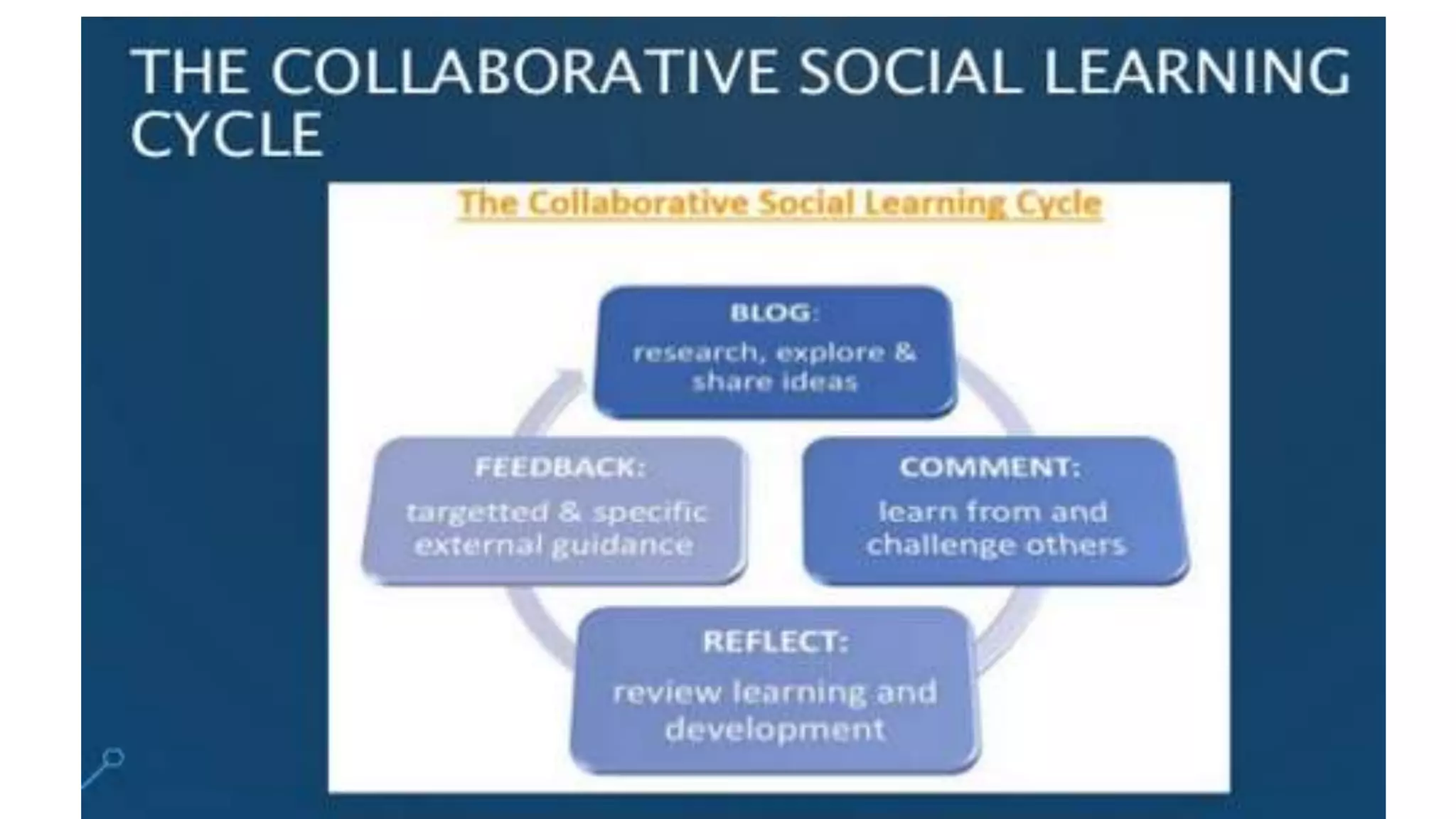
Students are encouraged (via the assessment process) to:
• Research and present their answer to a set question via their blog
• Read the contributions of their peers
• Provide an evidenced-based comment on the work of at least two of their
colleagues
• Write a reflection on how this process enhanced their learning about the
topic
• Feedback provided by tutor
• Process repeats several times throughout the module
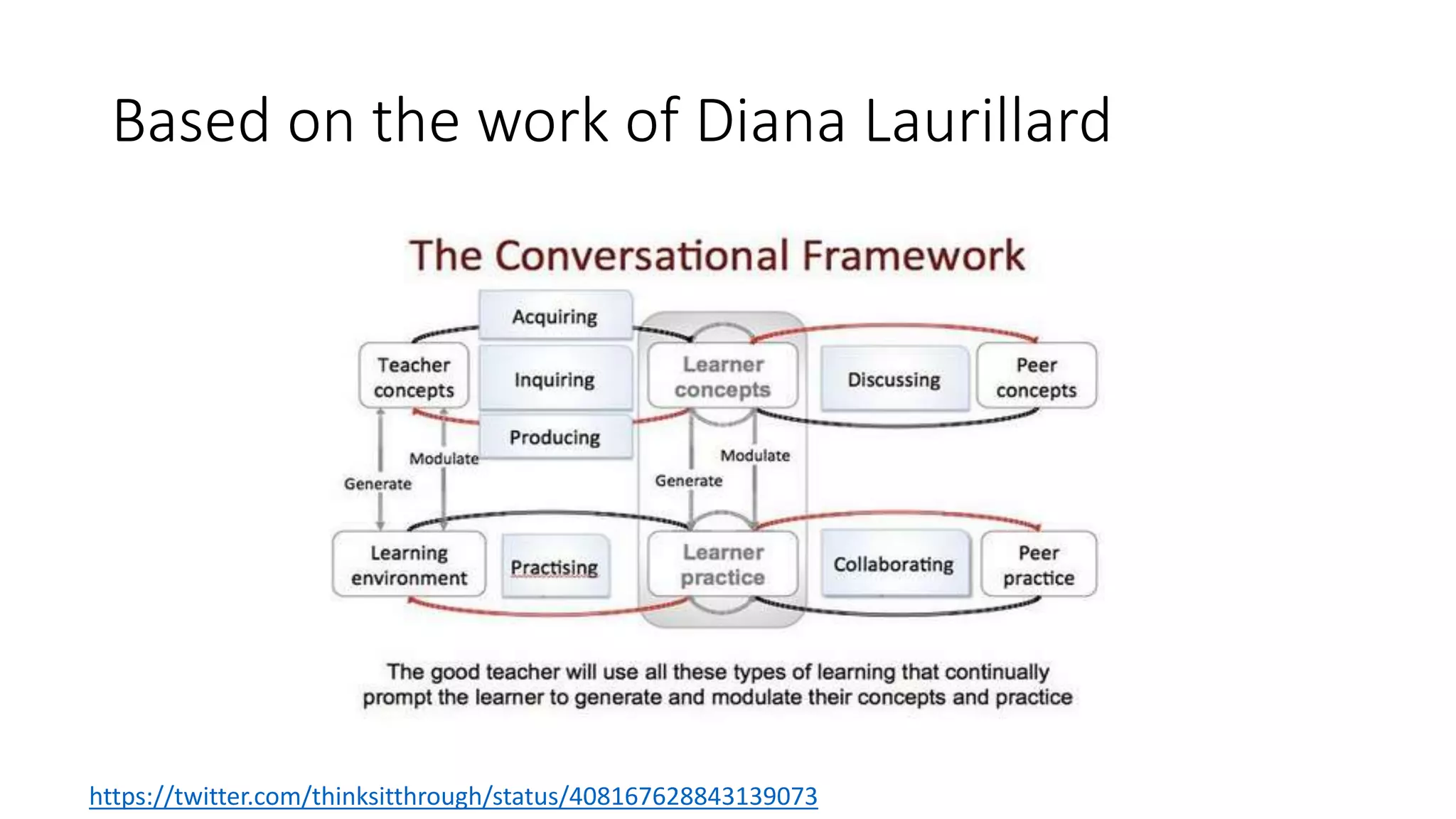
Based on the work of Diana Laurillard
https://twitter.com/thinksitthrough/status/408167628843139073
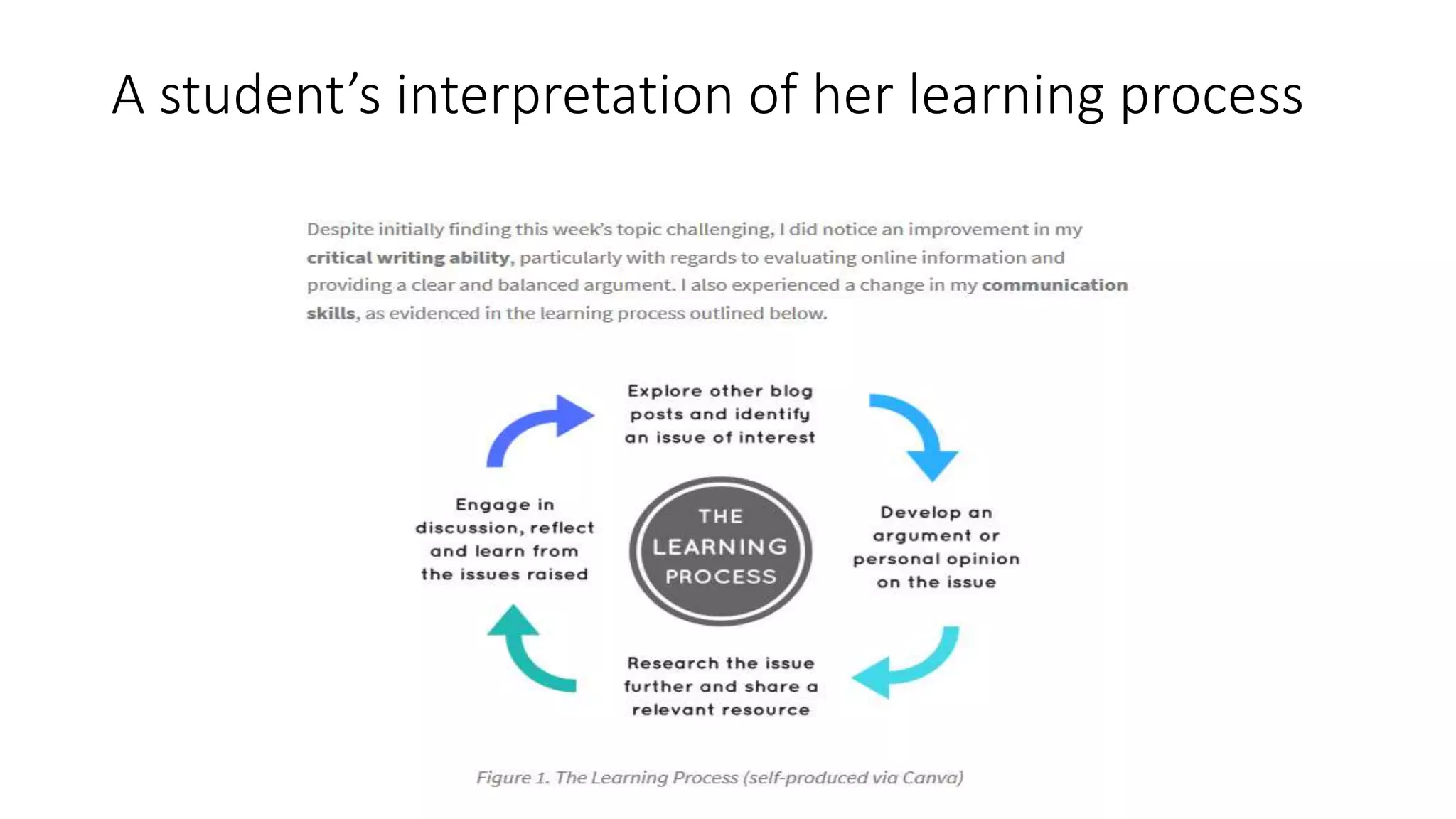
A student’s interpretation of her learning process
Example student posts reflecting on their
learning
• Bradley - see sample interaction in the comments
• Bradley - specific reflection on learning gained from peers
• Patricia’s summary of peer learning by topic
• Scott’s infographic summarising peer learning from each topic
• Patricia’s interpretation of the overall learning process
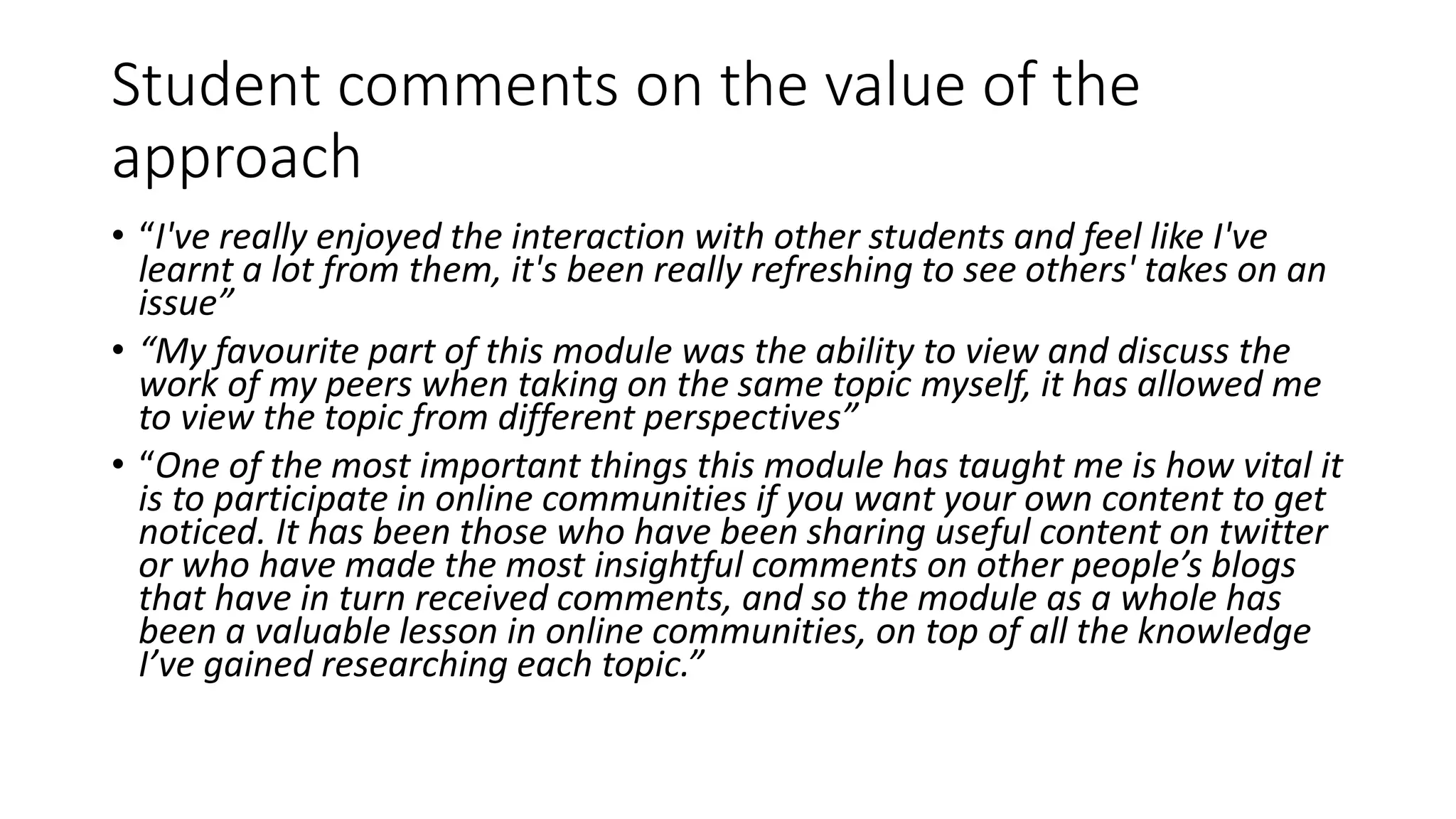
Student comments on the value of the
approach
• “I've really enjoyed the interaction with other students and feel like I've
learnt a lot from them, it's been really refreshing to see others' takes on an
issue”
• “My favourite part of this module was the ability to view and discuss the
work of my peers when taking on the same topic myself, it has allowed me
to view the topic from different perspectives”
• “One of the most important things this module has taught me is how vital it
is to participate in online communities if you want your own content to get
noticed. It has been those who have been sharing useful content on twitter
or who have made the most insightful comments on other people’s blogs
that have in turn received comments, and so the module as a whole has
been a valuable lesson in online communities, on top of all the knowledge
I’ve gained researching each topic.”
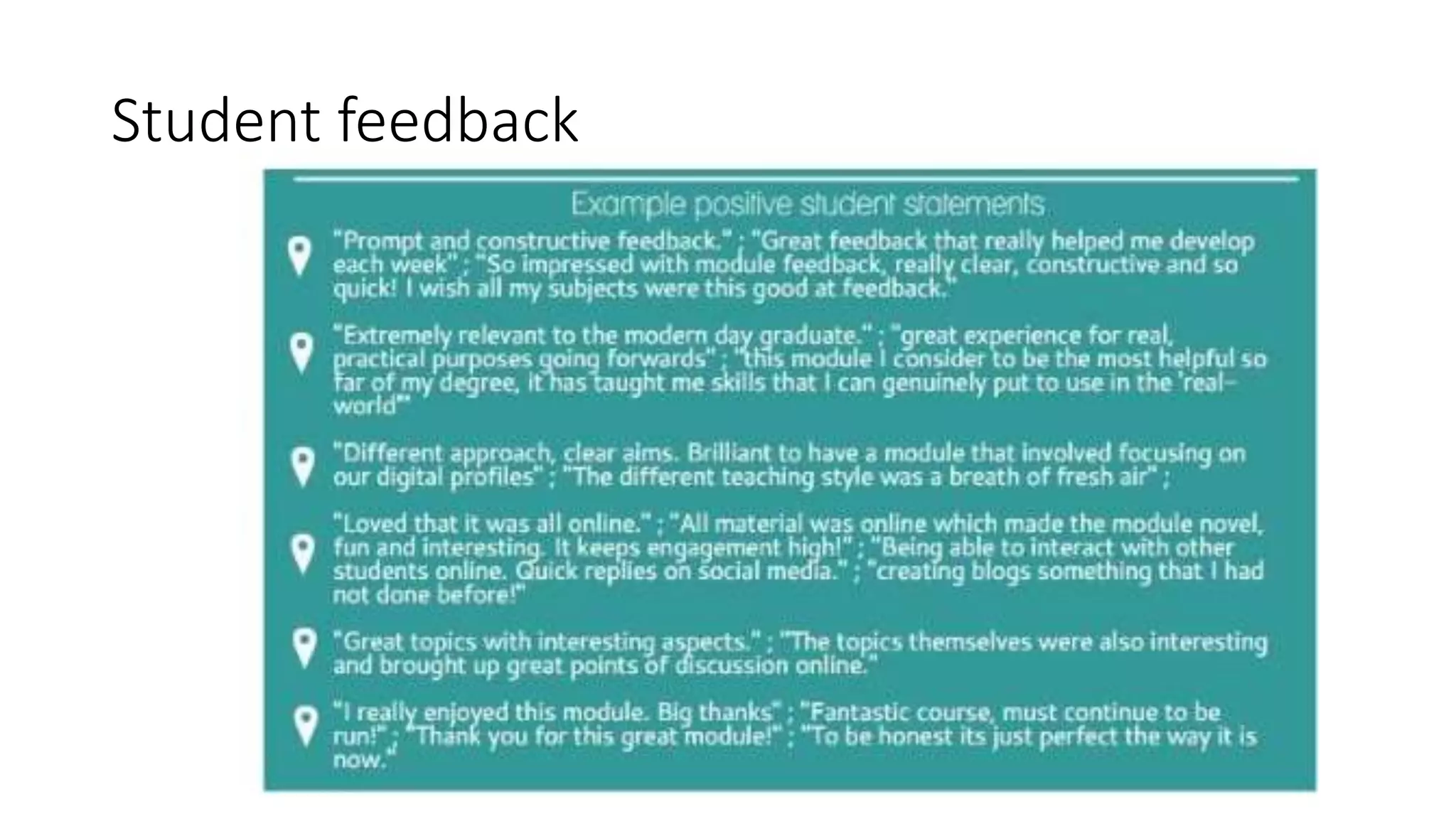
Student feedback
Our Publications
https://www.slideshare.net/lisaharris/collaborative-social-learning-for-
montreal-www2016 (Our presentation to WWW conference, Montreal)
http://nicfair.co.uk/site/wp-
content/uploads/2016/06/EDULEARNpaperdraft2.pdf (our supporting
paper)
Cristina Costa & Lisa Harris (2017) Reconsidering the technologies of
intellectual inquiry in curriculum design, The Curriculum Journal, 28:4,
559-577, DOI: 10.1080/09585176.2017.1308260

Collaborative Social Learning

  • 1.
    Collaborative Social Learning LisaHarris T&L Workshop #DigiLearningPlayground
  • 2.
    What is collaborativesocial learning? Students are encouraged (via the assessment process) to: • Research and present their answer to a set question via their blog • Read the contributions of their peers • Provide an evidenced-based comment on the work of at least two of their colleagues • Write a reflection on how this process enhanced their learning about the topic • Feedback provided by tutor • Process repeats several times throughout the module
  • 4.
    Based on thework of Diana Laurillard https://twitter.com/thinksitthrough/status/408167628843139073
  • 5.
    A student’s interpretationof her learning process
  • 6.
    Example student postsreflecting on their learning • Bradley - see sample interaction in the comments • Bradley - specific reflection on learning gained from peers • Patricia’s summary of peer learning by topic • Scott’s infographic summarising peer learning from each topic • Patricia’s interpretation of the overall learning process
  • 7.
    Student comments onthe value of the approach • “I've really enjoyed the interaction with other students and feel like I've learnt a lot from them, it's been really refreshing to see others' takes on an issue” • “My favourite part of this module was the ability to view and discuss the work of my peers when taking on the same topic myself, it has allowed me to view the topic from different perspectives” • “One of the most important things this module has taught me is how vital it is to participate in online communities if you want your own content to get noticed. It has been those who have been sharing useful content on twitter or who have made the most insightful comments on other people’s blogs that have in turn received comments, and so the module as a whole has been a valuable lesson in online communities, on top of all the knowledge I’ve gained researching each topic.”
  • 8.
  • 10.
    Our Publications https://www.slideshare.net/lisaharris/collaborative-social-learning-for- montreal-www2016 (Ourpresentation to WWW conference, Montreal) http://nicfair.co.uk/site/wp- content/uploads/2016/06/EDULEARNpaperdraft2.pdf (our supporting paper) Cristina Costa & Lisa Harris (2017) Reconsidering the technologies of intellectual inquiry in curriculum design, The Curriculum Journal, 28:4, 559-577, DOI: 10.1080/09585176.2017.1308260