Integrating deep learning
skills into the curriculum
Lisa Harris
Web Science Institute
@lisaharris
How the Web is Changing the World and the World is changing the Web.
Connect with us on our:
Website
Blog
YouTube
Twitter
Web Science Institute
The Web is the largest information system ever constructed; a social and
technical phenomenon that is transforming our world in innovative and
unexpected ways.
A deep understanding of the Web's technologies and social construction is
enabling Southampton to develop new forms of economic, social, political,
technological and cultural capital.
The WSI is staffed by a multi-disciplinary team drawn from across the
Faculties, led by Professor Dame Wendy Hall and Professor Sir Nigel
Shadbolt.
 Focuses on interdisciplinary collaborations and partnerships
 Leverages staff and student expertise across the University
 Provides a platform for public, private and third sector collaboration
 Showcases unique and creative education
Web Science Institute
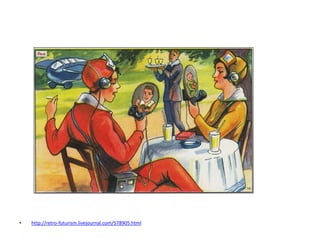
• http://retro-futurism.livejournal.com/578905.html
The Plan
• Digital Literacies – what are they?
• Three examples of the challenges and opportunities of
integrating deep learning skills into the curriculum:
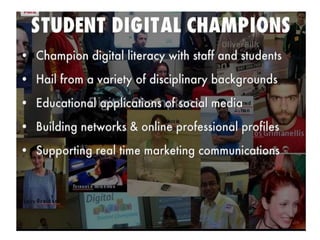
• Student Digital Champions (Digichamps)
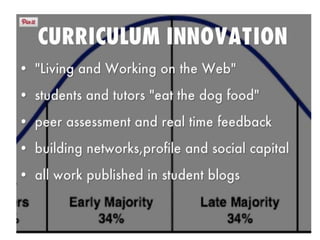
• An award-winning module called Living and Working on the
Web The entire content is provided, discussed and critiqued by
the students via their blogs
• Students as Creators and Change Agents project. A team of
students are designing and providing content for a suite of new
introductory undergraduate modules in partnership with
academic staff.
What do we mean by Digital Literacy?
• Collecting, managing and evaluating online information
• Building an online brand for personal or career
development
• Creating and curating content in written, audio and
visual media
• Communicating effectively online for networking and
collaboration purposes
• Managing digital identity/ies with due awareness of
privacy and security issues
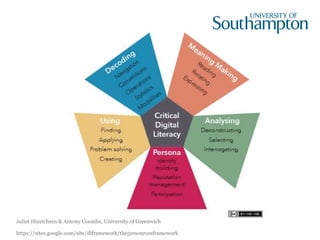
Juliet Hinrichsen & Antony Coombs, University of Greenwich
https://sites.google.com/site/dlframework/the5resourcesframework
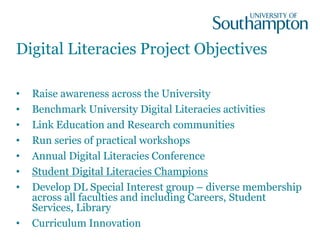
Digital Literacies Project Objectives
• Raise awareness across the University
• Benchmark University Digital Literacies activities
• Link Education and Research communities
• Run series of practical workshops
• Annual Digital Literacies Conference
• Student Digital Literacies Champions
• Develop DL Special Interest group – diverse membership
across all faculties and including Careers, Student
Services, Library
• Curriculum Innovation
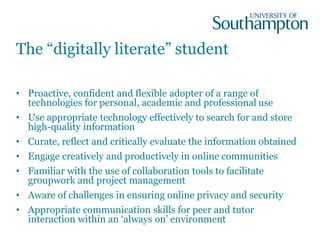
The “digitally literate” student
• Proactive, confident and flexible adopter of a range of
technologies for personal, academic and professional use
• Use appropriate technology effectively to search for and store
high-quality information
• Curate, reflect and critically evaluate the information obtained
• Engage creatively and productively in online communities
• Familiar with the use of collaboration tools to facilitate
groupwork and project management
• Aware of challenges in ensuring online privacy and security
• Appropriate communication skills for peer and tutor
interaction within an ‘always on’ environment
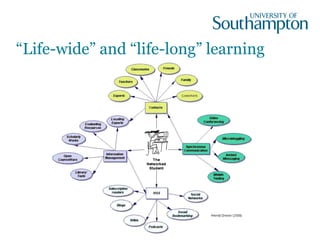
“Life-wide” and “life-long” learning
From Knowledgeable to Knowledge-able: Building New
Learning Environments for New Media Environments | UM
Events | University of Michigan.
“The new media environment can be disruptive to our current
teaching methods and philosophies. As we increasingly move
toward an environment of instant and infinite information, it
becomes less important for students to know, memorize, or
recall information and more important for them to be able to
find, sort, analyze, share, discuss, critique, and create
information and knowledge. They need to move from being
simply knowledgeable to being knowledge-able.” (Wesch, M.,
2011. )
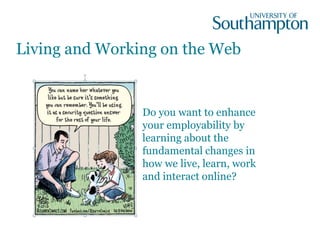
Living and Working on the Web
Do you want to enhance
your employability by
learning about the
fundamental changes in
how we live, learn, work
and interact online?
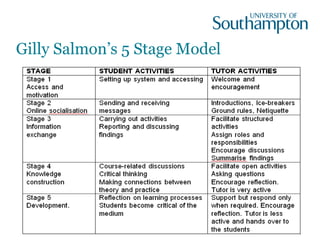
Gilly Salmon’s 5 Stage Model
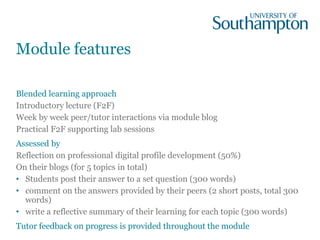
Module features
Blended learning approach
Introductory lecture (F2F)
Week by week peer/tutor interactions via module blog
Practical F2F supporting lab sessions
Assessed by
Reflection on professional digital profile development (50%)
On their blogs (for 5 topics in total)
• Students post their answer to a set question (300 words)
• comment on the answers provided by their peers (2 short posts, total 300
words)
• write a reflective summary of their learning for each topic (300 words)
Tutor feedback on progress is provided throughout the module
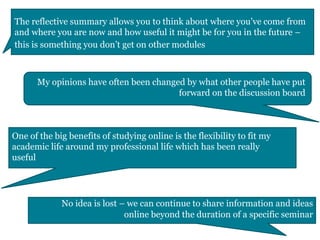
The reflective summary allows you to think about where you’ve come from
and where you are now and how useful it might be for you in the future –
this is something you don’t get on other modules
My opinions have often been changed by what other people have put
forward on the discussion board
One of the big benefits of studying online is the flexibility to fit my
academic life around my professional life which has been really
useful
No idea is lost – we can continue to share information and ideas
online beyond the duration of a specific seminar
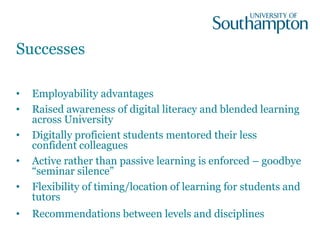
Successes
• Employability advantages
• Raised awareness of digital literacy and blended learning
across University
• Digitally proficient students mentored their less
confident colleagues
• Active rather than passive learning is enforced – goodbye
“seminar silence”
• Flexibility of timing/location of learning for students and
tutors
• Recommendations between levels and disciplines
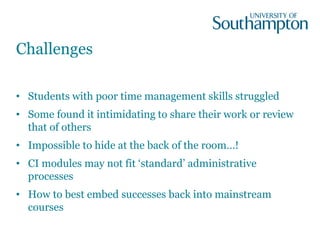
Challenges
• Students with poor time management skills struggled
• Some found it intimidating to share their work or review
that of others
• Impossible to hide at the back of the room…!
• CI modules may not fit ‘standard’ administrative
processes
• How to best embed successes back into mainstream
courses
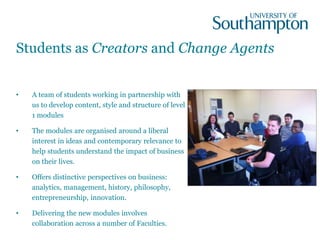
Students as Creators and Change Agents
• A team of students working in partnership with
us to develop content, style and structure of level
1 modules
• The modules are organised around a liberal
interest in ideas and contemporary relevance to
help students understand the impact of business
on their lives.
• Offers distinctive perspectives on business:
analytics, management, history, philosophy,
entrepreneurship, innovation.
• Delivering the new modules involves
collaboration across a number of Faculties.
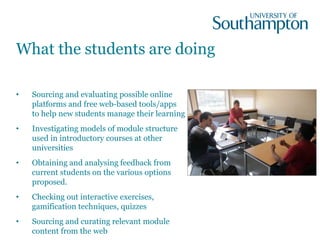
What the students are doing
• Sourcing and evaluating possible online
platforms and free web-based tools/apps
to help new students manage their learning
• Investigating models of module structure
used in introductory courses at other
universities
• Obtaining and analysing feedback from
current students on the various options
proposed.
• Checking out interactive exercises,
gamification techniques, quizzes
• Sourcing and curating relevant module
content from the web
Where next?
• Lessons of learning in online communities to be extended
to MOOCs
• Streamlining the assessment to retain interaction and
improve efficiency
• How to address the differing expectations of students
who have been socialised in very different ways of
learning
• Addressing inequality of skills/attitudes by introducing
the themes of the module at the start of their degrees to
provide more continuity
More information
• Digichamps videos
• Digichamps Blog
• Introduction to Students as Creators and Change Agents
Project (#SBScoCreate)
• JISC Digital Student Exemplars
• The Living and Working on the Web module blog
• Futurelearn MOOCs

Integrating deep learning skills into the curriculum

  • 1.
    Integrating deep learning skillsinto the curriculum Lisa Harris Web Science Institute @lisaharris
  • 2.
    How the Webis Changing the World and the World is changing the Web. Connect with us on our: Website Blog YouTube Twitter Web Science Institute
  • 3.
    The Web isthe largest information system ever constructed; a social and technical phenomenon that is transforming our world in innovative and unexpected ways. A deep understanding of the Web's technologies and social construction is enabling Southampton to develop new forms of economic, social, political, technological and cultural capital. The WSI is staffed by a multi-disciplinary team drawn from across the Faculties, led by Professor Dame Wendy Hall and Professor Sir Nigel Shadbolt.  Focuses on interdisciplinary collaborations and partnerships  Leverages staff and student expertise across the University  Provides a platform for public, private and third sector collaboration  Showcases unique and creative education Web Science Institute
  • 4.
  • 5.
    The Plan • DigitalLiteracies – what are they? • Three examples of the challenges and opportunities of integrating deep learning skills into the curriculum: • Student Digital Champions (Digichamps) • An award-winning module called Living and Working on the Web The entire content is provided, discussed and critiqued by the students via their blogs • Students as Creators and Change Agents project. A team of students are designing and providing content for a suite of new introductory undergraduate modules in partnership with academic staff.
  • 6.
    What do wemean by Digital Literacy? • Collecting, managing and evaluating online information • Building an online brand for personal or career development • Creating and curating content in written, audio and visual media • Communicating effectively online for networking and collaboration purposes • Managing digital identity/ies with due awareness of privacy and security issues
  • 7.
    Juliet Hinrichsen &Antony Coombs, University of Greenwich https://sites.google.com/site/dlframework/the5resourcesframework
  • 8.
    Digital Literacies ProjectObjectives • Raise awareness across the University • Benchmark University Digital Literacies activities • Link Education and Research communities • Run series of practical workshops • Annual Digital Literacies Conference • Student Digital Literacies Champions • Develop DL Special Interest group – diverse membership across all faculties and including Careers, Student Services, Library • Curriculum Innovation
  • 9.
    The “digitally literate”student • Proactive, confident and flexible adopter of a range of technologies for personal, academic and professional use • Use appropriate technology effectively to search for and store high-quality information • Curate, reflect and critically evaluate the information obtained • Engage creatively and productively in online communities • Familiar with the use of collaboration tools to facilitate groupwork and project management • Aware of challenges in ensuring online privacy and security • Appropriate communication skills for peer and tutor interaction within an ‘always on’ environment
  • 10.
  • 11.
    From Knowledgeable toKnowledge-able: Building New Learning Environments for New Media Environments | UM Events | University of Michigan. “The new media environment can be disruptive to our current teaching methods and philosophies. As we increasingly move toward an environment of instant and infinite information, it becomes less important for students to know, memorize, or recall information and more important for them to be able to find, sort, analyze, share, discuss, critique, and create information and knowledge. They need to move from being simply knowledgeable to being knowledge-able.” (Wesch, M., 2011. )
  • 14.
    Living and Workingon the Web Do you want to enhance your employability by learning about the fundamental changes in how we live, learn, work and interact online?
  • 15.
    Gilly Salmon’s 5Stage Model
  • 16.
    Module features Blended learningapproach Introductory lecture (F2F) Week by week peer/tutor interactions via module blog Practical F2F supporting lab sessions Assessed by Reflection on professional digital profile development (50%) On their blogs (for 5 topics in total) • Students post their answer to a set question (300 words) • comment on the answers provided by their peers (2 short posts, total 300 words) • write a reflective summary of their learning for each topic (300 words) Tutor feedback on progress is provided throughout the module
  • 17.
    The reflective summaryallows you to think about where you’ve come from and where you are now and how useful it might be for you in the future – this is something you don’t get on other modules My opinions have often been changed by what other people have put forward on the discussion board One of the big benefits of studying online is the flexibility to fit my academic life around my professional life which has been really useful No idea is lost – we can continue to share information and ideas online beyond the duration of a specific seminar
  • 18.
    Successes • Employability advantages •Raised awareness of digital literacy and blended learning across University • Digitally proficient students mentored their less confident colleagues • Active rather than passive learning is enforced – goodbye “seminar silence” • Flexibility of timing/location of learning for students and tutors • Recommendations between levels and disciplines
  • 19.
    Challenges • Students withpoor time management skills struggled • Some found it intimidating to share their work or review that of others • Impossible to hide at the back of the room…! • CI modules may not fit ‘standard’ administrative processes • How to best embed successes back into mainstream courses
  • 20.
    Students as Creatorsand Change Agents • A team of students working in partnership with us to develop content, style and structure of level 1 modules • The modules are organised around a liberal interest in ideas and contemporary relevance to help students understand the impact of business on their lives. • Offers distinctive perspectives on business: analytics, management, history, philosophy, entrepreneurship, innovation. • Delivering the new modules involves collaboration across a number of Faculties.
  • 21.
    What the studentsare doing • Sourcing and evaluating possible online platforms and free web-based tools/apps to help new students manage their learning • Investigating models of module structure used in introductory courses at other universities • Obtaining and analysing feedback from current students on the various options proposed. • Checking out interactive exercises, gamification techniques, quizzes • Sourcing and curating relevant module content from the web
  • 22.
    Where next? • Lessonsof learning in online communities to be extended to MOOCs • Streamlining the assessment to retain interaction and improve efficiency • How to address the differing expectations of students who have been socialised in very different ways of learning • Addressing inequality of skills/attitudes by introducing the themes of the module at the start of their degrees to provide more continuity
  • 23.
    More information • Digichampsvideos • Digichamps Blog • Introduction to Students as Creators and Change Agents Project (#SBScoCreate) • JISC Digital Student Exemplars • The Living and Working on the Web module blog • Futurelearn MOOCs

Editor's Notes

  • #8 Life wide learning and digital and web literacies walk hand in hand in providing environments for authentic learning. Both focus on the “personal life course of an individual through which they learn” (Jackson, n/d, p.4). Learning on the web and learning how to be “digitally savvy” is a personalised learning experience. Nonetheless, it is not an isolated one. It is rather a shared venture. And curriculum design must take that into account and cater for situated learner and the skills that are relevant to help learners strive in a changing society.