The Fundamentals of Digital Image
Processing
22/6/2020 - 26/2/2020
Day 5 : Applications
Summary :
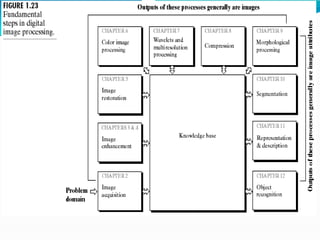
•Steps in Digital Image Processing Components
•Elements of Visual Perception
•Image Sensing and Acquisition
•Image Sampling and Quantization
•Relationships between pixels
•Color image fundamentals - RGB, HSI models,
• Two-dimensional mathematical preliminaries, 2D
transforms - DFT, DCT.
Introduction
 Digital image processing is the use of computer
algorithms to perform image processing on digital
images
 As a subcategory or field of digital signal processing,
digital image processing has many advantages
over analog image processing.
 Since images are defined over two dimensions
(perhaps more) digital image processing may be
modeled in the form of multidimensional systems
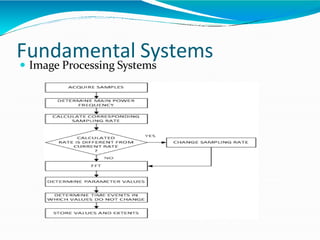
Fundamental Systems
 Image Processing Systems
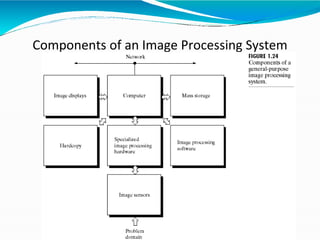
Components of an Image Processing System
Working Principles
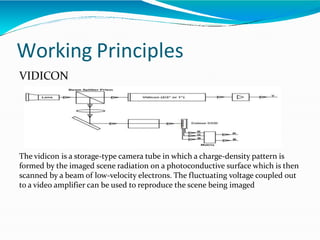
VIDICON
The vidicon is a storage-type camera tube in which a charge-density pattern is
formed by the imaged scene radiation on a photoconductive surface which is then
scanned by a beam of low-velocity electrons. The fluctuating voltage coupled out
to a video amplifier can be used to reproduce the scene being imaged
Working Principles
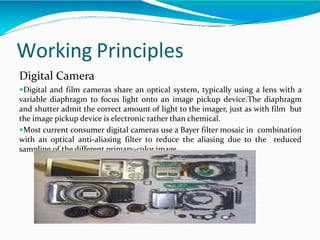
Digital Camera
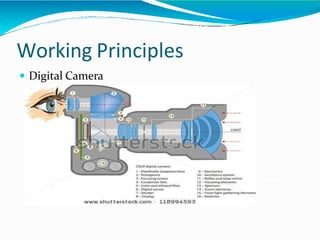
Digital and film cameras share an optical system, typically using a lens with a
variable diaphragm to focus light onto an image pickup device.The diaphragm
and shutter admit the correct amount of light to the imager, just as with film but
the image pickup device is electronic rather than chemical.
Most current consumer digital cameras use a Bayer filter mosaic in combination
with an optical anti-aliasing filter to reduce the aliasing due to the reduced
sampling of the different primary-color image
Working Principles
 Digital Camera
Elements of Visual Perception
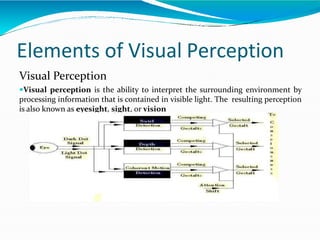
Visual Perception
Visual perception is the ability to interpret the surrounding environment by
processing information that is contained in visible light. The resulting perception
is also known as eyesight, sight, or vision
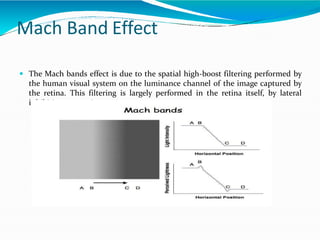
Mach Band Effect
 The Mach bands effect is due to the spatial high-boost filtering performed by
the human visual system on the luminance channel of the image captured by
the retina. This filtering is largely performed in the retina itself, by lateral
inhibition among its neurons.
Colour Models
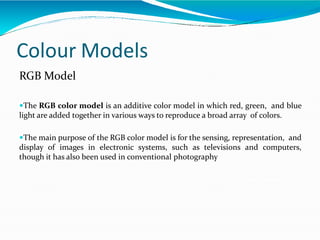
RGB Model
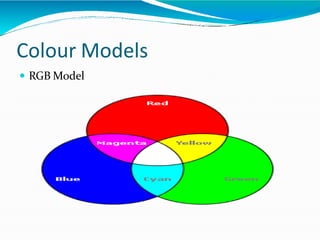
The RGB color model is an additive color model in which red, green, and blue
light are added together in various ways to reproduce a broad array of colors.
The main purpose of the RGB color model is for the sensing, representation, and
display of images in electronic systems, such as televisions and computers,
though it has also been used in conventional photography
Colour Models
 RGB Model
Colour Models
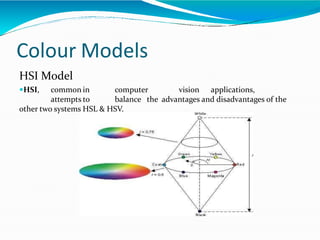
HSI Model
HSI, common in computer vision applications,
attempts to balance the advantages and disadvantages of the
other two systems HSL & HSV.
Sampling & Quantization
Sampling
 sampling is the reduction of a continuous signal to a discrete signal.
 A sample is a value or set of values at a point in time and/or space.
 A sampler is a subsystem or operation that extracts samples from a continuous
signal.
Quantization
 Quantization, involved in image processing, is a lossy compression technique
achieved by compressing a range of values to a single quantum value.
 When the number of discrete symbols in a given stream is reduced, the stream
becomes more compressible.
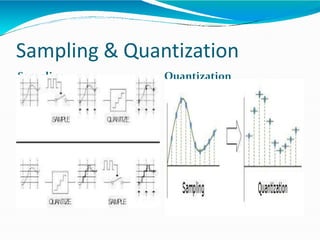
Sampling & Quantization
Sampling Quantization
Two Dimensional Mathematical
Preliminaries
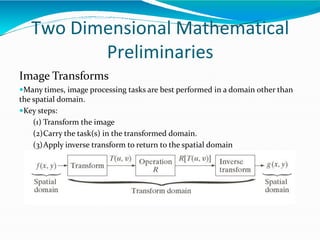
Image Transforms
Many times, image processing tasks are best performed in a domain other than
the spatial domain.
Key steps:
(1) Transform the image
(2)Carry the task(s) in the transformed domain.
(3)Apply inverse transform to return to the spatial domain
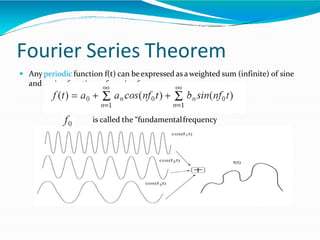
Fourier Series Theorem
 Any periodic function f(t) can beexpressed as aweighted sum (infinite) of sine
and cosine functions of varying frequency
is called the “fundamentalfrequency
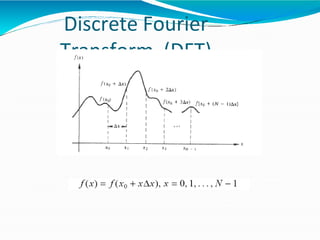
Discrete Fourier
Transform (DFT)
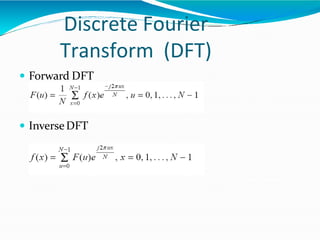
Discrete Fourier
Transform (DFT)
 Forward DFT
 InverseDFT
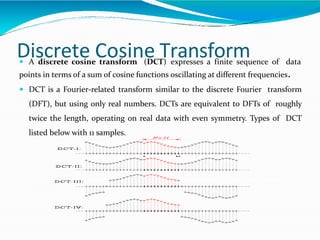
Discrete Cosine Transform A discrete cosine transform (DCT) expresses a finite sequence of data
points in terms of a sum of cosine functions oscillating at different frequencies.
 DCT is a Fourier-related transform similar to the discrete Fourier transform
(DFT), but using only real numbers. DCTs are equivalent to DFTs of roughly
twice the length, operating on real data with even symmetry. Types of DCT
listed below with 11 samples.
Applications of Digital Image Processing
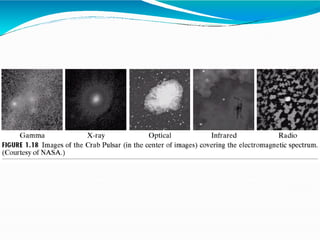
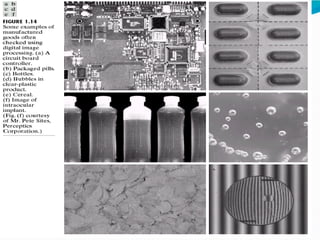
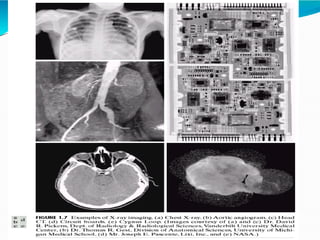
Some of the major fields in which digital image processing is widely
used are mentioned below :
•Image sharpening and restoration
•Medical field
•Remote sensing
•Transmission and encoding
•Machine/Robot vision
•Colour processing
•Pattern recognition
•Video processing
•Microscopic Imaging
•Others
https://www.youtube.com/watch?v=GTZYwjnc-gI application Ranger3 – 3D vision
camera setting
https://www.youtube.com/watch?v=hyFa5w3MlGs&list=PLD9ADB43D3E3E1DD6&index
=22 Robot
https://www.youtube.com/watch?v=KIvz9HlZtIo Industry 4.0 and Machine Vision
https://www.youtube.com/watch?v=pSyIBDilPcY How is deep learning different than
machine vision?
https://www.youtube.com/watch?v=Ijp3-zjTIp0 Boeing’s Compact Laser Weapons
System: Sets Up in Minutes, Directs Energy in Seconds
https://www.youtube.com/watch?v=Ddeht8prpJw RAFAEL's MicroLite Compact EO
ISTAR system for UAVs
https://www.youtube.com/watch?v=WrRGMvdq5q0 Drone security system watches
over home from above
https://www.youtube.com/watch?v=I8vYrAUb0BQ Vision Picking at DHL - Augmented
Reality in Logistics
https://www.youtube.com/watch?time_continue=6&v=RdYwrCItHKY&feature=emb_log
o Smart Parking demo connected to neqto: cloud service
https://www.youtube.com/watch?v=NRVnlYVUp8I Precision agriculture with Spresense
https://www.youtube.com/watch?time_continue=24&v=Ve4sZa1Kq88&feature=emb_l
ogo Hand Wash Monitoring Solution

DIGITAL IMAGE PROCESSING - Day 5 Applications of DIP

  • 1.
    The Fundamentals ofDigital Image Processing 22/6/2020 - 26/2/2020 Day 5 : Applications Summary : •Steps in Digital Image Processing Components •Elements of Visual Perception •Image Sensing and Acquisition •Image Sampling and Quantization •Relationships between pixels •Color image fundamentals - RGB, HSI models, • Two-dimensional mathematical preliminaries, 2D transforms - DFT, DCT.
  • 2.
    Introduction  Digital imageprocessing is the use of computer algorithms to perform image processing on digital images  As a subcategory or field of digital signal processing, digital image processing has many advantages over analog image processing.  Since images are defined over two dimensions (perhaps more) digital image processing may be modeled in the form of multidimensional systems
  • 3.
  • 8.
    Components of anImage Processing System
  • 9.
    Working Principles VIDICON The vidiconis a storage-type camera tube in which a charge-density pattern is formed by the imaged scene radiation on a photoconductive surface which is then scanned by a beam of low-velocity electrons. The fluctuating voltage coupled out to a video amplifier can be used to reproduce the scene being imaged
  • 10.
    Working Principles Digital Camera Digitaland film cameras share an optical system, typically using a lens with a variable diaphragm to focus light onto an image pickup device.The diaphragm and shutter admit the correct amount of light to the imager, just as with film but the image pickup device is electronic rather than chemical. Most current consumer digital cameras use a Bayer filter mosaic in combination with an optical anti-aliasing filter to reduce the aliasing due to the reduced sampling of the different primary-color image
  • 11.
  • 12.
    Elements of VisualPerception Visual Perception Visual perception is the ability to interpret the surrounding environment by processing information that is contained in visible light. The resulting perception is also known as eyesight, sight, or vision
  • 13.
    Mach Band Effect The Mach bands effect is due to the spatial high-boost filtering performed by the human visual system on the luminance channel of the image captured by the retina. This filtering is largely performed in the retina itself, by lateral inhibition among its neurons.
  • 14.
    Colour Models RGB Model TheRGB color model is an additive color model in which red, green, and blue light are added together in various ways to reproduce a broad array of colors. The main purpose of the RGB color model is for the sensing, representation, and display of images in electronic systems, such as televisions and computers, though it has also been used in conventional photography
  • 15.
  • 16.
    Colour Models HSI Model HSI,common in computer vision applications, attempts to balance the advantages and disadvantages of the other two systems HSL & HSV.
  • 17.
    Sampling & Quantization Sampling sampling is the reduction of a continuous signal to a discrete signal.  A sample is a value or set of values at a point in time and/or space.  A sampler is a subsystem or operation that extracts samples from a continuous signal. Quantization  Quantization, involved in image processing, is a lossy compression technique achieved by compressing a range of values to a single quantum value.  When the number of discrete symbols in a given stream is reduced, the stream becomes more compressible.
  • 18.
  • 19.
    Two Dimensional Mathematical Preliminaries ImageTransforms Many times, image processing tasks are best performed in a domain other than the spatial domain. Key steps: (1) Transform the image (2)Carry the task(s) in the transformed domain. (3)Apply inverse transform to return to the spatial domain
  • 20.
    Fourier Series Theorem Any periodic function f(t) can beexpressed as aweighted sum (infinite) of sine and cosine functions of varying frequency is called the “fundamentalfrequency
  • 21.
  • 22.
    Discrete Fourier Transform (DFT) Forward DFT  InverseDFT
  • 23.
    Discrete Cosine TransformA discrete cosine transform (DCT) expresses a finite sequence of data points in terms of a sum of cosine functions oscillating at different frequencies.  DCT is a Fourier-related transform similar to the discrete Fourier transform (DFT), but using only real numbers. DCTs are equivalent to DFTs of roughly twice the length, operating on real data with even symmetry. Types of DCT listed below with 11 samples.
  • 24.
    Applications of DigitalImage Processing Some of the major fields in which digital image processing is widely used are mentioned below : •Image sharpening and restoration •Medical field •Remote sensing •Transmission and encoding •Machine/Robot vision •Colour processing •Pattern recognition •Video processing •Microscopic Imaging •Others
  • 25.
    https://www.youtube.com/watch?v=GTZYwjnc-gI application Ranger3– 3D vision camera setting https://www.youtube.com/watch?v=hyFa5w3MlGs&list=PLD9ADB43D3E3E1DD6&index =22 Robot https://www.youtube.com/watch?v=KIvz9HlZtIo Industry 4.0 and Machine Vision https://www.youtube.com/watch?v=pSyIBDilPcY How is deep learning different than machine vision? https://www.youtube.com/watch?v=Ijp3-zjTIp0 Boeing’s Compact Laser Weapons System: Sets Up in Minutes, Directs Energy in Seconds
  • 26.
    https://www.youtube.com/watch?v=Ddeht8prpJw RAFAEL's MicroLiteCompact EO ISTAR system for UAVs https://www.youtube.com/watch?v=WrRGMvdq5q0 Drone security system watches over home from above https://www.youtube.com/watch?v=I8vYrAUb0BQ Vision Picking at DHL - Augmented Reality in Logistics https://www.youtube.com/watch?time_continue=6&v=RdYwrCItHKY&feature=emb_log o Smart Parking demo connected to neqto: cloud service https://www.youtube.com/watch?v=NRVnlYVUp8I Precision agriculture with Spresense https://www.youtube.com/watch?time_continue=24&v=Ve4sZa1Kq88&feature=emb_l ogo Hand Wash Monitoring Solution