Digital Identity: Who
do you want to be
online?
Shawna Reibling
Knoweldge mobilization officer, ORS
Staff development day May 16, 2013
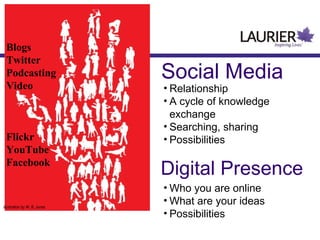
Social Media
Illustration by W. B. Jones
• Relationship
• A cycle of knowledge
exchange
• Searching, sharing
• Possibilities
Blogs
Twitter
Podcasting
Video
Flickr
YouTube
Facebook
Digital Presence
• Who you are online
• What are your ideas
• Possibilities
Digital Identity
Digital identity… a set of data that uniquely
describes a person or a thing and contains
information about the subject's relationships to
other entities.
http://en.wikipedia.org/wiki/Digital_identity
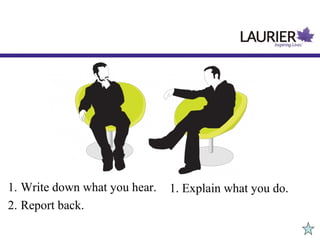
1. Explain what you do.1. Write down what you hear.
2. Report back.
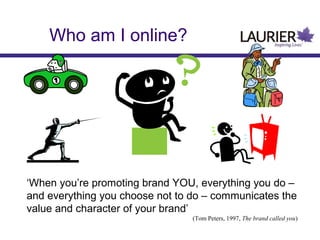
Who am I online?
‘When you’re promoting brand YOU, everything you do –
and everything you choose not to do – communicates the
value and character of your brand’
(Tom Peters, 1997, The brand called you)
Questions to consider
• Do I need a online presence?
• Am I ready to be digitally social?
• What is my online presence?
• Am I starting from scratch?
• Precautions & opportunities …
Questions to consider before
joining social media
• Who am I trying to reach?
• What do I want people to know about
me?
• How much time can I spend online?
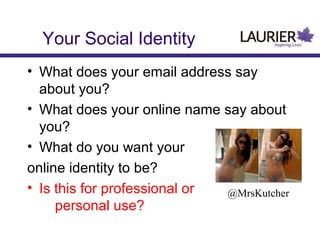
Your Social Identity
• What does your email address say
about you?
• What does your online name say about
you?
• What do you want your
online identity to be?
• Is this for professional or
personal use?
@MrsKutcher
Why am I crafting
a digital identity?
• Knowledge mobilization: Moving research
knowledge into active service
• Feedback on ideas
• What are others in your field working on today?
• Real-time conversation and network exchange
• Resource sharing
• Immediate awareness of information
• Conferences? Contacts? Partnerships?
• Event promotion?
Why am I crafting
a digital identity?
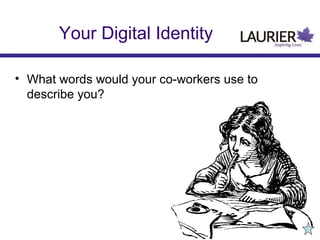
• What words would your co-workers use to
describe you?
Your Digital Identity
Di gi t al I dent i t y
Exampl es
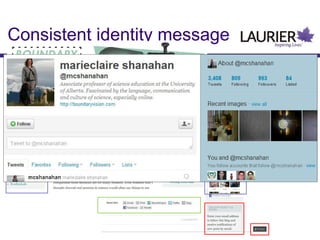
Consistent identity message
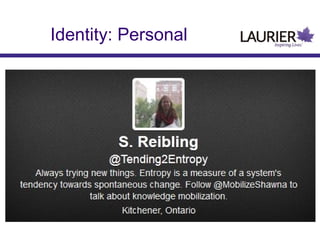
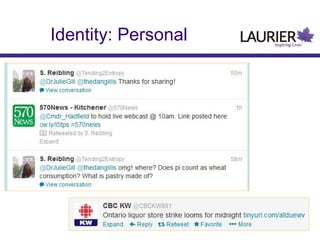
Identity: Personal
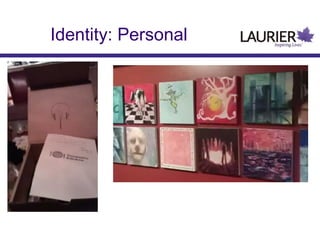
Identity: Personal
Identity: Personal
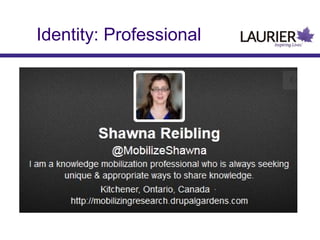
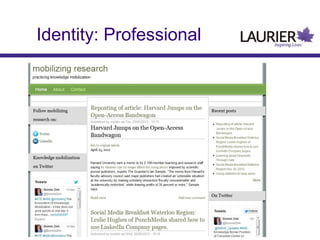
Identity: Professional
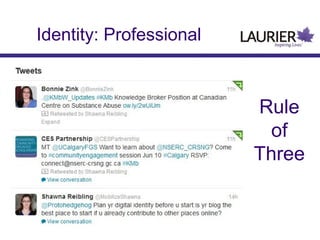
Rule
of
Three
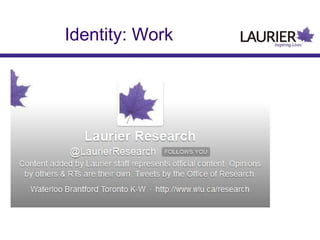
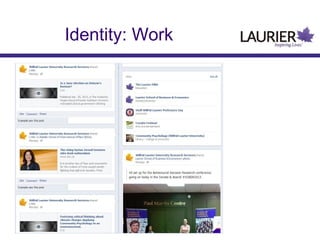
Identity: Work
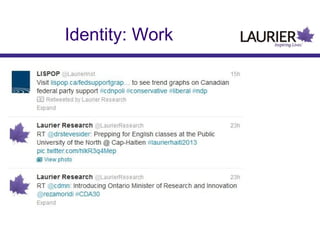
Identity: Work
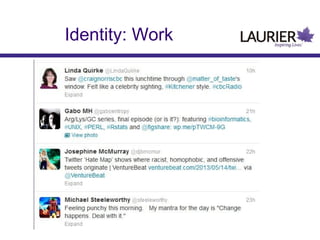
Identity: Work
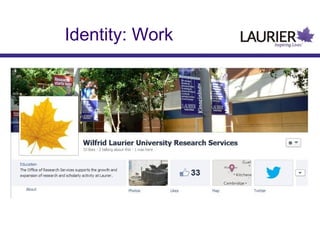
Identity: Work
Identity: Work
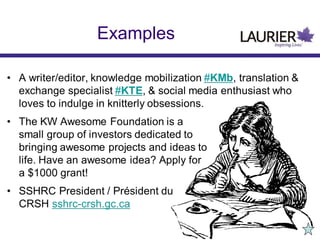
Examples
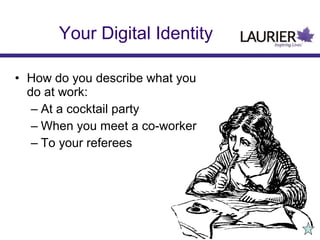
• How do you describe what you
do at work:
– At a cocktail party
– When you meet a co-worker
– To your referees
Your Digital Identity
Di gi t al I dent i t y
Set up
Choosing an Identity
Checklist
• What name do you currently use?(if
any)
• For Twitter: choose something short
• Do you use mobile devices? Is it easy
to type?
• Can you get a persistent alias
Web Identity at Laurier
• www.wlu.ca/faculty/name
• Ask ITS
• i.e. wlu.ca/education/kmoreno
• Wlu.ca/childlab
Privacy Settings
• Set them up well
• They change
• Test them regularly
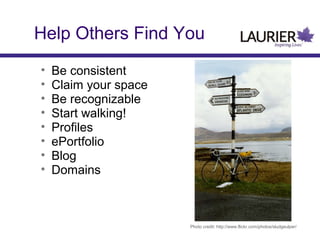
Help Others Find You
• Be consistent
• Claim your space
• Be recognizable
• Start walking!
• Profiles
• ePortfolio
• Blog
• Domains
Photo credit: http://www.flickr.com/photos/sludgeulper/
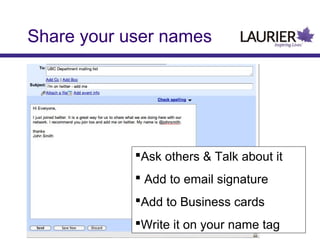
Ask others & Talk about it
 Add to email signature
Add to Business cards
Write it on your name tag
Share your user names
A video summary
https://www.youtube.com/watch?v=2UlcOX1fZW4
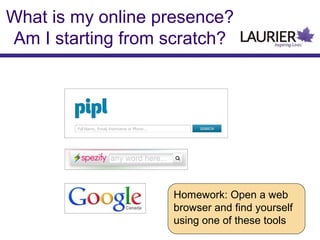
What is my online presence?
Am I starting from scratch?
Homework: Open a web
browser and find yourself
using one of these tools
Contact me
Web: wlu.ca/research/kmb
Email: sreibling@wlu.ca
Twitter:@LaurierResearch

Digital identity16may13shorter

  • 1.
    Digital Identity: Who doyou want to be online? Shawna Reibling Knoweldge mobilization officer, ORS Staff development day May 16, 2013
  • 2.
    Social Media Illustration byW. B. Jones • Relationship • A cycle of knowledge exchange • Searching, sharing • Possibilities Blogs Twitter Podcasting Video Flickr YouTube Facebook Digital Presence • Who you are online • What are your ideas • Possibilities
  • 3.
    Digital Identity Digital identity…a set of data that uniquely describes a person or a thing and contains information about the subject's relationships to other entities. http://en.wikipedia.org/wiki/Digital_identity
  • 4.
    1. Explain whatyou do.1. Write down what you hear. 2. Report back.
  • 5.
    Who am Ionline? ‘When you’re promoting brand YOU, everything you do – and everything you choose not to do – communicates the value and character of your brand’ (Tom Peters, 1997, The brand called you)
  • 6.
    Questions to consider •Do I need a online presence? • Am I ready to be digitally social? • What is my online presence? • Am I starting from scratch? • Precautions & opportunities …
  • 7.
    Questions to considerbefore joining social media • Who am I trying to reach? • What do I want people to know about me? • How much time can I spend online?
  • 8.
    Your Social Identity •What does your email address say about you? • What does your online name say about you? • What do you want your online identity to be? • Is this for professional or personal use? @MrsKutcher
  • 10.
    Why am Icrafting a digital identity? • Knowledge mobilization: Moving research knowledge into active service • Feedback on ideas • What are others in your field working on today? • Real-time conversation and network exchange • Resource sharing • Immediate awareness of information • Conferences? Contacts? Partnerships? • Event promotion?
  • 11.
    Why am Icrafting a digital identity?
  • 12.
    • What wordswould your co-workers use to describe you? Your Digital Identity
  • 13.
    Di gi tal I dent i t y Exampl es
  • 14.
  • 15.
  • 16.
  • 17.
  • 18.
  • 19.
  • 20.
  • 21.
  • 22.
  • 23.
  • 24.
  • 25.
  • 26.
  • 27.
    • How doyou describe what you do at work: – At a cocktail party – When you meet a co-worker – To your referees Your Digital Identity
  • 28.
    Di gi tal I dent i t y Set up
  • 29.
    Choosing an Identity Checklist •What name do you currently use?(if any) • For Twitter: choose something short • Do you use mobile devices? Is it easy to type? • Can you get a persistent alias
  • 30.
    Web Identity atLaurier • www.wlu.ca/faculty/name • Ask ITS • i.e. wlu.ca/education/kmoreno • Wlu.ca/childlab
  • 31.
    Privacy Settings • Setthem up well • They change • Test them regularly
  • 32.
    Help Others FindYou • Be consistent • Claim your space • Be recognizable • Start walking! • Profiles • ePortfolio • Blog • Domains Photo credit: http://www.flickr.com/photos/sludgeulper/
  • 33.
    Ask others &Talk about it  Add to email signature Add to Business cards Write it on your name tag Share your user names
  • 34.
  • 35.
    What is myonline presence? Am I starting from scratch? Homework: Open a web browser and find yourself using one of these tools
  • 36.
    Contact me Web: wlu.ca/research/kmb Email:sreibling@wlu.ca Twitter:@LaurierResearch

Editor's Notes

  • #2 Knowledge mobilization is defined as Moving research knowledge into active service
  • #3 Knowledge mobilization is defined as Moving research knowledge into active service
  • #4 http://www.youtube.com/watch?v=MpIOClX1jPE
  • #11 Knowledge mobilization is defined as Moving research knowledge into active service Moving this research knowledge into active service involves moving ideas , connecting researchers and people, sharing both people and ideas, as well as searching out and making the connections between ideas and people with common interests visible and transparent. Examples of how these network effects translate to research includes: Faster transfer of information than a journal publication (blog) Feedback on ideas (comments and responses) Knowing what are others in your field working on today ? (twitter) Real-time conversation and network exchange (twitter) Resource sharing (blogs) Notification of when new information is shared (RSS) Ideas, people, sharing and searching are all ways to build your knowledge transfer network.
  • #12 Knowledge mobilization is defined as Moving research knowledge into active service Moving this research knowledge into active service involves moving ideas , connecting researchers and people, sharing both people and ideas, as well as searching out and making the connections between ideas and people with common interests visible and transparent. Examples of how these network effects translate to research includes: Faster transfer of information than a journal publication (blog) Feedback on ideas (comments and responses) Knowing what are others in your field working on today ? (twitter) Real-time conversation and network exchange (twitter) Resource sharing (blogs) Notification of when new information is shared (RSS) Ideas, people, sharing and searching are all ways to build your knowledge transfer network.
  • #14 Welcome Introduce kyle and shawna Explain why we ’re partnering together
  • #15 Blog address: http://boundaryvision.com/about/
  • #29 Welcome Introduce kyle and shawna Explain why we ’re partnering together
  • #34 PJ: So you still don’t have any followers. It would be cool if you could get important people in your network to add you. First, you should let others know you are on twitter - send out an email <CLICK> PJ: Verbally ask your colleagues, send out an email, place your twitter name on your email signature, add it to your business cards, attach it to your door, tell your colleagues, add it to your conference badge. Be visible. <next page> NOTE: Shawna will wear name tag with twitter ID on them