Writing your knowledge
mobilization plan
Shawna Reibling, Knowledge Mobilization Officer
Email: sreibling@wlu.ca
Twitter: @MobilizeShawna
@LaurierResearch
• KM or KMb (SSHRC)
• Knowledge translation (CIHR),
• Knowledge exchange (CHSRF)
• Knowledge transfer partnerships (UK)
• Knowledge dissemination (MSFHR)
• ‘Tech transfer’(S.T.E.M. disciplines)
• Extension (agriculture)
What is “kmb”?
What is knowledge mobilization?
• SSHRC: “moving knowledge into active service for
the broadest possible common good”.
SSHRC (2008b). Knowledge impact in society: A SSHRC transformation program. Social
Sciences and Humanities Research Council. Available:
http://www.sshrc.ca/web/apply/program_descriptions/knowledge_impact_e.asp
• “accepting a common set of values, such as respect
for others’ perspective (to encourage wide
participation)”, this is important in “acculturating new
participants to function effectively in knowledge
networks” Dede, C. The role of emerging technologies
for knowledge mobilization, dissemination, and use in education. Paper
commissioned by Office of Educational Research and Improvement, US Dept. of
Education. www.virtual.gmu.edu
Knowledge mobilization defined
• The reciprocal and complementary flow and uptake
of research knowledge between researchers,
knowledge brokers and knowledge users —both
within and beyond academia— in such a way that
may benefit users and create positive impacts within
Canada and/or internationally, and, ultimately, has
the potential to enhance the profile, reach and
impact of social sciences and humanities research.
• http://www.sshrc-crsh.gc.ca/funding-financement/programs-programmes/definitions-eng.aspx#km-mc
Knowledge mobilization initiatives
• Knowledge mobilization initiatives must address at
least one of the following, as appropriate, depending
on research area and project objectives, context, and
target audience:
• Within academia:
– informs, advances and/or improves research agendas;
theory; and/or methods.
• Beyond academia:
– Informs public debate; policies; and/or practice;
– enhances/improves services; and/or
– informs the decisions and/or processes of people in
business, government, the media, practitioner communities
and civil society.
• http://www.sshrc-crsh.gc.ca/funding-financement/programs-programmes/definitions-eng.aspx#km-mc
• “End of Grant” KMb: (curiosity-driven research):
The researcher develops and implements a plan for making
knowledge users aware of the knowledge generated.
• “Integrated” KMb (problem-based research):
The researcher engages potential knowledge users as
partners in the research process. Requires a collaborative
or participatory approach to research that is action oriented
and is solutions and impact focused.
Types of “kmb”
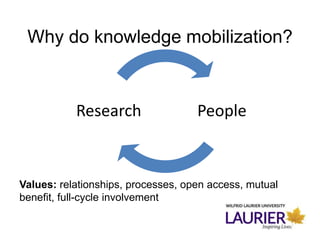
Values: relationships, processes, open access, mutual
benefit, full-cycle involvement
Why do knowledge mobilization?
PeopleResearch
Research outcome
What is your research outcome(s)?
Audience
Who? (Be specific) Why them?
Typical Audience Outreach Tools
• Book?
• Publications in Journals (previous publications,
top-tier, open access)
• Conference presentations (how many people?
Who will be there?)
• Workshops (tailored to audience)
• Student training
• Classroom
• Community
Audience reach
How do you reach them? (barriers, existing relationships)
Short & long term
• Leverage what
you already
have
• Describe use
of time,
money,
people
resources.
Source: http://affirmyourlife.blogspot.com/
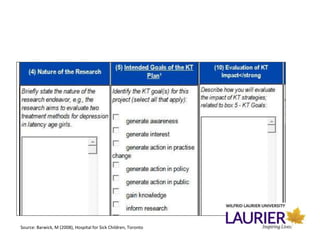
Source: Barwick, M (2008), Hospital for Sick Children, Toronto
Evaluation
Evaluate impact (past & going forward)
Don’t wait till the end to evaluate
Selected KMb Products
• Face-to-Face Meetings
• Reports
• Focus groups
• Toolkits
• Models
• Procedures
• Website content
• Online tool
• Policy brief
• Meeting
• Video
• Audio lecture
• Community work
• Advisory committee
• Networking event
• Tweets, blog
• Dinner
• Presentation
• Panel presentation
• Opinion piece
• Interview (tv, radio, written)
• One pager
• Clear language summary
• Journal publication, book, chapter
• Open access publication
• Conference presentation, keynote
• Professional organization publication
• Textbook
• Testifying as an expert
• Lay presentation
• Webinar
• Etc.
Reasons NOT to Build a Website
• ‘Everyone else’ has one and social media is cool
• My publisher asks me to build one
• I don’t know if the audience is online
• I know that the audience I want to reach is not online
• I don’t have a website with an existing audience
• I need a place to put the results (use scholars.wlu.ca
instead)
• There are existing places on the web people go to find
out about this area of research
• I hate technology and someone else can deal with ‘that
stuff’ for me
Reasons TO Build a Website
• I already have a website that people visit and I want to
expand it and/or my existing site in inadequate
• I need to host interactive or non-text products from my
work i.e. database, annotated bibliography, videos etc.
• There are no other online credible sources for
knowledge in this area
• I already am on social media
• I hate technology and someone else can deal with ‘that
stuff’ for me
Evaluation
Evaluate impact (past & going forward)
Don’t wait till the end to evaluate
How would you concretely report your results to your funder? To your audiences?
How will you know you have had an impact?
How will you know you are done?
Evaluation
Evaluate impact (past & going forward)
Don’t wait till the end to evaluate
Research outcome
What is your research outcome(s)?
Audience
Who? (Be specific) Why them?
Audience reach
How do you reach them? (barriers, existing
relationships)
Short & long term
Budget and Timeline
Identify what you need to pay for with money
and/or time
• Knowledge broker
• Clear language training and writing
• Web development/IT
• Travel
• Workshops/venue
• Web 2.0 (social media)
• Hand outs?
Open Access
• Journal articles must be available through Open
Access within 12 months of publication.
• How to do this:
1. Pay for it (list specifically how much it costs)
2. Choose open access journal.
• What is a journal’s copyright policy? Here
http://library.wlu.ca/services/scholarly-communication#tab-tri-
council-tips
Example
• Partnership of 12 universities
• Examples of services:
• I need to find community partners to work with
• I want to find someone who can put my research to use
• I am working with partners but want to grow and sustain my
research program
• My graduate student wants work experience with policy-makers
• We are doing our own research but we need help
• We need to do research but do not know where to start
• We need to tap into research, knowledge, and expertise at a
university
Phipps, D. (2008) “Opinion Leader Editorial: Turning Research into Action” in Research Money Oct. 29, 2008: p. 8.
ResearchImpact.ca
Resources
Laurier Institutional Repository: scholars.wlu.ca
This slide deck: Slideshare
www.kmbtoolkit.ca
Tri-Council Resources:
• Tri-Council Guiding Principles
• Research Data Archiving Policy
• SSHRC: Open Access Policy
• SSHRC: Aboriginal Research Statement of Principles
• CIHR: Access to Research Outputs
• Dissemination of faculty research to the broader public,
through materials, events and social media
• Brokering research partnerships between community
members and university researchers
• Clear language assistance
• Social media
• Event training
• More….
Laurier Services
• Clear language summary writing: Oct. 22, 8:30-
9:30am, Bricker Academic112
• Building a digital identity for engaging in social
media: Dec. 11, 3-4:30pm, Arts1C17
• How to create a digital identity for engaging your
event/conference in social media: December 17, 4-
5:00pm, DAWB 1-101A
Register by email: sreibling@wlu.ca
Upcoming Workshops
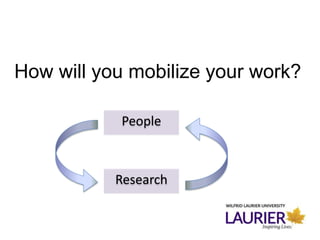
How will you mobilize your work?
People
Research
Shawna Reibling
Knowledge Mobilization Officer
Email: sreibling@wlu.ca
Twitter: @MobilizeShawna
@LaurierResearch
Questions?

6 oct15 writing kmb plan edited

  • 1.
    Writing your knowledge mobilizationplan Shawna Reibling, Knowledge Mobilization Officer Email: sreibling@wlu.ca Twitter: @MobilizeShawna @LaurierResearch
  • 2.
    • KM orKMb (SSHRC) • Knowledge translation (CIHR), • Knowledge exchange (CHSRF) • Knowledge transfer partnerships (UK) • Knowledge dissemination (MSFHR) • ‘Tech transfer’(S.T.E.M. disciplines) • Extension (agriculture) What is “kmb”?
  • 3.
    What is knowledgemobilization? • SSHRC: “moving knowledge into active service for the broadest possible common good”. SSHRC (2008b). Knowledge impact in society: A SSHRC transformation program. Social Sciences and Humanities Research Council. Available: http://www.sshrc.ca/web/apply/program_descriptions/knowledge_impact_e.asp • “accepting a common set of values, such as respect for others’ perspective (to encourage wide participation)”, this is important in “acculturating new participants to function effectively in knowledge networks” Dede, C. The role of emerging technologies for knowledge mobilization, dissemination, and use in education. Paper commissioned by Office of Educational Research and Improvement, US Dept. of Education. www.virtual.gmu.edu
  • 4.
    Knowledge mobilization defined •The reciprocal and complementary flow and uptake of research knowledge between researchers, knowledge brokers and knowledge users —both within and beyond academia— in such a way that may benefit users and create positive impacts within Canada and/or internationally, and, ultimately, has the potential to enhance the profile, reach and impact of social sciences and humanities research. • http://www.sshrc-crsh.gc.ca/funding-financement/programs-programmes/definitions-eng.aspx#km-mc
  • 5.
    Knowledge mobilization initiatives •Knowledge mobilization initiatives must address at least one of the following, as appropriate, depending on research area and project objectives, context, and target audience: • Within academia: – informs, advances and/or improves research agendas; theory; and/or methods. • Beyond academia: – Informs public debate; policies; and/or practice; – enhances/improves services; and/or – informs the decisions and/or processes of people in business, government, the media, practitioner communities and civil society. • http://www.sshrc-crsh.gc.ca/funding-financement/programs-programmes/definitions-eng.aspx#km-mc
  • 6.
    • “End ofGrant” KMb: (curiosity-driven research): The researcher develops and implements a plan for making knowledge users aware of the knowledge generated. • “Integrated” KMb (problem-based research): The researcher engages potential knowledge users as partners in the research process. Requires a collaborative or participatory approach to research that is action oriented and is solutions and impact focused. Types of “kmb”
  • 7.
    Values: relationships, processes,open access, mutual benefit, full-cycle involvement Why do knowledge mobilization? PeopleResearch
  • 8.
    Research outcome What isyour research outcome(s)?
  • 9.
  • 10.
    Typical Audience OutreachTools • Book? • Publications in Journals (previous publications, top-tier, open access) • Conference presentations (how many people? Who will be there?) • Workshops (tailored to audience) • Student training • Classroom • Community
  • 11.
    Audience reach How doyou reach them? (barriers, existing relationships) Short & long term • Leverage what you already have • Describe use of time, money, people resources. Source: http://affirmyourlife.blogspot.com/
  • 12.
    Source: Barwick, M(2008), Hospital for Sick Children, Toronto Evaluation Evaluate impact (past & going forward) Don’t wait till the end to evaluate
  • 13.
    Selected KMb Products •Face-to-Face Meetings • Reports • Focus groups • Toolkits • Models • Procedures • Website content • Online tool • Policy brief • Meeting • Video • Audio lecture • Community work • Advisory committee • Networking event • Tweets, blog • Dinner • Presentation • Panel presentation • Opinion piece • Interview (tv, radio, written) • One pager • Clear language summary • Journal publication, book, chapter • Open access publication • Conference presentation, keynote • Professional organization publication • Textbook • Testifying as an expert • Lay presentation • Webinar • Etc.
  • 14.
    Reasons NOT toBuild a Website • ‘Everyone else’ has one and social media is cool • My publisher asks me to build one • I don’t know if the audience is online • I know that the audience I want to reach is not online • I don’t have a website with an existing audience • I need a place to put the results (use scholars.wlu.ca instead) • There are existing places on the web people go to find out about this area of research • I hate technology and someone else can deal with ‘that stuff’ for me
  • 15.
    Reasons TO Builda Website • I already have a website that people visit and I want to expand it and/or my existing site in inadequate • I need to host interactive or non-text products from my work i.e. database, annotated bibliography, videos etc. • There are no other online credible sources for knowledge in this area • I already am on social media • I hate technology and someone else can deal with ‘that stuff’ for me
  • 16.
    Evaluation Evaluate impact (past& going forward) Don’t wait till the end to evaluate How would you concretely report your results to your funder? To your audiences? How will you know you have had an impact? How will you know you are done?
  • 17.
    Evaluation Evaluate impact (past& going forward) Don’t wait till the end to evaluate Research outcome What is your research outcome(s)? Audience Who? (Be specific) Why them? Audience reach How do you reach them? (barriers, existing relationships) Short & long term
  • 18.
    Budget and Timeline Identifywhat you need to pay for with money and/or time • Knowledge broker • Clear language training and writing • Web development/IT • Travel • Workshops/venue • Web 2.0 (social media) • Hand outs?
  • 19.
    Open Access • Journalarticles must be available through Open Access within 12 months of publication. • How to do this: 1. Pay for it (list specifically how much it costs) 2. Choose open access journal. • What is a journal’s copyright policy? Here http://library.wlu.ca/services/scholarly-communication#tab-tri- council-tips
  • 20.
  • 21.
    • Partnership of12 universities • Examples of services: • I need to find community partners to work with • I want to find someone who can put my research to use • I am working with partners but want to grow and sustain my research program • My graduate student wants work experience with policy-makers • We are doing our own research but we need help • We need to do research but do not know where to start • We need to tap into research, knowledge, and expertise at a university Phipps, D. (2008) “Opinion Leader Editorial: Turning Research into Action” in Research Money Oct. 29, 2008: p. 8. ResearchImpact.ca
  • 22.
    Resources Laurier Institutional Repository:scholars.wlu.ca This slide deck: Slideshare www.kmbtoolkit.ca Tri-Council Resources: • Tri-Council Guiding Principles • Research Data Archiving Policy • SSHRC: Open Access Policy • SSHRC: Aboriginal Research Statement of Principles • CIHR: Access to Research Outputs
  • 23.
    • Dissemination offaculty research to the broader public, through materials, events and social media • Brokering research partnerships between community members and university researchers • Clear language assistance • Social media • Event training • More…. Laurier Services
  • 24.
    • Clear languagesummary writing: Oct. 22, 8:30- 9:30am, Bricker Academic112 • Building a digital identity for engaging in social media: Dec. 11, 3-4:30pm, Arts1C17 • How to create a digital identity for engaging your event/conference in social media: December 17, 4- 5:00pm, DAWB 1-101A Register by email: sreibling@wlu.ca Upcoming Workshops
  • 25.
    How will youmobilize your work? People Research
  • 26.
    Shawna Reibling Knowledge MobilizationOfficer Email: sreibling@wlu.ca Twitter: @MobilizeShawna @LaurierResearch Questions?

Editor's Notes

  • #17 Roth: higher public and academic ‘visibility’ of each academic prior to the prize
  • #18 Roth: higher public and academic ‘visibility’ of each academic prior to the prize
  • #22 Uvic, Kwantlan, Usask, UQAM, UMontreal, YorkU, Laurier, UGuelph, CarletonU, Memorial