DIGITAL
SELF
Reporter:
Angelo Mirabel
TABLE OF CONTENTS
Here’s what you’ll find in this topic:
• Digital Self
• What Statistics Say
• Self and Other Cyberspace
• Two Categories of Online Disinhibition
• Managing Disinhibition
• I, Me, Myself and my user ID Online Identity
• Self Presentation Strategies and Impression Management
• Impact of Online Interactions on the Self
• Boundaries of the Self Online
• Private vs. Public
• Personal Individual vs. Social Identity Online
• Gender and Sexuality Online
1
DIGITAL SELF
The digital self is the persona you use
when you’re online. Some people
maintain one or more online identifies
that are distinct from their “real world”
selves.
2
What Statistics
Say?
According to the article Medinilla (2016), the
Philippines is the fastest - growing market of
smartphones in the Association of Southeast
Asia Nations (ASEAN), based on the report
of a market research company.
3
SELF AND OTHER CYBERSPACE
Cyberspace Digital Literacy
refers to the virtual
computer world, and more
specifically, an electronic
medium that is used to
facilitate online
communication.
means having the skills you
need to live, learn, and work
in a society where
communication and access
to information.
Online Disinhibition
Is the lack of restraint one feels
when communicating online in
comparison to communicating
in person.
4
TWO CATEGORIES OF ONLINE
DISINHIBITION
We’re more likely to open up,
show vulnerability, and share our
deepest fears. We help others,
and we give willingly to donates
on sites like Red Cross.
Benign Disinhibition Toxic Disinhibition
We’re more likely to harass,
abuse, and threaten others when
we can’t see their face. We
indulge our darkest desires. We
hurt people because it’s easy.
5
Digital identity or Online Identity is a social
identity that an Internet user establishes in online
communities and websites. It can also be
considered as an actively constructed
presentation of oneself.
I, ME, MYSELF AND MY USER ID ONLINE
IDENTITY
A User ID is a unique identifier, commonly used to
log on to a website, app, or online service. It may
be a username, account number, or email
address.
6
HOW DO YOU BUILD YOUR ONLINE
IDENTITY ONLINE
• Every websites that you interact with will collect its own version of who
you are, based on the information that you have shared.
• It is up to you how will you represent yourself closely as who you are and
what you do in real life.
• To create representation far from your real life.
7
SELF PRESENTATION STRATEGIES AND
IMPRESSION MANAGEMENT
1. Self - Promotion - refers to the practice of purposefully trying to present oneself as
highly competent to other people.
2. Ingratiation - refers to behaviors that a person illicitly enacts to make others like
him or her or think well of his or her qualities as a person.
3. Exemplification - is defined as a strategic self presentational strategy whereby an
individual attempts to project an image of integrity and moral worthiness.
4. Intimidation - is intentional behavior that would cause a person of ordinary
sensibilities to fear injury or harm.
5. Supplication - strategy for self - presentation that involves depicting oneself as
weak, needy, or dependent so as to motivate others to provide assistance or care.
8
IMPACT OF ONLINE INTERACTIONS ON
THE SELF
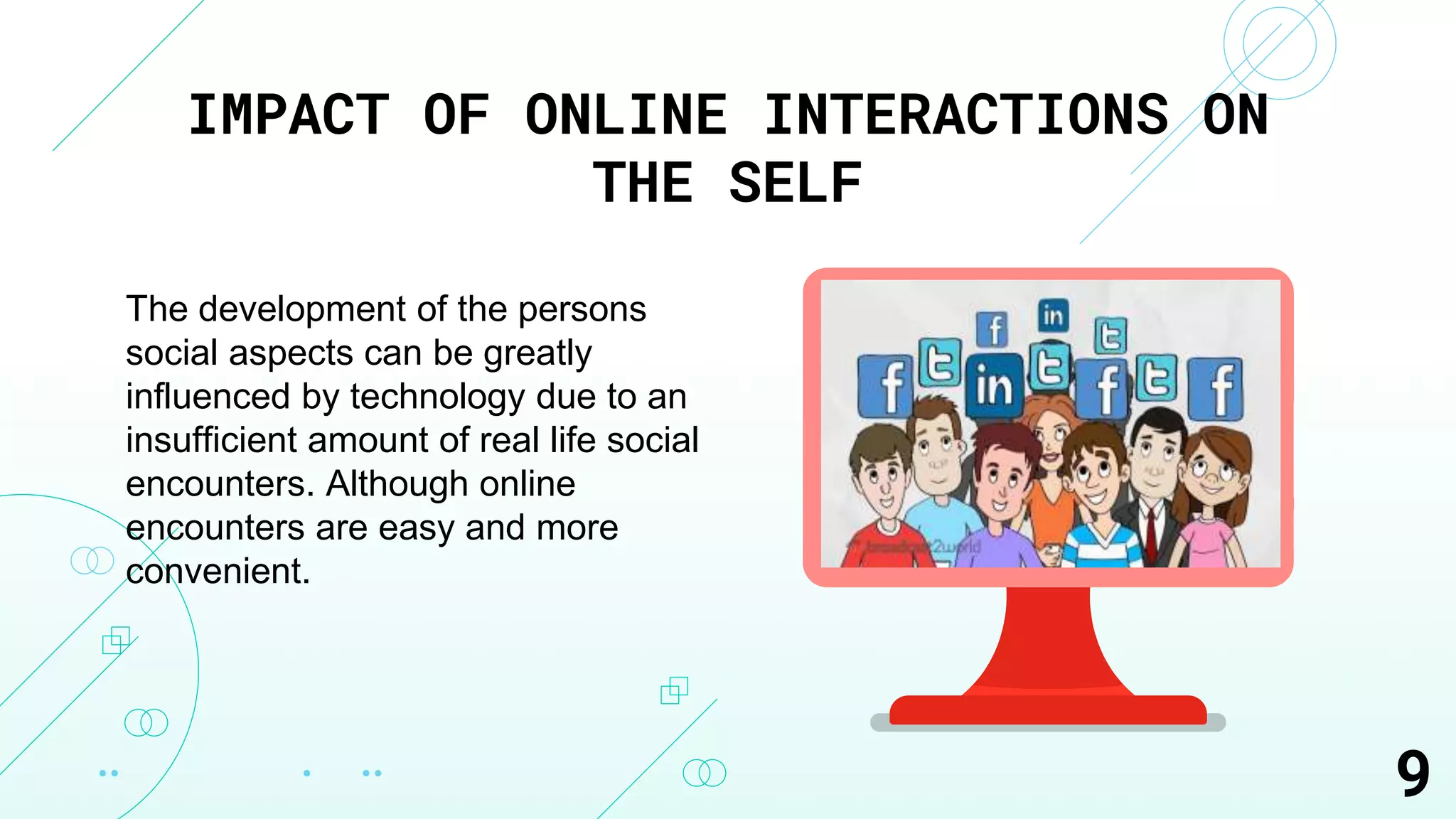
The development of the persons
social aspects can be greatly
influenced by technology due to an
insufficient amount of real life social
encounters. Although online
encounters are easy and more
convenient.
9
POSITIVE IMPACT OF SOCIAL MEDIA &
ONLINE INTERACTION ON THE SELF
● Social media sites inform and empower individuals to change themselves
and their communities.
● Increased self esteem when receiving many likes and shares.
NEGATIVE IMPACT OF SOCIAL MEDIA &
ONLINE INTERACTION ON THE SELF
● Extensive online engagement is correlated with personality and brain
disorders.
● Low self esteem due to risk of being exposed to cyber bullying and cyber
pornography.
10
BOUNDARIES OF THE SELF ONLINE
Personal boundaries are the set
of guidelines, rules or limits that a
person to creates identify
reasonable, safe and permissible
ways for people to behave towards
them and how they respond in
case someone breaks these rules
or overstep the limits.
11
SETTING BOUNDARIES TO ONLINE SELF
12
• Stick to safer sites.
• Guard your passwords.
• Be choosy about online friends.
• Remember that anything you put online or post on a site is there
forever, even if you try to delete it.
• Don't be mean or embarrass other people online.
• Limit what you share.
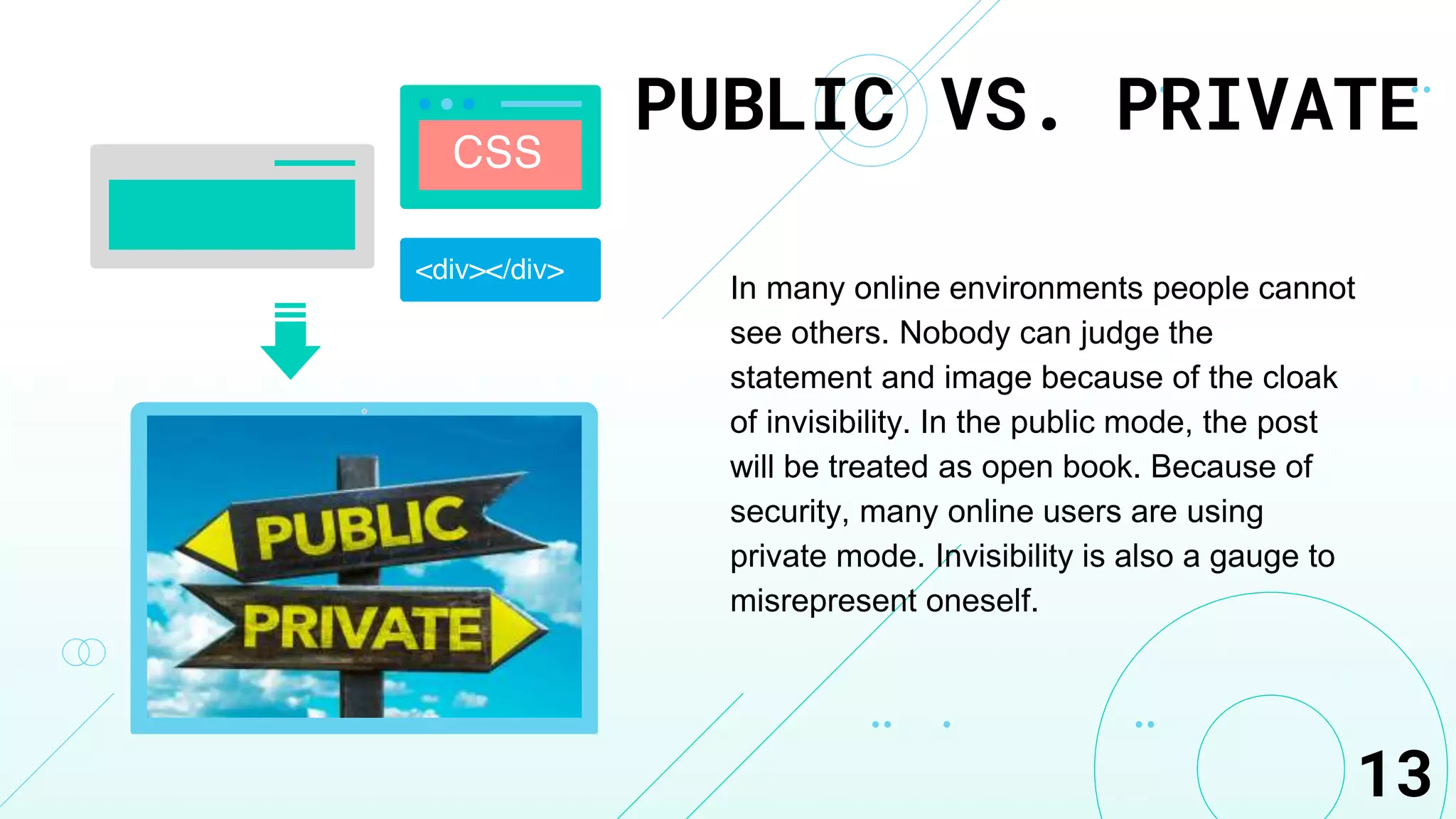
PUBLIC VS. PRIVATE
In many online environments people cannot
see others. Nobody can judge the
statement and image because of the cloak
of invisibility. In the public mode, the post
will be treated as open book. Because of
security, many online users are using
private mode. Invisibility is also a gauge to
misrepresent oneself.
13
PERSONAL/INDIVIDUAL VS. SOCIAL
IDENTITY ONLINE
Identity is made up of both personal
identity and social identity. Social
identity is usually based on group
affiliation. Like in social media many
people identify themselves as
member of certain group so that it will
be easy for them to communicate
their concerns or issues.
14
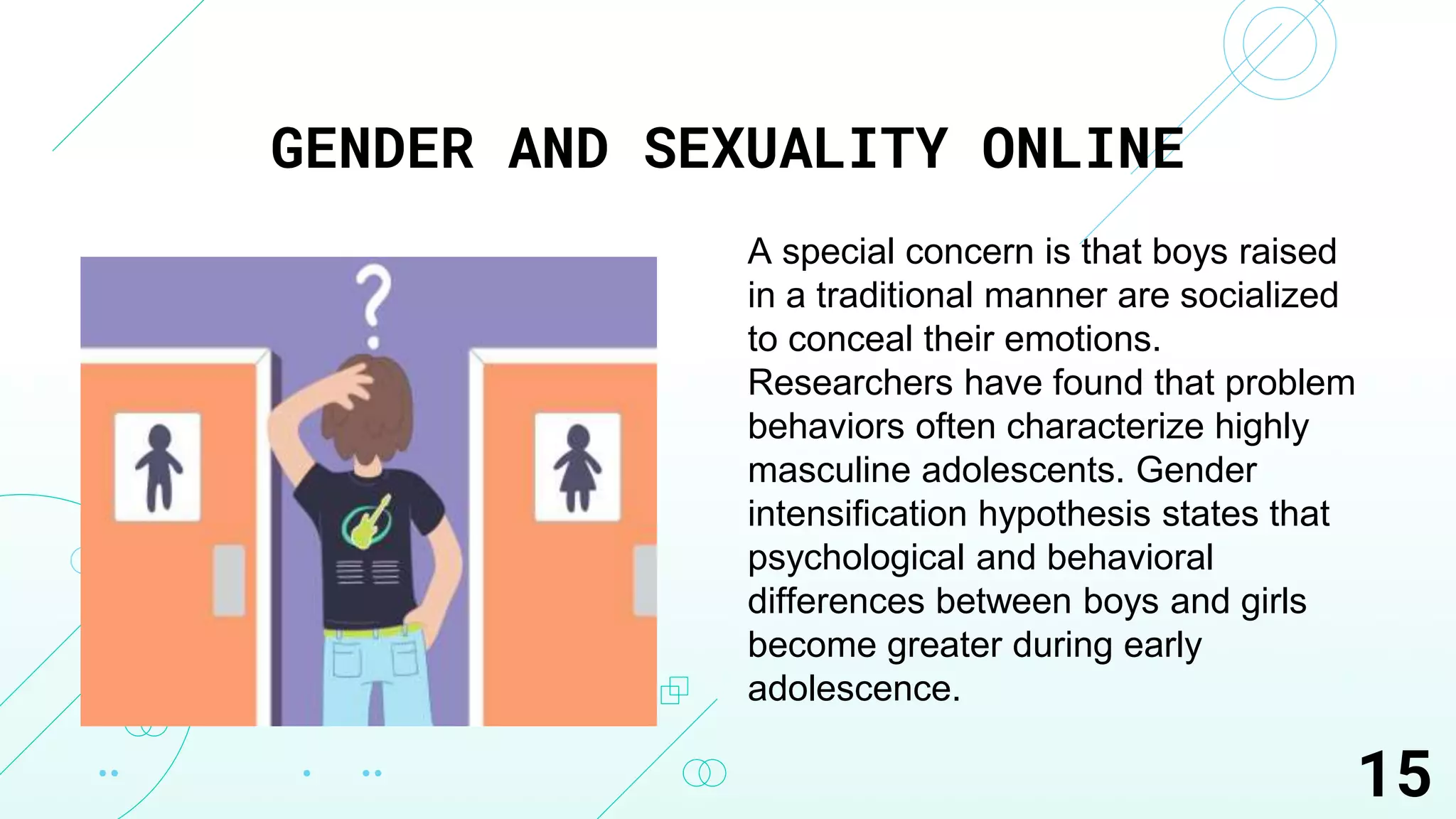
GENDER AND SEXUALITY ONLINE
A special concern is that boys raised
in a traditional manner are socialized
to conceal their emotions.
Researchers have found that problem
behaviors often characterize highly
masculine adolescents. Gender
intensification hypothesis states that
psychological and behavioral
differences between boys and girls
become greater during early
adolescence.
15
THANK YOU FOR
LISTENING!

Digital Self

  • 1.
  • 2.
    TABLE OF CONTENTS Here’swhat you’ll find in this topic: • Digital Self • What Statistics Say • Self and Other Cyberspace • Two Categories of Online Disinhibition • Managing Disinhibition • I, Me, Myself and my user ID Online Identity • Self Presentation Strategies and Impression Management • Impact of Online Interactions on the Self • Boundaries of the Self Online • Private vs. Public • Personal Individual vs. Social Identity Online • Gender and Sexuality Online 1
  • 3.
    DIGITAL SELF The digitalself is the persona you use when you’re online. Some people maintain one or more online identifies that are distinct from their “real world” selves. 2
  • 4.
    What Statistics Say? According tothe article Medinilla (2016), the Philippines is the fastest - growing market of smartphones in the Association of Southeast Asia Nations (ASEAN), based on the report of a market research company. 3
  • 5.
    SELF AND OTHERCYBERSPACE Cyberspace Digital Literacy refers to the virtual computer world, and more specifically, an electronic medium that is used to facilitate online communication. means having the skills you need to live, learn, and work in a society where communication and access to information. Online Disinhibition Is the lack of restraint one feels when communicating online in comparison to communicating in person. 4
  • 6.
    TWO CATEGORIES OFONLINE DISINHIBITION We’re more likely to open up, show vulnerability, and share our deepest fears. We help others, and we give willingly to donates on sites like Red Cross. Benign Disinhibition Toxic Disinhibition We’re more likely to harass, abuse, and threaten others when we can’t see their face. We indulge our darkest desires. We hurt people because it’s easy. 5
  • 7.
    Digital identity orOnline Identity is a social identity that an Internet user establishes in online communities and websites. It can also be considered as an actively constructed presentation of oneself. I, ME, MYSELF AND MY USER ID ONLINE IDENTITY A User ID is a unique identifier, commonly used to log on to a website, app, or online service. It may be a username, account number, or email address. 6
  • 8.
    HOW DO YOUBUILD YOUR ONLINE IDENTITY ONLINE • Every websites that you interact with will collect its own version of who you are, based on the information that you have shared. • It is up to you how will you represent yourself closely as who you are and what you do in real life. • To create representation far from your real life. 7
  • 9.
    SELF PRESENTATION STRATEGIESAND IMPRESSION MANAGEMENT 1. Self - Promotion - refers to the practice of purposefully trying to present oneself as highly competent to other people. 2. Ingratiation - refers to behaviors that a person illicitly enacts to make others like him or her or think well of his or her qualities as a person. 3. Exemplification - is defined as a strategic self presentational strategy whereby an individual attempts to project an image of integrity and moral worthiness. 4. Intimidation - is intentional behavior that would cause a person of ordinary sensibilities to fear injury or harm. 5. Supplication - strategy for self - presentation that involves depicting oneself as weak, needy, or dependent so as to motivate others to provide assistance or care. 8
  • 10.
    IMPACT OF ONLINEINTERACTIONS ON THE SELF The development of the persons social aspects can be greatly influenced by technology due to an insufficient amount of real life social encounters. Although online encounters are easy and more convenient. 9
  • 11.
    POSITIVE IMPACT OFSOCIAL MEDIA & ONLINE INTERACTION ON THE SELF ● Social media sites inform and empower individuals to change themselves and their communities. ● Increased self esteem when receiving many likes and shares. NEGATIVE IMPACT OF SOCIAL MEDIA & ONLINE INTERACTION ON THE SELF ● Extensive online engagement is correlated with personality and brain disorders. ● Low self esteem due to risk of being exposed to cyber bullying and cyber pornography. 10
  • 12.
    BOUNDARIES OF THESELF ONLINE Personal boundaries are the set of guidelines, rules or limits that a person to creates identify reasonable, safe and permissible ways for people to behave towards them and how they respond in case someone breaks these rules or overstep the limits. 11
  • 13.
    SETTING BOUNDARIES TOONLINE SELF 12 • Stick to safer sites. • Guard your passwords. • Be choosy about online friends. • Remember that anything you put online or post on a site is there forever, even if you try to delete it. • Don't be mean or embarrass other people online. • Limit what you share.
  • 14.
    PUBLIC VS. PRIVATE Inmany online environments people cannot see others. Nobody can judge the statement and image because of the cloak of invisibility. In the public mode, the post will be treated as open book. Because of security, many online users are using private mode. Invisibility is also a gauge to misrepresent oneself. 13
  • 15.
    PERSONAL/INDIVIDUAL VS. SOCIAL IDENTITYONLINE Identity is made up of both personal identity and social identity. Social identity is usually based on group affiliation. Like in social media many people identify themselves as member of certain group so that it will be easy for them to communicate their concerns or issues. 14
  • 16.
    GENDER AND SEXUALITYONLINE A special concern is that boys raised in a traditional manner are socialized to conceal their emotions. Researchers have found that problem behaviors often characterize highly masculine adolescents. Gender intensification hypothesis states that psychological and behavioral differences between boys and girls become greater during early adolescence. 15
  • 17.