Knowledge Mobilization:
“So what is it you do for a living?”
                                     Shawna Reibling,
                 Knowledge mobilization coordinator,
        College of Social and Applied Human Sciences
                                        Feb 28, 2012
      sreiblin@uoguelph.ca x53714 @ICESGuelph


                                         www.theresearchshop.ca
Outline:
  •What is it? Where did it come from?
  •Why do it?
  •Why me?
  •Examples
  •Your turn
  •Resources


                                www.theresearchshop.ca
What is knowledge mobilization?
• Knowledge mobilization (KMb) is a broad and
  encompassing term that includes the
  products, processes and relationships among
  knowledge creators, users, and mediators (individuals
  or intermediary organizations that support
  knowledge brokering).
   http://www.theresearchshop.ca/sites/default/files/Hawkins%20CSAHS%20CE%20and%20KM%20definitions.pdf


• “Yet knowledge mobilization in action surely must be
  understood to be a circulation of multiple meanings and
  responsibilities, in multiple directions—not just for diverse
  users, but also for the knowledge producers.” Fenwick, T. (2008). Considering
   ‘Knowledge Mobilization’ in Educational Research: What knowledge, what mobilities, what responsibilities? Educational Insights, 12(2).
   www.ccfi.educ.ubc.ca/publication/insights/v12n02/articles/fenwick/index.html


                                                                                                               www.theresearchshop.ca
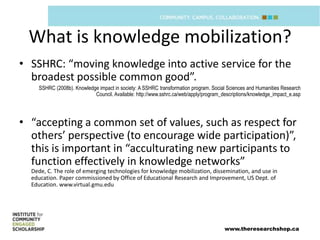
What is knowledge mobilization?
• SSHRC: “moving knowledge into active service for the
  broadest possible common good”.
     SSHRC (2008b). Knowledge impact in society: A SSHRC transformation program. Social Sciences and Humanities Research
                            Council. Available: http://www.sshrc.ca/web/apply/program_descriptions/knowledge_impact_e.asp


• “accepting a common set of values, such as respect for
  others’ perspective (to encourage wide participation)”,
  this is important in “acculturating new participants to
  function effectively in knowledge networks”
  Dede, C. The role of emerging technologies for knowledge mobilization, dissemination, and use in
  education. Paper commissioned by Office of Educational Research and Improvement, US Dept. of
  Education. www.virtual.gmu.edu


                                                                                       www.theresearchshop.ca
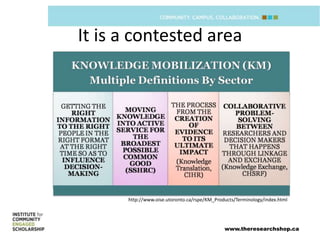
It is a contested area


      http://www.oise.utoronto.ca/rspe/KM_Products/Terminology/index.html


                                              www.theresearchshop.ca
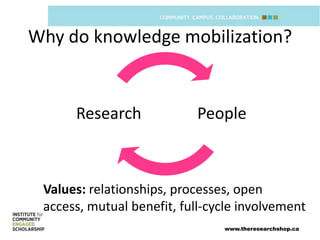
Why do knowledge mobilization?


      Research             People


 Values: relationships, processes, open
 access, mutual benefit, full-cycle involvement
                                www.theresearchshop.ca
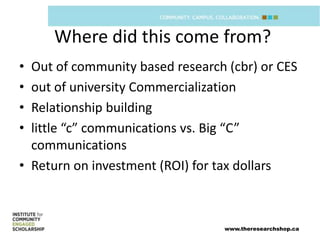
Where did this come from?
• Out of community based research (cbr) or CES
• out of university Commercialization
• Relationship building
• little “c” communications vs. Big “C”
  communications
• Return on investment (ROI) for tax dollars


                                 www.theresearchshop.ca
Why am I doing knowledge mobilization?
    -Got bored doing lab work
    -Process person
    -Degrees in communication (big and little)
    -community involvement
    - use a/v skills
    -Networks are important
    -Measuring 'High Tech' Social Capital in the Biotechnology
    Sector Located in Vancouver, British Columbia
                                http://summit.sfu.ca/item/10238


  More stories at: http://researchimpact.wordpress.com/category/meet-a-mobilizer/


                                                                  www.theresearchshop.ca
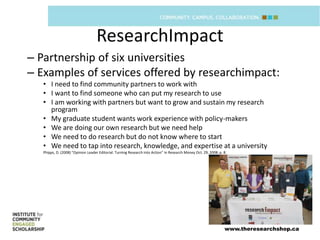
ResearchImpact
– Partnership of six universities
– Examples of services offered by researchimpact:
   • I need to find community partners to work with
   • I want to find someone who can put my research to use
   • I am working with partners but want to grow and sustain my research
     program
   • My graduate student wants work experience with policy-makers
   • We are doing our own research but we need help
   • We need to do research but do not know where to start
   • We need to tap into research, knowledge, and expertise at a university
   Phipps, D. (2008) “Opinion Leader Editorial: Turning Research into Action” in Research Money Oct. 29, 2008: p. 8.


                                                                                                                  www.theresearchshop.ca
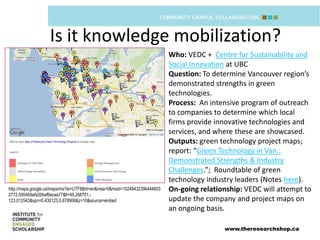
Is it knowledge mobilization?
                                                                           Who: VEDC + Centre for Sustainability and
                                                                           Social Innovation at UBC
                                                                           Question: To determine Vancouver region’s
                                                                           demonstrated strengths in green
                                                                           technologies.
                                                                           Process: An intensive program of outreach
                                                                           to companies to determine which local
                                                                           firms provide innovative technologies and
                                                                           services, and where these are showcased.
                                                                           Outputs: green technology project maps;
                                                                           report: “Green Technology in Van.:
                                                                           Demonstrated Strengths & Industry
                                                                           Challenges.”; Roundtable of green
                                                                           technology industry leaders (Notes here).
http://maps.google.ca/maps/ms?ie=UTF8&hl=en&msa=0&msid=10249432396444653   On-going relationship: VEDC will attempt to
2772.000469afa20bef6ecea77&ll=49.268701,-
123.012543&spn=0.430123,0.878906&z=10&source=embed                         update the company and project maps on
                                                                           an ongoing basis.

                                                                                           www.theresearchshop.ca
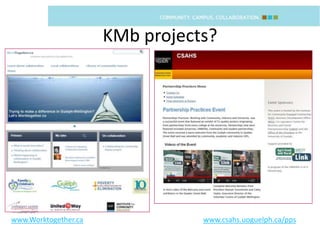
KMb projects?


www.Worktogether.ca              www.csahs.uoguelph.ca/pps
                                      www.theresearchshop.ca
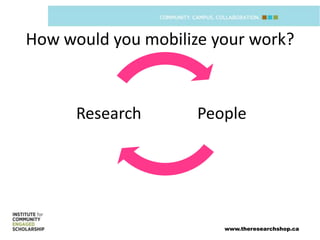
How would you mobilize your work?


      Research       People


                        www.theresearchshop.ca
Resources (Your Supervisor asks why)
• SSHRC: “Knowledge mobilization is a core priority for
  SSHRC…aimed at facilitating and enabling the
  mobilization of knowledge to various sectors of society
  to inform discussion, and enhance understanding and
  decision-making”. www.sshrc.ca/web/apply/program_descriptions/mbf_public_outreach_e.asp
• Academic book: Nutley, Sandra M. (2007). Using
  evidence: how research can inform public services.
  Policy Press. ISBN 978-1861346643.
• A big long annotated bibliography:
  www.oise.utoronto.ca/rspe/KM_Products/Annotated_
  Bibliography


                                                                 www.theresearchshop.ca
More Resources
• Case studies, SSHRC examples: Bennet, A and Bennet, D., With
  Katherine Fafard, Marc Fonda, Ted Lomond, Laurent Messier and
  Nicole Vaugeois. Knowledge Mobilization in the Social Sciences and
  Humanities: Moving from Research to Action, In cooperation with
  The Social Sciences and Humanities Research Council of Canada
  (SSHRC). Accessed at: http://www.mountainquestinstitute.com/
  knowledge_mobilization.htm
• Some of the theory behind it: Levin, B. (2008). Thinking About
  Knowledge Mobilization Paper prepared for an invitational
  symposium sponsored CCL and SSHRC May 15-18, 2008
• Defining our terms:
  http://www.theresearchshop.ca/sites/default/files/Hawkins%20CS
  AHS%20CE%20and%20KM%20definitions.pdf


                                                  www.theresearchshop.ca
Knowledge mobilization orgs.
• http://www.researchimpact.ca
• http://www.knowledgemobilization.net
• http://www.theresearchshop.ca
•


                                www.theresearchshop.ca

Kmb for students 22 feb12

  • 1.
    Knowledge Mobilization: “So whatis it you do for a living?” Shawna Reibling, Knowledge mobilization coordinator, College of Social and Applied Human Sciences Feb 28, 2012 sreiblin@uoguelph.ca x53714 @ICESGuelph www.theresearchshop.ca
  • 2.
    Outline: •Whatis it? Where did it come from? •Why do it? •Why me? •Examples •Your turn •Resources www.theresearchshop.ca
  • 3.
    What is knowledgemobilization? • Knowledge mobilization (KMb) is a broad and encompassing term that includes the products, processes and relationships among knowledge creators, users, and mediators (individuals or intermediary organizations that support knowledge brokering). http://www.theresearchshop.ca/sites/default/files/Hawkins%20CSAHS%20CE%20and%20KM%20definitions.pdf • “Yet knowledge mobilization in action surely must be understood to be a circulation of multiple meanings and responsibilities, in multiple directions—not just for diverse users, but also for the knowledge producers.” Fenwick, T. (2008). Considering ‘Knowledge Mobilization’ in Educational Research: What knowledge, what mobilities, what responsibilities? Educational Insights, 12(2). www.ccfi.educ.ubc.ca/publication/insights/v12n02/articles/fenwick/index.html www.theresearchshop.ca
  • 4.
    What is knowledgemobilization? • SSHRC: “moving knowledge into active service for the broadest possible common good”. SSHRC (2008b). Knowledge impact in society: A SSHRC transformation program. Social Sciences and Humanities Research Council. Available: http://www.sshrc.ca/web/apply/program_descriptions/knowledge_impact_e.asp • “accepting a common set of values, such as respect for others’ perspective (to encourage wide participation)”, this is important in “acculturating new participants to function effectively in knowledge networks” Dede, C. The role of emerging technologies for knowledge mobilization, dissemination, and use in education. Paper commissioned by Office of Educational Research and Improvement, US Dept. of Education. www.virtual.gmu.edu www.theresearchshop.ca
  • 5.
    It is acontested area http://www.oise.utoronto.ca/rspe/KM_Products/Terminology/index.html www.theresearchshop.ca
  • 6.
    Why do knowledgemobilization? Research People Values: relationships, processes, open access, mutual benefit, full-cycle involvement www.theresearchshop.ca
  • 7.
    Where did thiscome from? • Out of community based research (cbr) or CES • out of university Commercialization • Relationship building • little “c” communications vs. Big “C” communications • Return on investment (ROI) for tax dollars www.theresearchshop.ca
  • 8.
    Why am Idoing knowledge mobilization? -Got bored doing lab work -Process person -Degrees in communication (big and little) -community involvement - use a/v skills -Networks are important -Measuring 'High Tech' Social Capital in the Biotechnology Sector Located in Vancouver, British Columbia http://summit.sfu.ca/item/10238 More stories at: http://researchimpact.wordpress.com/category/meet-a-mobilizer/ www.theresearchshop.ca
  • 9.
    ResearchImpact – Partnership ofsix universities – Examples of services offered by researchimpact: • I need to find community partners to work with • I want to find someone who can put my research to use • I am working with partners but want to grow and sustain my research program • My graduate student wants work experience with policy-makers • We are doing our own research but we need help • We need to do research but do not know where to start • We need to tap into research, knowledge, and expertise at a university Phipps, D. (2008) “Opinion Leader Editorial: Turning Research into Action” in Research Money Oct. 29, 2008: p. 8. www.theresearchshop.ca
  • 10.
    Is it knowledgemobilization? Who: VEDC + Centre for Sustainability and Social Innovation at UBC Question: To determine Vancouver region’s demonstrated strengths in green technologies. Process: An intensive program of outreach to companies to determine which local firms provide innovative technologies and services, and where these are showcased. Outputs: green technology project maps; report: “Green Technology in Van.: Demonstrated Strengths & Industry Challenges.”; Roundtable of green technology industry leaders (Notes here). http://maps.google.ca/maps/ms?ie=UTF8&hl=en&msa=0&msid=10249432396444653 On-going relationship: VEDC will attempt to 2772.000469afa20bef6ecea77&ll=49.268701,- 123.012543&spn=0.430123,0.878906&z=10&source=embed update the company and project maps on an ongoing basis. www.theresearchshop.ca
  • 11.
    KMb projects? www.Worktogether.ca www.csahs.uoguelph.ca/pps www.theresearchshop.ca
  • 12.
    How would youmobilize your work? Research People www.theresearchshop.ca
  • 13.
    Resources (Your Supervisorasks why) • SSHRC: “Knowledge mobilization is a core priority for SSHRC…aimed at facilitating and enabling the mobilization of knowledge to various sectors of society to inform discussion, and enhance understanding and decision-making”. www.sshrc.ca/web/apply/program_descriptions/mbf_public_outreach_e.asp • Academic book: Nutley, Sandra M. (2007). Using evidence: how research can inform public services. Policy Press. ISBN 978-1861346643. • A big long annotated bibliography: www.oise.utoronto.ca/rspe/KM_Products/Annotated_ Bibliography www.theresearchshop.ca
  • 14.
    More Resources • Casestudies, SSHRC examples: Bennet, A and Bennet, D., With Katherine Fafard, Marc Fonda, Ted Lomond, Laurent Messier and Nicole Vaugeois. Knowledge Mobilization in the Social Sciences and Humanities: Moving from Research to Action, In cooperation with The Social Sciences and Humanities Research Council of Canada (SSHRC). Accessed at: http://www.mountainquestinstitute.com/ knowledge_mobilization.htm • Some of the theory behind it: Levin, B. (2008). Thinking About Knowledge Mobilization Paper prepared for an invitational symposium sponsored CCL and SSHRC May 15-18, 2008 • Defining our terms: http://www.theresearchshop.ca/sites/default/files/Hawkins%20CS AHS%20CE%20and%20KM%20definitions.pdf www.theresearchshop.ca
  • 15.
    Knowledge mobilization orgs. •http://www.researchimpact.ca • http://www.knowledgemobilization.net • http://www.theresearchshop.ca • www.theresearchshop.ca

Editor's Notes

  • #10 Goal-oriented people work steadily until they achieve their goal. Their motivation is the finished product. Their sense of satisfaction lies in a well-done, finished product. Goal-oriented people tend to work quickly, sometimes to the detriment of the finished product. Process-oriented people are motivated by the process of a project. They are interested in the planning and development. They receive their satisfaction in the work itself, and the completed process is secondary to the process. Process-oriented people sometimes have trouble finishing a project. By the time they near the end, the process is winding down, and their motivation and interest are lost.I learned this in terms of teaching. Most academics are process-oriented people (hence the reason so many take so long to finish their PhDs). Unfortunately, most students are goal-oriented people (hence the reason they ask questions like “Will this be on the test?”) . Understanding and working with these differing orientations can help lower frustration for both teachers and students.