Knowledge
mobilization 101
Shawna Reibling, Knowledge Mobilization Officer
Email: sreibling@wlu.ca Twitter: @MobilizeShawna
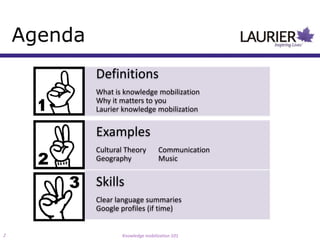
Agenda
             Definitions
             What is knowledge mobilization
             Why it matters to you
             Laurier knowledge mobilization


             Examples
             Cultural Theory        Communication
             Geography              Music


             Skills
             Clear language summaries
             Google profiles (if time)


2                   Knowledge mobilization 101
Agenda


                         Definitions
                         What is knowledge mobilization
                         Why it matters to you
                         Laurier knowledge mobilization


3            Knowledge mobilization 101
What is “kmb”?

     KM or KMb (SSHRC)
     Knowledge translation (CIHR),
     Knowledge exchange (CHSRF)
     Knowledge transfer partnerships (UK)
     Knowledge dissemination (MSFHR)
     „Tech transfer‟(S.T.E.M. disciplines)
     Extension (agriculture)


4                        Knowledge mobilization 101
Types of “kmb”

     “End of Grant” KMb: (curiosity-driven research):
     The researcher develops and implements a plan for making
     knowledge users aware of the knowledge generated.

     “Integrated” KMb (problem-based research):
     The researcher engages potential knowledge users as
     partners in the research process. Requires a colaborative
     or participatory approach to research that is action oriented
     and is solutions and impact focused.


5                         Knowledge mobilization 101
What is “kmb”?

    “…knowledge mobilization…[is] a circulation of multiple
    meanings and responsibilities, in multiple directions - not just
    for diverse users, but also for the knowledge producers.”

    Fenwick, T. (2008). Considering ‘Knowledge Mobilization’ in Educational Research: What knowledge, what mobilizes, what responsibilities? Educational
    Insights, 12(2). www.ccfi.educ.ubc.ca/publication/insights/v12n02/articles/fenwick/index.html


6                                                          Knowledge mobilization 101
What is “kmb”?
    The process of “moving knowledge into active service for
    the broadest possible common good”


                               People


                            Research

7                         Knowledge mobilization 101
Where did kmb come from?
    •   Community based research (CBR)
    •   Community engaged scholarship (CES)
    •   Action research/Practioner research
    •   University commercialization
    •   Relationship building
    •   little “c” communications and Big “C” communications
    •   Return on investment (ROI) for tax dollars


8                          Knowledge mobilization 101
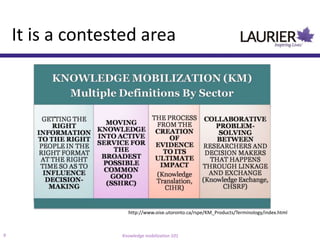
It is a contested area


                    http://www.oise.utoronto.ca/rspe/KM_Products/Terminology/index.html


9                 Knowledge mobilization 101
Why kmb matters

      •   $$$
      •   Shared desire to solve problems
      •   Publish research results more widely
      •   Promotion/demonstrating its value
      •   Strengthening scholarship
      •   Establishing relationships before grant opportunities
      •   Innovation


10                         Knowledge mobilization 101
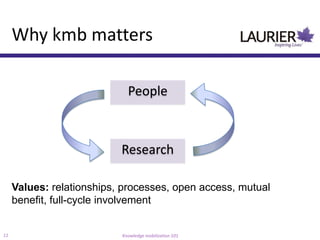
Why kmb matters

                             People


                           Research

     Values: relationships, processes, open access, mutual
     benefit, full-cycle involvement


11                         Knowledge mobilization 101
KMb products
     •   Face-to-Face Meetings     •   Dinner
     •   Reports                   •   Presentation
     •   Focus groups              •   Panel presentation
     •   Toolkits                  •   Opinion piece
     •   Models                    •   Interview (tv, radio, written)
     •   Procedures                •   One pager
     •   Website content           •   Clear language summary
     •   Online tool               •   Journal publication, book, chapter
     •   Policy brief              •   Open access publication
     •   Meeting                   •   Conference presentation, keynote
     •   Video                     •   Professional organization publication
     •   Audio lecture             •   Textbook
     •   Community work            •   Testifying as an expert
     •   Advisory committee        •   Lay presentation
     •   Networking event          •   Webinar
     •   Tweets, blog              •   Etc.

12                               Knowledge mobilization 101
Open Access
     Open access (OA) is the practice of providing unrestricted access
     via the Internet to peer-reviewed scholarly journal articles.

     • Green: authors publish in any journal and then self-archive a
       version of the article for free public use in their institutional
       repository.
     • Gold: authors publish in an open access journal that provides
       immediate OA to all of its articles on the publisher's website.

     • Hybrid: provide Gold OA only for those individual articles for
       which their authors (or their author's institution or funder) pay
       an OA publishing fee
13                             Knowledge mobilization 101
Open Access
     Tri-Council Resources:          Tools for faculty:
     • Tri-Council Guiding           • Using the SPARC Canadian Author
        Principles                     Addendum to secure your author
     • Research Data Archiving         rights.
        Policy                       • Greater Reach for Your Research :
     • SSHRC: Open Access              Expanding Readership through
     • CIHR: Access to                 Digital Repositories
        Research Outputs             • What is a journal’s copyright
                                       policy? Here or here


14                          Knowledge mobilization 101
Laurier services

      • Dissemination of faculty research to the broader public,
        through materials, events and social media
      • Brokering research partnerships between community
        members and university researchers
      • Assisting faculty with knowledge mobilization strategies
        for grants and research programs
      • Clear language assistance
      • Faculty consulting
      • Social media and other capacity building
      • More….

15                        Knowledge mobilization 101
Laurier services
      Next offering:
      http://laurierknowledgemobilization101.eventbrite.ca/


                         Contact:
                         Email: sreibling@wlu.ca
                         Twitter:@MobilizeShawna


16                         Knowledge mobilization 101
Research Facilitators

           Barry Ries, Social Sciences and Humanities
           Ph:519.884.0710 x3479                  E:bries@wlu.ca


           Charity Parr-Vasquez, Natural Sciences
           Ph:519.884.1970 x4662                  E:cparrvasquez@wlu.ca


           Susan Dimitry, Laurier Brantford
           Ph:519.884.0710 x5564                  E:sdimitry@wlu.ca


17                   Knowledge mobilization 101
Agenda


                          Examples
                          Cultural Theory   Communication
                          Geography         Music


18            Knowledge mobilization 101
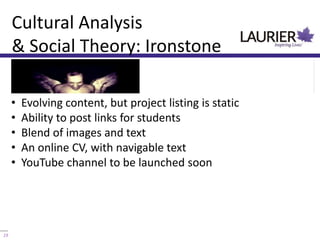
Cultural Analysis
     & Social Theory: Ironstone

     •   Evolving content, but project listing is static
     •   Ability to post links for students
     •   Blend of images and text
     •   An online CV, with navigable text
     •   YouTube channel to be launched soon


19                            Knowledge mobilization 101
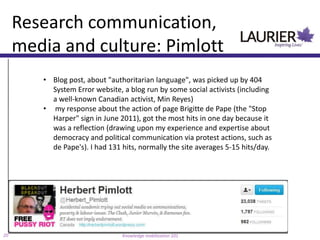
Research communication,
     media and culture: Pimlott
        • Blog post, about "authoritarian language", was picked up by 404
          System Error website, a blog run by some social activists (including
          a well-known Canadian activist, Min Reyes)
        • my response about the action of page Brigitte de Pape (the "Stop
          Harper" sign in June 2011), got the most hits in one day because it
          was a reflection (drawing upon my experience and expertise about
          democracy and political communication via protest actions, such as
          de Pape's). I had 131 hits, normally the site averages 5-15 hits/day.


20                              Knowledge mobilization 101
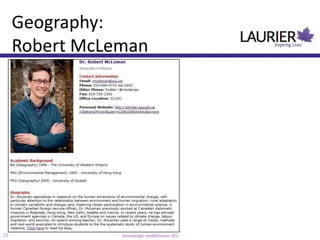
Geography:
     Robert McLeman


21              Knowledge mobilization 101
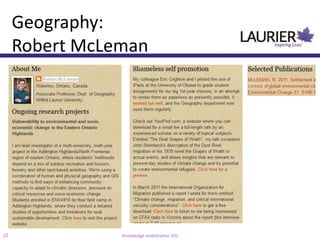
Geography:
     Robert McLeman


22              Knowledge mobilization 101
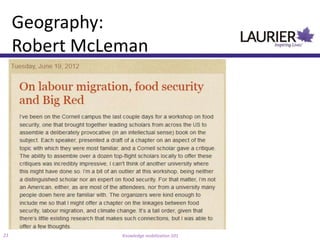
Geography:
     Robert McLeman


23              Knowledge mobilization 101
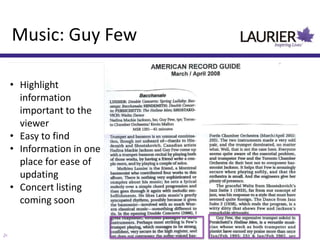
Music: Guy Few

     • Highlight
       information
       important to the
       viewer
     • Easy to find
     • Information in one
       place for ease of
       updating
     • Concert listing
       coming soon


24                          Knowledge mobilization 101
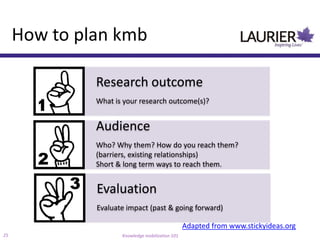
How to plan kmb

              Research outcome
              What is your research outcome(s)?


              Audience
              Who? Why them? How do you reach them?
              (barriers, existing relationships)
              Short & long term ways to reach them.


              Evaluation
              Evaluate impact (past & going forward)

                                                  Adapted from www.stickyideas.org
25                   Knowledge mobilization 101
Research outcome
     What is your research outcome(s)?


26          Knowledge mobilization 101
Audience
     Who? (Be specific) Why them?


27          Knowledge mobilization 101
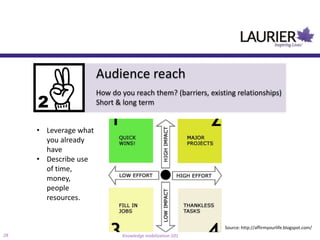
Audience reach
                       How do you reach them? (barriers, existing relationships)
                       Short & long term


     • Leverage what
       you already
       have
     • Describe use
       of time,
       money,
       people
       resources.


                                                              Source: http://affirmyourlife.blogspot.com/
28                             Knowledge mobilization 101
Evaluation
     Evaluate impact (past & going forward)
     Don’t wait till the end to evaluate


29          Knowledge mobilization 101
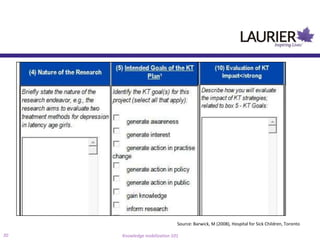
Evaluation
     Evaluate impact (past & going forward)
     Don’t wait till the end to evaluate


                                     Source: Barwick, M (2008), Hospital for Sick Children, Toronto

30          Knowledge mobilization 101
Agenda


                            Skills
                            Clear language
                            Google profiles


31            Knowledge mobilization 101
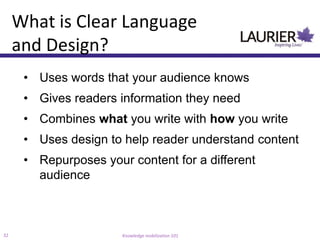
What is Clear Language
     and Design?
      • Uses words that your audience knows
      • Gives readers information they need
      • Combines what you write with how you write
      • Uses design to help reader understand content
      • Repurposes your content for a different
        audience


32                     Knowledge mobilization 101
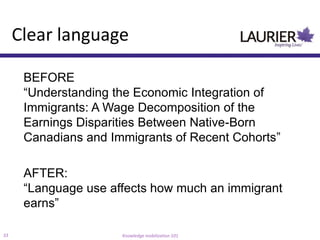
Clear language

      BEFORE
      “Understanding the Economic Integration of
      Immigrants: A Wage Decomposition of the
      Earnings Disparities Between Native-Born
      Canadians and Immigrants of Recent Cohorts”

      AFTER:
      “Language use affects how much an immigrant
      earns”

33                    Knowledge mobilization 101
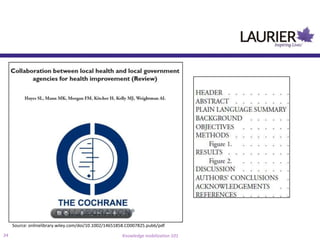
Source: onlinelibrary.wiley.com/doi/10.1002/14651858.CD007825.pub6/pdf

34                                                     Knowledge mobilization 101
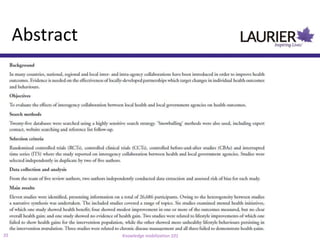
Abstract


     Source: onlinelibrary.wiley.com/doi/10.1002/14651858.CD007825.pub6/pdf


35                                                       Knowledge mobilization 101
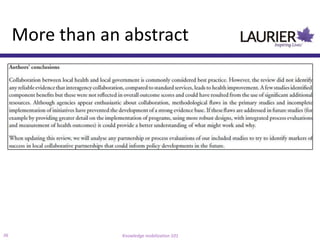
More than an abstract


36                Knowledge mobilization 101
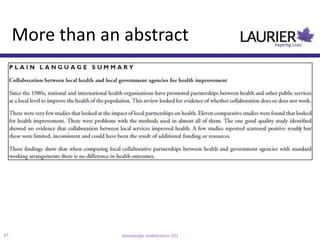
More than an abstract


37                Knowledge mobilization 101
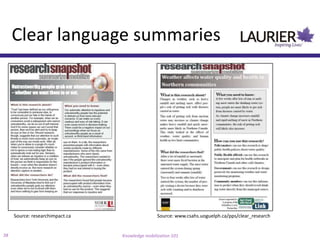
Clear language summaries


     Source: researchimpact.ca                   Source: www.csahs.uoguelph.ca/pps/clear_research


38                               Knowledge mobilization 101
Section titles
        • What is this research about?

        • What did the researchers do?

        • What you need to know?

        • What did the researchers find?

        • How can you use this research?

        • About the researcher

39                       Knowledge mobilization 101
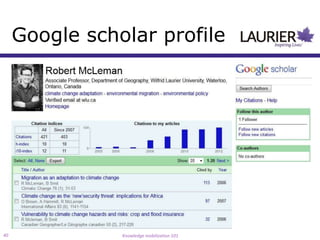
Google scholar profile


40              Knowledge mobilization 101
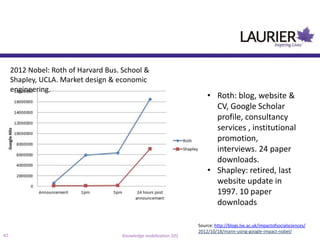
2012 Nobel: Roth of Harvard Bus. School &
     Shapley, UCLA. Market design & economic
     engineering.
                                                                       • Roth: blog, website &
                                                                         CV, Google Scholar
                                                                         profile, consultancy
                                                                         services , institutional
                                                                         promotion,
                                                                         interviews. 24 paper
                                                                         downloads.
                                                                       • Shapley: retired, last
                                                                         website update in
                                                                         1997. 10 paper
                                                                         downloads

                                                                   Source: http://blogs.lse.ac.uk/impactofsocialsciences/
                                                                   2012/10/18/mann-using-google-impact-nobel/
41                                    Knowledge mobilization 101
Google Scholar Profile


                                   create a public Scholar profile


     Google analyzes your articles (as identified in your Scholar profile), scan the entire web
     looking for new articles relevant to your research, and then show you the most
     relevant articles when you visit Scholar.

42                                    Knowledge mobilization 101
Follow Up
      Evaluation (using fluidsurveys.com): http://bit.ly/T3ki4k
      Next offering:
      http://laurierknowledgemobilization101.eventbrite.ca/


                         Contact:
                         Email: sreibling@wlu.ca
                         Twitter:@MobilizeShawna


43                         Knowledge mobilization 101
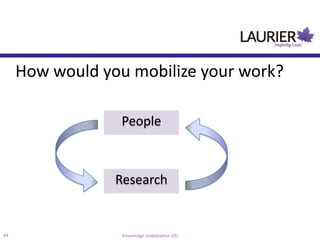
How would you mobilize your work?

                  People


                 Research


44                Knowledge mobilization 101

Kmb 101 19oct12 Reibling

  • 1.
    Knowledge mobilization 101 Shawna Reibling,Knowledge Mobilization Officer Email: sreibling@wlu.ca Twitter: @MobilizeShawna
  • 2.
    Agenda Definitions What is knowledge mobilization Why it matters to you Laurier knowledge mobilization Examples Cultural Theory Communication Geography Music Skills Clear language summaries Google profiles (if time) 2 Knowledge mobilization 101
  • 3.
    Agenda Definitions What is knowledge mobilization Why it matters to you Laurier knowledge mobilization 3 Knowledge mobilization 101
  • 4.
    What is “kmb”? KM or KMb (SSHRC) Knowledge translation (CIHR), Knowledge exchange (CHSRF) Knowledge transfer partnerships (UK) Knowledge dissemination (MSFHR) „Tech transfer‟(S.T.E.M. disciplines) Extension (agriculture) 4 Knowledge mobilization 101
  • 5.
    Types of “kmb” “End of Grant” KMb: (curiosity-driven research): The researcher develops and implements a plan for making knowledge users aware of the knowledge generated. “Integrated” KMb (problem-based research): The researcher engages potential knowledge users as partners in the research process. Requires a colaborative or participatory approach to research that is action oriented and is solutions and impact focused. 5 Knowledge mobilization 101
  • 6.
    What is “kmb”? “…knowledge mobilization…[is] a circulation of multiple meanings and responsibilities, in multiple directions - not just for diverse users, but also for the knowledge producers.” Fenwick, T. (2008). Considering ‘Knowledge Mobilization’ in Educational Research: What knowledge, what mobilizes, what responsibilities? Educational Insights, 12(2). www.ccfi.educ.ubc.ca/publication/insights/v12n02/articles/fenwick/index.html 6 Knowledge mobilization 101
  • 7.
    What is “kmb”? The process of “moving knowledge into active service for the broadest possible common good” People Research 7 Knowledge mobilization 101
  • 8.
    Where did kmbcome from? • Community based research (CBR) • Community engaged scholarship (CES) • Action research/Practioner research • University commercialization • Relationship building • little “c” communications and Big “C” communications • Return on investment (ROI) for tax dollars 8 Knowledge mobilization 101
  • 9.
    It is acontested area http://www.oise.utoronto.ca/rspe/KM_Products/Terminology/index.html 9 Knowledge mobilization 101
  • 10.
    Why kmb matters • $$$ • Shared desire to solve problems • Publish research results more widely • Promotion/demonstrating its value • Strengthening scholarship • Establishing relationships before grant opportunities • Innovation 10 Knowledge mobilization 101
  • 11.
    Why kmb matters People Research Values: relationships, processes, open access, mutual benefit, full-cycle involvement 11 Knowledge mobilization 101
  • 12.
    KMb products • Face-to-Face Meetings • Dinner • Reports • Presentation • Focus groups • Panel presentation • Toolkits • Opinion piece • Models • Interview (tv, radio, written) • Procedures • One pager • Website content • Clear language summary • Online tool • Journal publication, book, chapter • Policy brief • Open access publication • Meeting • Conference presentation, keynote • Video • Professional organization publication • Audio lecture • Textbook • Community work • Testifying as an expert • Advisory committee • Lay presentation • Networking event • Webinar • Tweets, blog • Etc. 12 Knowledge mobilization 101
  • 13.
    Open Access Open access (OA) is the practice of providing unrestricted access via the Internet to peer-reviewed scholarly journal articles. • Green: authors publish in any journal and then self-archive a version of the article for free public use in their institutional repository. • Gold: authors publish in an open access journal that provides immediate OA to all of its articles on the publisher's website. • Hybrid: provide Gold OA only for those individual articles for which their authors (or their author's institution or funder) pay an OA publishing fee 13 Knowledge mobilization 101
  • 14.
    Open Access Tri-Council Resources: Tools for faculty: • Tri-Council Guiding • Using the SPARC Canadian Author Principles Addendum to secure your author • Research Data Archiving rights. Policy • Greater Reach for Your Research : • SSHRC: Open Access Expanding Readership through • CIHR: Access to Digital Repositories Research Outputs • What is a journal’s copyright policy? Here or here 14 Knowledge mobilization 101
  • 15.
    Laurier services • Dissemination of faculty research to the broader public, through materials, events and social media • Brokering research partnerships between community members and university researchers • Assisting faculty with knowledge mobilization strategies for grants and research programs • Clear language assistance • Faculty consulting • Social media and other capacity building • More…. 15 Knowledge mobilization 101
  • 16.
    Laurier services Next offering: http://laurierknowledgemobilization101.eventbrite.ca/ Contact: Email: sreibling@wlu.ca Twitter:@MobilizeShawna 16 Knowledge mobilization 101
  • 17.
    Research Facilitators Barry Ries, Social Sciences and Humanities Ph:519.884.0710 x3479 E:bries@wlu.ca Charity Parr-Vasquez, Natural Sciences Ph:519.884.1970 x4662 E:cparrvasquez@wlu.ca Susan Dimitry, Laurier Brantford Ph:519.884.0710 x5564 E:sdimitry@wlu.ca 17 Knowledge mobilization 101
  • 18.
    Agenda Examples Cultural Theory Communication Geography Music 18 Knowledge mobilization 101
  • 19.
    Cultural Analysis & Social Theory: Ironstone • Evolving content, but project listing is static • Ability to post links for students • Blend of images and text • An online CV, with navigable text • YouTube channel to be launched soon 19 Knowledge mobilization 101
  • 20.
    Research communication, media and culture: Pimlott • Blog post, about "authoritarian language", was picked up by 404 System Error website, a blog run by some social activists (including a well-known Canadian activist, Min Reyes) • my response about the action of page Brigitte de Pape (the "Stop Harper" sign in June 2011), got the most hits in one day because it was a reflection (drawing upon my experience and expertise about democracy and political communication via protest actions, such as de Pape's). I had 131 hits, normally the site averages 5-15 hits/day. 20 Knowledge mobilization 101
  • 21.
    Geography: Robert McLeman 21 Knowledge mobilization 101
  • 22.
    Geography: Robert McLeman 22 Knowledge mobilization 101
  • 23.
    Geography: Robert McLeman 23 Knowledge mobilization 101
  • 24.
    Music: Guy Few • Highlight information important to the viewer • Easy to find • Information in one place for ease of updating • Concert listing coming soon 24 Knowledge mobilization 101
  • 25.
    How to plankmb Research outcome What is your research outcome(s)? Audience Who? Why them? How do you reach them? (barriers, existing relationships) Short & long term ways to reach them. Evaluation Evaluate impact (past & going forward) Adapted from www.stickyideas.org 25 Knowledge mobilization 101
  • 26.
    Research outcome What is your research outcome(s)? 26 Knowledge mobilization 101
  • 27.
    Audience Who? (Be specific) Why them? 27 Knowledge mobilization 101
  • 28.
    Audience reach How do you reach them? (barriers, existing relationships) Short & long term • Leverage what you already have • Describe use of time, money, people resources. Source: http://affirmyourlife.blogspot.com/ 28 Knowledge mobilization 101
  • 29.
    Evaluation Evaluate impact (past & going forward) Don’t wait till the end to evaluate 29 Knowledge mobilization 101
  • 30.
    Evaluation Evaluate impact (past & going forward) Don’t wait till the end to evaluate Source: Barwick, M (2008), Hospital for Sick Children, Toronto 30 Knowledge mobilization 101
  • 31.
    Agenda Skills Clear language Google profiles 31 Knowledge mobilization 101
  • 32.
    What is ClearLanguage and Design? • Uses words that your audience knows • Gives readers information they need • Combines what you write with how you write • Uses design to help reader understand content • Repurposes your content for a different audience 32 Knowledge mobilization 101
  • 33.
    Clear language BEFORE “Understanding the Economic Integration of Immigrants: A Wage Decomposition of the Earnings Disparities Between Native-Born Canadians and Immigrants of Recent Cohorts” AFTER: “Language use affects how much an immigrant earns” 33 Knowledge mobilization 101
  • 34.
  • 35.
    Abstract Source: onlinelibrary.wiley.com/doi/10.1002/14651858.CD007825.pub6/pdf 35 Knowledge mobilization 101
  • 36.
    More than anabstract 36 Knowledge mobilization 101
  • 37.
    More than anabstract 37 Knowledge mobilization 101
  • 38.
    Clear language summaries Source: researchimpact.ca Source: www.csahs.uoguelph.ca/pps/clear_research 38 Knowledge mobilization 101
  • 39.
    Section titles • What is this research about? • What did the researchers do? • What you need to know? • What did the researchers find? • How can you use this research? • About the researcher 39 Knowledge mobilization 101
  • 40.
    Google scholar profile 40 Knowledge mobilization 101
  • 41.
    2012 Nobel: Rothof Harvard Bus. School & Shapley, UCLA. Market design & economic engineering. • Roth: blog, website & CV, Google Scholar profile, consultancy services , institutional promotion, interviews. 24 paper downloads. • Shapley: retired, last website update in 1997. 10 paper downloads Source: http://blogs.lse.ac.uk/impactofsocialsciences/ 2012/10/18/mann-using-google-impact-nobel/ 41 Knowledge mobilization 101
  • 42.
    Google Scholar Profile create a public Scholar profile Google analyzes your articles (as identified in your Scholar profile), scan the entire web looking for new articles relevant to your research, and then show you the most relevant articles when you visit Scholar. 42 Knowledge mobilization 101
  • 43.
    Follow Up Evaluation (using fluidsurveys.com): http://bit.ly/T3ki4k Next offering: http://laurierknowledgemobilization101.eventbrite.ca/ Contact: Email: sreibling@wlu.ca Twitter:@MobilizeShawna 43 Knowledge mobilization 101
  • 44.
    How would youmobilize your work? People Research 44 Knowledge mobilization 101

Editor's Notes

  • #20 Websitewith project summaries and links for students
  • #21 Twitter and blogAt present, I teach and research communication, media and culture at Wilfrid Laurier University in Waterloo, Ontario, Canada. My research and teaching interests cover such areas as alternative media, union communications, journalism and dissent, media coverage of economic, labour and poverty issues, and political communication, particularly in Canada and the UK, as well as the USA.My interest in these areas is not strictly speaking, ‘academic’ (if you pardon the pun), but also practical. I have experience as a media professional in radio and TV (during the reign of ‘analogue’), as well as more recent experience running media relations workshops and providing communications advice for various social, environmental and economic justice organisations. I have also worked as a media relations officer and communications advisor to a faculty union and political riding association.I believe that there is much to be learned from bringing the two areas together.Of course, I am also interested in all aspects of post-secondary/higher education, from the conditions for faculty, both contract/contingent and permanent, students (quality and costs of their education), and support staff (who ensure faculty and students can do what they do best).Clearly, the views that I express are my own and do not reflect in any way the university (or the management of the university) which employs me (and which presumes to speak for the university, which is really a community of teachers, students, managers and support staff, but that is another issue).Please feel free to follow me, if you are so inclined, on twitter: @Herbert_Pimlott .Ps. If you are interested in a slightly longer or more detailed statement about my research and teaching interests, you can visit my official university webpage at: http://www.wlu.ca/homepage.php?grp_id=612&f_id=35.
  • #22 Twitter and blogAt present, I teach and research communication, media and culture at Wilfrid Laurier University in Waterloo, Ontario, Canada. My research and teaching interests cover such areas as alternative media, union communications, journalism and dissent, media coverage of economic, labour and poverty issues, and political communication, particularly in Canada and the UK, as well as the USA.My interest in these areas is not strictly speaking, ‘academic’ (if you pardon the pun), but also practical. I have experience as a media professional in radio and TV (during the reign of ‘analogue’), as well as more recent experience running media relations workshops and providing communications advice for various social, environmental and economic justice organisations. I have also worked as a media relations officer and communications advisor to a faculty union and political riding association.I believe that there is much to be learned from bringing the two areas together.Of course, I am also interested in all aspects of post-secondary/higher education, from the conditions for faculty, both contract/contingent and permanent, students (quality and costs of their education), and support staff (who ensure faculty and students can do what they do best).Clearly, the views that I express are my own and do not reflect in any way the university (or the management of the university) which employs me (and which presumes to speak for the university, which is really a community of teachers, students, managers and support staff, but that is another issue).Please feel free to follow me, if you are so inclined, on twitter: @Herbert_Pimlott .Ps. If you are interested in a slightly longer or more detailed statement about my research and teaching interests, you can visit my official university webpage at: http://www.wlu.ca/homepage.php?grp_id=612&f_id=35.
  • #23 Twitter and blogAt present, I teach and research communication, media and culture at Wilfrid Laurier University in Waterloo, Ontario, Canada. My research and teaching interests cover such areas as alternative media, union communications, journalism and dissent, media coverage of economic, labour and poverty issues, and political communication, particularly in Canada and the UK, as well as the USA.My interest in these areas is not strictly speaking, ‘academic’ (if you pardon the pun), but also practical. I have experience as a media professional in radio and TV (during the reign of ‘analogue’), as well as more recent experience running media relations workshops and providing communications advice for various social, environmental and economic justice organisations. I have also worked as a media relations officer and communications advisor to a faculty union and political riding association.I believe that there is much to be learned from bringing the two areas together.Of course, I am also interested in all aspects of post-secondary/higher education, from the conditions for faculty, both contract/contingent and permanent, students (quality and costs of their education), and support staff (who ensure faculty and students can do what they do best).Clearly, the views that I express are my own and do not reflect in any way the university (or the management of the university) which employs me (and which presumes to speak for the university, which is really a community of teachers, students, managers and support staff, but that is another issue).Please feel free to follow me, if you are so inclined, on twitter: @Herbert_Pimlott .Ps. If you are interested in a slightly longer or more detailed statement about my research and teaching interests, you can visit my official university webpage at: http://www.wlu.ca/homepage.php?grp_id=612&f_id=35.
  • #24 Twitter and blogAt present, I teach and research communication, media and culture at Wilfrid Laurier University in Waterloo, Ontario, Canada. My research and teaching interests cover such areas as alternative media, union communications, journalism and dissent, media coverage of economic, labour and poverty issues, and political communication, particularly in Canada and the UK, as well as the USA.My interest in these areas is not strictly speaking, ‘academic’ (if you pardon the pun), but also practical. I have experience as a media professional in radio and TV (during the reign of ‘analogue’), as well as more recent experience running media relations workshops and providing communications advice for various social, environmental and economic justice organisations. I have also worked as a media relations officer and communications advisor to a faculty union and political riding association.I believe that there is much to be learned from bringing the two areas together.Of course, I am also interested in all aspects of post-secondary/higher education, from the conditions for faculty, both contract/contingent and permanent, students (quality and costs of their education), and support staff (who ensure faculty and students can do what they do best).Clearly, the views that I express are my own and do not reflect in any way the university (or the management of the university) which employs me (and which presumes to speak for the university, which is really a community of teachers, students, managers and support staff, but that is another issue).Please feel free to follow me, if you are so inclined, on twitter: @Herbert_Pimlott .Ps. If you are interested in a slightly longer or more detailed statement about my research and teaching interests, you can visit my official university webpage at: http://www.wlu.ca/homepage.php?grp_id=612&f_id=35.
  • #25 Website with links to reviews
  • #30 Roth: higher public and academic ‘visibility’ of each academic prior to the prize
  • #42 Roth: higher public and academic ‘visibility’ of each academic prior to the prize