September 22, 2009Multiliteracies
Literacy is about more than reading or writing – it is about how we communicate in society. It is about social practices and relationships, about knowledge, language and culture.Those who use literacy take it for granted – but those who cannot use it are excluded from much communication in today’s world. Indeed, it is the excluded who can best appreciate the notion of “literacy as freedom”.        (UNESCO, Statement for the United Nations           Literacy Decade, 2003–2012, page 3, The           Ontario Curriculum, English Grades 9 and 10)
Multiliteracies-Coined by the New London Group (1996)Because the way people communicate is changing due to new technologies, and shifts in the usage of the English language within different cultures, a new understanding of literacy must also be used and developed.
For Today . . . 3 PartsHow might we understand multiliteracies and why is this important to English teaching? Support from current research. What does research tell us about teaching multiliteracies?
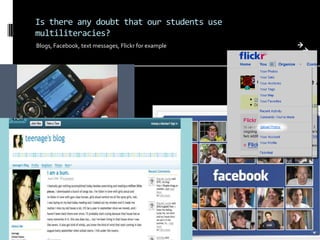
What does this shift in social and cultural practices and the research in multiliteracies mean for teaching English?Is there any doubt that our students use multiliteracies?Blogs, Facebook, text messages, Flickr for example
Take this story for instance . . .Justin BieberAnd of course YouTube
Some ideas for educators to ponder . . .What Does it all Mean?
A book is a technology too. Yes, a book.It’s not just digital though…
Remediation and AnxietyBolter and Grusin in 1999 wrote about how new media refashions prior media forms with a goal to improve upon the old while proclaiming itself a new medium. E.g. scroll to book; book to e-literature, etc.Anxiety is created though as we fear what is being lost and what we don’t understand about the new.
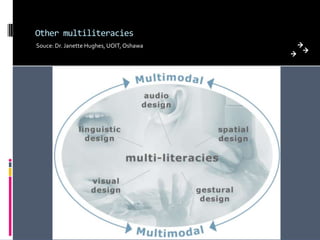
Other multiliteraciesSouce: Dr. Janette Hughes, UOIT, Oshawa
Page from Mausby  Art Spiegelman
Research RootsThe first discussions focused on “New Literacies”“New Literacy’s proposal is to reshape the work of the classroom around a different form of reading and writing. The moral, psychological, and social worth of this literacy begins with students as sources of experience and meaning.” John Willinsky
James Gee talked about New Literacy StudiesHe (and other theorists) explained that literacy is not a singular construct, but rather, individuals maintain multiple literacies relative to their environment (both physical and social). Gee introduced the term “big D” Discourse, by which he mean the social, cultural and historical practices that impact systems of literacy.
MultiliteraciesNew London Group is a collective of literacy researchers from Australia, Great Britain and the USA.They argued that literacy includesA multiplicity of discoursesIs influenced by information and multimedia technologies And that different representational forms are increasingly significant. E.g. visual design
They noted that	As soon as our sights are set on the objective of creating the learning conditions for full social participation, the issue of differences becomes critically important. How do we ensure that differences of culture, language, and gender are not barriers to educational success? And what are the implications of these differences for literacy pedagogy?
Teaching MultiliteraciesSituated effortful, meaningful practiceOvert instruction that introduces metalanguage to describe and interpret.Critical framing to interpret the social and cultural context of particular designs of meaning.Transformed practice, which puts meaning to work in other contexts.
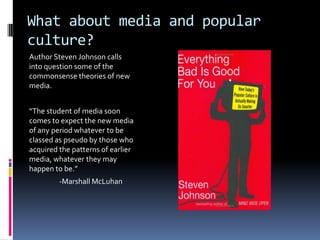
What about media and popular culture?Author Steven Johnson calls into question some of the commonsense theories of new media.“The student of media soon comes to expect the new media of any period whatever to be classed as pseudo by those who acquired the patterns of earlier media, whatever they may happen to be.”	-Marshall McLuhan
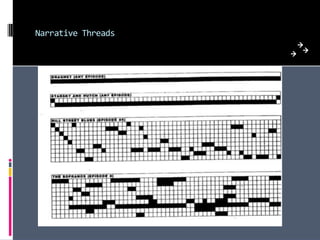
Some of Johnson’s FindingsBy almost all the standards we use to measure reading’s cognitive benefits—attention, memory, following threads, and so on—the nonliterary popular culture has been steadily growing more challenging over the past thirty years.Increasingly, the nonliterary popular culture is honing different mental skills that are just as important as ones exercised by reading books.
It’s not what you’re thinking about when you’re playing a game, it’s the way you’re thinking that matters.John Dewey: “Perhaps the greatest of all pedagogical fallacies is the notion that a person learns only that particular thing he is studying at the time. Collateral learning in the way of formation of enduring attitudes, of likes and dislikes, may be and often is much more important than the spelling lesson or the lesson in geography or history that is learned.”
Narrative Threads
James Paul Gee, 2003What Video Games Have to Teach Us About Learning and Literacy36 Learning Principlese.g. Identity Principle—Learning involves taking on and playing with identities in such a way that the learner has real choices (in developing the virtual identity) and ample opportunity to meditate on the relationship between new identities and old ones.There is a tripartite play of identities as learners relate, and reflect on, their multiple real-world identities, a virtual identity, and a projective identity.
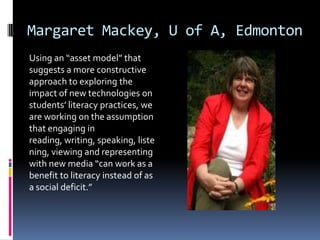
Margaret Mackey, U of A, EdmontonUsing an “asset model” that suggests a more constructive approach to exploring the impact of new technologies on students’ literacy practices, we are working on the assumption that engaging in reading, writing, speaking, listening, viewing and representing with new media “can work as a benefit to literacy instead of as a social deficit.”
What does this mean for teaching English?
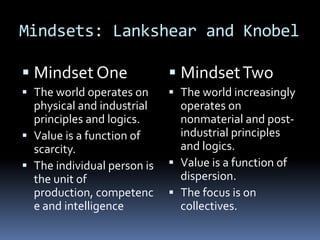
Mindsets: Lankshear and KnobelMindset OneThe world operates on physical and industrial principles and logics.Value is a function of scarcity.The individual person is the unit of production, competence and intelligenceMindset TwoThe world increasingly operates on nonmaterial and post-industrial principles and logics.Value is a function of dispersion.The focus is on collectives.
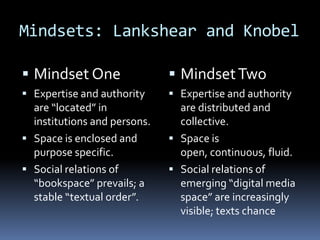
Mindsets: Lankshear and KnobelMindset OneExpertise and authority are “located” in institutions and persons.Space is enclosed and purpose specific.Social relations of “bookspace” prevails; a stable “textual order”.Mindset TwoExpertise and authority are distributed and collective.Space is open, continuous, fluid.Social relations of emerging “digital media space” are increasingly visible; texts chance
Billy CollinsNot an either/or, but both/and
Survey in your textbook

September 22wiki

  • 1.
  • 2.
    Literacy is aboutmore than reading or writing – it is about how we communicate in society. It is about social practices and relationships, about knowledge, language and culture.Those who use literacy take it for granted – but those who cannot use it are excluded from much communication in today’s world. Indeed, it is the excluded who can best appreciate the notion of “literacy as freedom”. (UNESCO, Statement for the United Nations Literacy Decade, 2003–2012, page 3, The Ontario Curriculum, English Grades 9 and 10)
  • 3.
    Multiliteracies-Coined by theNew London Group (1996)Because the way people communicate is changing due to new technologies, and shifts in the usage of the English language within different cultures, a new understanding of literacy must also be used and developed.
  • 4.
    For Today .. . 3 PartsHow might we understand multiliteracies and why is this important to English teaching? Support from current research. What does research tell us about teaching multiliteracies?
  • 5.
    What does thisshift in social and cultural practices and the research in multiliteracies mean for teaching English?Is there any doubt that our students use multiliteracies?Blogs, Facebook, text messages, Flickr for example
  • 6.
    Take this storyfor instance . . .Justin BieberAnd of course YouTube
  • 7.
    Some ideas foreducators to ponder . . .What Does it all Mean?
  • 8.
    A book isa technology too. Yes, a book.It’s not just digital though…
  • 9.
    Remediation and AnxietyBolterand Grusin in 1999 wrote about how new media refashions prior media forms with a goal to improve upon the old while proclaiming itself a new medium. E.g. scroll to book; book to e-literature, etc.Anxiety is created though as we fear what is being lost and what we don’t understand about the new.
  • 10.
    Other multiliteraciesSouce: Dr.Janette Hughes, UOIT, Oshawa
  • 11.
    Page from Mausby Art Spiegelman
  • 12.
    Research RootsThe firstdiscussions focused on “New Literacies”“New Literacy’s proposal is to reshape the work of the classroom around a different form of reading and writing. The moral, psychological, and social worth of this literacy begins with students as sources of experience and meaning.” John Willinsky
  • 13.
    James Gee talkedabout New Literacy StudiesHe (and other theorists) explained that literacy is not a singular construct, but rather, individuals maintain multiple literacies relative to their environment (both physical and social). Gee introduced the term “big D” Discourse, by which he mean the social, cultural and historical practices that impact systems of literacy.
  • 14.
    MultiliteraciesNew London Groupis a collective of literacy researchers from Australia, Great Britain and the USA.They argued that literacy includesA multiplicity of discoursesIs influenced by information and multimedia technologies And that different representational forms are increasingly significant. E.g. visual design
  • 15.
    They noted that Assoon as our sights are set on the objective of creating the learning conditions for full social participation, the issue of differences becomes critically important. How do we ensure that differences of culture, language, and gender are not barriers to educational success? And what are the implications of these differences for literacy pedagogy?
  • 16.
    Teaching MultiliteraciesSituated effortful,meaningful practiceOvert instruction that introduces metalanguage to describe and interpret.Critical framing to interpret the social and cultural context of particular designs of meaning.Transformed practice, which puts meaning to work in other contexts.
  • 17.
    What about mediaand popular culture?Author Steven Johnson calls into question some of the commonsense theories of new media.“The student of media soon comes to expect the new media of any period whatever to be classed as pseudo by those who acquired the patterns of earlier media, whatever they may happen to be.” -Marshall McLuhan
  • 18.
    Some of Johnson’sFindingsBy almost all the standards we use to measure reading’s cognitive benefits—attention, memory, following threads, and so on—the nonliterary popular culture has been steadily growing more challenging over the past thirty years.Increasingly, the nonliterary popular culture is honing different mental skills that are just as important as ones exercised by reading books.
  • 19.
    It’s not whatyou’re thinking about when you’re playing a game, it’s the way you’re thinking that matters.John Dewey: “Perhaps the greatest of all pedagogical fallacies is the notion that a person learns only that particular thing he is studying at the time. Collateral learning in the way of formation of enduring attitudes, of likes and dislikes, may be and often is much more important than the spelling lesson or the lesson in geography or history that is learned.”
  • 20.
  • 21.
    James Paul Gee,2003What Video Games Have to Teach Us About Learning and Literacy36 Learning Principlese.g. Identity Principle—Learning involves taking on and playing with identities in such a way that the learner has real choices (in developing the virtual identity) and ample opportunity to meditate on the relationship between new identities and old ones.There is a tripartite play of identities as learners relate, and reflect on, their multiple real-world identities, a virtual identity, and a projective identity.
  • 22.
    Margaret Mackey, Uof A, EdmontonUsing an “asset model” that suggests a more constructive approach to exploring the impact of new technologies on students’ literacy practices, we are working on the assumption that engaging in reading, writing, speaking, listening, viewing and representing with new media “can work as a benefit to literacy instead of as a social deficit.”
  • 23.
    What does thismean for teaching English?
  • 24.
    Mindsets: Lankshear andKnobelMindset OneThe world operates on physical and industrial principles and logics.Value is a function of scarcity.The individual person is the unit of production, competence and intelligenceMindset TwoThe world increasingly operates on nonmaterial and post-industrial principles and logics.Value is a function of dispersion.The focus is on collectives.
  • 25.
    Mindsets: Lankshear andKnobelMindset OneExpertise and authority are “located” in institutions and persons.Space is enclosed and purpose specific.Social relations of “bookspace” prevails; a stable “textual order”.Mindset TwoExpertise and authority are distributed and collective.Space is open, continuous, fluid.Social relations of emerging “digital media space” are increasingly visible; texts chance
  • 26.
    Billy CollinsNot aneither/or, but both/and
  • 27.