Self-Concept
by : Giovani
&
Lifestyle
What is a Self-concept
?
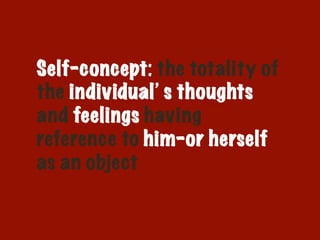
Self-concept: the totality of
the individual’s thoughts
and feelings having
reference to him-or herself
as an object
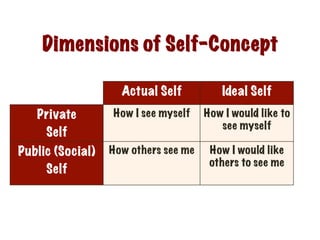
Dimensions of Self-Concept
Actual Self Ideal Self
Private
Self
How I see myself How I would like to
see myself
Public (Social)
Self
How others see me How I would like
others to see me
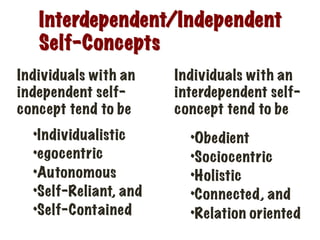
Interdependent/Independent
Self-Concepts
Individuals with an
interdependent self-
concept tend to be
• Obedient
• Sociocentric
• Holistic
• Connected, and
• Relation oriented
Individuals with an
independent self-
concept tend to be
• Individualistic
• egocentric
• Autonomous
• Self-Reliant, and
• Self-Contained
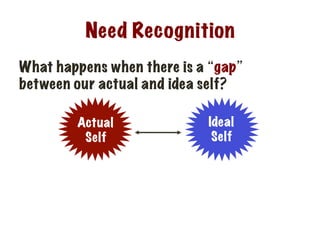
Ideal
Self
Actual
Self
Need Recognition
What happens when there is a “gap”
between our actual and idea self?
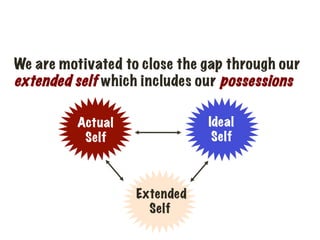
Extended
Self
Ideal
Self
Actual
Self
We are motivated to close the gap through our
extended self which includes our possessions
Possessions and the
Extended Self
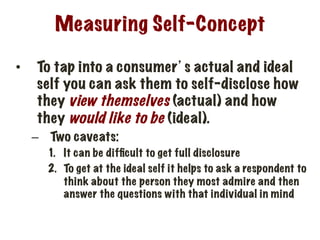
Measuring Self-Concept
•  To tap into a consumer’s actual and ideal
self you can ask them to self-disclose how
they view themselves (actual) and how
they would like to be (ideal).
–  Two caveats:
1.  It can be difficult to get full disclosure
2.  To get at the ideal self it helps to ask a respondent to
think about the person they most admire and then
answer the questions with that individual in mind
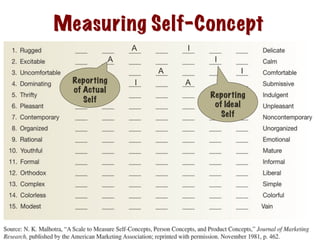
A I
A I
A I
I AReporting
of Actual
Self
Reporting
of Ideal
Self
Measuring Self-Concept
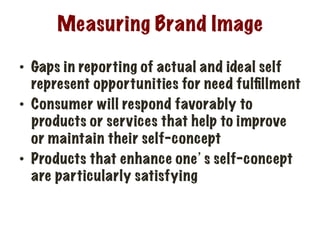
Measuring Brand Image
•  Gaps in reporting of actual and ideal self
represent opportunities for need fulfillment
•  Consumer will respond favorably to
products or services that help to improve
or maintain their self-concept
•  Products that enhance one’s self-concept
are particularly satisfying
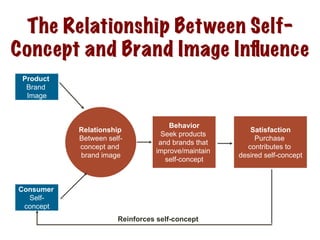
The Relationship Between Self-
Concept and Brand Image Influence
Product
Brand
Image
Consumer
Self-
concept
Relationship
Between self-
concept and
brand image
Behavior
Seek products
and brands that
improve/maintain
self-concept
Satisfaction
Purchase
contributes to
desired self-concept
Reinforces self-concept
The Nature of Lifestyle
Lifestyle is basically how a
person lives. It is how one enacts
his or her self-concept.
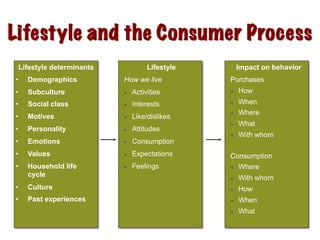
Lifestyle and the Consumer Process
Lifestyle determinants
•  Demographics
•  Subculture
•  Social class
•  Motives
•  Personality
•  Emotions
•  Values
•  Household life
cycle
•  Culture
•  Past experiences
Lifestyle
How we live
l  Activities
l  Interests
l  Like/dislikes
l  Attitudes
l  Consumption
l  Expectations
l  Feelings
Impact on behavior
Purchases
l  How
l  When
l  Where
l  What
l  With whom
Consumption
l  Where
l  With whom
l  How
l  When
l  What
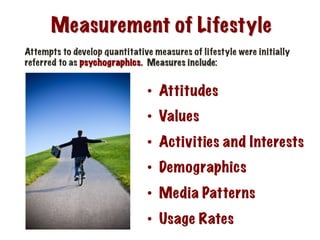
Measurement of Lifestyle
Attempts to develop quantitative measures of lifestyle were initially
referred to as psychographics. Measures include:
•  Attitudes
•  Values
•  Activities and Interests
•  Demographics
•  Media Patterns
•  Usage Rates
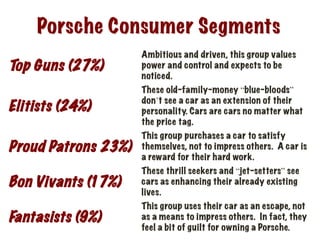
Porsche Consumer Segments
Top Guns (27%)
Ambitious and driven, this group values
power and control and expects to be
noticed.
Elitists (24%)
These old-family-money “blue-bloods”
don’t see a car as an extension of their
personality. Cars are cars no matter what
the price tag.
Proud Patrons 23%)
This group purchases a car to satisfy
themselves, not to impress others. A car is
a reward for their hard work.
Bon Vivants (17%)
These thrill seekers and “jet-setters” see
cars as enhancing their already existing
lives.
Fantasists (9%)
This group uses their car as an escape, not
as a means to impress others. In fact, they
feel a bit of guilt for owning a Porsche.
Three general lifestyle schemes:
1.  The VALSTM System
2. The PRIZM System
3.  Roper Starch Global Lifestyles
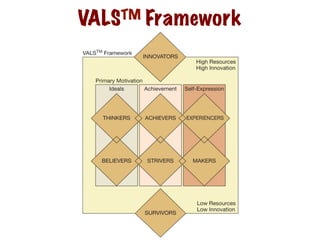
The VALSTM System
VALS provides a systematic classification of
U.S. adults into eight distinct consumer
segments.
VALS is based on enduring psychological
characteristics that correlate with purchase
patterns.
•  SRI Consulting Business Intelligence
•  42 statements of agreement
•  Classifies individuals using two
dimensions
– Self Orientation
•  Principle oriented
•  Status oriented
•  Action oriented
– Resources
•  Individuals are placed in one of 8 general
psychographic segments
VALSTM Framework
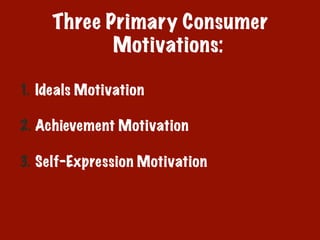
1.  Ideals Motivation
2. Achievement Motivation
3.  Self-Expression Motivation
Three Primary Consumer
Motivations:
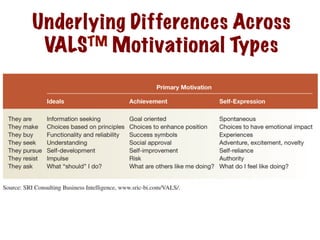
Underlying Differences Across
VALSTM Motivational Types
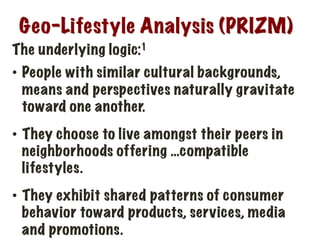
Geo-Lifestyle Analysis (PRIZM)
The underlying logic:1
•  People with similar cultural backgrounds,
means and perspectives naturally gravitate
toward one another.
•  They choose to live amongst their peers in
neighborhoods offering …compatible
lifestyles.
•  They exhibit shared patterns of consumer
behavior toward products, services, media
and promotions.
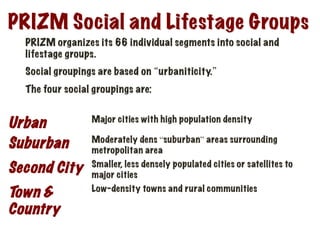
PRIZM organizes its 66 individual segments into social and
lifestage groups.
Social groupings are based on “urbaniticity.”
The four social groupings are:
Urban Major cities with high population density
Suburban Moderately dens “suburban” areas surrounding
metropolitan area
Second City Smaller, less densely populated cities or satellites to
major cities
Town &
Country
Low-density towns and rural communities
PRIZM Social and Lifestage Groups
12-26
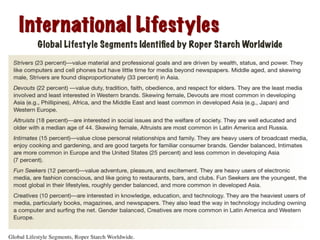
International Lifestyles
Global Lifestyle Segments Identified by Roper Starch Worldwide
THANK YOU

Self concept and lifestyle

  • 1.
  • 2.
    What is aSelf-concept ?
  • 3.
    Self-concept: the totalityof the individual’s thoughts and feelings having reference to him-or herself as an object
  • 4.
    Dimensions of Self-Concept ActualSelf Ideal Self Private Self How I see myself How I would like to see myself Public (Social) Self How others see me How I would like others to see me
  • 5.
    Interdependent/Independent Self-Concepts Individuals with an interdependentself- concept tend to be • Obedient • Sociocentric • Holistic • Connected, and • Relation oriented Individuals with an independent self- concept tend to be • Individualistic • egocentric • Autonomous • Self-Reliant, and • Self-Contained
  • 6.
    Ideal Self Actual Self Need Recognition What happenswhen there is a “gap” between our actual and idea self?
  • 7.
    Extended Self Ideal Self Actual Self We are motivatedto close the gap through our extended self which includes our possessions
  • 8.
  • 9.
    Measuring Self-Concept •  Totap into a consumer’s actual and ideal self you can ask them to self-disclose how they view themselves (actual) and how they would like to be (ideal). –  Two caveats: 1.  It can be difficult to get full disclosure 2.  To get at the ideal self it helps to ask a respondent to think about the person they most admire and then answer the questions with that individual in mind
  • 10.
    A I A I AI I AReporting of Actual Self Reporting of Ideal Self Measuring Self-Concept
  • 11.
    Measuring Brand Image • Gaps in reporting of actual and ideal self represent opportunities for need fulfillment •  Consumer will respond favorably to products or services that help to improve or maintain their self-concept •  Products that enhance one’s self-concept are particularly satisfying
  • 12.
    The Relationship BetweenSelf- Concept and Brand Image Influence Product Brand Image Consumer Self- concept Relationship Between self- concept and brand image Behavior Seek products and brands that improve/maintain self-concept Satisfaction Purchase contributes to desired self-concept Reinforces self-concept
  • 13.
    The Nature ofLifestyle
  • 14.
    Lifestyle is basicallyhow a person lives. It is how one enacts his or her self-concept.
  • 15.
    Lifestyle and theConsumer Process Lifestyle determinants •  Demographics •  Subculture •  Social class •  Motives •  Personality •  Emotions •  Values •  Household life cycle •  Culture •  Past experiences Lifestyle How we live l  Activities l  Interests l  Like/dislikes l  Attitudes l  Consumption l  Expectations l  Feelings Impact on behavior Purchases l  How l  When l  Where l  What l  With whom Consumption l  Where l  With whom l  How l  When l  What
  • 16.
    Measurement of Lifestyle Attemptsto develop quantitative measures of lifestyle were initially referred to as psychographics. Measures include: •  Attitudes •  Values •  Activities and Interests •  Demographics •  Media Patterns •  Usage Rates
  • 17.
    Porsche Consumer Segments TopGuns (27%) Ambitious and driven, this group values power and control and expects to be noticed. Elitists (24%) These old-family-money “blue-bloods” don’t see a car as an extension of their personality. Cars are cars no matter what the price tag. Proud Patrons 23%) This group purchases a car to satisfy themselves, not to impress others. A car is a reward for their hard work. Bon Vivants (17%) These thrill seekers and “jet-setters” see cars as enhancing their already existing lives. Fantasists (9%) This group uses their car as an escape, not as a means to impress others. In fact, they feel a bit of guilt for owning a Porsche.
  • 18.
    Three general lifestyleschemes: 1.  The VALSTM System 2. The PRIZM System 3.  Roper Starch Global Lifestyles
  • 19.
    The VALSTM System VALSprovides a systematic classification of U.S. adults into eight distinct consumer segments. VALS is based on enduring psychological characteristics that correlate with purchase patterns.
  • 20.
    •  SRI ConsultingBusiness Intelligence •  42 statements of agreement •  Classifies individuals using two dimensions – Self Orientation •  Principle oriented •  Status oriented •  Action oriented – Resources •  Individuals are placed in one of 8 general psychographic segments
  • 21.
  • 22.
    1.  Ideals Motivation 2. AchievementMotivation 3.  Self-Expression Motivation Three Primary Consumer Motivations:
  • 23.
  • 24.
    Geo-Lifestyle Analysis (PRIZM) Theunderlying logic:1 •  People with similar cultural backgrounds, means and perspectives naturally gravitate toward one another. •  They choose to live amongst their peers in neighborhoods offering …compatible lifestyles. •  They exhibit shared patterns of consumer behavior toward products, services, media and promotions.
  • 25.
    PRIZM organizes its66 individual segments into social and lifestage groups. Social groupings are based on “urbaniticity.” The four social groupings are: Urban Major cities with high population density Suburban Moderately dens “suburban” areas surrounding metropolitan area Second City Smaller, less densely populated cities or satellites to major cities Town & Country Low-density towns and rural communities PRIZM Social and Lifestage Groups
  • 26.
    12-26 International Lifestyles Global LifestyleSegments Identified by Roper Starch Worldwide
  • 27.