Diffusion Theories
INTC 5110
Fall 2010
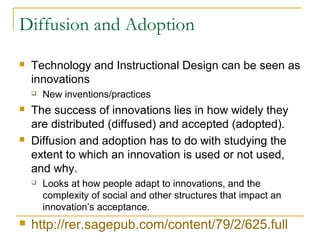
Diffusion and Adoption
 Technology and Instructional Design can be seen as
innovations
 New inventions/practices
 The success of innovations lies in how widely they
are distributed (diffused) and accepted (adopted).
 Diffusion and adoption has to do with studying the
extent to which an innovation is used or not used,
and why.
 Looks at how people adapt to innovations, and the
complexity of social and other structures that impact an
innovation’s acceptance.
 http://rer.sagepub.com/content/79/2/625.full
Process
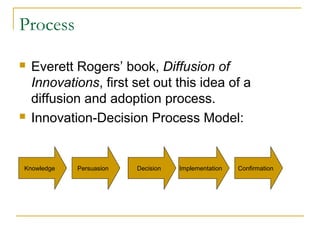
 Everett Rogers’ book, Diffusion of
Innovations, first set out this idea of a
diffusion and adoption process.
 Innovation-Decision Process Model:
Knowledge Persuasion Decision Implementation Confirmation
Adopter Categories
 In each community, organization, or group there are
different types of people:
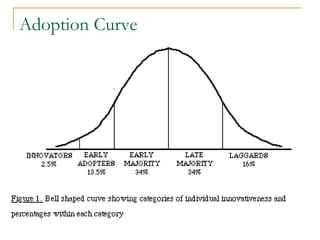
 Innovators are the 2.5% who readily adopt. These are the
people who will try any new technology that comes along.
 Early Adopters are the 13.5% who are persuaded quickly
and try the innovation and find it useful.
 Early Majority are the 34% who wait for Early Adopters to
have success then adopt.
 Late Majority are 34% who adopt once an innovation has
become commonplace.
 Laggards are the 16% who either never adopt or fight
adoption after it has become common.
Adoption Curve
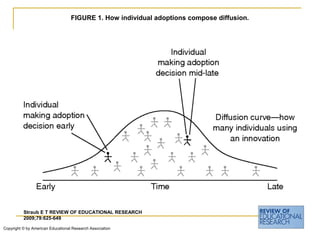
FIGURE 1. How individual adoptions compose diffusion.
Straub E T REVIEW OF EDUCATIONAL RESEARCH
2009;79:625-649
Copyright © by American Educational Research Association
Time to Adoption
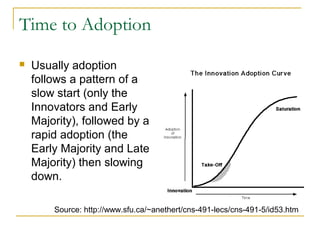
 Usually adoption
follows a pattern of a
slow start (only the
Innovators and Early
Majority), followed by a
rapid adoption (the
Early Majority and Late
Majority) then slowing
down.
Source: http://www.sfu.ca/~anethert/cns-491-lecs/cns-491-5/id53.htm
Theory of Perceived Attributes (Rogers)
 Increased adoption if perceived by adopters
in certain ways:
 Trialability - Can be tried on a limited basis before
adoption
 Observability- Offers observable results
 Relative Advantage - Has an advantage relative
to other innovations
 Complexity - Is not overly complex
 Compatibility - Is compatible with existing
practices and values.
How it Applies
 When looking to infuse technology into a
community (an organization or a school
district, for example), the diffusion and
adoption process helps you:
 Plan for best chance of success
 Identify important persons (users)
 Measure potential concerns/ problems
 Identify obstacles and plan to overcome
How it Applies
 Used for:
 Planning systemic change and reforms
 Increasing utilization of specific instructional
products and processes
 Useful as a tool for evaluating progress
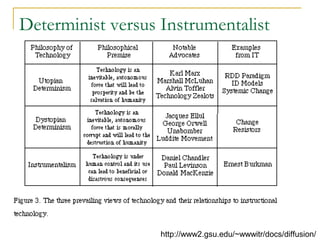
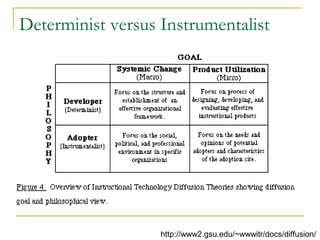
Determinist versus Instrumentalist
 Determinist – technology is a force that takes
over the process, and we are knowing or
unknowing slaves to it
 Instrumentalist – we control technology, using
it as a tool for our own aims and goals
http://www2.gsu.edu/~wwwitr/docs/diffusion/
Determinist versus Instrumentalist
http://www2.gsu.edu/~wwwitr/docs/diffusion/
Determinist versus Instrumentalist
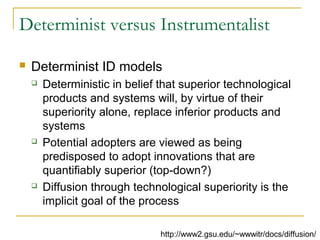
 Determinist ID models
 Deterministic in belief that superior technological
products and systems will, by virtue of their
superiority alone, replace inferior products and
systems
 Potential adopters are viewed as being
predisposed to adopt innovations that are
quantifiably superior (top-down?)
 Diffusion through technological superiority is the
implicit goal of the process
http://www2.gsu.edu/~wwwitr/docs/diffusion/
Determinist versus Instrumentalist
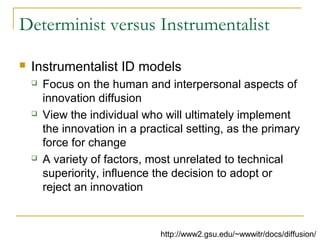
 Instrumentalist ID models
 Focus on the human and interpersonal aspects of
innovation diffusion
 View the individual who will ultimately implement
the innovation in a practical setting, as the primary
force for change
 A variety of factors, most unrelated to technical
superiority, influence the decision to adopt or
reject an innovation
http://www2.gsu.edu/~wwwitr/docs/diffusion/
Determinist versus Instrumentalist
http://www2.gsu.edu/~wwwitr/docs/diffusion/
User Oriented Instructional Development
 Burkman (1987)
 Identify the potential adopter
 Measure relevant potential adopter perceptions
 Design and develop a user-friendly product
 Inform the potential adopter (of the product's
user-friendliness)
 Provide Post Adoption Support
CBAM (Concerns Based Adoption Model)
 Hall and Hord (1987)
 Change facilitators understand change from the
point of view of the people who will be affected by
change
 Bring about systemic restructuring by
understanding the social, political, and
interpersonal aspects
 http://www.nas.edu/rise/backg4a.htm
CBAM Assumptions
 CBAM was developed based on six explicit
assumptions:
 “Change is a process, not an event.”
 “Change is accomplished by individuals.”
 “Change is a highly personal experience.”
 “Change involves developmental growth.”
 “Change is best understood in operational terms.”
 “The focus of facilitation should be on individuals,
innovations, and context.”
 (Hord, Rutherford, Huling-Austin, & Hall, 1987)
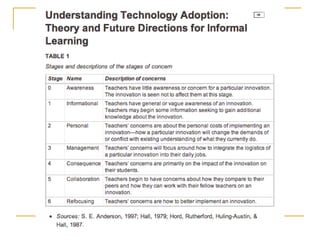
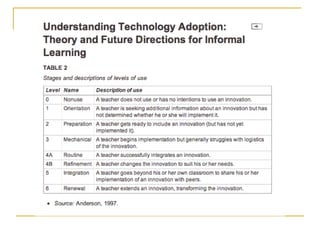
CBAM Components
 Stages of concern (SoC)
 Levels of use (LoU)
 Innovation configuration (IC).
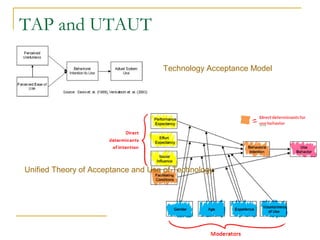
TAP and UTAUT
Technology Acceptance Model
Unified Theory of Acceptance and Use of Technology
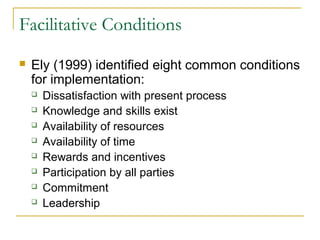
Facilitative Conditions
 Ely (1999) identified eight common conditions
for implementation:
 Dissatisfaction with present process
 Knowledge and skills exist
 Availability of resources
 Availability of time
 Rewards and incentives
 Participation by all parties
 Commitment
 Leadership
Other Factors
 A host of other factors can also impact
whether an innovation is adopted, including:
 Organizational climate
 Demographics
 Relative advantage
 Complexity vs. Simplicity
 “Trialability” before wholesale adoption
Applied to Organizations
 So how does technology and instructional
design become diffused and adopted?
 What make some innovations more likely to
be adopted?
 What innovations have been successfully
implemented already?
Some Background
 Instructional Design and Technology (IDT)
 “ID” Came out of systems thinking and military/corporate
practice
 “T” developed from visual communications and instructional
media
 Where the two meet they have been prone to
misunderstandings
 See IDT people as strictly technologists
 See value as technology integration specialists
 Merely an add-on to existing practice, not as redefining
practice
Goal of IDT
 Understanding the potential for technology to
be used in conjunction with instructional
design to enhance learning and performance.
 Understand how people utilize technology,
and support the development of new
practices that foster learning and
achievement.
 Provide alternative methods and strategies
for adoption.
Example: Objectives
 Objectives
 In IDT field, started in 1960s with Mager, and also via
Programmed Instruction (Skinner).
 In K-12, started in 1970s with administrative push for
teacher planning.
 Expectations of their value have been high, but research
mixed.
 Many times seen as trivial by teachers and trainers.
 Best when used to make sound decisions about
instructional strategies
 Low impact for this innovation.
Example: Problem-Based Learning
 Idea that using authentic problems and cases
when teaching helps students achieve
higher-order outcomes such as critical
thinking.
 Often works when done correctly.
 However, it takes a great deal of work, and often
appears misaligned to curriculum standards (does
not teach to the test).
 Some adoption, but not on large scale.
Implications
 Obviously, IDT has not had wide adoption in K-12 schools.
 Expectations often not met.
 Not part of K-12 culture.
 Standards and other initiatives take precedence.
 Still seen as technologists.
 Yet we persist in trying to match the two, and we get many
students in Masters programs in IDT.
 Value seen at the small scale level (one teacher, one school)
 Inherent belief that we can do things better
 Technology is a tool, and ID is a process, with great potential; we
just need to figure out better ways of using them in K-12

Diffusion

  • 1.
  • 2.
    Diffusion and Adoption Technology and Instructional Design can be seen as innovations  New inventions/practices  The success of innovations lies in how widely they are distributed (diffused) and accepted (adopted).  Diffusion and adoption has to do with studying the extent to which an innovation is used or not used, and why.  Looks at how people adapt to innovations, and the complexity of social and other structures that impact an innovation’s acceptance.  http://rer.sagepub.com/content/79/2/625.full
  • 3.
    Process  Everett Rogers’book, Diffusion of Innovations, first set out this idea of a diffusion and adoption process.  Innovation-Decision Process Model: Knowledge Persuasion Decision Implementation Confirmation
  • 4.
    Adopter Categories  Ineach community, organization, or group there are different types of people:  Innovators are the 2.5% who readily adopt. These are the people who will try any new technology that comes along.  Early Adopters are the 13.5% who are persuaded quickly and try the innovation and find it useful.  Early Majority are the 34% who wait for Early Adopters to have success then adopt.  Late Majority are 34% who adopt once an innovation has become commonplace.  Laggards are the 16% who either never adopt or fight adoption after it has become common.
  • 5.
  • 6.
    FIGURE 1. Howindividual adoptions compose diffusion. Straub E T REVIEW OF EDUCATIONAL RESEARCH 2009;79:625-649 Copyright © by American Educational Research Association
  • 7.
    Time to Adoption Usually adoption follows a pattern of a slow start (only the Innovators and Early Majority), followed by a rapid adoption (the Early Majority and Late Majority) then slowing down. Source: http://www.sfu.ca/~anethert/cns-491-lecs/cns-491-5/id53.htm
  • 8.
    Theory of PerceivedAttributes (Rogers)  Increased adoption if perceived by adopters in certain ways:  Trialability - Can be tried on a limited basis before adoption  Observability- Offers observable results  Relative Advantage - Has an advantage relative to other innovations  Complexity - Is not overly complex  Compatibility - Is compatible with existing practices and values.
  • 9.
    How it Applies When looking to infuse technology into a community (an organization or a school district, for example), the diffusion and adoption process helps you:  Plan for best chance of success  Identify important persons (users)  Measure potential concerns/ problems  Identify obstacles and plan to overcome
  • 10.
    How it Applies Used for:  Planning systemic change and reforms  Increasing utilization of specific instructional products and processes  Useful as a tool for evaluating progress
  • 11.
    Determinist versus Instrumentalist Determinist – technology is a force that takes over the process, and we are knowing or unknowing slaves to it  Instrumentalist – we control technology, using it as a tool for our own aims and goals http://www2.gsu.edu/~wwwitr/docs/diffusion/
  • 12.
  • 13.
    Determinist versus Instrumentalist Determinist ID models  Deterministic in belief that superior technological products and systems will, by virtue of their superiority alone, replace inferior products and systems  Potential adopters are viewed as being predisposed to adopt innovations that are quantifiably superior (top-down?)  Diffusion through technological superiority is the implicit goal of the process http://www2.gsu.edu/~wwwitr/docs/diffusion/
  • 14.
    Determinist versus Instrumentalist Instrumentalist ID models  Focus on the human and interpersonal aspects of innovation diffusion  View the individual who will ultimately implement the innovation in a practical setting, as the primary force for change  A variety of factors, most unrelated to technical superiority, influence the decision to adopt or reject an innovation http://www2.gsu.edu/~wwwitr/docs/diffusion/
  • 15.
  • 16.
    User Oriented InstructionalDevelopment  Burkman (1987)  Identify the potential adopter  Measure relevant potential adopter perceptions  Design and develop a user-friendly product  Inform the potential adopter (of the product's user-friendliness)  Provide Post Adoption Support
  • 17.
    CBAM (Concerns BasedAdoption Model)  Hall and Hord (1987)  Change facilitators understand change from the point of view of the people who will be affected by change  Bring about systemic restructuring by understanding the social, political, and interpersonal aspects  http://www.nas.edu/rise/backg4a.htm
  • 18.
    CBAM Assumptions  CBAMwas developed based on six explicit assumptions:  “Change is a process, not an event.”  “Change is accomplished by individuals.”  “Change is a highly personal experience.”  “Change involves developmental growth.”  “Change is best understood in operational terms.”  “The focus of facilitation should be on individuals, innovations, and context.”  (Hord, Rutherford, Huling-Austin, & Hall, 1987)
  • 19.
    CBAM Components  Stagesof concern (SoC)  Levels of use (LoU)  Innovation configuration (IC).
  • 22.
    TAP and UTAUT TechnologyAcceptance Model Unified Theory of Acceptance and Use of Technology
  • 23.
    Facilitative Conditions  Ely(1999) identified eight common conditions for implementation:  Dissatisfaction with present process  Knowledge and skills exist  Availability of resources  Availability of time  Rewards and incentives  Participation by all parties  Commitment  Leadership
  • 24.
    Other Factors  Ahost of other factors can also impact whether an innovation is adopted, including:  Organizational climate  Demographics  Relative advantage  Complexity vs. Simplicity  “Trialability” before wholesale adoption
  • 25.
    Applied to Organizations So how does technology and instructional design become diffused and adopted?  What make some innovations more likely to be adopted?  What innovations have been successfully implemented already?
  • 26.
    Some Background  InstructionalDesign and Technology (IDT)  “ID” Came out of systems thinking and military/corporate practice  “T” developed from visual communications and instructional media  Where the two meet they have been prone to misunderstandings  See IDT people as strictly technologists  See value as technology integration specialists  Merely an add-on to existing practice, not as redefining practice
  • 27.
    Goal of IDT Understanding the potential for technology to be used in conjunction with instructional design to enhance learning and performance.  Understand how people utilize technology, and support the development of new practices that foster learning and achievement.  Provide alternative methods and strategies for adoption.
  • 28.
    Example: Objectives  Objectives In IDT field, started in 1960s with Mager, and also via Programmed Instruction (Skinner).  In K-12, started in 1970s with administrative push for teacher planning.  Expectations of their value have been high, but research mixed.  Many times seen as trivial by teachers and trainers.  Best when used to make sound decisions about instructional strategies  Low impact for this innovation.
  • 29.
    Example: Problem-Based Learning Idea that using authentic problems and cases when teaching helps students achieve higher-order outcomes such as critical thinking.  Often works when done correctly.  However, it takes a great deal of work, and often appears misaligned to curriculum standards (does not teach to the test).  Some adoption, but not on large scale.
  • 30.
    Implications  Obviously, IDThas not had wide adoption in K-12 schools.  Expectations often not met.  Not part of K-12 culture.  Standards and other initiatives take precedence.  Still seen as technologists.  Yet we persist in trying to match the two, and we get many students in Masters programs in IDT.  Value seen at the small scale level (one teacher, one school)  Inherent belief that we can do things better  Technology is a tool, and ID is a process, with great potential; we just need to figure out better ways of using them in K-12

Editor's Notes

  • #7 How individual adoptions compose diffusion.