COM546 : Frameworks and Theories: Diffusion and Adoption Kathy E. Gill 27 January 2009
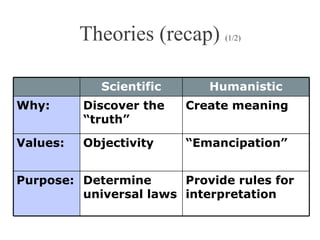
Theories (recap)  (1/2) Scientific Humanistic Why: Discover the “truth” Create meaning Values: Objectivity “ Emancipation” Purpose: Determine universal laws Provide rules for interpretation
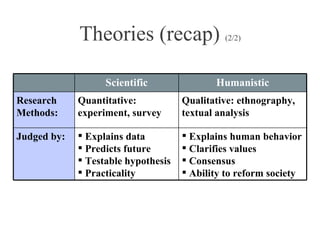
Theories (recap)  (2/2) Scientific Humanistic Research Methods: Quantitative: experiment, survey Qualitative: ethnography, textual analysis Judged by: Explains data Predicts future Testable hypothesis Practicality Explains human behavior Clarifies values Consensus Ability to reform society
Two Theories of Mediated Communication Shannon-Weaver “ Transmission model” or “ hypodermic  model  Osgood & Schramm “ Circular model” that stresses the  social nature   of communication
Thinking About Rogers and Christensen …
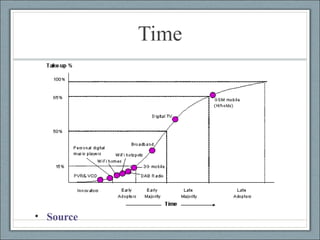
Linear innovation-diffusion theory The process by which an   innovation   is   communicated   through certain   channels   over  time   among the members of a   social system .  Rogers, 1995, page 5
Elements Innovation Social system  Time  Communications channels
Innovation An idea, practice, or object that is  perceived as new  by an individual or other unit of adoption
Communication A process in which participants  create and share information  with one another in order to reach mutual understanding
Time Source
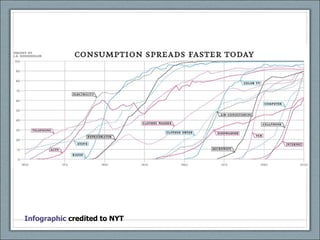
Infographic  credited to NYT
Social System A set of interrelated units that are engaged in joint problem-solving to accomplish a common goal.  Members or units of a social system may be individuals, informal groups, organizations, and/or subsystems.
Innovation-Decision Process The mental process through which an individual passes : from knowledge to forming an attitude toward the innovation (adopt, reject)
Rogers: Five steps of adoption Knowledge Persuasion Decision (adopt or reject) Implementation Confirmation
Critical Mass Rogers (1995) :  "the critical mass occurs at the point at which enough individuals have adopted an innovation so that the innovation's further rate of adoption becomes self-sustaining.”
Adopter categories Innovators Early adopters Early majority Late majority Laggards
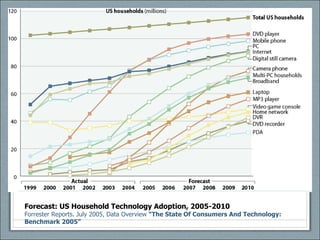
Forecast: US Household Technology Adoption, 2005-2010 Forrester Reports. July 2005, Data Overview  “The State Of Consumers And Technology: Benchmark 2005”
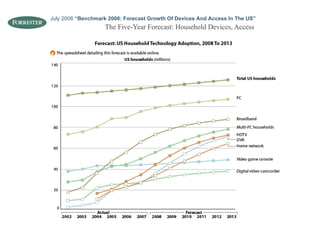
The Five-Year Forecast: Household Devices, Access July 2008  “Benchmark 2008: Forecast Growth Of Devices And Access In The US”
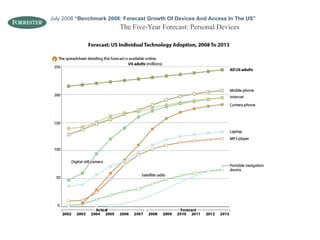
The Five-Year Forecast: Personal Devices July 2008  “Benchmark 2008: Forecast Growth Of Devices And Access In The US”
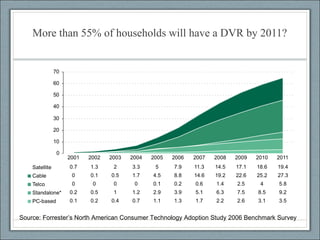
More than 55% of households will have a DVR by 2011? Source: Forrester’s North American Consumer Technology Adoption Study 2006 Benchmark Survey
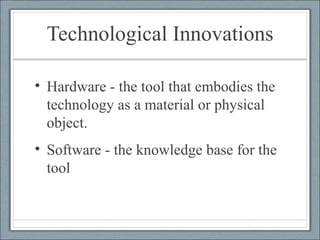
Technological Innovations Hardware - the tool that embodies the technology as a material or physical object. Software - the knowledge base for the tool
For additional thought … Increasing capacity w/out adding wires (telegraph). Parallels today? Grey v Bell …. Jobs v Gates? …. ? v Google? What is today’s “railroad” sector? Price models: Bell’s renting the phone, IBM’s renting the mainframe, cellphone contracts … what do they have in common?
Thinking About Rogers and Christensen … we’ll talk about disruptive technologies
Credits Presentation by Kathy E. Gill,  [email_address] , @kegill  CC share-and-share alike, non-commercial use “ S-curve” from  http://www.ofcom.org.uk/research/cm/cm05/overview05/keycomms/

COM546 - Week 4

  • 1.
    COM546 : Frameworksand Theories: Diffusion and Adoption Kathy E. Gill 27 January 2009
  • 2.
    Theories (recap) (1/2) Scientific Humanistic Why: Discover the “truth” Create meaning Values: Objectivity “ Emancipation” Purpose: Determine universal laws Provide rules for interpretation
  • 3.
    Theories (recap) (2/2) Scientific Humanistic Research Methods: Quantitative: experiment, survey Qualitative: ethnography, textual analysis Judged by: Explains data Predicts future Testable hypothesis Practicality Explains human behavior Clarifies values Consensus Ability to reform society
  • 4.
    Two Theories ofMediated Communication Shannon-Weaver “ Transmission model” or “ hypodermic model Osgood & Schramm “ Circular model” that stresses the social nature of communication
  • 5.
    Thinking About Rogersand Christensen …
  • 6.
    Linear innovation-diffusion theoryThe process by which an innovation is communicated through certain channels over time among the members of a social system . Rogers, 1995, page 5
  • 7.
    Elements Innovation Socialsystem Time Communications channels
  • 8.
    Innovation An idea,practice, or object that is perceived as new by an individual or other unit of adoption
  • 9.
    Communication A processin which participants create and share information with one another in order to reach mutual understanding
  • 10.
  • 11.
  • 12.
    Social System Aset of interrelated units that are engaged in joint problem-solving to accomplish a common goal. Members or units of a social system may be individuals, informal groups, organizations, and/or subsystems.
  • 13.
    Innovation-Decision Process Themental process through which an individual passes : from knowledge to forming an attitude toward the innovation (adopt, reject)
  • 14.
    Rogers: Five stepsof adoption Knowledge Persuasion Decision (adopt or reject) Implementation Confirmation
  • 15.
    Critical Mass Rogers(1995) : "the critical mass occurs at the point at which enough individuals have adopted an innovation so that the innovation's further rate of adoption becomes self-sustaining.”
  • 16.
    Adopter categories InnovatorsEarly adopters Early majority Late majority Laggards
  • 17.
    Forecast: US HouseholdTechnology Adoption, 2005-2010 Forrester Reports. July 2005, Data Overview “The State Of Consumers And Technology: Benchmark 2005”
  • 18.
    The Five-Year Forecast:Household Devices, Access July 2008 “Benchmark 2008: Forecast Growth Of Devices And Access In The US”
  • 19.
    The Five-Year Forecast:Personal Devices July 2008 “Benchmark 2008: Forecast Growth Of Devices And Access In The US”
  • 20.
    More than 55%of households will have a DVR by 2011? Source: Forrester’s North American Consumer Technology Adoption Study 2006 Benchmark Survey
  • 21.
    Technological Innovations Hardware- the tool that embodies the technology as a material or physical object. Software - the knowledge base for the tool
  • 22.
    For additional thought… Increasing capacity w/out adding wires (telegraph). Parallels today? Grey v Bell …. Jobs v Gates? …. ? v Google? What is today’s “railroad” sector? Price models: Bell’s renting the phone, IBM’s renting the mainframe, cellphone contracts … what do they have in common?
  • 23.
    Thinking About Rogersand Christensen … we’ll talk about disruptive technologies
  • 24.
    Credits Presentation byKathy E. Gill, [email_address] , @kegill CC share-and-share alike, non-commercial use “ S-curve” from http://www.ofcom.org.uk/research/cm/cm05/overview05/keycomms/