Diffusion of Innovations   by Everett Rogers, 2003 Chapter 1: Elements of Diffusion What is Diffusion? It is the processing which an innovation is communicated through certain channels over time among the members of a social system. o A special type of communication; about a new idea Communication is a process in which participants create and share information with one another in order to reach a mutual understanding. o A convergence or divergence; a two-way street New ideas cause o Uncertainty: the degree to which a number of alternatives are perceived with respect  to the occurrence of an event and their reliability To replace uncertainty o Information: difference in matter-energy that affects uncertainty in a situation where a  choice exists among a set of alternatives Innovation is a kind of social change o Social Change: the process by which alteration occurs in the structure and function of  a social system
Four Main Elements in the Diffusion of Innovations o The Innovation: an idea, practice, or object perceived as new by an individual or other unit of  adoption; not necessarily new o Technological Innovations, Information and Uncertainty Technology: a design for an instrumental action that reduces the uncertainty in the cause/effect relationship involved in achieving a desired outcome Two Components Hardware: physical object Software: information o Technology Clusters: one or more distinguishable elements of technology that are perceived as  being close interrelated o Perceived Attributes of innovations Relative Advantage: the degree to which an innovation is perceived as better than the idea it supercedes Compatibility: the degree to which an innovation is perceived as being consistent with existing values, past experiences, and needs of potential adopters Complexity: the degree to which an innovation is perceived as difficult to understand and use Trialability: the degree to which an innovation may be experimented with on a limited basis Observability: the degree to which the results of an innovation are visible to others o Re-invention: the degree to which an innovation is changed or modified by the user in the process  of adoption and implementation
Communication Channels o The means by which messages get from one individual to another o Mass Media Channels: all those means of transmitting messages that involved a mass medium  that enable a few to reach an audience of many o Interpersonal Channels: involved a face to face communication between two parties o Heterophily and Diffusion Homophily: the degree to which two or more individuals who interact are similar in certain attributes Heterophily: opposite of above; “differ” Heterophily causes problems for diffusion of innovations; most people are heterophilous
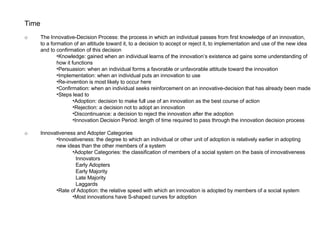
Time o The Innovative-Decision Process: the process in which an individual passes from first knowledge of an innovation,  to a formation of an attitude toward it, to a decision to accept or reject it, to implementation and use of the new idea  and to confirmation of this decision Knowledge: gained when an individual learns of the innovation’s existence ad gains some understanding of how it functions Persuasion: when an individual forms a favorable or unfavorable attitude toward the innovation Implementation: when an individual puts an innovation to use Re-invention is most likely to occur here Confirmation: when an individual seeks reinforcement on an innovative-decision that has already been made Steps lead to Adoption: decision to make full use of an innovation as the best course of action Rejection: a decision not to adopt an innovation Discontinuance: a decision to reject the innovation after the adoption Innovation Decision Period: length of time required to pass through the innovation decision process o Innovativeness and Adopter Categories Innovativeness: the degree to which an individual or other unit of adoption is relatively earlier in adopting new ideas than the other members of a system Adopter Categories: the classification of members of a social system on the basis of innovativeness  Innovators  Early Adopters  Early Majority  Late Majority  Laggards Rate of Adoption: the relative speed with which an innovation is adopted by members of a social system Most innovations have S-shaped curves for adoption
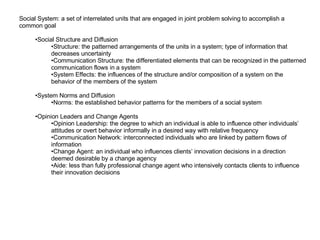
Social System: a set of interrelated units that are engaged in joint problem solving to accomplish a common goal Social Structure and Diffusion Structure: the patterned arrangements of the units in a system; type of information that decreases uncertainty Communication Structure: the differentiated elements that can be recognized in the patterned communication flows in a system System Effects: the influences of the structure and/or composition of a system on the behavior of the members of the system System Norms and Diffusion Norms: the established behavior patterns for the members of a social system Opinion Leaders and Change Agents Opinion Leadership: the degree to which an individual is able to influence other individuals’ attitudes or overt behavior informally in a desired way with relative frequency Communication Network: interconnected individuals who are linked by pattern flows of information Change Agent: an individual who influences clients’ innovation decisions in a direction deemed desirable by a change agency Aide: less than fully professional change agent who intensively contacts clients to influence their innovation decisions
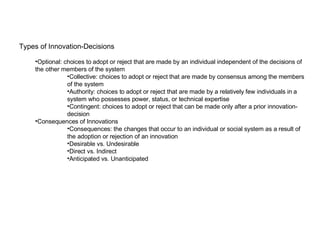
Types of Innovation-Decisions Optional: choices to adopt or reject that are made by an individual independent of the decisions of the other members of the system Collective: choices to adopt or reject that are made by consensus among the members of the system Authority: choices to adopt or reject that are made by a relatively few individuals in a system who possesses power, status, or technical expertise Contingent: choices to adopt or reject that can be made only after a prior innovation-decision Consequences of Innovations Consequences: the changes that occur to an individual or social system as a result of the adoption or rejection of an innovation Desirable vs. Undesirable Direct vs. Indirect Anticipated vs. Unanticipated
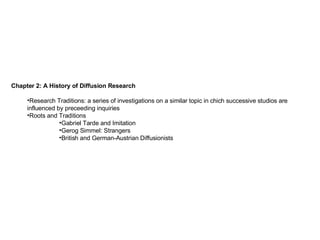
Chapter 2: A History of Diffusion Research Research Traditions: a series of investigations on a similar topic in chich successive studios are influenced by preceeding inquiries Roots and Traditions Gabriel Tarde and Imitation Gerog Simmel: Strangers British and German-Austrian Diffusionists
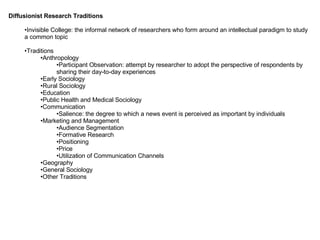
Diffusionist Research Traditions Invisible College: the informal network of researchers who form around an intellectual paradigm to study a common topic Traditions Anthropology Participant Observation: attempt by researcher to adopt the perspective of respondents by sharing their day-to-day experiences Early Sociology Rural Sociology Education Public Health and Medical Sociology Communication Salience: the degree to which a news event is perceived as important by individuals Marketing and Management Audience Segmentation Formative Research Positioning Price Utilization of Communication Channels Geography General Sociology Other Traditions
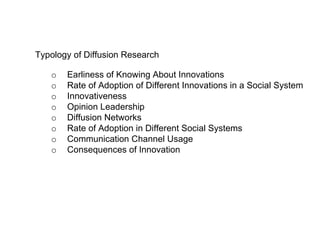
Typology of Diffusion Research o Earliness of Knowing About Innovations o Rate of Adoption of Different Innovations in a Social System o Innovativeness o Opinion Leadership o Diffusion Networks o Rate of Adoption in Different Social Systems o Communication Channel Usage o Consequences of Innovation

Diffusion of Innovations Chapters 1-2

  • 1.
    Diffusion of Innovations by Everett Rogers, 2003 Chapter 1: Elements of Diffusion What is Diffusion? It is the processing which an innovation is communicated through certain channels over time among the members of a social system. o A special type of communication; about a new idea Communication is a process in which participants create and share information with one another in order to reach a mutual understanding. o A convergence or divergence; a two-way street New ideas cause o Uncertainty: the degree to which a number of alternatives are perceived with respect to the occurrence of an event and their reliability To replace uncertainty o Information: difference in matter-energy that affects uncertainty in a situation where a choice exists among a set of alternatives Innovation is a kind of social change o Social Change: the process by which alteration occurs in the structure and function of a social system
  • 2.
    Four Main Elementsin the Diffusion of Innovations o The Innovation: an idea, practice, or object perceived as new by an individual or other unit of adoption; not necessarily new o Technological Innovations, Information and Uncertainty Technology: a design for an instrumental action that reduces the uncertainty in the cause/effect relationship involved in achieving a desired outcome Two Components Hardware: physical object Software: information o Technology Clusters: one or more distinguishable elements of technology that are perceived as being close interrelated o Perceived Attributes of innovations Relative Advantage: the degree to which an innovation is perceived as better than the idea it supercedes Compatibility: the degree to which an innovation is perceived as being consistent with existing values, past experiences, and needs of potential adopters Complexity: the degree to which an innovation is perceived as difficult to understand and use Trialability: the degree to which an innovation may be experimented with on a limited basis Observability: the degree to which the results of an innovation are visible to others o Re-invention: the degree to which an innovation is changed or modified by the user in the process of adoption and implementation
  • 3.
    Communication Channels oThe means by which messages get from one individual to another o Mass Media Channels: all those means of transmitting messages that involved a mass medium that enable a few to reach an audience of many o Interpersonal Channels: involved a face to face communication between two parties o Heterophily and Diffusion Homophily: the degree to which two or more individuals who interact are similar in certain attributes Heterophily: opposite of above; “differ” Heterophily causes problems for diffusion of innovations; most people are heterophilous
  • 4.
    Time o TheInnovative-Decision Process: the process in which an individual passes from first knowledge of an innovation, to a formation of an attitude toward it, to a decision to accept or reject it, to implementation and use of the new idea and to confirmation of this decision Knowledge: gained when an individual learns of the innovation’s existence ad gains some understanding of how it functions Persuasion: when an individual forms a favorable or unfavorable attitude toward the innovation Implementation: when an individual puts an innovation to use Re-invention is most likely to occur here Confirmation: when an individual seeks reinforcement on an innovative-decision that has already been made Steps lead to Adoption: decision to make full use of an innovation as the best course of action Rejection: a decision not to adopt an innovation Discontinuance: a decision to reject the innovation after the adoption Innovation Decision Period: length of time required to pass through the innovation decision process o Innovativeness and Adopter Categories Innovativeness: the degree to which an individual or other unit of adoption is relatively earlier in adopting new ideas than the other members of a system Adopter Categories: the classification of members of a social system on the basis of innovativeness  Innovators  Early Adopters  Early Majority  Late Majority  Laggards Rate of Adoption: the relative speed with which an innovation is adopted by members of a social system Most innovations have S-shaped curves for adoption
  • 5.
    Social System: aset of interrelated units that are engaged in joint problem solving to accomplish a common goal Social Structure and Diffusion Structure: the patterned arrangements of the units in a system; type of information that decreases uncertainty Communication Structure: the differentiated elements that can be recognized in the patterned communication flows in a system System Effects: the influences of the structure and/or composition of a system on the behavior of the members of the system System Norms and Diffusion Norms: the established behavior patterns for the members of a social system Opinion Leaders and Change Agents Opinion Leadership: the degree to which an individual is able to influence other individuals’ attitudes or overt behavior informally in a desired way with relative frequency Communication Network: interconnected individuals who are linked by pattern flows of information Change Agent: an individual who influences clients’ innovation decisions in a direction deemed desirable by a change agency Aide: less than fully professional change agent who intensively contacts clients to influence their innovation decisions
  • 6.
    Types of Innovation-DecisionsOptional: choices to adopt or reject that are made by an individual independent of the decisions of the other members of the system Collective: choices to adopt or reject that are made by consensus among the members of the system Authority: choices to adopt or reject that are made by a relatively few individuals in a system who possesses power, status, or technical expertise Contingent: choices to adopt or reject that can be made only after a prior innovation-decision Consequences of Innovations Consequences: the changes that occur to an individual or social system as a result of the adoption or rejection of an innovation Desirable vs. Undesirable Direct vs. Indirect Anticipated vs. Unanticipated
  • 7.
    Chapter 2: AHistory of Diffusion Research Research Traditions: a series of investigations on a similar topic in chich successive studios are influenced by preceeding inquiries Roots and Traditions Gabriel Tarde and Imitation Gerog Simmel: Strangers British and German-Austrian Diffusionists
  • 8.
    Diffusionist Research TraditionsInvisible College: the informal network of researchers who form around an intellectual paradigm to study a common topic Traditions Anthropology Participant Observation: attempt by researcher to adopt the perspective of respondents by sharing their day-to-day experiences Early Sociology Rural Sociology Education Public Health and Medical Sociology Communication Salience: the degree to which a news event is perceived as important by individuals Marketing and Management Audience Segmentation Formative Research Positioning Price Utilization of Communication Channels Geography General Sociology Other Traditions
  • 9.
    Typology of DiffusionResearch o Earliness of Knowing About Innovations o Rate of Adoption of Different Innovations in a Social System o Innovativeness o Opinion Leadership o Diffusion Networks o Rate of Adoption in Different Social Systems o Communication Channel Usage o Consequences of Innovation