



S O U R C E : M O R R I S O N , G A R Y R . D E S I G N I N G E F F E C T I V E
I N S T R U C T I O N , 6 T H E D I T I O N . J O H N W I L E Y & S O N S
PLANNING FOR
INSTRUCTIONAL
IMPLEMENTATION
QUESTIONS TO CONSIDER
• What is planned change?
• How do I develop a plan for implementing my
project?
• What resources can I use to implement a project?
• What else must I consider when implementing a
project?
PLANNED CHANGE
• The Adoption of new innovations can be seen as an
organizational change.
• New instruction involves changing the perceptions of users.
• Bhola (1982) labeled this process planned change.
• Selling the new innovation to users can be seen as Diffusion.
• Diffusion is the process of communicating information to a
client and target audience about an innovation (i.e., an
instructional intervention) (Rogers, 2003).
• Adoption is the decision to use the innovation.
• According to Rogers, there are four components of the
diffusion process:
• the innovation
• communication
• time, and
• social system.
INNOVATION
• An innovation is something new to an
organization, manager, worker, teacher, or student
who is considering using it.
• When an Instructional innovation is produced, it
seen as an innovation to users.
• If and when the client or users decide to use the
product or Instruction is dependent on the five
characteristics of the intervention(Rogers, 2003).
THE ADVANTAGE OF THE
INNOVATION
• Merit of the Training: Each training product is judged
on its relative merit.
• Perception of the Training: If the users perceive it as
providing useful knowledge, then they are more
likely to adopt it. Although the training program
might have many advantages and make an
employee or student more productive, leading to
monetary or efficiency rewards, the user has to
perceive it as being advantageous.
COMPATIBILITY WITH
VALUES, NEEDS, AND EXPERIENCES
• Alignment with User Values and Needs:
• Users will evaluate a training program or instructional
innovation to determine whether it is compatible with their
values, matches their needs, and is compatible with what
they have learned in the past.
• For example, in recent years there has been a push for
professors and teachers to adopt a more student-centered
approach to their teaching. This approach requires the
professor or teacher to change his or her role from that of a
lecturer to one of a facilitator. Some may perceive this role
shift as incompatible with their values—teachers need to
lecture to teach the student.
INNOVATION COMPLEXITY
• Level of Difficulty and Complexity:
• If the users perceive the innovation as complex or difficult to
use, they are more likely to resist using it.
• perception of complexity can become a major obstacle to
adoption of the innovation.
• For example Consider the difficulty you might face
implementing Web-based instruction for instructors who have
limited experience with the Internet. If the software requires
them to create pages using Hypertext Markup Language
(HTML), participate in online chats, and create PowerPoint
presentations with streaming video, they will probably view this
innovation as too complex to adopt.
• The complexity of such a system could cause the users to resist
adopting it.
ABILITY TO TRY THE INNOVATION
• User Attempt at Innovation Use:
• Users often like to try an innovation on a small scale first.
• For example, the Ministry of Education might identify a need
to use a wireless network in the schools where all the
students have laptop computers. Rather than purchasing
equipment for all the schools, the network administrators
might install this new innovation in one or two classrooms of
schools to determine whether it will meet their needs. If it
works, then the administrators may make the decision to
install it in all the schools.
OBSERVABILITY OF RESULTS
• Visible Benefits:
• A training program is more likely to be adopted when the users can
easily see the benefits.
• For example, if the managers of the accountants can see a benefit of
the training for a new auditing software, they are more likely to send
others to the training. However, if an accountant returns from the
training and either refuses to use or seldom uses the new
software, others will not see the benefits and may not attend the
training. Also, if a critical mass of users is not trained, the training may
become a wasted resource because those using the software will not
have the support of management or other employees.
• Communication of the Advantages of the Innovation:
• As we plan an implementation strategy for a new instructional
product, we must consider how to communicate the advantage of
the product, its compatibility with existing ways, how the user can try it
out with minimal risk, and how to make the results observable. We also
must show that it is not a complex process
COMMUNICATION
• Communication is central to the diffusion process.
• We have to communicate information about the innovation to
potential users so they can decide to use it.
• The most effective communication occurs between individuals
who are similar, such as those belonging to the same peer group
or having similar interests (Rogers, 2003).
• For example, a designer needs to consider who could best
communicate information on a new course for plant electricians.
Is it the instructional designer, or is it the master electrician who
served as the SME for the project who should communicate
information about the course? The master electrician is a
member of the group of electricians and probably has more in
common with group members than the instructional designer.
Selecting the master electrician to sell the course may be more
productive than having the instructional designer sell it, because
the electrician has more in common with the target group.
TIME
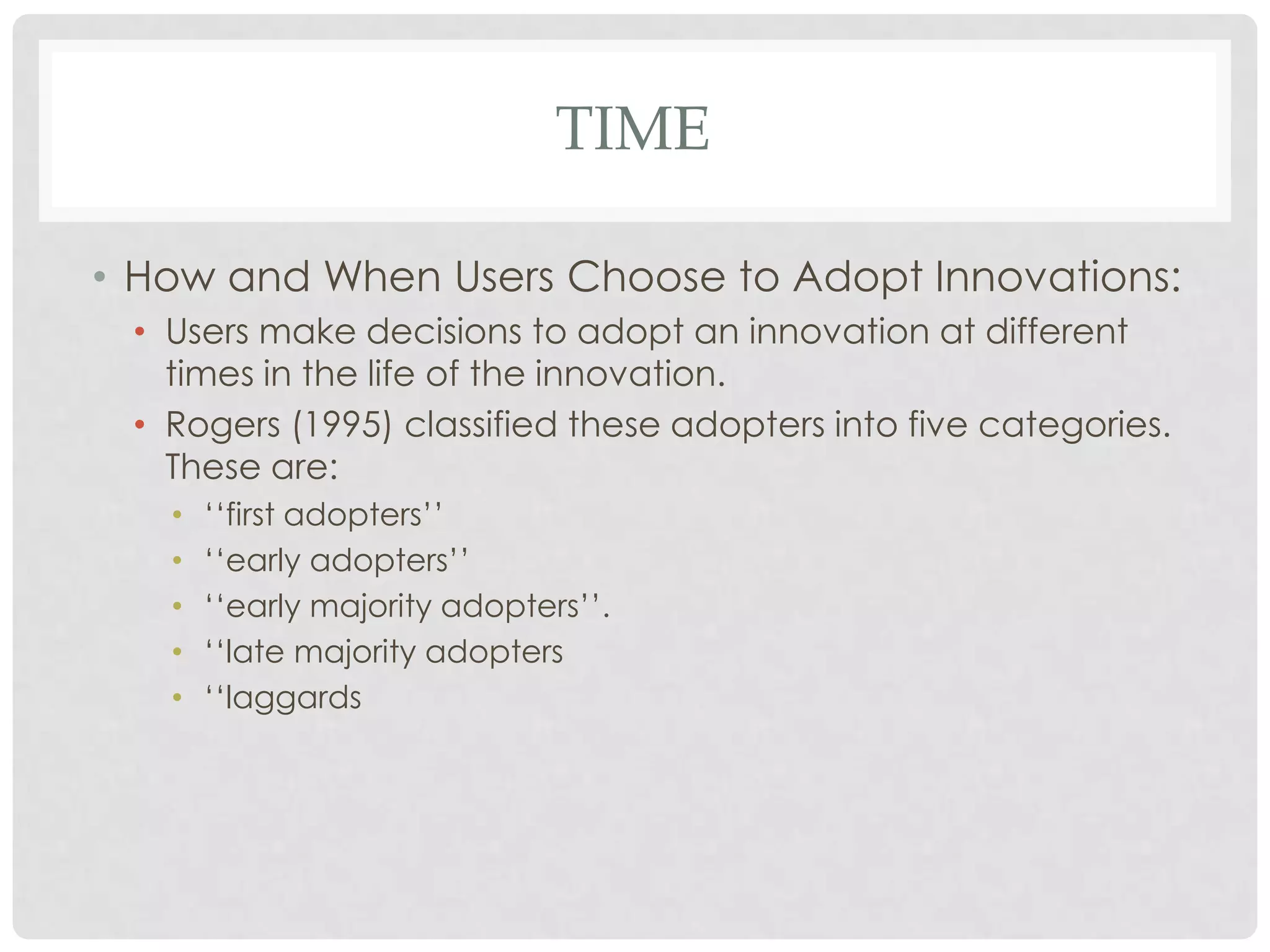
• How and When Users Choose to Adopt Innovations:
• Users make decisions to adopt an innovation at different
times in the life of the innovation.
• Rogers (1995) classified these adopters into five categories.
These are:
• ‘‘first adopters’’
• ‘‘early adopters’’
• ‘‘early majority adopters’’.
• ‘‘late majority adopters
• ‘‘laggards
SOCIAL SYSTEM
• Relationships Between Users and Implementers:
• i.e. networks and relationships between the members of our
target audience.
• Opinion leaders can influence the success of the innovation
implementation
• Identifying the opinion leaders and other stakeholders early in
the implementation-planning process will identify one group to
target with communications.
• Identify the various networks in the social system that can help
communicate information about the instructional intervention.
These networks of people, however, may also resist the
adoption process.
• Understanding the role of the
innovation, communication, time, and the social system can
help us develop a plan for implementing our product
(Malopinsky & Osman, 2006).
THE CLER MODEL
• The implementation strategy is a means of specifying how to
communicate information about an instructional product and to whom.
• One strategy for preparing an implementation plan is Bhola’s (1982, 1988–
1989) CLER model.
• CLER is an acronym for:
• Configuration
• Linkages
• Environment
• Resources
• These components are used to facilitate the diffusion and adoption
processes to implement an innovation.
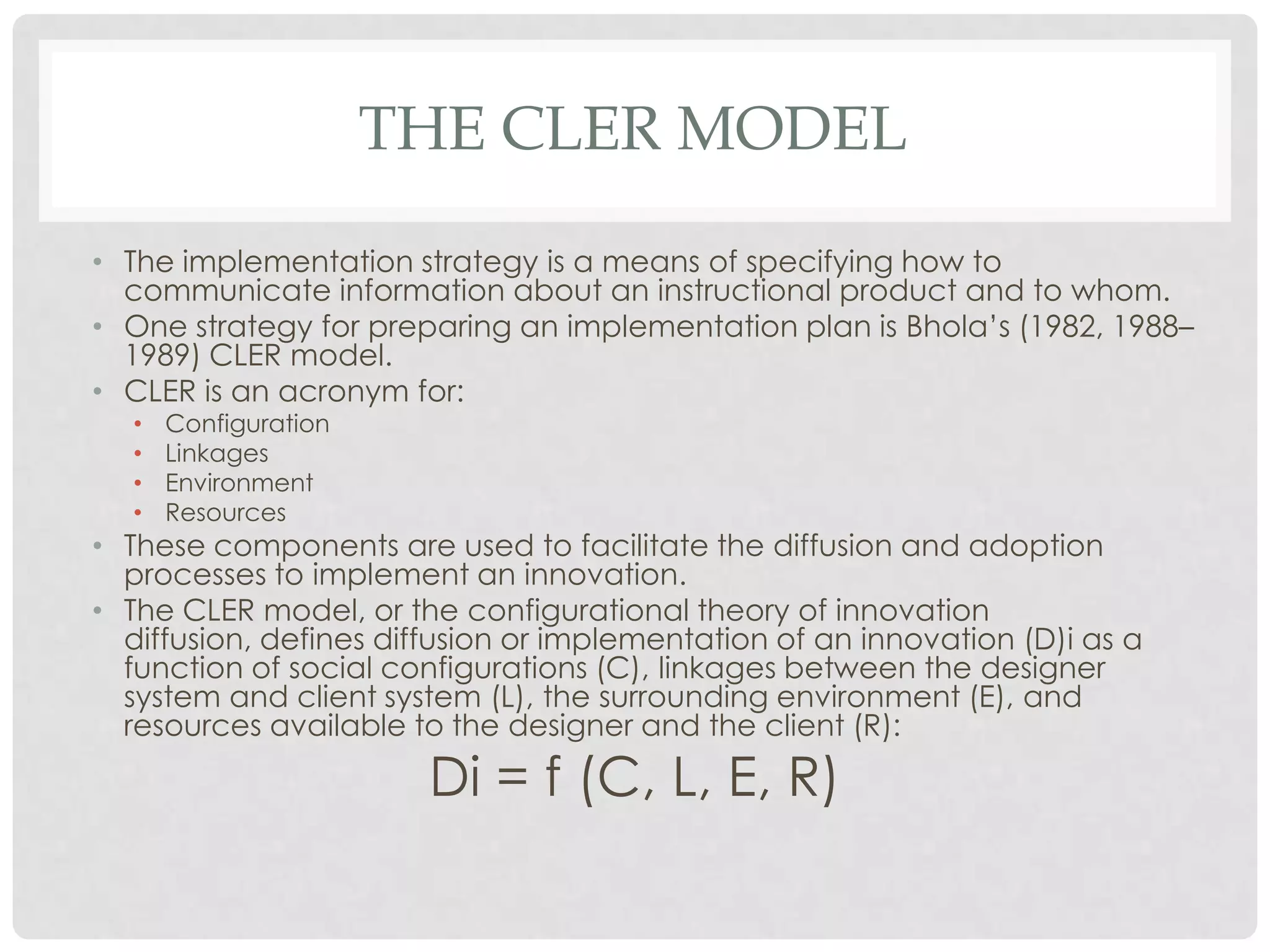
• The CLER model, or the configurational theory of innovation
diffusion, defines diffusion or implementation of an innovation (D)i as a
function of social configurations (C), linkages between the designer
system and client system (L), the surrounding environment (E), and
resources available to the designer and the client (R):
Di = f (C, L, E, R)
CONFIGURATION
• Configuration represents the network of
relationships of various social units in the
organization and the individuals who play a variety
of formal and informal roles in the ‘‘in’’ group. These
relationships include:
• the designer system.
• The designer system includes the instructional designer,
• the evaluator, and
• the manager of the instructional design department.
• The client system includes:
CONFIGURATION
• the target audience as well as the managers and other
stakeholders.
• Identifying these configurational relationships and
the roles of the various individuals helps us to
develop a communication plan for the
implementation strategy.
• There are four types of configurational relationships:
• individuals,
• groups,
• institutions, and
• cultures.
CONFIGURATION
• Groups are formal workgroups within an
organization such as the accounting department or
the electricians.
• Institutions are formal organizations such as
businesses or schools.
• Culture describes subcultures or communities.
CONFIGURATION
• For preparing an implementation plan, the
configuration includes both the instructional
designer (e.g., innovator) and the client, or
adopters.
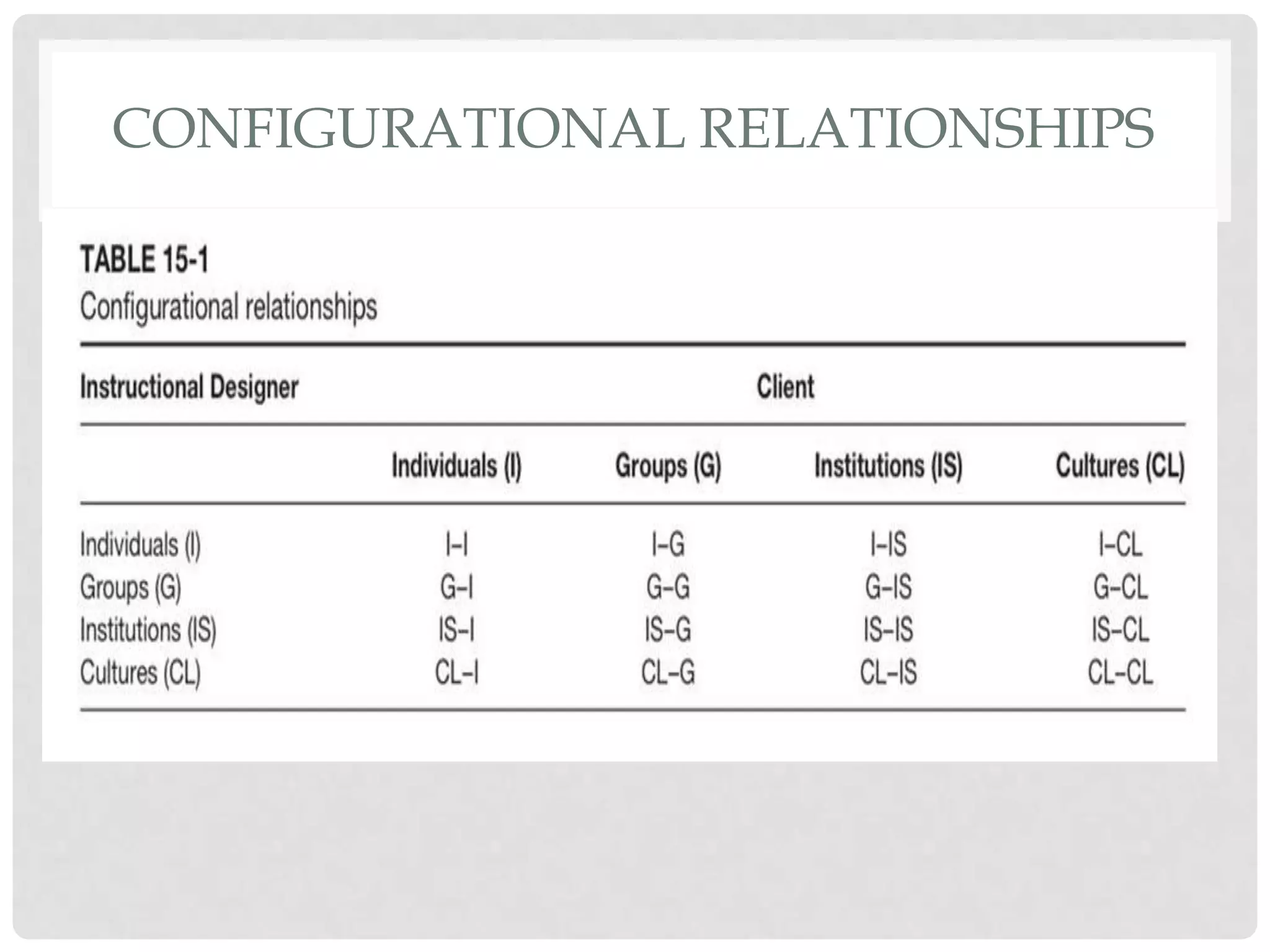
• Using the four types of configurations, Bhola (1982)
identifies 16 possible relationships (Table 15-1).
• Table 15-1 lists the various configurational
relationships for interactions between the
instructional designer and the client.
• Although Bhola (1982) identified 16 possible
configurations, the most effective are those that are
one-on-one.
CONFIGURATIONAL RELATIONSHIPS
LINKAGES
• Linkages represent networks or relationships
between and within the instructional designer and
client organizations.
• Formal linkages exist within the context of the group
and institutional configurations as defined by the
management structure.
• Informal linkages result from
partnerships, friendships, and working relationships.
These informal relationships often bypass traditional
organizational structure.
ENVIRONMENT
• The environment represents the physical, social, and
intellectual forces operating within a configuration.
• Environmental forces can provide a supportive, neutral, or
inhibiting atmosphere for adopting an innovation.
• Consider, for example, a school that wants to provide students
with their own laptop computers they can use in each
classroom. A new school could create a supportive
environment by providing training and readily available
technical support for the teachers. An older school might
have a more difficult time due to the physical environment.
For example, a lack of electrical outlets placed around the
room could make it difficult to charge the batteries during
class. Similarly, the desks or tables may not be ergonomically
correct or of the right size to hold the laptops. These
environmental variables could hinder the plan’s adoption.
RESOURCES
• Resources are used to support the implementation
process. There are six types of resources an
instructional designer can use to support the
implementation of a project (Bhola, 1982)
CONCEPTUAL RESOURCES.
• Technical skills and support are one type of conceptual
resource that is often needed for implementing projects
involving the use of technology.
• Consider the technical support needed to offer a
database administrators’ course at a hotel. The course
needs computers, software, and access to the
company’s intranet.
• Successful implementation of this course requires
networking and technical expertise from a variety of
individuals.
• Other conceptual resources include management
abilities and planning assistance.
INFLUENCE RESOURCES.
• Goodwill, brand names, incentives, shaming, and
threatening are examples of influence resources
one can use in the diffusion of an innovation.
• An instructional designer who has developed
goodwill during the development phase will have a
resource to act on with the client.
• Other types of influence resources include
incentives such as bonuses or monetary incentives;
for faculty, release time from teaching a course;
and travel benefits.
• Negative-influence resources could include the
withholding of monetary or promotional incentives.
MATERIAL RESOURCES
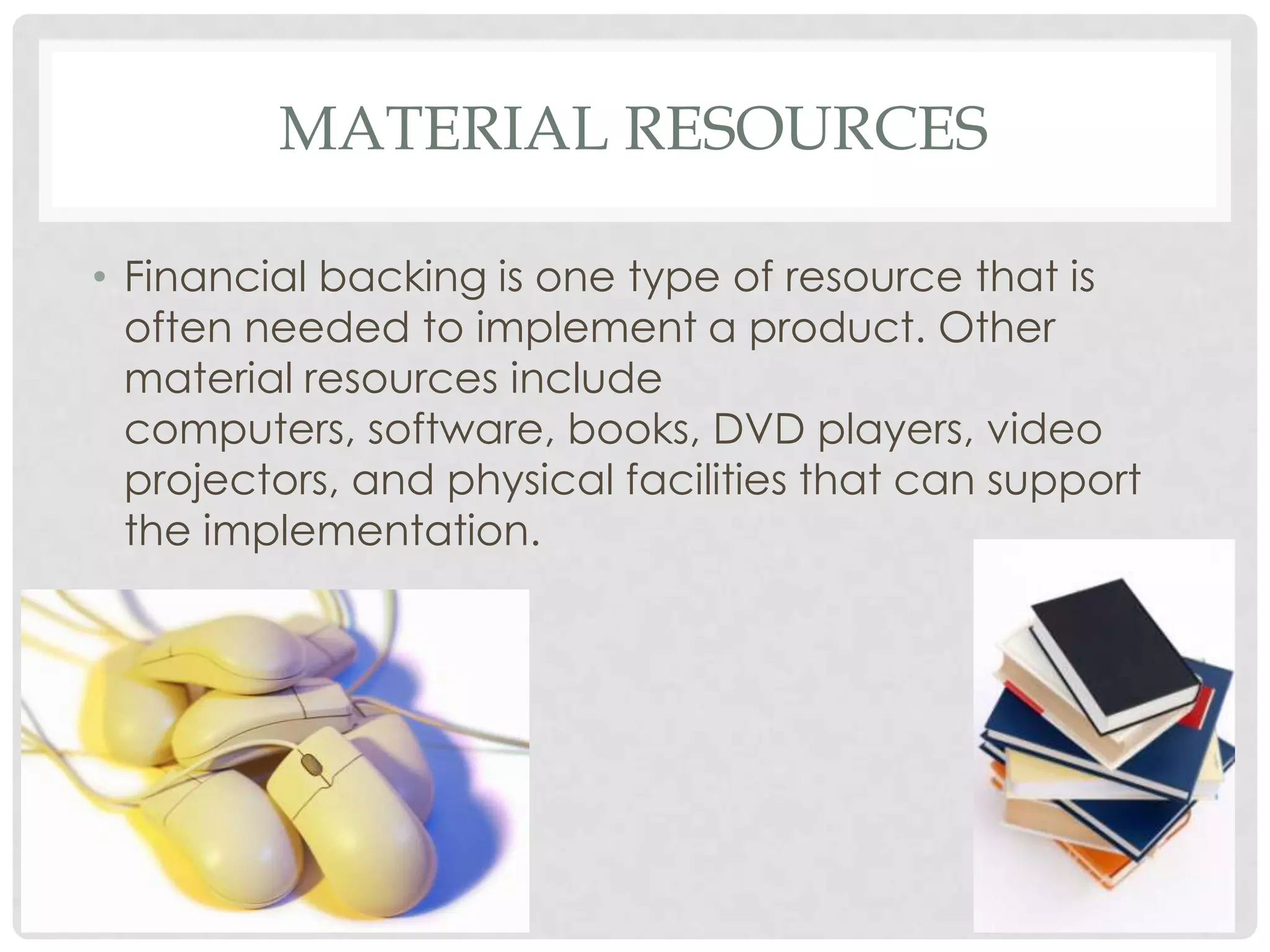
• Financial backing is one type of resource that is
often needed to implement a product. Other
material resources include
computers, software, books, DVD players, video
projectors, and physical facilities that can support
the implementation.
PERSONNEL RESOURCES
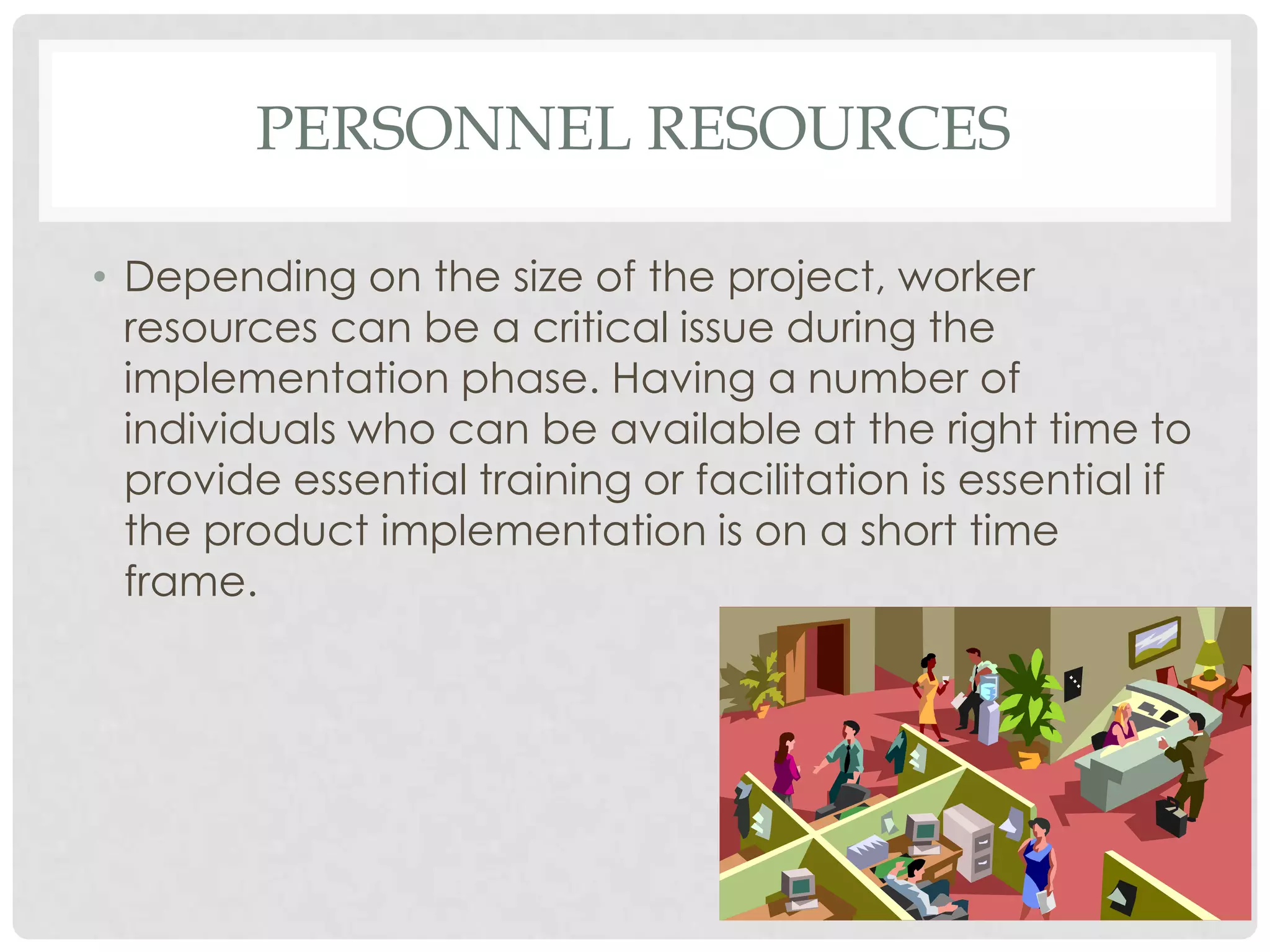
• Depending on the size of the project, worker
resources can be a critical issue during the
implementation phase. Having a number of
individuals who can be available at the right time to
provide essential training or facilitation is essential if
the product implementation is on a short time
frame.
INSTITUTIONAL RESOURCES
• The infrastructure provided by the institution including both the
technology/communication and personnel infrastructure is
considered an institutional resource.
• Other resources can include institutional capabilities, such as
printing and shipping instructional materials.
• For Web-based instruction, a server on either the Internet or
intranet is considered an institutional resource necessary for
implementation.
• Consider again the introduction of laptop computers. A new
school could provide tables for using the laptops that have
built-in electrical outlets and network connections. An older
school’s building could inhibit the use of laptops because the
individual desks are too small to hold the laptops and there
are only one or two electrical outlets in the room and a single
network connection on the front wall.
TIME RESOURCE.
• It can take time for all the users to adopt a product.
The time needed for the implementation must
consider all the adopters, from the innovators to the
laggards. Trying to implement the program in an
unreasonably short time frame can result in poor
results.
PLANNING THE IMPLEMENTATION
WITH THE CLER MODEL
• An implementation plan identifies the various
configurational relationships and then identifies
ways to manipulate and capitalize on the
configurations to facilitate the process.
IMPLEMENTATION PLAN
COMPONENTS
• Implementation Plan according to CLER:
• Configuration and Linkages
• Environment
• Resources
• First Course Offerings
DEVELOPMENTAL STAGES AND
INFORMATIONDECISION PROCESS
MODELS
• The Concerns-Based Adoption Model (CBAM) (Hall
& Hord, 1987; Hord, Ruther- ford, Huling-Austin, &
Hall, 1987; Newhouse, 2001) and information-
decision process models (Dormant, 1986;
Dormant, 1999; Rogers, 1995) describe sequential
stages that an individual uses to investigate an
innovation and decide whether to adopt or reject
it.
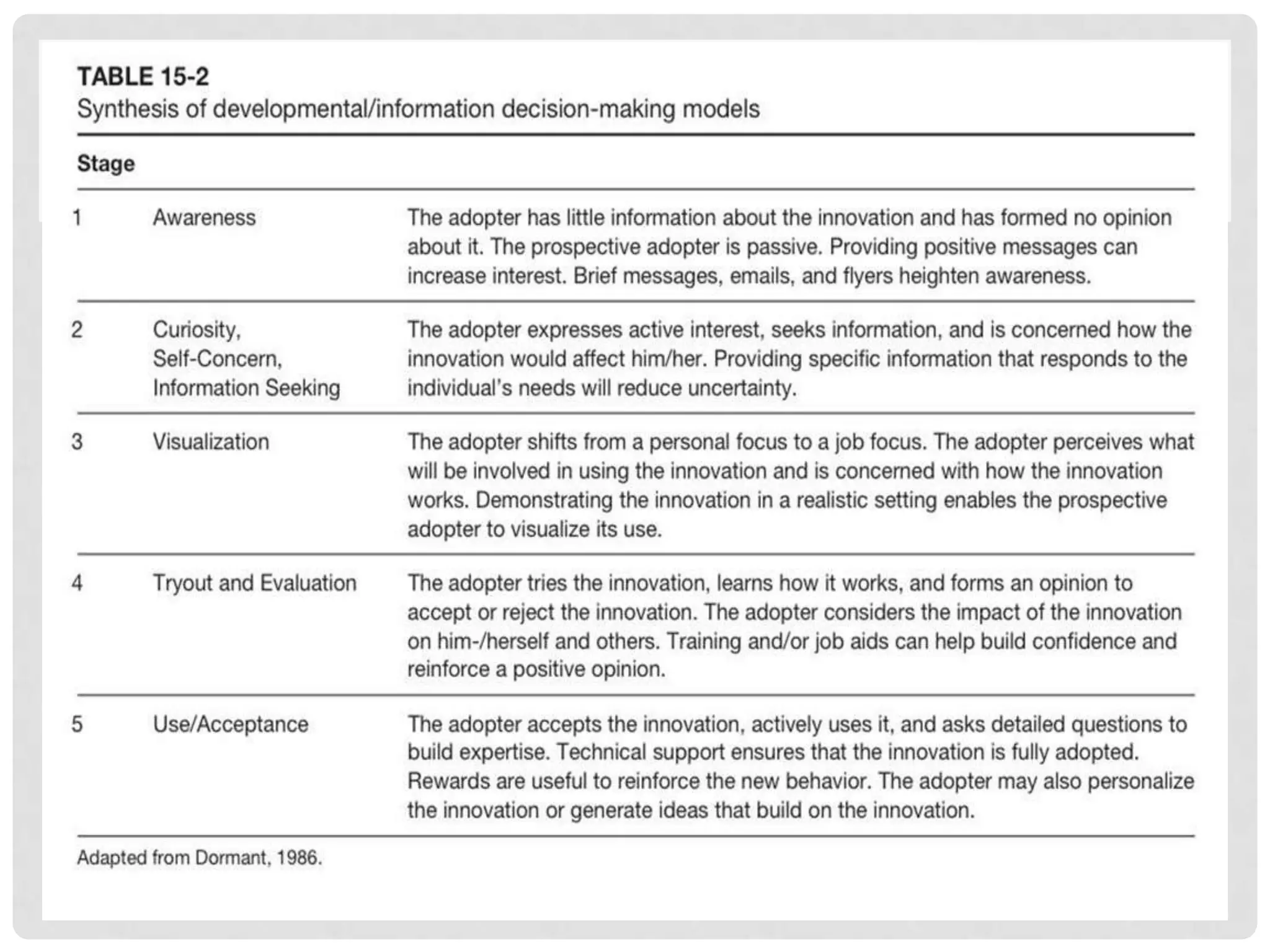
• Table 15-2 synthesizes the stages of acceptance.
• For CBAM, the individual is initially concerned with
what the change is and how it will personally affect
him or her.
• The concerns are informational and personal.
DEVELOPMENTAL STAGES AND
INFORMATIONDECISION PROCESS
MODELS
• The next stage is managerial: understanding the
mechanics of the change, or ‘‘how to do it.’’
• The last stages of concern consider consequences and
collaboration.
• In these later stages, the prospective adopter evaluates
whether the change is effective and generates new
ideas that refocus the innovation.
• An individual must feel a sense of control; otherwise the
change probably will be resisted (Conner, 1992; King &
Anderson, 1995). Participation and involvement of
supervisors and SMEs can increase a sense of control as
well as reduce uncertainty (see Cummings &
Worley, 2005).
IMPLEMENTATION DECISIONS
• A training program in industry requires an
infrastructure to implement and deliver instruction.
The following sections describe the implementation
decisions related to instructional
delivery, instructional materials, scheduling, and
instructors.
• Program Promotion: Often, the instructional designer is
responsible for program promotion. This may involve preparing
advertising for the employee newsletter, sending a
promotional email announcement to supervisors, or posting
flyers in the employee lunchroom. The instructional designer
may also meet with the human resources department to
ensure that the course is included for consideration in
employee development plans. Once the course is
implemented, the instructional designer might request that the
communications department write a feature story for inclusion
in internal publications describing how employees have
benefited from the course and how the course has
contributed toward organizational goals.
• Instructional Delivery: Some training departments have a
support person or group that manages the delivery of the
instruction. The complexity of this task grows with the number
of different sites and the number of courses offered.
• Classroom Facilities:
• Schedule and Reserve Location
• Training rooms at a company, university, or school are often
booked months in advance.
• Ensure you carefully decided on your room type.
• Include equipment resources list in your reservations
• Media Equipment:
• Make Arrangements for media equipment, such as DVD
players and video projectors,
• Visit the classroom before because this helps with getting a
sense of layout and placement of resources.
• If technology is to be used, involve the Information
Technology/Networking staff in the planning process
• Other Equipment:
• Document other equipment needs such as photocopiers, electrical tools etc.
• Transportation:
• Make providence for transport to the course
• There are two levels of transportation planning.
• First is transportation from the learner’s home to the training site, which might require air
transportation and either a shuttle service or rental car. This level also includes
transportation for instructors and guest speakers.
• Second is group transportation for field trips during the course. Buses or vans from either
the company car pool or from a private company are options for field-trip transportation.
• Housing: Some companies have training facilities resembling a small
college campus that include not only classrooms but also dormitories
and cafeterias. Other options include using a hotel that can also provide
the training rooms. Again, these facilities must be scheduled in advance.
• Food
• Make arrangements for meals/snacks etc. for the duration of the instructional
implementation
• Materials:
• Coordinating the instructional materials for a course can
require a substantial amount of time. Ensure ample time is
given for packaging, duplication, shipping etc.
INSTRUCTORS
• The last implementation decision concerns the
instructors.
• The two primary issues of concern are the
scheduling and training.
SCHEDULING
• Some companies have a group of professional
instructors or rotate employee experts through the
training department to serve as instructors.
• For example, expert company engineers might serve as
instructors for the network-engineering course described earlier
in this chapter.
• Regardless of the source of the instructors, careful
planning is required to schedule their time.
• Using company experts as instructors assumes that their
manager will allow them to leave their job several times
a year to teach a course.
• Scheduling a course requires consideration of their
workload to minimize the impact on their productivity.
INSTRUCTOR TRAINING
• There are three reasons to provide instructor
training.
• First is to improve the instructors’ teaching and presentation
skills.
• Second is to train instructors on how to teach a specific
course.
• Last, instructor training ensures that all instructors consistently
facilitate the course the same way.
ROLE OF SUPERVISORS
• Supervisors play an important role in preparing employees for
training.
• Supervisor involvement increases the likelihood that the
employee will learn what is expected.
• Ideally, the supervisor should meet with the employee prior to
the training to discuss learning goals and after the training to
review what was learned.
• During the meeting, the supervisor also makes clear what the
employee is expected to do on the job (see
Zenger, Folkman, & Sherman, 2006).
• Supervisor follow-up reinforces new behaviors. In some
organizations, the instructional designer provides a briefing
guide (or sends an email) to supervisors outlining their support
role and a set of key points to discuss before and after the
employee attends training.
Planning for instructional implementation

Planning for instructional implementation

  • 1.
    S O UR C E : M O R R I S O N , G A R Y R . D E S I G N I N G E F F E C T I V E I N S T R U C T I O N , 6 T H E D I T I O N . J O H N W I L E Y & S O N S PLANNING FOR INSTRUCTIONAL IMPLEMENTATION
  • 2.
    QUESTIONS TO CONSIDER •What is planned change? • How do I develop a plan for implementing my project? • What resources can I use to implement a project? • What else must I consider when implementing a project?
  • 4.
    PLANNED CHANGE • TheAdoption of new innovations can be seen as an organizational change. • New instruction involves changing the perceptions of users. • Bhola (1982) labeled this process planned change. • Selling the new innovation to users can be seen as Diffusion. • Diffusion is the process of communicating information to a client and target audience about an innovation (i.e., an instructional intervention) (Rogers, 2003). • Adoption is the decision to use the innovation. • According to Rogers, there are four components of the diffusion process: • the innovation • communication • time, and • social system.
  • 5.
    INNOVATION • An innovationis something new to an organization, manager, worker, teacher, or student who is considering using it. • When an Instructional innovation is produced, it seen as an innovation to users. • If and when the client or users decide to use the product or Instruction is dependent on the five characteristics of the intervention(Rogers, 2003).
  • 6.
    THE ADVANTAGE OFTHE INNOVATION • Merit of the Training: Each training product is judged on its relative merit. • Perception of the Training: If the users perceive it as providing useful knowledge, then they are more likely to adopt it. Although the training program might have many advantages and make an employee or student more productive, leading to monetary or efficiency rewards, the user has to perceive it as being advantageous.
  • 7.
    COMPATIBILITY WITH VALUES, NEEDS,AND EXPERIENCES • Alignment with User Values and Needs: • Users will evaluate a training program or instructional innovation to determine whether it is compatible with their values, matches their needs, and is compatible with what they have learned in the past. • For example, in recent years there has been a push for professors and teachers to adopt a more student-centered approach to their teaching. This approach requires the professor or teacher to change his or her role from that of a lecturer to one of a facilitator. Some may perceive this role shift as incompatible with their values—teachers need to lecture to teach the student.
  • 8.
    INNOVATION COMPLEXITY • Levelof Difficulty and Complexity: • If the users perceive the innovation as complex or difficult to use, they are more likely to resist using it. • perception of complexity can become a major obstacle to adoption of the innovation. • For example Consider the difficulty you might face implementing Web-based instruction for instructors who have limited experience with the Internet. If the software requires them to create pages using Hypertext Markup Language (HTML), participate in online chats, and create PowerPoint presentations with streaming video, they will probably view this innovation as too complex to adopt. • The complexity of such a system could cause the users to resist adopting it.
  • 9.
    ABILITY TO TRYTHE INNOVATION • User Attempt at Innovation Use: • Users often like to try an innovation on a small scale first. • For example, the Ministry of Education might identify a need to use a wireless network in the schools where all the students have laptop computers. Rather than purchasing equipment for all the schools, the network administrators might install this new innovation in one or two classrooms of schools to determine whether it will meet their needs. If it works, then the administrators may make the decision to install it in all the schools.
  • 10.
    OBSERVABILITY OF RESULTS •Visible Benefits: • A training program is more likely to be adopted when the users can easily see the benefits. • For example, if the managers of the accountants can see a benefit of the training for a new auditing software, they are more likely to send others to the training. However, if an accountant returns from the training and either refuses to use or seldom uses the new software, others will not see the benefits and may not attend the training. Also, if a critical mass of users is not trained, the training may become a wasted resource because those using the software will not have the support of management or other employees. • Communication of the Advantages of the Innovation: • As we plan an implementation strategy for a new instructional product, we must consider how to communicate the advantage of the product, its compatibility with existing ways, how the user can try it out with minimal risk, and how to make the results observable. We also must show that it is not a complex process
  • 11.
    COMMUNICATION • Communication iscentral to the diffusion process. • We have to communicate information about the innovation to potential users so they can decide to use it. • The most effective communication occurs between individuals who are similar, such as those belonging to the same peer group or having similar interests (Rogers, 2003). • For example, a designer needs to consider who could best communicate information on a new course for plant electricians. Is it the instructional designer, or is it the master electrician who served as the SME for the project who should communicate information about the course? The master electrician is a member of the group of electricians and probably has more in common with group members than the instructional designer. Selecting the master electrician to sell the course may be more productive than having the instructional designer sell it, because the electrician has more in common with the target group.
  • 12.
    TIME • How andWhen Users Choose to Adopt Innovations: • Users make decisions to adopt an innovation at different times in the life of the innovation. • Rogers (1995) classified these adopters into five categories. These are: • ‘‘first adopters’’ • ‘‘early adopters’’ • ‘‘early majority adopters’’. • ‘‘late majority adopters • ‘‘laggards
  • 13.
    SOCIAL SYSTEM • RelationshipsBetween Users and Implementers: • i.e. networks and relationships between the members of our target audience. • Opinion leaders can influence the success of the innovation implementation • Identifying the opinion leaders and other stakeholders early in the implementation-planning process will identify one group to target with communications. • Identify the various networks in the social system that can help communicate information about the instructional intervention. These networks of people, however, may also resist the adoption process. • Understanding the role of the innovation, communication, time, and the social system can help us develop a plan for implementing our product (Malopinsky & Osman, 2006).
  • 14.
    THE CLER MODEL •The implementation strategy is a means of specifying how to communicate information about an instructional product and to whom. • One strategy for preparing an implementation plan is Bhola’s (1982, 1988– 1989) CLER model. • CLER is an acronym for: • Configuration • Linkages • Environment • Resources • These components are used to facilitate the diffusion and adoption processes to implement an innovation. • The CLER model, or the configurational theory of innovation diffusion, defines diffusion or implementation of an innovation (D)i as a function of social configurations (C), linkages between the designer system and client system (L), the surrounding environment (E), and resources available to the designer and the client (R): Di = f (C, L, E, R)
  • 15.
    CONFIGURATION • Configuration representsthe network of relationships of various social units in the organization and the individuals who play a variety of formal and informal roles in the ‘‘in’’ group. These relationships include: • the designer system. • The designer system includes the instructional designer, • the evaluator, and • the manager of the instructional design department. • The client system includes:
  • 16.
    CONFIGURATION • the targetaudience as well as the managers and other stakeholders. • Identifying these configurational relationships and the roles of the various individuals helps us to develop a communication plan for the implementation strategy. • There are four types of configurational relationships: • individuals, • groups, • institutions, and • cultures.
  • 17.
    CONFIGURATION • Groups areformal workgroups within an organization such as the accounting department or the electricians. • Institutions are formal organizations such as businesses or schools. • Culture describes subcultures or communities.
  • 18.
    CONFIGURATION • For preparingan implementation plan, the configuration includes both the instructional designer (e.g., innovator) and the client, or adopters. • Using the four types of configurations, Bhola (1982) identifies 16 possible relationships (Table 15-1). • Table 15-1 lists the various configurational relationships for interactions between the instructional designer and the client. • Although Bhola (1982) identified 16 possible configurations, the most effective are those that are one-on-one.
  • 19.
  • 20.
    LINKAGES • Linkages representnetworks or relationships between and within the instructional designer and client organizations. • Formal linkages exist within the context of the group and institutional configurations as defined by the management structure. • Informal linkages result from partnerships, friendships, and working relationships. These informal relationships often bypass traditional organizational structure.
  • 21.
    ENVIRONMENT • The environmentrepresents the physical, social, and intellectual forces operating within a configuration. • Environmental forces can provide a supportive, neutral, or inhibiting atmosphere for adopting an innovation. • Consider, for example, a school that wants to provide students with their own laptop computers they can use in each classroom. A new school could create a supportive environment by providing training and readily available technical support for the teachers. An older school might have a more difficult time due to the physical environment. For example, a lack of electrical outlets placed around the room could make it difficult to charge the batteries during class. Similarly, the desks or tables may not be ergonomically correct or of the right size to hold the laptops. These environmental variables could hinder the plan’s adoption.
  • 22.
    RESOURCES • Resources areused to support the implementation process. There are six types of resources an instructional designer can use to support the implementation of a project (Bhola, 1982)
  • 23.
    CONCEPTUAL RESOURCES. • Technicalskills and support are one type of conceptual resource that is often needed for implementing projects involving the use of technology. • Consider the technical support needed to offer a database administrators’ course at a hotel. The course needs computers, software, and access to the company’s intranet. • Successful implementation of this course requires networking and technical expertise from a variety of individuals. • Other conceptual resources include management abilities and planning assistance.
  • 24.
    INFLUENCE RESOURCES. • Goodwill,brand names, incentives, shaming, and threatening are examples of influence resources one can use in the diffusion of an innovation. • An instructional designer who has developed goodwill during the development phase will have a resource to act on with the client. • Other types of influence resources include incentives such as bonuses or monetary incentives; for faculty, release time from teaching a course; and travel benefits. • Negative-influence resources could include the withholding of monetary or promotional incentives.
  • 25.
    MATERIAL RESOURCES • Financialbacking is one type of resource that is often needed to implement a product. Other material resources include computers, software, books, DVD players, video projectors, and physical facilities that can support the implementation.
  • 26.
    PERSONNEL RESOURCES • Dependingon the size of the project, worker resources can be a critical issue during the implementation phase. Having a number of individuals who can be available at the right time to provide essential training or facilitation is essential if the product implementation is on a short time frame.
  • 27.
    INSTITUTIONAL RESOURCES • Theinfrastructure provided by the institution including both the technology/communication and personnel infrastructure is considered an institutional resource. • Other resources can include institutional capabilities, such as printing and shipping instructional materials. • For Web-based instruction, a server on either the Internet or intranet is considered an institutional resource necessary for implementation. • Consider again the introduction of laptop computers. A new school could provide tables for using the laptops that have built-in electrical outlets and network connections. An older school’s building could inhibit the use of laptops because the individual desks are too small to hold the laptops and there are only one or two electrical outlets in the room and a single network connection on the front wall.
  • 28.
    TIME RESOURCE. • Itcan take time for all the users to adopt a product. The time needed for the implementation must consider all the adopters, from the innovators to the laggards. Trying to implement the program in an unreasonably short time frame can result in poor results.
  • 29.
    PLANNING THE IMPLEMENTATION WITHTHE CLER MODEL • An implementation plan identifies the various configurational relationships and then identifies ways to manipulate and capitalize on the configurations to facilitate the process.
  • 30.
    IMPLEMENTATION PLAN COMPONENTS • ImplementationPlan according to CLER: • Configuration and Linkages • Environment • Resources • First Course Offerings
  • 31.
    DEVELOPMENTAL STAGES AND INFORMATIONDECISIONPROCESS MODELS • The Concerns-Based Adoption Model (CBAM) (Hall & Hord, 1987; Hord, Ruther- ford, Huling-Austin, & Hall, 1987; Newhouse, 2001) and information- decision process models (Dormant, 1986; Dormant, 1999; Rogers, 1995) describe sequential stages that an individual uses to investigate an innovation and decide whether to adopt or reject it. • Table 15-2 synthesizes the stages of acceptance. • For CBAM, the individual is initially concerned with what the change is and how it will personally affect him or her. • The concerns are informational and personal.
  • 32.
    DEVELOPMENTAL STAGES AND INFORMATIONDECISIONPROCESS MODELS • The next stage is managerial: understanding the mechanics of the change, or ‘‘how to do it.’’ • The last stages of concern consider consequences and collaboration. • In these later stages, the prospective adopter evaluates whether the change is effective and generates new ideas that refocus the innovation. • An individual must feel a sense of control; otherwise the change probably will be resisted (Conner, 1992; King & Anderson, 1995). Participation and involvement of supervisors and SMEs can increase a sense of control as well as reduce uncertainty (see Cummings & Worley, 2005).
  • 34.
    IMPLEMENTATION DECISIONS • Atraining program in industry requires an infrastructure to implement and deliver instruction. The following sections describe the implementation decisions related to instructional delivery, instructional materials, scheduling, and instructors.
  • 35.
    • Program Promotion:Often, the instructional designer is responsible for program promotion. This may involve preparing advertising for the employee newsletter, sending a promotional email announcement to supervisors, or posting flyers in the employee lunchroom. The instructional designer may also meet with the human resources department to ensure that the course is included for consideration in employee development plans. Once the course is implemented, the instructional designer might request that the communications department write a feature story for inclusion in internal publications describing how employees have benefited from the course and how the course has contributed toward organizational goals. • Instructional Delivery: Some training departments have a support person or group that manages the delivery of the instruction. The complexity of this task grows with the number of different sites and the number of courses offered.
  • 36.
    • Classroom Facilities: •Schedule and Reserve Location • Training rooms at a company, university, or school are often booked months in advance. • Ensure you carefully decided on your room type. • Include equipment resources list in your reservations • Media Equipment: • Make Arrangements for media equipment, such as DVD players and video projectors, • Visit the classroom before because this helps with getting a sense of layout and placement of resources. • If technology is to be used, involve the Information Technology/Networking staff in the planning process
  • 37.
    • Other Equipment: •Document other equipment needs such as photocopiers, electrical tools etc. • Transportation: • Make providence for transport to the course • There are two levels of transportation planning. • First is transportation from the learner’s home to the training site, which might require air transportation and either a shuttle service or rental car. This level also includes transportation for instructors and guest speakers. • Second is group transportation for field trips during the course. Buses or vans from either the company car pool or from a private company are options for field-trip transportation. • Housing: Some companies have training facilities resembling a small college campus that include not only classrooms but also dormitories and cafeterias. Other options include using a hotel that can also provide the training rooms. Again, these facilities must be scheduled in advance. • Food • Make arrangements for meals/snacks etc. for the duration of the instructional implementation
  • 38.
    • Materials: • Coordinatingthe instructional materials for a course can require a substantial amount of time. Ensure ample time is given for packaging, duplication, shipping etc.
  • 39.
    INSTRUCTORS • The lastimplementation decision concerns the instructors. • The two primary issues of concern are the scheduling and training.
  • 40.
    SCHEDULING • Some companieshave a group of professional instructors or rotate employee experts through the training department to serve as instructors. • For example, expert company engineers might serve as instructors for the network-engineering course described earlier in this chapter. • Regardless of the source of the instructors, careful planning is required to schedule their time. • Using company experts as instructors assumes that their manager will allow them to leave their job several times a year to teach a course. • Scheduling a course requires consideration of their workload to minimize the impact on their productivity.
  • 41.
    INSTRUCTOR TRAINING • Thereare three reasons to provide instructor training. • First is to improve the instructors’ teaching and presentation skills. • Second is to train instructors on how to teach a specific course. • Last, instructor training ensures that all instructors consistently facilitate the course the same way.
  • 42.
    ROLE OF SUPERVISORS •Supervisors play an important role in preparing employees for training. • Supervisor involvement increases the likelihood that the employee will learn what is expected. • Ideally, the supervisor should meet with the employee prior to the training to discuss learning goals and after the training to review what was learned. • During the meeting, the supervisor also makes clear what the employee is expected to do on the job (see Zenger, Folkman, & Sherman, 2006). • Supervisor follow-up reinforces new behaviors. In some organizations, the instructional designer provides a briefing guide (or sends an email) to supervisors outlining their support role and a set of key points to discuss before and after the employee attends training.

Editor's Notes

  • #12 CommunicationCommunication is central to the diffusion process. We have to communicate infor- mation about the innovation to potential users so they can decide to use it. Although the instructional designer can prepare materials such as informative memos and presentations, the designer might not be the best individual to communicate the information or ‘‘advertise’’ the course. The most effective communication occurs between individuals who are similar, such as those belonging to the same peer group or having similar interests (Rogers, 2003). For example, a designer needs to consider who could best communicate information on a new course for plant electricians. Is it the instructional designer, or is it the master electrician who served as the SME for the project who should communicate information about the course? The master electrician is a member of the group of electricians and probably has more in common with group members than the instructional designer. Selecting the master electrician to sell the course may be more productive than having the instructional designer sell it, because the electrician has more in common with the target group. (Morrison 408)Morrison, Gary R. Designing Effective Instruction, 6th Edition. John Wiley & Sons, 022010. <vbk:9780470574089#page(408)>.
  • #13 How and When Users Choose to Adopt Innovations:Users make decisions to adopt an innovation at different times in the life of the innovation. You are probably familiar with an individual who is always the first to have the latest computer, television, or electronic gadget and also, on the other hand, an individual who still has a 13-inch black-and-white television. Rogers (1995) classified these adopters into five categories. The ‘‘first adopters’’ are the innovators who rush out to adopt innovations as soon as possible. Sometimes these first adopters are willing to accept prototypes or test versions of a product. The ‘‘early adopters’’ are the second group to adopt the innovation, often as soon as it is available in ‘‘commercial’’ form. The ‘‘early majority adopters’’ are the third group and comprise the first 50 percent to adopt the innovation. Fourth are the ‘‘late majority adopters’’ who adopt after it appears safe. The final group is the ‘‘laggards,’’ who are the last to adopt an innovation or perhaps never adopt it. The actual time frame for adoption varies depending on the nature of the instructional product. It is conceivable that the adoption cycle could be a week or less for a small project and upward of a year or more for a complex project.
  • #14 Social SystemThe social system describes the networks and relationships between the members of our target audience. Decisions to adopt a training program or instruction are typically influenced by the opinion leaders’ views about the consequences ofadopting the program. Identifying the opinion leaders and other stakeholders early in the implementation-planning process will identify one group to target with communications. At the same time, we must identify the various networks in the social system that can help communicate information about the instructional intervention. These networks of people, however, may also resist the adoption process. Understanding the role of the innovation, communication, time, and the social system can help us develop a plan for implementing our product (Malopinsky & Osman, 2006). In the next section, we examine how to use this information to develop an implementation plan. (Morrison 409)Morrison, Gary R. Designing Effective Instruction, 6th Edition. John Wiley & Sons, 022010. <vbk:9780470574089#page(409)>.
  • #16 Configuration represents the network of relationships of various social units in the organization and the individuals who play a variety of formal and informal roles in the ‘‘in’’ group. These relationships include the designer system and the client system. The designer system includes the instructional designer, the evaluator, and the manager of the instructional design department. The client system includes the target audience as well as the managers and other stakeholders. Identifying these configurational relationships and the roles of the various individuals helps us to develop a communication plan for the implementation strategy.There are four types of configurational relationships: individuals, groups, insti- tutions, and cultures. Groups are formal workgroups within an organization such as the accounting department or the electricians. Institutions are formal organizations such as businesses or schools. Culture describes subcultures or communities.For example, there may be several accounting, marketing, finance, and engineering groups in a business (i.e., institution). One group might include individuals from engineering, finance, and marketing. Engineers from all these
  • #17 Configuration represents the network of relationships of various social units in the organization and the individuals who play a variety of formal and informal roles in the ‘‘in’’ group. These relationships include the designer system and the client system. The designer system includes the instructional designer, the evaluator, and the manager of the instructional design department. The client system includes the target audience as well as the managers and other stakeholders. Identifying these configurational relationships and the roles of the various individuals helps us to develop a communication plan for the implementation strategy.There are four types of configurational relationships: individuals, groups, institutions, and cultures. Groups are formal workgroups within an organization such as the accounting department or the electricians. Institutions are formal organizations such as businesses or schools. Culture describes subcultures or communities.For example, there may be several accounting, marketing, finance, and engineering groups in a business (i.e., institution). One group might include individuals from engineering, finance, and marketing. Engineers from all these
  • #19 For example, there may be several accounting, marketing, finance, and engineering groups in a business (i.e., institution). One group might include individuals from engineering, finance, and marketing. Engineers from all these various groups also belong to an engineering subculture that is open only to engineers. For preparing an implementation plan, the configuration includes both the instructional designer (e.g., innovator) and the client, or adopters. Using the four types of configurations, Bhola (1982) identifies 16 possible relationships (Table 15-1).Table 15-1 lists the various configurational relationships for interactions between the instructional designer and the client. For example, the instructional designer could act as an individual on the various client relationships. Similarly, the instructional design group or department could act on the various client configurations.Although Bhola (1982) identified 16 possible configurations, the most effective are those that are one-on-one. Although you might identify several different relationships such as managers ‘‘in’’ with the accounting managers (a group), the most effective way to communicate information about your instructional product would be by having your manager talk individually to each of the accounting managers.
  • #21 Linkages represent networks or relationships between and within the instructional designer and client organizations.Formal linkages exist within the context of the group and institutional configurations as defined by the management structure. Informal linkages result from partnerships, friendships, and working relationships. These informal relationships often bypass traditional organizational structure. For example, consider a friendship between a vice president and a salesperson who happen to have children who take gymnastic lessons from the same coach. Although they both work for the same organization, the relationship is informal rather than formal. Identifying these different linkages can provide a rich source of communication links for the implementation plan.
  • #42 There are three reasons to provide instructor training. First is to improve the instructors’ teaching and presentation skills. In business, many of the individuals who serve as instructors have not had any formal training in teaching. One or more basic courses in presentation, facilitation, and teaching strategies can help them improve their skills. Second is to train instructors on how to teach a specific course. For example, the implementation plan for the network-engineering course example is to use the two SMEs as the instructors for the first six months. New instructors with the necessary technical knowledge and skills will be needed to conduct future courses. These new instructors may need to attend the course one or more times and receive tutoring or coaching to develop their technical expertise to teach the course. Last, instructor training ensures that all instructors consistently facilitate the course the same way.