Motivation INTC 5110 Fall 2010
Paradigms and Motivation Behaviorist view Rewards, reinforcements and punishments Cognitive Processing Internal cognition due to extrinsic rewards and consequences Can also be intrinsic – cognition based on internal drives
Paradigms and Motivation Objectivist view Find the motivation and provide it to the learner Constructivist view Each person has their own motivations based on meaning they associate Social Learning Contextual and cultural influences on what is valued and strength of motivation
Sources of Motivation Curiosity Variance of instruction Imagination/Fantasy Problems Choice Relevance
Goal Setting Set by Individual and/or Instructor? Explicit Better than General Increase in Difficulty Proximal (close & quick) over Distal (distant) Performance vs. Learning Motive Matching - aligned with learner motives
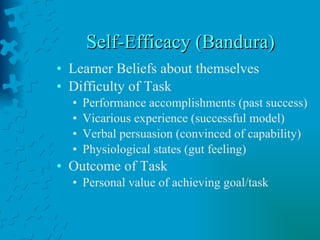
Self-Efficacy (Bandura) Learner Beliefs about themselves  Difficulty of Task Performance accomplishments (past success) Vicarious experience (successful model) Verbal persuasion (convinced of capability) Physiological states (gut feeling) Outcome of Task Personal value of achieving goal/task
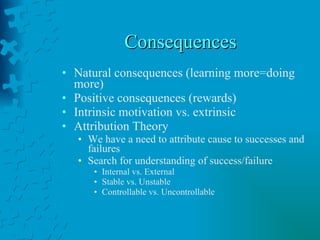
Consequences Natural consequences (learning more=doing more) Positive consequences (rewards) Intrinsic motivation vs. extrinsic Attribution Theory We have a need to attribute cause to successes and failures Search for understanding of success/failure Internal vs. External Stable vs. Unstable Controllable vs. Uncontrollable
Keller ARCS Model Here is one of the  original  publications of the model A resource is at  http://ide.ed.psu.edu/idde/ARCS.htm Another resource:  http://www.ericdigests.org/1998-1/motivation.htm
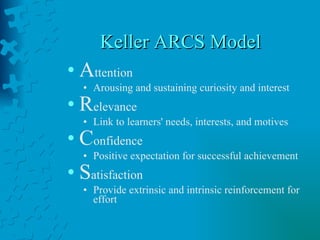
Keller ARCS Model A ttention Arousing and sustaining curiosity and interest  R elevance Link to learners' needs, interests, and motives  C onfidence Positive expectation for successful achievement  S atisfaction Provide extrinsic and intrinsic reinforcement for effort
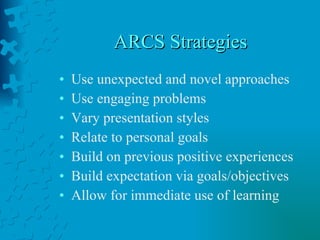
ARCS Strategies Use unexpected and novel approaches Use engaging problems Vary presentation styles Relate to personal goals Build on previous positive experiences Build expectation via goals/objectives Allow for immediate use of learning
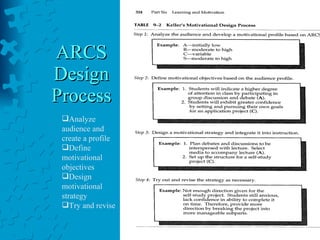
ARCS Design Process Analyze audience and create a profile Define motivational objectives Design motivational strategy Try and revise
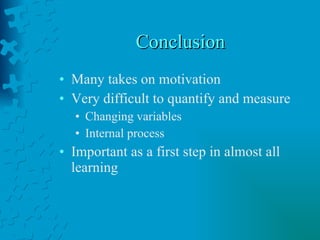
Conclusion Many takes on motivation Very difficult to quantify and measure Changing variables Internal process Important as a first step in almost all learning

Motivation

  • 1.
  • 2.
    Paradigms and MotivationBehaviorist view Rewards, reinforcements and punishments Cognitive Processing Internal cognition due to extrinsic rewards and consequences Can also be intrinsic – cognition based on internal drives
  • 3.
    Paradigms and MotivationObjectivist view Find the motivation and provide it to the learner Constructivist view Each person has their own motivations based on meaning they associate Social Learning Contextual and cultural influences on what is valued and strength of motivation
  • 4.
    Sources of MotivationCuriosity Variance of instruction Imagination/Fantasy Problems Choice Relevance
  • 5.
    Goal Setting Setby Individual and/or Instructor? Explicit Better than General Increase in Difficulty Proximal (close & quick) over Distal (distant) Performance vs. Learning Motive Matching - aligned with learner motives
  • 6.
    Self-Efficacy (Bandura) LearnerBeliefs about themselves Difficulty of Task Performance accomplishments (past success) Vicarious experience (successful model) Verbal persuasion (convinced of capability) Physiological states (gut feeling) Outcome of Task Personal value of achieving goal/task
  • 7.
    Consequences Natural consequences(learning more=doing more) Positive consequences (rewards) Intrinsic motivation vs. extrinsic Attribution Theory We have a need to attribute cause to successes and failures Search for understanding of success/failure Internal vs. External Stable vs. Unstable Controllable vs. Uncontrollable
  • 8.
    Keller ARCS ModelHere is one of the original publications of the model A resource is at http://ide.ed.psu.edu/idde/ARCS.htm Another resource: http://www.ericdigests.org/1998-1/motivation.htm
  • 9.
    Keller ARCS ModelA ttention Arousing and sustaining curiosity and interest R elevance Link to learners' needs, interests, and motives C onfidence Positive expectation for successful achievement S atisfaction Provide extrinsic and intrinsic reinforcement for effort
  • 10.
    ARCS Strategies Useunexpected and novel approaches Use engaging problems Vary presentation styles Relate to personal goals Build on previous positive experiences Build expectation via goals/objectives Allow for immediate use of learning
  • 11.
    ARCS Design ProcessAnalyze audience and create a profile Define motivational objectives Design motivational strategy Try and revise
  • 12.
    Conclusion Many takeson motivation Very difficult to quantify and measure Changing variables Internal process Important as a first step in almost all learning