Partial Differential
Equations-Formation
Suman Mathews
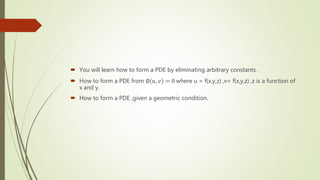
 You will learn how to form a PDE by eliminating arbitrary constants.
 How to form a PDE from ∅ 𝑢, 𝑣 = 0 where u = f(x,y,z) ,v= f(x,y,z) ,z is a function of
x and y.
 How to form a PDE ,given a geometric condition.
0
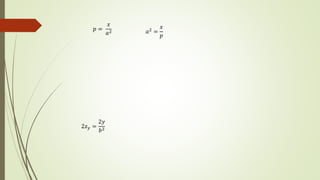
𝑝 =
𝑥
𝑎2
2𝑧 𝑦 =
2𝑦
𝑏2
𝑎2
=
𝑥
𝑝
 You have learnt how to form a PDE by eliminating arbitrary constants, using a given
geometric condition and using Chain Rule
 Practice along with me, every step, every line!
Secrets of solving a PDE-College math

Secrets of solving a PDE-College math

  • 1.
  • 2.
     You willlearn how to form a PDE by eliminating arbitrary constants.  How to form a PDE from ∅ 𝑢, 𝑣 = 0 where u = f(x,y,z) ,v= f(x,y,z) ,z is a function of x and y.  How to form a PDE ,given a geometric condition.
  • 6.
  • 11.
    𝑝 = 𝑥 𝑎2 2𝑧 𝑦= 2𝑦 𝑏2 𝑎2 = 𝑥 𝑝
  • 29.
     You havelearnt how to form a PDE by eliminating arbitrary constants, using a given geometric condition and using Chain Rule  Practice along with me, every step, every line!