BABASAHEB BHEEMRAO AMBEDKAR
UNIVERSITY
REGULATORY ASPECTS OF
PACKAGING
Presented by:- Submitted to:-
Neha Singh Subhini A. Sharaf
M.pharm 1st Sem
(Pharmaceutics)
CONTENTS-
1. Introduction
2. Definition of the pack
3. European Union processes for drug evaluation
4. CPMP report opinion
5. Legal requirements of labelling and packaging
6. USA procedure for drug evaluation
7. FDA packaging guideline
8. Format of NDA application
9. Packaging for clinical trials in the USA
INTRODUCTION
The pharmaceutical industry is one of the most highly
regulated industries
in the world ,Control is imposed on:
 how the product is developed (toxicology testing is
controlled through good laboratory practice (GLP); clinical
testing is controlled by good clinical practice (GCP)
 how the product is manufactured (through good
manufacturing practice (GMP)
 how the product is sold (through controls imposed
through the Product License Application (PLA)
 how the product is labeled (through the Labelling
Directive and summary of product characteristics
(SPC)
 how the product is advertised (through the
Advertising Directive)
 how the product is disposed of (by the Packaging
Waste Directive).
DEFINITION OF THE PACK
 The packaging technologist defines the pack as ‘a
device for carrying and protecting the product from
producer to user’, thus it is involved in containment,
convenience, compliance, and confidence
 The regulator, however, is interested in only some of
these aspects. In particular, the regulator sees the
pack as having the following characteristics:
1. product/ preparation related requirements :
 protection of the product
 protection of the consumer
 dosage control
2. label requirements
legal control of the product
informing the recipient
3. Environmental aspects
packaging waste
ozone depletion
4. Consumer protection
child-resistant closures
tamper-evidence.
TIME TO DEVELOP NEW DRUG
Activity Time (years)
Research 2
Toxicology 3
Development 3
Clinical 4
Registration ?
Total 12+
In regulatory terms the situation is not quite as bad as it
might appear. If we look at the world market, the EU
represents approximately 30% of the market, the US
approximately 27% and Japan approximately 18%. In
total this represents 75% of the total market.
REGULATORY AUTHORITIES—BACKGROUND
 The EU, although under criticism in many areas,
has been fairly successful in the pharmaceutical
area, with the following achievements:
 Centralized system in place
 Decentralized system in place
 harmonization of format
 expanding acceptance of format outside EU
 Harmonization of standards.
 The Food and Drug Administration (FDA) is
finally recognizing the competence of certain
overseas agencies and the skill of scientists, and
accepting more data that has been generated
overseas..
 Japan is becoming more international, with
several initiatives suggesting, in theory at least,
that data from overseas should be acceptable
within Japan.
EUROPEAN UNION PROCESSES FOR DRUG
EVALUATION
 The EU there are currently three processes by
which a drug can be approved for marketing.
 These are individual local applications to specific
countries, the decentralized system, (mutual
recognition route), and the centralized system.
 Local applications :- For products intended for
a single country a local application can be made.
 Since 1 January 1998 any subsequent
application to a second country must be made
through the decentralized system.
DECENTRALIED SYSTEM (MUTUAL
RECOGNITION)
 The de-centralized system is, in effect, a system of
mutual recognition.
 An application is first made in a single country and
when approved the application, translated in certain
aspects, along with the assessment report prepared by
the regulatory agency, is sent to the other countries.
Each country then has a limited time to accept the
application and assessment report or to provide
reasoned objections.
If the objections cannot be resolved by bilateral discussion
then the application is referred to the CPMP for a
binding recommendation,
CENTRALIZED SYSTEM
 It was recognized that certain products, such as
biotechnology products, were taking a considerable
period to become registered in Europe because of
their complexity and the absence of skills to
evaluate them in certain countries .
 A central scheme was therefore set up where by a
single evaluation of the application is made and a
recommendation for approval issued by the CPMP
followed by issue of a single license issued by the
London-based European Medicines Evaluation
Agency (EMEA) for all the EU.
CONTINUE.......!!!!
 1 January 1995 this centralized procedure has been
mandatory for all products of biotechnology and
optional for projects which are very innovative such as
new chemical entities or new presentations of drugs.
 CPMP appoints one or two of its members to act as
reporteir to co-ordinate the assessment using the
facilities of the various regulatory agencies within
Europe.
 Once the evaluation reports are available the CPMP
makes an opinion within 210 days of receipt of the
application and a single license is then granted, valid
throughout the Union.
CPMP LIST OF ALLOWED TERMS
 Descriptive terms for pharmaceutical forms, routes of
administration, and packaging and delivery systems allowed
to be used in a Product Licence Application are now
prescribed by EU Regulations.
 It is hard to understand the value of this legislation except
in terms of the legal nature of the Product License
Application. It must be remembered that a product license
is more a legal than a truly technical document.
CPMP GUIDELINES III 9090
 IIA2 Immediate packaging
Description container including:
• nature of material (qualitative)
• description of closure
• method of opening
• information on container
• Description of tamper-evidence and child-resistant closure
 IIA4 Development pharmaceutics
Justification of choice of containers in terms of:
• stability of active ingredient and product
• method of administration
• sterilisation procedures.
Choice of plastic including information on:
• tightness of closure
• protection of contents against external factors
• container—contents interaction
• influence of manufacturing process.
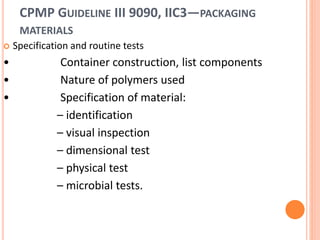
CPMP GUIDELINE III 9090, IIC3—PACKAGING
MATERIALS
 Specification and routine tests
• Container construction, list components
• Nature of polymers used
• Specification of material:
– identification
– visual inspection
– dimensional test
– physical test
– microbial tests.
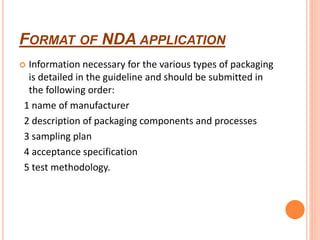
FORMAT OF NDA APPLICATION
 Information necessary for the various types of packaging
is detailed in the guideline and should be submitted in
the following order:
1 name of manufacturer
2 description of packaging components and processes
3 sampling plan
4 acceptance specification
5 test methodology.
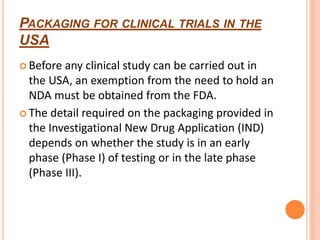
PACKAGING FOR CLINICAL TRIALS IN THE
USA
 Before any clinical study can be carried out in
the USA, an exemption from the need to hold an
NDA must be obtained from the FDA.
 The detail required on the packaging provided in
the Investigational New Drug Application (IND)
depends on whether the study is in an early
phase (Phase I) of testing or in the late phase
(Phase III).
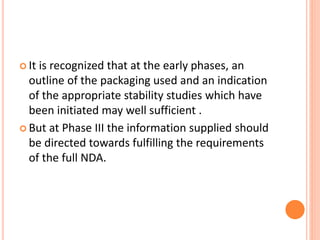
 It is recognized that at the early phases, an
outline of the packaging used and an indication
of the appropriate stability studies which have
been initiated may well sufficient .
 But at Phase III the information supplied should
be directed towards fulfilling the requirements
of the full NDA.
THE PACK AS CARRIER OF THE LABELLING
 The container cannot be separated from the product in
regulatory or technical terms, the container, label and
leaflet are also intimately connected, and in
pharmaceuticals the term ‘labeling’ generally includes
both the labels and any leaflet included with the
product.
 The term ‘label’ can mean the label on the immediate
container, the carton label, the outer label or the label
on the case or pallet.
THE FUNCTION OF LABELLING
 The function of the label and leaflet is to inform
the patient, to inform the
pharmacist/wholesaler/manufacturer, to control
the product in terms of its distribution and
medical aspects, and to reduce the risk of
product liability claims.
LABEL AND LEAFLET DIRECTIVE 92/27
 Label and leaflet directive 92/27 starts with a
definition of name of product, common name
and strength of product, immediate packaging,
outer packaging, labelling and manufacturer.
 When the immediate packaging takes the form
of a blister pack which is placed in an outer
package that complies with the provisions
above, then the blister pack reduced particulars,
but must show at least the name of the product,
the name of the holder of the authorization, the
expiry date and batch number.
Immediate packaging must contain:
• product name
• active ingredients
• pharmaceutical form and contents
• list of excepients
(all for ophthalmic or parenteral)
(any with recognizable effect)
• method and route of administration
• special warnings
• expiry date
• special precautions
• name and address of authorization holder
• authorization number
REFERENCE
 Lachman / Lieberman’s “ the theory and
practice of industrial pharmacy; published by
CBS publishers and distributors, ed.4th.
 Remington, The Science and Practice of
Pharmacy; published by Wolters Kluwer (India)
pvt. Ltd, ed.21 , vol 1
 Jain U.K. , Goupale D.C. ‘ Pharmaceutical
packaging technlogy’ ; PharmaMed Press.
THANK YOU….
9/7/2018
Queries……….?
??????/

Regulatory aspects of packaging

  • 1.
    BABASAHEB BHEEMRAO AMBEDKAR UNIVERSITY REGULATORYASPECTS OF PACKAGING Presented by:- Submitted to:- Neha Singh Subhini A. Sharaf M.pharm 1st Sem (Pharmaceutics)
  • 2.
    CONTENTS- 1. Introduction 2. Definitionof the pack 3. European Union processes for drug evaluation 4. CPMP report opinion 5. Legal requirements of labelling and packaging 6. USA procedure for drug evaluation 7. FDA packaging guideline 8. Format of NDA application 9. Packaging for clinical trials in the USA
  • 3.
    INTRODUCTION The pharmaceutical industryis one of the most highly regulated industries in the world ,Control is imposed on:  how the product is developed (toxicology testing is controlled through good laboratory practice (GLP); clinical testing is controlled by good clinical practice (GCP)  how the product is manufactured (through good manufacturing practice (GMP)  how the product is sold (through controls imposed through the Product License Application (PLA)
  • 4.
     how theproduct is labeled (through the Labelling Directive and summary of product characteristics (SPC)  how the product is advertised (through the Advertising Directive)  how the product is disposed of (by the Packaging Waste Directive).
  • 5.
    DEFINITION OF THEPACK  The packaging technologist defines the pack as ‘a device for carrying and protecting the product from producer to user’, thus it is involved in containment, convenience, compliance, and confidence  The regulator, however, is interested in only some of these aspects. In particular, the regulator sees the pack as having the following characteristics: 1. product/ preparation related requirements :  protection of the product  protection of the consumer  dosage control
  • 6.
    2. label requirements legalcontrol of the product informing the recipient 3. Environmental aspects packaging waste ozone depletion 4. Consumer protection child-resistant closures tamper-evidence.
  • 7.
    TIME TO DEVELOPNEW DRUG Activity Time (years) Research 2 Toxicology 3 Development 3 Clinical 4 Registration ? Total 12+ In regulatory terms the situation is not quite as bad as it might appear. If we look at the world market, the EU represents approximately 30% of the market, the US approximately 27% and Japan approximately 18%. In total this represents 75% of the total market.
  • 8.
    REGULATORY AUTHORITIES—BACKGROUND  TheEU, although under criticism in many areas, has been fairly successful in the pharmaceutical area, with the following achievements:  Centralized system in place  Decentralized system in place  harmonization of format  expanding acceptance of format outside EU  Harmonization of standards.
  • 9.
     The Foodand Drug Administration (FDA) is finally recognizing the competence of certain overseas agencies and the skill of scientists, and accepting more data that has been generated overseas..  Japan is becoming more international, with several initiatives suggesting, in theory at least, that data from overseas should be acceptable within Japan.
  • 10.
    EUROPEAN UNION PROCESSESFOR DRUG EVALUATION  The EU there are currently three processes by which a drug can be approved for marketing.  These are individual local applications to specific countries, the decentralized system, (mutual recognition route), and the centralized system.  Local applications :- For products intended for a single country a local application can be made.  Since 1 January 1998 any subsequent application to a second country must be made through the decentralized system.
  • 11.
    DECENTRALIED SYSTEM (MUTUAL RECOGNITION) The de-centralized system is, in effect, a system of mutual recognition.  An application is first made in a single country and when approved the application, translated in certain aspects, along with the assessment report prepared by the regulatory agency, is sent to the other countries. Each country then has a limited time to accept the application and assessment report or to provide reasoned objections. If the objections cannot be resolved by bilateral discussion then the application is referred to the CPMP for a binding recommendation,
  • 12.
    CENTRALIZED SYSTEM  Itwas recognized that certain products, such as biotechnology products, were taking a considerable period to become registered in Europe because of their complexity and the absence of skills to evaluate them in certain countries .  A central scheme was therefore set up where by a single evaluation of the application is made and a recommendation for approval issued by the CPMP followed by issue of a single license issued by the London-based European Medicines Evaluation Agency (EMEA) for all the EU.
  • 13.
    CONTINUE.......!!!!  1 January1995 this centralized procedure has been mandatory for all products of biotechnology and optional for projects which are very innovative such as new chemical entities or new presentations of drugs.  CPMP appoints one or two of its members to act as reporteir to co-ordinate the assessment using the facilities of the various regulatory agencies within Europe.  Once the evaluation reports are available the CPMP makes an opinion within 210 days of receipt of the application and a single license is then granted, valid throughout the Union.
  • 14.
    CPMP LIST OFALLOWED TERMS  Descriptive terms for pharmaceutical forms, routes of administration, and packaging and delivery systems allowed to be used in a Product Licence Application are now prescribed by EU Regulations.  It is hard to understand the value of this legislation except in terms of the legal nature of the Product License Application. It must be remembered that a product license is more a legal than a truly technical document.
  • 15.
    CPMP GUIDELINES III9090  IIA2 Immediate packaging Description container including: • nature of material (qualitative) • description of closure • method of opening • information on container • Description of tamper-evidence and child-resistant closure
  • 16.
     IIA4 Developmentpharmaceutics Justification of choice of containers in terms of: • stability of active ingredient and product • method of administration • sterilisation procedures. Choice of plastic including information on: • tightness of closure • protection of contents against external factors • container—contents interaction • influence of manufacturing process.
  • 17.
    CPMP GUIDELINE III9090, IIC3—PACKAGING MATERIALS  Specification and routine tests • Container construction, list components • Nature of polymers used • Specification of material: – identification – visual inspection – dimensional test – physical test – microbial tests.
  • 18.
    FORMAT OF NDAAPPLICATION  Information necessary for the various types of packaging is detailed in the guideline and should be submitted in the following order: 1 name of manufacturer 2 description of packaging components and processes 3 sampling plan 4 acceptance specification 5 test methodology.
  • 19.
    PACKAGING FOR CLINICALTRIALS IN THE USA  Before any clinical study can be carried out in the USA, an exemption from the need to hold an NDA must be obtained from the FDA.  The detail required on the packaging provided in the Investigational New Drug Application (IND) depends on whether the study is in an early phase (Phase I) of testing or in the late phase (Phase III).
  • 20.
     It isrecognized that at the early phases, an outline of the packaging used and an indication of the appropriate stability studies which have been initiated may well sufficient .  But at Phase III the information supplied should be directed towards fulfilling the requirements of the full NDA.
  • 21.
    THE PACK ASCARRIER OF THE LABELLING  The container cannot be separated from the product in regulatory or technical terms, the container, label and leaflet are also intimately connected, and in pharmaceuticals the term ‘labeling’ generally includes both the labels and any leaflet included with the product.  The term ‘label’ can mean the label on the immediate container, the carton label, the outer label or the label on the case or pallet.
  • 22.
    THE FUNCTION OFLABELLING  The function of the label and leaflet is to inform the patient, to inform the pharmacist/wholesaler/manufacturer, to control the product in terms of its distribution and medical aspects, and to reduce the risk of product liability claims.
  • 23.
    LABEL AND LEAFLETDIRECTIVE 92/27  Label and leaflet directive 92/27 starts with a definition of name of product, common name and strength of product, immediate packaging, outer packaging, labelling and manufacturer.  When the immediate packaging takes the form of a blister pack which is placed in an outer package that complies with the provisions above, then the blister pack reduced particulars, but must show at least the name of the product, the name of the holder of the authorization, the expiry date and batch number.
  • 24.
    Immediate packaging mustcontain: • product name • active ingredients • pharmaceutical form and contents • list of excepients (all for ophthalmic or parenteral) (any with recognizable effect) • method and route of administration • special warnings • expiry date • special precautions • name and address of authorization holder • authorization number
  • 25.
    REFERENCE  Lachman /Lieberman’s “ the theory and practice of industrial pharmacy; published by CBS publishers and distributors, ed.4th.  Remington, The Science and Practice of Pharmacy; published by Wolters Kluwer (India) pvt. Ltd, ed.21 , vol 1  Jain U.K. , Goupale D.C. ‘ Pharmaceutical packaging technlogy’ ; PharmaMed Press.
  • 26.
  • 27.