Bioreactor Design
CHAPTER 6
• The bioreactor is the heart of any biochemical
process which enzymes, microbial,
mammalian or plant cell systems are used for
manufacture of useful biological products.
The performance of any bioreactor
depends on:
• Biomass concentration
• Nutrient supply
• Sterile conditions
• Product removal
• Effective agitations
• Product inhibition
• Heat removal
• Aeration
• Correct shear conditions
• Metabolisms/microbial activities
• some objectives To design a bioreactor:
significant impact on overall process
performance.
reaction kinetics is essential for understanding.
how a biological reactor works.
areas of bioprocess engineering (mass and
energy balances, mixing, mass transfer and heat
transfer )
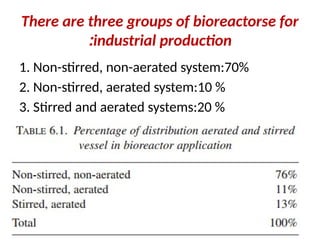
There are three groups of bioreactorse for
industrial production
:
1. Non-stirred, non-aerated system:70%
2. Non-stirred, aerated system:10 %
3. Stirred and aerated systems:20 %
• Non-stirred, aerated vessels are used in the
process for wine, beer and cheese production.
BACKGROUND TO BIOREACTORS
• The main function of designed bioreactor is:
-to provide a controlled environment.
-to achieve optimal growth and/or product
formation in cell system employed.
• the term “fermenter” mean “bioreactor”.
performance of any bioreactor depends on
many functions
:
• Biomass concentration must remain high enough to show high
yield.
• Sterile conditions must be maintained for pure culture system
• Effective agitation is required for uniform distribution of
substrate and microbes
• Heat transfer is needed to operate the bioreactor at constant
temperature
• Creation of the correct shear conditions.
- High shear rate harmful to the organism and disrupt
the cell wall.
-low shear undesirable because of unwanted
flocculation and aggregation of the cells.
TYPE OF BIOREACTOR
• Aerobic bioreactors are four categories,
depending on
how the gas is distributed.
 Stirred tank reactor: most common type of
bioreactor (provides a defined circulation pattern)
 Airlift pressure cycle bioreactor: gas is circulated by
means of pressurized air.
 Loop bioreactor: modified type of airlift
system(pump transports the air and liquid)
• Immobilized system: air circulates over a film of
microorganisms that grows on a solid surface.
• Fluidized bed: packed beds are operated in upflow mode,
bed expands at high flow rates
• Trickle bed: fluid is sprayed onto the top of the packing
and trickles down through the bed.
• Fed-batch mixed reactor: starting with a relatively dilute
solution of substrate provides control substrate
concentration.
• Batch mixed reactor: three principal modes (a) batch; (b)
fed batch; (c) continuous.
• Industrial bioreactors can withstand up to 3
atmospheres positive pressure.
• pH, temperature and dissolved oxygen sensors
are a minimum requirement.
The advantages of airlift bioreactor
1. In low shear, there is low mixing which means the
bioreactor can be used for growing plant and animal
cells.
2. Since there is no agitation, sterility is easily
maintained.
3. In a large vessel, the height of liquid can be as high
as 60 m, the pressure at the bottom of the vessel will
increase the oxygen solubility, and the value of KL a
will increase.
4. Extremely large vessels can be constructed.
applications of airlift bioreactor
• various types of fermenter.
• airlift bioreactors are pressure cycle
• internal and external loop bioreactors.
Airlift Pressure Cycle Bioreactors
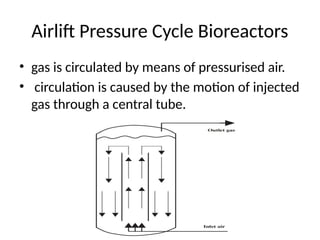
• gas is circulated by means of pressurised air.
• circulation is caused by the motion of injected
gas through a central tube.
Loop Bioreactor
• modified type of airlift system with gas and
liquid flow patterns.
• pump transports the air and liquid through the
vessel.
• an external loop is used.
• mechanical pump to remove the liquid.
• Gas and circulated liquid are injected into the
tower through a nozzle.
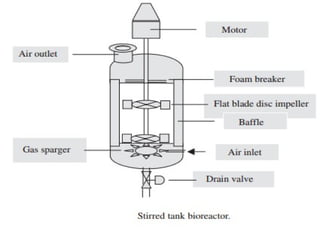
STIRRED TANK BIOREACTORS
• most important bioreactor for industrial application .
• has the dual advantages of low capital and low
operating costs.
• Vessels for laboratory experiments of volume up to 20
litres are made of glass.
• For larger volumes, construction is made of stainless
steel.
• . The height:diameter ratio of the vessel can vary
between 2:1 and 6:1, depending on amount of the
heat to be removed,
• the stirrer may be top- or bottom driven.
• tanks are fitted with baffles , to prevent a large
central vortex being formed as well as improve
mixing.
• Four baffles are used for vessels less than 3 meters
in diameter, and six to eight baffles are used in
larger vessels. The width of the baffle is usually
between T/10 and T/12, in which T is the tank
diameter.
The bioreactor-Design- Buildings- intros

The bioreactor-Design- Buildings- intros

  • 1.
  • 2.
    • The bioreactoris the heart of any biochemical process which enzymes, microbial, mammalian or plant cell systems are used for manufacture of useful biological products.
  • 3.
    The performance ofany bioreactor depends on: • Biomass concentration • Nutrient supply • Sterile conditions • Product removal • Effective agitations • Product inhibition • Heat removal • Aeration • Correct shear conditions • Metabolisms/microbial activities
  • 4.
    • some objectivesTo design a bioreactor: significant impact on overall process performance. reaction kinetics is essential for understanding. how a biological reactor works. areas of bioprocess engineering (mass and energy balances, mixing, mass transfer and heat transfer )
  • 5.
    There are threegroups of bioreactorse for industrial production : 1. Non-stirred, non-aerated system:70% 2. Non-stirred, aerated system:10 % 3. Stirred and aerated systems:20 %
  • 6.
    • Non-stirred, aeratedvessels are used in the process for wine, beer and cheese production.
  • 7.
    BACKGROUND TO BIOREACTORS •The main function of designed bioreactor is: -to provide a controlled environment. -to achieve optimal growth and/or product formation in cell system employed. • the term “fermenter” mean “bioreactor”.
  • 8.
    performance of anybioreactor depends on many functions : • Biomass concentration must remain high enough to show high yield. • Sterile conditions must be maintained for pure culture system • Effective agitation is required for uniform distribution of substrate and microbes • Heat transfer is needed to operate the bioreactor at constant temperature • Creation of the correct shear conditions. - High shear rate harmful to the organism and disrupt the cell wall. -low shear undesirable because of unwanted flocculation and aggregation of the cells.
  • 9.
    TYPE OF BIOREACTOR •Aerobic bioreactors are four categories, depending on how the gas is distributed.  Stirred tank reactor: most common type of bioreactor (provides a defined circulation pattern)  Airlift pressure cycle bioreactor: gas is circulated by means of pressurized air.  Loop bioreactor: modified type of airlift system(pump transports the air and liquid)
  • 10.
    • Immobilized system:air circulates over a film of microorganisms that grows on a solid surface. • Fluidized bed: packed beds are operated in upflow mode, bed expands at high flow rates • Trickle bed: fluid is sprayed onto the top of the packing and trickles down through the bed. • Fed-batch mixed reactor: starting with a relatively dilute solution of substrate provides control substrate concentration. • Batch mixed reactor: three principal modes (a) batch; (b) fed batch; (c) continuous.
  • 11.
    • Industrial bioreactorscan withstand up to 3 atmospheres positive pressure. • pH, temperature and dissolved oxygen sensors are a minimum requirement.
  • 12.
    The advantages ofairlift bioreactor 1. In low shear, there is low mixing which means the bioreactor can be used for growing plant and animal cells. 2. Since there is no agitation, sterility is easily maintained. 3. In a large vessel, the height of liquid can be as high as 60 m, the pressure at the bottom of the vessel will increase the oxygen solubility, and the value of KL a will increase. 4. Extremely large vessels can be constructed.
  • 13.
    applications of airliftbioreactor • various types of fermenter. • airlift bioreactors are pressure cycle • internal and external loop bioreactors.
  • 14.
    Airlift Pressure CycleBioreactors • gas is circulated by means of pressurised air. • circulation is caused by the motion of injected gas through a central tube.
  • 15.
    Loop Bioreactor • modifiedtype of airlift system with gas and liquid flow patterns. • pump transports the air and liquid through the vessel. • an external loop is used. • mechanical pump to remove the liquid. • Gas and circulated liquid are injected into the tower through a nozzle.
  • 16.
    STIRRED TANK BIOREACTORS •most important bioreactor for industrial application . • has the dual advantages of low capital and low operating costs. • Vessels for laboratory experiments of volume up to 20 litres are made of glass. • For larger volumes, construction is made of stainless steel. • . The height:diameter ratio of the vessel can vary between 2:1 and 6:1, depending on amount of the heat to be removed,
  • 17.
    • the stirrermay be top- or bottom driven. • tanks are fitted with baffles , to prevent a large central vortex being formed as well as improve mixing. • Four baffles are used for vessels less than 3 meters in diameter, and six to eight baffles are used in larger vessels. The width of the baffle is usually between T/10 and T/12, in which T is the tank diameter.