Why is 5G called 5G?
@3g4gUK
Š3G4G
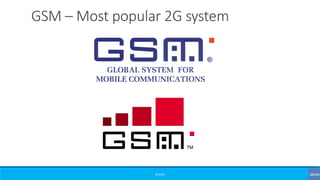
GSM – Most popular 2G system
Š3G4G
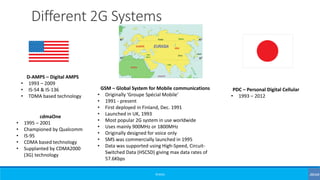
Different 2G Systems
D-AMPS – Digital AMPS
• 1993 – 2009
• IS-54 & IS-136
• TDMA based technology
cdmaOne
• 1995 – 2001
• Championed by Qualcomm
• IS-95
• CDMA based technology
• Supplanted by CDMA2000
(3G) technology
PDC – Personal Digital Cellular
• 1993 – 2012
GSM – Global System for Mobile communications
• Originally ‘Groupe Spécial Mobile’
• 1991 - present
• First deployed in Finland, Dec. 1991
• Launched in UK, 1993
• Most popular 2G system in use worldwide
• Uses mainly 900MHz or 1800MHz
• Originally designed for voice only
• SMS was commercially launched in 1995
• Data was supported using High-Speed, Circuit-
Switched Data (HSCSD) giving max data rates of
57.6Kbps
Š3G4G
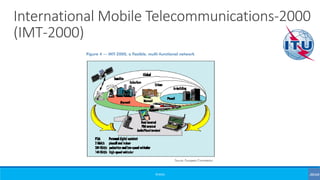
International Mobile Telecommunications-2000
(IMT-2000)
Š3G4G
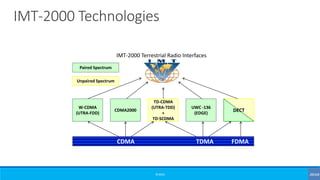
IMT-2000 Technologies
IMT-2000 Terrestrial Radio Interfaces
W-CDMA
(UTRA-FDD)
TD-CDMA
(UTRA-TDD)
+
TD-SCDMA
CDMA2000
UWC -136
(EDGE)
DECT
CDMA TDMA FDMA
Paired Spectrum
Unpaired Spectrum
Š3G4G
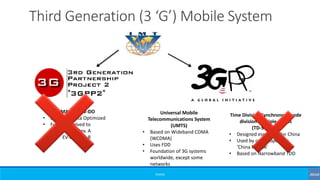
Third Generation (3 ‘G’) Mobile System
CDMA2000 EV-DO
• Evolution Data Optimized
• Further evolved to
• EV-DO Rev. A
• EV-DO Rev. B
Universal Mobile
Telecommunications System
(UMTS)
• Based on Wideband CDMA
(WCDMA)
• Uses FDD
• Foundation of 3G systems
worldwide, except some
networks
Time Division Synchronous code
division multiple access
(TD-SCDMA)
• Designed especially for China
• Used by only 1 operator,
‘China Mobile’
• Based on Narrowband TDD
Š3G4G
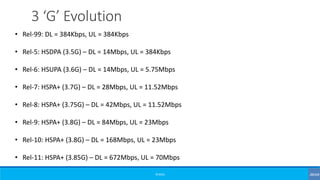
• Rel-99: DL = 384Kbps, UL = 384Kbps
• Rel-5: HSDPA (3.5G) – DL = 14Mbps, UL = 384Kbps
• Rel-6: HSUPA (3.6G) – DL = 14Mbps, UL = 5.75Mbps
• Rel-7: HSPA+ (3.7G) – DL = 28Mbps, UL = 11.52Mbps
• Rel-8: HSPA+ (3.75G) – DL = 42Mbps, UL = 11.52Mbps
• Rel-9: HSPA+ (3.8G) – DL = 84Mbps, UL = 23Mbps
• Rel-10: HSPA+ (3.8G) – DL = 168Mbps, UL = 23Mbps
• Rel-11: HSPA+ (3.85G) – DL = 672Mbps, UL = 70Mbps
3 ‘G’ Evolution
Š3G4G
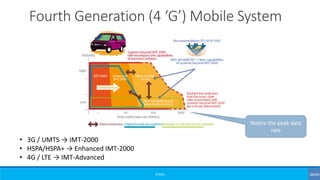
Fourth Generation (4 ‘G’) Mobile System
• 3G / UMTS → IMT-2000
• HSPA/HSPA+ → Enhanced IMT-2000
• 4G / LTE → IMT-Advanced
Notice the peak data
rate
Š3G4G
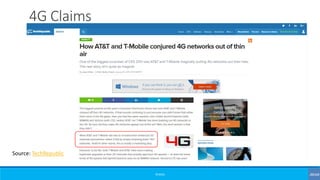
4G Claims
Source: TechRepublic
Š3G4G
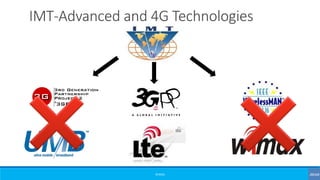
IMT-Advanced and 4G Technologies
Š3G4G
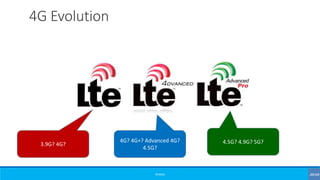
4G Evolution
3.9G? 4G?
4G? 4G+? Advanced 4G?
4.5G?
4.5G? 4.9G? 5G?
Š3G4G
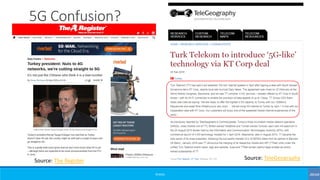
5G Confusion?
Source: TeleGeographySource: The Register
Š3G4G
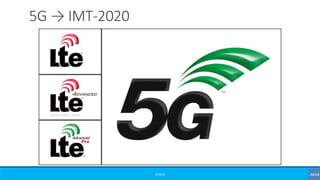
5G → IMT-2020
Š3G4G
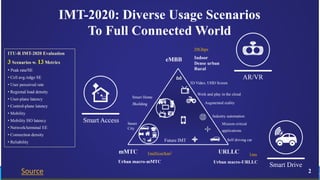
5G
Source
Š3G4G
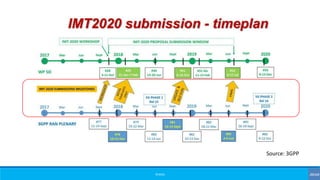
Source: 3GPP
Thank You
To learn more, visit:
3G4G Website – http://www.3g4g.co.uk/
3G4G Blog – http://blog.3g4g.co.uk/
3G4G Small Cells Blog – http://smallcells.3g4g.co.uk/
Follow us on Twitter: https://twitter.com/3g4gUK
Follow us on Linkedin: https://www.linkedin.com/company/3g4g
Š3G4G

Why is 5G called 5G?

  • 1.
    Why is 5Gcalled 5G? @3g4gUK
  • 2.
    ©3G4G GSM – Mostpopular 2G system
  • 3.
    ©3G4G Different 2G Systems D-AMPS– Digital AMPS • 1993 – 2009 • IS-54 & IS-136 • TDMA based technology cdmaOne • 1995 – 2001 • Championed by Qualcomm • IS-95 • CDMA based technology • Supplanted by CDMA2000 (3G) technology PDC – Personal Digital Cellular • 1993 – 2012 GSM – Global System for Mobile communications • Originally ‘Groupe Spécial Mobile’ • 1991 - present • First deployed in Finland, Dec. 1991 • Launched in UK, 1993 • Most popular 2G system in use worldwide • Uses mainly 900MHz or 1800MHz • Originally designed for voice only • SMS was commercially launched in 1995 • Data was supported using High-Speed, Circuit- Switched Data (HSCSD) giving max data rates of 57.6Kbps
  • 4.
  • 5.
    Š3G4G IMT-2000 Technologies IMT-2000 TerrestrialRadio Interfaces W-CDMA (UTRA-FDD) TD-CDMA (UTRA-TDD) + TD-SCDMA CDMA2000 UWC -136 (EDGE) DECT CDMA TDMA FDMA Paired Spectrum Unpaired Spectrum
  • 6.
    ©3G4G Third Generation (3‘G’) Mobile System CDMA2000 EV-DO • Evolution Data Optimized • Further evolved to • EV-DO Rev. A • EV-DO Rev. B Universal Mobile Telecommunications System (UMTS) • Based on Wideband CDMA (WCDMA) • Uses FDD • Foundation of 3G systems worldwide, except some networks Time Division Synchronous code division multiple access (TD-SCDMA) • Designed especially for China • Used by only 1 operator, ‘China Mobile’ • Based on Narrowband TDD
  • 7.
    ©3G4G • Rel-99: DL= 384Kbps, UL = 384Kbps • Rel-5: HSDPA (3.5G) – DL = 14Mbps, UL = 384Kbps • Rel-6: HSUPA (3.6G) – DL = 14Mbps, UL = 5.75Mbps • Rel-7: HSPA+ (3.7G) – DL = 28Mbps, UL = 11.52Mbps • Rel-8: HSPA+ (3.75G) – DL = 42Mbps, UL = 11.52Mbps • Rel-9: HSPA+ (3.8G) – DL = 84Mbps, UL = 23Mbps • Rel-10: HSPA+ (3.8G) – DL = 168Mbps, UL = 23Mbps • Rel-11: HSPA+ (3.85G) – DL = 672Mbps, UL = 70Mbps 3 ‘G’ Evolution
  • 8.
    ©3G4G Fourth Generation (4‘G’) Mobile System • 3G / UMTS → IMT-2000 • HSPA/HSPA+ → Enhanced IMT-2000 • 4G / LTE → IMT-Advanced Notice the peak data rate
  • 9.
  • 10.
  • 11.
    Š3G4G 4G Evolution 3.9G? 4G? 4G?4G+? Advanced 4G? 4.5G? 4.5G? 4.9G? 5G?
  • 12.
  • 13.
  • 14.
  • 15.
  • 16.
    Thank You To learnmore, visit: 3G4G Website – http://www.3g4g.co.uk/ 3G4G Blog – http://blog.3g4g.co.uk/ 3G4G Small Cells Blog – http://smallcells.3g4g.co.uk/ Follow us on Twitter: https://twitter.com/3g4gUK Follow us on Linkedin: https://www.linkedin.com/company/3g4g ©3G4G