Disclosure Statement:  
Financial —
Ellen Kester is the founder and owner of
Bilinguistics. Ellen Kester and Scott Prath
receive salaries from Bilinguistics.
Bilinguistics receives royalties from product
sales.
Nonfinancial — None
• Bilingualism and Language
• Typical Language Development in Bilinguals
▫ Form
 Syntax
 Morphology
▫ Content
• Application to All Languages
• Case Studies
Outline
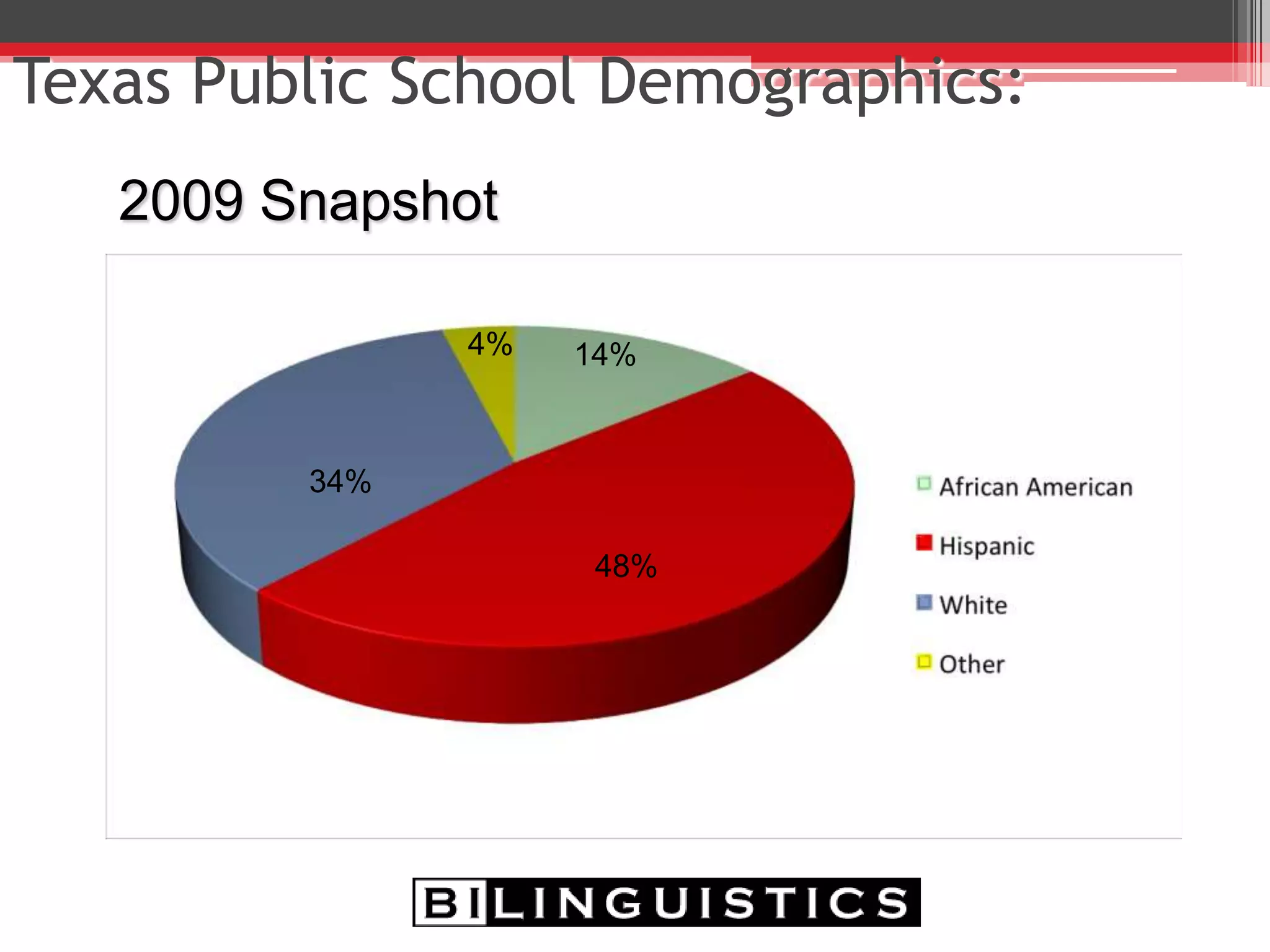
Demographic Example: Texas Public
Schools
48%
34%
14%4%
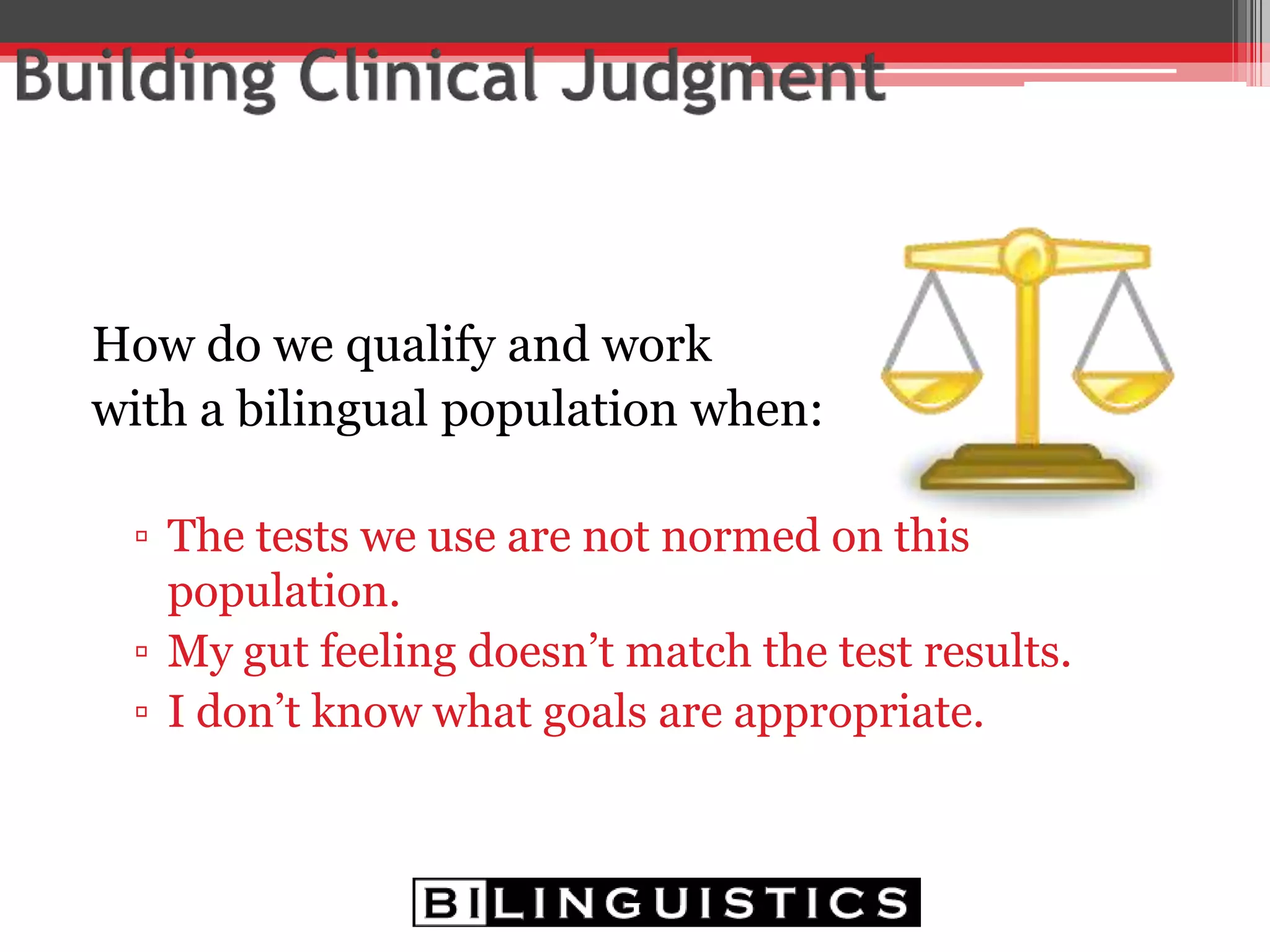
How do we qualify and work
with a bilingual population when:
▫ The tests we use are not normed on this
population.
▫ My gut feeling doesn’t match the test results.
▫ I don’t know what goals are appropriate.
Do you need Continuing Education or want 
to listen to this course live?
Click here to visit 
the online courses.
Click for Audio‐over‐Powerpoint Presentation
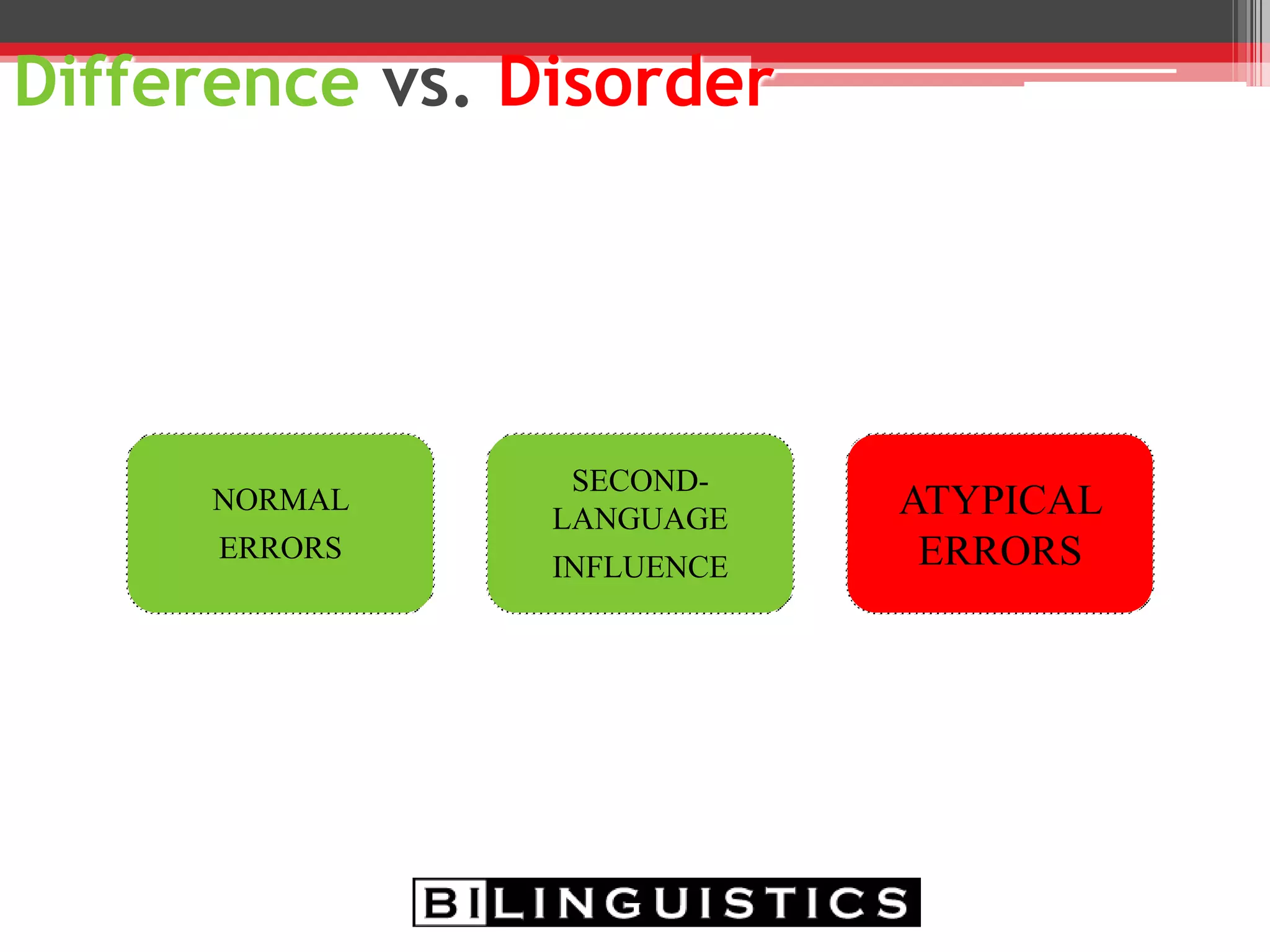
Difference vs. Disorder
NORMAL
ERRORS
SECOND-
LANGUAGE
INFLUENCE
ATYPICAL
ERRORS
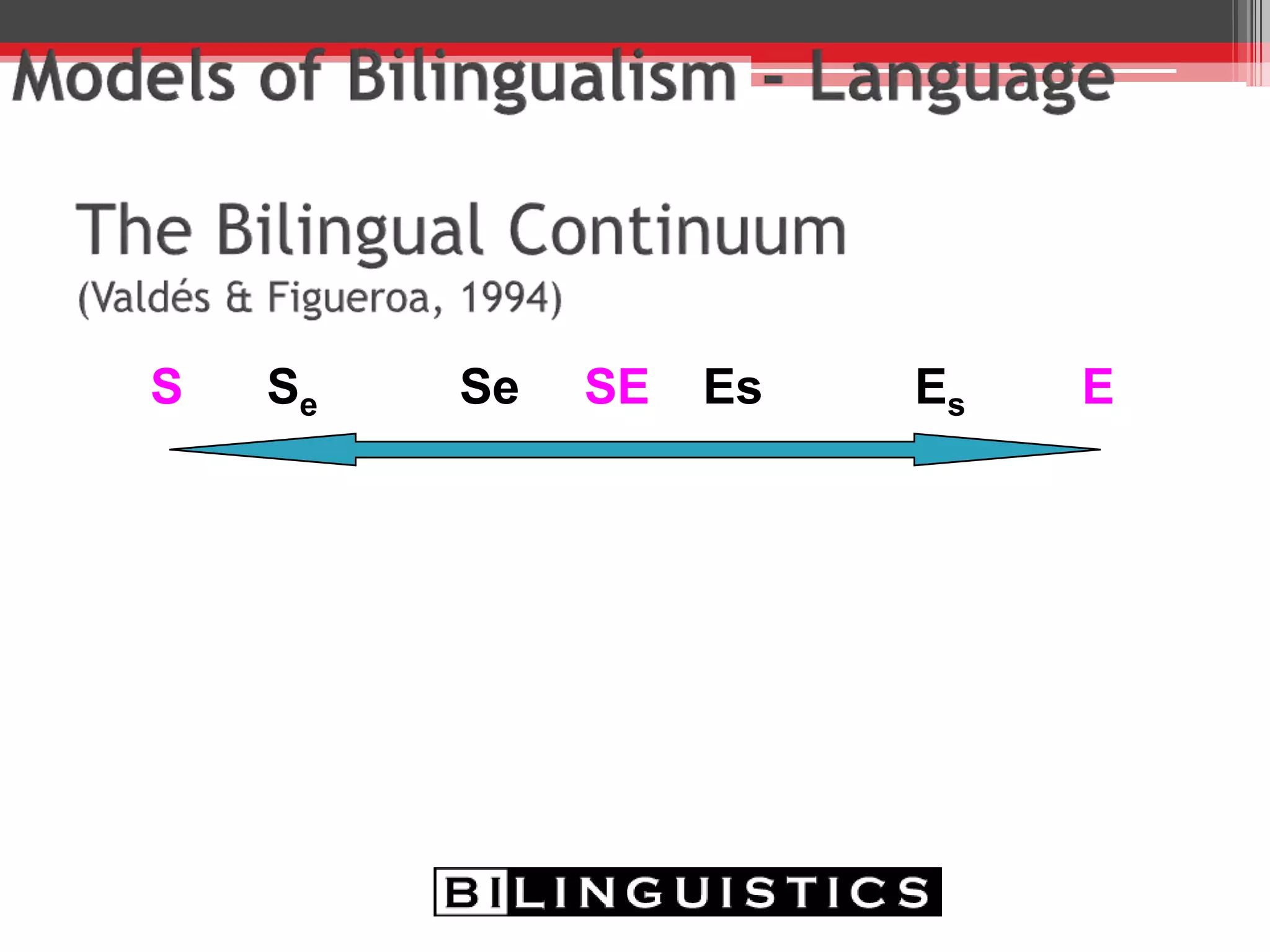
S Se Se SE Es Es E
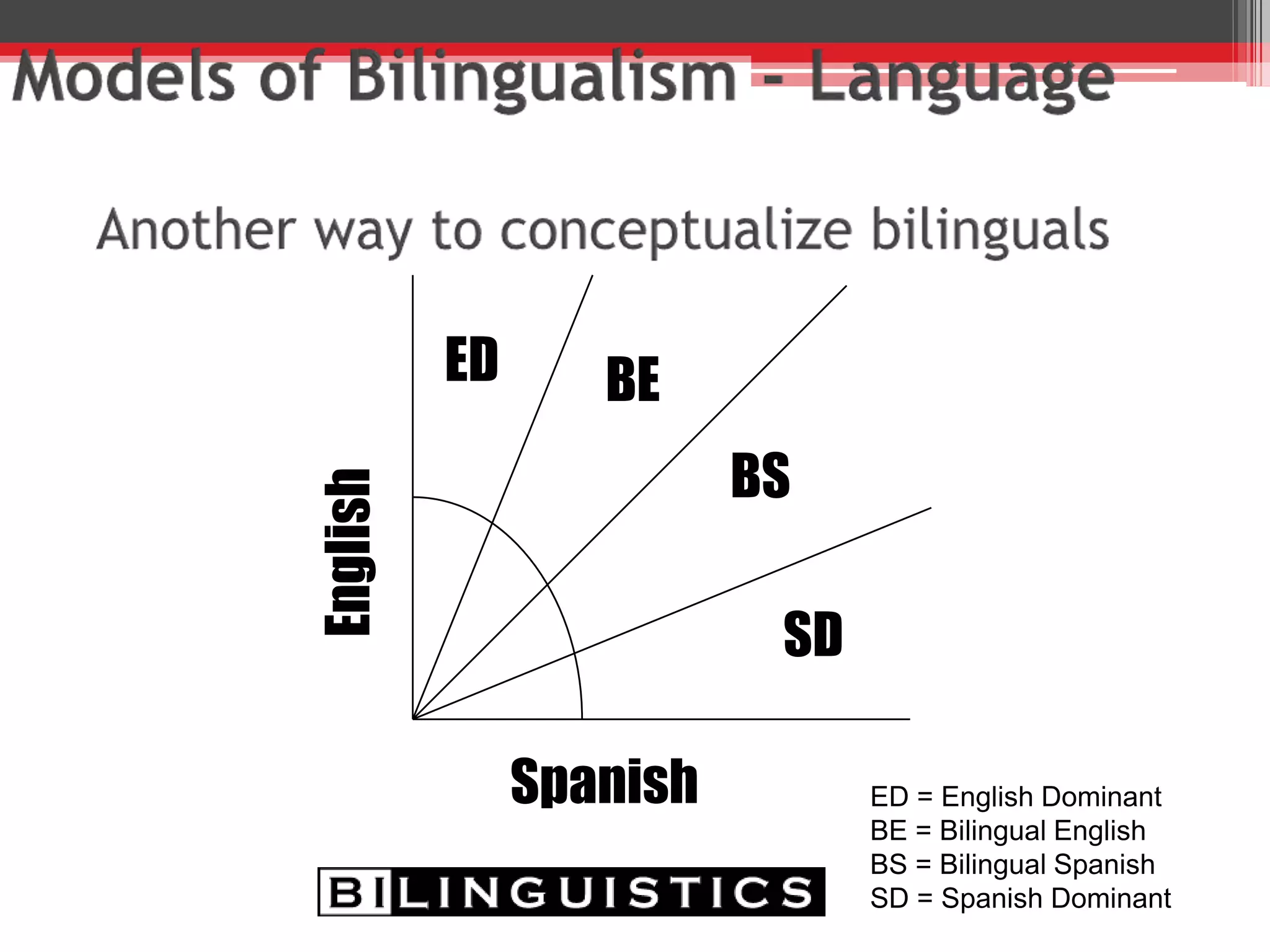
Spanish
English ED BE
BS
SD
ED = English Dominant
BE = Bilingual English
BS = Bilingual Spanish
SD = Spanish Dominant
Spanish
English ED BE
BS
SD
ED = English Dominant
BE = Bilingual English
BS = Bilingual Spanish
SD = Spanish Dominant
Low
Spanish
Proficiency
Spanish
English ED BE
BS
SD
ED = English Dominant
BE = Bilingual English
BS = Bilingual Spanish
SD = Spanish Dominant
High
English
Proficiency
Low
English
Proficiency
Spanish
English ED BE
BS
SD
ED = English Dominant
BE = Bilingual English
BS = Bilingual Spanish
SD = Spanish Dominant
Spanish
English ED BE
BS
SD
ED = English Dominant
BE = Bilingual English
BS = Bilingual Spanish
SD = Spanish Dominant
Low
English
Proficiency
All of the documents and charts in this
presentation can be downloaded from our Free
Resource Library.
Click here to visit the Resource Library
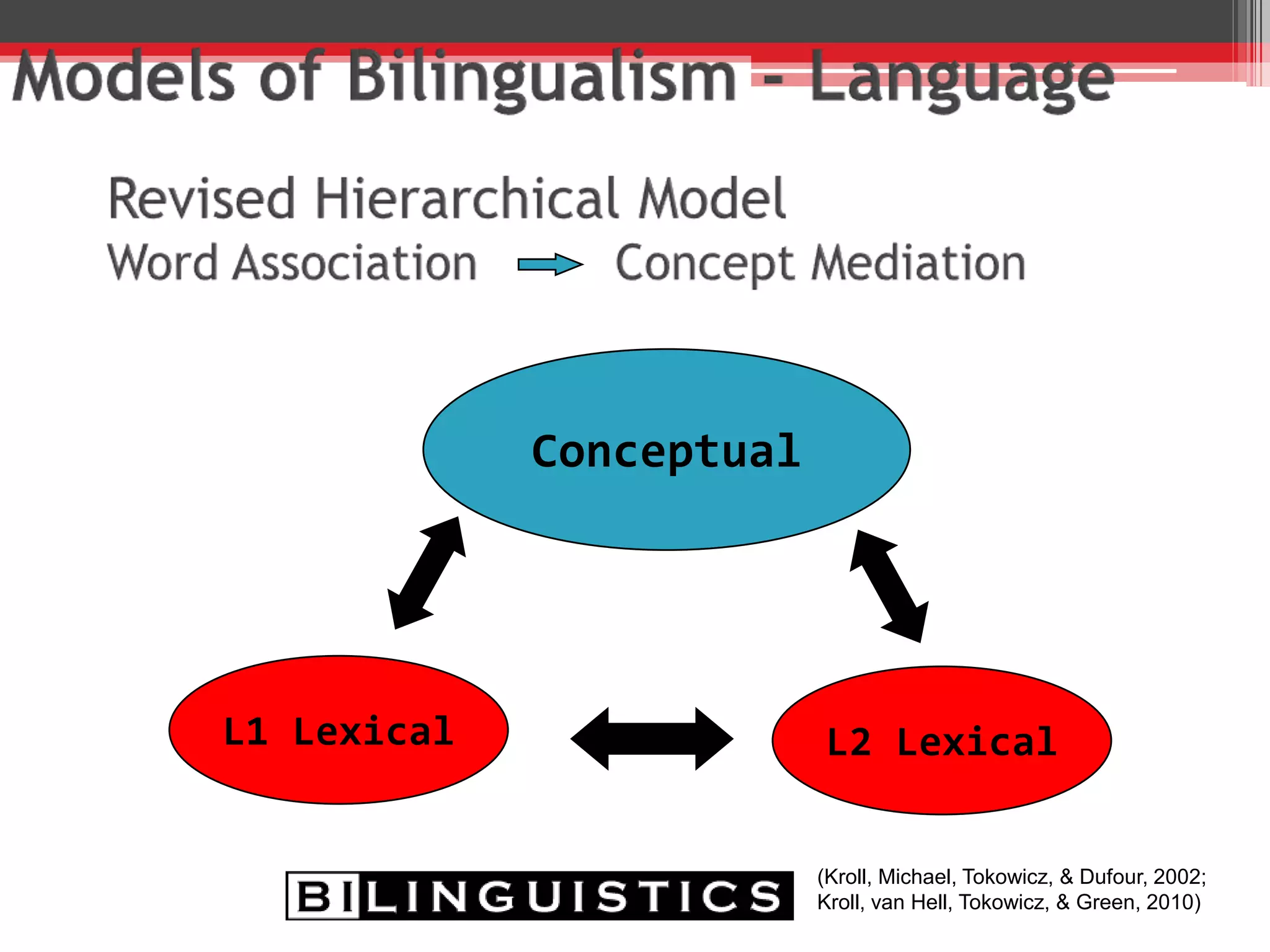
Conceptual
L1 Lexical L2 Lexical
(Kroll, Michael, Tokowicz, & Dufour, 2002;
Kroll, van Hell, Tokowicz, & Green, 2010)
Conceptual
L1 Lexical L2 Lexical
(Kroll, Michael, Tokowicz, & Dufour, 2002;
Kroll, van Hell, Tokowicz, & Green, 2010)
Conceptual
L1 Lexical L2 Lexical
(Kroll, Michael, Tokowicz, & Dufour, 2002;
Kroll, van Hell, Tokowicz, & Green, 2010)
Conceptual
L1 Lexical L2 Lexical
(Kroll, Michael, Tokowicz, & Dufour, 2002;
Kroll, van Hell, Tokowicz, & Green, 2010)
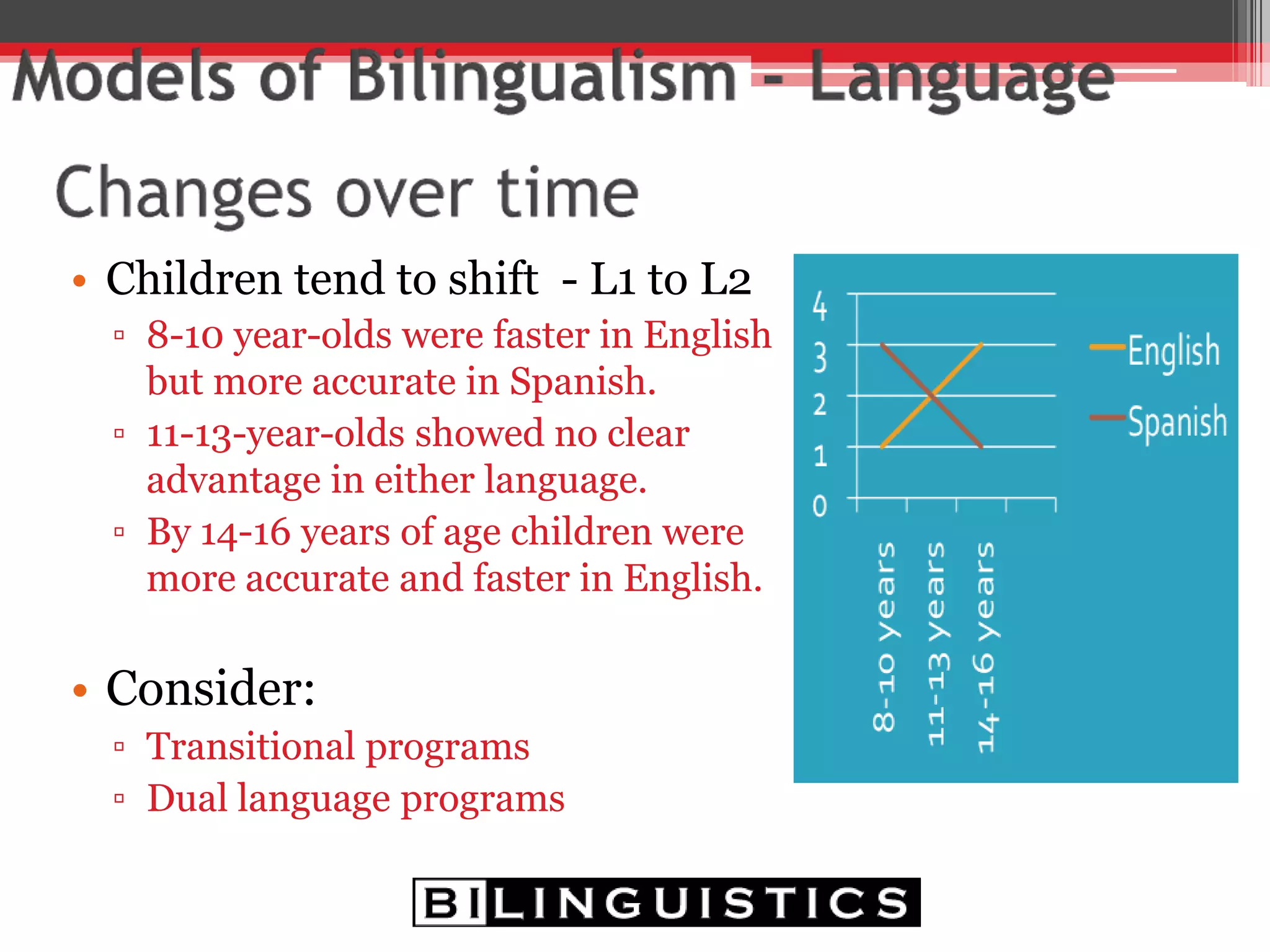
• Children tend to shift - L1 to L2
▫ 8-10 year-olds were faster in English
but more accurate in Spanish.
▫ 11-13-year-olds showed no clear
advantage in either language.
▫ By 14-16 years of age children were
more accurate and faster in English.
• Consider:
▫ Transitional programs
▫ Dual language programs
Language Activity
Children code switch between
languages because they don’t know
either language well.
FACT
or
MYTH
Language Activity
Raising children with two languages
will confuse them.
FACT
or
MYTH
Language Activity
Parents should not use more than
one language with their child.
FACT
or
MYTH
Language Activity
Children with language impairment
should not learn more than one
language at a time.
FACT
or
MYTH
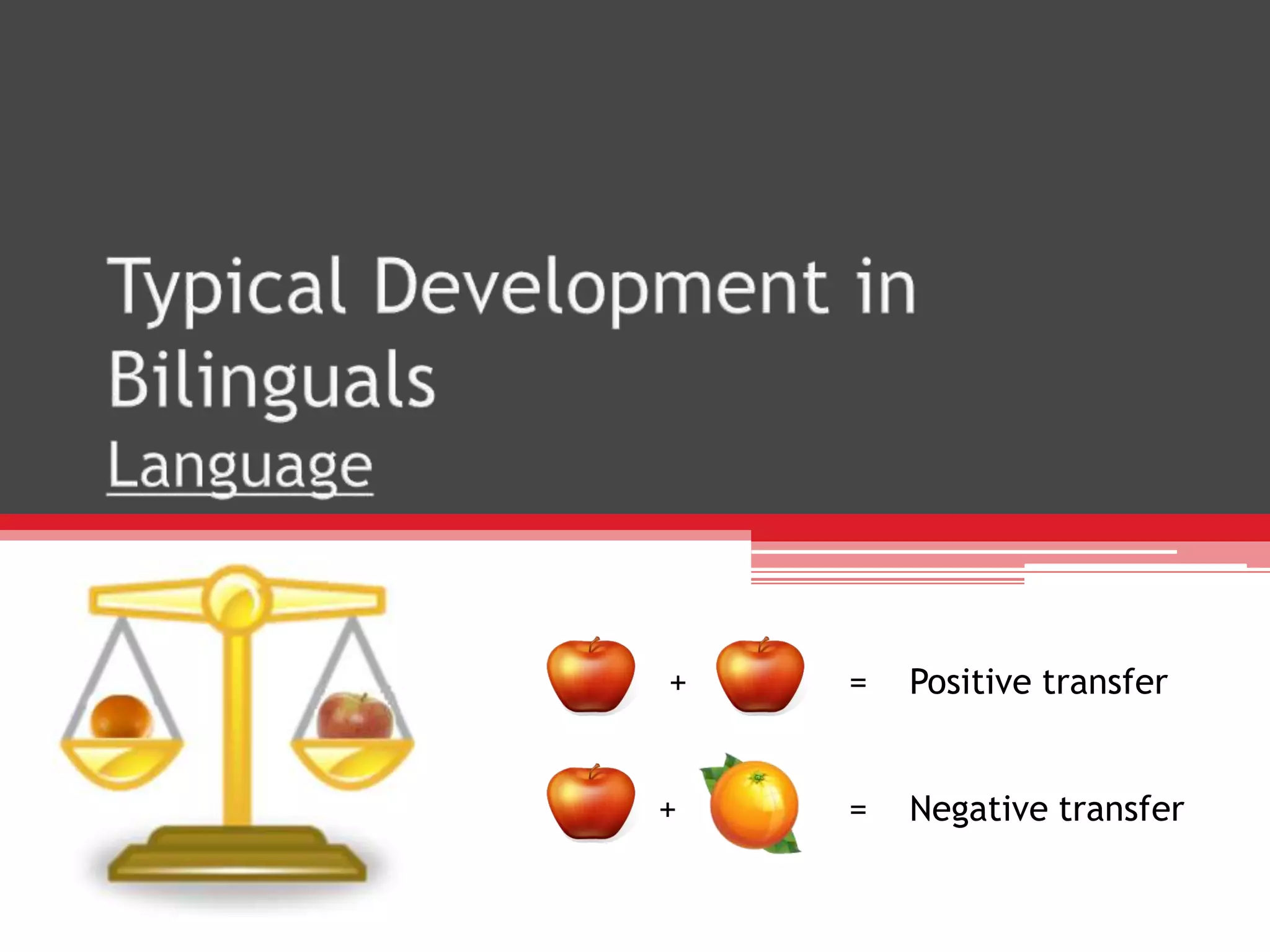
Differences Similarities
+ = Positive transfer
+ = Negative transfer
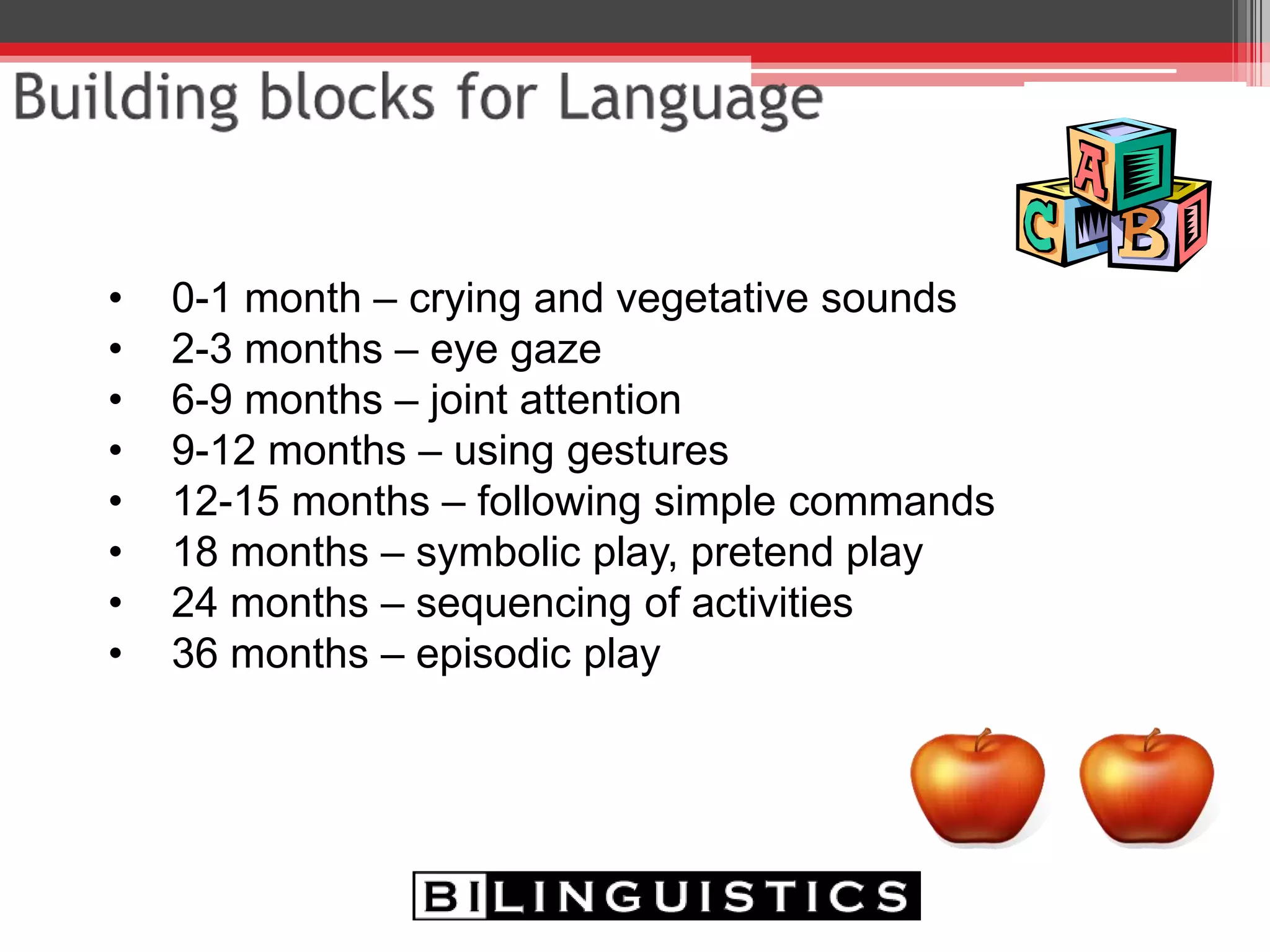
• 0-1 month – crying and vegetative sounds
• 2-3 months – eye gaze
• 6-9 months – joint attention
• 9-12 months – using gestures
• 12-15 months – following simple commands
• 18 months – symbolic play, pretend play
• 24 months – sequencing of activities
• 36 months – episodic play
• Based on the Competition Model as applied to
bilingual development (MacWhinney & Bates, 1989)
▫ Forward Transfer (L1 to L2) expected for ELLs
• The effects of Spanish on English can result in
errors in:
▫ Verb errors (especially unmarked present for past
tense)
▫ Content word errors (more than general words)
▫ Prepositions
▫ Pronouns
▫ Word order
0
5
10
15
20
25
30
35
PK K 1st 2nd 3rd
NumberofErrors
Mean Errors Per Grade Spanish
SpnMorph
SpnSemantic
SpnSyntactic
SpnTotal
0
5
10
15
20
25
30
35
PK K 1st 2nd 3rd
NumberofErrors
Mean Errors Per Grade English
EngMorph
EngSemantic
EngSyntactic
EngTotal
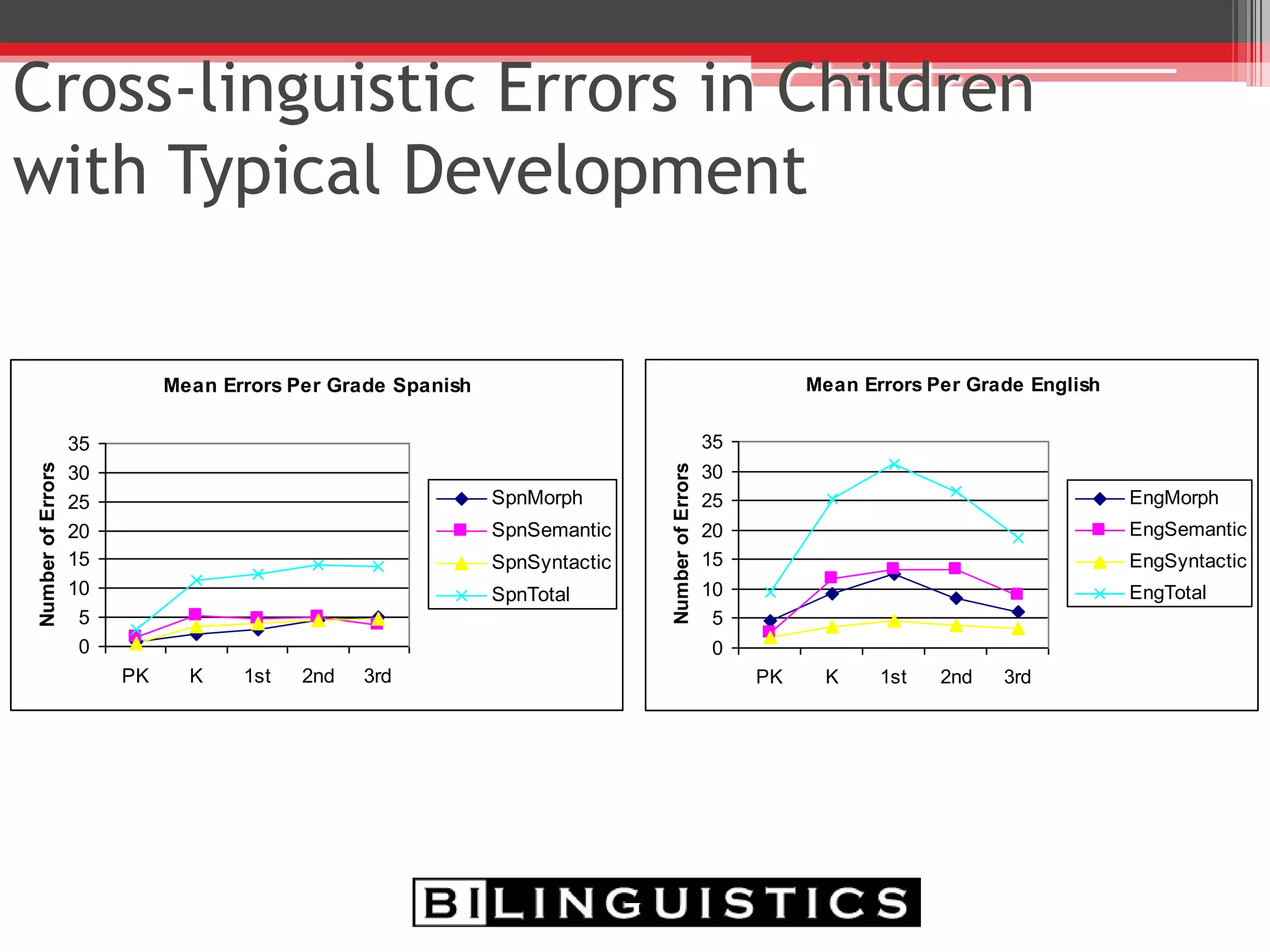
Cross-linguistic Errors in Children
with Typical Development
0
5
10
15
20
25
30
35
PK K 1st 2nd 3rd
NumberofErrors
Mean Errors Per Grade Spanish
SpnMorph
SpnSemantic
SpnSyntactic
SpnTotal
0
5
10
15
20
25
30
35
PK K 1st 2nd 3rd
NumberofErrors
Mean Errors Per Grade English
EngMorph
EngSemantic
EngSyntactic
EngTotal
Cross-linguistic Errors in Children
with Typical Development
Morphological Errors Spanish
0
1
2
3
4
5
6
7
8
Plurals
Adj/AdvN
egation
O
ther
Verb:Past/Present
Verb:Present/Past
Verb:R
eg/Irreg
Verb:U
nm
arkedPres/Past
Verb:PersonVerb:O
ther
G
ender
PK
K
1
2
3
Morphological Errors English
0
1
2
3
4
5
6
7
8
Plurals
Adj/Adv
N
egation
O
ther
Verb:Past/Present
Verb:Present/Past
Verb:R
eg/Irreg
Verb:U
nm
arkedPres/Past
Verb:PersonVerb:O
ther
PK
K
1st
2nd
3rd
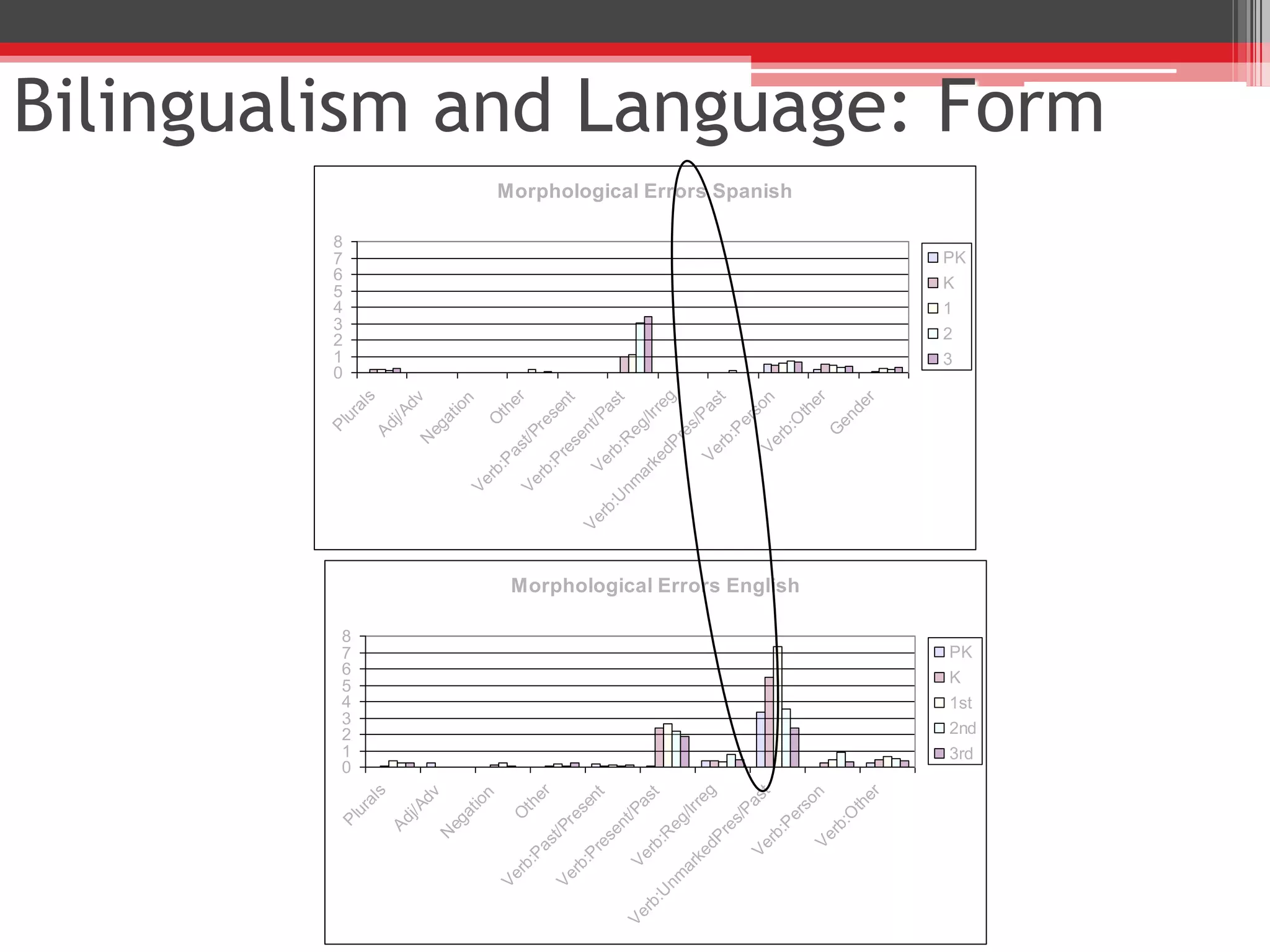
Bilingualism and Language: Form
Morphological Errors Spanish
0
1
2
3
4
5
6
7
8
Plurals
Adj/AdvN
egation
O
ther
Verb:Past/Present
Verb:Present/Past
Verb:R
eg/Irreg
Verb:U
nm
arkedPres/Past
Verb:PersonVerb:O
ther
G
ender
PK
K
1
2
3
Morphological Errors English
0
1
2
3
4
5
6
7
8
Plurals
Adj/Adv
N
egation
O
ther
Verb:Past/Present
Verb:Present/Past
Verb:R
eg/Irreg
Verb:U
nm
arkedPres/Past
Verb:PersonVerb:O
ther
PK
K
1st
2nd
3rd
Bilingualism and Language: Form
Morphological Errors Spanish
0
1
2
3
4
5
6
7
8
Plurals
Adj/AdvN
egation
O
ther
Verb:Past/Present
Verb:Present/Past
Verb:R
eg/Irreg
Verb:U
nm
arkedPres/Past
Verb:PersonVerb:O
ther
G
ender
PK
K
1
2
3
Morphological Errors English
0
1
2
3
4
5
6
7
8
Plurals
Adj/Adv
N
egation
O
ther
Verb:Past/Present
Verb:Present/Past
Verb:R
eg/Irreg
Verb:U
nm
arkedPres/Past
Verb:PersonVerb:O
ther
PK
K
1st
2nd
3rd
Bilingualism and Language: Form
Morphological Errors Spanish
0
1
2
3
4
5
6
7
8
Plurals
Adj/AdvN
egation
O
ther
Verb:Past/Present
Verb:Present/Past
Verb:R
eg/Irreg
Verb:U
nm
arkedPres/Past
Verb:PersonVerb:O
ther
G
ender
PK
K
1
2
3
Morphological Errors English
0
1
2
3
4
5
6
7
8
Plurals
Adj/Adv
N
egation
O
ther
Verb:Past/Present
Verb:Present/Past
Verb:R
eg/Irreg
Verb:U
nm
arkedPres/Past
Verb:PersonVerb:O
ther
PK
K
1st
2nd
3rd
Bilingualism and Language: Form
0
1
2
3
4
5
6
7
8
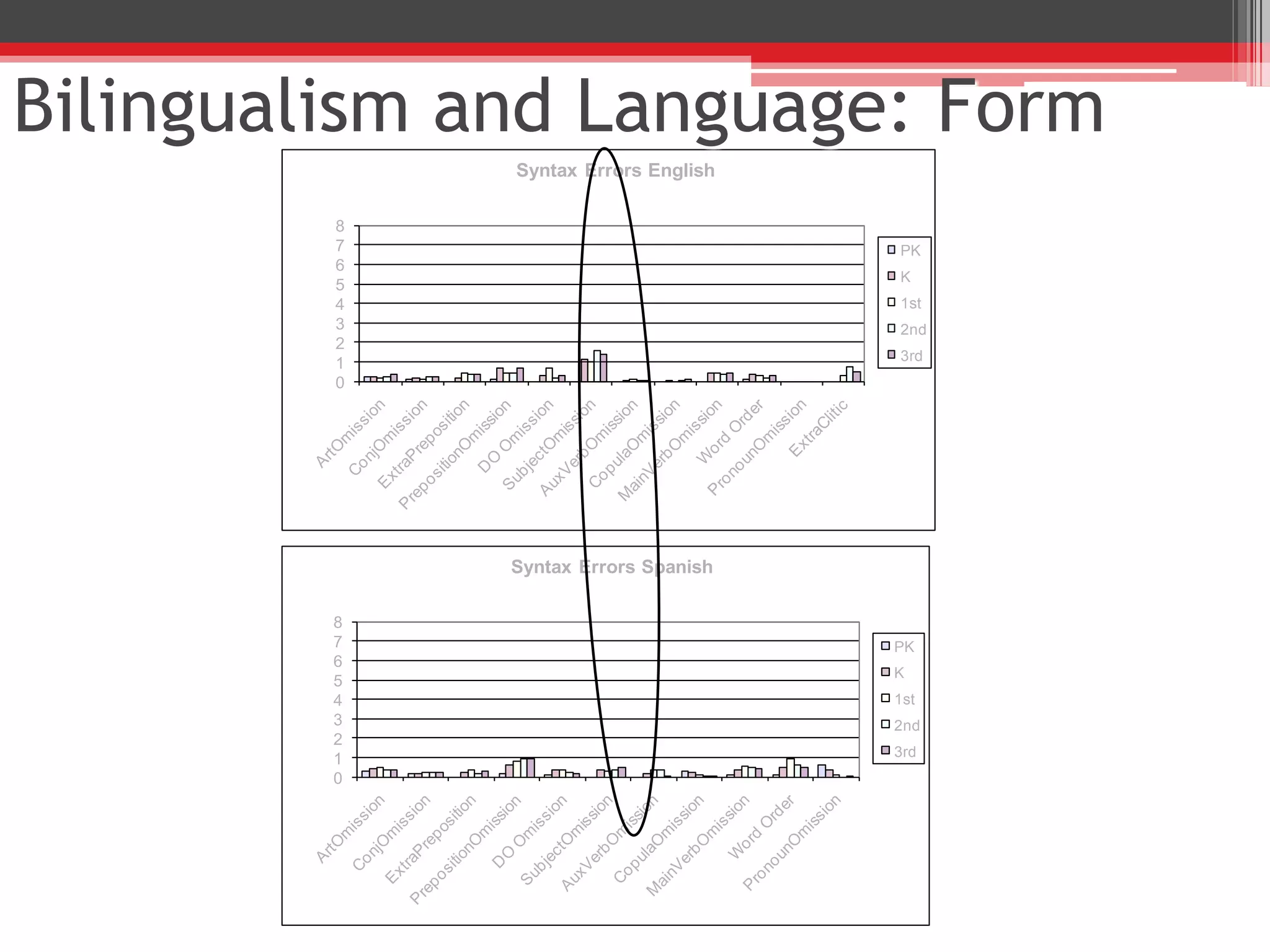
Syntax Errors English
PK
K
1st
2nd
3rd
0
1
2
3
4
5
6
7
8
Syntax Errors Spanish
PK
K
1st
2nd
3rd
Bilingualism and Language: Form
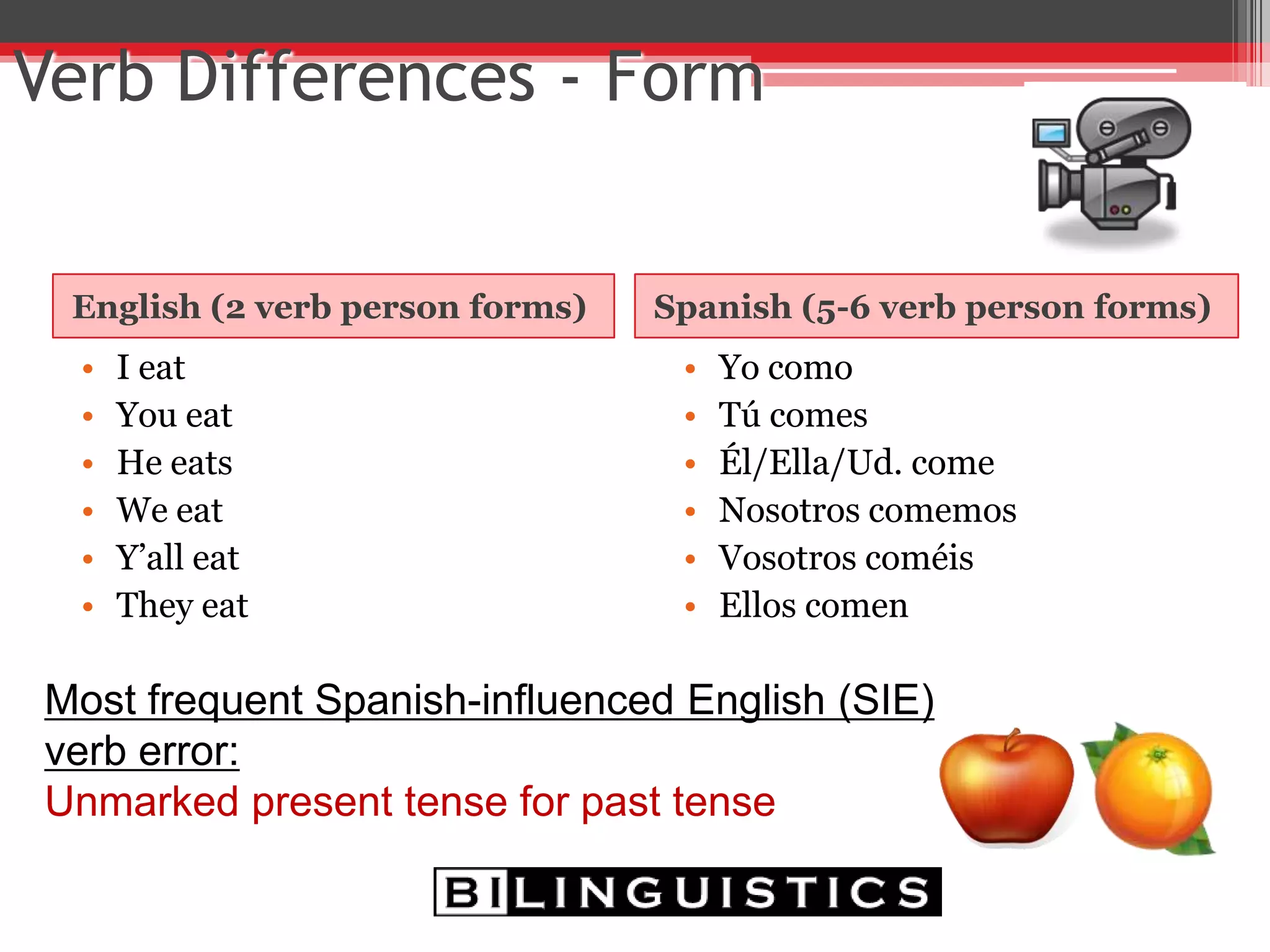
Verb Differences - Form
English (2 verb person forms) Spanish (5-6 verb person forms)
• I eat
• You eat
• He eats
• We eat
• Y’all eat
• They eat
• Yo como
• Tú comes
• Él/Ella/Ud. come
• Nosotros comemos
• Vosotros coméis
• Ellos comen
Most frequent Spanish-influenced English (SIE)
verb error:
Unmarked present tense for past tense
Pronouns - Form
• Spanish is called a Pro-Drop language because
subjects/pronouns are usually dropped once the
subject has been established.
• In English, pronouns are required.
Spanish English
Maria fue a la tienda.  (Ella) 
Compró pan.
Maria went to the store.  She
bought bread.
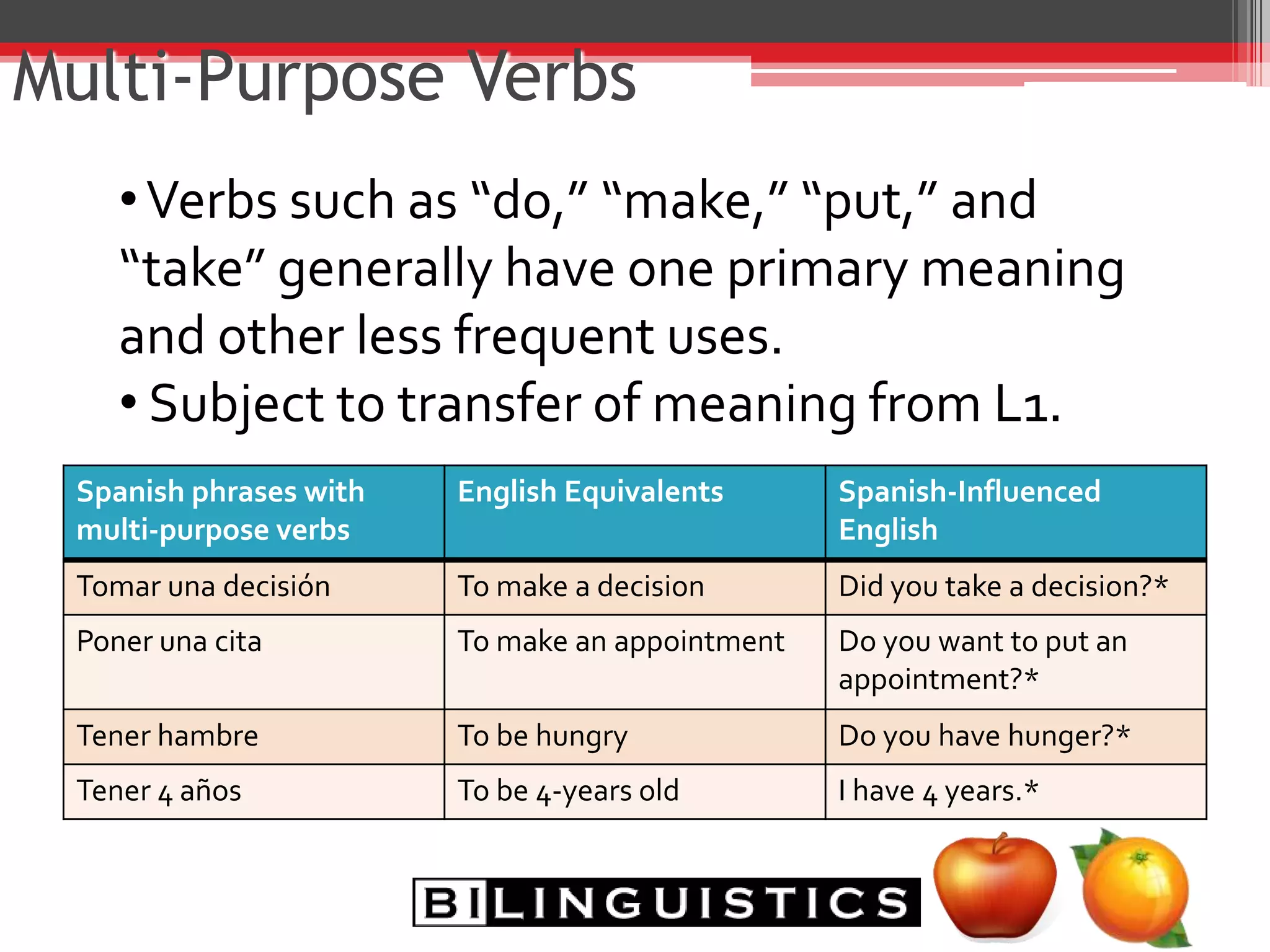
Multi-Purpose Verbs
Spanish phrases with 
multi‐purpose verbs
English Equivalents Spanish‐Influenced 
English
Tomar una decisión To make a decision Did you take a decision?*
Poner una cita To make an appointment Do you want to put an 
appointment?*
Tener hambre To be hungry Do you have hunger?*
Tener 4 años To be 4‐years old I have 4 years.*
•Verbs such as “do,” “make,” “put,” and 
“take” generally have one primary meaning 
and other less frequent uses.  
• Subject to transfer of meaning from L1.  
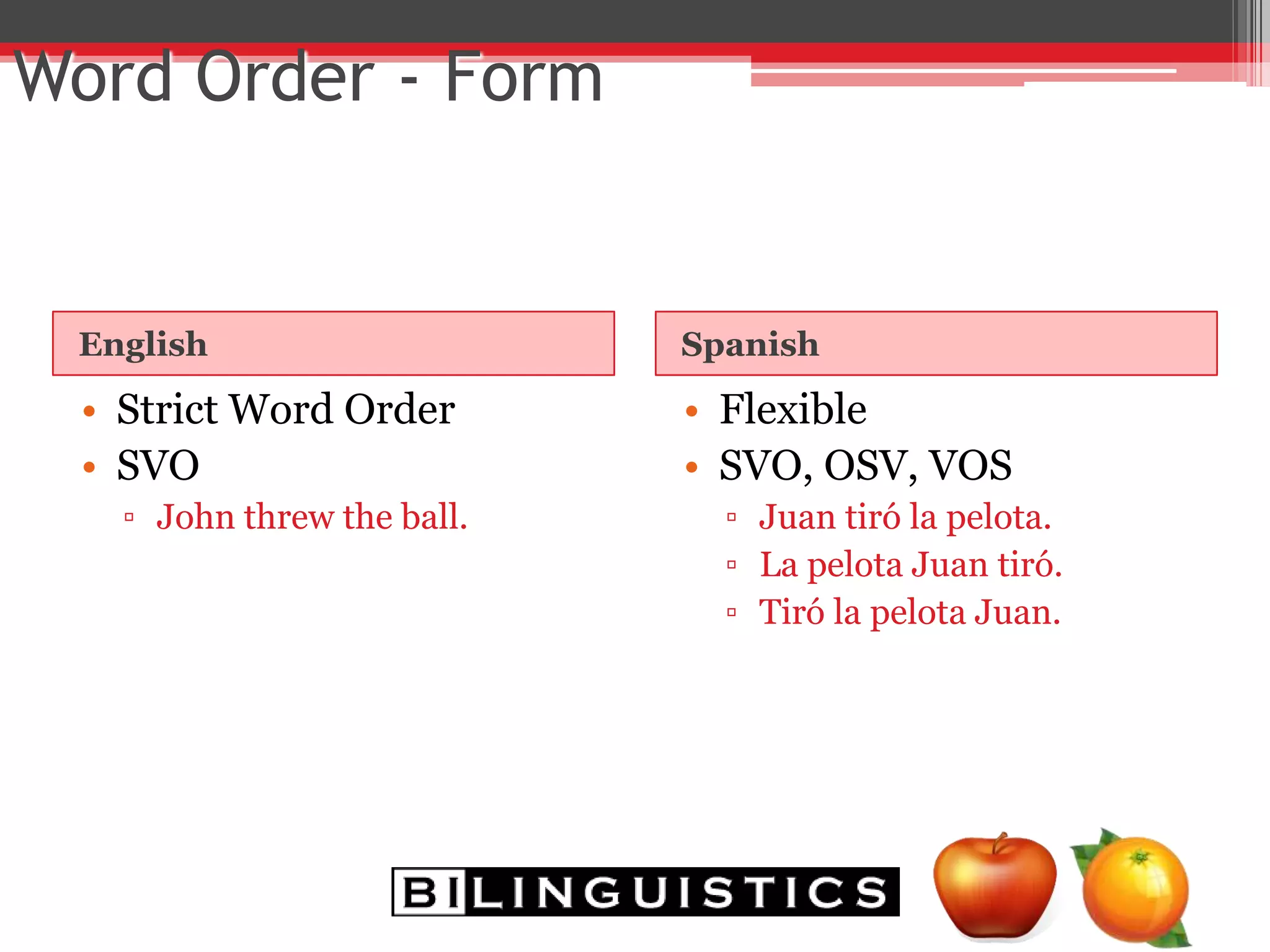
Word Order - Form
English Spanish
• Strict Word Order
• SVO
▫ John threw the ball.
• Flexible
• SVO, OSV, VOS
▫ Juan tiró la pelota.
▫ La pelota Juan tiró.
▫ Tiró la pelota Juan.
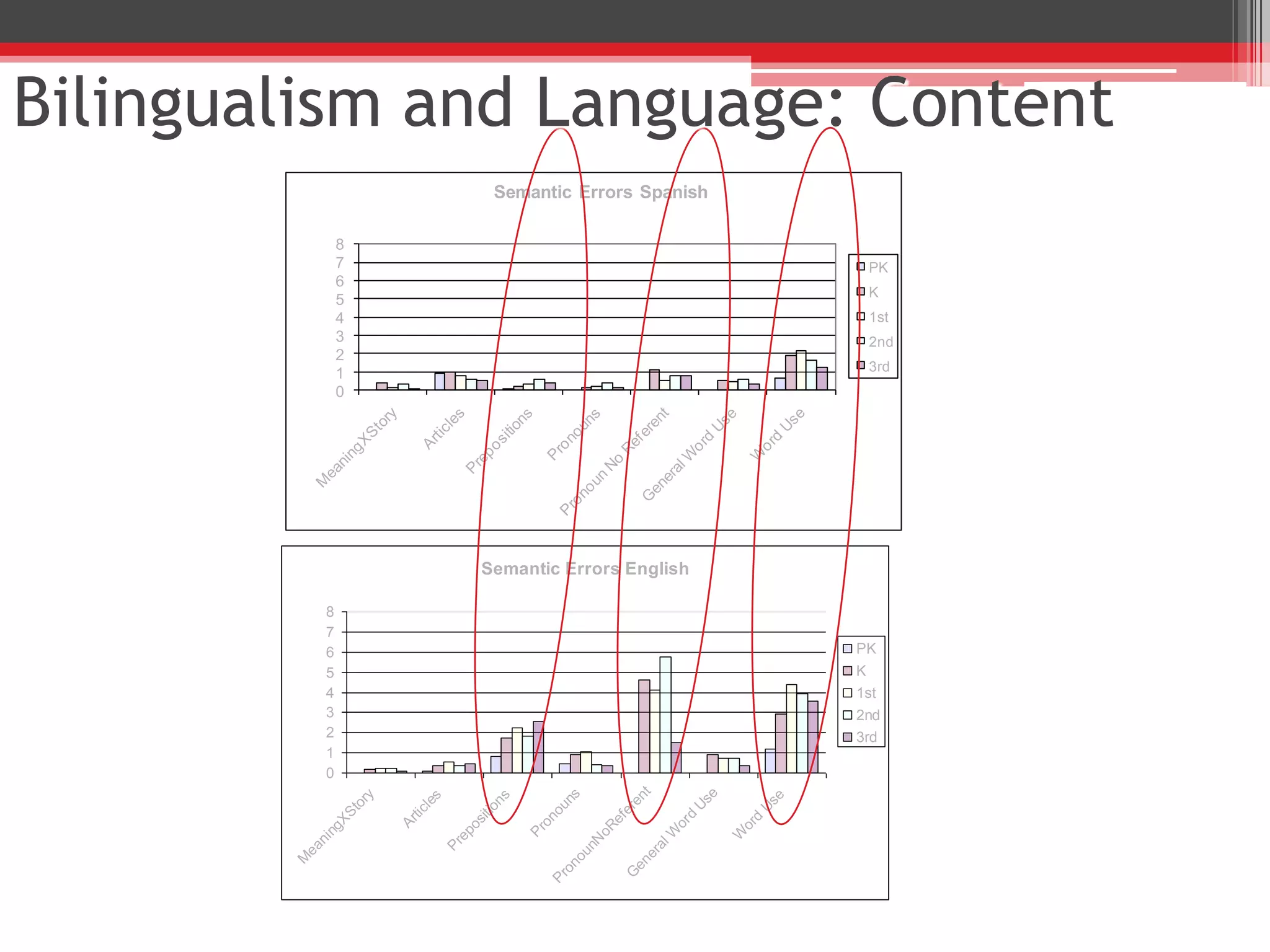
Semantic Errors English
0
1
2
3
4
5
6
7
8
M
eaningXStory
Articles
Prepositions
Pronouns
PronounN
oReferent
G
eneralW
ord
Use
W
ord
Use
PK
K
1st
2nd
3rd
0
1
2
3
4
5
6
7
8
Semantic Errors Spanish
PK
K
1st
2nd
3rd
Bilingualism and Language: Content
Semantic Errors English
0
1
2
3
4
5
6
7
8
M
eaningXStory
Articles
Prepositions
Pronouns
PronounN
oReferent
G
eneralW
ord
Use
W
ord
Use
PK
K
1st
2nd
3rd
0
1
2
3
4
5
6
7
8
Semantic Errors Spanish
PK
K
1st
2nd
3rd
Bilingualism and Language: Content
Prepositions
Semantic Errors English
0
1
2
3
4
5
6
7
8
M
eaningXStory
Articles
Prepositions
Pronouns
PronounN
oReferent
G
eneralW
ord
Use
W
ord
Use
PK
K
1st
2nd
3rd
0
1
2
3
4
5
6
7
8
Semantic Errors Spanish
PK
K
1st
2nd
3rd
Bilingualism and Language: Content
Pronoun Dropping
Semantic Errors English
0
1
2
3
4
5
6
7
8
M
eaningXStory
Articles
Prepositions
Pronouns
PronounN
oReferent
G
eneralW
ord
Use
W
ord
Use
PK
K
1st
2nd
3rd
0
1
2
3
4
5
6
7
8
Semantic Errors Spanish
PK
K
1st
2nd
3rd
Bilingualism and Language: Content
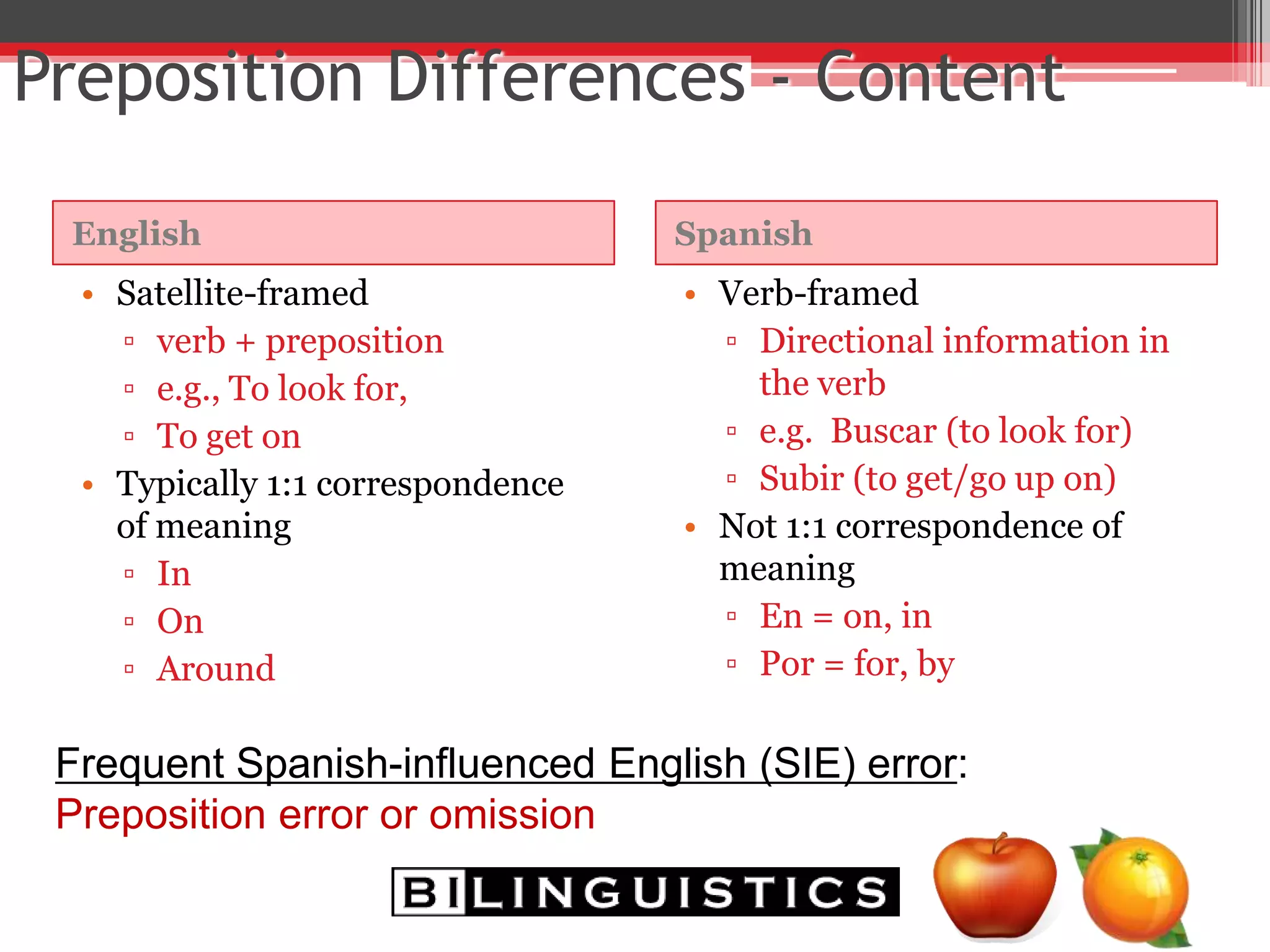
Word Use
English
• Satellite-framed
▫ verb + preposition
▫ e.g., To look for,
▫ To get on
• Typically 1:1 correspondence
of meaning
▫ In
▫ On
▫ Around
Spanish
• Verb-framed
▫ Directional information in
the verb
▫ e.g. Buscar (to look for)
▫ Subir (to get/go up on)
• Not 1:1 correspondence of
meaning
▫ En = on, in
▫ Por = for, by
Preposition Differences - Content
Frequent Spanish-influenced English (SIE) error:
Preposition error or omission
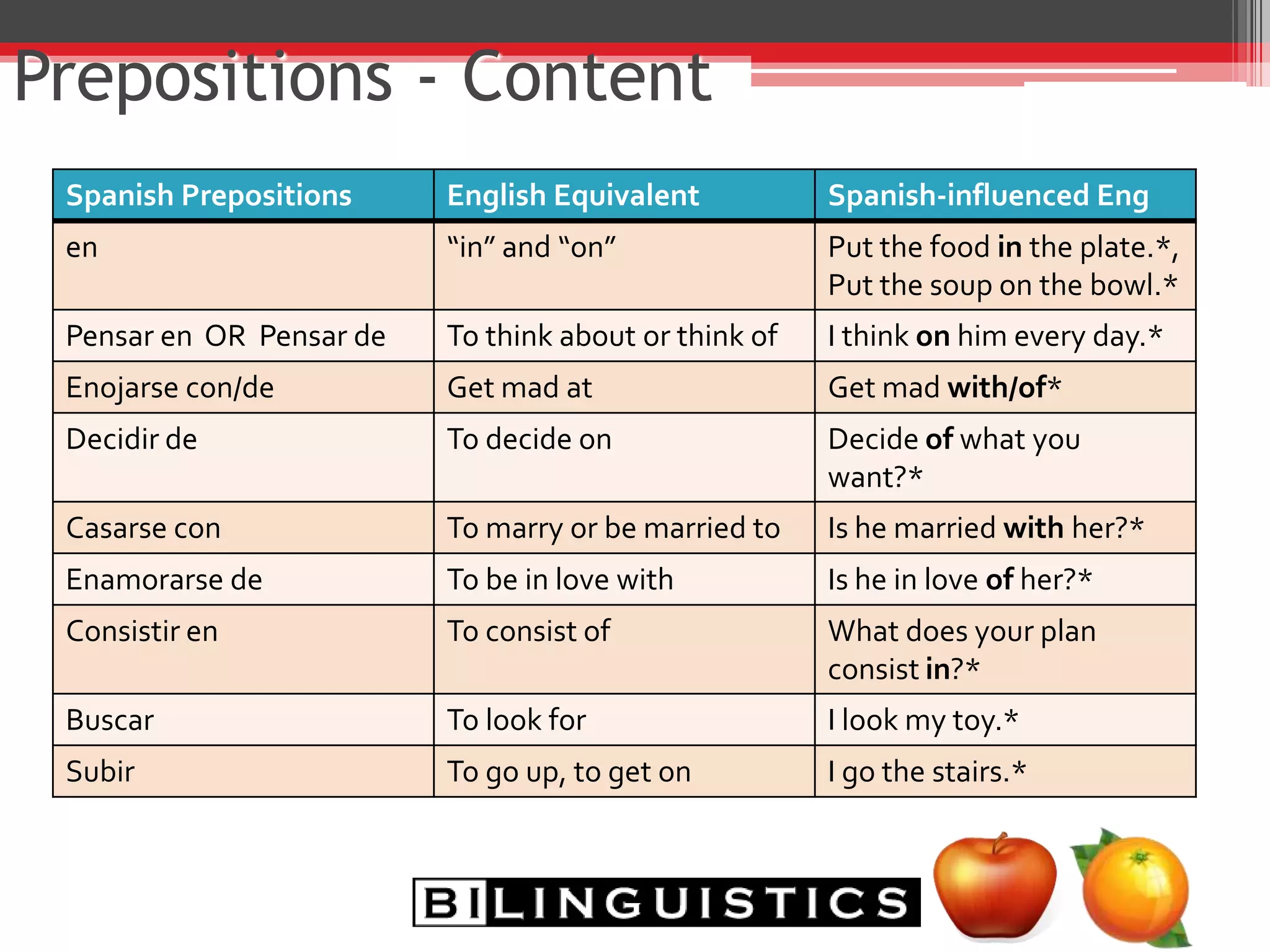
Prepositions - Content
Spanish Prepositions English Equivalent Spanish‐influenced Eng
en “in” and “on” Put the food in the plate.*, 
Put the soup on the bowl.*
Pensar en  OR  Pensar de To think about or think of I think on him every day.*
Enojarse con/de Get mad at Get mad with/of*
Decidir de To decide on Decide of what you 
want?*
Casarse con To marry or be married to Is he married with her?*
Enamorarse de To be in love with Is he in love of her?*
Consistir en To consist of What does your plan 
consist in?*
Buscar To look for I look my toy.*
Subir To go up, to get on I go the stairs.*
Click here to download this chart as a pdf.
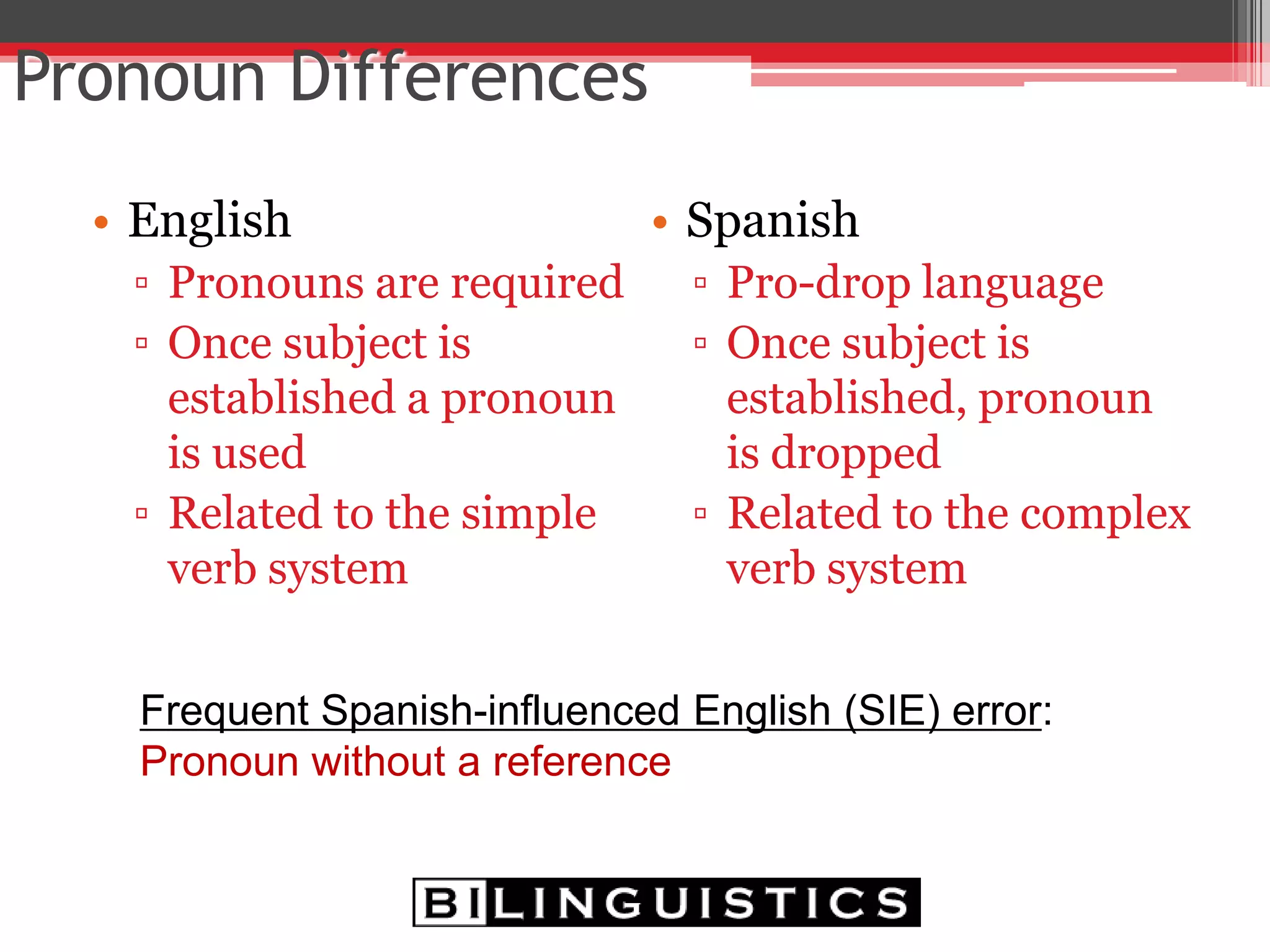
Pronoun Differences
• English
▫ Pronouns are required
▫ Once subject is
established a pronoun
is used
▫ Related to the simple
verb system
• Spanish
▫ Pro-drop language
▫ Once subject is
established, pronoun
is dropped
▫ Related to the complex
verb system
Frequent Spanish-influenced English (SIE) error:
Pronoun without a reference
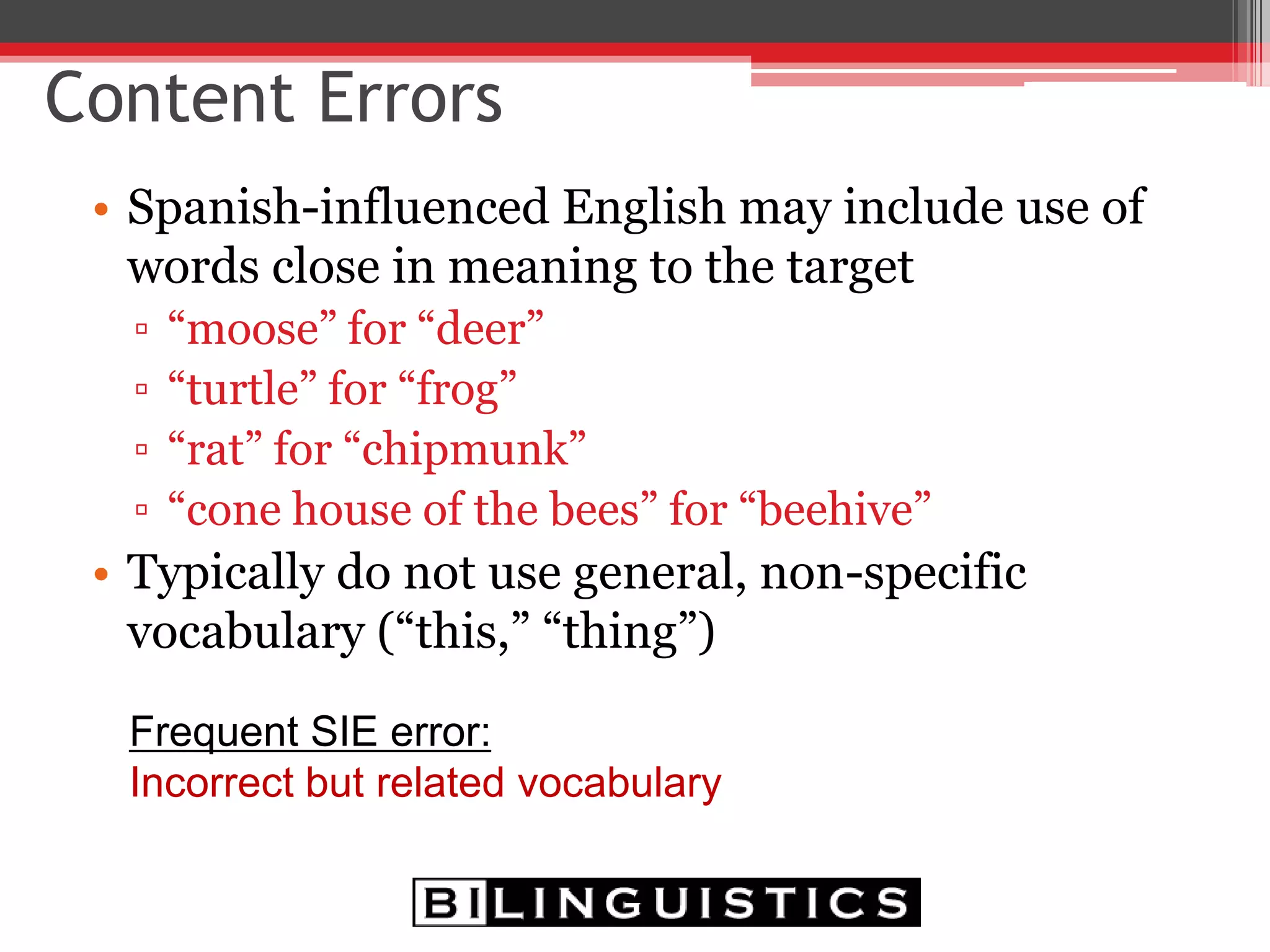
Content Errors
• Spanish-influenced English may include use of
words close in meaning to the target
▫ “moose” for “deer”
▫ “turtle” for “frog”
▫ “rat” for “chipmunk”
▫ “cone house of the bees” for “beehive”
• Typically do not use general, non-specific
vocabulary (“this,” “thing”)
Frequent SIE error:
Incorrect but related vocabulary
• Bilingual children develop early vocabulary at
the same rate as monolingual children (Pearson, 1993).
• Early language milestones are similar (single
words, lexical spurt, 2-word phrases) (Pearson and
Fernandez, 2001).
• Conceptual scores are similar (Pearson, 1998).
• Language exposure drives vocabulary
production (Pearson, Fernandez, Lewedeg, and Oller, 1997)
• For bilingual toddlers 30% of vocabulary are
translation equivalents1
• Young school-age bilinguals produce same # of
category items in Spanish and English BUT 70%
are unique to one language2
• Task performance varies by language3
• 1 Pearson, Fernandez & Oller, 1995
• 2 Peña, Bedore & Zlatic, 2002
• 3 Peña, Bedore, & Rappazzo, 2003
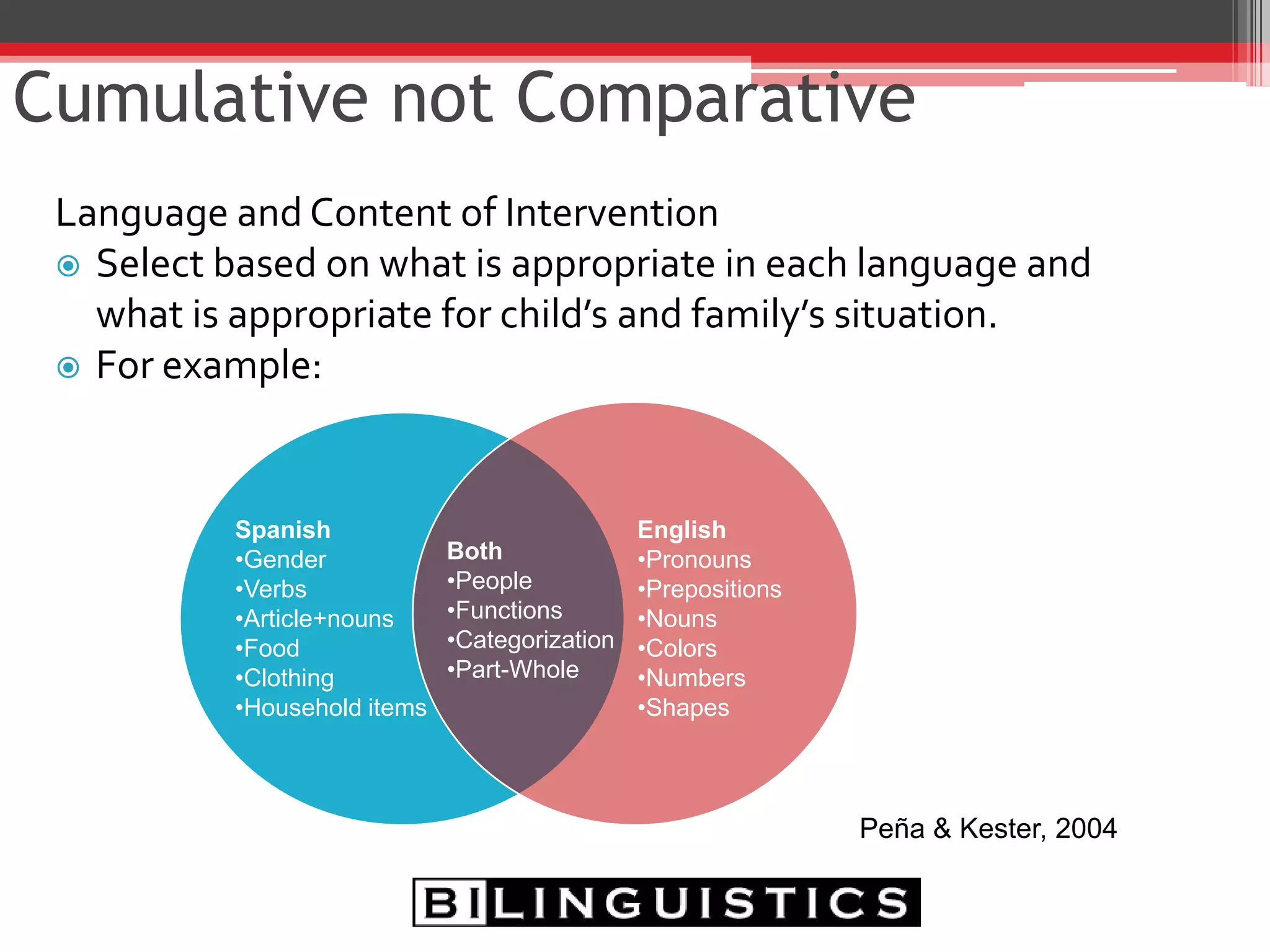
Cumulative not Comparative
Language and Content of Intervention
 Select based on what is appropriate in each language and 
what is appropriate for child’s and family’s situation.
 For example:
Spanish
•Gender
•Verbs
•Article+nouns
•Food
•Clothing
•Household items
Both
•People
•Functions
•Categorization
•Part-Whole
English
•Pronouns
•Prepositions
•Nouns
•Colors
•Numbers
•Shapes
Peña & Kester, 2004
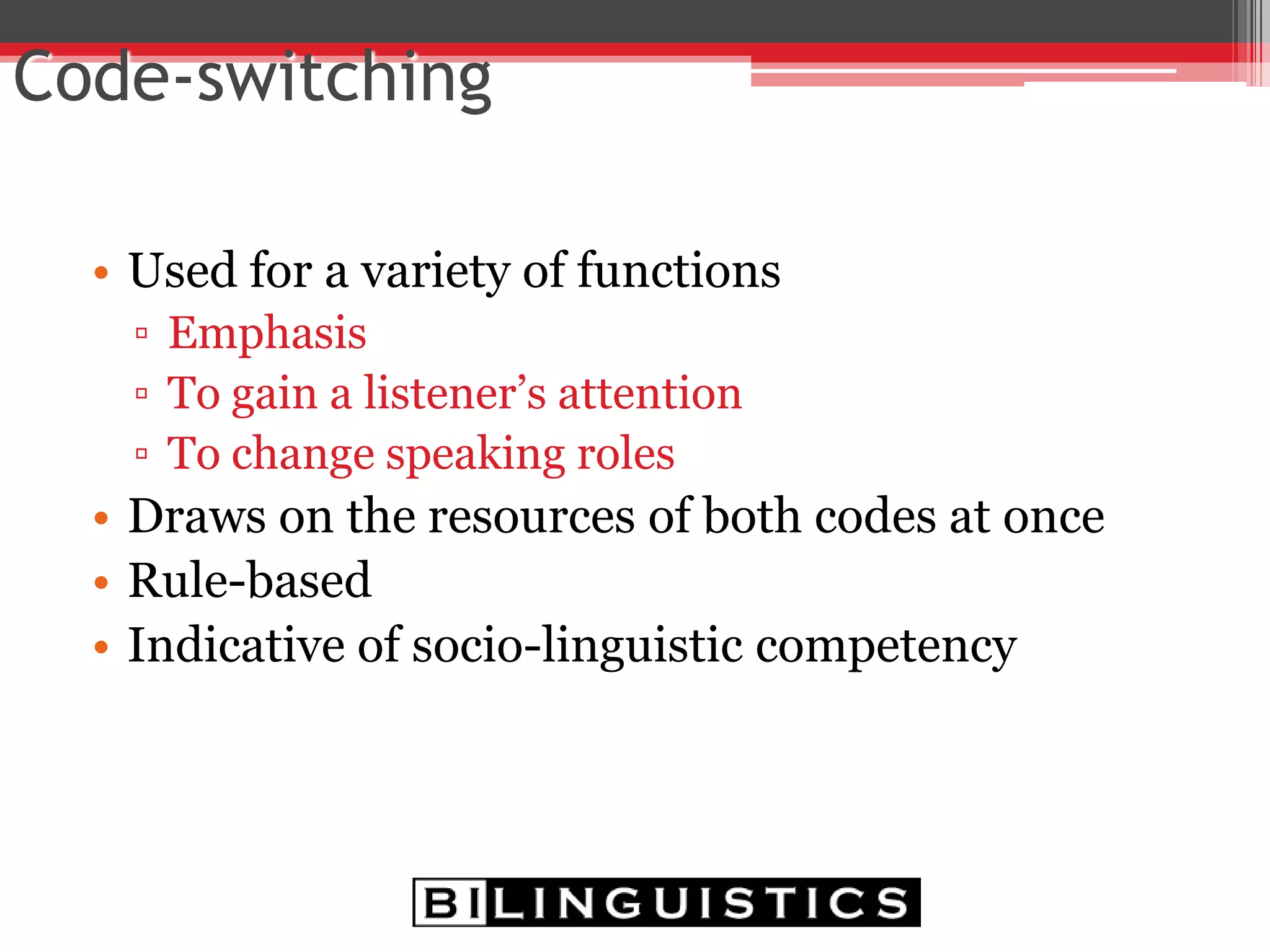
Code-switching
• A natural dynamic phenomenon that serves
specific purposes in specific contexts.
• Used for a variety of functions
▫ Emphasis
▫ To gain a listener’s attention
▫ To change speaking roles
• Draws on the resources of both codes at once
• Rule-based
• Indicative of socio-linguistic competency
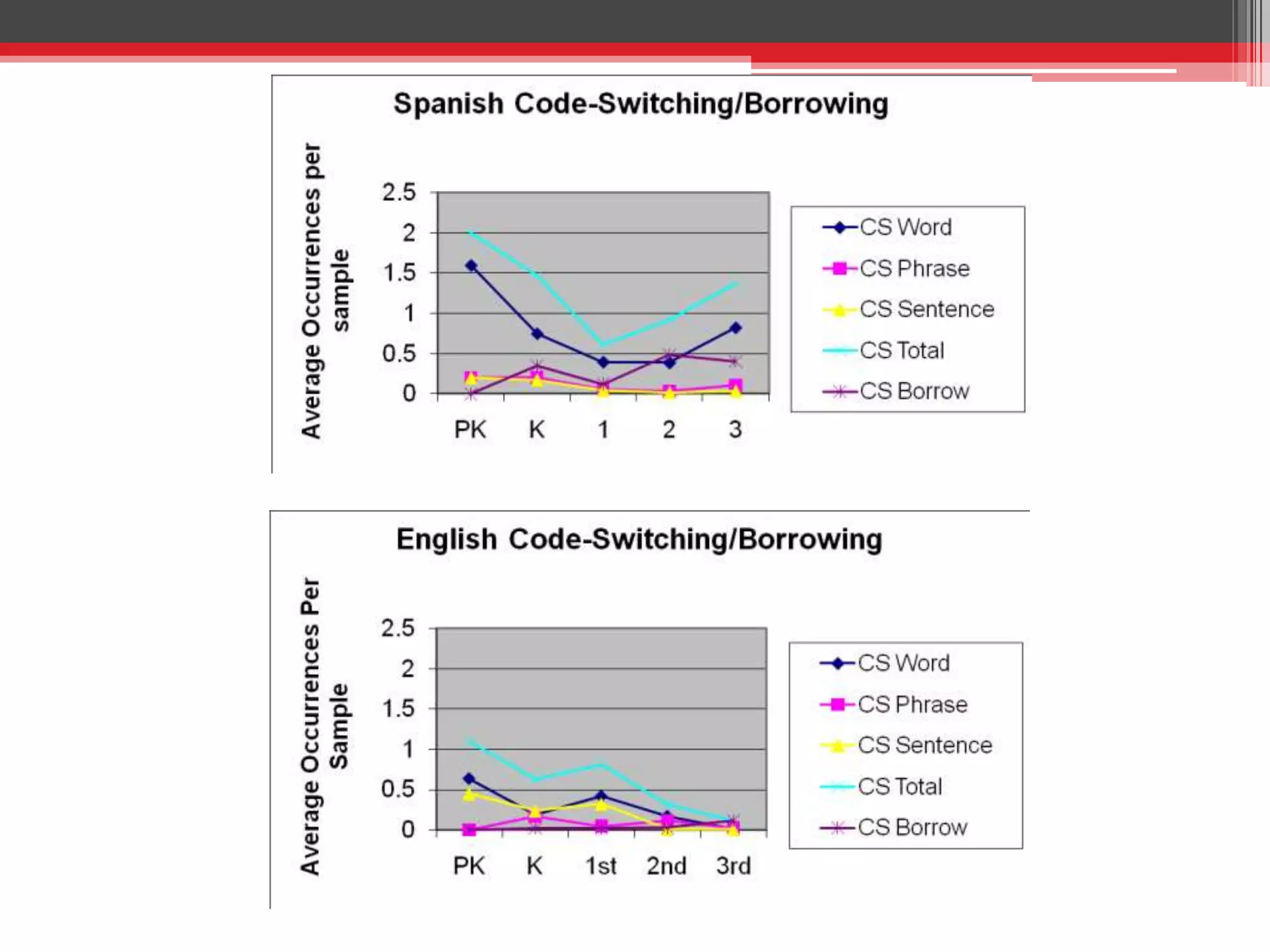
0
0.5
1
1.5
2
2.5
PK K 1 2 3
AverageOccurrencesper
sample
Spanish Code-Switching/Borrowing
CS Word
CS Phrase
CS Sentence
CS Total
CS Borrow
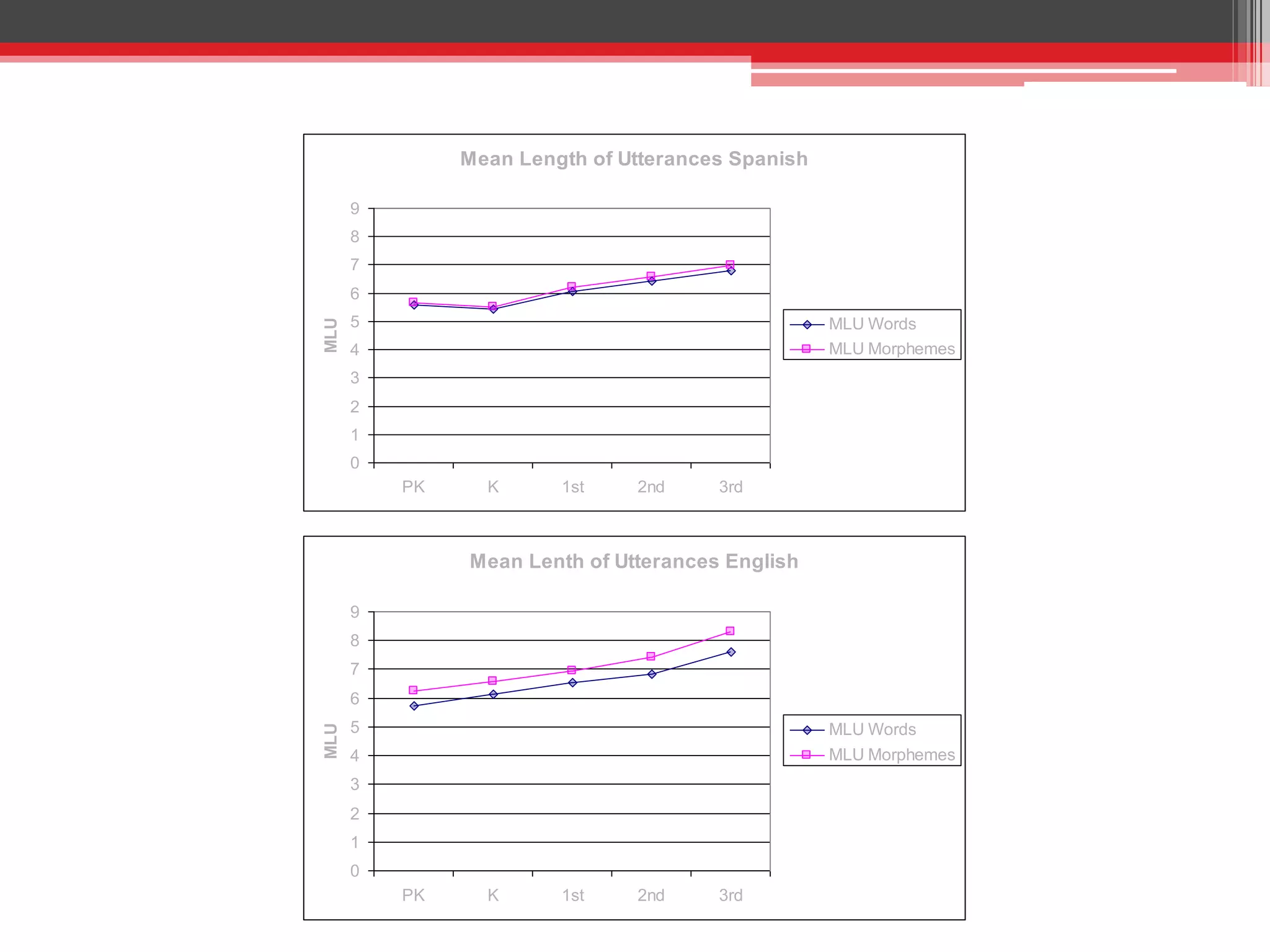
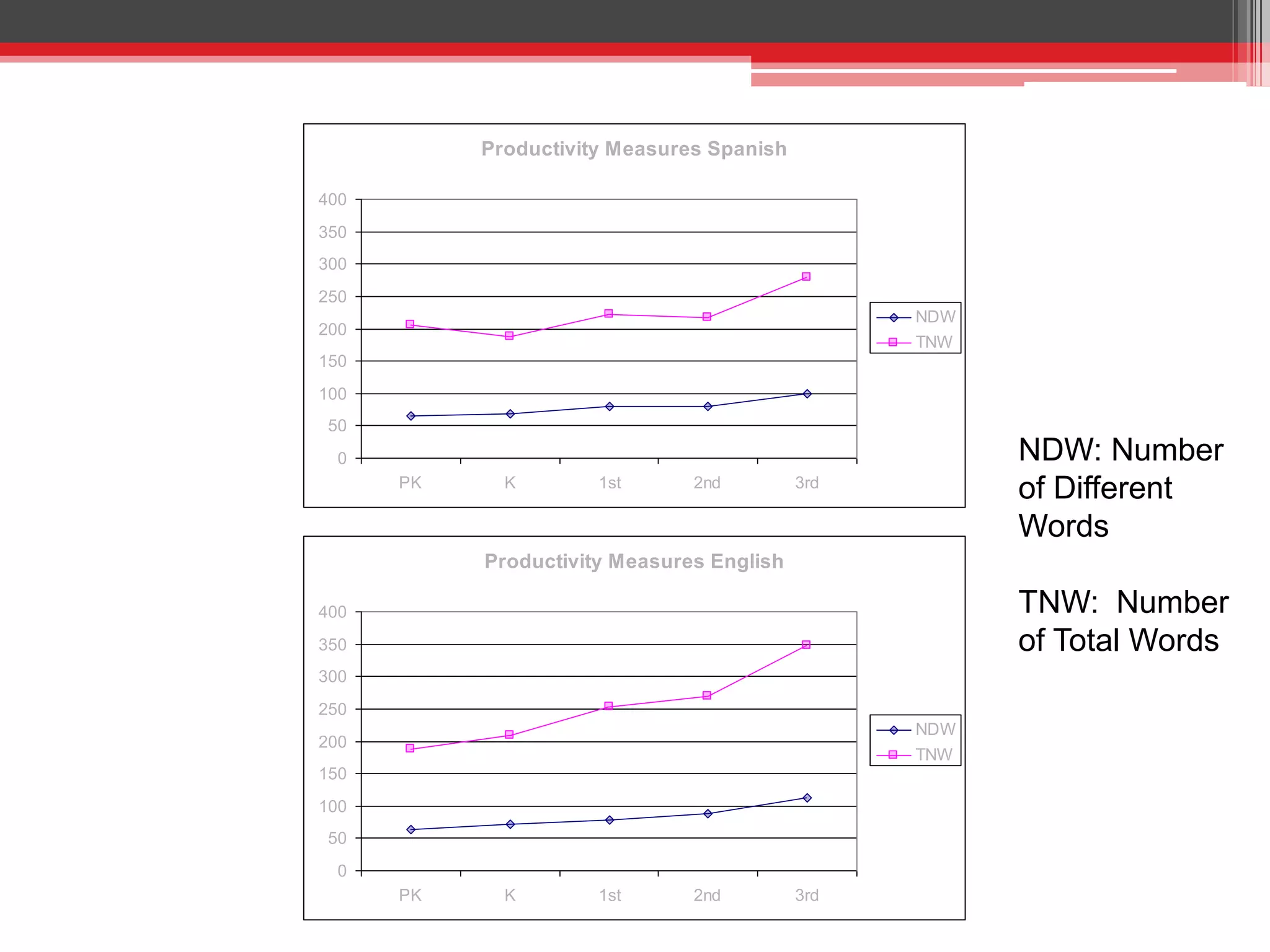
Measures of Productivity &
Complexity
Often used as measures of
proficiency
Look very similar in English and
Spanish
Mean Length of Utterances Spanish
0
1
2
3
4
5
6
7
8
9
PK K 1st 2nd 3rd
MLU MLU Words
MLU Morphemes
Mean Lenth of Utterances English
0
1
2
3
4
5
6
7
8
9
PK K 1st 2nd 3rd
MLU
MLU Words
MLU Morphemes
Productivity Measures Spanish
0
50
100
150
200
250
300
350
400
PK K 1st 2nd 3rd
NDW
TNW
Productivity Measures English
0
50
100
150
200
250
300
350
400
PK K 1st 2nd 3rd
NDW
TNW
NDW: Number
of Different
Words
TNW: Number
of Total Words
Spanish-Influenced English
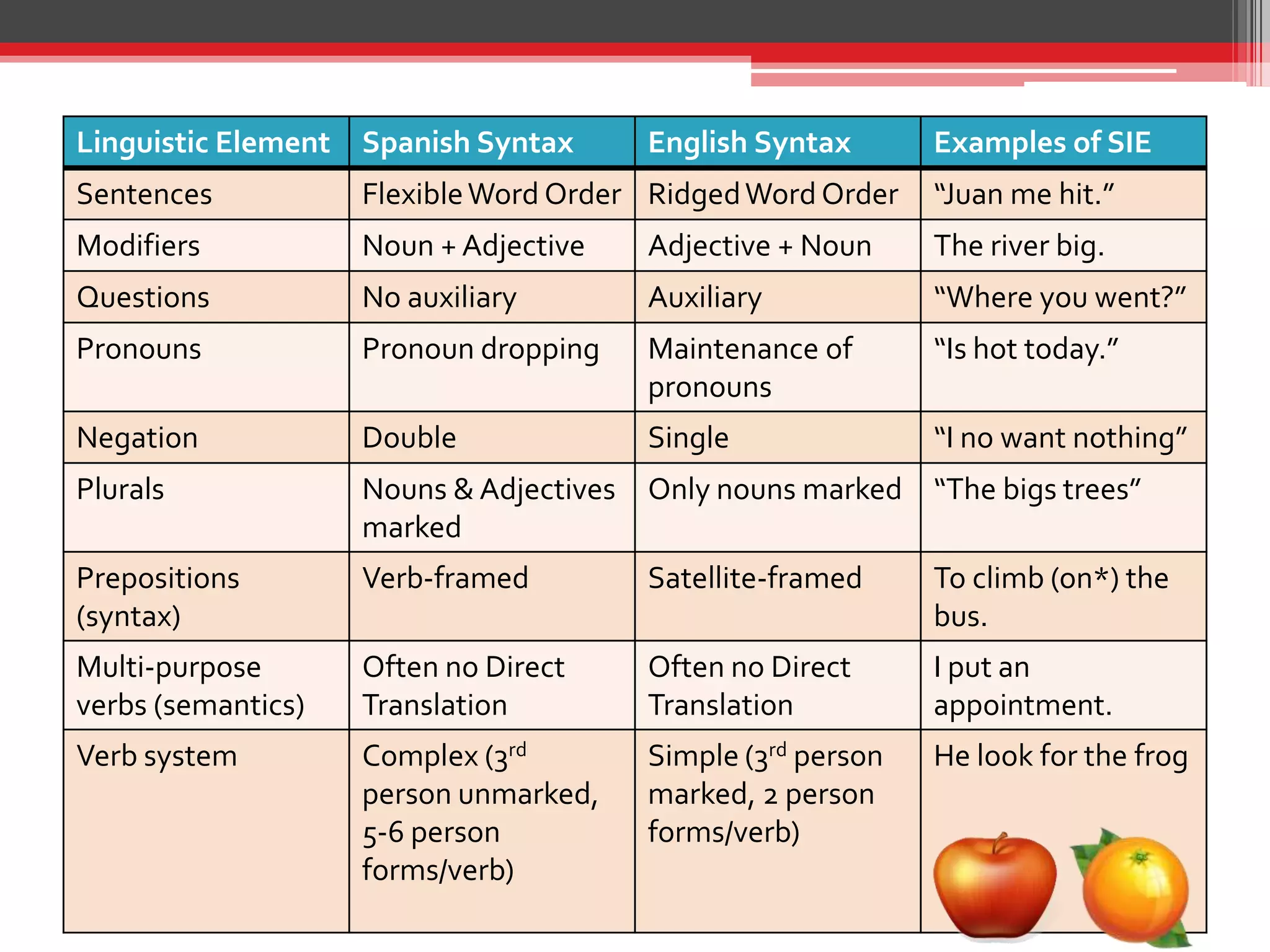
Linguistic Element Spanish Syntax English Syntax Examples of SIE
Sentences Flexible Word Order Ridged Word Order “Juan me hit.” 
Modifiers Noun + Adjective Adjective + Noun The river big.
Questions No auxiliary Auxiliary “Where you went?” 
Pronouns Pronoun dropping Maintenance of 
pronouns
“Is hot today.” 
Negation Double Single “I no want nothing” 
Plurals Nouns & Adjectives 
marked 
Only nouns marked “The bigs trees”
Prepositions 
(syntax)
Verb‐framed Satellite‐framed To climb (on*) the 
bus.
Multi‐purpose 
verbs (semantics)
Often no Direct 
Translation
Often no Direct 
Translation
I put an 
appointment.
Verb system Complex (3rd
person unmarked, 
5‐6 person 
forms/verb)
Simple (3rd person 
marked, 2 person 
forms/verb)
He look for the frog
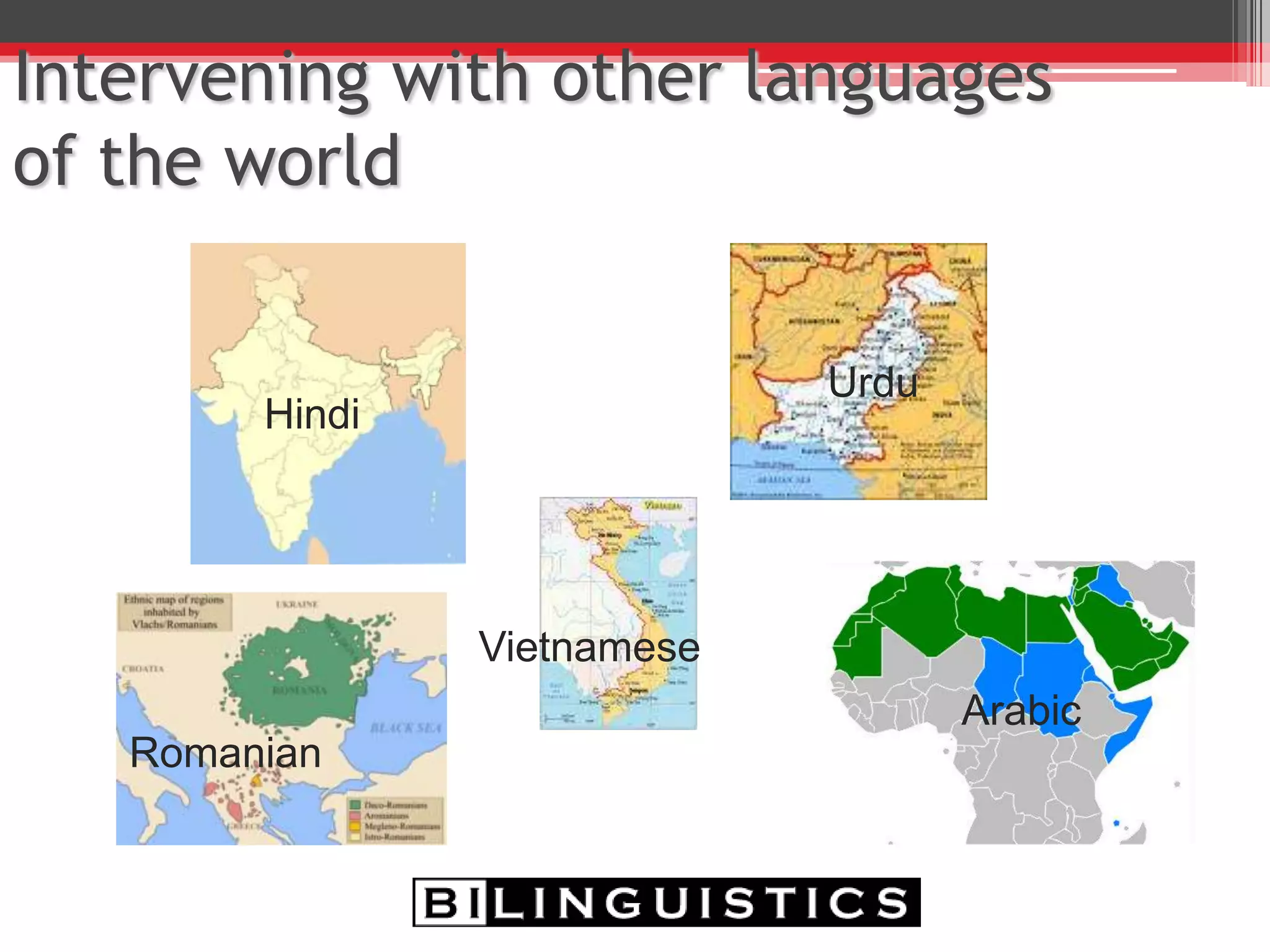
Intervening with other languages
of the world
Vietnamese
Romanian
Hindi
Urdu
Arabic
Other Common Languages
• “difference between ___________ and
English Language”
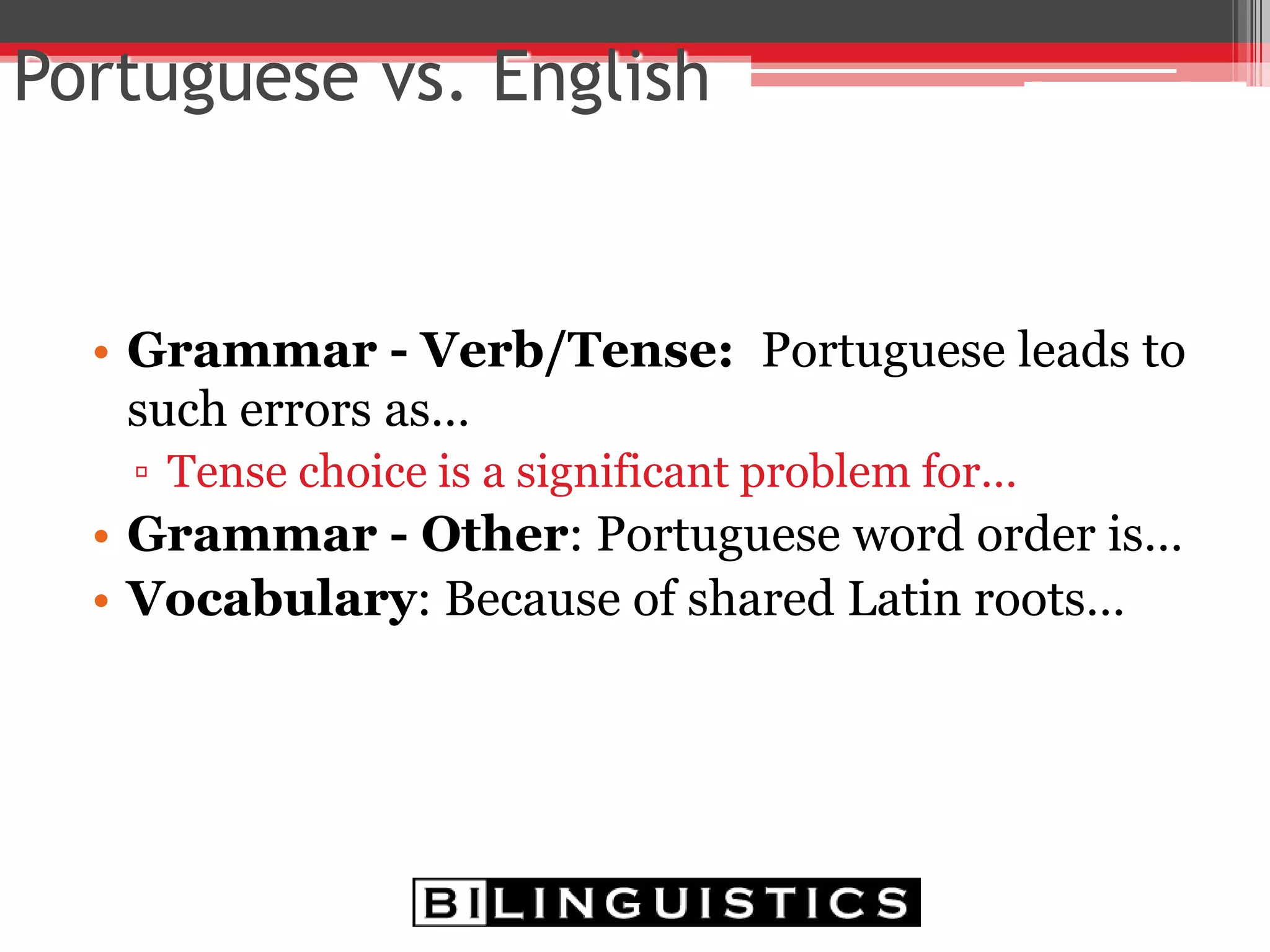
Portuguese vs. English
• Grammar - Verb/Tense: Portuguese leads to
such errors as…
▫ Tense choice is a significant problem for…
• Grammar - Other: Portuguese word order is…
• Vocabulary: Because of shared Latin roots…
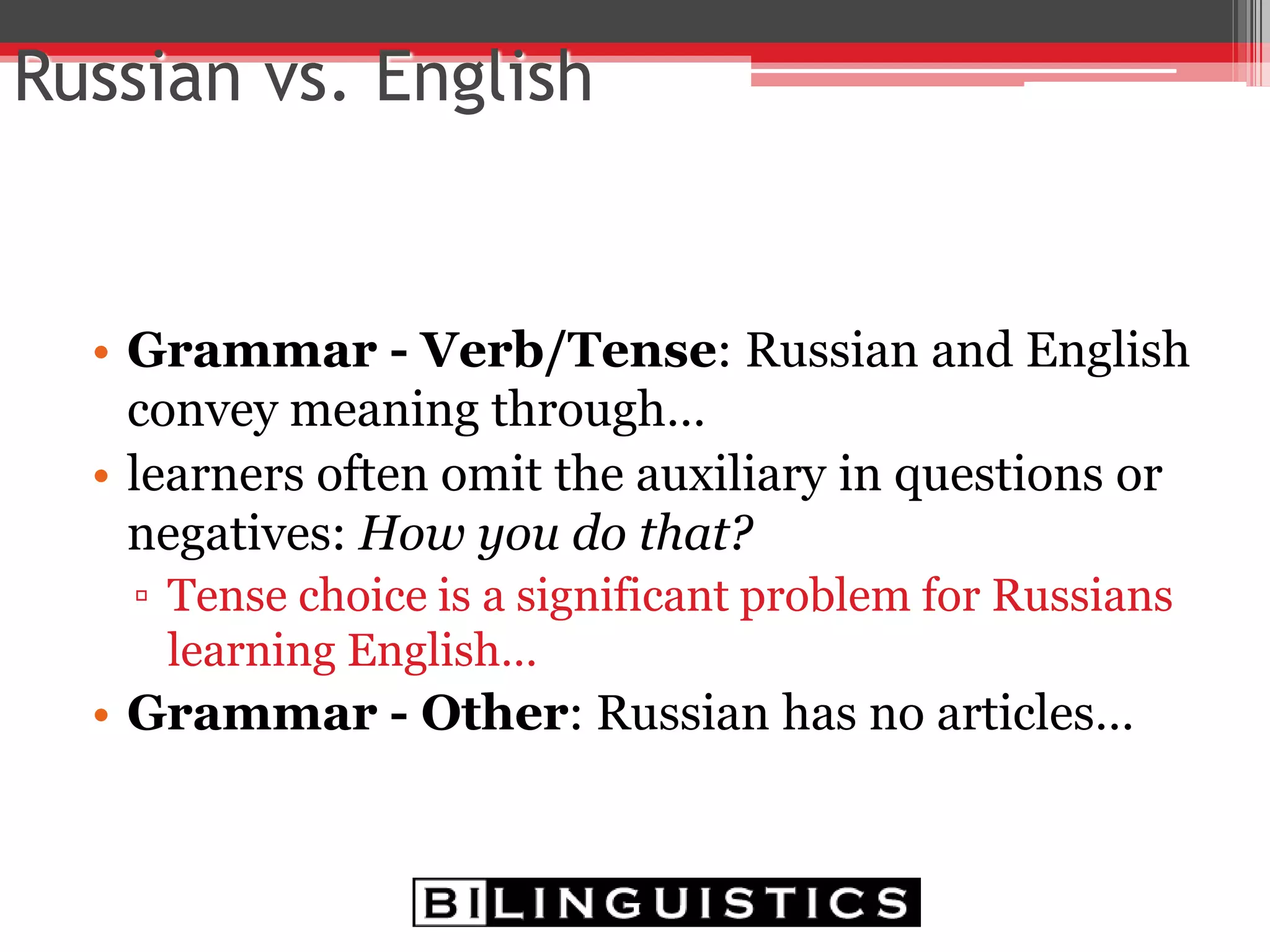
Russian vs. English
• Grammar - Verb/Tense: Russian and English
convey meaning through…
• learners often omit the auxiliary in questions or
negatives: How you do that?
▫ Tense choice is a significant problem for Russians
learning English…
• Grammar - Other: Russian has no articles…
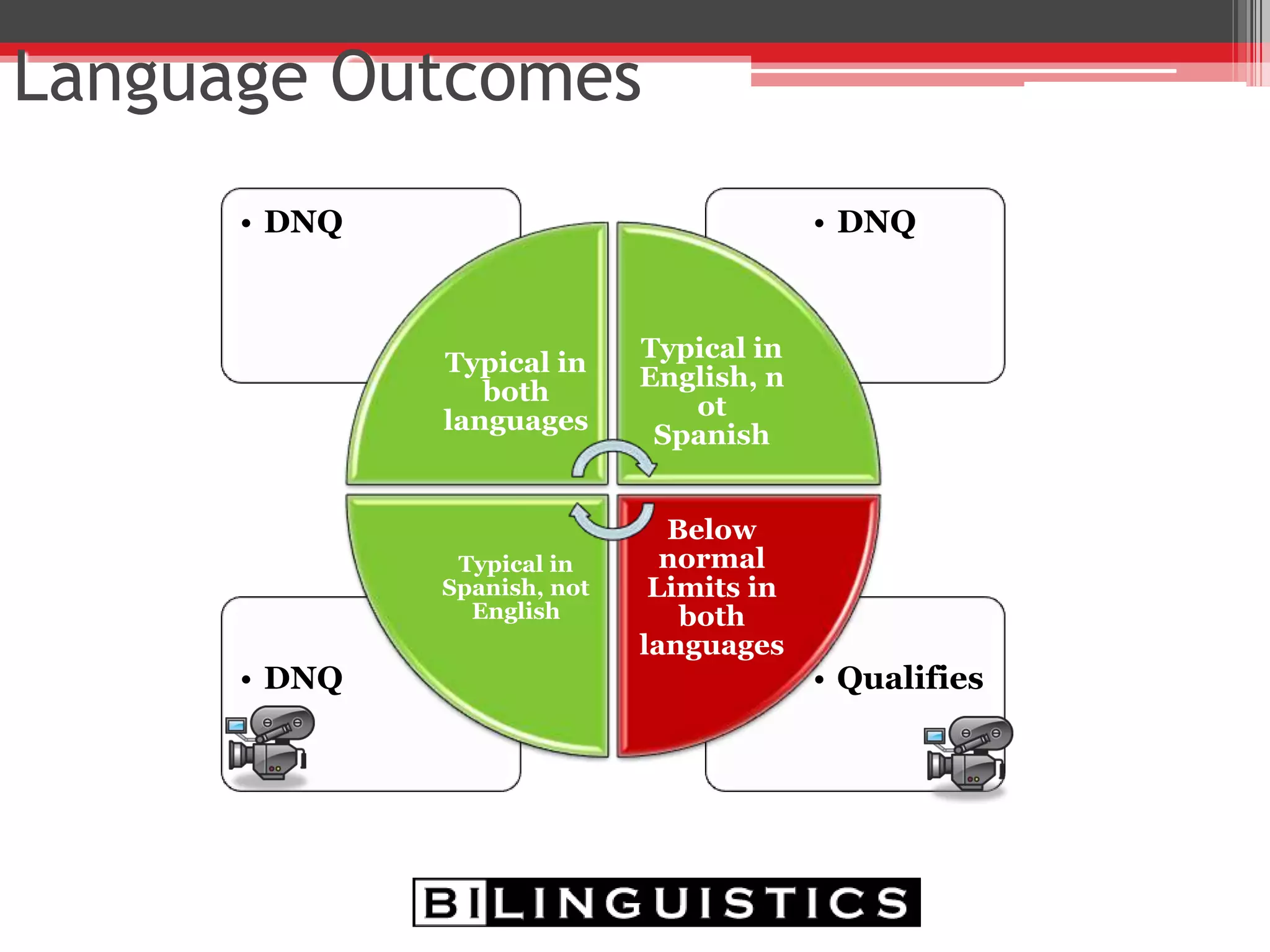
Language Outcomes
• Qualifies• DNQ
• DNQ• DNQ
Typical in
both
languages
Typical in
English,
not
Spanish
Below
normal
Limits in
both
languages
Typical in
Spanish,
not
English
Click to visit www.bilinguistics.com
Difference or Disorder? 
Understanding Speech and Language 
Patterns in Culturally and Linguistically 
Diverse Students
Rapidly identify speech‐language 
patterns related to second language 
acquisition to 
distinguish difference from disorder.
Thank
you!

Difference vs. Disorder: Language Development in Culturally and Linguistically Diverse Populations