Effective Educational Strategies That 
Take Poverty into Consideration
Phuong Lien Palafox, M.S., CCC‐SLP
Region 15 Education Service Center
August 14, 2014
Disclosure Statement:  
Phuong Lien Palafox, CCC-SLP is employed
by Bilinguistics, Inc.
Disclosure:
Financial — Salaried by Bilinguistics, Inc.
Nonfinancial — None
Phuong Lien Palafox,
CCC-SLP
Do you need Continuing Education or want 
to listen to this course live?
Click here to visit 
the online courses.
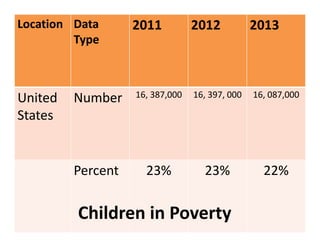
Location Data 
Type
2011 2012 2013
United 
States
Number 16, 387,000 16, 397, 000 16, 087,000
Percent 23% 23% 22%
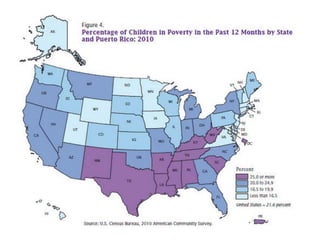
Children in Poverty
All of the documents and charts in this presentation 
can be downloaded from our Free Resource Library.
Click here to visit the Resource Library
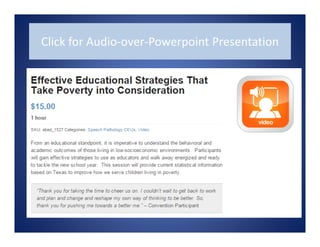
Click for Audio‐over‐Powerpoint Presentation
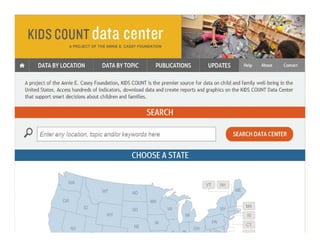
http://datacenter.kidscount.org/
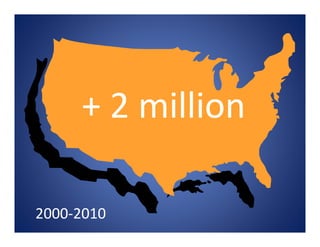
2000‐2010
+ 2 million
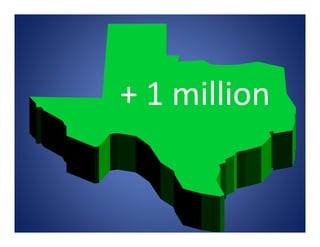
+ 1 million
“Officially Poor”Officially Poor
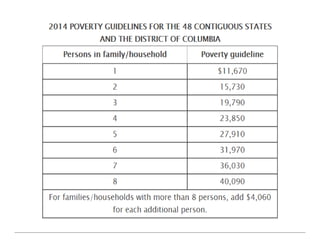
http://aspe.hhs.gov/poverty/13poverty.cfm
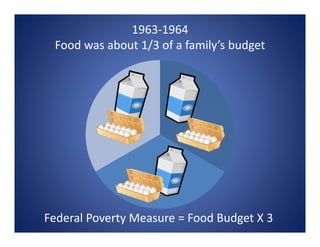
1963‐1964 
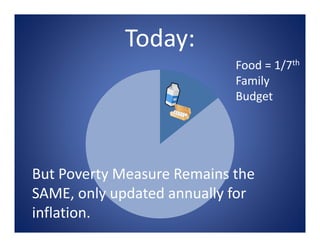
Food was about 1/3 of a family’s budget
Federal Poverty Measure = Food Budget X 3
Modern Families’ Expenses
Today:
Food = 1/7th
Family 
Budget
But Poverty Measure Remains the 
SAME, only updated annually for 
inflation.
What does the 
poverty measure tell 
us?
21
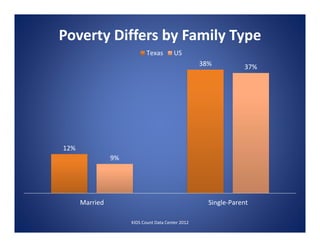
12%
38%
9%
37%
Married Single‐Parent
Poverty Differs by Family Type
Texas US
KIDS Count Data Center 2012
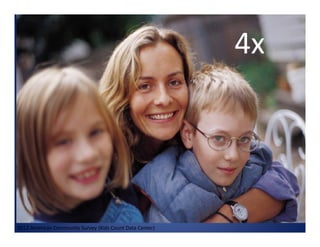
2012 American Community Survey (Kids Count Data Center)                                                         
4x
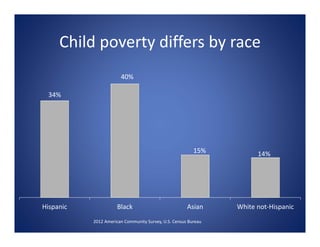
Child poverty differs by race
34%
40%
15% 14%
Hispanic Black Asian White not‐Hispanic
2012 American Community Survey, U.S. Census Bureau
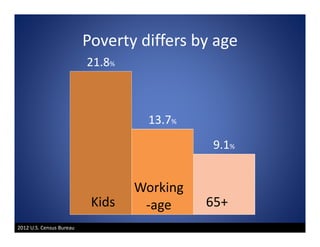
Poverty differs by age
21.8%
13.7%
9.1%
Kids
Working
‐age 65+
2012 U.S. Census Bureau
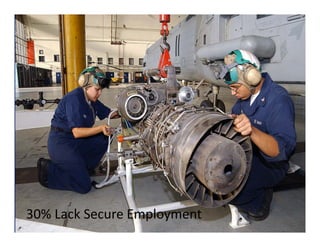
30% Lack Secure Employment
Trends in 
Education
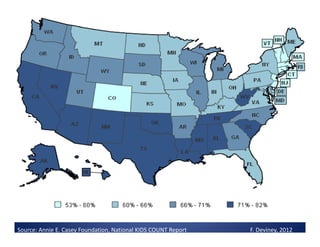
Source: Annie E. Casey Foundation, National KIDS COUNT Report F. Deviney, 2012
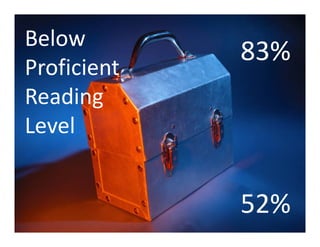
Below 
Proficient 
Reading 
Level
83%
52%
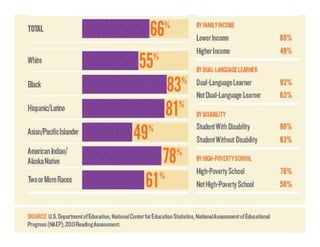
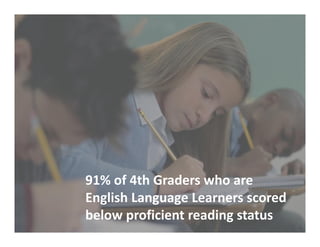
91% of 4th Graders who are 
English Language Learners scored 
below proficient reading status
Toddlers from middle and high income families speak 
MORE than parents from low SES environments when 
speaking to their own children.              ‐ Bracy, 2006
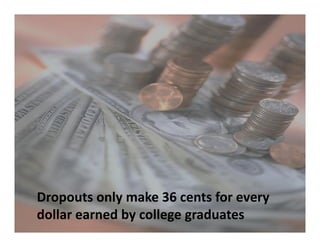
Dropouts only make 36 cents for every 
dollar earned by college graduates
ERIC
Jensen
TOUR 2014
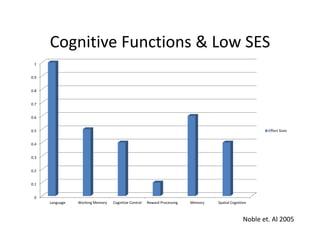
0
0.1
0.2
0.3
0.4
0.5
0.6
0.7
0.8
0.9
1
Language Working Memory Cognitive Control Reward Processing Memory Spatial Cognition
Effect Sizes
Noble et. Al 2005
Cognitive Functions & Low SES
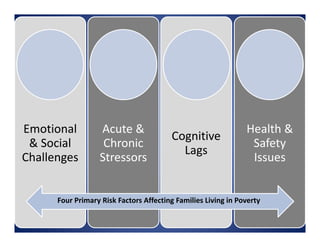
Emotional 
& Social 
Challenges
Acute & 
Chronic 
Stressors
Cognitive 
Lags
Health & 
Safety 
Issues
Four Primary Risk Factors Affecting Families Living in Poverty
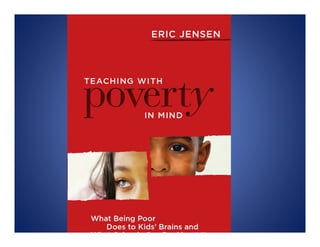
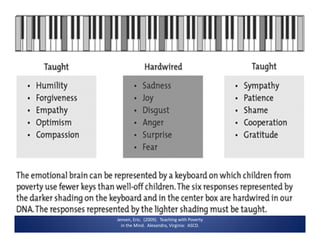
Jensen, Eric.  (2009).  Teaching with Poverty 
in the Mind.  Alexandra, Virginia:  ASCD.
Neurogenesis
Merriam‐Webster’s 
Definition
development of nerves, 
nervous tissue, or the 
nervous system
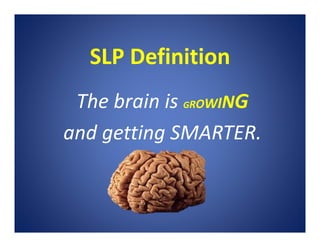
SLP Definition
The brain is GROWING
and getting SMARTER.
Build Vocabulary.
Every.  Single.  Day.
By 3rd grade, children add about 
3000 vocabulary words per year.
An average reading program teaches 
about 400 words per year.
Type I Words:  Basic Words 
(girl, happy, fast)
Montgomery, 2007
Type II Words:  High Frequency Words, 
Across Multiple Domains,  Multiple 
Meanings (measure, sympathy, 
estimate)
Montgomery, 2007
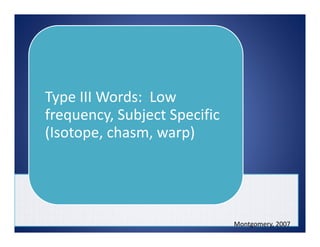
Type III Words:  Low 
frequency, Subject Specific 
(Isotope, chasm, warp)
Montgomery, 2007
Relationships 
Matter
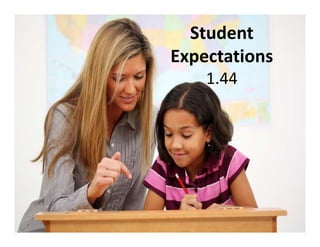
Student 
Expectations
1.44
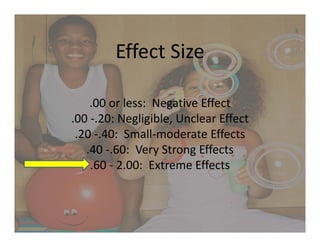
Effect Size
.00 or less:  Negative Effect
.00 ‐.20: Negligible, Unclear Effect
.20 ‐.40:  Small‐moderate Effects
.40 ‐.60:  Very Strong Effects
.60 ‐ 2.00:  Extreme Effects
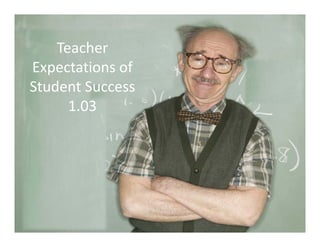
Teacher 
Expectations of 
Student Success
1.03
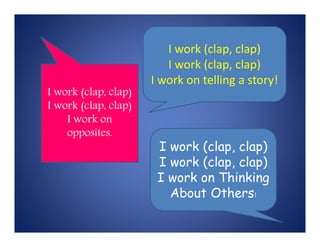
I work (clap, clap)
I work (clap, clap)
I work on telling a story!
I work (clap, clap)
I work (clap, clap)
I work on
opposites.
I work (clap, clap)
I work (clap, clap)
I work on Thinking
About Others!
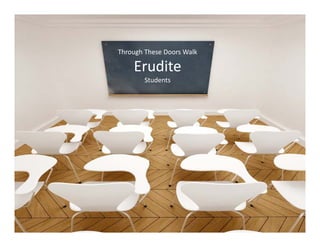
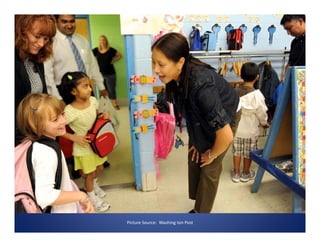
Through These Doors Walk
Erudite
Students
Picture Source:  Washing ton Post
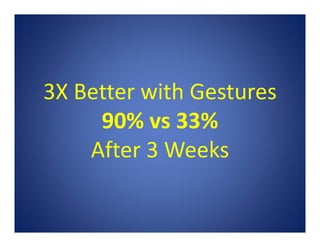
3X Better with Gestures
90% vs 33%
After 3 Weeks
Hi Five
Low Five
Working 
Memory
Let’s ALL 
tell a 
story!
OUR
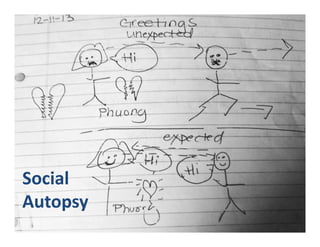
Social 
Autopsy
Click to visit www.bilinguistics.com
Difference or Disorder? Understanding 
Speech and Language Patterns in 
Culturally and Linguistically Diverse 
Students
Rapidly identify speech‐language 
patterns related to second language 
acquisition to 
distinguish difference from disorder.

Effective Educational Strategies That Take Poverty into Consideration