Copyright © 2014 Bilinguistics, Inc.  All 
Rights Reserved.
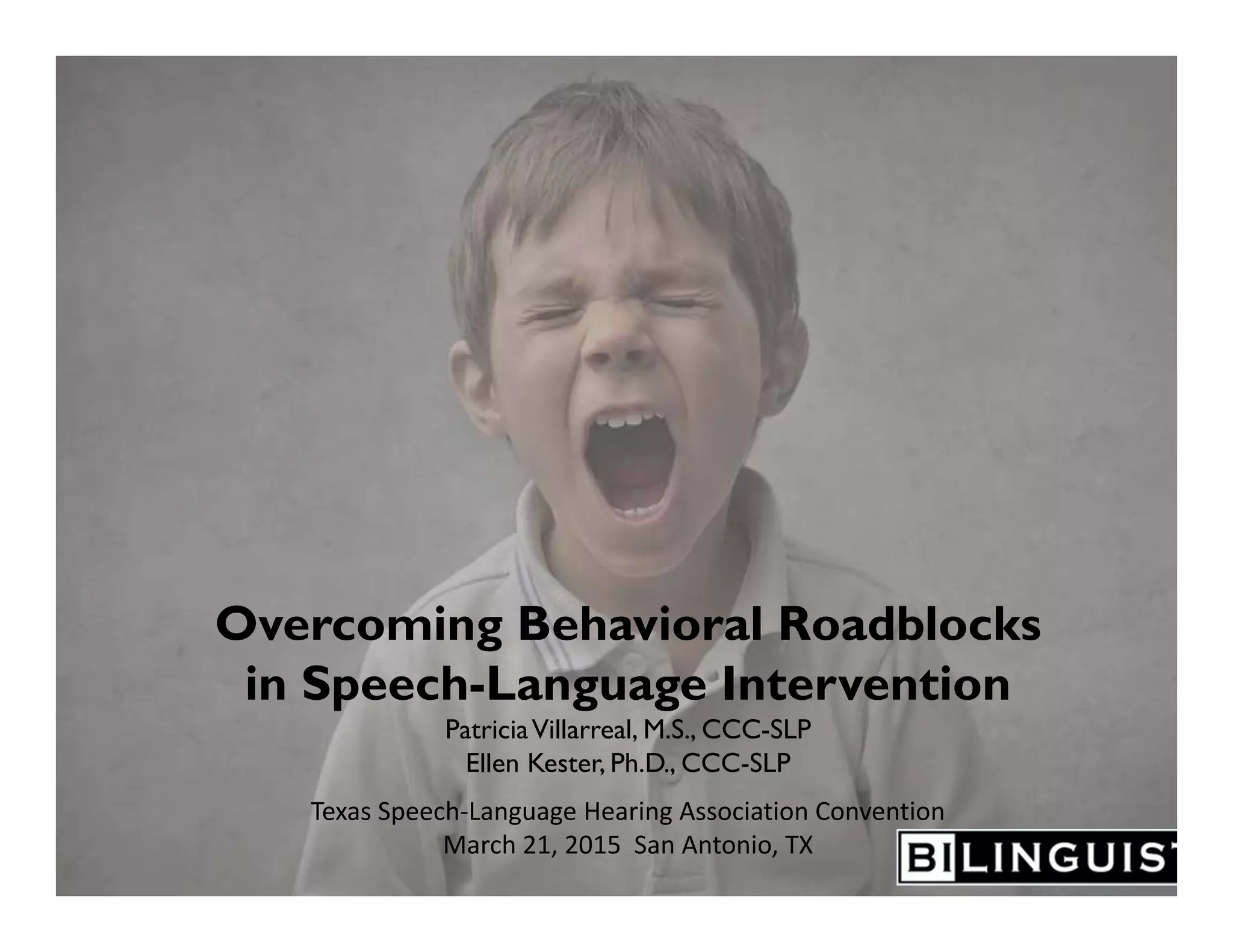
Overcoming Behavioral Roadblocks
in Speech-Language Intervention
PatriciaVillarreal, M.S., CCC-SLP
Ellen Kester, Ph.D., CCC-SLP
Texas Speech‐Language Hearing Association Convention
March 21, 2015  San Antonio, TX
Co‐occurrence of communication 
disorders and behavior
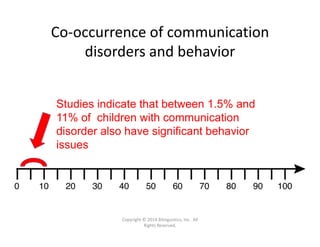
Studies indicate that between 1.5% and
11% of children with communication
disorder also have significant behavior
issues
Copyright © 2014 Bilinguistics, Inc.  All 
Rights Reserved.
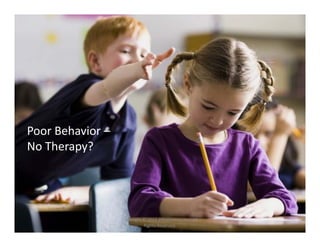
Poor Behavior –
No Therapy?
Copyright © 2014 Bilinguistics, Inc.  All 
Rights Reserved.
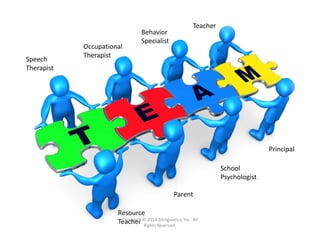
Speech 
Therapist
Occupational 
Therapist
Behavior 
Specialist
Teacher
Principal
School 
Psychologist
Parent
Resource 
TeacherCopyright © 2014 Bilinguistics, Inc.  All 
Rights Reserved.
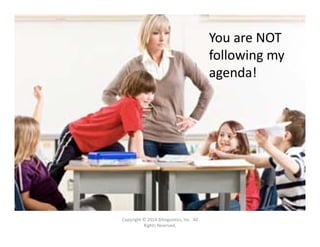
You are NOT following 
my agenda!
Copyright © 2014 Bilinguistics, Inc.  All 
Rights Reserved.
You are NOT 
following my 
agenda!
Do you need Continuing Education or want 
to listen to this course live?
Click here to visit 
the online courses.
Click for Audio‐over‐Powerpoint Presentation
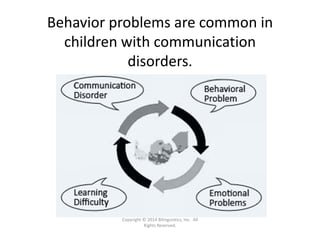
Behavior problems are common in 
children with communication 
disorders.
Copyright © 2014 Bilinguistics, Inc.  All 
Rights Reserved.
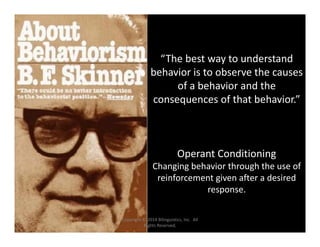
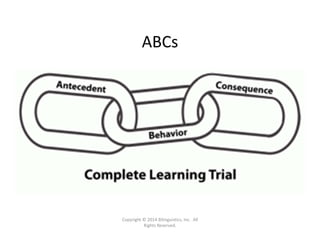
“The best way to understand 
behavior is to observe the causes 
of a behavior and the 
consequences of that behavior.”
Operant Conditioning
Changing behavior through the use of 
reinforcement given after a desired 
response.
Copyright © 2014 Bilinguistics, Inc.  All 
Rights Reserved.
Function of the Behavior
Copyright © 2014 Bilinguistics, Inc.  All 
Rights Reserved.
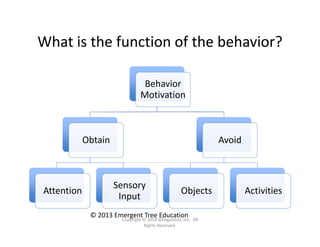
What is the function of the behavior?
Behavior 
Motivation
Obtain
Attention
Sensory 
Input
Avoid
Objects Activities
© 2013 Emergent Tree Education 
Copyright © 2014 Bilinguistics, Inc.  All 
Rights Reserved.
ABCs
Copyright © 2014 Bilinguistics, Inc.  All 
Rights Reserved.
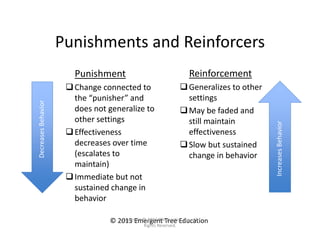
Punishments and Reinforcers
Punishment
Change connected to 
the “punisher” and 
does not generalize to 
other settings
Effectiveness 
decreases over time 
(escalates to 
maintain)
Immediate but not 
sustained change in 
behavior
Reinforcement
Generalizes to other 
settings
May be faded and 
still maintain 
effectiveness
Slow but sustained 
change in behavior
© 2013 Emergent Tree Education 
Decreases Behavior
Increases Behavior
Copyright © 2014 Bilinguistics, Inc.  All 
Rights Reserved.
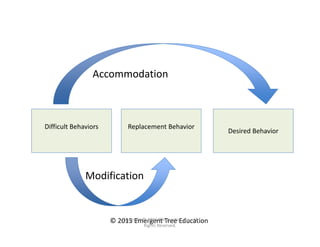
Difficult Behaviors Replacement Behavior
Desired Behavior
Accommodation
Modification
© 2013 Emergent Tree Education Copyright © 2014 Bilinguistics, Inc.  All 
Rights Reserved.
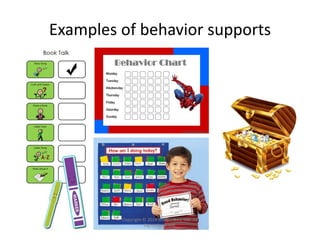
Examples of behavior supports
Copyright © 2014 Bilinguistics, Inc.  All 
Rights Reserved.
All of the documents and charts in this presentation 
can be downloaded from our Free Resource Library.
Click here to visit the Resource Library
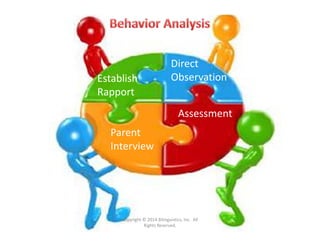
Parent 
Interview
Direct 
ObservationEstablish 
Rapport
Assessment
Copyright © 2014 Bilinguistics, Inc.  All 
Rights Reserved.
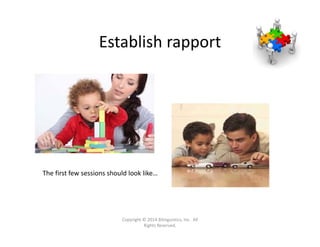
Establish rapport
The first few sessions should look like…
Copyright © 2014 Bilinguistics, Inc.  All 
Rights Reserved.
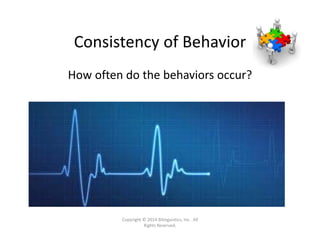
Consistency of Behavior
How often do the behaviors occur?
Copyright © 2014 Bilinguistics, Inc.  All 
Rights Reserved.
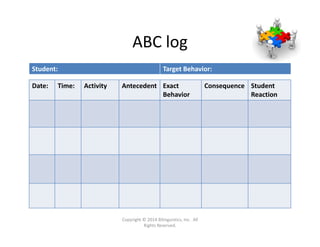
ABC log
Date: Time: Activity Antecedent Exact 
Behavior
Consequence Student 
Reaction
Student: Target Behavior:
Copyright © 2014 Bilinguistics, Inc.  All 
Rights Reserved.
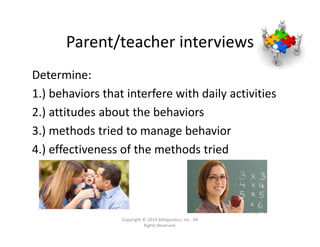
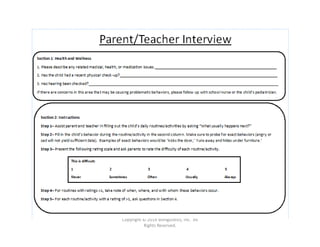
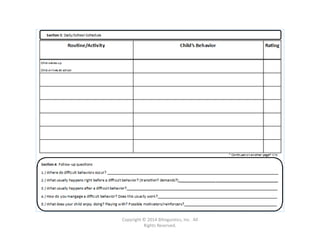
Parent/teacher interviews
Determine:
1.) behaviors that interfere with daily activities
2.) attitudes about the behaviors
3.) methods tried to manage behavior
4.) effectiveness of the methods tried
Copyright © 2014 Bilinguistics, Inc.  All 
Rights Reserved.
Copyright © 2014 Bilinguistics, Inc.  All 
Rights Reserved.
Copyright © 2014 Bilinguistics, Inc.  All 
Rights Reserved.
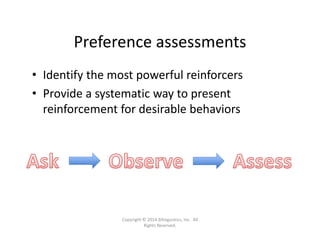
Preference assessments
• Identify the most powerful reinforcers
• Provide a systematic way to present 
reinforcement for desirable behaviors
Copyright © 2014 Bilinguistics, Inc.  All 
Rights Reserved.
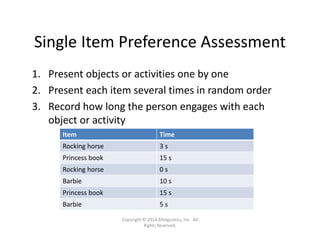
Single Item Preference Assessment
1. Present objects or activities one by one
2. Present each item several times in random order
3. Record how long the person engages with each 
object or activity
Item Time
Rocking horse 3 s
Princess book 15 s
Rocking horse 0 s
Barbie 10 s
Princess book 15 s
Barbie 5 s
Copyright © 2014 Bilinguistics, Inc.  All 
Rights Reserved.
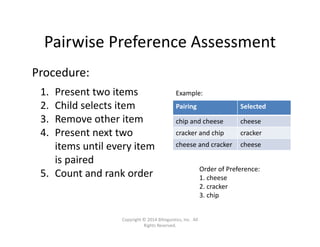
Pairwise Preference Assessment
Procedure:
1. Present two items
2. Child selects item
3. Remove other item
4. Present next two 
items until every item 
is paired
5. Count and rank order
Pairing Selected
chip and cheese cheese
cracker and chip cracker
cheese and cracker cheese
Example:
Order of Preference:
1. cheese
2. cracker
3. chip
Copyright © 2014 Bilinguistics, Inc.  All 
Rights Reserved.
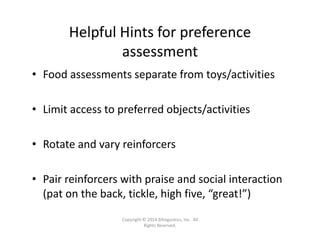
Helpful Hints for preference 
assessment
• Food assessments separate from toys/activities 
• Limit access to preferred objects/activities
• Rotate and vary reinforcers
• Pair reinforcers with praise and social interaction 
(pat on the back, tickle, high five, “great!”)
Copyright © 2014 Bilinguistics, Inc.  All 
Rights Reserved.
Intervention
Copyright © 2014 Bilinguistics, Inc.  All 
Rights Reserved.
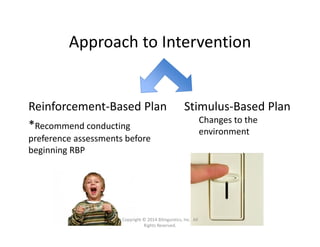
Approach to Intervention
Reinforcement‐Based Plan
*Recommend conducting 
preference assessments before 
beginning RBP
Stimulus‐Based Plan
Changes to the 
environment
Copyright © 2014 Bilinguistics, Inc.  All 
Rights Reserved.
Reinforcement‐Based Plans
1. Differential Reinforcement of Other Behavior 
(DRO)
2. Differential Reinforcement of Incompatible 
Behavior (DRI)
3. Reinforcement of Skills Acquisition (PRT)
Copyright © 2014 Bilinguistics, Inc.  All 
Rights Reserved.
Skills Acquisition 
• Compliance Training (Discrete Trial Training)
• Self‐management
• Differential reinforcement of communicative 
behavior (DRC)
• Functional independence training
Copyright © 2014 Bilinguistics, Inc.  All 
Rights Reserved.
Stimulus‐Based Plans
1. Introduce factors that control low rates of behavior 
problems. 
2. Modify factors that control high rates of behavior 
problems.
3. Embed Stimuli that control high rates of behavior 
problems among those that control low rates of 
behavior problems
4. Modify curriculum associated with behavior 
problems
5. Improve upon context‐dependent behaviors
Copyright © 2014 Bilinguistics, Inc.  All 
Rights Reserved.
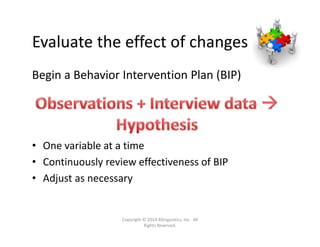
Evaluate the effect of changes 
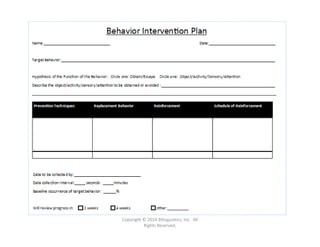
Begin a Behavior Intervention Plan (BIP)
• One variable at a time      
• Continuously review effectiveness of BIP
• Adjust as necessary
Copyright © 2014 Bilinguistics, Inc.  All 
Rights Reserved.
Copyright © 2014 Bilinguistics, Inc.  All 
Rights Reserved.
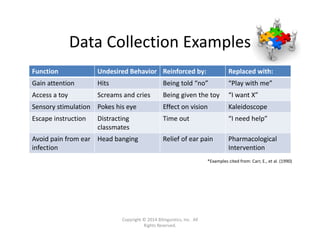
Data Collection Examples
Function Undesired Behavior Reinforced by: Replaced with:
Gain attention Hits Being told “no” “Play with me”
Access a toy Screams and cries Being given the toy “I want X”
Sensory stimulation Pokes his eye Effect on vision Kaleidoscope
Escape instruction Distracting
classmates
Time out “I need help”
Avoid pain from ear 
infection
Head banging Relief of ear pain Pharmacological
Intervention
*Examples cited from: Carr, E., et al. (1990)
Copyright © 2014 Bilinguistics, Inc.  All 
Rights Reserved.
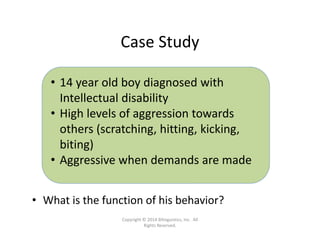
Case Study
• What is the function of his behavior?
• 14 year old boy diagnosed with 
Intellectual disability
• High levels of aggression towards 
others (scratching, hitting, kicking, 
biting)
• Aggressive when demands are made
Copyright © 2014 Bilinguistics, Inc.  All 
Rights Reserved.
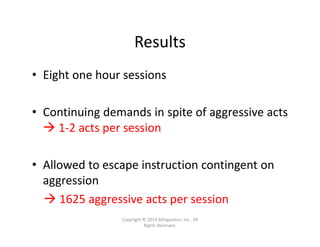
Results
• Eight one hour sessions
• Continuing demands in spite of aggressive acts 
 1‐2 acts per session
• Allowed to escape instruction contingent on 
aggression 
 1625 aggressive acts per session
Copyright © 2014 Bilinguistics, Inc.  All 
Rights Reserved.
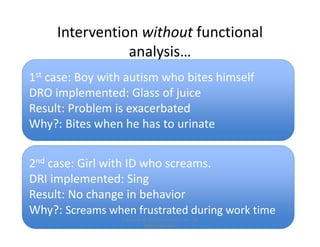
Intervention without functional 
analysis…
1st case: Boy with autism who bites himself
DRO implemented: Glass of juice 
Result: Problem is exacerbated
Why?: Bites when he has to urinate
2nd case: Girl with ID who screams.
DRI implemented: Sing
Result: No change in behavior
Why?: Screams when frustrated during work time 
Copyright © 2014 Bilinguistics, Inc.  All 
Rights Reserved.
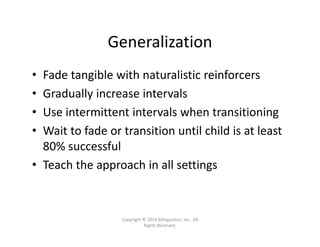
Generalization
• Fade tangible with naturalistic reinforcers
• Gradually increase intervals
• Use intermittent intervals when transitioning
• Wait to fade or transition until child is at least 
80% successful
• Teach the approach in all settings
Copyright © 2014 Bilinguistics, Inc.  All 
Rights Reserved.
Click to visit www.bilinguistics.com
Difference or Disorder? 
Understanding Speech and Language 
Patterns in Culturally and Linguistically 
Diverse Students
Rapidly identify speech‐language 
patterns related to second language 
acquisition to 
distinguish difference from disorder.
References
• Bopp, K., Brown, K., Mirenda, P. (2004). Speech‐language pathologists’ roles in the delivery of positive behavior 
support for individuals with developmental disabilities. American Journal of Speech‐Language Pathology Vol. 13 p. 
5‐19
• Carter, D. R., & Horner, R. H. (2007). Adding function‐based behavioral support to First Step to Success: Combining 
manualized and function‐based interventions. Journal of Positive Behavior Interventions, 9, 4, 229‐38. 
• Durand, V. M., & Merges, E.  (2001). Functional communication training: A contemporary behavior analytic 
technique for problem behavior. Focus on Autism and Other Developmental Disabilities, 16, 110–119. 
• Filter, K. J., and R. H. Horner. "Functionally‐indicated academic interventions for problem behavior." Journal of 
Positive Behavior Interventions (2006). 
• Ingram, K., Lewis‐Palmer, T., & Sugai, G. (2005). Function‐based intervention planning: Comparing the 
effectiveness of FBA function‐based and non‐function‐based intervention plans. Journal of Positive Behavior 
Interventions, 7, 224‐236. 
• Jensen, Eric.  (2000).  Brain‐Based Learning.  Alexandra, Virginia.  Thousand Oaks, California:  Corwin  Press.
• March, R. E., & Horner, R. H. (2002). Feasibility and contributions of functional behavioral assessment in schools. 
Journal of Emotional and Behavioral Disorders, 10, 158‐170. 
• McIntosh, K., Campbell, A. L., Carter, D. R. and Dickey, C. R. (2009).  Differential Effects of a Tier Two Behavior 
Intervention Based on Function of Problem Behavior.  Journal of Positive Behavior Interventions, 11, 2, 82‐97.
• Morgan, S. B., & Coffman, M.  (2013).  Developing quality FBAs that lead to effective BIPs.  Presentation at the 
Texas Council of Administrators in Special Education Annual Meeting.  Austin, TX.,  
• Newcomer, L. L., & Lewis, T. J. (2004). Functional behavioral assessment: An investigation of assessment reliability 
and effectiveness of function‐based interventions. Journal of Emotional and Behavioral Disorders, 12, 168‐181. 
• Skinner, B.F. (1938). The behavior of organisms: An experimental analysis.
• Carr, E., Robinson, S., Taylor, J., Carlson, J. (1990). Positive Approaches to the Treatment of Severe Behavior 
Problems in Persons with Developmental Disabilities: A Review and Analysis of Reinforcement and Stimulus‐Based 
Procedures.
Copyright © 2014 Bilinguistics, Inc.  All 
Rights Reserved.

Overcoming Behavioral Roadblocks in Speech-Language Intervention