Internet Multimedia Architecture
Jim Chou and Thinh Nguyen
February 12, 2002
Outline
Overview
Multimedia Applications
Signaling Protocols (SIP/SDP, SAP, H.323,
MGCP)
Streaming Protocols (RTP, RTSP, HTTP, etc.)
QoS (RSVP, Diff-Serv, IntServ)
Conclusions
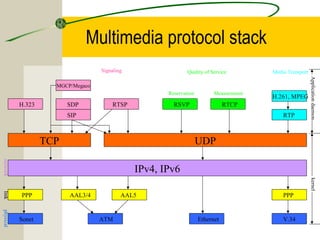
Multimedia protocol stack
Signaling

Quality of Service

Media Transport

Reservation

H.323

SDP

RSVP

RTSP

Measurement

RTCP

SIP

H.261, MPEG
RTP

TCP

Application daemon

MGCP/Megaco

UDP

network

IPv4, IPv6
kernel

link

PPP

physical

Sonet

AAL3/4

AAL5

ATM

PPP

Ethernet

V.34
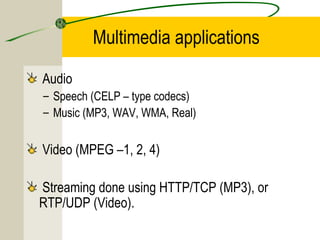
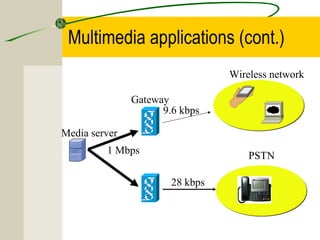
Multimedia applications
Audio
– Speech (CELP – type codecs)
– Music (MP3, WAV, WMA, Real)

Video (MPEG –1, 2, 4)
Streaming done using HTTP/TCP (MP3), or
RTP/UDP (Video).
Multimedia applications (cont.)
Wireless network
Gateway
9.6 kbps
Media server
1 Mbps

PSTN
28 kbps
Signaling protocols
VoIP predominantly uses two:
– SIP/SDP
– H.323
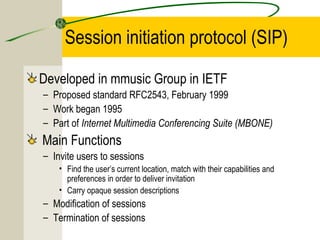
Session initiation protocol (SIP)
Developed in mmusic Group in IETF
– Proposed standard RFC2543, February 1999
– Work began 1995
– Part of Internet Multimedia Conferencing Suite (MBONE)

Main Functions
– Invite users to sessions
• Find the user’s current location, match with their capabilities and
preferences in order to deliver invitation
• Carry opaque session descriptions

– Modification of sessions
– Termination of sessions
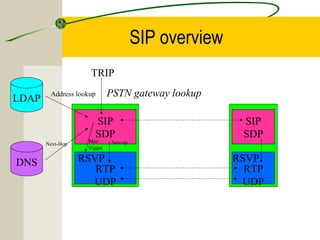
SIP overview
TRIP
LDAP

PSTN gateway lookup

Address lookup

SIP
SDP

Next-Hop

DNS

SIP
SDP

RSVP
RTP
UDP

RSVP
RTP
UDP

May
trigger

Sets up
SIP components
User Agent Client (UAC)
– End systems
– Send SIP requests

User Agent Server (UAS)
– Listens for call requests
– Prompts user or executes program to determine response

User Agent
– UAC plus UAS
SIP components (cont.)
Redirect Server
– Network server - redirects users to try other server

Proxy Server
– Network server - a proxy request to another server can “fork”
request to multiple servers, creating a search tree

Registrar
– Receives registrations regarding current user locations
SIP architecture
Request
Response
columbia.edu

Media

SIP Redirect
Server

Location Service

2
3

berkeley.edu

sip.com
5

4

sip:alice@eecs.berkeley.edu
1

7

11

12
13

SIP Client

6

SIP Proxy

sales.sip.com

10

SIP Proxy
8

14

9

bob@mypc.sales.sip.com

SIP Client
(User Agent Server)
Sip architecture (cont.)
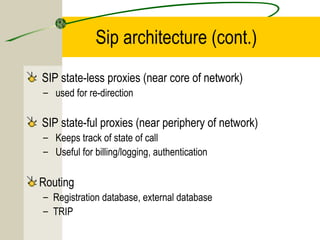
SIP state-less proxies (near core of network)
– used for re-direction

SIP state-ful proxies (near periphery of network)
– Keeps track of state of call
– Useful for billing/logging, authentication

Routing
– Registration database, external database
– TRIP
SIP architecture (cont.)
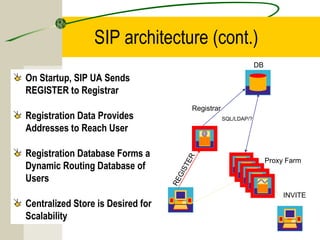
DB

On Startup, SIP UA Sends
REGISTER to Registrar

Registration Database Forms a
Dynamic Routing Database of
Users
Centralized Store is Desired for
Scalability

SQL/LDAP/?

RE
GI
ST
ER

Registration Data Provides
Addresses to Reach User

Registrar

Proxy Farm

INVITE
SIP architecture (cont.)
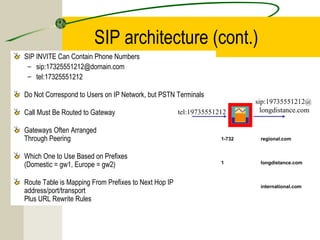
SIP INVITE Can Contain Phone Numbers
– sip:17325551212@domain.com
– tel:17325551212
Do Not Correspond to Users on IP Network, but PSTN Terminals
Call Must Be Routed to Gateway
Gateways Often Arranged
Through Peering
Which One to Use Based on Prefixes
(Domestic = gw1, Europe = gw2)
Route Table is Mapping From Prefixes to Next Hop IP
address/port/transport
Plus URL Rewrite Rules

tel:19735551212

sip:19735551212@
longdistance.com

1-732

regional.com

1

longdistance.com

international.com
SIP architecture (cont.)
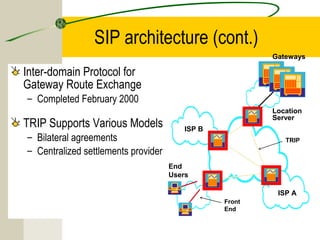
Gateways

Inter-domain Protocol for
Gateway Route Exchange
– Completed February 2000

TRIP Supports Various Models
– Bilateral agreements
– Centralized settlements provider

Location
Server
ISP B
TRIP

End
Users
ISP A
Front
End
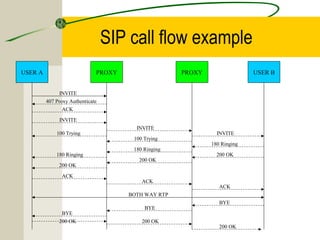
SIP call flow example
USER A

PROXY

PROXY

USER B

INVITE
407 Proxy Authenticate
ACK
INVITE
100 Trying

180 Ringing
200 OK
ACK

INVITE
100 Trying
180 Ringing
200 OK

ACK

INVITE
180 Ringing
200 OK

ACK

BOTH WAY RTP
BYE
200 OK

BYE
200 OK

BYE

200 OK
Session Description Protocol (SDP)
Used to specify client capabilities
Example (client can support MPEG-1 video
codec, and MP3 codecs)
Session Anouncement Protocol
(SAP)
Originated around same time as SIP
Used to announce multimedia sessions
– Announcement goes to users in a multicast group
– Announcements can contain start time of session,
duration of session, etc.
Multimedia Gateway Control Protocol
(MGCP)
Decompose gateway into a controlling signalling
component and a controlled media component.
Can be used in phones or gateways in
conjunction with SIP
H.323
May 1995 - H.323 work started
June 1996 - Decided by ITU-T
Designed for exchanging multimedia over IP
networks (4 versions of H.323)
H.323 Components
Terminals
Gatekeepers
Gateways (H.323 to H.320/H.324/POTS)
MCUs
– Multipoint Controller (MC)
– Multipoint Processor (MP)
H.323 Gatekeeper
Address Translation
– H.323 Alias to transport (IP) address based on terminal
registration
– “email-like” names possible
– “phone number like” names possible

Admission control
– Permission to complete call
– Can apply bandwidth limits
– Method to control LAN traffic
H.323 Gatekeeper (cont.)
Management of gateway
– H.320, H.324, POTS, etc.

Call Signaling
– May route calls in order to provide supplementary
services or to provide Multipoint Controller
functionality

Call Management/Reporting/Logging
H.323 Gateway
Provide world wide connectivity and
interoperability from LAN
– H.320, H.324, regular POTS telephones

Map Call Signaling (Q.931 to H.225.0)
Map Control (H.242/H.243 to H.245)
Media Mapping (FEC, multiplex, rate matching,
audio transcoding)
H.323 MCU
Media Distribution
– Unicast - send media to one terminal (centralized in
MP; traditional model)
– Multicast - send to each receiver directly
– Hybrid - some of each

Manage Ad Hoc multipoint calls
– Join, invite, control of conference modes

Multiprotocol via Gateways
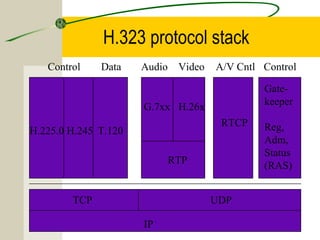
H.323 protocol stack
Control

Data

Audio

Video

A/V Cntl Control
Gatekeeper

G.7xx H.26x
RTCP

H.225.0 H.245 T.120
RTP

TCP

UDP
IP

Reg,
Adm,
Status
(RAS)
H.323 protocol stack (cont.)
H.323 - System Document
H.225.0 - Call Signaling, Packetization
– Gatekeeper Registration, Admission, and Status

H.245 - Control (also used in H.324, H.310)
T.120 - Data and Conference Control
H.323 example
A Call Setup Example
a point to point call
One Gatekeeper using the Direct Call Model
H.323 example (cont.)
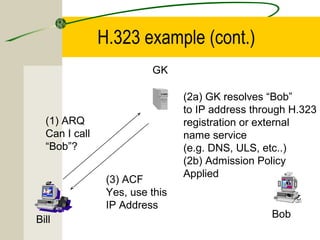
GK

(1) ARQ
Can I call
“Bob”?

PictureTel

PictureTel

Bill

(3) ACF
Yes, use this
IP Address

(2a) GK resolves “Bob”
to IP address through H.323
registration or external
name service
(e.g. DNS, ULS, etc..)
(2b) Admission Policy
Applied
PictureTel

Bob
H.323 example (cont.)
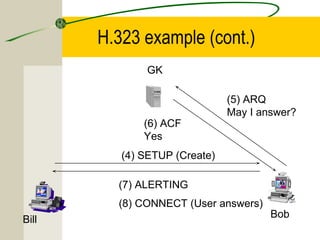
GK

(6) ACF
Yes

(5) ARQ
May I answer?

(4) SETUP (Create)
P
ictureTel

PictureTel

(7) ALERTING
(8) CONNECT (User answers)

Bill

PictureTel

Bob
H.323 example (cont.)

PictureTel
P
ictureTel

PictureTel

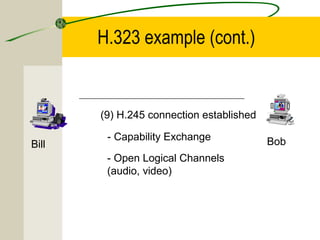
(9) H.245 connection established
Bill

- Capability Exchange
- Open Logical Channels
(audio, video)

Bob

Internet multimedia

  • 1.
    Internet Multimedia Architecture JimChou and Thinh Nguyen February 12, 2002
  • 2.
    Outline Overview Multimedia Applications Signaling Protocols(SIP/SDP, SAP, H.323, MGCP) Streaming Protocols (RTP, RTSP, HTTP, etc.) QoS (RSVP, Diff-Serv, IntServ) Conclusions
  • 3.
    Multimedia protocol stack Signaling Qualityof Service Media Transport Reservation H.323 SDP RSVP RTSP Measurement RTCP SIP H.261, MPEG RTP TCP Application daemon MGCP/Megaco UDP network IPv4, IPv6 kernel link PPP physical Sonet AAL3/4 AAL5 ATM PPP Ethernet V.34
  • 4.
    Multimedia applications Audio – Speech(CELP – type codecs) – Music (MP3, WAV, WMA, Real) Video (MPEG –1, 2, 4) Streaming done using HTTP/TCP (MP3), or RTP/UDP (Video).
  • 5.
    Multimedia applications (cont.) Wirelessnetwork Gateway 9.6 kbps Media server 1 Mbps PSTN 28 kbps
  • 6.
    Signaling protocols VoIP predominantlyuses two: – SIP/SDP – H.323
  • 7.
    Session initiation protocol(SIP) Developed in mmusic Group in IETF – Proposed standard RFC2543, February 1999 – Work began 1995 – Part of Internet Multimedia Conferencing Suite (MBONE) Main Functions – Invite users to sessions • Find the user’s current location, match with their capabilities and preferences in order to deliver invitation • Carry opaque session descriptions – Modification of sessions – Termination of sessions
  • 8.
    SIP overview TRIP LDAP PSTN gatewaylookup Address lookup SIP SDP Next-Hop DNS SIP SDP RSVP RTP UDP RSVP RTP UDP May trigger Sets up
  • 9.
    SIP components User AgentClient (UAC) – End systems – Send SIP requests User Agent Server (UAS) – Listens for call requests – Prompts user or executes program to determine response User Agent – UAC plus UAS
  • 10.
    SIP components (cont.) RedirectServer – Network server - redirects users to try other server Proxy Server – Network server - a proxy request to another server can “fork” request to multiple servers, creating a search tree Registrar – Receives registrations regarding current user locations
  • 11.
    SIP architecture Request Response columbia.edu Media SIP Redirect Server LocationService 2 3 berkeley.edu sip.com 5 4 sip:alice@eecs.berkeley.edu 1 7 11 12 13 SIP Client 6 SIP Proxy sales.sip.com 10 SIP Proxy 8 14 9 bob@mypc.sales.sip.com SIP Client (User Agent Server)
  • 12.
    Sip architecture (cont.) SIPstate-less proxies (near core of network) – used for re-direction SIP state-ful proxies (near periphery of network) – Keeps track of state of call – Useful for billing/logging, authentication Routing – Registration database, external database – TRIP
  • 13.
    SIP architecture (cont.) DB OnStartup, SIP UA Sends REGISTER to Registrar Registration Database Forms a Dynamic Routing Database of Users Centralized Store is Desired for Scalability SQL/LDAP/? RE GI ST ER Registration Data Provides Addresses to Reach User Registrar Proxy Farm INVITE
  • 14.
    SIP architecture (cont.) SIPINVITE Can Contain Phone Numbers – sip:17325551212@domain.com – tel:17325551212 Do Not Correspond to Users on IP Network, but PSTN Terminals Call Must Be Routed to Gateway Gateways Often Arranged Through Peering Which One to Use Based on Prefixes (Domestic = gw1, Europe = gw2) Route Table is Mapping From Prefixes to Next Hop IP address/port/transport Plus URL Rewrite Rules tel:19735551212 sip:19735551212@ longdistance.com 1-732 regional.com 1 longdistance.com international.com
  • 15.
    SIP architecture (cont.) Gateways Inter-domainProtocol for Gateway Route Exchange – Completed February 2000 TRIP Supports Various Models – Bilateral agreements – Centralized settlements provider Location Server ISP B TRIP End Users ISP A Front End
  • 16.
    SIP call flowexample USER A PROXY PROXY USER B INVITE 407 Proxy Authenticate ACK INVITE 100 Trying 180 Ringing 200 OK ACK INVITE 100 Trying 180 Ringing 200 OK ACK INVITE 180 Ringing 200 OK ACK BOTH WAY RTP BYE 200 OK BYE 200 OK BYE 200 OK
  • 17.
    Session Description Protocol(SDP) Used to specify client capabilities Example (client can support MPEG-1 video codec, and MP3 codecs)
  • 18.
    Session Anouncement Protocol (SAP) Originatedaround same time as SIP Used to announce multimedia sessions – Announcement goes to users in a multicast group – Announcements can contain start time of session, duration of session, etc.
  • 19.
    Multimedia Gateway ControlProtocol (MGCP) Decompose gateway into a controlling signalling component and a controlled media component. Can be used in phones or gateways in conjunction with SIP
  • 20.
    H.323 May 1995 -H.323 work started June 1996 - Decided by ITU-T Designed for exchanging multimedia over IP networks (4 versions of H.323)
  • 21.
    H.323 Components Terminals Gatekeepers Gateways (H.323to H.320/H.324/POTS) MCUs – Multipoint Controller (MC) – Multipoint Processor (MP)
  • 22.
    H.323 Gatekeeper Address Translation –H.323 Alias to transport (IP) address based on terminal registration – “email-like” names possible – “phone number like” names possible Admission control – Permission to complete call – Can apply bandwidth limits – Method to control LAN traffic
  • 23.
    H.323 Gatekeeper (cont.) Managementof gateway – H.320, H.324, POTS, etc. Call Signaling – May route calls in order to provide supplementary services or to provide Multipoint Controller functionality Call Management/Reporting/Logging
  • 24.
    H.323 Gateway Provide worldwide connectivity and interoperability from LAN – H.320, H.324, regular POTS telephones Map Call Signaling (Q.931 to H.225.0) Map Control (H.242/H.243 to H.245) Media Mapping (FEC, multiplex, rate matching, audio transcoding)
  • 25.
    H.323 MCU Media Distribution –Unicast - send media to one terminal (centralized in MP; traditional model) – Multicast - send to each receiver directly – Hybrid - some of each Manage Ad Hoc multipoint calls – Join, invite, control of conference modes Multiprotocol via Gateways
  • 26.
    H.323 protocol stack Control Data Audio Video A/VCntl Control Gatekeeper G.7xx H.26x RTCP H.225.0 H.245 T.120 RTP TCP UDP IP Reg, Adm, Status (RAS)
  • 27.
    H.323 protocol stack(cont.) H.323 - System Document H.225.0 - Call Signaling, Packetization – Gatekeeper Registration, Admission, and Status H.245 - Control (also used in H.324, H.310) T.120 - Data and Conference Control
  • 28.
    H.323 example A CallSetup Example a point to point call One Gatekeeper using the Direct Call Model
  • 29.
    H.323 example (cont.) GK (1)ARQ Can I call “Bob”? PictureTel PictureTel Bill (3) ACF Yes, use this IP Address (2a) GK resolves “Bob” to IP address through H.323 registration or external name service (e.g. DNS, ULS, etc..) (2b) Admission Policy Applied PictureTel Bob
  • 30.
    H.323 example (cont.) GK (6)ACF Yes (5) ARQ May I answer? (4) SETUP (Create) P ictureTel PictureTel (7) ALERTING (8) CONNECT (User answers) Bill PictureTel Bob
  • 31.
    H.323 example (cont.) PictureTel P ictureTel PictureTel (9)H.245 connection established Bill - Capability Exchange - Open Logical Channels (audio, video) Bob