DFT and FFT
‱ FFT is an algorithm to convert a time domain
signal to DFT efficiently.
‱ FFT is not unique. Many algorithms are
available.
‱ Each algorithm has merits and demerits.
‱ In each algorithm, depending on the sequence
needed at the output, the input is regrouped.
‱ The groups are decided by the number of
samples.
FFTs
‱ The number of points can be nine too.
‱ It can be 15 as well.
‱ Any number in multiples of two integers.
‱ It can not be any prime number.
‱ It can be in the multiples of two prime
numbers.
FFTs
‱ The purpose of this series of lectures is to
learn the basics of FFT algorithms.
‱ Algorithms having number of samples 2N
,
where N is an integer is most preferred.
‱ 8 point radix-2 FFT by decimation is used
from learning point of view.
‱ Radix-x: here ‘x’ represents number of
samples in each group made at the first
stage. They are generally equal.
‱ We shall study radix-2 and radix-3.
Radix-2: DIT or, DIF
‱ Radix-2 is the first FFT algorithm. It was
proposed by Cooley and Tukey in 1965.
‱ Though it is not the efficient algorithm, it lays
foundation for time-efficient DFT calculations.
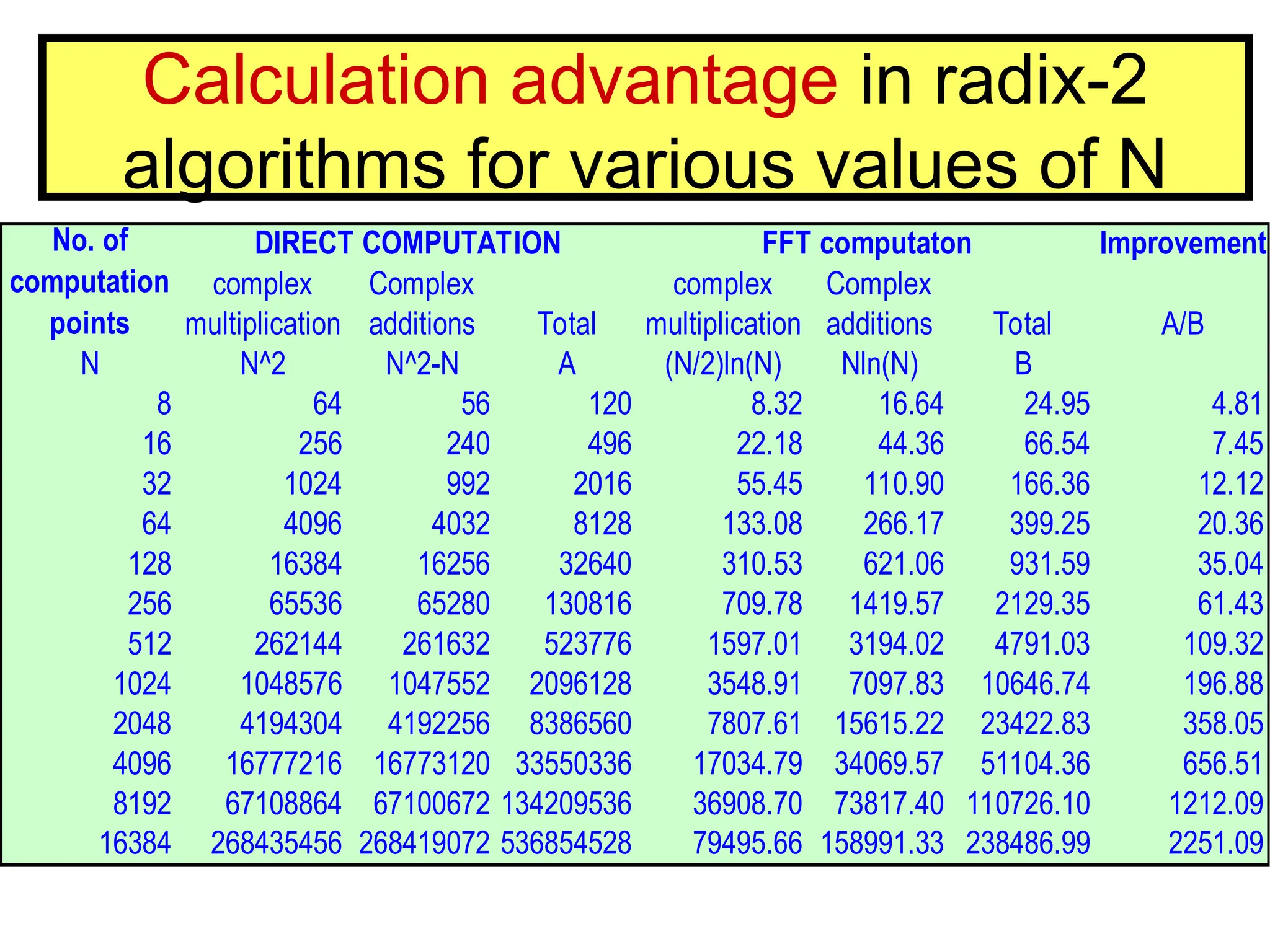
‱ The next slide shows the saving in time
required for calculations with radix-2.
‱ The algorithms appear either in
(a) Decimation In Time (DIT), or,
(b) Decimation In Frequency (DIF).
‱ DIT and DIF, both yield same complexity and
results. They are complementary.
‱ We shall stress on 8 to radix 2 DIT FFT.
Other popular Algorithms
Besides many, the popular algorithms are:
‱ Goertzel algorithm
‱ Chirp Z algorithm
‱ Index mapping algorithm
‱ Split radix in prime number algorithm.
have modified approach over radix-2.
Split radix in prime number does not use even the twiddles.
We now pay attention to 8/radix-2 butterfly FIT FFT algorithm.
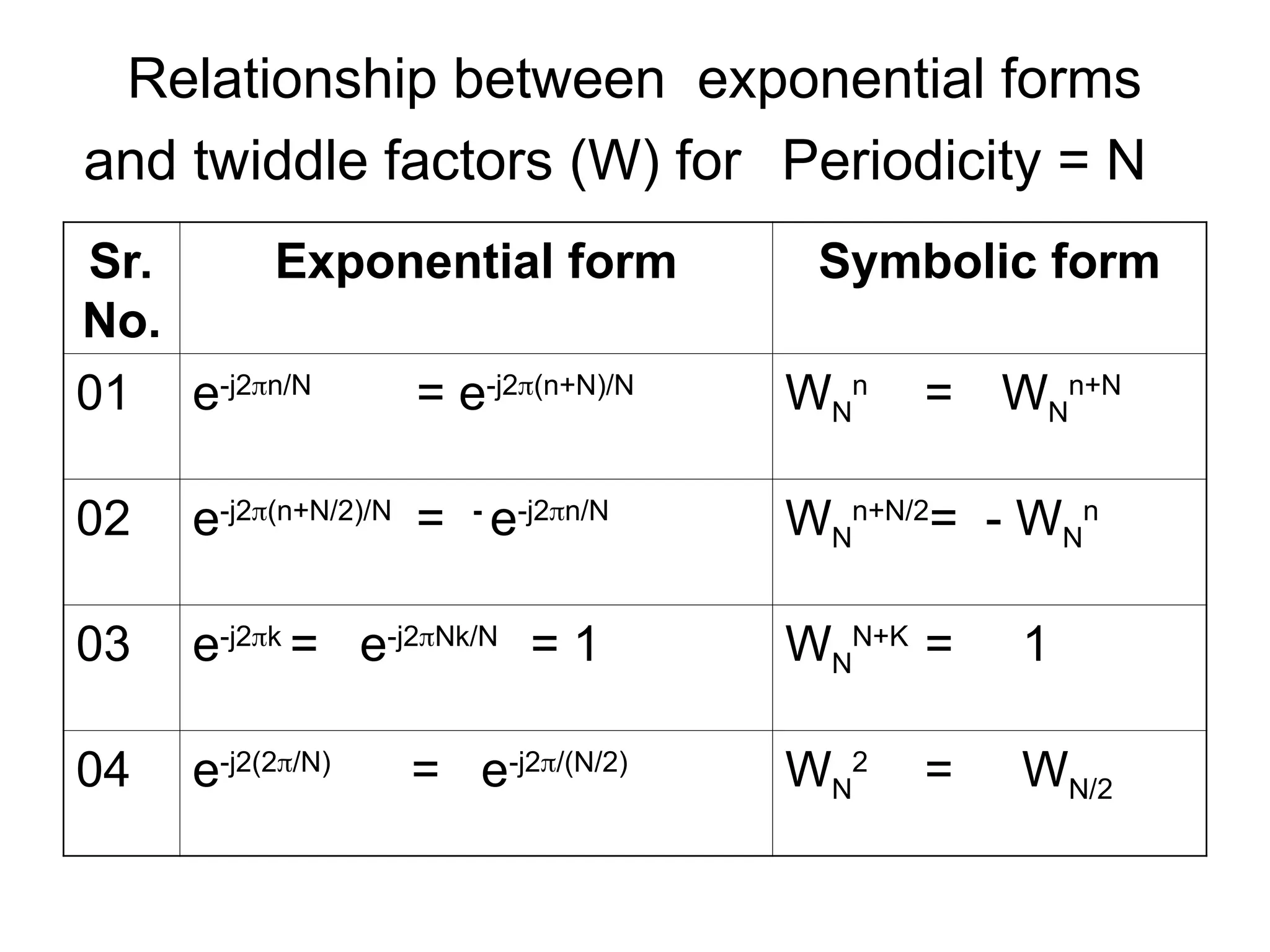
Relationship between exponential forms
and twiddle factors (W) for Periodicity = N
Sr.
No.
Exponential form Symbolic form
01 e-j2n/N
= e-j2(n+N)/N
WN
n
= WN
n+N
02 e-j2(n+N/2)/N
= -
e-j2n/N
WN
n+N/2
= - WN
n
03 e-j2k
= e-j2Nk/N
= 1 WN
N+K
= 1
04 e-j2(2/N)
= e-j2/(N/2)
WN
2
= WN/2
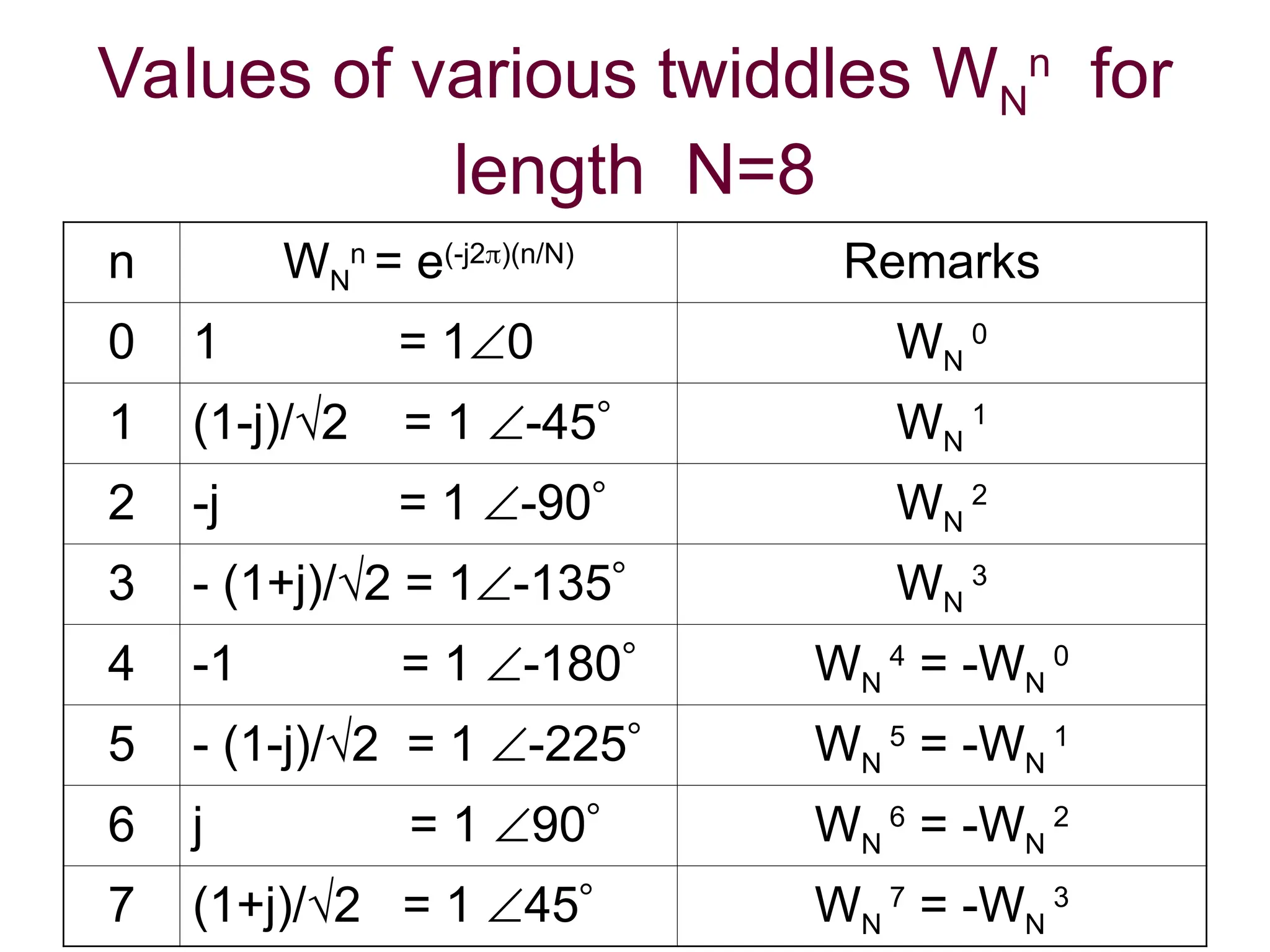
Values of various twiddles WN
n
for
length N=8
n WN
n
= e(-j2)(n/N)
Remarks
0 1 = 10 WN
0
1 (1-j)/√2 = 1 -45 WN
1
2 -j = 1 -90 WN
2
3 - (1+j)/√2 = 1-135 WN
3
4 -1 = 1 -180 WN
4
= -WN
0
5 - (1-j)/√2 = 1 -225 WN
5
= -WN
1
6 j = 1 90 WN
6
= -WN
2
7 (1+j)/√2 = 1 45 WN
7
= -WN
3
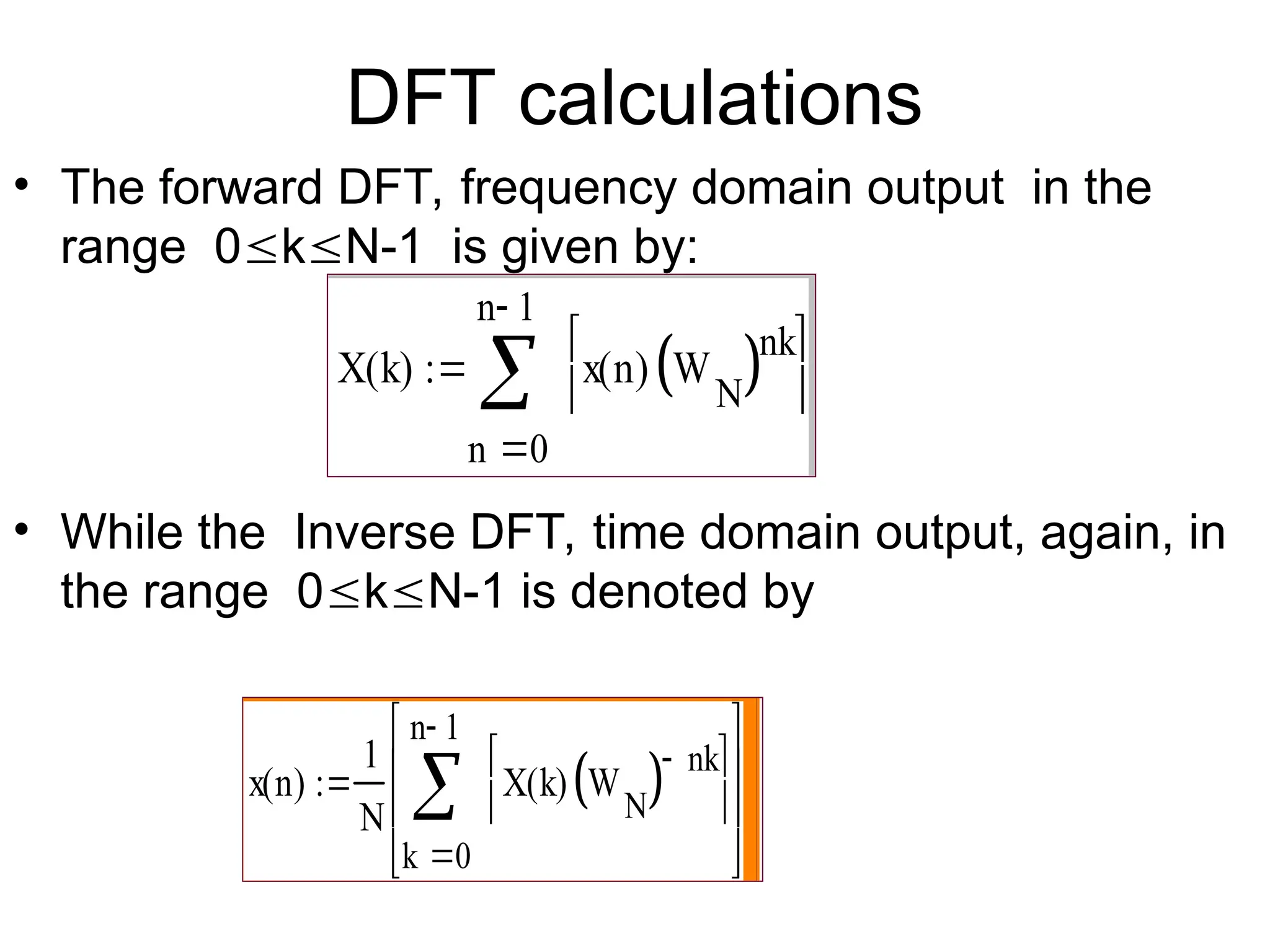
DFT calculations
‱ The forward DFT, frequency domain output in the
range 0ï‚Łkï‚ŁN-1 is given by:
‱ While the Inverse DFT, time domain output, again, in
the range 0ï‚Łkï‚ŁN-1 is denoted by
X k
( )
0
n 1

n
x n
( ) W
N
 nk


ïƒč



ï€ș
x n
( )
1
N
0
n 1

k
X k
( ) W
N
  nk



ïƒč




ïƒȘ
ïƒȘ

ïƒč
ïƒș
ïƒș

ï€ș
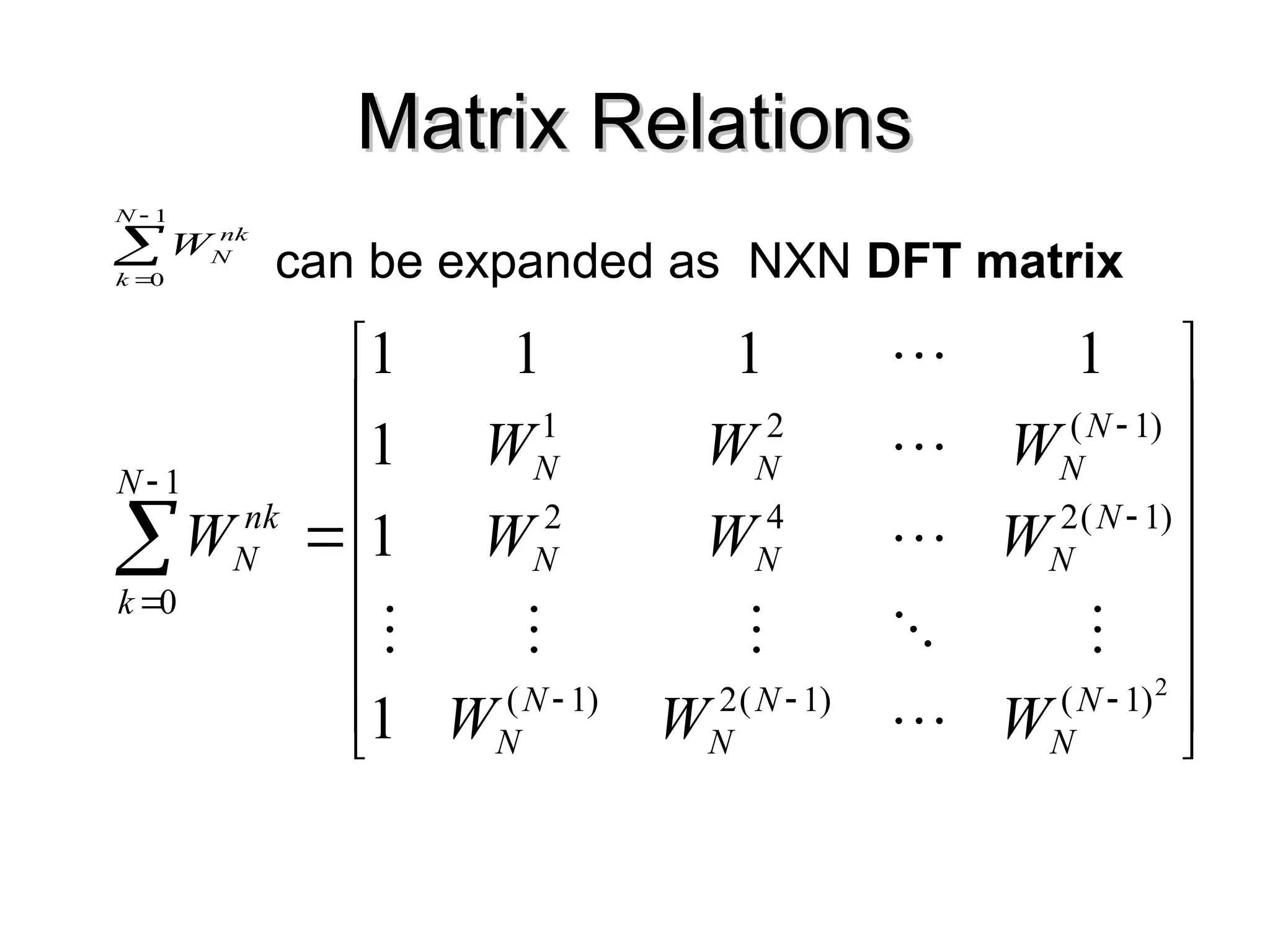
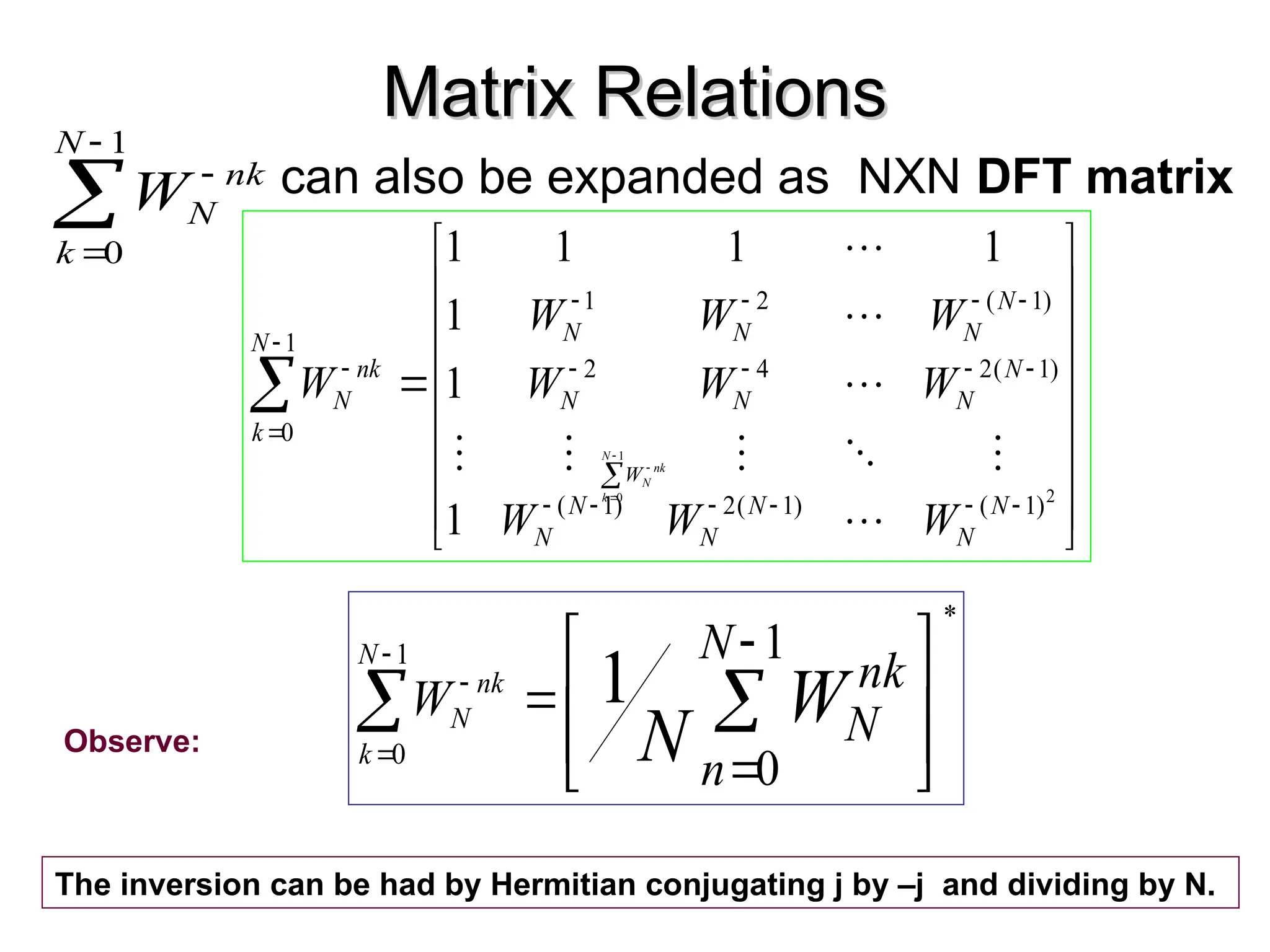
Matrix Relations
Matrix Relations
‱ The DFT samples defined by
can be expressed in NxN matrix as
where
 T
N
X
X
X ]
[
.....
]
[
]
[ 1
1
0 

X
 T
N
x
x
x ]
[
.....
]
[
]
[ 1
1
0 

x
1
0
,
]
[
]
[
1
0

ï‚Ł
ï‚Ł




N
k
W
n
x
k
X
N
n
kn
N
   
x(n)
X(k)
1
0
n
ïƒș

ïƒč
ïƒȘ


 


N
nk
N
W
Matrix Relations
Matrix Relations
can be expanded as NXN DFT matrix
ïƒș
ïƒș
ïƒș
ïƒș
ïƒș
ïƒș

ïƒč
ïƒȘ
ïƒȘ
ïƒȘ
ïƒȘ
ïƒȘ
ïƒȘ











2
)
1
(
)
1
(
2
)
1
(
)
1
(
2
4
2
)
1
(
2
1
1
0
1
1
1
1
1
1
1
N
N
N
N
N
N
N
N
N
N
N
N
N
N
N
k
nk
N
W
W
W
W
W
W
W
W
W
W












1
0
N
k
nk
N
W
DFT:
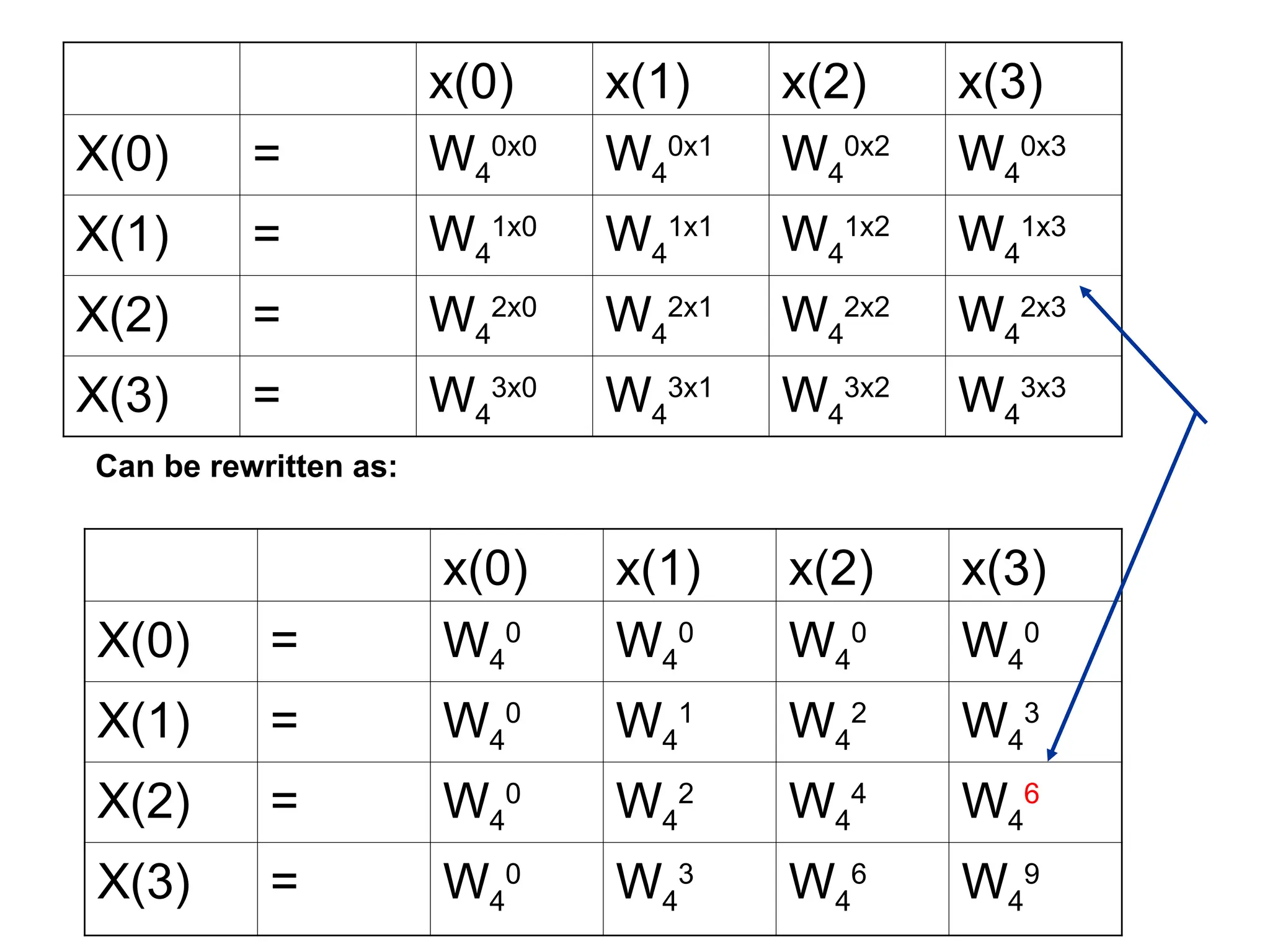
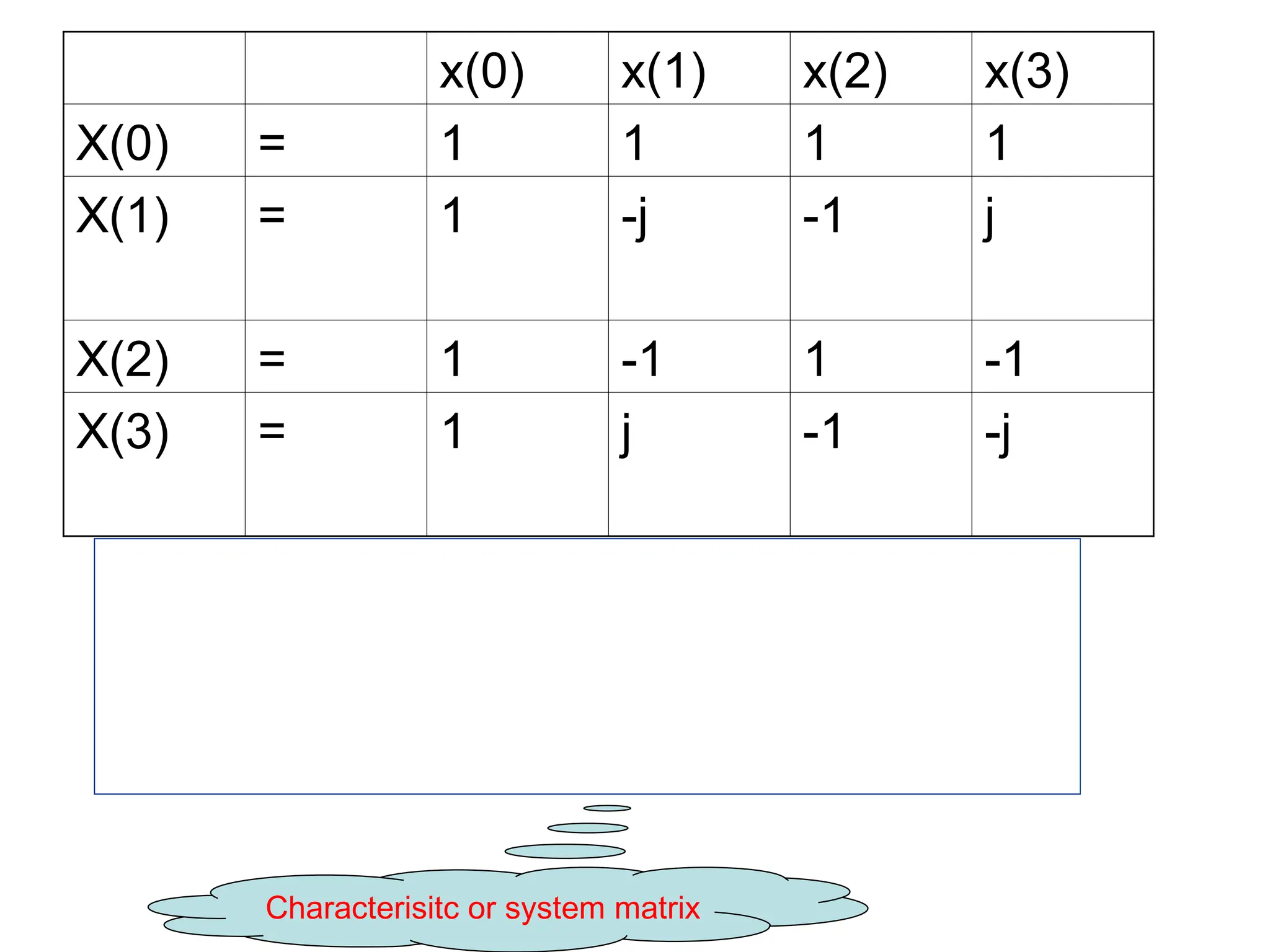
For N of length 4,range of n, k = [0 1 2 3] each.
Hence X(n) = x(0)WN
n.0
+x(1)WN
n.1
+x(2)WN
n.2
+ x(3)WN
n.3
X k
( )
0
n 1

n
x n
( ) W
N
 nk


ïƒč



ï€ș x
x(0) x(1) x(2) x(3)
X(0) = W4
0x0
W4
0x1
W4
0x2
W4
0x3
X(1) = W4
1x0
W4
1x1
W4
1x2
W4
1x3
X(2) = W4
2x0
W4
2x1
W4
2x2
W4
2x3
X(3) = W4
3x0
W4
3x1
W4
3x2
W4
3x3
x(0) x(1) x(2) x(3)
X(0) = W4
0x0
W4
0x1
W4
0x2
W4
0x3
X(1) = W4
1x0
W4
1x1
W4
1x2
W4
1x3
X(2) = W4
2x0
W4
2x1
W4
2x2
W4
2x3
X(3) = W4
3x0
W4
3x1
W4
3x2
W4
3x3
x(0) x(1) x(2) x(3)
X(0) = W4
0
W4
0
W4
0
W4
0
X(1) = W4
0
W4
1
W4
2
W4
3
X(2) = W4
0
W4
2
W4
4
W4
6
X(3) = W4
0
W4
3
W4
6
W4
9
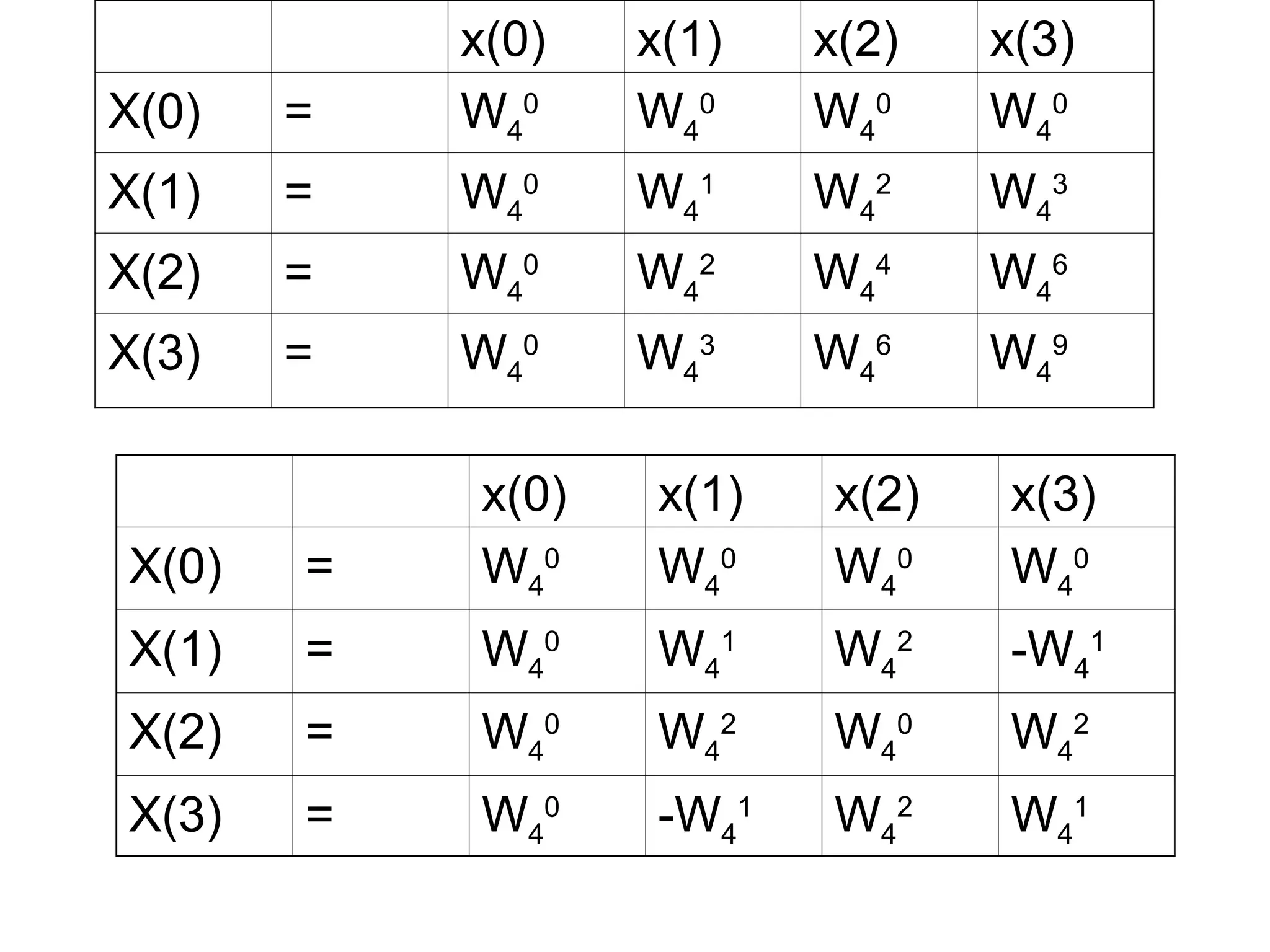
Can be rewritten as:
x(0) x(1) x(2) x(3)
X(0) = W4
0
W4
0
W4
0
W4
0
X(1) = W4
0
W4
1
W4
2
W4
3
X(2) = W4
0
W4
2
W4
4
W4
6
X(3) = W4
0
W4
3
W4
6
W4
9
x(0) x(1) x(2) x(3)
X(0) = W4
0
W4
0
W4
0
W4
0
X(1) = W4
0
W4
1
W4
2
-W4
1
X(2) = W4
0
W4
2
W4
0
W4
2
X(3) = W4
0
-W4
1
W4
2
W4
1
x(0) x(1) x(2) x(3)
X(0) = W4
0
W4
0
W4
0
W4
0
X(1) = W4
0
W4
1
W4
2
-W4
1
X(2) = W4
0
W4
2
W4
0
W4
2
X(3) = W4
0
-W4
1
W4
2
W4
1
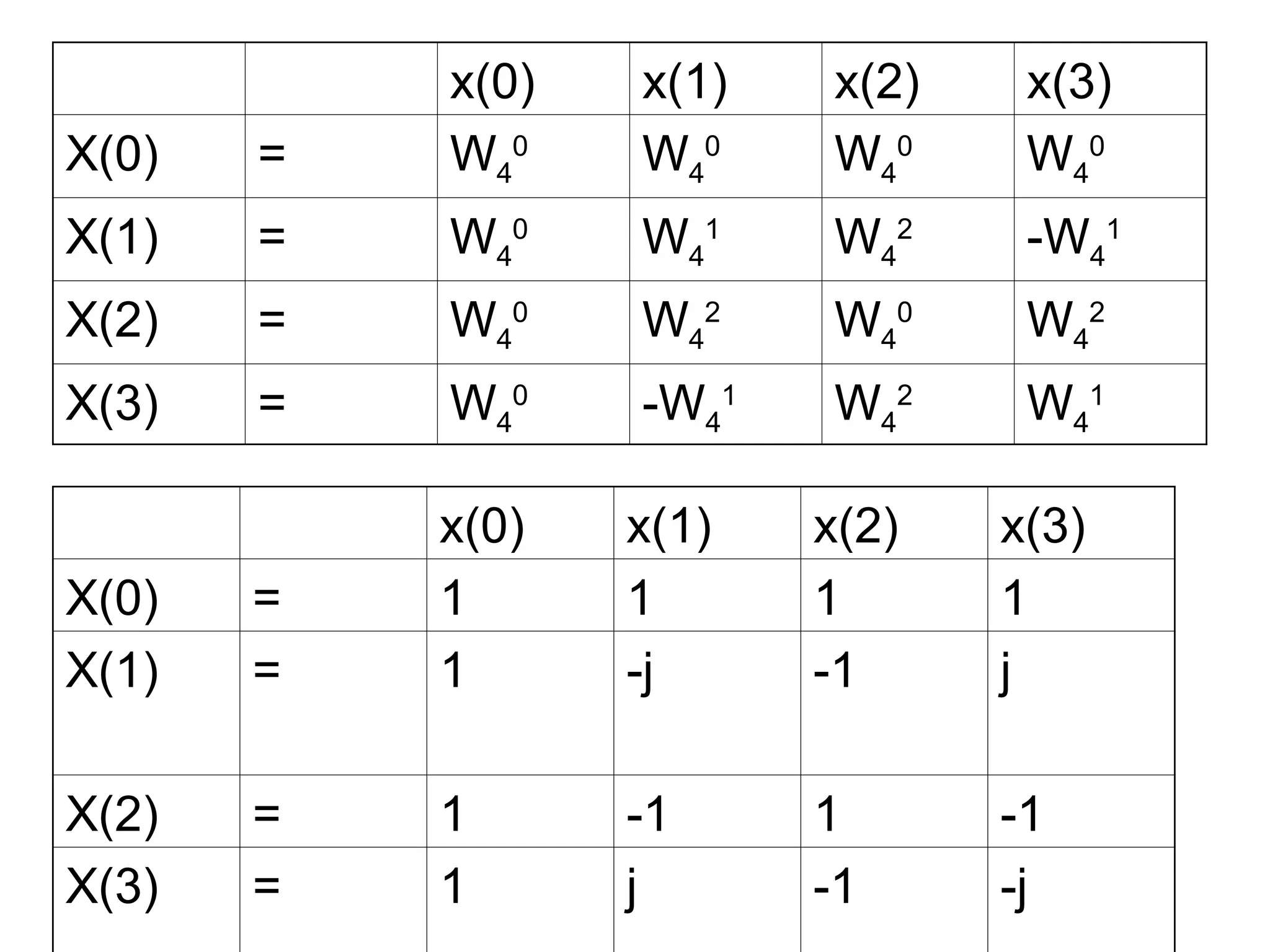
x(0) x(1) x(2) x(3)
X(0) = 1 1 1 1
X(1) = 1 -j -1 j
X(2) = 1 -1 1 -1
X(3) = 1 j -1 -j
Matrix Relations
Matrix Relations
‱ Likewise, the IDFT is
can be expressed in NxN matrix form as
1
0
,
]
[
]
[
1
0

ï‚Ł
ï‚Ł





N
n
W
k
X
n
x
N
k
n
k
N
   
X(k)
1
0
n
x
1
ïƒș

ïƒč
ïƒȘ







N
n
nk
N
W
Matrix Relations
Matrix Relations
can also be expanded as NXN DFT matrix
ïƒș
ïƒș
ïƒș
ïƒș
ïƒș
ïƒș

ïƒč
ïƒȘ
ïƒȘ
ïƒȘ
ïƒȘ
ïƒȘ
ïƒȘ





















2
)
1
(
)
1
(
2
)
1
(
)
1
(
2
4
2
)
1
(
2
1
1
0
1
1
1
1
1
1
1
N
N
N
N
N
N
N
N
N
N
N
N
N
N
N
k
nk
N
W
W
W
W
W
W
W
W
W
W













1
0
N
k
nk
N
W
Observe:




1
0
N
k
nk
N
W
ïƒș

ïƒč
ïƒȘ










1
0
1
*
1
0
N
n
nk
N
W W
N
N
k
nk
N
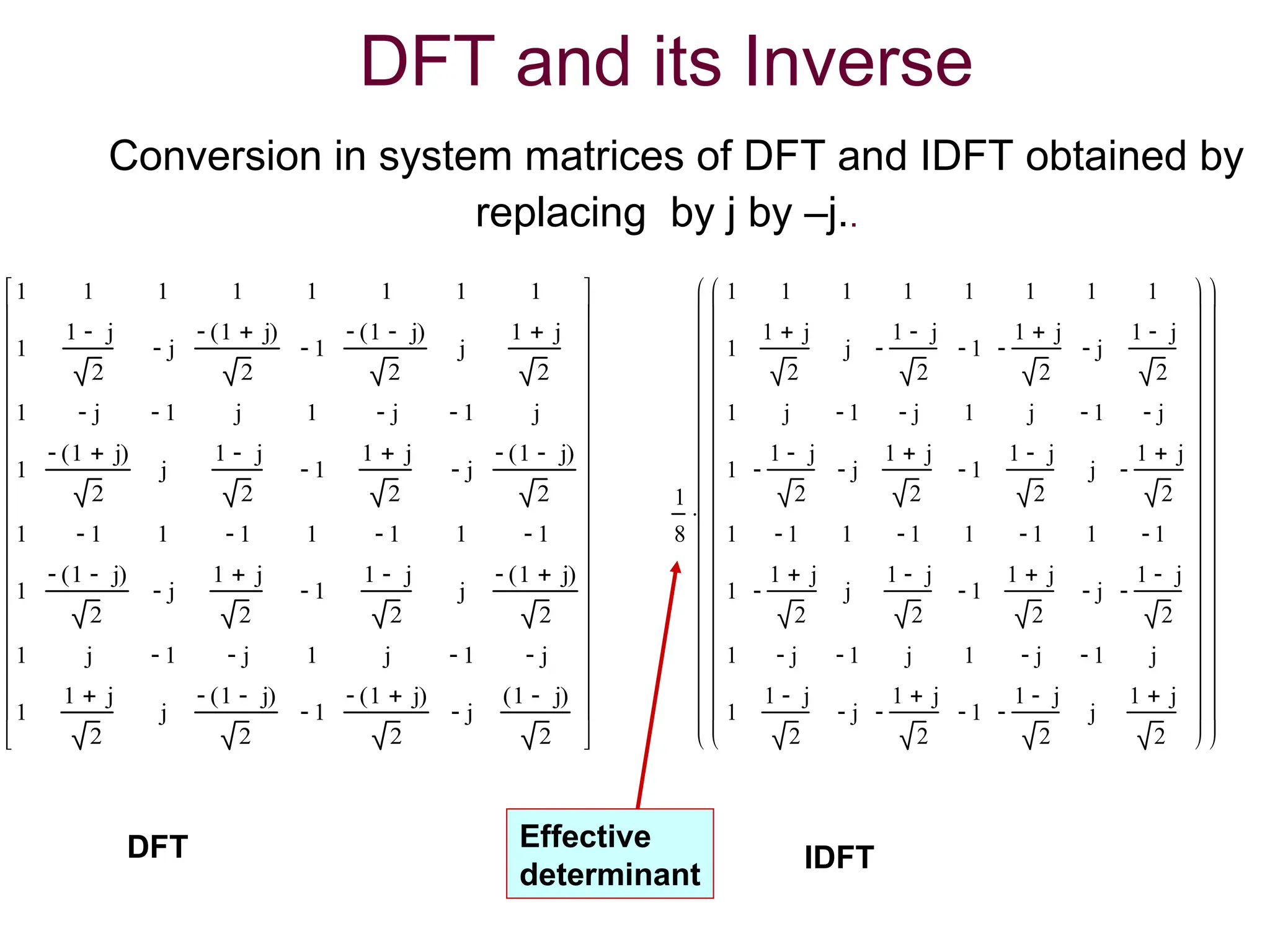
The inversion can be had by Hermitian conjugating j by –j and dividing by N.
x(0) x(1) x(2) x(3)
X(0) = 1 1 1 1
X(1) = 1 -j -1 j
X(2) = 1 -1 1 -1
X(3) = 1 j -1 -j
X 0
( )
X 1
( )
X 2
( )
X 3
( )












1
1
1
1
1
j

1

j
1
1

1
1

1
j
1

j













x 0
( )
x 1
( )
x 2
( )
x 3
( )













ï€ș
Characterisitc or system matrix
X 0
( )
X 1
( )
X 2
( )
X 3
( )












1
1
1
1
1
j

1

j
1
1

1
1

1
j
1

j













x 0
( )
x 1
( )
x 2
( )
x 3
( )













ï€ș
x 0
( )
x 1
( )
x 2
( )
x 3
( )




1
4
1
1
1
1
1
j
1

j

1
1

1
1

1
j

1

j




X 0
( )
X 1
( )
X 2
( )
X 3
( )







ïƒč

ï€ș
x
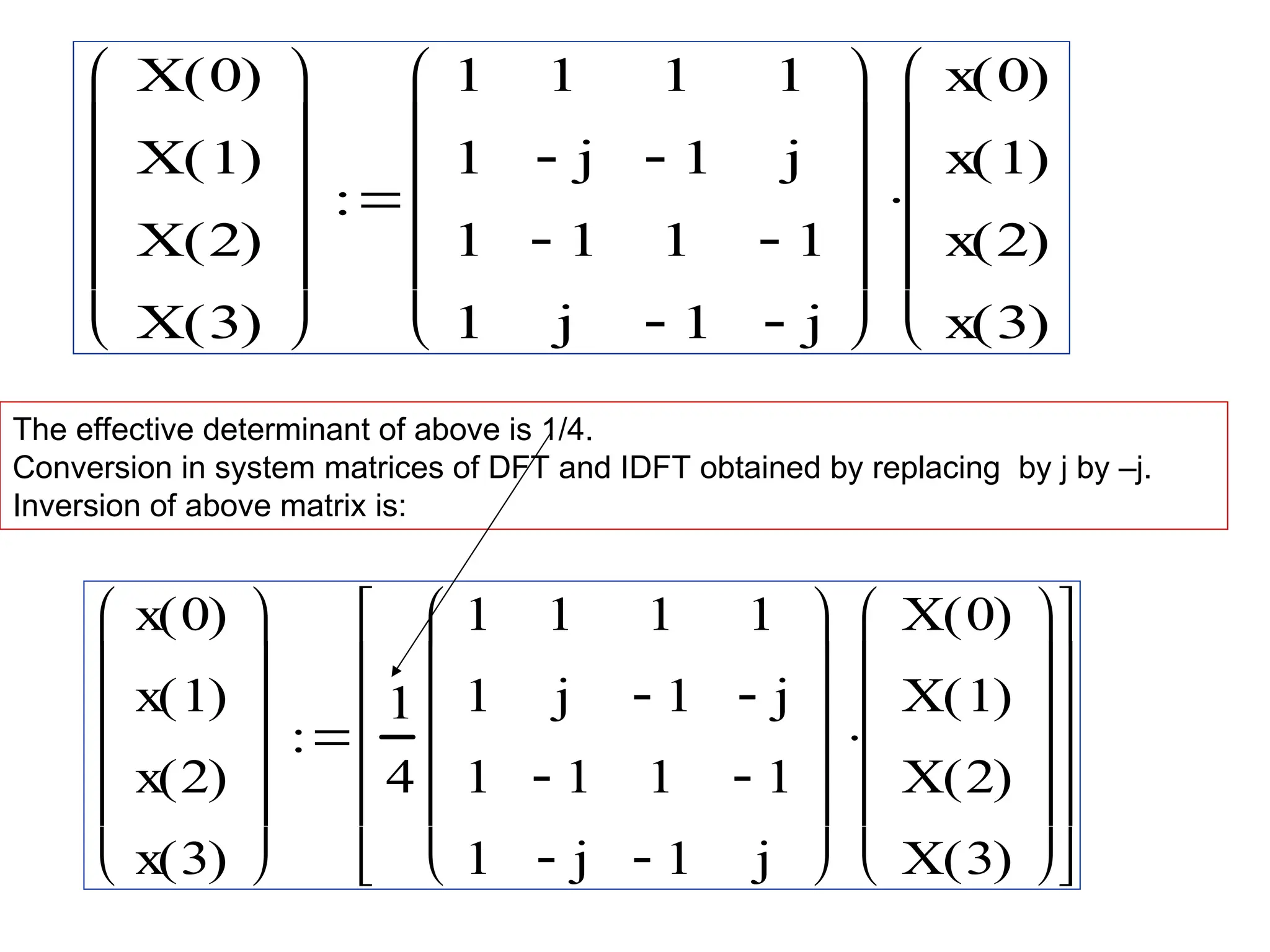
The effective determinant of above is 1/4.
Conversion in system matrices of DFT and IDFT obtained by replacing by j by –j.
Inversion of above matrix is:
x 0
( )
x 1
( )
x 2
( )
x 3
( )












1
4
1
1
1
1
1
j
1

j

1
1

1
1

1
j

1

j












X 0
( )
X 1
( )
X 2
( )
X 3
( )














ïƒȘ
ïƒȘ
ïƒȘ
ïƒȘ

ïƒč
ïƒș
ïƒș
ïƒș
ïƒș

ï€ș
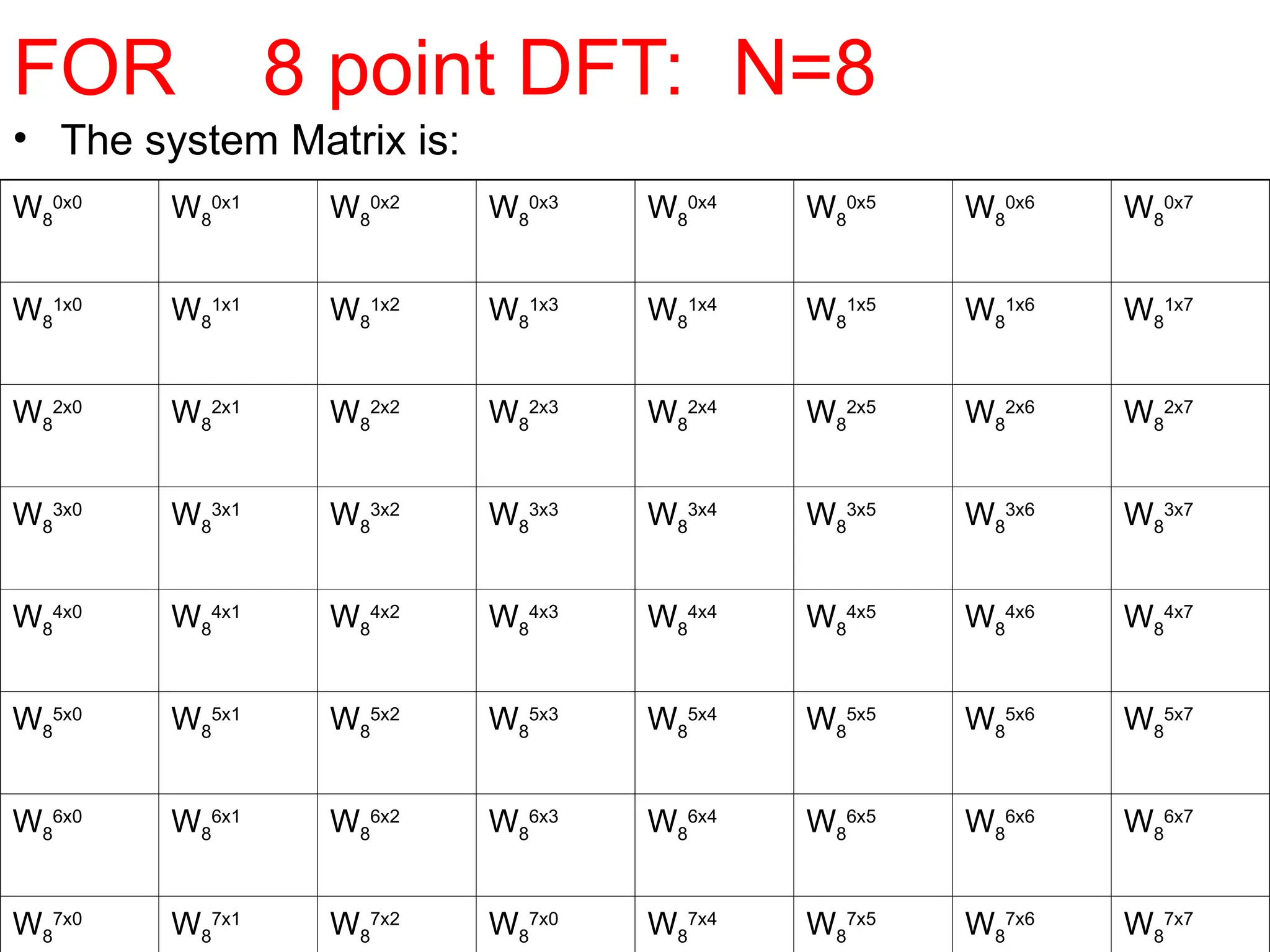
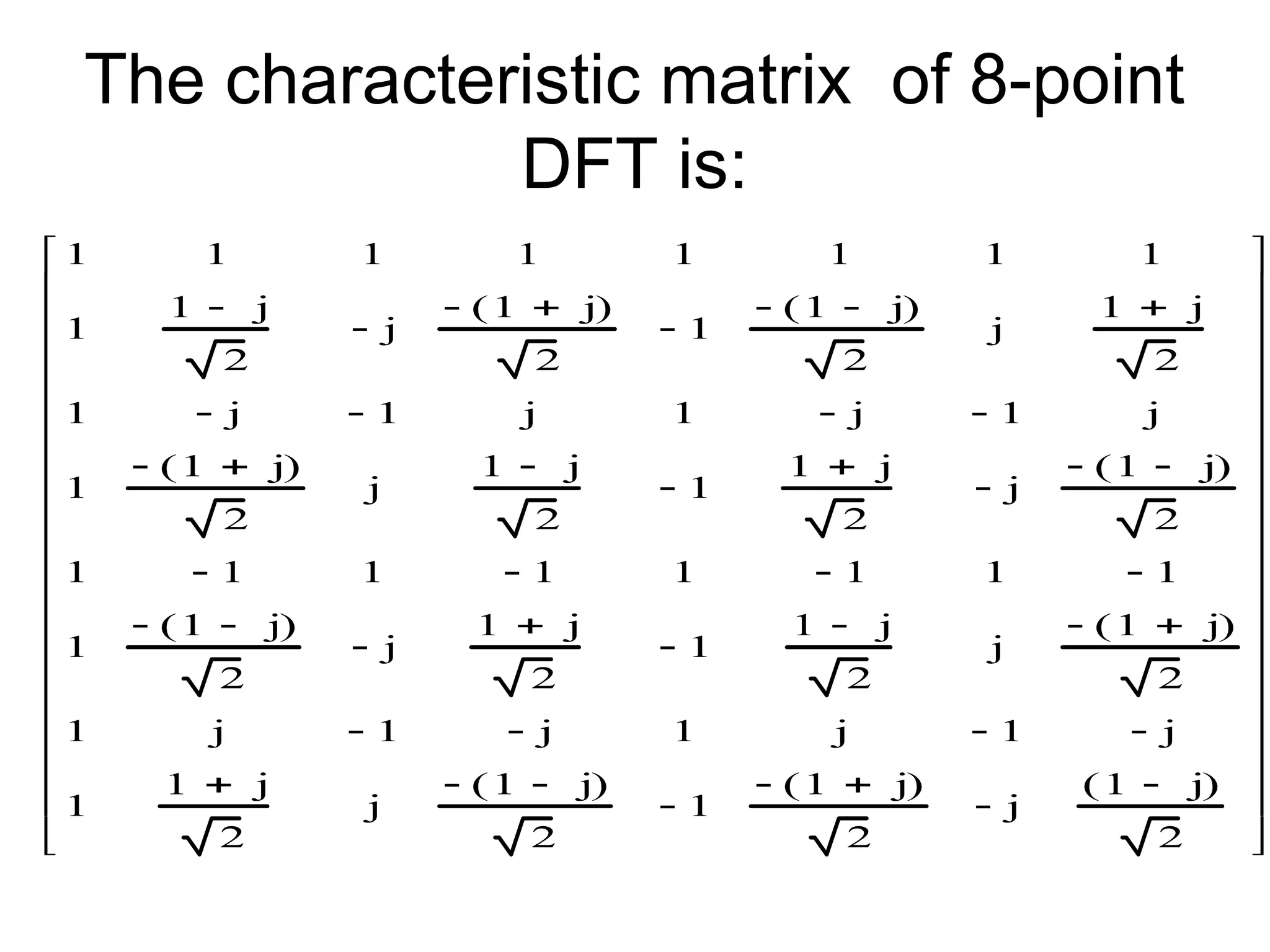
FOR 8 point DFT: N=8
‱ The system Matrix is:
W8
0x0
W8
0x1
W8
0x2
W8
0x3
W8
0x4
W8
0x5
W8
0x6
W8
0x7
W8
1x0
W8
1x1
W8
1x2
W8
1x3
W8
1x4
W8
1x5
W8
1x6
W8
1x7
W8
2x0
W8
2x1
W8
2x2
W8
2x3
W8
2x4
W8
2x5
W8
2x6
W8
2x7
W8
3x0
W8
3x1
W8
3x2
W8
3x3
W8
3x4
W8
3x5
W8
3x6
W8
3x7
W8
4x0
W8
4x1
W8
4x2
W8
4x3
W8
4x4
W8
4x5
W8
4x6
W8
4x7
W8
5x0
W8
5x1
W8
5x2
W8
5x3
W8
5x4
W8
5x5
W8
5x6
W8
5x7
W8
6x0
W8
6x1
W8
6x2
W8
6x3
W8
6x4
W8
6x5
W8
6x6
W8
6x7
W8
7x0
W8
7x1
W8
7x2
W8
7x0
W8
7x4
W8
7x5
W8
7x6
W8
7x7
The characteristic matrix of 8-point
DFT is:
1
1
1
1
1
1
1
1
1
1 j

2
j

1 j

( )

2
1

1 j

( )

2
j
1 j

2
1
j

1

j
1
j

1

j
1
1 j

( )

2
j
1 j

2
1

1 j

2
j

1 j

( )

2
1
1

1
1

1
1

1
1

1
1 j

( )

2
j

1 j

2
1

1 j

2
j
1 j

( )

2
1
j
1

j

1
j
1

j

1
1 j

2
j
1 j

( )

2
1

1 j

( )

2
j

1 j

( )
2

ïƒȘ
ïƒȘ
ïƒȘ
ïƒȘ
ïƒȘ
ïƒȘ
ïƒȘ
ïƒȘ
ïƒȘ
ïƒȘ
ïƒȘ
ïƒȘ
ïƒȘ
ïƒȘ
ïƒȘ

ïƒč
ïƒș
ïƒș
ïƒș
ïƒș
ïƒș
ïƒș
ïƒș
ïƒș
ïƒș
ïƒș
ïƒș
ïƒș
ïƒș
ïƒș
ïƒș

DFT and its Inverse
Conversion in system matrices of DFT and IDFT obtained by
replacing by j by –j..
1
1
1
1
1
1
1
1
1
1 j

2
j

1 j

( )

2
1

1 j

( )

2
j
1 j

2
1
j

1

j
1
j

1

j
1
1 j

( )

2
j
1 j

2
1

1 j

2
j

1 j

( )

2
1
1

1
1

1
1

1
1

1
1 j

( )

2
j

1 j

2
1

1 j

2
j
1 j

( )

2
1
j
1

j

1
j
1

j

1
1 j

2
j
1 j

( )

2
1

1 j

( )

2
j

1 j

( )
2

ïƒȘ
ïƒȘ
ïƒȘ
ïƒȘ
ïƒȘ
ïƒȘ
ïƒȘ
ïƒȘ
ïƒȘ
ïƒȘ
ïƒȘ
ïƒȘ
ïƒȘ
ïƒȘ
ïƒȘ

ïƒč
ïƒș
ïƒș
ïƒș
ïƒș
ïƒș
ïƒș
ïƒș
ïƒș
ïƒș
ïƒș
ïƒș
ïƒș
ïƒș
ïƒș
ïƒș

1
8
1
1
1
1
1
1
1
1
1
1 j

2
j
1 j

2

1

1 j

2

j

1 j

2
1
j
1

j

1
j
1

j

1
1 j

2

j

1 j

2
1

1 j

2
j
1 j

2

1
1

1
1

1
1

1
1

1
1 j

2

j
1 j

2
1

1 j

2
j

1 j

2

1
j

1

j
1
j

1

j
1
1 j

2
j

1 j

2

1

1 j

2

j
1 j

2





































































DFT IDFT
Effective
determinant
Calculation advantage in radix-2
algorithms for various values of N
Improvement
A/B
N N^2 N^2-N A (N/2)ln(N) Nln(N) B
8 64 56 120 8.32 16.64 24.95 4.81
16 256 240 496 22.18 44.36 66.54 7.45
32 1024 992 2016 55.45 110.90 166.36 12.12
64 4096 4032 8128 133.08 266.17 399.25 20.36
128 16384 16256 32640 310.53 621.06 931.59 35.04
256 65536 65280 130816 709.78 1419.57 2129.35 61.43
512 262144 261632 523776 1597.01 3194.02 4791.03 109.32
1024 1048576 1047552 2096128 3548.91 7097.83 10646.74 196.88
2048 4194304 4192256 8386560 7807.61 15615.22 23422.83 358.05
4096 16777216 16773120 33550336 17034.79 34069.57 51104.36 656.51
8192 67108864 67100672 134209536 36908.70 73817.40 110726.10 1212.09
16384 268435456 268419072 536854528 79495.66 158991.33 238486.99 2251.09
No. of
computation
points
DIRECT COMPUTATION FFT computaton
complex
multiplication
Complex
additions
complex
multiplication
Complex
additions
Total Total
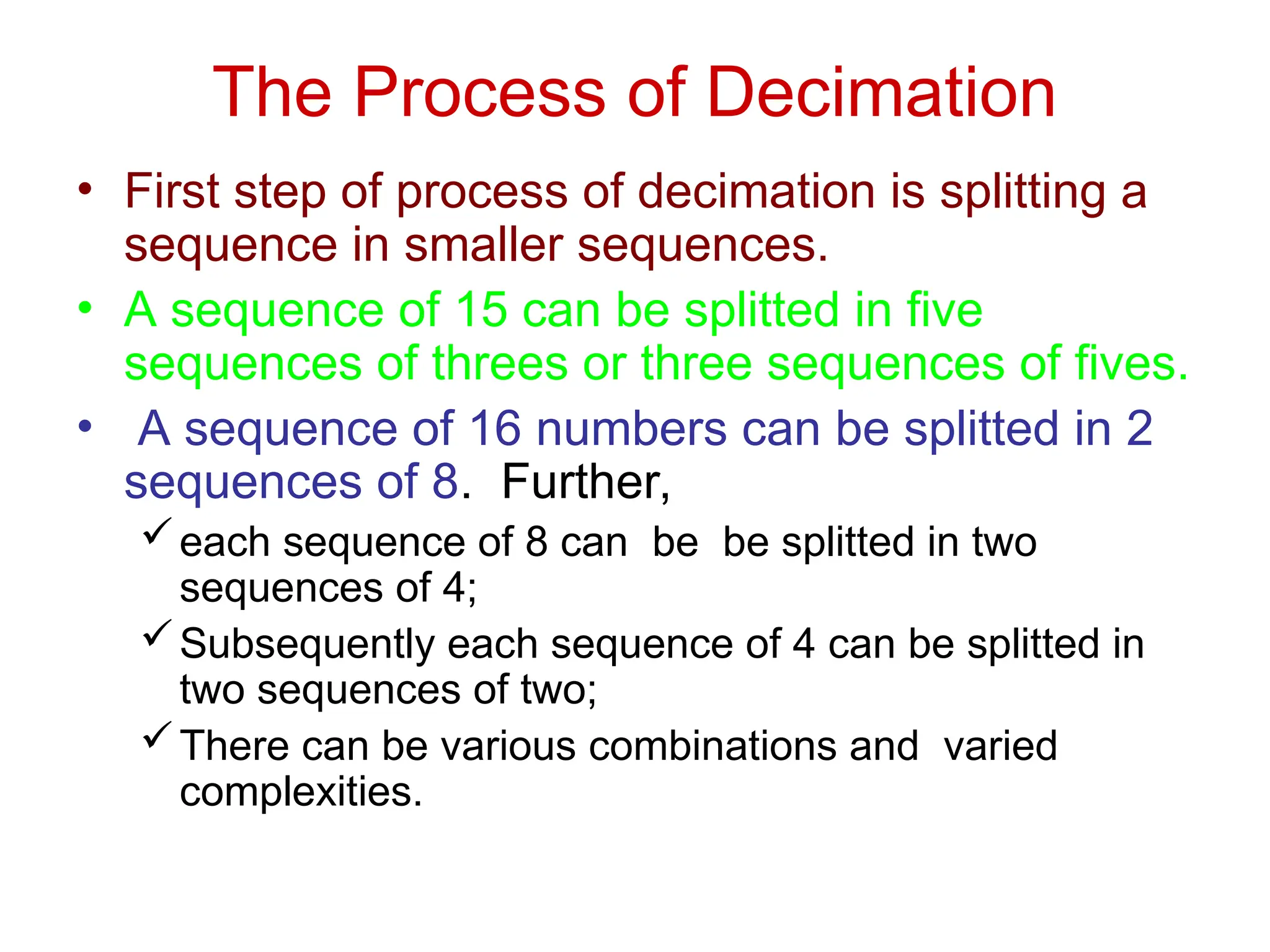
The Process of Decimation
‱ First step of process of decimation is splitting a
sequence in smaller sequences.
‱ A sequence of 15 can be splitted in five
sequences of threes or three sequences of fives.
‱ A sequence of 16 numbers can be splitted in 2
sequences of 8. Further,
each sequence of 8 can be be splitted in two
sequences of 4;
Subsequently each sequence of 4 can be splitted in
two sequences of two;
There can be various combinations and varied
complexities.
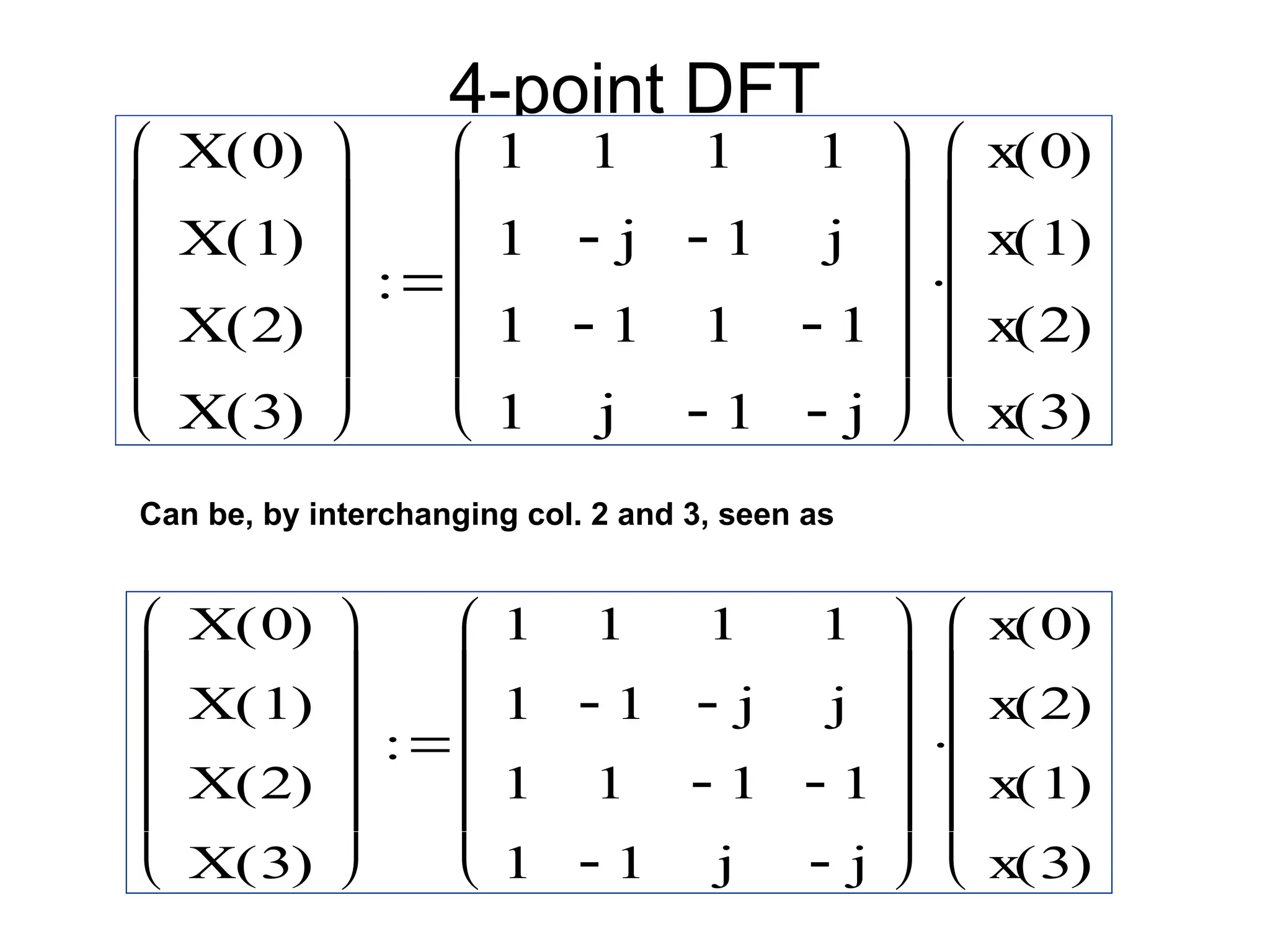
4-point DFT
X 0
( )
X 1
( )
X 2
( )
X 3
( )












1
1
1
1
1
j

1

j
1
1

1
1

1
j
1

j













x 0
( )
x 1
( )
x 2
( )
x 3
( )













ï€ș
Can be, by interchanging col. 2 and 3, seen as
X 0
( )
X 1
( )
X 2
( )
X 3
( )












1
1
1
1
1
1

1
1

1
j

1

j
1
j
1

j













x 0
( )
x 2
( )
x 1
( )
x 3
( )













ï€ș
4-point DFT
X 0
( )
X 1
( )
X 2
( )
X 3
( )












1
1
1
1
1
1

1
1

1
j

1

j
1
j
1

j













x 0
( )
x 2
( )
x 1
( )
x 3
( )













ï€ș
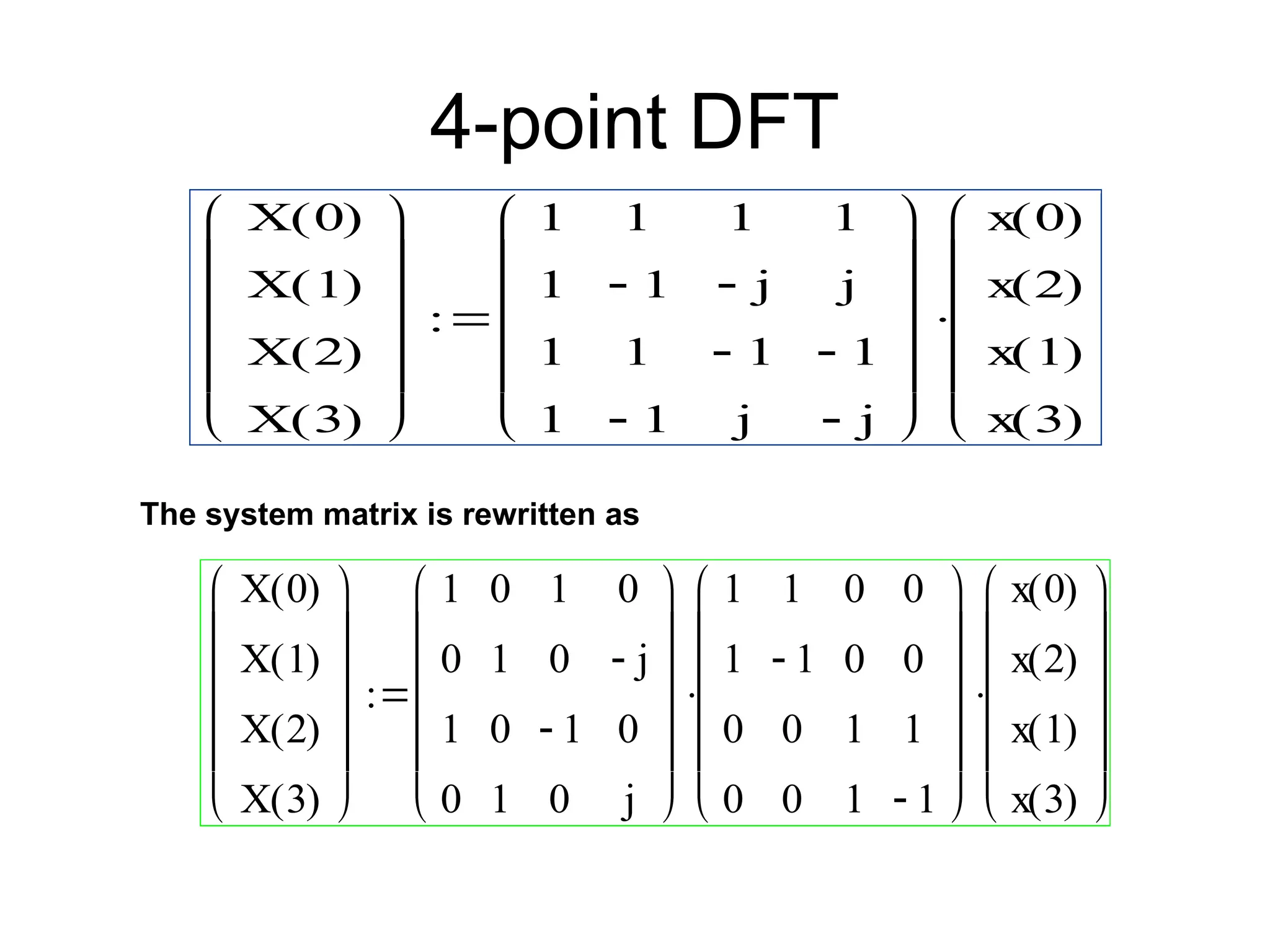
The system matrix is rewritten as
X 0
( )
X 1
( )
X 2
( )
X 3
( )












1
0
1
0
0
1
0
1
1
0
1

0
0
j

0
j












1
1
0
0
1
1

0
0
0
0
1
1
0
0
1
1














x 0
( )
x 2
( )
x 1
( )
x 3
( )













ï€ș
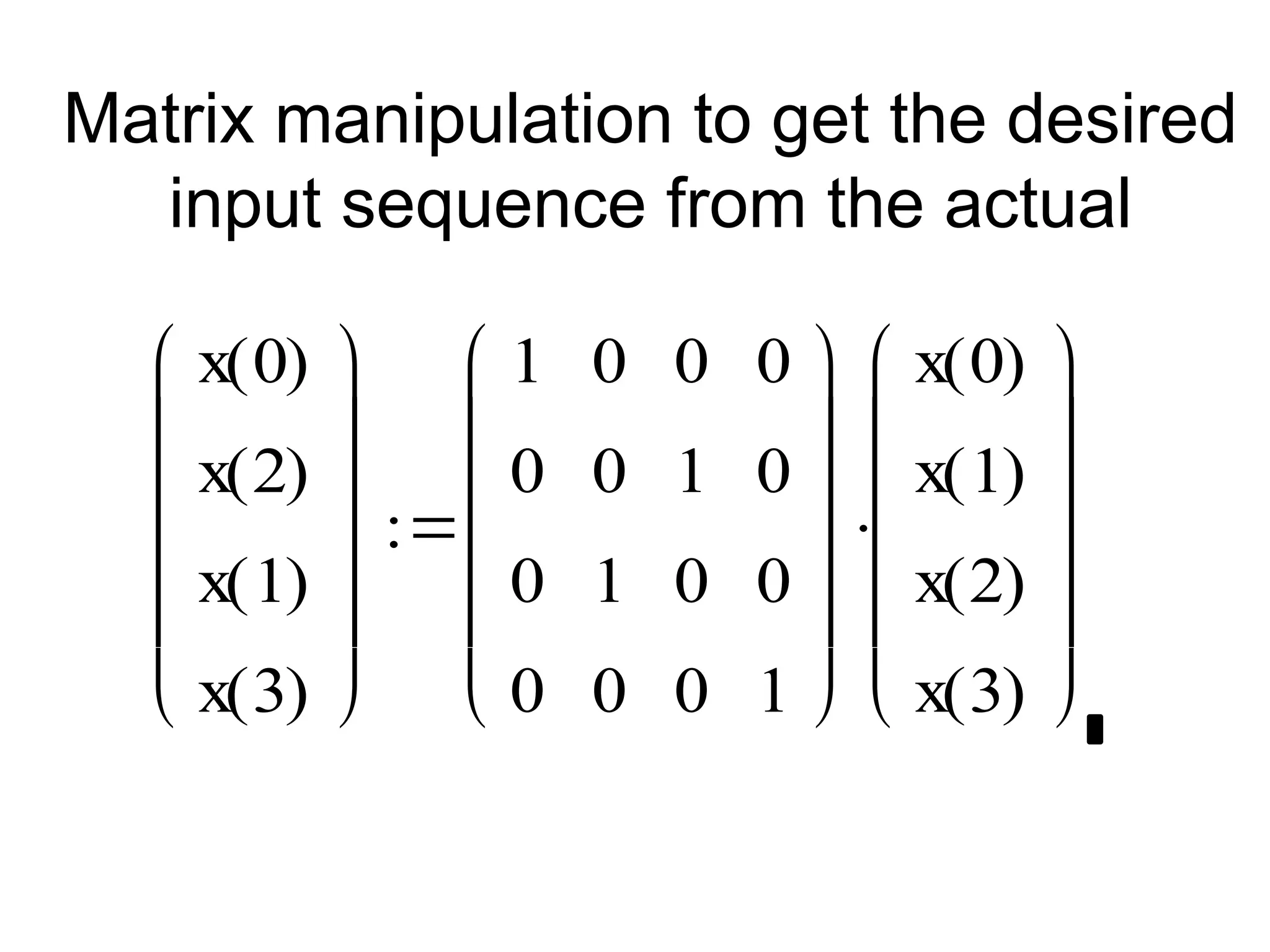
Matrix manipulation to get the desired
input sequence from the actual
x 0
( )
x 2
( )
x 1
( )
x 3
( )












1
0
0
0
0
0
1
0
0
1
0
0
0
0
0
1












x 0
( )
x 1
( )
x 2
( )
x 3
( )













ï€ș
Process of decimation: example
X[n]
-1
-2 1
2 3 4
5
6
7 n
X[1]
X[3]
X[5]
X[7]
X[n]
-1
-2 1
2 3 4
5
6
7 n
X[1]
X[2]
X[3] X[4]
X[5]
X[6]
X[7]
X[0]
X[n]
-1
-2 1
2 3 4
5
6
7 n
X[2]
X[4]
X[6]
X[0]
Separating the above sequence for +ve ‘n’ in even and odd sequence numbers .
Process of decimation: example
X[n]
-
- 1
2 3 4
5
6
7 n
X[1]
X[3]
X[5]
X[7]
2 3 4 6
X[n]
- 1 5 7 n
X[2]
X[4]
X[6]
X[0]
Compress the even sequence by two.
Shift the sequence to left by one and
compress by two
X[n]
-
1 2 3
n
X[2]
X[4]
X[6]
X[0]
X[n]
2
4 6 n
X[1]
X[3]
X[5]
X[7]
The compression is also called decimation
x 0
( ) x 2
( )

x 0
( ) x 2
( )

x 1
( ) x 3
( )

x 1
( ) x 3
( )













1
1
0
0
1
1

0
0
0
0
1
1
0
0
1
1













x 0
( )
x 2
( )
x 1
( )
x 3
( )













ï€ș
X 0
( )
X 1
( )
X 2
( )
X 3
( )












1
0
1
0
0
1
0
1
1
0
1

0
0
j

0
j












x 0
( ) x 2
( )

x 0
( ) x 2
( )

x 1
( ) x 3
( )

x 1
( ) x 3
( )














ï€ș
X 0
( )
X 1
( )
X 2
( )
X 3
( )












1
0
1
0
0
1
0
1
1
0
1

0
0
j

0
j












1
1
0
0
1
1

0
0
0
0
1
1
0
0
1
1














x 0
( )
x 2
( )
x 1
( )
x 3
( )













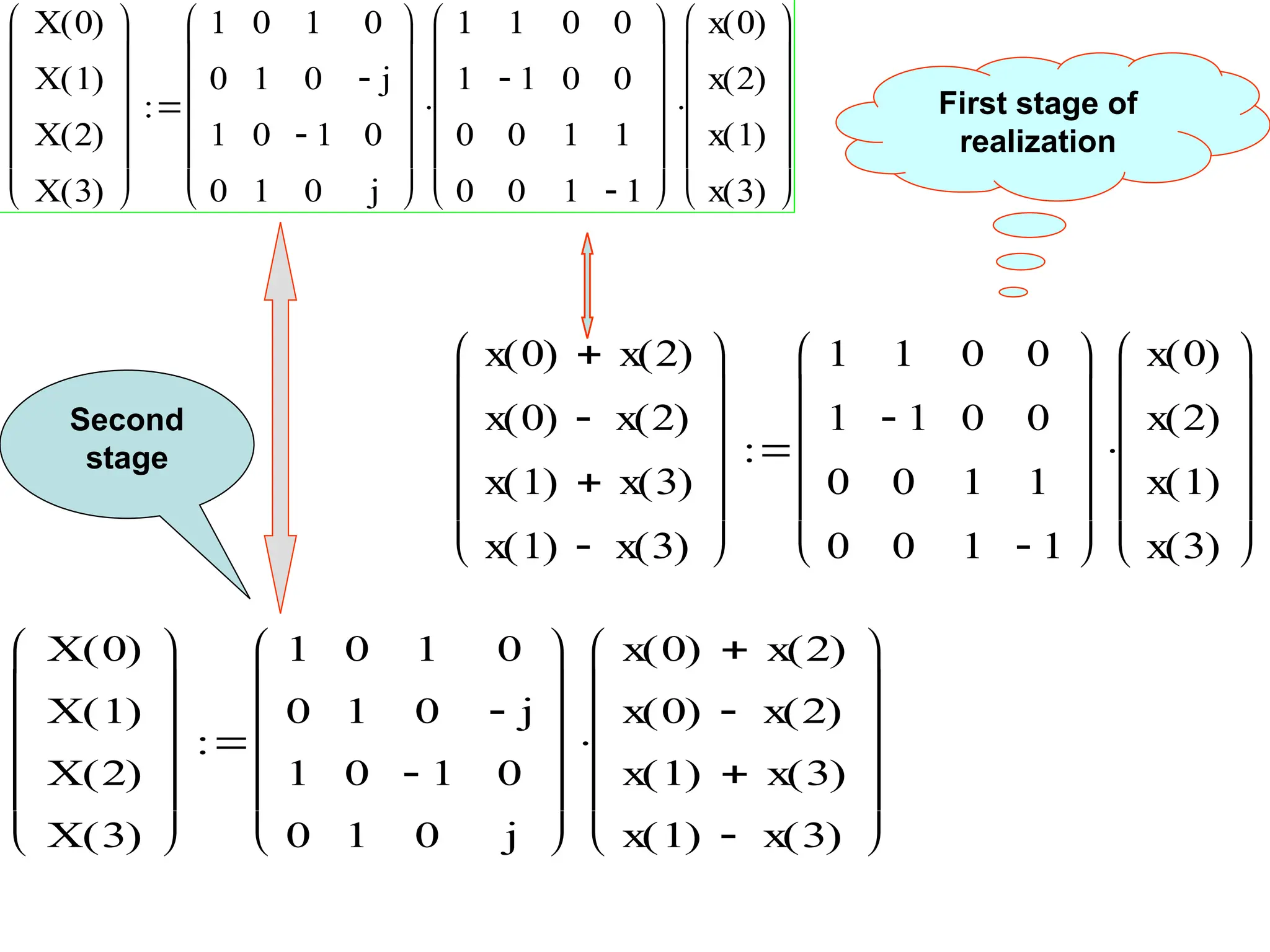
ï€ș First stage of
realization
Second
stage
Decimation of 4 point DFT into 2xradix-2
‱ The values of
W4
0
= 1; W4
2
= -1; W4
1
= -j; and W4
3
= j
X[0]
x0
x2
x1
x3
x0+x2
xo -x2
x1+x3
x1-x3
X[1]
X[2]
X[3]
Wo
ï‚ź
w1
ï‚ź
W2
ï‚Ż
W3
ï‚Ż
-1
-1
Decimation of 4 point DFT into 2xradix-2
‱ The values of
W4
0
= 1; W4
2
= -1; W4
1
= -j; and W4
3
= j
X[0]
N/4 point
DFT
even
N/4 point
DFT
odd
x0
x2
x1
x3
x0+x2
xo -x2
x1+x3
x1-x3
X[1]
X[2]
X[3]
Wo
ï‚ź
w1
ï‚ź
W2
ï‚Ż
W3
ï‚Ż
N=8-point radix-4 DIT-FFT:
N/2 point
DFT
[EVEN]
N/2 point
DFT
[ODD]
X(0)
X(4)
X(2)
X(6)
X(1)
X(3)
X(5)
X(7)
X[0]
X[1]
X[2]
X[3]
X[4]
X[5]
X[6]
X[7]
X0[0]
X1 [0]
X0[1]
X1 [1]
X0[2]
X1[2]
X0[3]
X1[3]
aï‚ź
-j ï‚ź
-bï‚ź
-1ï‚Ż
-a ï‚Ż
jï‚Ż
bï‚Ż
Note: -W4
= W0
=1; -W5
= W1
= a = (1-j)/2;
-W2
= W6
=j and -W3
= W7
= b = (1+j)/2
1
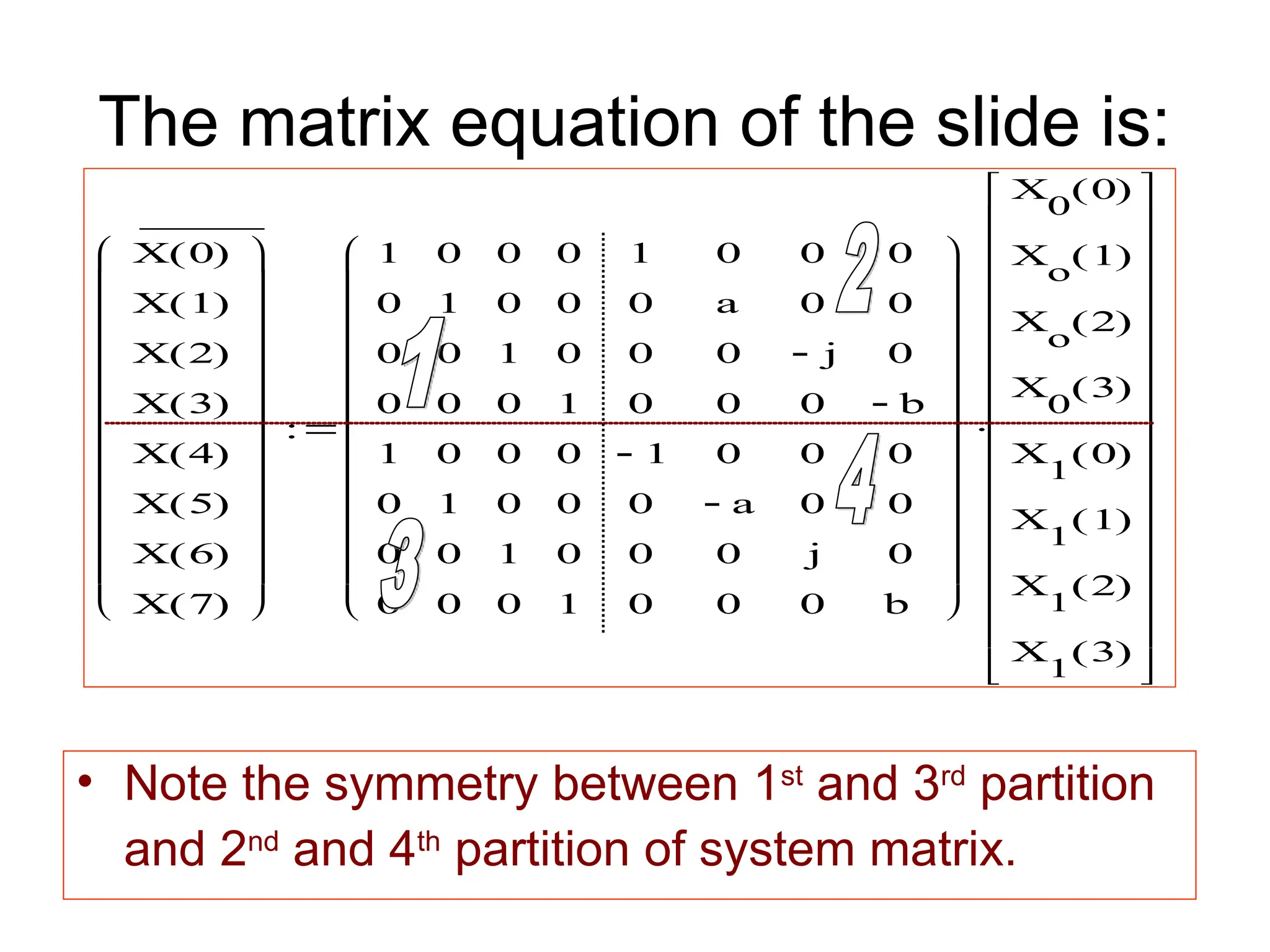
The matrix equation of the slide is:
‱ Note the symmetry between 1st
and 3rd
partition
and 2nd
and 4th
partition of system matrix.
X 0
( )
X 1
( )
X 2
( )
X 3
( )
X 4
( )
X 5
( )
X 6
( )
X 7
( )























1
0
0
0
1
0
0
0
0
1
0
0
0
1
0
0
0
0
1
0
0
0
1
0
0
0
0
1
0
0
0
1
1
0
0
0
1

0
0
0
0
a
0
0
0
a

0
0
0
0
j

0
0
0
j
0
0
0
0
b

0
0
0
b






















X
0
0
( )
X
o
1
( )
X
o
2
( )
X
0
3
( )
X
1
0
( )
X
1
1
( )
X
1
2
( )
X
1
3
( )

ïƒȘ
ïƒȘ
ïƒȘ
ïƒȘ
ïƒȘ
ïƒȘ
ïƒȘ
ïƒȘ
ïƒȘ
ïƒȘ
ïƒȘ
ïƒȘ
ïƒȘ

ïƒč
ïƒș
ïƒș
ïƒș
ïƒș
ïƒș
ïƒș
ïƒș
ïƒș
ïƒș
ïƒș
ïƒș
ïƒș
ïƒș


ï€ș
N=8-point radix-2 DIT-FFT:
N-point DFT
N/2 point DFT
N/4 point DFT
X[0]
X[1]
X[2]
X[3]
X[4]
X[5]
X[6]
X[7]
x[0]
x[4]
x[2]
x[6]
x[1]
x[5]
x[3]
x[7]
-1
-1
-1
-1
-1
-1
-1
-1
w2
w2
w2
w1
w3
-1
-1
-1
-1
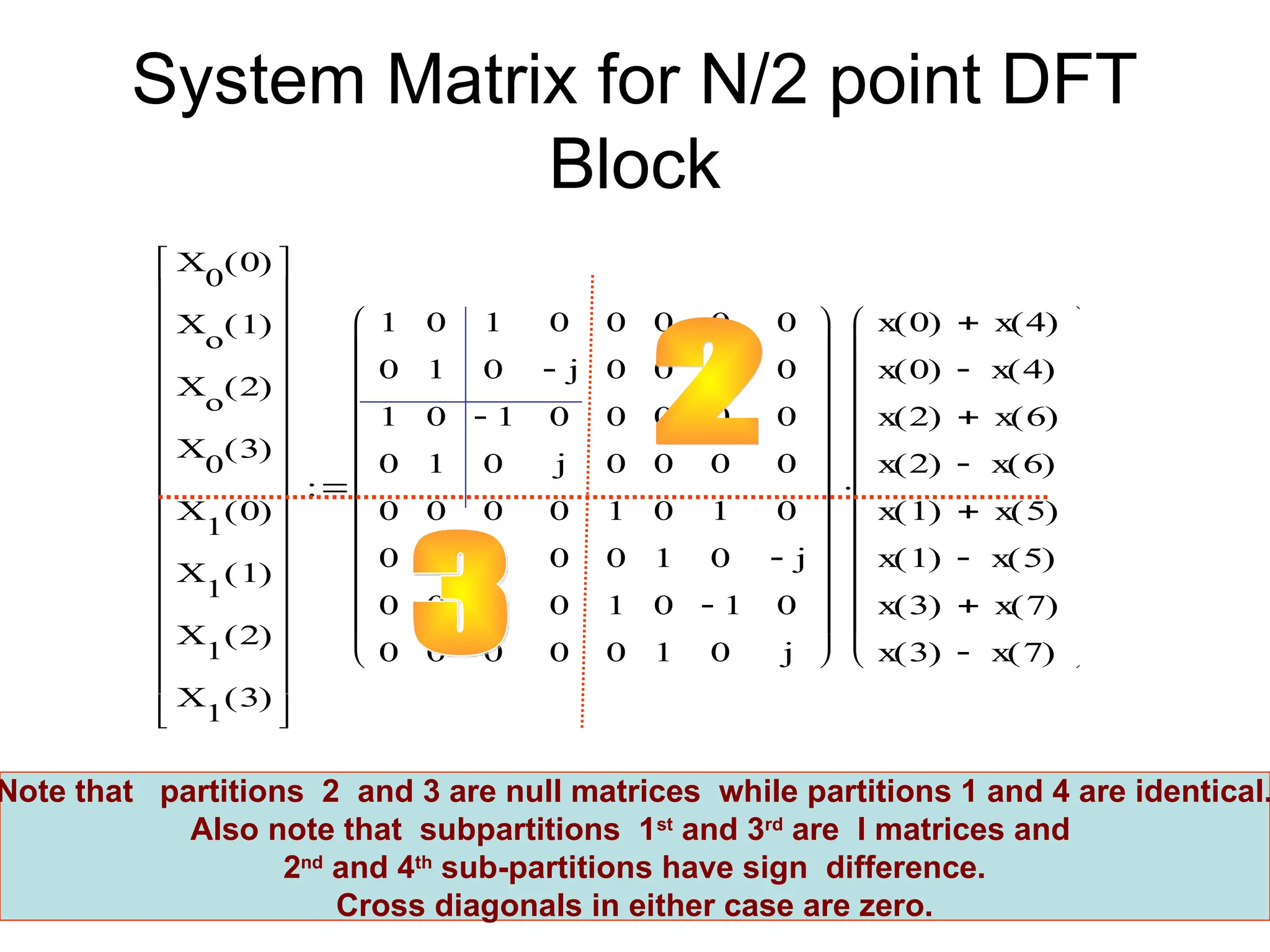
System Matrix for N/2 point DFT
Block
Note that partitions 2 and 3 are null matrices while partitions 1 and 4 are identical.
Also note that subpartitions 1st
and 3rd
are I matrices and
2nd
and 4th
sub-partitions have sign difference.
Cross diagonals in either case are zero.
X
0
0
( )
X
o
1
( )
X
o
2
( )
X
0
3
( )
X
1
0
( )
X
1
1
( )
X
1
2
( )
X
1
3
( )

ïƒȘ
ïƒȘ
ïƒȘ
ïƒȘ
ïƒȘ
ïƒȘ
ïƒȘ
ïƒȘ
ïƒȘ
ïƒȘ
ïƒȘ
ïƒȘ
ïƒȘ

ïƒč
ïƒș
ïƒș
ïƒș
ïƒș
ïƒș
ïƒș
ïƒș
ïƒș
ïƒș
ïƒș
ïƒș
ïƒș
ïƒș

1
0
1
0
0
0
0
0
0
1
0
1
0
0
0
0
1
0
1

0
0
0
0
0
0
j

0
j
0
0
0
0
0
0
0
0
1
0
1
0
0
0
0
0
0
1
0
1
0
0
0
0
1
0
1

0
0
0
0
0
0
j

0
j






















x 0
( ) x 4
( )

x 0
( ) x 4
( )

x 2
( ) x 6
( )

x 2
( ) x 6
( )

x 1
( ) x 5
( )

x 1
( ) x 5
( )

x 3
( ) x 7
( )

x 3
( ) x 7
( )
























ï€ș
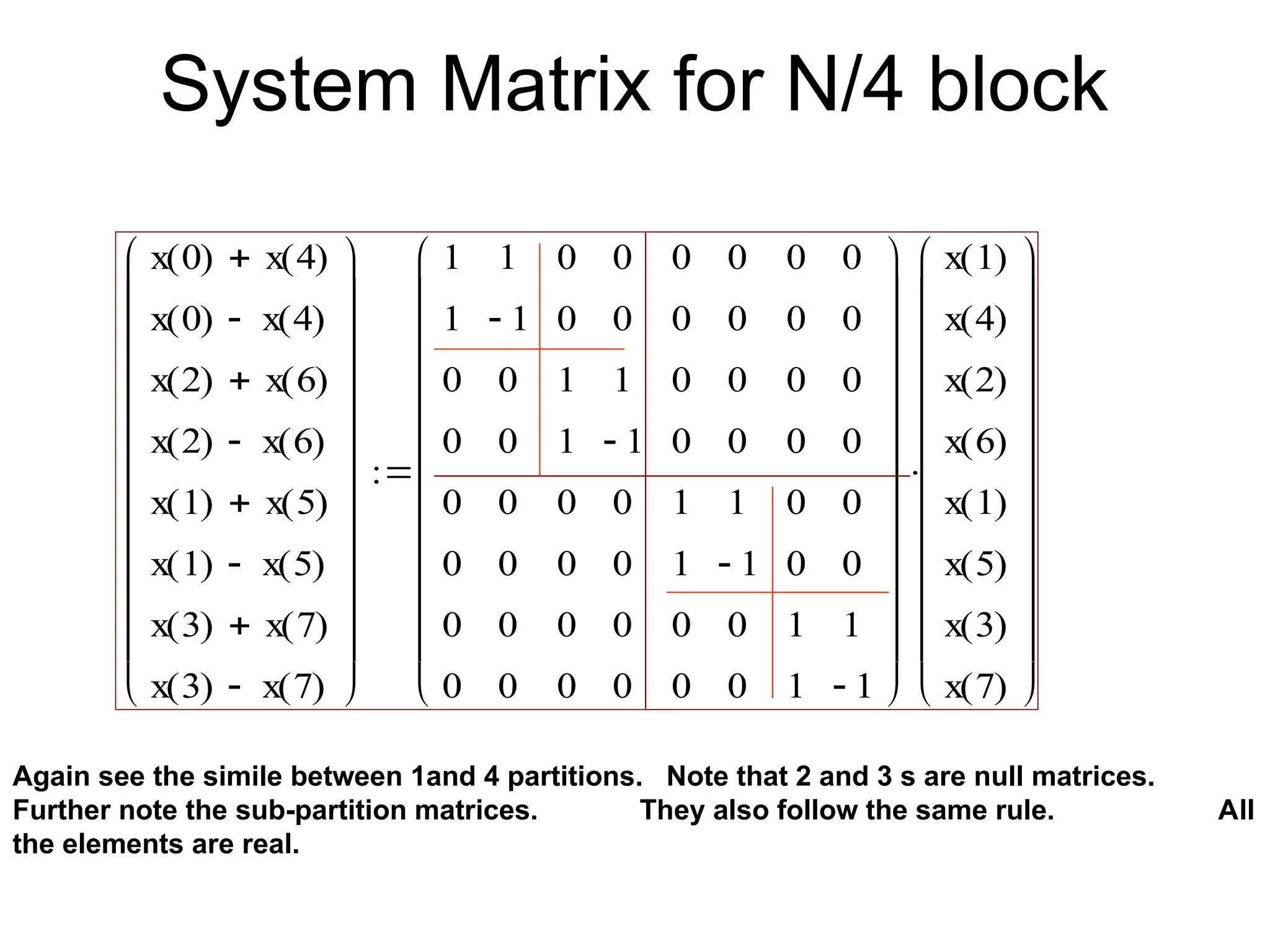
System Matrix for N/4 block
Again see the simile between 1and 4 partitions. Note that 2 and 3 s are null matrices.
Further note the sub-partition matrices. They also follow the same rule. All
the elements are real.
x 0
( ) x 4
( )

x 0
( ) x 4
( )

x 2
( ) x 6
( )

x 2
( ) x 6
( )

x 1
( ) x 5
( )

x 1
( ) x 5
( )

x 3
( ) x 7
( )

x 3
( ) x 7
( )























1
1
0
0
0
0
0
0
1
1

0
0
0
0
0
0
0
0
1
1
0
0
0
0
0
0
1
1

0
0
0
0
0
0
0
0
1
1
0
0
0
0
0
0
1
1

0
0
0
0
0
0
0
0
1
1
0
0
0
0
0
0
1
1























x 1
( )
x 4
( )
x 2
( )
x 6
( )
x 1
( )
x 5
( )
x 3
( )
x 7
( )























ï€ș
Signal flow graph for decimation of 8 point DFT
N-point DFT
N/2 point DFT
N/4 point DFT
X[0]
X[1]
X[2]
X[3]
X[4]
X[5]
X[6]
X[7]
x[0]
x[4]
x[2]
x[6]
x[1]
x[5]
x[3]
x[7]
-1
-1
-1
-1
-1
-1
-1
-1
w2
w2
w2
w1
w3
-1
-1
-1
-1

DSP12_PP 8 POINT RADIX-2 pptDIT-FFT.ppt

  • 1.
    DFT and FFT ‱FFT is an algorithm to convert a time domain signal to DFT efficiently. ‱ FFT is not unique. Many algorithms are available. ‱ Each algorithm has merits and demerits. ‱ In each algorithm, depending on the sequence needed at the output, the input is regrouped. ‱ The groups are decided by the number of samples.
  • 2.
    FFTs ‱ The numberof points can be nine too. ‱ It can be 15 as well. ‱ Any number in multiples of two integers. ‱ It can not be any prime number. ‱ It can be in the multiples of two prime numbers.
  • 3.
    FFTs ‱ The purposeof this series of lectures is to learn the basics of FFT algorithms. ‱ Algorithms having number of samples 2N , where N is an integer is most preferred. ‱ 8 point radix-2 FFT by decimation is used from learning point of view. ‱ Radix-x: here ‘x’ represents number of samples in each group made at the first stage. They are generally equal. ‱ We shall study radix-2 and radix-3.
  • 4.
    Radix-2: DIT or,DIF ‱ Radix-2 is the first FFT algorithm. It was proposed by Cooley and Tukey in 1965. ‱ Though it is not the efficient algorithm, it lays foundation for time-efficient DFT calculations. ‱ The next slide shows the saving in time required for calculations with radix-2. ‱ The algorithms appear either in (a) Decimation In Time (DIT), or, (b) Decimation In Frequency (DIF). ‱ DIT and DIF, both yield same complexity and results. They are complementary. ‱ We shall stress on 8 to radix 2 DIT FFT.
  • 5.
    Other popular Algorithms Besidesmany, the popular algorithms are: ‱ Goertzel algorithm ‱ Chirp Z algorithm ‱ Index mapping algorithm ‱ Split radix in prime number algorithm. have modified approach over radix-2. Split radix in prime number does not use even the twiddles. We now pay attention to 8/radix-2 butterfly FIT FFT algorithm.
  • 6.
    Relationship between exponentialforms and twiddle factors (W) for Periodicity = N Sr. No. Exponential form Symbolic form 01 e-j2n/N = e-j2(n+N)/N WN n = WN n+N 02 e-j2(n+N/2)/N = - e-j2n/N WN n+N/2 = - WN n 03 e-j2k = e-j2Nk/N = 1 WN N+K = 1 04 e-j2(2/N) = e-j2/(N/2) WN 2 = WN/2
  • 7.
    Values of varioustwiddles WN n for length N=8 n WN n = e(-j2)(n/N) Remarks 0 1 = 10 WN 0 1 (1-j)/√2 = 1 -45 WN 1 2 -j = 1 -90 WN 2 3 - (1+j)/√2 = 1-135 WN 3 4 -1 = 1 -180 WN 4 = -WN 0 5 - (1-j)/√2 = 1 -225 WN 5 = -WN 1 6 j = 1 90 WN 6 = -WN 2 7 (1+j)/√2 = 1 45 WN 7 = -WN 3
  • 8.
    DFT calculations ‱ Theforward DFT, frequency domain output in the range 0ï‚Łkï‚ŁN-1 is given by: ‱ While the Inverse DFT, time domain output, again, in the range 0ï‚Łkï‚ŁN-1 is denoted by X k ( ) 0 n 1  n x n ( ) W N  nk   ïƒč    ï€ș x n ( ) 1 N 0 n 1  k X k ( ) W N   nk    ïƒč     ïƒȘ ïƒȘ  ïƒč ïƒș ïƒș  ï€ș
  • 9.
    Matrix Relations Matrix Relations ‱The DFT samples defined by can be expressed in NxN matrix as where  T N X X X ] [ ..... ] [ ] [ 1 1 0   X  T N x x x ] [ ..... ] [ ] [ 1 1 0   x 1 0 , ] [ ] [ 1 0  ï‚Ł ï‚Ł     N k W n x k X N n kn N     x(n) X(k) 1 0 n ïƒș  ïƒč ïƒȘ       N nk N W
  • 10.
    Matrix Relations Matrix Relations canbe expanded as NXN DFT matrix ïƒș ïƒș ïƒș ïƒș ïƒș ïƒș  ïƒč ïƒȘ ïƒȘ ïƒȘ ïƒȘ ïƒȘ ïƒȘ            2 ) 1 ( ) 1 ( 2 ) 1 ( ) 1 ( 2 4 2 ) 1 ( 2 1 1 0 1 1 1 1 1 1 1 N N N N N N N N N N N N N N N k nk N W W W W W W W W W W             1 0 N k nk N W
  • 11.
    DFT: For N oflength 4,range of n, k = [0 1 2 3] each. Hence X(n) = x(0)WN n.0 +x(1)WN n.1 +x(2)WN n.2 + x(3)WN n.3 X k ( ) 0 n 1  n x n ( ) W N  nk   ïƒč    ï€ș x x(0) x(1) x(2) x(3) X(0) = W4 0x0 W4 0x1 W4 0x2 W4 0x3 X(1) = W4 1x0 W4 1x1 W4 1x2 W4 1x3 X(2) = W4 2x0 W4 2x1 W4 2x2 W4 2x3 X(3) = W4 3x0 W4 3x1 W4 3x2 W4 3x3
  • 12.
    x(0) x(1) x(2)x(3) X(0) = W4 0x0 W4 0x1 W4 0x2 W4 0x3 X(1) = W4 1x0 W4 1x1 W4 1x2 W4 1x3 X(2) = W4 2x0 W4 2x1 W4 2x2 W4 2x3 X(3) = W4 3x0 W4 3x1 W4 3x2 W4 3x3 x(0) x(1) x(2) x(3) X(0) = W4 0 W4 0 W4 0 W4 0 X(1) = W4 0 W4 1 W4 2 W4 3 X(2) = W4 0 W4 2 W4 4 W4 6 X(3) = W4 0 W4 3 W4 6 W4 9 Can be rewritten as:
  • 13.
    x(0) x(1) x(2)x(3) X(0) = W4 0 W4 0 W4 0 W4 0 X(1) = W4 0 W4 1 W4 2 W4 3 X(2) = W4 0 W4 2 W4 4 W4 6 X(3) = W4 0 W4 3 W4 6 W4 9 x(0) x(1) x(2) x(3) X(0) = W4 0 W4 0 W4 0 W4 0 X(1) = W4 0 W4 1 W4 2 -W4 1 X(2) = W4 0 W4 2 W4 0 W4 2 X(3) = W4 0 -W4 1 W4 2 W4 1
  • 14.
    x(0) x(1) x(2)x(3) X(0) = W4 0 W4 0 W4 0 W4 0 X(1) = W4 0 W4 1 W4 2 -W4 1 X(2) = W4 0 W4 2 W4 0 W4 2 X(3) = W4 0 -W4 1 W4 2 W4 1 x(0) x(1) x(2) x(3) X(0) = 1 1 1 1 X(1) = 1 -j -1 j X(2) = 1 -1 1 -1 X(3) = 1 j -1 -j
  • 15.
    Matrix Relations Matrix Relations ‱Likewise, the IDFT is can be expressed in NxN matrix form as 1 0 , ] [ ] [ 1 0  ï‚Ł ï‚Ł      N n W k X n x N k n k N     X(k) 1 0 n x 1 ïƒș  ïƒč ïƒȘ        N n nk N W
  • 16.
    Matrix Relations Matrix Relations canalso be expanded as NXN DFT matrix ïƒș ïƒș ïƒș ïƒș ïƒș ïƒș  ïƒč ïƒȘ ïƒȘ ïƒȘ ïƒȘ ïƒȘ ïƒȘ                      2 ) 1 ( ) 1 ( 2 ) 1 ( ) 1 ( 2 4 2 ) 1 ( 2 1 1 0 1 1 1 1 1 1 1 N N N N N N N N N N N N N N N k nk N W W W W W W W W W W              1 0 N k nk N W Observe:     1 0 N k nk N W ïƒș  ïƒč ïƒȘ           1 0 1 * 1 0 N n nk N W W N N k nk N The inversion can be had by Hermitian conjugating j by –j and dividing by N.
  • 17.
    x(0) x(1) x(2)x(3) X(0) = 1 1 1 1 X(1) = 1 -j -1 j X(2) = 1 -1 1 -1 X(3) = 1 j -1 -j X 0 ( ) X 1 ( ) X 2 ( ) X 3 ( )             1 1 1 1 1 j  1  j 1 1  1 1  1 j 1  j              x 0 ( ) x 1 ( ) x 2 ( ) x 3 ( )              ï€ș Characterisitc or system matrix
  • 18.
    X 0 ( ) X1 ( ) X 2 ( ) X 3 ( )             1 1 1 1 1 j  1  j 1 1  1 1  1 j 1  j              x 0 ( ) x 1 ( ) x 2 ( ) x 3 ( )              ï€ș x 0 ( ) x 1 ( ) x 2 ( ) x 3 ( )     1 4 1 1 1 1 1 j 1  j  1 1  1 1  1 j  1  j     X 0 ( ) X 1 ( ) X 2 ( ) X 3 ( )        ïƒč  ï€ș x The effective determinant of above is 1/4. Conversion in system matrices of DFT and IDFT obtained by replacing by j by –j. Inversion of above matrix is: x 0 ( ) x 1 ( ) x 2 ( ) x 3 ( )             1 4 1 1 1 1 1 j 1  j  1 1  1 1  1 j  1  j             X 0 ( ) X 1 ( ) X 2 ( ) X 3 ( )               ïƒȘ ïƒȘ ïƒȘ ïƒȘ  ïƒč ïƒș ïƒș ïƒș ïƒș  ï€ș
  • 19.
    FOR 8 pointDFT: N=8 ‱ The system Matrix is: W8 0x0 W8 0x1 W8 0x2 W8 0x3 W8 0x4 W8 0x5 W8 0x6 W8 0x7 W8 1x0 W8 1x1 W8 1x2 W8 1x3 W8 1x4 W8 1x5 W8 1x6 W8 1x7 W8 2x0 W8 2x1 W8 2x2 W8 2x3 W8 2x4 W8 2x5 W8 2x6 W8 2x7 W8 3x0 W8 3x1 W8 3x2 W8 3x3 W8 3x4 W8 3x5 W8 3x6 W8 3x7 W8 4x0 W8 4x1 W8 4x2 W8 4x3 W8 4x4 W8 4x5 W8 4x6 W8 4x7 W8 5x0 W8 5x1 W8 5x2 W8 5x3 W8 5x4 W8 5x5 W8 5x6 W8 5x7 W8 6x0 W8 6x1 W8 6x2 W8 6x3 W8 6x4 W8 6x5 W8 6x6 W8 6x7 W8 7x0 W8 7x1 W8 7x2 W8 7x0 W8 7x4 W8 7x5 W8 7x6 W8 7x7
  • 20.
    The characteristic matrixof 8-point DFT is: 1 1 1 1 1 1 1 1 1 1 j  2 j  1 j  ( )  2 1  1 j  ( )  2 j 1 j  2 1 j  1  j 1 j  1  j 1 1 j  ( )  2 j 1 j  2 1  1 j  2 j  1 j  ( )  2 1 1  1 1  1 1  1 1  1 1 j  ( )  2 j  1 j  2 1  1 j  2 j 1 j  ( )  2 1 j 1  j  1 j 1  j  1 1 j  2 j 1 j  ( )  2 1  1 j  ( )  2 j  1 j  ( ) 2  ïƒȘ ïƒȘ ïƒȘ ïƒȘ ïƒȘ ïƒȘ ïƒȘ ïƒȘ ïƒȘ ïƒȘ ïƒȘ ïƒȘ ïƒȘ ïƒȘ ïƒȘ  ïƒč ïƒș ïƒș ïƒș ïƒș ïƒș ïƒș ïƒș ïƒș ïƒș ïƒș ïƒș ïƒș ïƒș ïƒș ïƒș 
  • 21.
    DFT and itsInverse Conversion in system matrices of DFT and IDFT obtained by replacing by j by –j.. 1 1 1 1 1 1 1 1 1 1 j  2 j  1 j  ( )  2 1  1 j  ( )  2 j 1 j  2 1 j  1  j 1 j  1  j 1 1 j  ( )  2 j 1 j  2 1  1 j  2 j  1 j  ( )  2 1 1  1 1  1 1  1 1  1 1 j  ( )  2 j  1 j  2 1  1 j  2 j 1 j  ( )  2 1 j 1  j  1 j 1  j  1 1 j  2 j 1 j  ( )  2 1  1 j  ( )  2 j  1 j  ( ) 2  ïƒȘ ïƒȘ ïƒȘ ïƒȘ ïƒȘ ïƒȘ ïƒȘ ïƒȘ ïƒȘ ïƒȘ ïƒȘ ïƒȘ ïƒȘ ïƒȘ ïƒȘ  ïƒč ïƒș ïƒș ïƒș ïƒș ïƒș ïƒș ïƒș ïƒș ïƒș ïƒș ïƒș ïƒș ïƒș ïƒș ïƒș  1 8 1 1 1 1 1 1 1 1 1 1 j  2 j 1 j  2  1  1 j  2  j  1 j  2 1 j 1  j  1 j 1  j  1 1 j  2  j  1 j  2 1  1 j  2 j 1 j  2  1 1  1 1  1 1  1 1  1 1 j  2  j 1 j  2 1  1 j  2 j  1 j  2  1 j  1  j 1 j  1  j 1 1 j  2 j  1 j  2  1  1 j  2  j 1 j  2                                                                      DFT IDFT Effective determinant
  • 22.
    Calculation advantage inradix-2 algorithms for various values of N Improvement A/B N N^2 N^2-N A (N/2)ln(N) Nln(N) B 8 64 56 120 8.32 16.64 24.95 4.81 16 256 240 496 22.18 44.36 66.54 7.45 32 1024 992 2016 55.45 110.90 166.36 12.12 64 4096 4032 8128 133.08 266.17 399.25 20.36 128 16384 16256 32640 310.53 621.06 931.59 35.04 256 65536 65280 130816 709.78 1419.57 2129.35 61.43 512 262144 261632 523776 1597.01 3194.02 4791.03 109.32 1024 1048576 1047552 2096128 3548.91 7097.83 10646.74 196.88 2048 4194304 4192256 8386560 7807.61 15615.22 23422.83 358.05 4096 16777216 16773120 33550336 17034.79 34069.57 51104.36 656.51 8192 67108864 67100672 134209536 36908.70 73817.40 110726.10 1212.09 16384 268435456 268419072 536854528 79495.66 158991.33 238486.99 2251.09 No. of computation points DIRECT COMPUTATION FFT computaton complex multiplication Complex additions complex multiplication Complex additions Total Total
  • 23.
    The Process ofDecimation ‱ First step of process of decimation is splitting a sequence in smaller sequences. ‱ A sequence of 15 can be splitted in five sequences of threes or three sequences of fives. ‱ A sequence of 16 numbers can be splitted in 2 sequences of 8. Further, each sequence of 8 can be be splitted in two sequences of 4; Subsequently each sequence of 4 can be splitted in two sequences of two; There can be various combinations and varied complexities.
  • 24.
    4-point DFT X 0 () X 1 ( ) X 2 ( ) X 3 ( )             1 1 1 1 1 j  1  j 1 1  1 1  1 j 1  j              x 0 ( ) x 1 ( ) x 2 ( ) x 3 ( )              ï€ș Can be, by interchanging col. 2 and 3, seen as X 0 ( ) X 1 ( ) X 2 ( ) X 3 ( )             1 1 1 1 1 1  1 1  1 j  1  j 1 j 1  j              x 0 ( ) x 2 ( ) x 1 ( ) x 3 ( )              ï€ș
  • 25.
    4-point DFT X 0 () X 1 ( ) X 2 ( ) X 3 ( )             1 1 1 1 1 1  1 1  1 j  1  j 1 j 1  j              x 0 ( ) x 2 ( ) x 1 ( ) x 3 ( )              ï€ș The system matrix is rewritten as X 0 ( ) X 1 ( ) X 2 ( ) X 3 ( )             1 0 1 0 0 1 0 1 1 0 1  0 0 j  0 j             1 1 0 0 1 1  0 0 0 0 1 1 0 0 1 1               x 0 ( ) x 2 ( ) x 1 ( ) x 3 ( )              ï€ș
  • 26.
    Matrix manipulation toget the desired input sequence from the actual x 0 ( ) x 2 ( ) x 1 ( ) x 3 ( )             1 0 0 0 0 0 1 0 0 1 0 0 0 0 0 1             x 0 ( ) x 1 ( ) x 2 ( ) x 3 ( )              ï€ș
  • 27.
    Process of decimation:example X[n] -1 -2 1 2 3 4 5 6 7 n X[1] X[3] X[5] X[7] X[n] -1 -2 1 2 3 4 5 6 7 n X[1] X[2] X[3] X[4] X[5] X[6] X[7] X[0] X[n] -1 -2 1 2 3 4 5 6 7 n X[2] X[4] X[6] X[0] Separating the above sequence for +ve ‘n’ in even and odd sequence numbers .
  • 28.
    Process of decimation:example X[n] - - 1 2 3 4 5 6 7 n X[1] X[3] X[5] X[7] 2 3 4 6 X[n] - 1 5 7 n X[2] X[4] X[6] X[0] Compress the even sequence by two. Shift the sequence to left by one and compress by two X[n] - 1 2 3 n X[2] X[4] X[6] X[0] X[n] 2 4 6 n X[1] X[3] X[5] X[7] The compression is also called decimation
  • 29.
    x 0 ( )x 2 ( )  x 0 ( ) x 2 ( )  x 1 ( ) x 3 ( )  x 1 ( ) x 3 ( )              1 1 0 0 1 1  0 0 0 0 1 1 0 0 1 1              x 0 ( ) x 2 ( ) x 1 ( ) x 3 ( )              ï€ș X 0 ( ) X 1 ( ) X 2 ( ) X 3 ( )             1 0 1 0 0 1 0 1 1 0 1  0 0 j  0 j             x 0 ( ) x 2 ( )  x 0 ( ) x 2 ( )  x 1 ( ) x 3 ( )  x 1 ( ) x 3 ( )               ï€ș X 0 ( ) X 1 ( ) X 2 ( ) X 3 ( )             1 0 1 0 0 1 0 1 1 0 1  0 0 j  0 j             1 1 0 0 1 1  0 0 0 0 1 1 0 0 1 1               x 0 ( ) x 2 ( ) x 1 ( ) x 3 ( )              ï€ș First stage of realization Second stage
  • 30.
    Decimation of 4point DFT into 2xradix-2 ‱ The values of W4 0 = 1; W4 2 = -1; W4 1 = -j; and W4 3 = j X[0] x0 x2 x1 x3 x0+x2 xo -x2 x1+x3 x1-x3 X[1] X[2] X[3] Wo ï‚ź w1 ï‚ź W2 ï‚Ż W3 ï‚Ż -1 -1
  • 31.
    Decimation of 4point DFT into 2xradix-2 ‱ The values of W4 0 = 1; W4 2 = -1; W4 1 = -j; and W4 3 = j X[0] N/4 point DFT even N/4 point DFT odd x0 x2 x1 x3 x0+x2 xo -x2 x1+x3 x1-x3 X[1] X[2] X[3] Wo ï‚ź w1 ï‚ź W2 ï‚Ż W3 ï‚Ż
  • 32.
    N=8-point radix-4 DIT-FFT: N/2point DFT [EVEN] N/2 point DFT [ODD] X(0) X(4) X(2) X(6) X(1) X(3) X(5) X(7) X[0] X[1] X[2] X[3] X[4] X[5] X[6] X[7] X0[0] X1 [0] X0[1] X1 [1] X0[2] X1[2] X0[3] X1[3] aï‚ź -j ï‚ź -bï‚ź -1ï‚Ż -a ï‚Ż jï‚Ż bï‚Ż Note: -W4 = W0 =1; -W5 = W1 = a = (1-j)/2; -W2 = W6 =j and -W3 = W7 = b = (1+j)/2 1
  • 33.
    The matrix equationof the slide is: ‱ Note the symmetry between 1st and 3rd partition and 2nd and 4th partition of system matrix. X 0 ( ) X 1 ( ) X 2 ( ) X 3 ( ) X 4 ( ) X 5 ( ) X 6 ( ) X 7 ( )                        1 0 0 0 1 0 0 0 0 1 0 0 0 1 0 0 0 0 1 0 0 0 1 0 0 0 0 1 0 0 0 1 1 0 0 0 1  0 0 0 0 a 0 0 0 a  0 0 0 0 j  0 0 0 j 0 0 0 0 b  0 0 0 b                       X 0 0 ( ) X o 1 ( ) X o 2 ( ) X 0 3 ( ) X 1 0 ( ) X 1 1 ( ) X 1 2 ( ) X 1 3 ( )  ïƒȘ ïƒȘ ïƒȘ ïƒȘ ïƒȘ ïƒȘ ïƒȘ ïƒȘ ïƒȘ ïƒȘ ïƒȘ ïƒȘ ïƒȘ  ïƒč ïƒș ïƒș ïƒș ïƒș ïƒș ïƒș ïƒș ïƒș ïƒș ïƒș ïƒș ïƒș ïƒș   ï€ș
  • 34.
    N=8-point radix-2 DIT-FFT: N-pointDFT N/2 point DFT N/4 point DFT X[0] X[1] X[2] X[3] X[4] X[5] X[6] X[7] x[0] x[4] x[2] x[6] x[1] x[5] x[3] x[7] -1 -1 -1 -1 -1 -1 -1 -1 w2 w2 w2 w1 w3 -1 -1 -1 -1
  • 35.
    System Matrix forN/2 point DFT Block Note that partitions 2 and 3 are null matrices while partitions 1 and 4 are identical. Also note that subpartitions 1st and 3rd are I matrices and 2nd and 4th sub-partitions have sign difference. Cross diagonals in either case are zero. X 0 0 ( ) X o 1 ( ) X o 2 ( ) X 0 3 ( ) X 1 0 ( ) X 1 1 ( ) X 1 2 ( ) X 1 3 ( )  ïƒȘ ïƒȘ ïƒȘ ïƒȘ ïƒȘ ïƒȘ ïƒȘ ïƒȘ ïƒȘ ïƒȘ ïƒȘ ïƒȘ ïƒȘ  ïƒč ïƒș ïƒș ïƒș ïƒș ïƒș ïƒș ïƒș ïƒș ïƒș ïƒș ïƒș ïƒș ïƒș  1 0 1 0 0 0 0 0 0 1 0 1 0 0 0 0 1 0 1  0 0 0 0 0 0 j  0 j 0 0 0 0 0 0 0 0 1 0 1 0 0 0 0 0 0 1 0 1 0 0 0 0 1 0 1  0 0 0 0 0 0 j  0 j                       x 0 ( ) x 4 ( )  x 0 ( ) x 4 ( )  x 2 ( ) x 6 ( )  x 2 ( ) x 6 ( )  x 1 ( ) x 5 ( )  x 1 ( ) x 5 ( )  x 3 ( ) x 7 ( )  x 3 ( ) x 7 ( )                         ï€ș
  • 36.
    System Matrix forN/4 block Again see the simile between 1and 4 partitions. Note that 2 and 3 s are null matrices. Further note the sub-partition matrices. They also follow the same rule. All the elements are real. x 0 ( ) x 4 ( )  x 0 ( ) x 4 ( )  x 2 ( ) x 6 ( )  x 2 ( ) x 6 ( )  x 1 ( ) x 5 ( )  x 1 ( ) x 5 ( )  x 3 ( ) x 7 ( )  x 3 ( ) x 7 ( )                        1 1 0 0 0 0 0 0 1 1  0 0 0 0 0 0 0 0 1 1 0 0 0 0 0 0 1 1  0 0 0 0 0 0 0 0 1 1 0 0 0 0 0 0 1 1  0 0 0 0 0 0 0 0 1 1 0 0 0 0 0 0 1 1                        x 1 ( ) x 4 ( ) x 2 ( ) x 6 ( ) x 1 ( ) x 5 ( ) x 3 ( ) x 7 ( )                        ï€ș
  • 37.
    Signal flow graphfor decimation of 8 point DFT N-point DFT N/2 point DFT N/4 point DFT X[0] X[1] X[2] X[3] X[4] X[5] X[6] X[7] x[0] x[4] x[2] x[6] x[1] x[5] x[3] x[7] -1 -1 -1 -1 -1 -1 -1 -1 w2 w2 w2 w1 w3 -1 -1 -1 -1

Editor's Notes