1
Copyright © 2015 Wireless Innovation Forum
All Rights Reserved
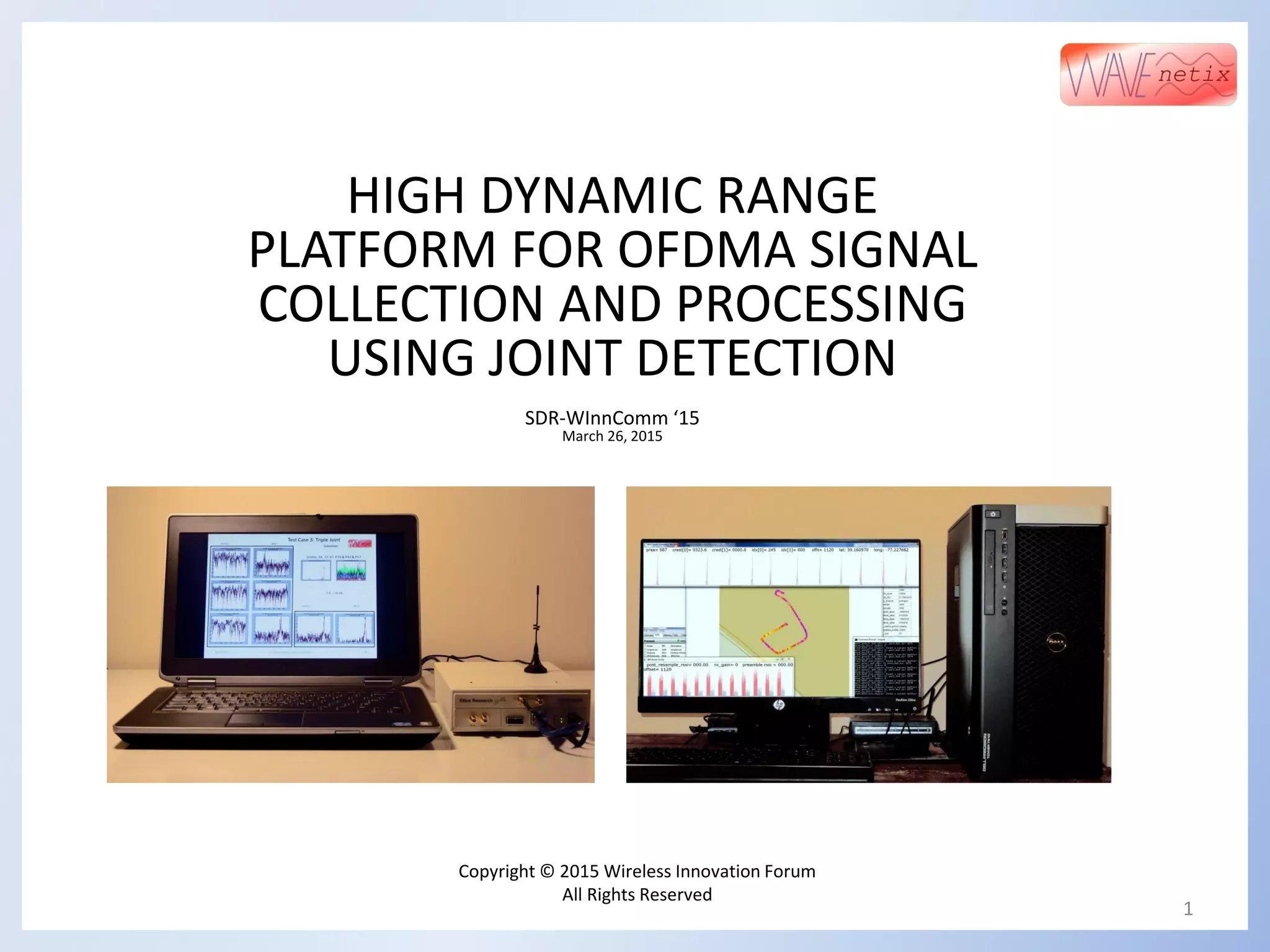
HIGH DYNAMIC RANGE
PLATFORM FOR OFDMA SIGNAL
COLLECTION AND PROCESSING
USING JOINT DETECTION
SDR-WInnComm ‘15
March 26, 2015
2
Contents
1. INTRODUCTION
2. SYSTEM DESCRIPTION
3. SOFTWARE ARCHITECTURE
4. SIGNAL PROCESSING ALGORITHMS
4.1 ACQ Mode
4.2 POST Mode
4.3 FFT class
5. JOINT SIGNAL DETECTION AND ITERATIVE INTERFERENCE
CANCELLATION
5.1. Co-channel interference mitigation in RF test receivers
5.2. Reference pattern cross-correlation as dynamic range-limiting factor
5.3. Parallel iterative interference cancellation
5.4. Serial iterative interference cancellation
6. PERFORMANCE TEST: SYNTHESIZED PREAMBLES
6.1 Two preambles; level difference at 12 dB
6.2 Two preambles; level difference at 20 dB
7. FIELD PERFORMANCE TESTS
7.1. Car not moving, suburban location
7.2. Complete drive-test; Longear used to collect and process signals
8. CONCLUSION
3
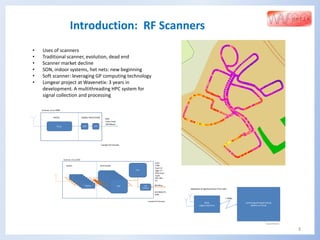
Introduction: RF Scanners
• Uses of scanners
• Traditional scanner, evolution, dead end
• Scanner market decline
• SON, indoor systems, het nets: new beginning
• Soft scanner: leveraging GP computing technology
• Longear project at Wavenetix: 3 years in
development. A multithreading HPC system for
signal collection and processing
4
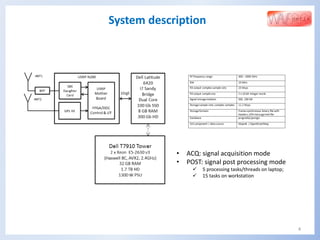
System description
• ACQ: signal acquisition mode
• POST: signal post processing mode
 5 processing tasks/threads on laptop;
 15 tasks on workstation
5
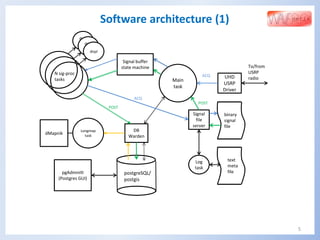
Software architecture (1)
postgreSQL/
postgis
dMapnik
Longmap
task
UHD
USRP
Driver
Signal buffer
state machine
Main
task
Log
task
Signal
file
server
DB
Warden
binary
signal
file
text
meta
file
To/from
USRP
radio
displ
. displ
.
displ
pgAdminIII
(Postgres GUI)
N sig-proc
tasks
ACQ
ACQ
POST
POST
6
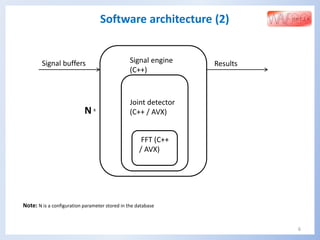
Software architecture (2)
Signal engine
(C++)
Joint detector
(C++ / AVX)
FFT (C++
/ AVX)
Signal buffers Results
N x
Note: N is a configuration parameter stored in the database
7
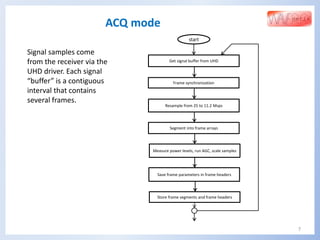
ACQ mode
Signal samples come
from the receiver via the
UHD driver. Each signal
“buffer” is a contiguous
interval that contains
several frames.
Segment into frame arrays
Measure power levels, run AGC, scale samples
Resample from 25 to 11.2 Msps
start
Save frame parameters in frame headers
Store frame segments and frame headers
Get signal buffer from UHD
Frame synchronization
8
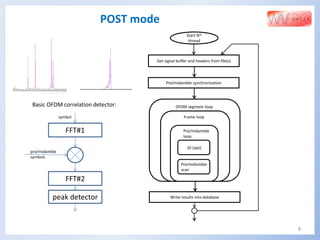
POST mode
Start Nth
thread
Write results into database
Get signal buffer and headers from file(s)
Pre/midamble synchronization
OFDM segment loop
Frame loop
Pre/midamble
loop
JD (opt)
Pre/midamble
scan
Basic OFDM correlation detector:
FFT#1
FFT#2
pre/midamble
symbols
peak detector
symbol
9
FFT class
Advantages of implementing FFT as a class:
• An instance of FFT in a sig-proc thread gets its static memory independent
of other threads.
• Static arrays for storing signals make function calls more efficient; memory
use is not of concern.
• An example of beneficial use of static storage is storing a LUT for bit
reversal operation as a member of this class. It is generated during object
initialization.
FFT optimization steps:
• Started with the classic “Numerical Recipes” code (Lanczos-Daniels
algorithm).
• Unrolled first and last loop iterations.
• Tailored code to specific FFT size.
• Treated std::complex<float> arrays as pairs of interleaved real numbers by
using C pointers.
• The code uses Intel AVX intrinsics throughout. Each operation typically
involves eight floats. This lets the code do two butterflies in one iteration.
• Use of a look-up table for bit reversal step.
10
ITERATIVE INTERFERENCE CANCELLATION(1)
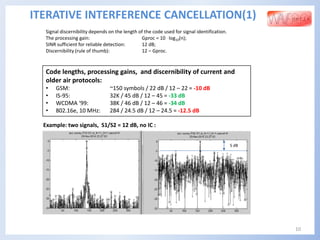
Signal discernibility depends on the length of the code used for signal identification.
The processing gain: Gproc = 10 . log10(n);
SINR sufficient for reliable detection: 12 dB;
Discernibility (rule of thumb): 12 – Gproc.
Code lengths, processing gains, and discernibility of current and
older air protocols:
• GSM: ~150 symbols / 22 dB / 12 – 22 = -10 dB
• IS-95: 32K / 45 dB / 12 – 45 = -33 dB
• WCDMA ‘99: 38K / 46 dB / 12 – 46 = -34 dB
• 802.16e, 10 MHz: 284 / 24.5 dB / 12 – 24.5 = -12.5 dB
Example: two signals, S1/S2 = 12 dB, no IC :
5 dB
11
ITERATIVE INTERFERENCE CANCELLATION(2)
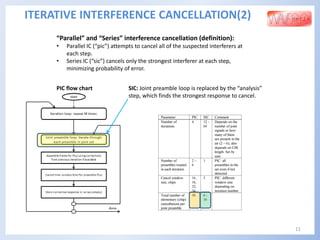
“Parallel” and “Series” interference cancellation (definition):
• Parallel IC (“pic”) attempts to cancel all of the suspected interferers at
each step.
• Series IC (“sic”) cancels only the strongest interferer at each step,
minimizing probability of error.
PIC flow chart SIC: Joint preamble loop is replaced by the “analysis”
step, which finds the strongest response to cancel.
12
ITERATIVE INTERFERENCE CANCELLATION(3)
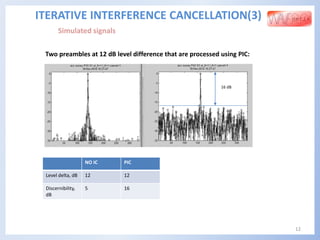
Two preambles at 12 dB level difference that are processed using PIC:
16 dB
Simulated signals
NO IC PIC
Level delta, dB 12 12
Discernibility,
dB
5 16
13
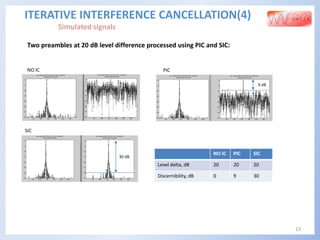
ITERATIVE INTERFERENCE CANCELLATION(4)
Two preambles at 20 dB level difference processed using PIC and SIC:
Simulated signals
NO IC PIC SIC
Level delta, dB 20 20 20
Discernibility, dB 0 9 30
NO IC PIC
9 dB
SIC
30 dB
14
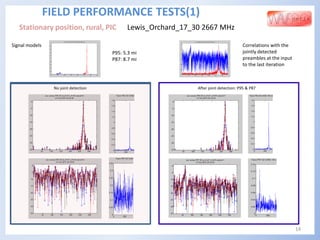
FIELD PERFORMANCE TESTS(1)
Stationary position, rural, PIC Lewis_Orchard_17_30 2667 MHz
Signal models Correlations with the
jointly detected
preambles at the input
to the last iteration
No joint detection After joint detection: P95 & P87
P95: 5.3 mi
P87: 8.7 mi
15
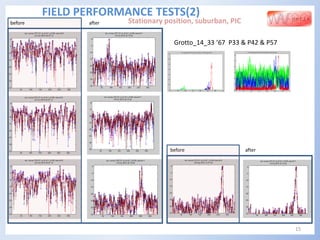
FIELD PERFORMANCE TESTS(2)
Stationary position, suburban, PIC
Grotto_14_33 ’67 P33 & P42 & P57
before after
before after
16
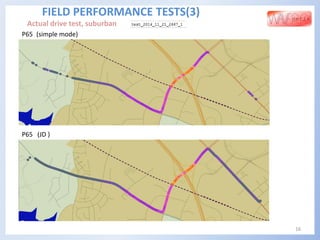
FIELD PERFORMANCE TESTS(3)
Actual drive test, suburban
(simple mode)P65
P65 (JD )
17
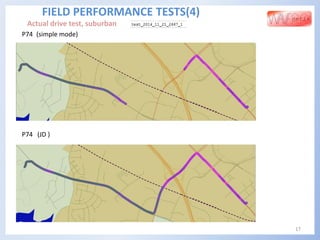
FIELD PERFORMANCE TESTS(4)
Actual drive test, suburban
(simple mode)P74
P74 (JD )
18
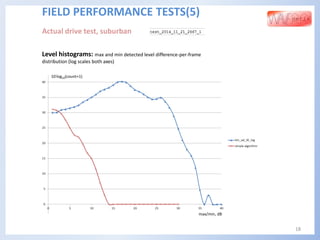
FIELD PERFORMANCE TESTS(5)
Actual drive test, suburban
Level histograms: max and min detected level difference-per-frame
distribution (log scales both axes)
max/min, dB
10.log10(count+1)
Wavenetix is a private T&M company
Wavenetix offers technologies and services for wireless testing and is looking for
partnerships
Incorporated July 2010
Headquartered in Virginia
Products and services: systems and tools for the measurement and modeling of 4G
wireless wideband MIMO propagation channels, e.g. WCDMA, WiMAX, TD-SCDMA, LTE, LTE-
A, TD-LTE
Targeted markets:
Device and network test and test equipment providers
Wireless operators and network providers
19
CONCLUSION
Thank you!
Q & A

DickeyS_presentation_2015_3_26_2_1

  • 1.
    1 Copyright © 2015Wireless Innovation Forum All Rights Reserved HIGH DYNAMIC RANGE PLATFORM FOR OFDMA SIGNAL COLLECTION AND PROCESSING USING JOINT DETECTION SDR-WInnComm ‘15 March 26, 2015
  • 2.
    2 Contents 1. INTRODUCTION 2. SYSTEMDESCRIPTION 3. SOFTWARE ARCHITECTURE 4. SIGNAL PROCESSING ALGORITHMS 4.1 ACQ Mode 4.2 POST Mode 4.3 FFT class 5. JOINT SIGNAL DETECTION AND ITERATIVE INTERFERENCE CANCELLATION 5.1. Co-channel interference mitigation in RF test receivers 5.2. Reference pattern cross-correlation as dynamic range-limiting factor 5.3. Parallel iterative interference cancellation 5.4. Serial iterative interference cancellation 6. PERFORMANCE TEST: SYNTHESIZED PREAMBLES 6.1 Two preambles; level difference at 12 dB 6.2 Two preambles; level difference at 20 dB 7. FIELD PERFORMANCE TESTS 7.1. Car not moving, suburban location 7.2. Complete drive-test; Longear used to collect and process signals 8. CONCLUSION
  • 3.
    3 Introduction: RF Scanners •Uses of scanners • Traditional scanner, evolution, dead end • Scanner market decline • SON, indoor systems, het nets: new beginning • Soft scanner: leveraging GP computing technology • Longear project at Wavenetix: 3 years in development. A multithreading HPC system for signal collection and processing
  • 4.
    4 System description • ACQ:signal acquisition mode • POST: signal post processing mode  5 processing tasks/threads on laptop;  15 tasks on workstation
  • 5.
    5 Software architecture (1) postgreSQL/ postgis dMapnik Longmap task UHD USRP Driver Signalbuffer state machine Main task Log task Signal file server DB Warden binary signal file text meta file To/from USRP radio displ . displ . displ pgAdminIII (Postgres GUI) N sig-proc tasks ACQ ACQ POST POST
  • 6.
    6 Software architecture (2) Signalengine (C++) Joint detector (C++ / AVX) FFT (C++ / AVX) Signal buffers Results N x Note: N is a configuration parameter stored in the database
  • 7.
    7 ACQ mode Signal samplescome from the receiver via the UHD driver. Each signal “buffer” is a contiguous interval that contains several frames. Segment into frame arrays Measure power levels, run AGC, scale samples Resample from 25 to 11.2 Msps start Save frame parameters in frame headers Store frame segments and frame headers Get signal buffer from UHD Frame synchronization
  • 8.
    8 POST mode Start Nth thread Writeresults into database Get signal buffer and headers from file(s) Pre/midamble synchronization OFDM segment loop Frame loop Pre/midamble loop JD (opt) Pre/midamble scan Basic OFDM correlation detector: FFT#1 FFT#2 pre/midamble symbols peak detector symbol
  • 9.
    9 FFT class Advantages ofimplementing FFT as a class: • An instance of FFT in a sig-proc thread gets its static memory independent of other threads. • Static arrays for storing signals make function calls more efficient; memory use is not of concern. • An example of beneficial use of static storage is storing a LUT for bit reversal operation as a member of this class. It is generated during object initialization. FFT optimization steps: • Started with the classic “Numerical Recipes” code (Lanczos-Daniels algorithm). • Unrolled first and last loop iterations. • Tailored code to specific FFT size. • Treated std::complex<float> arrays as pairs of interleaved real numbers by using C pointers. • The code uses Intel AVX intrinsics throughout. Each operation typically involves eight floats. This lets the code do two butterflies in one iteration. • Use of a look-up table for bit reversal step.
  • 10.
    10 ITERATIVE INTERFERENCE CANCELLATION(1) Signaldiscernibility depends on the length of the code used for signal identification. The processing gain: Gproc = 10 . log10(n); SINR sufficient for reliable detection: 12 dB; Discernibility (rule of thumb): 12 – Gproc. Code lengths, processing gains, and discernibility of current and older air protocols: • GSM: ~150 symbols / 22 dB / 12 – 22 = -10 dB • IS-95: 32K / 45 dB / 12 – 45 = -33 dB • WCDMA ‘99: 38K / 46 dB / 12 – 46 = -34 dB • 802.16e, 10 MHz: 284 / 24.5 dB / 12 – 24.5 = -12.5 dB Example: two signals, S1/S2 = 12 dB, no IC : 5 dB
  • 11.
    11 ITERATIVE INTERFERENCE CANCELLATION(2) “Parallel”and “Series” interference cancellation (definition): • Parallel IC (“pic”) attempts to cancel all of the suspected interferers at each step. • Series IC (“sic”) cancels only the strongest interferer at each step, minimizing probability of error. PIC flow chart SIC: Joint preamble loop is replaced by the “analysis” step, which finds the strongest response to cancel.
  • 12.
    12 ITERATIVE INTERFERENCE CANCELLATION(3) Twopreambles at 12 dB level difference that are processed using PIC: 16 dB Simulated signals NO IC PIC Level delta, dB 12 12 Discernibility, dB 5 16
  • 13.
    13 ITERATIVE INTERFERENCE CANCELLATION(4) Twopreambles at 20 dB level difference processed using PIC and SIC: Simulated signals NO IC PIC SIC Level delta, dB 20 20 20 Discernibility, dB 0 9 30 NO IC PIC 9 dB SIC 30 dB
  • 14.
    14 FIELD PERFORMANCE TESTS(1) Stationaryposition, rural, PIC Lewis_Orchard_17_30 2667 MHz Signal models Correlations with the jointly detected preambles at the input to the last iteration No joint detection After joint detection: P95 & P87 P95: 5.3 mi P87: 8.7 mi
  • 15.
    15 FIELD PERFORMANCE TESTS(2) Stationaryposition, suburban, PIC Grotto_14_33 ’67 P33 & P42 & P57 before after before after
  • 16.
    16 FIELD PERFORMANCE TESTS(3) Actualdrive test, suburban (simple mode)P65 P65 (JD )
  • 17.
    17 FIELD PERFORMANCE TESTS(4) Actualdrive test, suburban (simple mode)P74 P74 (JD )
  • 18.
    18 FIELD PERFORMANCE TESTS(5) Actualdrive test, suburban Level histograms: max and min detected level difference-per-frame distribution (log scales both axes) max/min, dB 10.log10(count+1)
  • 19.
    Wavenetix is aprivate T&M company Wavenetix offers technologies and services for wireless testing and is looking for partnerships Incorporated July 2010 Headquartered in Virginia Products and services: systems and tools for the measurement and modeling of 4G wireless wideband MIMO propagation channels, e.g. WCDMA, WiMAX, TD-SCDMA, LTE, LTE- A, TD-LTE Targeted markets: Device and network test and test equipment providers Wireless operators and network providers 19 CONCLUSION Thank you! Q & A