The Telecommunications TIG

     Prof. Mary Ann Ingram
        March 30, 2004
Overview
   Define Digital Telecomunication
    Networks
   Curriculum
   Research Examples
   Conclusion
Analog vs. Digital
   Information, such as voice, can be
    converted into a continuously varying
    analog voltage, using a microphone for
    example, and be transmitted
       
           How telephones and cell phones used to
           operate
   Alternatively, the analog information can
    be quantized, and transmitted using
    digital modulation
Digital Communications
   At any particular time, only one of a few
    waveform choices are transmitted
   A noisy version of the waveform is
    received
   The receiver compares the noisy
    waveform to the clean ones it has
    stored and decides on the clean one
    that has the closest match
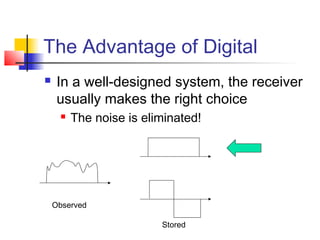
The Advantage of Digital
    In a well-designed system, the receiver
     usually makes the right choice
        The noise is eliminated!


    Observed

                         Stored
A Pervasive Technology
   Cellular Telephone
   Satellite Broadcasting
   Digital Subscriber Line
   Cable
   Wireless Local Area Networks
   Internet
   CDs and DVDs
At Georgia Tech…
   We focus on digital communications in
    the Telecommunications Technical
    Interest Group (TIG)
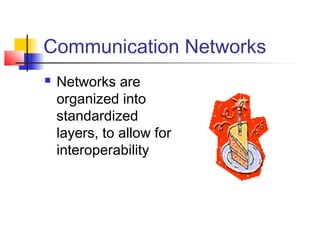
Communication Networks
   Networks are
    organized into
    standardized
    layers, to allow for
    interoperability
7-Layer OSI (International Organ-
    ization for Standardization) Model
                  Responsibilities
Layer 
1. Physical       Basic hardware components for networks.
                  i.e. RS-232 specification

2. Data Link      Frame format, Transmitting frames over the net.
                  i.e. bit/byte stuffing, checksum


3. Network        Address assignment, Packet's forwarding methods

4. Transport      Transfer correctness
5. Session        Establishing a communication session, Security, Authentication
                  i.e. passwords

6. Presentation   Computers represent data in different ways (char, integer) thus the
                  protocol need to translate the data to and from the local node.

7. Application    Specifications for applications using the network, how to send a
                  request, how to specify a filename over the net, how to respond to a
                  request etc..
Packets
    Each layer contains packets
    The payload on one layer is the payload &
     header from the previous layer

         Header     Payload         layer i


Header            Payload          layer i+1
Protocols
   A protocol is a set of rules for operation
    at a given layer
   Generally, a protocol operates only on
    the header and is indifferent to the
    payload

                      ??
Overview
   Define Digital Telecomunication
    Networks
   Curriculum
   Research Examples
   Conclusion
UG Elective Courses
   PHY
       ECE 4601, Communications Systems
       ECE 4602, Communications Systems Lab
   NET
       ECE 4604, Networking Design and Simulation
       ECE 4894 Advanced Internetworking
       ECE 4823 Wireless Communications
       ECE 4823 Intro to Wireless and Mobile
        Networking
Telecom Grad Courses -PHY
   ECE 6601 - Random Processes
   ECE 6602 - Digital Communications
   ECE 6603 - Advanced Digital
    Communications
   ECE 6604 - Personal and Mobile
    Communications
   ECE 6605 - Information Theory
   ECE 6606 - Coding Theory and Applications
   Hybrid Fiber-Coax Communication Systems
   Space-Time Processing for Communication
Telecom Grad Courses -NET
   ECE 6607 - Computer Communication Networks
   ECE 6608 - Performance Analysis of Comm
    Networks
   ECE 6609 - ATM Networks
   ECE 6610 - Wireless Networks
   ECE 7611 - Advanced Communication Theory
   Computer Network Security
   Multimedia Communication
   Cryptography: Theory and Practice
Overview
   Define Digital Telecomunication
    Networks
   Curriculum
   Research Examples
   Conclusion
Research Examples
   CD and DVD optical recording
   Ground stations for low earth orbit
    (LEO) satellites
   High-speed wireless prototype
Binary and Nonbinary optical
   recording
• Increased storage capacity of CD and DVD
        - from theory to commercialization
• Binary and M-ary in optical recording
• Much of the technology developed in Prof. McLaughlin’s group
        Signal from                           M-ary CD, DVD
      Binary CD, DVD


 CD and DVD:
                                      Our system:
 Information encoded in transitions
                                      Information encoded in amplitude
     Jan 25, 2013                                          18
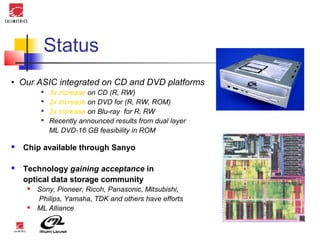
Status
• Our ASIC integrated on CD and DVD platforms
            3x increase on CD (R, RW)
            2x increase on DVD for (R, RW, ROM)
            2x increase on Blu-ray for R, RW
            Recently announced results from dual layer
             ML DVD-16 GB feasibility in ROM

   Chip available through Sanyo

   Technology gaining acceptance in
    optical data storage community
       Sony, Pioneer, Ricoh, Panasonic, Mitsubishi,
        Philips, Yamaha, TDK and others have efforts
       ML Alliance
Satellite Communications with
Adaptive and Phased Array
Antennas
Problem with Current Ground
    Stations for LEOs
   11m Dish – System
    costs $ 2- 4 million
   Single satellites         Single-Line
   Satellite tracking        of Site
    cumbersome                (LOS)-path
    (mechanical)              signal
   Avoidance of other
    signals good (thin main
    lobe)
   Located near poles
   Staff of 8
Adaptive Array Ground Station
   Smaller phased
    array elements low
    on cost curve
   Located anywhere
   No staff
   Electronically
    steered
         0100111001010   Adaptive
         1011000110101   Processor
Georgia Tech:Successful Smart Antenna Tests
         at Georgia Tech 11-19-03 and 11-25-03
                                        System noise floor
                                                       Analyzer noise floor


                                                                              Sirius and XM Radio
                                                                              interference,
                                                                              1,000,000 times
                                                                              stronger than EO-1
                                                                              signal.

1. Prior to the pass: antenna with
cement blocks to prevent it from
blowing over. Atlanta skyline in the
background. The antenna had a                                           In test 1, 11-19-03:
significant vertical wobble (ground                                     EO-1 spectrum
plane) due to wind.                                                     detected on analyzer

2. Students observing EO-1 signal
spectrum.                                                               In test 2, 11-25-03:

3. Prior to pass, checking spectra of                                   EO-1 signal digitized,
know interference.                                                      fast fourier transform
                                                                        performed and EO-1
                                                                        spectrum observed
4. Detected EO-1 spectrum during
                                                                        on computer screen.
pass
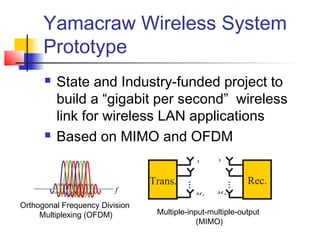
Yamacraw Wireless System
      Prototype
         State and Industry-funded project to
          build a “gigabit per second” wireless
          link for wireless LAN applications
         Based on MIMO and OFDM
                                             1    1


                                Trans.                   Rec.
                         f                   MT   MR


Orthogonal Frequency Division
     Multiplexing (OFDM)         Multiple-input-multiple-output
                                             (MIMO)
Yamacraw Network Testbed

                     MAC Capture                                              MAC Capture
                         PC                         Wireless                      PC
                                                    channels
                                       array                    array

End Host                                                                                            End Host
                                FPDP                                        FPDP


Transport   Ethernet Local Client       Software                Software                    Ethernet Transport
 Protocol                PC            radio cage              radio cage                             Protocol
Physical Layer Architecture
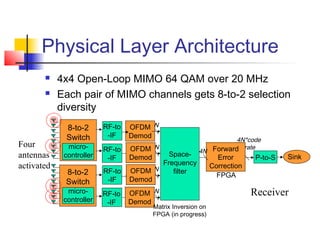
           4x4 Open-Loop MIMO 64 QAM over 20 MHz
           Each pair of MIMO channels gets 8-to-2 selection
            diversity
              8-to-2      RF-to   OFDM N
              Switch       -IF    Demod
                                                                     4N*code
Four          micro-              OFDM N                      Forward rate
                          RF-to
antennas     controller           Demod    Space- 4N   Error              P-to-S   Sink
                           -IF
activated                                Frequency   Correction
             8-to-2       RF-to   OFDM N    filter
                                                       FPGA
             Switch        -IF    Demod
              micro-      RF-to   OFDM N                                 Receiver
             controller    -IF    Demod
                                        Matrix Inversion on
                                        FPGA (in progress)
PEAK DATA RATES
CURRENT OFFLINE PROCESSING:
  25 MHz*(200/256) subcarriers * 6 bits/symbol * 4
  channels = 468 Mb/s

 GOAL AT END OF PROJECT (Upper Limit)
50 MHz*(200/256) subcarriers * 6 bits/symbol * 4
  channels = 937 Mb/s
*Actual real-time implementation speed will depend on processing and
  hardware limitations
MIMO OFDM Wireless Tests
  OFDM Waveform
                                 Waveform:
                                 25 Ms/s (Goal is 40 –50 Ms/s),
                                 4x4 MIMO, 64-QAM


     Channel Estimates (1 x 4)          Constellation
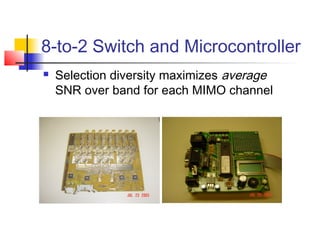
8-to-2 Switch and Microcontroller
   Selection diversity maximizes average
    SNR over band for each MIMO channel
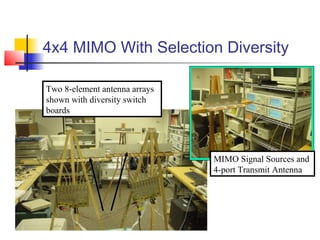
4x4 MIMO With Selection Diversity

Two 8-element antenna arrays
shown with diversity switch
boards


                               MIMO Signal Sources and
                               4-port Transmit Antenna
Subcarrier Allocation MAC
                        Protocol
State for guaranteed
and controlled-load                                          in frame mapping subframe Construct resource
services                                                                                  mapping table
                                                                    in downlink control
                                                                    subframe                    Piggybacked
                              State for all services                                            transmission
                                                                                                               Dynamic resource
    Admission                                                                                   request        allocation
    request            Transmission New         Packets to be
                       request        packets retransmitted                                                    Optimum subcarrier    Admission
                                                                                                               bit-allocation        control
                            Piggyback
                                                                                                Received              Transmission     Admission
                                                                                                packets               request          request
           in uplink                     in subframes
                                                          time slots                      Yes
           control                       for services
           subframe                                       bits per                                    No                                     time slots
                                                          subcarrier             Need ARQ ?                     What request ?
                                                                                                                                             bits per
                                                            power                                                                            subcarrier
                                                        allocated resources                                                                    power
      Transmit packets according                                                     Receive packets according                            allocated resources
      to the resource allocation results                                             to the resource allocation results


                Physical layer                                                                   Physical layer

           Mobile Terminal Side                                                                 Base Station Side
Reliable Transport Protocal with
          Guaranteed Services
                                                                                   TCP-G
   GTCP has been                               Connection request      Transmit        Connection

    implemented in user                         (fid, bandwidth)             (data)     tear-down
                                                                                        complete(fid)

    level both on Linux and
    Windows platforms                                            Connection Connection tear-
                                                                 admitted(fid) down request(fid)

   GTCP interaction with                  Connection request
                                           (bandwidth, conn_id)

    MAC defined using a              CAC Connection tear-
                                            down
                                                                          MAC
    set of interfaces,
                                            request(conn_id)


    shown:=>                 APPLIC PC    SRT                     SRT               APPLIC PC
                               APPLIC                                                 APPLIC
   GTCP-software radio        GTCP
                                           PCAP                    PCAP
                                                                                      GTCP
    integration plan:=>     RAW SOCKETS
                                        ETH MAC                MAC ETH
                                                                                  RAW SOCKETS
                                            ETHERNET                                      ETHERNET
                                                          PHY1 PHY2           PHY2 PHY1
                                              PHY1                                          PHY1
                                                           SRT: Software Radio Test-bed
Overview
   Define Digital Telecomunication
    Networks
   Curriculum
   Research Examples
   Conclusion
Conclusions
   Telecommunication technology is
    everywhere in our lives
   Many courses on UG and GRAD levels
   Active and exciting research area

Telecommunications Concentration

  • 1.
    The Telecommunications TIG Prof. Mary Ann Ingram March 30, 2004
  • 2.
    Overview  Define Digital Telecomunication Networks  Curriculum  Research Examples  Conclusion
  • 3.
    Analog vs. Digital  Information, such as voice, can be converted into a continuously varying analog voltage, using a microphone for example, and be transmitted  How telephones and cell phones used to operate  Alternatively, the analog information can be quantized, and transmitted using digital modulation
  • 4.
    Digital Communications  At any particular time, only one of a few waveform choices are transmitted  A noisy version of the waveform is received  The receiver compares the noisy waveform to the clean ones it has stored and decides on the clean one that has the closest match
  • 5.
    The Advantage ofDigital  In a well-designed system, the receiver usually makes the right choice  The noise is eliminated! Observed Stored
  • 6.
    A Pervasive Technology  Cellular Telephone  Satellite Broadcasting  Digital Subscriber Line  Cable  Wireless Local Area Networks  Internet  CDs and DVDs
  • 7.
    At Georgia Tech…  We focus on digital communications in the Telecommunications Technical Interest Group (TIG)
  • 8.
    Communication Networks  Networks are organized into standardized layers, to allow for interoperability
  • 9.
    7-Layer OSI (InternationalOrgan- ization for Standardization) Model Responsibilities Layer  1. Physical Basic hardware components for networks. i.e. RS-232 specification 2. Data Link Frame format, Transmitting frames over the net. i.e. bit/byte stuffing, checksum 3. Network Address assignment, Packet's forwarding methods 4. Transport Transfer correctness 5. Session Establishing a communication session, Security, Authentication i.e. passwords 6. Presentation Computers represent data in different ways (char, integer) thus the protocol need to translate the data to and from the local node. 7. Application Specifications for applications using the network, how to send a request, how to specify a filename over the net, how to respond to a request etc..
  • 10.
    Packets  Each layer contains packets  The payload on one layer is the payload & header from the previous layer Header Payload layer i Header Payload layer i+1
  • 11.
    Protocols  A protocol is a set of rules for operation at a given layer  Generally, a protocol operates only on the header and is indifferent to the payload ??
  • 12.
    Overview  Define Digital Telecomunication Networks  Curriculum  Research Examples  Conclusion
  • 13.
    UG Elective Courses  PHY  ECE 4601, Communications Systems  ECE 4602, Communications Systems Lab  NET  ECE 4604, Networking Design and Simulation  ECE 4894 Advanced Internetworking  ECE 4823 Wireless Communications  ECE 4823 Intro to Wireless and Mobile Networking
  • 14.
    Telecom Grad Courses-PHY  ECE 6601 - Random Processes  ECE 6602 - Digital Communications  ECE 6603 - Advanced Digital Communications  ECE 6604 - Personal and Mobile Communications  ECE 6605 - Information Theory  ECE 6606 - Coding Theory and Applications  Hybrid Fiber-Coax Communication Systems  Space-Time Processing for Communication
  • 15.
    Telecom Grad Courses-NET  ECE 6607 - Computer Communication Networks  ECE 6608 - Performance Analysis of Comm Networks  ECE 6609 - ATM Networks  ECE 6610 - Wireless Networks  ECE 7611 - Advanced Communication Theory  Computer Network Security  Multimedia Communication  Cryptography: Theory and Practice
  • 16.
    Overview  Define Digital Telecomunication Networks  Curriculum  Research Examples  Conclusion
  • 17.
    Research Examples  CD and DVD optical recording  Ground stations for low earth orbit (LEO) satellites  High-speed wireless prototype
  • 18.
    Binary and Nonbinaryoptical recording • Increased storage capacity of CD and DVD - from theory to commercialization • Binary and M-ary in optical recording • Much of the technology developed in Prof. McLaughlin’s group Signal from M-ary CD, DVD Binary CD, DVD CD and DVD: Our system: Information encoded in transitions Information encoded in amplitude Jan 25, 2013 18
  • 19.
    Status • Our ASICintegrated on CD and DVD platforms  3x increase on CD (R, RW)  2x increase on DVD for (R, RW, ROM)  2x increase on Blu-ray for R, RW  Recently announced results from dual layer ML DVD-16 GB feasibility in ROM  Chip available through Sanyo  Technology gaining acceptance in optical data storage community  Sony, Pioneer, Ricoh, Panasonic, Mitsubishi, Philips, Yamaha, TDK and others have efforts  ML Alliance
  • 20.
    Satellite Communications with Adaptiveand Phased Array Antennas
  • 21.
    Problem with CurrentGround Stations for LEOs  11m Dish – System costs $ 2- 4 million  Single satellites Single-Line  Satellite tracking of Site cumbersome (LOS)-path (mechanical) signal  Avoidance of other signals good (thin main lobe)  Located near poles  Staff of 8
  • 22.
    Adaptive Array GroundStation  Smaller phased array elements low on cost curve  Located anywhere  No staff  Electronically steered 0100111001010 Adaptive 1011000110101 Processor
  • 24.
    Georgia Tech:Successful SmartAntenna Tests at Georgia Tech 11-19-03 and 11-25-03 System noise floor Analyzer noise floor Sirius and XM Radio interference, 1,000,000 times stronger than EO-1 signal. 1. Prior to the pass: antenna with cement blocks to prevent it from blowing over. Atlanta skyline in the background. The antenna had a In test 1, 11-19-03: significant vertical wobble (ground EO-1 spectrum plane) due to wind. detected on analyzer 2. Students observing EO-1 signal spectrum. In test 2, 11-25-03: 3. Prior to pass, checking spectra of EO-1 signal digitized, know interference. fast fourier transform performed and EO-1 spectrum observed 4. Detected EO-1 spectrum during on computer screen. pass
  • 25.
    Yamacraw Wireless System Prototype  State and Industry-funded project to build a “gigabit per second” wireless link for wireless LAN applications  Based on MIMO and OFDM 1 1 Trans.   Rec. f MT MR Orthogonal Frequency Division Multiplexing (OFDM) Multiple-input-multiple-output (MIMO)
  • 26.
    Yamacraw Network Testbed MAC Capture MAC Capture PC Wireless PC channels array array End Host End Host FPDP FPDP Transport Ethernet Local Client Software Software Ethernet Transport Protocol PC radio cage radio cage Protocol
  • 27.
    Physical Layer Architecture  4x4 Open-Loop MIMO 64 QAM over 20 MHz  Each pair of MIMO channels gets 8-to-2 selection diversity 8-to-2 RF-to OFDM N Switch -IF Demod 4N*code Four micro- OFDM N Forward rate RF-to antennas controller Demod Space- 4N Error P-to-S Sink -IF activated Frequency Correction 8-to-2 RF-to OFDM N filter FPGA Switch -IF Demod micro- RF-to OFDM N Receiver controller -IF Demod Matrix Inversion on FPGA (in progress)
  • 28.
    PEAK DATA RATES CURRENTOFFLINE PROCESSING: 25 MHz*(200/256) subcarriers * 6 bits/symbol * 4 channels = 468 Mb/s GOAL AT END OF PROJECT (Upper Limit) 50 MHz*(200/256) subcarriers * 6 bits/symbol * 4 channels = 937 Mb/s *Actual real-time implementation speed will depend on processing and hardware limitations
  • 29.
    MIMO OFDM WirelessTests OFDM Waveform Waveform: 25 Ms/s (Goal is 40 –50 Ms/s), 4x4 MIMO, 64-QAM Channel Estimates (1 x 4) Constellation
  • 30.
    8-to-2 Switch andMicrocontroller  Selection diversity maximizes average SNR over band for each MIMO channel
  • 31.
    4x4 MIMO WithSelection Diversity Two 8-element antenna arrays shown with diversity switch boards MIMO Signal Sources and 4-port Transmit Antenna
  • 32.
    Subcarrier Allocation MAC Protocol State for guaranteed and controlled-load in frame mapping subframe Construct resource services mapping table in downlink control subframe Piggybacked State for all services transmission Dynamic resource Admission request allocation request Transmission New Packets to be request packets retransmitted Optimum subcarrier Admission bit-allocation control Piggyback Received Transmission Admission packets request request in uplink in subframes time slots Yes control for services subframe bits per No time slots subcarrier Need ARQ ? What request ? bits per power subcarrier allocated resources power Transmit packets according Receive packets according allocated resources to the resource allocation results to the resource allocation results Physical layer Physical layer Mobile Terminal Side Base Station Side
  • 33.
    Reliable Transport Protocalwith Guaranteed Services TCP-G  GTCP has been Connection request Transmit Connection implemented in user (fid, bandwidth) (data) tear-down complete(fid) level both on Linux and Windows platforms Connection Connection tear- admitted(fid) down request(fid)  GTCP interaction with Connection request (bandwidth, conn_id) MAC defined using a CAC Connection tear- down MAC set of interfaces, request(conn_id) shown:=> APPLIC PC SRT SRT APPLIC PC APPLIC APPLIC  GTCP-software radio GTCP PCAP PCAP GTCP integration plan:=> RAW SOCKETS ETH MAC MAC ETH RAW SOCKETS ETHERNET ETHERNET PHY1 PHY2 PHY2 PHY1 PHY1 PHY1 SRT: Software Radio Test-bed
  • 34.
    Overview  Define Digital Telecomunication Networks  Curriculum  Research Examples  Conclusion
  • 35.
    Conclusions  Telecommunication technology is everywhere in our lives  Many courses on UG and GRAD levels  Active and exciting research area