Diarrhoea
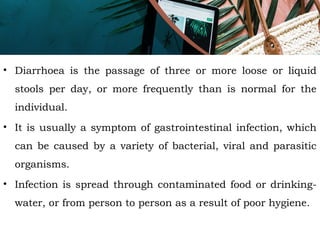
• Diarrhoea isthe passage
of stools with increased
frequency, fluidity or
volume compared to the
usual for a given
individual.
3.
• Diarrhoea isthe passage of three or more loose or liquid
stools per day, or more frequently than is normal for the
individual.
• It is usually a symptom of gastrointestinal infection, which
can be caused by a variety of bacterial, viral and parasitic
organisms.
• Infection is spread through contaminated food or drinking-
water, or from person to person as a result of poor hygiene.
4.
Types
• Diarrhoea canbe either acute (short-term) or chronic
(long-term).
• The acute form, which lasts less than 4 weeks, is usually
related to a bacterial, viral, or parasitic infection.
• Chronic diarrhoea lasts more than 4 weeks and is
usually related to functional disorders like irritable
bowel syndrome or inflammatory bowel diseases like
celiac disease.
6.
Causes of diarrhoea
•Diarrhoea may be caused by a temporary problem, like an infection, or
a chronic problem, like an intestinal disease. A few of the more
common causes of diarrhoea are
• Bacterial infections. Several types of bacteria, consumed through
contaminated food or water, can cause diarrhoea. Common culprits
include Campylobacter, Salmonella, Shigella, and Escherichia coli.
• Viral infections. Many viruses cause diarrhoea, including rotavirus,
Norwalk virus, cytomegalovirus, herpes simplex virus, and viral
hepatitis.
8.
• Food intolerances.Some people are unable to digest some component
of food, such as lactose, the sugar found in milk.
• Parasites. Parasites can enter the body through food or water and settle
in the digestive system. Parasites that cause diarrhoea include Giardia
lamblia, Entamoeba histolytica, and Cryptosporidium.
• Reaction to medicines, such as antibiotics, blood pressure
medications, and antacids containing magnesium.
• Intestinal diseases like inflammatory bowel disease or celiac disease.
• Functional bowel disorders, such as irritable bowel syndrome, in
which the intestines do not work normally.
10.
Symptoms of diarrhoea
•Diarrhoea may be accompanied by cramping
abdominal pain, bloating, nausea, or an urgent
need to use the bathroom.
• Depending on the cause, a person may have a
fever or bloody stools .
11.
• Severe diarrhoealeads to fluid loss, and may be
life-threatening, particularly in young children
and people who are malnourished or have
impaired immunity.
• Elderly persons are also at risk.
13.
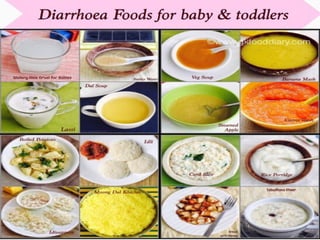
• Nutritional careincludes the replacement of lost
fluids and electrolytes by increasing the oral
intake of fluids, particularly those high in
sodium and potassium such as soups and juices.
• Diet must include mainly fluids like oral boiled
water containing electrolyte salts, i.e glucose and
sodium chloride.
14.
• Fluids shouldbe given frequently.
• Gradually fruit juices, butter milk, diluted milk
must be introduced.
• During treatment phase soft bland diet like milk
pudding, rice dhal gruel etc. can be started.
• Oral rehydration solution must be given which
fulfills the nutritional and electrolyte balance.
17.
• Oral RehydrationSolution (ORS) is given which is
made by mixing one glass of boiled cooled water
with one pinch of salt and one teaspoon of sugar.
• When the diarrhoea stops, starchy foods like rice,
potato and plain cereals can be given followed by
protein foods.
• Fat need not be limited if the individual is otherwise
healthy.
20.
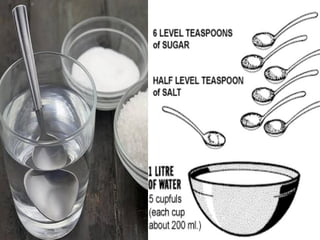
• Oral RehydrationSolution
• Home Made ORS recipe - The “simple solution” Preparing.
• One (1) Litre Oral Rehydration Solution [ORS] using
Salt, Sugar and Water at Home.
• Ingredients
• Half (1/2) level teaspoon of Salt.
• Six (6) level teaspoons of Sugar.
• One (1) Litre of clean drinking or boiled water and then
cooled 5 cupfuls (each cup about 200 ml).
• Preparation Method: Stir the mixture till the salt and
sugar dissolve.
22.
Constipation
• Constipation isa condition resulting from insufficient frequency of
defecation, deficient quantity of stool or production of abnormally
hard and dry stools.
• The frequency of passage of stools varies from individual to
individual and from race to race.
• It is important to develop regular habits of defecation right from
childhood.
• However excessive parental concern over toilet training of the child
is not good as children often try to seek attention by not passing
stools!
23.
• Certain factorswhich could lead to constipation are
• Low intake of water: As the food passes through the
colon water is reabsorbed from it. If water intake is
already low, this causes the stools to become hard
and dry and difficult to evacuate.
• Excessive use of laxatives and certain
other drugs can eventually lead to constipation.
24.
• Loss ofmuscle tone of intestinal muscles, as in the elderly, can
also lead to constipation.
• Lack of sufficient physical exercise could lead to constipation
• A diet low in fibre leads to constipation emphasizing the need for
a high fibre diet.
• Fibre in the diet helps to absorb and hold water which makes
the stools soft and helps in their easy passage.
• Fibre also decreases the transit time through the intestines and
helps in easy defecation.
Classification
• Constipation refersto difficult or painful defecation with
less than 3 motions per week.
• The frequency of bowel movements varies among
individuals and is related to their personal habits. Both
daily elimination or evacuation once in two or three days
may be normal.
• Constipation may lead to malaise, headache, coated
tongue, foul breath and lack of appetite.
SPASTIC CONSTIPATION
• Aspasm in the intestines causes food to move in an irregular
manner. It is also very painful. The spasm may be caused by
irritation of the intestinal mucosa through excessive use of –
• Alcohol
• Tea/coffee
• Spices.
• Bran
• Laxatives
29.
• High strungand nervous people are affected by this type of constipation.
• Dietary fibre plays an important role in the prevention of constipation.
• Fibre has water absorption capacity which contributes to the bulk
forming laxative effect and influences the transit time of the food mass
through the digestive tract.
• Water held by fibre increase the volume of feces and softens the stools,
causing the colon muscles to contract and propel the food residue
quickly.
• Dietary fibre plays an important role in the prevention and treatment of
diverticular disease also.
30.
ATONIC CONSTIPATION
• Muscletone of the intestinal wall is reduced so that peristaltic
movements are impaired.
• As a result, food mass cannot move at a normal rate down the tract.
• Bacteria acts on the stagnated food, causing some of
the symptoms of constipation.
• Moreover the longer the food stays in the intestines, the more the
water absorbed.
• This make the stools dry and hard.
31.
Atonic constipation occursdue to
• A diet poor in fibre
• Insufficient intake of fluids
• Lack of physical exercise
• Illness
• Pregnancy etc
32.
Diet in Constipation
•Constipation is decreased frequency of passing
stools or complete retention of faeces.
• The diet should include foods rich in fibre content
like whole cereals, legumes and vegetables.
• Other foods such as fruits rich in fibre e.g. banana,
apple, guava etc. more of fluids should be
consumed in any form.





![• Oral Rehydration Solution
• Home Made ORS recipe - The “simple solution” Preparing.
• One (1) Litre Oral Rehydration Solution [ORS] using
Salt, Sugar and Water at Home.
• Ingredients
• Half (1/2) level teaspoon of Salt.
• Six (6) level teaspoons of Sugar.
• One (1) Litre of clean drinking or boiled water and then
cooled 5 cupfuls (each cup about 200 ml).
• Preparation Method: Stir the mixture till the salt and
sugar dissolve.](https://image.slidesharecdn.com/diarrhoeaconstipation-250324062625-90950738/85/Diarrhoea-Constipation-pptx-causes-20-320.jpg)