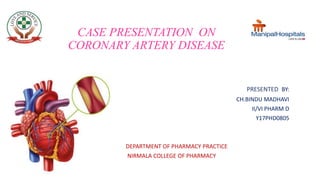
CASE PRESENTATION ON
CORONARY ARTERY DISEASE
PRESENTED BY:
CH.BINDU MADHAVI
II/VI PHARM D
Y17PHD0805
DEPARTMENT OF PHARMACY PRACTICE
NIRMALA COLLEGE OF PHARMACY
Brief summary about the case:
• A male patient of age 65 yrs was admitted in the hospital with the c/o
shortness of breath –grade II, palpitations, urinary frequency and is
having a past history of type 2 DM and he is diagnosed that he is
having mild CAD with triple vessel disease. followed by standard
treatment the patient was normalised.
• The above case was presented in the format of SOAP ANALYSIS.
Subjectiveevidence:
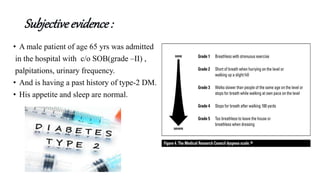
• A male patient of age 65 yrs was admitted
in the hospital with c/o SOB(grade –II) ,
palpitations, urinary frequency.
• And is having a past history of type-2 DM.
• His appetite and sleep are normal.
OBJECTIVEevidence:
• Physical examinations:
• BP-110/80 mm Hg R.R-18 cycles/min P.R-84 beats/min
• Pt : conscious
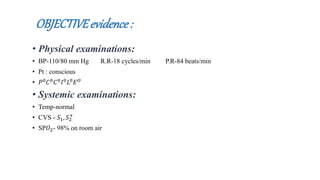
• 𝑃0 𝐶0 𝐶0 𝐼0 𝐿0 𝐸 𝑂
• Systemic examinations:
• Temp-normal
• CVS - 𝑆1, 𝑆2
+
• SP𝑂2- 98% on room air
Laboratoryinvestigations:
Haematology Abnormal values Normal values
Hb 12.7g/dl ( ) 14-18 gm /dl
Haematocrit (PCV) 40% ( ) 42-54%
Mean corpuscular
haemoglobin(MCH)
26.9pgm ( ) 27-31pgm
Red cell distribution width
(RDW)
15.6% ( ) 11.6-14%
Mean cell Hb conc
(MCHC)
31.8g/dl ( ) 32-37g/dl
Differential count Abnormal values Normal values
Neutrophils 77% ( ) 40-75%
Lymphocytes 18% ( ) 20-45%
• DIAGNOSTIC TEST :
• Coronary angiogram report:
n Impression:CAD mild [MCA + critical triple vessel disease]
Left anterior descending artery
Left Circumflex artery
Right coronary
artery
parameter profile Abnormal values Normal values
TSH 5.540 mic IU/ml ( ) 0.4 - 4 mic IU/ml
Assessment:
• Based on the subjective and objective data the final diagnosis was found to
be CAD(coronary artery disease)
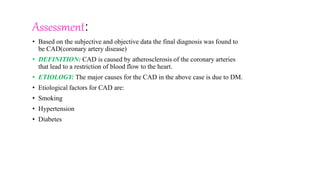
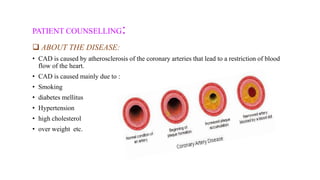
• DEFINITION: CAD is caused by atherosclerosis of the coronary arteries
that lead to a restriction of blood flow to the heart.
• ETIOLOGY: The major causes for the CAD in the above case is due to DM.
• Etiological factors for CAD are:
• Smoking
• Hypertension
• Diabetes
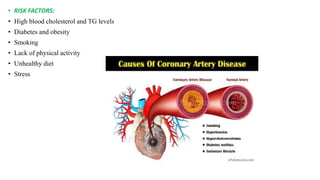
• RISK FACTORS:
• High blood cholesterol and TG levels
• Diabetes and obesity
• Smoking
• Lack of physical activity
• Unhealthy diet
• Stress
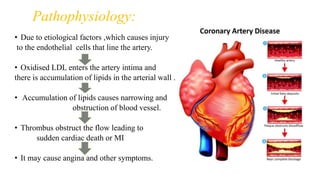
Pathophysiology:
• Due to etiological factors ,which causes injury
to the endothelial cells that line the artery.
• Oxidised LDL enters the artery intima and
there is accumulation of lipids in the arterial wall .
• Accumulation of lipids causes narrowing and
obstruction of blood vessel.
• Thrombus obstruct the flow leading to
sudden cardiac death or MI
• It may cause angina and other symptoms.
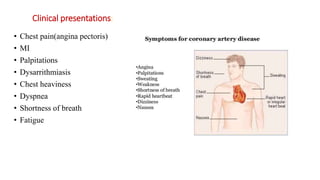
Clinical presentations:
• Chest pain(angina pectoris)
• MI
• Palpitations
• Dysarrithmiasis
• Chest heaviness
• Dyspnea
• Shortness of breath
• Fatigue
• STANDARD TREATMENT:
• PHARMACOLOGICAL THERAPY:
• Anti anginal medications like:
• Nitrates (ISD)
• β- adrenergic blockers(Atenolol)
• Calcium channel blockers (nefidipine)
• ACE inhibitors(captopril)
• Statins
• Imipramine for analgesia
• Diuretics
• SURGERY’S
• Coronary angioplasty
• Coronary artery bypass graft(CABG)
• Heart transplant
• Stents
Plan:
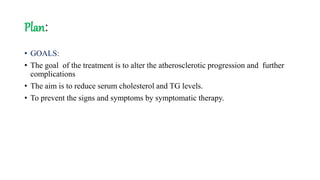
• GOALS:
• The goal of the treatment is to alter the atherosclerotic progression and further
complications
• The aim is to reduce serum cholesterol and TG levels.
• To prevent the signs and symptoms by symptomatic therapy.
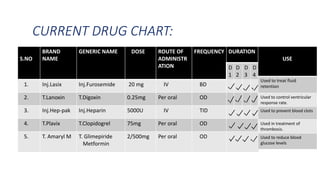
CURRENT DRUG CHART:
S.NO
BRAND
NAME
GENERIC NAME DOSE ROUTE OF
ADMINISTR
ATION
FREQUENCY DURATION
D
1
D
2
D
3
D
4
1. Inj.Lasix Inj.Furosemide 20 mg IV BD
2. T.Lanoxin T.Digoxin 0.25mg Per oral OD
3. Inj.Hep-pak Inj.Heparin 5000U IV TID
4. T.Plavix T.Clopidogrel 75mg Per oral OD
5. T. Amaryl M T. Glimepiride
Metformin
2/500mg Per oral OD
USE
Used to treat fluid
retention
Used to control ventricular
response rate.
Used to prevent blood clots
Used in treatment of
thrombosis.
Used to reduce blood
glucose levels
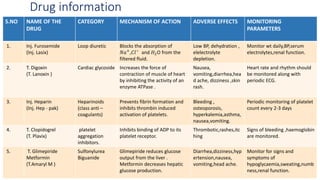
Drug information
S.NO NAME OF THE
DRUG
CATEGORY MECHANISM OF ACTION ADVERSE EFFECTS MONITORING
PARAMETERS
1. Inj. Furosemide
(Inj. Lasix)
Loop diuretic Blocks the absorption of
𝑁𝑎+
,𝐶𝑙−
and 𝐻2O from the
filtered fluid.
Low BP, dehydration ,
elelectrolyte
depletion.
Monitor wt daily,BP,serum
electrolytes,renal function.
2. T. Digoxin
(T. Lanoxin )
Cardiac glycoside Increases the force of
contraction of muscle of heart
by inhibiting the activity of an
enzyme ATPase .
Nausea,
vomiting,diarrhea,hea
d ache, dizziness ,skin
rash.
Heart rate and rhythm should
be monitored along with
periodic ECG.
3. Inj. Heparin
(Inj. Hep - pak)
Heparinoids
(class anti –
coagulants)
Prevents fibrin formation and
inhibits thrombin induced
activation of platelets.
Bleeding ,
osteoporosis,
hyperkalemia,asthma,
nausea,vomiting.
Periodic monitoring of platelet
count every 2-3 days
4. T. Clopidogrel
(T. Plavix)
platelet
aggregation
inhibitors.
Inhibits binding of ADP to its
platelet receptor.
Thrombotic,rashes,itc
hing
Signs of bleeding ,haemoglobin
are monitored.
5. T. Glimepiride
Metformin
(T.Amaryl M )
Sulfonylurea
Biguanide
Glimepiride reduces glucose
output from the liver .
Metformin decreases hepatic
glucose production.
Diarrhea,dizziness,hyp
ertension,nausea,
vomiting,head ache.
Monitor for signs and
symptoms of
hypoglycaemia,sweating,numb
ness,renal function.
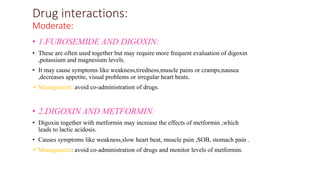
Drug interactions:
Moderate:
• 1.FUROSEMIDE AND DIGOXIN:
• These are often used together but may require more frequent evaluation of digoxin
,potassium and magnesium levels.
• It may cause symptoms like weakness,tiredness,muscle pains or cramps,nausea
,decreases appetite, visual problems or irregular heart beats.
 Management: avoid co-administration of drugs.
• 2.DIGOXIN AND METFORMIN:
• Digoxin together with metformin may increase the effects of metformin ,which
leads to lactic acidosis.
• Causes symptoms like weakness,slow heart beat, muscle pain ,SOB, stomach pain .
 Management: avoid co-administration of drugs and monitor levels of metformin.
• 3.FUROSEMIDE AND METFORMIN:
• Furosemide together with metformin may increase the effects of metformin, which
leads to life-threatening condition called lactic acidosis.
• It includes symptoms like weakness, increasing sleepiness, slow heart
rate,SOB,stomach pain.
Management: avoid co-administration of drugs and monitor levels of metformin.
• 4.FUROSEMIDE AND GLIMEPIRIDE:
• Furosemide interfere with blood glucose control and reduce the effectiveness of
glimepiride.
Management: check the dose adjustment of your diabetic medications during and after
the treatment with furosemide.monitor the blood glucose levels.
• 5.HEPARIN AND GLIMEPIRIDE:
• Heparin can increase the effects of glimepiride and cause your blood sugar
levels to get low.
• Symptoms include headache, dizziness, drowsiness, nausea, hunger, sweating,
tremors.
Management: need a dose adjustment and monitor the levels of blood sugar.
PATIENT COUNSELLING:
 ABOUT THE DISEASE:
• CAD is caused by atherosclerosis of the coronary arteries that lead to a restriction of blood
flow of the heart.
• CAD is caused mainly due to :
• Smoking
• diabetes mellitus
• Hypertension
• high cholesterol
• over weight etc.
 About the drugs:
• FUROSEMIDE- should be taken with food because the levels of
furosemide may decrease in presence of food.
• DIGOXIN-should be taken with food .meals containing increased fibre or
foods high in pectin may increase oral absorption of digoxin.
• HEPARIN-should not be given into the muscle.
• CLOPIDOGREL-Consumption of three 200ml glasses of grape fruit juice
a day may reduce clopidogrel effect.so it is better to avoid or minimize the
consumption of grapefruit juice.
• GLIMEPIRIDE-should not be taken with ethanol .because ethanol may
cause rare disulfiram reactions.
• METFORMIN-should be taken with a meal because it decreases the extent
and slightly delays absorption .since metformin causes GI upset it is taken
with food.
 About life style modifications:
• STOP SMOKING: smoking is toxic to your heart and blood vessels.
• EAT A HEALTHY DIET: a diet that is low in fat, cholesterol, salt and sugar.
• EXERCISE: exercising at a moderate intensity just for 30 minutes a day ,five days a
week.
• STRESS MANAGEMENT: anger , depression and anxiety are linked to heart diseases.
• DECREASE OR DISCONTINUE ALCOHOL CONSUMPTION: excess alcohol increases TG
levels in blood which lead to atherosclerosis.
REFRENCES:
• www.mayoclinic.org
• www.coronaryarterydiseasewikipedia.org
• www.medscape.com
• www.uptodate.com
• Drugs.com
Case presentation on CAD

Case presentation on CAD

  • 1.
    CASE PRESENTATION ON CORONARYARTERY DISEASE PRESENTED BY: CH.BINDU MADHAVI II/VI PHARM D Y17PHD0805 DEPARTMENT OF PHARMACY PRACTICE NIRMALA COLLEGE OF PHARMACY
  • 2.
    Brief summary aboutthe case: • A male patient of age 65 yrs was admitted in the hospital with the c/o shortness of breath –grade II, palpitations, urinary frequency and is having a past history of type 2 DM and he is diagnosed that he is having mild CAD with triple vessel disease. followed by standard treatment the patient was normalised. • The above case was presented in the format of SOAP ANALYSIS.
  • 3.
    Subjectiveevidence: • A malepatient of age 65 yrs was admitted in the hospital with c/o SOB(grade –II) , palpitations, urinary frequency. • And is having a past history of type-2 DM. • His appetite and sleep are normal.
  • 4.
    OBJECTIVEevidence: • Physical examinations: •BP-110/80 mm Hg R.R-18 cycles/min P.R-84 beats/min • Pt : conscious • 𝑃0 𝐶0 𝐶0 𝐼0 𝐿0 𝐸 𝑂 • Systemic examinations: • Temp-normal • CVS - 𝑆1, 𝑆2 + • SP𝑂2- 98% on room air
  • 5.
    Laboratoryinvestigations: Haematology Abnormal valuesNormal values Hb 12.7g/dl ( ) 14-18 gm /dl Haematocrit (PCV) 40% ( ) 42-54% Mean corpuscular haemoglobin(MCH) 26.9pgm ( ) 27-31pgm Red cell distribution width (RDW) 15.6% ( ) 11.6-14% Mean cell Hb conc (MCHC) 31.8g/dl ( ) 32-37g/dl Differential count Abnormal values Normal values Neutrophils 77% ( ) 40-75% Lymphocytes 18% ( ) 20-45%
  • 6.
    • DIAGNOSTIC TEST: • Coronary angiogram report: n Impression:CAD mild [MCA + critical triple vessel disease] Left anterior descending artery Left Circumflex artery Right coronary artery parameter profile Abnormal values Normal values TSH 5.540 mic IU/ml ( ) 0.4 - 4 mic IU/ml
  • 7.
    Assessment: • Based onthe subjective and objective data the final diagnosis was found to be CAD(coronary artery disease) • DEFINITION: CAD is caused by atherosclerosis of the coronary arteries that lead to a restriction of blood flow to the heart. • ETIOLOGY: The major causes for the CAD in the above case is due to DM. • Etiological factors for CAD are: • Smoking • Hypertension • Diabetes
  • 8.
    • RISK FACTORS: •High blood cholesterol and TG levels • Diabetes and obesity • Smoking • Lack of physical activity • Unhealthy diet • Stress
  • 9.
    Pathophysiology: • Due toetiological factors ,which causes injury to the endothelial cells that line the artery. • Oxidised LDL enters the artery intima and there is accumulation of lipids in the arterial wall . • Accumulation of lipids causes narrowing and obstruction of blood vessel. • Thrombus obstruct the flow leading to sudden cardiac death or MI • It may cause angina and other symptoms.
  • 10.
    Clinical presentations: • Chestpain(angina pectoris) • MI • Palpitations • Dysarrithmiasis • Chest heaviness • Dyspnea • Shortness of breath • Fatigue
  • 11.
    • STANDARD TREATMENT: •PHARMACOLOGICAL THERAPY: • Anti anginal medications like: • Nitrates (ISD) • β- adrenergic blockers(Atenolol) • Calcium channel blockers (nefidipine) • ACE inhibitors(captopril) • Statins • Imipramine for analgesia • Diuretics • SURGERY’S • Coronary angioplasty • Coronary artery bypass graft(CABG) • Heart transplant • Stents
  • 12.
    Plan: • GOALS: • Thegoal of the treatment is to alter the atherosclerotic progression and further complications • The aim is to reduce serum cholesterol and TG levels. • To prevent the signs and symptoms by symptomatic therapy.
  • 13.
    CURRENT DRUG CHART: S.NO BRAND NAME GENERICNAME DOSE ROUTE OF ADMINISTR ATION FREQUENCY DURATION D 1 D 2 D 3 D 4 1. Inj.Lasix Inj.Furosemide 20 mg IV BD 2. T.Lanoxin T.Digoxin 0.25mg Per oral OD 3. Inj.Hep-pak Inj.Heparin 5000U IV TID 4. T.Plavix T.Clopidogrel 75mg Per oral OD 5. T. Amaryl M T. Glimepiride Metformin 2/500mg Per oral OD USE Used to treat fluid retention Used to control ventricular response rate. Used to prevent blood clots Used in treatment of thrombosis. Used to reduce blood glucose levels
  • 14.
    Drug information S.NO NAMEOF THE DRUG CATEGORY MECHANISM OF ACTION ADVERSE EFFECTS MONITORING PARAMETERS 1. Inj. Furosemide (Inj. Lasix) Loop diuretic Blocks the absorption of 𝑁𝑎+ ,𝐶𝑙− and 𝐻2O from the filtered fluid. Low BP, dehydration , elelectrolyte depletion. Monitor wt daily,BP,serum electrolytes,renal function. 2. T. Digoxin (T. Lanoxin ) Cardiac glycoside Increases the force of contraction of muscle of heart by inhibiting the activity of an enzyme ATPase . Nausea, vomiting,diarrhea,hea d ache, dizziness ,skin rash. Heart rate and rhythm should be monitored along with periodic ECG. 3. Inj. Heparin (Inj. Hep - pak) Heparinoids (class anti – coagulants) Prevents fibrin formation and inhibits thrombin induced activation of platelets. Bleeding , osteoporosis, hyperkalemia,asthma, nausea,vomiting. Periodic monitoring of platelet count every 2-3 days 4. T. Clopidogrel (T. Plavix) platelet aggregation inhibitors. Inhibits binding of ADP to its platelet receptor. Thrombotic,rashes,itc hing Signs of bleeding ,haemoglobin are monitored. 5. T. Glimepiride Metformin (T.Amaryl M ) Sulfonylurea Biguanide Glimepiride reduces glucose output from the liver . Metformin decreases hepatic glucose production. Diarrhea,dizziness,hyp ertension,nausea, vomiting,head ache. Monitor for signs and symptoms of hypoglycaemia,sweating,numb ness,renal function.
  • 15.
    Drug interactions: Moderate: • 1.FUROSEMIDEAND DIGOXIN: • These are often used together but may require more frequent evaluation of digoxin ,potassium and magnesium levels. • It may cause symptoms like weakness,tiredness,muscle pains or cramps,nausea ,decreases appetite, visual problems or irregular heart beats.  Management: avoid co-administration of drugs. • 2.DIGOXIN AND METFORMIN: • Digoxin together with metformin may increase the effects of metformin ,which leads to lactic acidosis. • Causes symptoms like weakness,slow heart beat, muscle pain ,SOB, stomach pain .  Management: avoid co-administration of drugs and monitor levels of metformin.
  • 16.
    • 3.FUROSEMIDE ANDMETFORMIN: • Furosemide together with metformin may increase the effects of metformin, which leads to life-threatening condition called lactic acidosis. • It includes symptoms like weakness, increasing sleepiness, slow heart rate,SOB,stomach pain. Management: avoid co-administration of drugs and monitor levels of metformin. • 4.FUROSEMIDE AND GLIMEPIRIDE: • Furosemide interfere with blood glucose control and reduce the effectiveness of glimepiride. Management: check the dose adjustment of your diabetic medications during and after the treatment with furosemide.monitor the blood glucose levels.
  • 17.
    • 5.HEPARIN ANDGLIMEPIRIDE: • Heparin can increase the effects of glimepiride and cause your blood sugar levels to get low. • Symptoms include headache, dizziness, drowsiness, nausea, hunger, sweating, tremors. Management: need a dose adjustment and monitor the levels of blood sugar.
  • 18.
    PATIENT COUNSELLING:  ABOUTTHE DISEASE: • CAD is caused by atherosclerosis of the coronary arteries that lead to a restriction of blood flow of the heart. • CAD is caused mainly due to : • Smoking • diabetes mellitus • Hypertension • high cholesterol • over weight etc.
  • 19.
     About thedrugs: • FUROSEMIDE- should be taken with food because the levels of furosemide may decrease in presence of food. • DIGOXIN-should be taken with food .meals containing increased fibre or foods high in pectin may increase oral absorption of digoxin. • HEPARIN-should not be given into the muscle. • CLOPIDOGREL-Consumption of three 200ml glasses of grape fruit juice a day may reduce clopidogrel effect.so it is better to avoid or minimize the consumption of grapefruit juice. • GLIMEPIRIDE-should not be taken with ethanol .because ethanol may cause rare disulfiram reactions. • METFORMIN-should be taken with a meal because it decreases the extent and slightly delays absorption .since metformin causes GI upset it is taken with food.
  • 20.
     About lifestyle modifications: • STOP SMOKING: smoking is toxic to your heart and blood vessels. • EAT A HEALTHY DIET: a diet that is low in fat, cholesterol, salt and sugar. • EXERCISE: exercising at a moderate intensity just for 30 minutes a day ,five days a week. • STRESS MANAGEMENT: anger , depression and anxiety are linked to heart diseases. • DECREASE OR DISCONTINUE ALCOHOL CONSUMPTION: excess alcohol increases TG levels in blood which lead to atherosclerosis.
  • 21.

Editor's Notes