T.B. Cases
Dr. Sameh Ahmad Muhamad abdelghany
Lecturer Of Clinical Pharmacology
Mansura Faculty of medicine
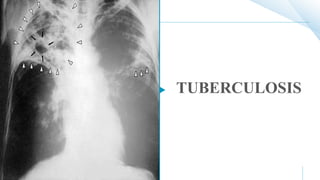
TUBERCULOSIS
CAS(1)
CHIEF COMPLAINT
4
 “I have had a cough for a month. Two nights ago I
woke up with a sharp pain in my chest and I coughed
up some blood.”.
HISTORY
5
 HS is a 52-year-old Hispanic female who presents to the emergency
department with complaints of cough, productive of small amounts of yellow
sputum within the last month. She has experienced increasing fatigue,
occasional shortness of breath on exertion, and mild chest discomfort. She
has had periodic night sweats; last night her temperature was 38.9°C. Two
nights ago, she noticed streaks of bright-red blood in her sputum without any
particular odor or taste. The only medication she has taken is an over-the-
counter cough preparation. Three months ago, the patient presented to a free
clinic and diagnosis revealed a diagnosis of type 2 diabetes. A purified protein
derivative (ppd) test, required for work clearance, was placed. She was noted
to have a positive ppd test, but because her chest x-ray showed no active
disease, she was cleared to work.
HISTORY
6
Past Medical History:
 Type 2 DM diagnosed 3 months ago
 Immunized with BCG
 Allergies/Intolerances/Adverse Drug Events:Penicillin
(rash)
PHYSICAL EXAMINATION
7
General
Vital Signs
 BP 144/92 mm Hg, P 82, RR 18, T 37.9°C
Neck and Lymph Nodes
 Few small 2–3-mm non tender, freely movable lymph
nodes in left anterior cervical and axial area
PHYSICAL EXAMINATION
8
Chest
 Configuration and expansion symmetrical. Tactile
fremitus, percussion symmetrical bilaterally. Breath
sounds and vocal fremitus are normal. A few rales are
noted at the left apex posteriorly.
 Other areas of examination was normal
LABORATORY
9
 Skin Test Results
 PPD (tuberculin) 16 mm at 48 hours
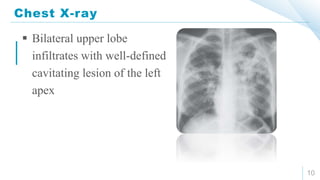
Chest X-ray
10
 Bilateral upper lobe
infiltrates with well-defined
cavitating lesion of the left
apex
Questions
11
 Q1.What groups are at highest risk for developing TB?
 Q2: In patients with laboratory-confirmed drug-susceptible
active pulmonary Mycobacterium tuberculosis (MTB), what are
the standard medication(s) and duration of treatment?
 Q3: The patient’s liver function tests are slightly elevated. Why
is this important and does it change the management of her TB
infection?
 Q4: How is therapeutic efficacy assessed in the treatment of TB?
Questions
12
Four weeks later, the patient returns for follow-up. Her
sputum cultures are positive for AFB and the organism is
identified as M. tuberculosis resistant to isoniazid (INH).
 Q5: How does this information change your recommended drug
combination and duration of drug therapy?
 Q6: How should the close contacts of this patient be treated?
Answer of Question 1
13
 Elderly
 Infants
 Low socioeconomic status
 Crowded living conditions
 Disease that weakens immune system like HIV
 Alcoholism
 Recent Tubercular infection (within last 2 years)
Back
Answer of Question 2
14
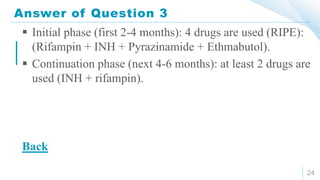
 Initial phase (first 2-4 months): 4 drugs are used (RIPE):
(Rifampin + INH + Pyrazinamide + Ethmabutol).
 Continuation phase (next 4-6 months): at least 2 drugs are
used (INH + rifampin).
Back
Answer of Question 3
15
 Most of anti-tuberculous drugs in first line are
hepatotoxic so needs liver functions monitoring
 INH, rifampin, and pyrazinamide are hepatotoxic
but because of their effectiveness, they should be
used depending on monitoring of liver function
tests.
 In severe liver damage, only one drug can be used.
Back
Answer of Question 4
16
 Efficacy assessed:
i. Clinical: symptoms & signs of TB dimnished
ii. Lab: sputum smear & Culture
iii. Radiological: chest x-ray
Back
Answer of Question 5
17
 Treatment must be individualized
 should seek expert consultation
 6 months intensive treatment (always including an
injectable drug) followed by at least an 18 month
continuation phase
 May proceed to 2nd line of anti-tuberculous drugs:
o Para aminosalicylic
acid ,Ethionamide,Cycloserine,Fluoroquinolones and
Capreomycin
Back
Answer of Question 6
18
 Latent TB (i.e. patients with +ve Tuberculin skin test and
had history of contact to a person proved to have TB)
 INH alone for 6-9 months or dual Rifampicin + INH for 3
months.
Back
CAS(2)
Scenario
20
A man in his 40s is referred to a chest physician with a cough
productive of sputum and a fever. A chest x-ray indicates bilateral
pneumonia with apical involvement. A sputum smear reveals the
presence of acid, alcohol-fast bacilli. His physician considers that
TB is the most likely clinical diagnosis. This is subsequently
confirmed microbiologically. The patient does not comply with
treatment and needs to be admitted to hospital, but refuses. There
are indications he might be disruptive if admitted into hospital.
Questions
21
 Q1: What form of TB does this patient have?
 Q2: What can be done to compel his admission to hospital?
 Q3: What treatment should he receive for his TB??
Answer of Question 1
22
 This man has sputum smear-positive pulmonary TB, the
infectious form of the disease, and poses a risk of infection to
others.
Answer of Question 2
23
 Legal measures should be considered to have the patient
compulsorily admitted to hospital.
 He will need to be admitted to a side room.
Back
Answer of Question 3
24
 Initial phase (first 2-4 months): 4 drugs are used (RIPE):
(Rifampin + INH + Pyrazinamide + Ethmabutol).
 Continuation phase (next 4-6 months): at least 2 drugs are
used (INH + rifampin).
Back
CAS(3)
Scenario
26
A woman in her mid-20s is diagnosed as having sputum smear-
negative pulmonary TB. Although she initially takes her anti-TB
drugs, she does not attend follow-up clinics and her condition
deteriorates. Her primary care doctor collects a sputum sample
from her and persuades her to attend the chest clinic. The sputum
smear is now positive and it is found she has continued to work,
despite being advised not to do so.
Questions
27
 Q1:What type of treatment regimen should be offered to this
patient?
 Q2: Should the patient's work contacts be screened?
Answer of Question 1
28
 Patients like this should receive supervised treatment
(DOTS) three times a week in a convenient setting, such
as at home.
Back
Answer of Question 2
29
 The question of whether work contacts should be
screened must be dealt with on an individual case basis.
 A telephone conversation will provide initial information
on the working environment and should be followed up
by a visit if initial inquiries indicate a possible need to
screen workplace contacts.
Back
T H A N K Y O U !
A N Y Q U E S T I O N S ?

Tuberculosis cases

  • 1.
    T.B. Cases Dr. SamehAhmad Muhamad abdelghany Lecturer Of Clinical Pharmacology Mansura Faculty of medicine
  • 2.
  • 3.
  • 4.
    CHIEF COMPLAINT 4  “Ihave had a cough for a month. Two nights ago I woke up with a sharp pain in my chest and I coughed up some blood.”.
  • 5.
    HISTORY 5  HS isa 52-year-old Hispanic female who presents to the emergency department with complaints of cough, productive of small amounts of yellow sputum within the last month. She has experienced increasing fatigue, occasional shortness of breath on exertion, and mild chest discomfort. She has had periodic night sweats; last night her temperature was 38.9°C. Two nights ago, she noticed streaks of bright-red blood in her sputum without any particular odor or taste. The only medication she has taken is an over-the- counter cough preparation. Three months ago, the patient presented to a free clinic and diagnosis revealed a diagnosis of type 2 diabetes. A purified protein derivative (ppd) test, required for work clearance, was placed. She was noted to have a positive ppd test, but because her chest x-ray showed no active disease, she was cleared to work.
  • 6.
    HISTORY 6 Past Medical History: Type 2 DM diagnosed 3 months ago  Immunized with BCG  Allergies/Intolerances/Adverse Drug Events:Penicillin (rash)
  • 7.
    PHYSICAL EXAMINATION 7 General Vital Signs BP 144/92 mm Hg, P 82, RR 18, T 37.9°C Neck and Lymph Nodes  Few small 2–3-mm non tender, freely movable lymph nodes in left anterior cervical and axial area
  • 8.
    PHYSICAL EXAMINATION 8 Chest  Configurationand expansion symmetrical. Tactile fremitus, percussion symmetrical bilaterally. Breath sounds and vocal fremitus are normal. A few rales are noted at the left apex posteriorly.  Other areas of examination was normal
  • 9.
    LABORATORY 9  Skin TestResults  PPD (tuberculin) 16 mm at 48 hours
  • 10.
    Chest X-ray 10  Bilateralupper lobe infiltrates with well-defined cavitating lesion of the left apex
  • 11.
    Questions 11  Q1.What groupsare at highest risk for developing TB?  Q2: In patients with laboratory-confirmed drug-susceptible active pulmonary Mycobacterium tuberculosis (MTB), what are the standard medication(s) and duration of treatment?  Q3: The patient’s liver function tests are slightly elevated. Why is this important and does it change the management of her TB infection?  Q4: How is therapeutic efficacy assessed in the treatment of TB?
  • 12.
    Questions 12 Four weeks later,the patient returns for follow-up. Her sputum cultures are positive for AFB and the organism is identified as M. tuberculosis resistant to isoniazid (INH).  Q5: How does this information change your recommended drug combination and duration of drug therapy?  Q6: How should the close contacts of this patient be treated?
  • 13.
    Answer of Question1 13  Elderly  Infants  Low socioeconomic status  Crowded living conditions  Disease that weakens immune system like HIV  Alcoholism  Recent Tubercular infection (within last 2 years) Back
  • 14.
    Answer of Question2 14  Initial phase (first 2-4 months): 4 drugs are used (RIPE): (Rifampin + INH + Pyrazinamide + Ethmabutol).  Continuation phase (next 4-6 months): at least 2 drugs are used (INH + rifampin). Back
  • 15.
    Answer of Question3 15  Most of anti-tuberculous drugs in first line are hepatotoxic so needs liver functions monitoring  INH, rifampin, and pyrazinamide are hepatotoxic but because of their effectiveness, they should be used depending on monitoring of liver function tests.  In severe liver damage, only one drug can be used. Back
  • 16.
    Answer of Question4 16  Efficacy assessed: i. Clinical: symptoms & signs of TB dimnished ii. Lab: sputum smear & Culture iii. Radiological: chest x-ray Back
  • 17.
    Answer of Question5 17  Treatment must be individualized  should seek expert consultation  6 months intensive treatment (always including an injectable drug) followed by at least an 18 month continuation phase  May proceed to 2nd line of anti-tuberculous drugs: o Para aminosalicylic acid ,Ethionamide,Cycloserine,Fluoroquinolones and Capreomycin Back
  • 18.
    Answer of Question6 18  Latent TB (i.e. patients with +ve Tuberculin skin test and had history of contact to a person proved to have TB)  INH alone for 6-9 months or dual Rifampicin + INH for 3 months. Back
  • 19.
  • 20.
    Scenario 20 A man inhis 40s is referred to a chest physician with a cough productive of sputum and a fever. A chest x-ray indicates bilateral pneumonia with apical involvement. A sputum smear reveals the presence of acid, alcohol-fast bacilli. His physician considers that TB is the most likely clinical diagnosis. This is subsequently confirmed microbiologically. The patient does not comply with treatment and needs to be admitted to hospital, but refuses. There are indications he might be disruptive if admitted into hospital.
  • 21.
    Questions 21  Q1: Whatform of TB does this patient have?  Q2: What can be done to compel his admission to hospital?  Q3: What treatment should he receive for his TB??
  • 22.
    Answer of Question1 22  This man has sputum smear-positive pulmonary TB, the infectious form of the disease, and poses a risk of infection to others.
  • 23.
    Answer of Question2 23  Legal measures should be considered to have the patient compulsorily admitted to hospital.  He will need to be admitted to a side room. Back
  • 24.
    Answer of Question3 24  Initial phase (first 2-4 months): 4 drugs are used (RIPE): (Rifampin + INH + Pyrazinamide + Ethmabutol).  Continuation phase (next 4-6 months): at least 2 drugs are used (INH + rifampin). Back
  • 25.
  • 26.
    Scenario 26 A woman inher mid-20s is diagnosed as having sputum smear- negative pulmonary TB. Although she initially takes her anti-TB drugs, she does not attend follow-up clinics and her condition deteriorates. Her primary care doctor collects a sputum sample from her and persuades her to attend the chest clinic. The sputum smear is now positive and it is found she has continued to work, despite being advised not to do so.
  • 27.
    Questions 27  Q1:What typeof treatment regimen should be offered to this patient?  Q2: Should the patient's work contacts be screened?
  • 28.
    Answer of Question1 28  Patients like this should receive supervised treatment (DOTS) three times a week in a convenient setting, such as at home. Back
  • 29.
    Answer of Question2 29  The question of whether work contacts should be screened must be dealt with on an individual case basis.  A telephone conversation will provide initial information on the working environment and should be followed up by a visit if initial inquiries indicate a possible need to screen workplace contacts. Back
  • 30.
    T H AN K Y O U ! A N Y Q U E S T I O N S ?

Editor's Notes