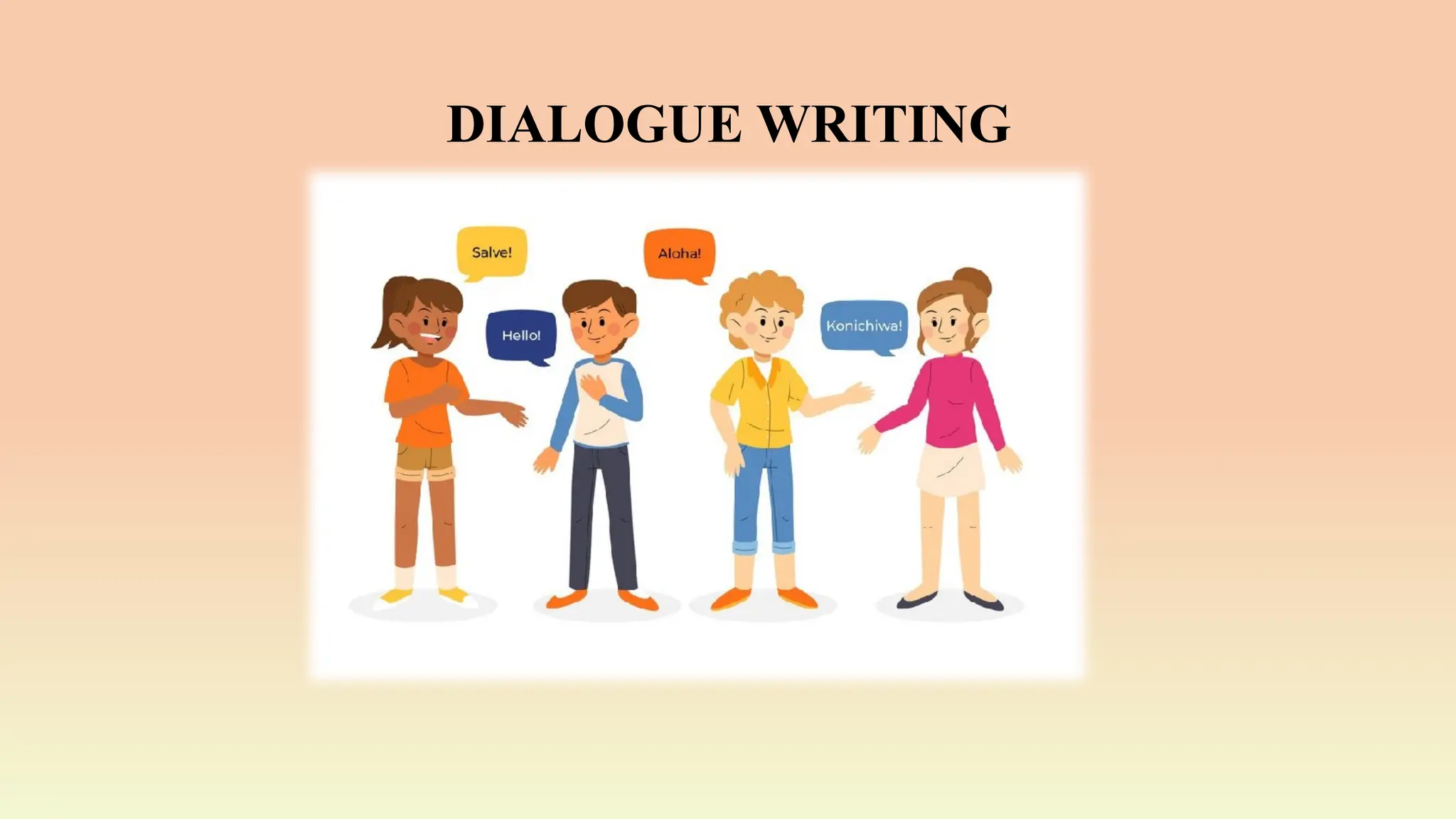
DIALOGUE WRITING
WHAT IS DIALOGUE
Dialogue is a conversation between two or more people. It is a fundamental aspect
of human interaction and communication. Dialogue can be formal or informal, and it
can take place in person, over the phone, or through written communication.
In literature and drama, dialogue is the spoken words of characters. It is used to reveal
character, advance the plot, and create a sense of realism.
BASIC FEATURES OF A DIALOGUE
1. Casual language: Less formal and more relaxed.
2. Contractions: Using shortened forms of words (e.g., "can't," "won't").
3. Standard language: Avoiding slang and jargon.
4. Non-verbal cues: Using tone of voice, facial expressions, and body language.
5. Real-time interaction: Immediate responses and feedback.
6. Adaptive conversation: Adjusting speech based on the listener's reactions.
7. Flexible grammar: Less rigid adherence to grammatical rules.
8. Informal style: Not strictly following standard language norms.
9. Tone-based communication: Using tone to convey meaning and emotion.
TYPES OF DIALOGUE WRITING
1. BASED ON THE NATURE OF THE DIALOGUE:
i) Direct Dialogue: This is the most common type, where the characters' exact words
are presented within quotation marks. Example: "I can't believe you did that," she
said.
ii) Indirect Dialogue: Here, the speaker's words are reported indirectly, often using
verbs like "said," "asked," or "replied." Example: She told him that she couldn't
believe he did that.
iii) Free Indirect Dialogue: A blend of direct and indirect dialogue, where the narrator's
voice merges with the character's thoughts. Example: She couldn't believe he did that.
How could he be so careless?
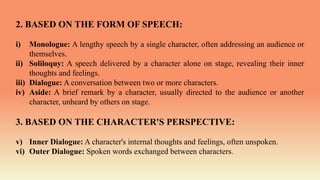
2. BASED ON THE FORM OF SPEECH:
i) Monologue: A lengthy speech by a single character, often addressing an audience or
themselves.
ii) Soliloquy: A speech delivered by a character alone on stage, revealing their inner
thoughts and feelings.
iii) Dialogue: A conversation between two or more characters.
iv) Aside: A brief remark by a character, usually directed to the audience or another
character, unheard by others on stage.
3. BASED ON THE CHARACTER'S PERSPECTIVE:
v) Inner Dialogue: A character's internal thoughts and feelings, often unspoken.
vi) Outer Dialogue: Spoken words exchanged between characters.
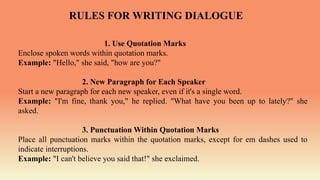
RULES FOR WRITING DIALOGUE
1. Use Quotation Marks
Enclose spoken words within quotation marks.
Example: "Hello," she said, "how are you?"
2. New Paragraph for Each Speaker
Start a new paragraph for each new speaker, even if it's a single word.
Example: "I'm fine, thank you," he replied. "What have you been up to lately?" she
asked.
3. Punctuation Within Quotation Marks
Place all punctuation marks within the quotation marks, except for em dashes used to
indicate interruptions.
Example: "I can't believe you said that!" she exclaimed.
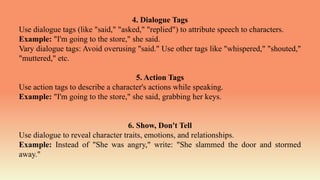
4. Dialogue Tags
Use dialogue tags (like "said," "asked," "replied") to attribute speech to characters.
Example: "I'm going to the store," she said.
Vary dialogue tags: Avoid overusing "said." Use other tags like "whispered," "shouted,"
"muttered," etc.
5. Action Tags
Use action tags to describe a character's actions while speaking.
Example: "I'm going to the store," she said, grabbing her keys.
6. Show, Don't Tell
Use dialogue to reveal character traits, emotions, and relationships.
Example: Instead of "She was angry," write: "She slammed the door and stormed
away."
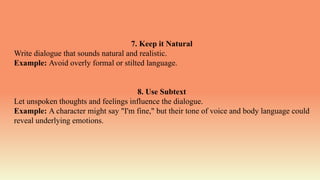
7. Keep it Natural
Write dialogue that sounds natural and realistic.
Example: Avoid overly formal or stilted language.
8. Use Subtext
Let unspoken thoughts and feelings influence the dialogue.
Example: A character might say "I'm fine," but their tone of voice and body language could
reveal underlying emotions.
HOW TO WRITE DIALOGUE CORRECTLY
 Character Development: Give characters distinct voices and personalities &
consider their age, background, education, and social class.
 Purposeful Dialogue: Every line of dialogue should serve a purpose, whether it's
moving the plot forward, revealing character, or creating atmosphere.
 Subtext: Use subtext to add depth and complexity to dialogue & let unspoken
thoughts and feelings influence the character’s words and actions.
 Show, Don't Tell: Use dialogue to reveal character traits and emotions, rather than
simply stating them.
 Avoid Info-Dumping: Avoid having characters simply explain information to
each other & use dialogue to reveal information in a natural way.
 Edit and Revise: Read dialogue aloud to hear how it sounds & cut out
unnecessary words and phrases. Therefore, make sure the dialogue is clear and
concise.
Open A New Savings Account.
Bank Officer: Good morning, sir/ma'am. How may I assist you today?
Customer: Good morning. I'd like to open a new savings account.
Bank Officer: Certainly. To open an account, we'll need some basic information. May I have your full name, please?
Customer: Sure. It's [Customer's Name].
Bank Officer: Thank you. Could you please provide your date of birth and PAN card number?
Customer: My date of birth is [Date of Birth] and my PAN card number is [PAN Card Number].
Bank Officer: Great. Now, we'll need to know your address and contact number.
Customer: My address is [Address] and my contact number is [Contact Number].
Bank Officer: Thank you. To comply with KYC norms, we'll need to verify your identity. Could you please provide a
government-issued photo ID proof, like an Aadhaar card or a passport?
Customer: Yes, of course. Here's my Aadhaar card.
Bank Officer: Thank you. I'll verify this. Now, let's discuss the type of account you'd prefer. We offer various options,
including regular savings accounts, salary accounts, and senior citizen accounts.
Customer: I think a regular savings account would be suitable for me.
Bank Officer: Perfect. To open a regular savings account, we require a minimum initial deposit of [Minimum Deposit
Amount].
Customer: I can deposit that amount.
Bank Officer: Great. Once you've filled out the account opening form and submitted the required documents, your account
will be opened. You will receive your debit card and cheque book within [Number] working days.
Customer: Thank you for your assistance.
Bank Officer: You're welcome. Please feel free to contact us if you have any further questions
Conversation Between Teacher & Student
Student: Excuse me, Teacher, I have a question about the homework.
Teacher: Go ahead, [Student's Name]. What's your question?
Student: I'm a bit confused about the math problem number 5. I don't understand how to
find the area of the triangle.
Teacher: That's a good question. Remember, the formula for the area of a triangle is 1/2 *
base * height. Can you point to the base and height of the triangle in your book?
Student: (Points to the diagram in the book) Is this the base? And this the height?
Teacher: Exactly! So, you just need to multiply the base by the height, and then divide
the result by 2.
Student: Oh, I get it now! Thank you, Teacher.
Teacher: You're welcome. If you have any more questions, don't hesitate to ask.
A Conversation Between Friends
Alex: Hey Riley! Long time no see. What's new?
Riley: Hi Alex! Yeah, it has been a while. Not much, just the usual work stuff. How about
you?
Alex: Same old, same old. Work's been pretty busy, but I managed to catch that new
movie last weekend. Have you seen it?
Riley: No, I haven't. What's it about?
Alex: It's a sci-fi thriller. Really intense! There's this alien invasion.
Riley: Sounds interesting. I might check it out. So, what are you doing this weekend?
Alex: I'm thinking of going hiking. Want to join?
Riley: Sure, that sounds fun. I could use some fresh air.
Alex: Great! We can meet at the trailhead around 10 AM.
Riley: Perfect. See you then.
THANK YOU
- Sarnali Paul

Dialogue Writing and it's Rules : Grammar.

  • 1.
  • 2.
    WHAT IS DIALOGUE Dialogueis a conversation between two or more people. It is a fundamental aspect of human interaction and communication. Dialogue can be formal or informal, and it can take place in person, over the phone, or through written communication. In literature and drama, dialogue is the spoken words of characters. It is used to reveal character, advance the plot, and create a sense of realism.
  • 3.
    BASIC FEATURES OFA DIALOGUE 1. Casual language: Less formal and more relaxed. 2. Contractions: Using shortened forms of words (e.g., "can't," "won't"). 3. Standard language: Avoiding slang and jargon. 4. Non-verbal cues: Using tone of voice, facial expressions, and body language. 5. Real-time interaction: Immediate responses and feedback. 6. Adaptive conversation: Adjusting speech based on the listener's reactions. 7. Flexible grammar: Less rigid adherence to grammatical rules. 8. Informal style: Not strictly following standard language norms. 9. Tone-based communication: Using tone to convey meaning and emotion.
  • 4.
    TYPES OF DIALOGUEWRITING 1. BASED ON THE NATURE OF THE DIALOGUE: i) Direct Dialogue: This is the most common type, where the characters' exact words are presented within quotation marks. Example: "I can't believe you did that," she said. ii) Indirect Dialogue: Here, the speaker's words are reported indirectly, often using verbs like "said," "asked," or "replied." Example: She told him that she couldn't believe he did that. iii) Free Indirect Dialogue: A blend of direct and indirect dialogue, where the narrator's voice merges with the character's thoughts. Example: She couldn't believe he did that. How could he be so careless?
  • 5.
    2. BASED ONTHE FORM OF SPEECH: i) Monologue: A lengthy speech by a single character, often addressing an audience or themselves. ii) Soliloquy: A speech delivered by a character alone on stage, revealing their inner thoughts and feelings. iii) Dialogue: A conversation between two or more characters. iv) Aside: A brief remark by a character, usually directed to the audience or another character, unheard by others on stage. 3. BASED ON THE CHARACTER'S PERSPECTIVE: v) Inner Dialogue: A character's internal thoughts and feelings, often unspoken. vi) Outer Dialogue: Spoken words exchanged between characters.
  • 6.
    RULES FOR WRITINGDIALOGUE 1. Use Quotation Marks Enclose spoken words within quotation marks. Example: "Hello," she said, "how are you?" 2. New Paragraph for Each Speaker Start a new paragraph for each new speaker, even if it's a single word. Example: "I'm fine, thank you," he replied. "What have you been up to lately?" she asked. 3. Punctuation Within Quotation Marks Place all punctuation marks within the quotation marks, except for em dashes used to indicate interruptions. Example: "I can't believe you said that!" she exclaimed.
  • 7.
    4. Dialogue Tags Usedialogue tags (like "said," "asked," "replied") to attribute speech to characters. Example: "I'm going to the store," she said. Vary dialogue tags: Avoid overusing "said." Use other tags like "whispered," "shouted," "muttered," etc. 5. Action Tags Use action tags to describe a character's actions while speaking. Example: "I'm going to the store," she said, grabbing her keys. 6. Show, Don't Tell Use dialogue to reveal character traits, emotions, and relationships. Example: Instead of "She was angry," write: "She slammed the door and stormed away."
  • 8.
    7. Keep itNatural Write dialogue that sounds natural and realistic. Example: Avoid overly formal or stilted language. 8. Use Subtext Let unspoken thoughts and feelings influence the dialogue. Example: A character might say "I'm fine," but their tone of voice and body language could reveal underlying emotions.
  • 9.
    HOW TO WRITEDIALOGUE CORRECTLY  Character Development: Give characters distinct voices and personalities & consider their age, background, education, and social class.  Purposeful Dialogue: Every line of dialogue should serve a purpose, whether it's moving the plot forward, revealing character, or creating atmosphere.  Subtext: Use subtext to add depth and complexity to dialogue & let unspoken thoughts and feelings influence the character’s words and actions.  Show, Don't Tell: Use dialogue to reveal character traits and emotions, rather than simply stating them.  Avoid Info-Dumping: Avoid having characters simply explain information to each other & use dialogue to reveal information in a natural way.  Edit and Revise: Read dialogue aloud to hear how it sounds & cut out unnecessary words and phrases. Therefore, make sure the dialogue is clear and concise.
  • 10.
    Open A NewSavings Account. Bank Officer: Good morning, sir/ma'am. How may I assist you today? Customer: Good morning. I'd like to open a new savings account. Bank Officer: Certainly. To open an account, we'll need some basic information. May I have your full name, please? Customer: Sure. It's [Customer's Name]. Bank Officer: Thank you. Could you please provide your date of birth and PAN card number? Customer: My date of birth is [Date of Birth] and my PAN card number is [PAN Card Number]. Bank Officer: Great. Now, we'll need to know your address and contact number. Customer: My address is [Address] and my contact number is [Contact Number]. Bank Officer: Thank you. To comply with KYC norms, we'll need to verify your identity. Could you please provide a government-issued photo ID proof, like an Aadhaar card or a passport? Customer: Yes, of course. Here's my Aadhaar card. Bank Officer: Thank you. I'll verify this. Now, let's discuss the type of account you'd prefer. We offer various options, including regular savings accounts, salary accounts, and senior citizen accounts. Customer: I think a regular savings account would be suitable for me. Bank Officer: Perfect. To open a regular savings account, we require a minimum initial deposit of [Minimum Deposit Amount]. Customer: I can deposit that amount. Bank Officer: Great. Once you've filled out the account opening form and submitted the required documents, your account will be opened. You will receive your debit card and cheque book within [Number] working days. Customer: Thank you for your assistance. Bank Officer: You're welcome. Please feel free to contact us if you have any further questions
  • 11.
    Conversation Between Teacher& Student Student: Excuse me, Teacher, I have a question about the homework. Teacher: Go ahead, [Student's Name]. What's your question? Student: I'm a bit confused about the math problem number 5. I don't understand how to find the area of the triangle. Teacher: That's a good question. Remember, the formula for the area of a triangle is 1/2 * base * height. Can you point to the base and height of the triangle in your book? Student: (Points to the diagram in the book) Is this the base? And this the height? Teacher: Exactly! So, you just need to multiply the base by the height, and then divide the result by 2. Student: Oh, I get it now! Thank you, Teacher. Teacher: You're welcome. If you have any more questions, don't hesitate to ask.
  • 12.
    A Conversation BetweenFriends Alex: Hey Riley! Long time no see. What's new? Riley: Hi Alex! Yeah, it has been a while. Not much, just the usual work stuff. How about you? Alex: Same old, same old. Work's been pretty busy, but I managed to catch that new movie last weekend. Have you seen it? Riley: No, I haven't. What's it about? Alex: It's a sci-fi thriller. Really intense! There's this alien invasion. Riley: Sounds interesting. I might check it out. So, what are you doing this weekend? Alex: I'm thinking of going hiking. Want to join? Riley: Sure, that sounds fun. I could use some fresh air. Alex: Great! We can meet at the trailhead around 10 AM. Riley: Perfect. See you then.
  • 13.