INTRODUCTORY "THERE"
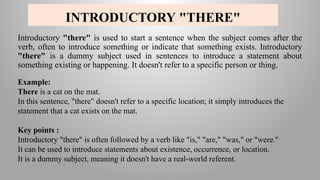
Introductory "there" is used to start a sentence when the subject comes after the
verb, often to introduce something or indicate that something exists. Introductory
"there" is a dummy subject used in sentences to introduce a statement about
something existing or happening. It doesn't refer to a specific person or thing.
Example:
There is a cat on the mat.
In this sentence, "there" doesn't refer to a specific location; it simply introduces the
statement that a cat exists on the mat.
Key points :
Introductory "there" is often followed by a verb like "is," "are," "was," or "were."
It can be used to introduce statements about existence, occurrence, or location.
It is a dummy subject, meaning it doesn't have a real-world referent.
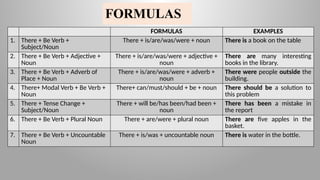
FORMULAS EXAMPLES
1. There + Be Verb +
Subject/Noun
There + is/are/was/were + noun There is a book on the table
2. There + Be Verb + Adjective +
Noun
There + is/are/was/were + adjective +
noun
There are many interesting
books in the library.
3. There + Be Verb + Adverb of
Place + Noun
There + is/are/was/were + adverb +
noun
There were people outside the
building.
4. There+ Modal Verb + Be Verb +
Noun
There+ can/must/should + be + noun There should be a solution to
this problem
5. There + Tense Change +
Subject/Noun
There + will be/has been/had been +
noun
There has been a mistake in
the report
6. There + Be Verb + Plural Noun There + are/were + plural noun There are five apples in the
basket.
7. There + Be Verb + Uncountable
Noun
There + is/was + uncountable noun There is water in the bottle.
FORMULAS
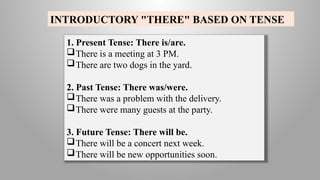
INTRODUCTORY "THERE" BASED ON TENSE
1. Present Tense: There is/are.
There is a meeting at 3 PM.
There are two dogs in the yard.
2. Past Tense: There was/were.
There was a problem with the delivery.
There were many guests at the party.
3. Future Tense: There will be.
There will be a concert next week.
There will be new opportunities soon.
USE OF HAVE
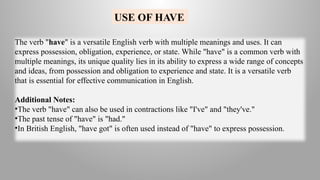
The verb "have" is a versatile English verb with multiple meanings and uses. It can
express possession, obligation, experience, or state. While "have" is a common verb with
multiple meanings, its unique quality lies in its ability to express a wide range of concepts
and ideas, from possession and obligation to experience and state. It is a versatile verb
that is essential for effective communication in English.
Additional Notes:
•The verb "have" can also be used in contractions like "I've" and "they've."
•The past tense of "have" is "had."
•In British English, "have got" is often used instead of "have" to express possession.
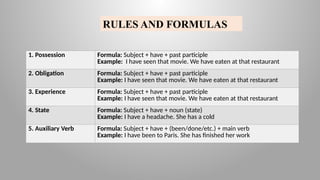
RULES AND FORMULAS
1. Possession Formula: Subject + have + past participle
Example: I have seen that movie. We have eaten at that restaurant
2. Obligation Formula: Subject + have + past participle
Example: I have seen that movie. We have eaten at that restaurant
3. Experience Formula: Subject + have + past participle
Example: I have seen that movie. We have eaten at that restaurant
4. State Formula: Subject + have + noun (state)
Example: I have a headache. She has a cold
5. Auxiliary Verb Formula: Subject + have + (been/done/etc.) + main verb
Example: I have been to Paris. She has finished her work
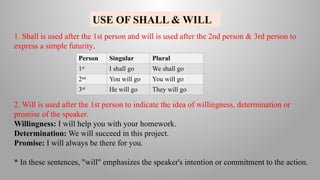
USE OF SHALL & WILL
1. Shall is used after the 1st person and will is used after the 2nd person & 3rd person to
express a simple futurity.
Person Singular Plural
1st
I shall go We shall go
2nd
You will go You will go
3rd
He will go They will go
2. Will is used after the 1st person to indicate the idea of willingness, determination or
promise of the speaker.
Willingness: I will help you with your homework.
Determination: We will succeed in this project.
Promise: I will always be there for you.
* In these sentences, "will" emphasizes the speaker's intention or commitment to the action.
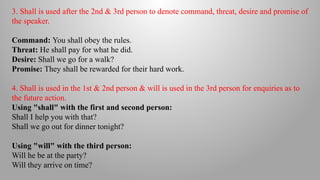
3. Shall is used after the 2nd & 3rd person to denote command, threat, desire and promise of
the speaker.
Command: You shall obey the rules.
Threat: He shall pay for what he did.
Desire: Shall we go for a walk?
Promise: They shall be rewarded for their hard work.
4. Shall is used in the 1st & 2nd person & will is used in the 3rd person for enquiries as to
the future action.
Using "shall" with the first and second person:
Shall I help you with that?
Shall we go out for dinner tonight?
Using "will" with the third person:
Will he be at the party?
Will they arrive on time?
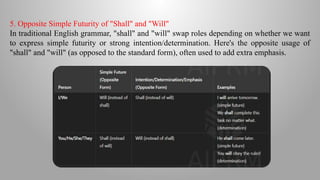
5. Opposite Simple Futurity of "Shall" and "Will"
In traditional English grammar, "shall" and "will" swap roles depending on whether we want
to express simple futurity or strong intention/determination. Here's the opposite usage of
"shall" and "will" (as opposed to the standard form), often used to add extra emphasis.
USE OF SHOULD & WOULD
1. Shall's past tense is should and will's past tense is would, these are used for future in the
past.
He said that he would not go home.
Krishna said to me that I should do that work.
2. Should is used in the 1st
person to express modesty and also used to express willingness &
condition.
I should do it for him.
If I were a king, I should do it.
3. Should is used to mean duty & obligation in all persons and also used after the conjunction
“Lest”
Boys should not smoke.
You should go home.
4. Would is used to express past habitual action & also used to express request with
politeness.
Mr. Dutta would often come late in the office.
I hope, you would kindly grant my petition.
5. Would or used to is used in all persons to express an action at regular intervals.
While I was at Kolkata I would go to the zoo.
I used to walk in the morning, or, I would walk in the morning.
"Used to" is a grammatical structure that indicates a past habit or state that is no longer true.
It is used to describe actions or conditions that were common in the past but are no longer
the case.
Rules and Formula:
Formula: Subject + used to + verb (base form)
She used to have long hair.
We used to live in a small town.
He used to smoke, but he quit.
They used to go to the beach every summer
Additional Notes:
 "Used to" is followed by the base form of the verb.
 It can be used to express both positive and negative habits or states.
 The past tense of "used to" is "used to."
USE OF “USED TO”
"Used on" is a prepositional phrase that indicates the purpose or application of something. It
is often used to express the intended or actual function of an object or item.
Rules and Formula:
Formula: Subject + verb + object + used on + noun
This tool is used on cars.
The medicine is used on patients with fever.
The knife is used on vegetables.
Additional Notes:
 The noun following "used on" should be related to the object or item being described.
 "Used on" can also be used to indicate a specific time or occasion. For example:
• The product is used on special occasions.
• The machine is used on Tuesdays.
USE OF “USED ON”
Thank You
- Sarnali Paul

Introductory There, Have, Shall, will : Grammar

  • 1.
    INTRODUCTORY "THERE" Introductory "there"is used to start a sentence when the subject comes after the verb, often to introduce something or indicate that something exists. Introductory "there" is a dummy subject used in sentences to introduce a statement about something existing or happening. It doesn't refer to a specific person or thing. Example: There is a cat on the mat. In this sentence, "there" doesn't refer to a specific location; it simply introduces the statement that a cat exists on the mat. Key points : Introductory "there" is often followed by a verb like "is," "are," "was," or "were." It can be used to introduce statements about existence, occurrence, or location. It is a dummy subject, meaning it doesn't have a real-world referent.
  • 2.
    FORMULAS EXAMPLES 1. There+ Be Verb + Subject/Noun There + is/are/was/were + noun There is a book on the table 2. There + Be Verb + Adjective + Noun There + is/are/was/were + adjective + noun There are many interesting books in the library. 3. There + Be Verb + Adverb of Place + Noun There + is/are/was/were + adverb + noun There were people outside the building. 4. There+ Modal Verb + Be Verb + Noun There+ can/must/should + be + noun There should be a solution to this problem 5. There + Tense Change + Subject/Noun There + will be/has been/had been + noun There has been a mistake in the report 6. There + Be Verb + Plural Noun There + are/were + plural noun There are five apples in the basket. 7. There + Be Verb + Uncountable Noun There + is/was + uncountable noun There is water in the bottle. FORMULAS
  • 3.
    INTRODUCTORY "THERE" BASEDON TENSE 1. Present Tense: There is/are. There is a meeting at 3 PM. There are two dogs in the yard. 2. Past Tense: There was/were. There was a problem with the delivery. There were many guests at the party. 3. Future Tense: There will be. There will be a concert next week. There will be new opportunities soon.
  • 4.
    USE OF HAVE Theverb "have" is a versatile English verb with multiple meanings and uses. It can express possession, obligation, experience, or state. While "have" is a common verb with multiple meanings, its unique quality lies in its ability to express a wide range of concepts and ideas, from possession and obligation to experience and state. It is a versatile verb that is essential for effective communication in English. Additional Notes: •The verb "have" can also be used in contractions like "I've" and "they've." •The past tense of "have" is "had." •In British English, "have got" is often used instead of "have" to express possession.
  • 5.
    RULES AND FORMULAS 1.Possession Formula: Subject + have + past participle Example: I have seen that movie. We have eaten at that restaurant 2. Obligation Formula: Subject + have + past participle Example: I have seen that movie. We have eaten at that restaurant 3. Experience Formula: Subject + have + past participle Example: I have seen that movie. We have eaten at that restaurant 4. State Formula: Subject + have + noun (state) Example: I have a headache. She has a cold 5. Auxiliary Verb Formula: Subject + have + (been/done/etc.) + main verb Example: I have been to Paris. She has finished her work
  • 6.
    USE OF SHALL& WILL 1. Shall is used after the 1st person and will is used after the 2nd person & 3rd person to express a simple futurity. Person Singular Plural 1st I shall go We shall go 2nd You will go You will go 3rd He will go They will go 2. Will is used after the 1st person to indicate the idea of willingness, determination or promise of the speaker. Willingness: I will help you with your homework. Determination: We will succeed in this project. Promise: I will always be there for you. * In these sentences, "will" emphasizes the speaker's intention or commitment to the action.
  • 7.
    3. Shall isused after the 2nd & 3rd person to denote command, threat, desire and promise of the speaker. Command: You shall obey the rules. Threat: He shall pay for what he did. Desire: Shall we go for a walk? Promise: They shall be rewarded for their hard work. 4. Shall is used in the 1st & 2nd person & will is used in the 3rd person for enquiries as to the future action. Using "shall" with the first and second person: Shall I help you with that? Shall we go out for dinner tonight? Using "will" with the third person: Will he be at the party? Will they arrive on time?
  • 8.
    5. Opposite SimpleFuturity of "Shall" and "Will" In traditional English grammar, "shall" and "will" swap roles depending on whether we want to express simple futurity or strong intention/determination. Here's the opposite usage of "shall" and "will" (as opposed to the standard form), often used to add extra emphasis.
  • 9.
    USE OF SHOULD& WOULD 1. Shall's past tense is should and will's past tense is would, these are used for future in the past. He said that he would not go home. Krishna said to me that I should do that work. 2. Should is used in the 1st person to express modesty and also used to express willingness & condition. I should do it for him. If I were a king, I should do it. 3. Should is used to mean duty & obligation in all persons and also used after the conjunction “Lest” Boys should not smoke. You should go home.
  • 10.
    4. Would isused to express past habitual action & also used to express request with politeness. Mr. Dutta would often come late in the office. I hope, you would kindly grant my petition. 5. Would or used to is used in all persons to express an action at regular intervals. While I was at Kolkata I would go to the zoo. I used to walk in the morning, or, I would walk in the morning.
  • 11.
    "Used to" isa grammatical structure that indicates a past habit or state that is no longer true. It is used to describe actions or conditions that were common in the past but are no longer the case. Rules and Formula: Formula: Subject + used to + verb (base form) She used to have long hair. We used to live in a small town. He used to smoke, but he quit. They used to go to the beach every summer Additional Notes:  "Used to" is followed by the base form of the verb.  It can be used to express both positive and negative habits or states.  The past tense of "used to" is "used to." USE OF “USED TO”
  • 12.
    "Used on" isa prepositional phrase that indicates the purpose or application of something. It is often used to express the intended or actual function of an object or item. Rules and Formula: Formula: Subject + verb + object + used on + noun This tool is used on cars. The medicine is used on patients with fever. The knife is used on vegetables. Additional Notes:  The noun following "used on" should be related to the object or item being described.  "Used on" can also be used to indicate a specific time or occasion. For example: • The product is used on special occasions. • The machine is used on Tuesdays. USE OF “USED ON”
  • 13.