







Formal letter
PRESENTED BY MISS KUBONI
A THIRD YEAR STUDENT AT THE UNIVERSITY OF JOHANNESBURG
lesson
objectives
At the end of the lesson,
learners must be able to:
define what a formal letter is.
explain how to write a formal letter.
discuss when to write a formal letter
construct a formal letter.
distinguish between a formal/business
letter and an informal/friendly letter.
What is a letter
A letter is a written, typed or printed communication sent in an
envelope by post or messenger.
OR
A letter is a written message conveyed from one person to another
through a medium and it can either be formal or informal.
what is a
formal letter
and
its purpose
Well…
A formal letter also known as
a business letter is a letter
written for official or
professional communication.
A formal letter serves many
purposes such as; to
complain, to give
information, to apply for a
job, to apply at universities
and for bursaries, in
response to a letter or fax,
to apply for a position and
so on.
what to know about a formal letter
 Scribendi (2014) state that in today’s Internet- and email driven society,
the need to write a formal letter arises less often than it did in the past.
 Nonetheless, formal letters are still important and they are still utilized
for professional purposes.
CONTI...
BEFORE WE MOVE ON…
LET’S FIRSTLY WATCH A VIDEO
TO GET AN IDEA OF HOW A
FORMAL LETTER LOOKS LIKE
An
interesting
video
exploring
formal letter
writing
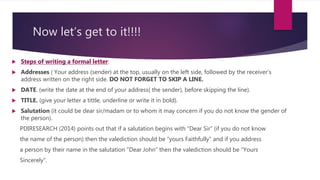
Now let’s get to it!!!!
 Steps of writing a formal letter:
 Addresses ( Your address (sender) at the top, usually on the left side, followed by the receiver’s
address written on the right side. DO NOT FORGET TO SKIP A LINE.
 DATE. (write the date at the end of your address( the sender), before skipping the line).
 TITLE. (give your letter a tittle, underline or write it in bold).
 Salutation (it could be dear sir/madam or to whom it may concern if you do not know the gender of
the person).
PDIRESEARCH (2014) points out that if a salutation begins with “Dear Sir” (if you do not know
the name of the person) then the valediction should be “yours Faithfully” and if you address
a person by their name in the salutation “Dear John” then the valediction should be “Yours
Sincerely”.
Conti…
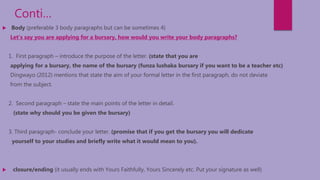
 Body (preferable 3 body paragraphs but can be sometimes 4)
Let’s say you are applying for a bursary, how would you write your body paragraphs?
1. First paragraph – introduce the purpose of the letter. (state that you are
applying for a bursary, the name of the bursary (funza lushaka bursary if you want to be a teacher etc)
Dingwayo (2012) mentions that state the aim of your formal letter in the first paragraph, do not deviate
from the subject.
2. Second paragraph – state the main points of the letter in detail.
(state why should you be given the bursary)
3. Third paragraph- conclude your letter. (promise that if you get the bursary you will dedicate
yourself to your studies and briefly write what it would mean to you).
 closure/ending (it usually ends with Yours Faithfully, Yours Sincerely etc. Put your signature as well)
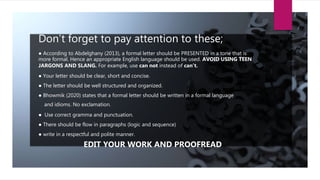
Don’t forget to pay attention to these;
● According to Abdelghany (2013), a formal letter should be PRESENTED in a tone that is
more formal. Hence an appropriate English language should be used. AVOID USING TEEN
JARGONS AND SLANG. For example, use can not instead of can’t.
● Your letter should be clear, short and concise.
● The letter should be well structured and organized.
● Bhowmik (2020) states that a formal letter should be written in a formal language
and idioms. No exclamation.
● Use correct gramma and punctuation.
● There should be flow in paragraphs (logic and sequence)
● write in a respectful and polite manner.
EDIT YOUR WORK AND PROOFREAD
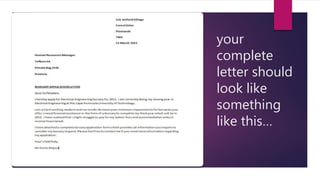
your
complete
letter should
look like
something
like this…
Reference list
Abdelghany. (2013) Steps of writing a formal letter. Retrieved from:
of-writing-a-formal-letter [accessed on 14 August 2020]
Bhowmik, P. (2020). Formal letter writing tricks. Available at: https://www.slideshare.net/PrajnaparamitaBhowmik/formal-
letter-writing-tricks-easy-letter-writing-writingskills-learningisfun [accessed on 14 August 2020]
Dingwayo, S. (2017) Presenting a formal letter. Available at: https://www.slideshare.net/SIYABONGADINGWAYO/write-a-
formal-letter [accessed on 14 August 2020]
PDIFResearch. (2013). English Language Composition Situational writing formal letters. Available at:
https://www.slideshare.net/PDIFResearch/bmc-on-englishlanguagecompositionsituational-writingformal-
letterslideshare[accessed on 14 August 2020]
Scibendi. (2015). How to write a formal letter. Available at: https://www.slideshare.net/Scribendi_Editing/how-to-write-a-
formal-letter-45658684 [accessed on 14 August 2020]
Formal letter.

Formal letter.

  • 1.
    Formal letter PRESENTED BYMISS KUBONI A THIRD YEAR STUDENT AT THE UNIVERSITY OF JOHANNESBURG
  • 2.
  • 3.
    At the endof the lesson, learners must be able to: define what a formal letter is. explain how to write a formal letter. discuss when to write a formal letter construct a formal letter. distinguish between a formal/business letter and an informal/friendly letter.
  • 4.
    What is aletter
  • 5.
    A letter isa written, typed or printed communication sent in an envelope by post or messenger. OR A letter is a written message conveyed from one person to another through a medium and it can either be formal or informal.
  • 6.
    what is a formalletter and its purpose
  • 7.
    Well… A formal letteralso known as a business letter is a letter written for official or professional communication. A formal letter serves many purposes such as; to complain, to give information, to apply for a job, to apply at universities and for bursaries, in response to a letter or fax, to apply for a position and so on.
  • 8.
    what to knowabout a formal letter  Scribendi (2014) state that in today’s Internet- and email driven society, the need to write a formal letter arises less often than it did in the past.  Nonetheless, formal letters are still important and they are still utilized for professional purposes.
  • 9.
    CONTI... BEFORE WE MOVEON… LET’S FIRSTLY WATCH A VIDEO TO GET AN IDEA OF HOW A FORMAL LETTER LOOKS LIKE
  • 10.
  • 11.
    Now let’s getto it!!!!  Steps of writing a formal letter:  Addresses ( Your address (sender) at the top, usually on the left side, followed by the receiver’s address written on the right side. DO NOT FORGET TO SKIP A LINE.  DATE. (write the date at the end of your address( the sender), before skipping the line).  TITLE. (give your letter a tittle, underline or write it in bold).  Salutation (it could be dear sir/madam or to whom it may concern if you do not know the gender of the person). PDIRESEARCH (2014) points out that if a salutation begins with “Dear Sir” (if you do not know the name of the person) then the valediction should be “yours Faithfully” and if you address a person by their name in the salutation “Dear John” then the valediction should be “Yours Sincerely”.
  • 12.
    Conti…  Body (preferable3 body paragraphs but can be sometimes 4) Let’s say you are applying for a bursary, how would you write your body paragraphs? 1. First paragraph – introduce the purpose of the letter. (state that you are applying for a bursary, the name of the bursary (funza lushaka bursary if you want to be a teacher etc) Dingwayo (2012) mentions that state the aim of your formal letter in the first paragraph, do not deviate from the subject. 2. Second paragraph – state the main points of the letter in detail. (state why should you be given the bursary) 3. Third paragraph- conclude your letter. (promise that if you get the bursary you will dedicate yourself to your studies and briefly write what it would mean to you).  closure/ending (it usually ends with Yours Faithfully, Yours Sincerely etc. Put your signature as well)
  • 13.
    Don’t forget topay attention to these; ● According to Abdelghany (2013), a formal letter should be PRESENTED in a tone that is more formal. Hence an appropriate English language should be used. AVOID USING TEEN JARGONS AND SLANG. For example, use can not instead of can’t. ● Your letter should be clear, short and concise. ● The letter should be well structured and organized. ● Bhowmik (2020) states that a formal letter should be written in a formal language and idioms. No exclamation. ● Use correct gramma and punctuation. ● There should be flow in paragraphs (logic and sequence) ● write in a respectful and polite manner. EDIT YOUR WORK AND PROOFREAD
  • 14.
  • 16.
    Reference list Abdelghany. (2013)Steps of writing a formal letter. Retrieved from: of-writing-a-formal-letter [accessed on 14 August 2020] Bhowmik, P. (2020). Formal letter writing tricks. Available at: https://www.slideshare.net/PrajnaparamitaBhowmik/formal- letter-writing-tricks-easy-letter-writing-writingskills-learningisfun [accessed on 14 August 2020] Dingwayo, S. (2017) Presenting a formal letter. Available at: https://www.slideshare.net/SIYABONGADINGWAYO/write-a- formal-letter [accessed on 14 August 2020] PDIFResearch. (2013). English Language Composition Situational writing formal letters. Available at: https://www.slideshare.net/PDIFResearch/bmc-on-englishlanguagecompositionsituational-writingformal- letterslideshare[accessed on 14 August 2020] Scibendi. (2015). How to write a formal letter. Available at: https://www.slideshare.net/Scribendi_Editing/how-to-write-a- formal-letter-45658684 [accessed on 14 August 2020]