IDEA ON MOOD
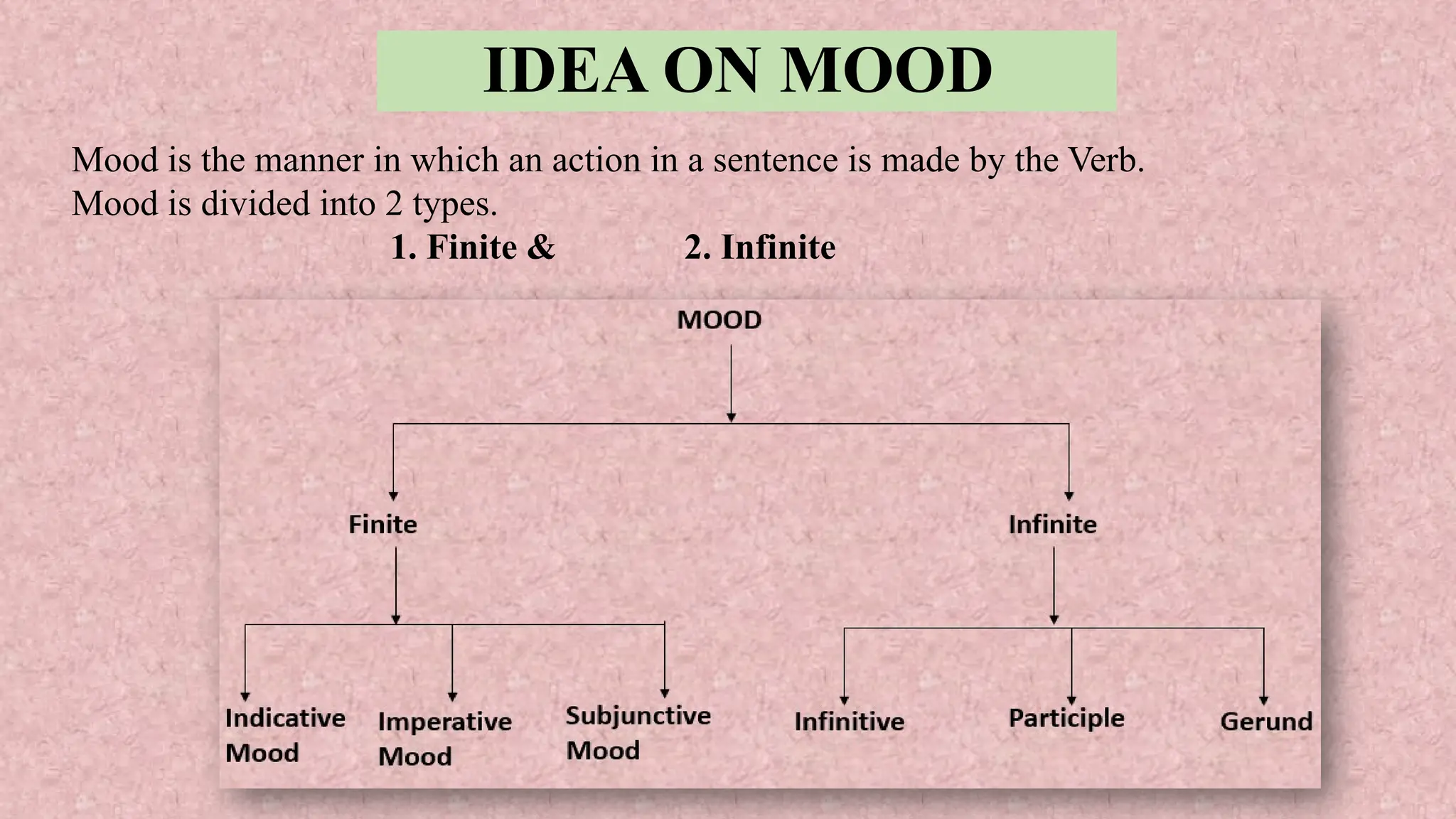
Mood is the manner in which an action in a sentence is made by the Verb.
Mood is divided into 2 types.
1. Finite & 2. Infinite
INDICATIVE MOOD
The indicative mood is used to state facts, ask questions, or make statements about
reality. It is the most common mood in English.
Examples:
He is a doctor. (Statement of fact)
Do you like pizza? (Question)
The sun is shining. (Statement about reality)
IMPERATIVE MOOD
The imperative mood is used to give commands, orders, or requests. It is often used
with the base form of the verb and does not have a subject (you is implied).
Examples:
Open the door. (Command)
Please be quiet. (Request)
Let's go to the park. (Suggestion)
SUBJECTIVE MOOD
The subjunctive mood is used to express wishes, desires, possibilities, or conditions that
are contrary to fact or unlikely to happen. It is less common in everyday speech but is
often used in formal writing and certain grammatical constructions.
Examples:
I wish I were rich. (Wish)
If I were you, I wouldn't do that. (Hypothetical condition)
It is important that he be on time. (Desire)
INFINITIVE VERB
An infinitive is a verb form that usually begins with "to". It is used
as a noun, an adjective or an adverb. It denotes by “to+V1”.
Example:
Noun: To err is human (subject)
I want to study
Adjective: This year India is the team To beat (to beat modifies
the noun)
GERUND
A gerund is the form of a verb that ends in -ing and acts as a noun
in a sentence. It is not used as a verb in this case, but as a noun that
can be the subject, object, or complement. It denoted by “V1+ing”
and also acts as a noun & verb. Hence, Gerund is also called Verb-
Noun.
Example:
Swimming is a good exercise.
I like watching T.V.
Here watching is the object of verb “like” but if T.V is taken as an
object, then watching acts as verb. Thus, V1+ing is both noun &
verb,
Note: With the following verbs/adjectives/ phrases V1+ing is used
after “To”.
Verb+ used to, accustomed to, averse to, with a view to, addicted
to, devoted to, in addition to, look forward to, object to, owing to,
given to, taken to, prone to.
Like: He is addicted to smoking.
I am looking forward to meeting you.
He is used to driving the car.
* After all the preposition (including to), if a verb comes, the verb has to be in “V1+ing”
form.
PARTICIPLES
A participle is a verb form that can be used 1.as an adjective, 2. to
create verb tense, or 3. to create the passive voice or object in
the sentences.
Or, A word that acts as a verb as well as adjective is called a
participle.
There re 3 types of participle:
i. Present Participle ( ending -ing)(V1+ing)
ii. Past Participle ( usually ending -ed, -d, -t, -en, or -n) (V3)
iii. Perfect Participle (Having V3).
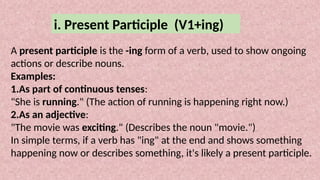
i. Present Participle (V1+ing)
A present participle is the -ing form of a verb, used to show ongoing
actions or describe nouns.
Examples:
1.As part of continuous tenses:
"She is running." (The action of running is happening right now.)
2.As an adjective:
"The movie was exciting." (Describes the noun "movie.")
In simple terms, if a verb has "ing" at the end and shows something
happening now or describes something, it's likely a present participle.
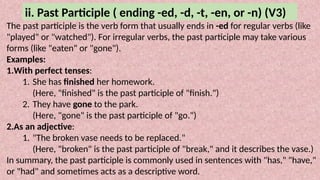
ii. Past Participle ( ending -ed, -d, -t, -en, or -n) (V3)
The past participle is the verb form that usually ends in -ed for regular verbs (like
"played" or "watched"). For irregular verbs, the past participle may take various
forms (like "eaten" or "gone").
Examples:
1.With perfect tenses:
1. She has finished her homework.
(Here, "finished" is the past participle of "finish.")
2. They have gone to the park.
(Here, "gone" is the past participle of "go.")
2.As an adjective:
1. "The broken vase needs to be replaced."
(Here, "broken" is the past participle of "break," and it describes the vase.)
In summary, the past participle is commonly used in sentences with "has," "have,"
or "had" and sometimes acts as a descriptive word.
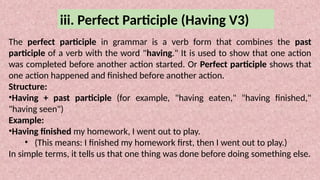
iii. Perfect Participle (Having V3)
The perfect participle in grammar is a verb form that combines the past
participle of a verb with the word "having." It is used to show that one action
was completed before another action started. Or Perfect participle shows that
one action happened and finished before another action.
Structure:
•Having + past participle (for example, "having eaten," "having finished,"
"having seen")
Example:
•Having finished my homework, I went out to play.
• (This means: I finished my homework first, then I went out to play.)
In simple terms, it tells us that one thing was done before doing something else.
THANK YOU
- Sarnali Paul

Idea on MOOD, Types & Others : Grammar

  • 1.
    IDEA ON MOOD Moodis the manner in which an action in a sentence is made by the Verb. Mood is divided into 2 types. 1. Finite & 2. Infinite
  • 2.
    INDICATIVE MOOD The indicativemood is used to state facts, ask questions, or make statements about reality. It is the most common mood in English. Examples: He is a doctor. (Statement of fact) Do you like pizza? (Question) The sun is shining. (Statement about reality)
  • 3.
    IMPERATIVE MOOD The imperativemood is used to give commands, orders, or requests. It is often used with the base form of the verb and does not have a subject (you is implied). Examples: Open the door. (Command) Please be quiet. (Request) Let's go to the park. (Suggestion)
  • 4.
    SUBJECTIVE MOOD The subjunctivemood is used to express wishes, desires, possibilities, or conditions that are contrary to fact or unlikely to happen. It is less common in everyday speech but is often used in formal writing and certain grammatical constructions. Examples: I wish I were rich. (Wish) If I were you, I wouldn't do that. (Hypothetical condition) It is important that he be on time. (Desire)
  • 5.
    INFINITIVE VERB An infinitiveis a verb form that usually begins with "to". It is used as a noun, an adjective or an adverb. It denotes by “to+V1”. Example: Noun: To err is human (subject) I want to study Adjective: This year India is the team To beat (to beat modifies the noun)
  • 6.
    GERUND A gerund isthe form of a verb that ends in -ing and acts as a noun in a sentence. It is not used as a verb in this case, but as a noun that can be the subject, object, or complement. It denoted by “V1+ing” and also acts as a noun & verb. Hence, Gerund is also called Verb- Noun. Example: Swimming is a good exercise. I like watching T.V. Here watching is the object of verb “like” but if T.V is taken as an object, then watching acts as verb. Thus, V1+ing is both noun & verb,
  • 7.
    Note: With thefollowing verbs/adjectives/ phrases V1+ing is used after “To”. Verb+ used to, accustomed to, averse to, with a view to, addicted to, devoted to, in addition to, look forward to, object to, owing to, given to, taken to, prone to. Like: He is addicted to smoking. I am looking forward to meeting you. He is used to driving the car. * After all the preposition (including to), if a verb comes, the verb has to be in “V1+ing” form.
  • 8.
    PARTICIPLES A participle isa verb form that can be used 1.as an adjective, 2. to create verb tense, or 3. to create the passive voice or object in the sentences. Or, A word that acts as a verb as well as adjective is called a participle. There re 3 types of participle: i. Present Participle ( ending -ing)(V1+ing) ii. Past Participle ( usually ending -ed, -d, -t, -en, or -n) (V3) iii. Perfect Participle (Having V3).
  • 9.
    i. Present Participle(V1+ing) A present participle is the -ing form of a verb, used to show ongoing actions or describe nouns. Examples: 1.As part of continuous tenses: "She is running." (The action of running is happening right now.) 2.As an adjective: "The movie was exciting." (Describes the noun "movie.") In simple terms, if a verb has "ing" at the end and shows something happening now or describes something, it's likely a present participle.
  • 10.
    ii. Past Participle( ending -ed, -d, -t, -en, or -n) (V3) The past participle is the verb form that usually ends in -ed for regular verbs (like "played" or "watched"). For irregular verbs, the past participle may take various forms (like "eaten" or "gone"). Examples: 1.With perfect tenses: 1. She has finished her homework. (Here, "finished" is the past participle of "finish.") 2. They have gone to the park. (Here, "gone" is the past participle of "go.") 2.As an adjective: 1. "The broken vase needs to be replaced." (Here, "broken" is the past participle of "break," and it describes the vase.) In summary, the past participle is commonly used in sentences with "has," "have," or "had" and sometimes acts as a descriptive word.
  • 11.
    iii. Perfect Participle(Having V3) The perfect participle in grammar is a verb form that combines the past participle of a verb with the word "having." It is used to show that one action was completed before another action started. Or Perfect participle shows that one action happened and finished before another action. Structure: •Having + past participle (for example, "having eaten," "having finished," "having seen") Example: •Having finished my homework, I went out to play. • (This means: I finished my homework first, then I went out to play.) In simple terms, it tells us that one thing was done before doing something else.
  • 12.