Dialogue as  Participatory Design   Peter H. Jones, PhD Redesign Research Dialogic Design International, LLC designdialogues.net
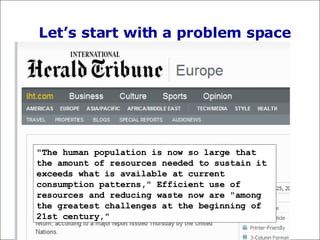
Let’s start with a problem space "The human population is now so large that the amount of resources needed to sustain it exceeds what is available at current consumption patterns," Efficient use of resources and reducing waste now are "among the greatest challenges at the beginning of 21st century,"
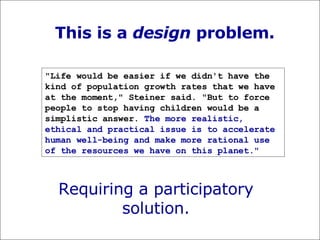
This is a  design  problem. "Life would be easier if we didn't have the kind of population growth rates that we have at the moment," Steiner said. "But to force people to stop having children would be a simplistic answer.  The more realistic, ethical and practical issue is to accelerate human well-being and make more rational use of the resources we have on this planet."   Requiring a participatory solution.
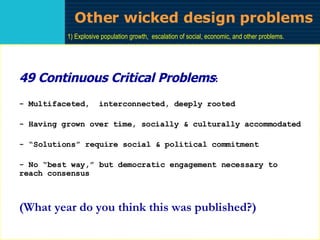
Other wicked design problems 1) Explosive population growth,  escalation of social, economic, and other problems. 2) Widespread poverty throughout the world. 3) Increase in the production, destructive capacity, and accessibility of all weapons of war. 4) Uncontrolled urban spread. 5) Generalized and growing malnutrition. 6) Persistence of widespread illiteracy. 7) Expanding mechanization and bureaucratization of almost all human activity. 8) Growing inequalities in the distribution of wealth throughout the world. 9) Insufficient and irrationally organized medical care. 10) Hardening discrimination against minorities. 11) Hardening prejudices against differing cultures. 12) Affluence and its unknown consequences. 13) Anachronistic and irrelevant education. 14) Generalized environmental deterioration. 15) Generalized lack of agreed-on alternatives to present trends. 16) Widespread failure to stimulate man's creative capacity to confront the future. 17) Continuing deterioration of inner-cities or slums. 18) Growing irrelevance of traditional values & continuing failure to evolve new value systems … .  49 CCPs 49 Continuous Critical Problems : - Multifaceted,  interconnected, deeply rooted - Having grown over time, socially & culturally accommodated - “Solutions” require social & political commitment  - No “best way,” but democratic engagement necessary to  reach consensus (What year do you think this was published?)
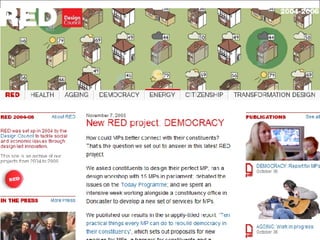
How are we designing today? What do we even call this? Social Systems Design  (Christakis, Ozbekhan) Transformation Design  (UK Design Council,RED) Design 3.0?  (NextD)
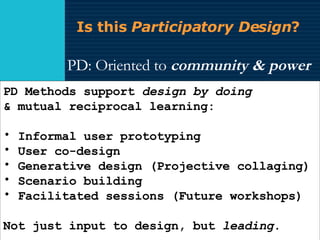
Is this  Participatory Design ? PD: Oriented to  community & power   Retrieved  by UX practices as  methods RED calls it  design-led innovation . PD Methods support  design by doing & mutual reciprocal learning:  Informal user prototyping  User co-design  Generative design (Projective collaging)  Scenario building  Facilitated sessions (Future workshops) Not just input to design, but  leading .
Is this Participatory Design? How  do we conduct PD for these  enormous social problems ? (Same methods?) What does  participation  look like? What’s missing from our practice?
Dialogue IN Design. Enormous / complex / socially-distributed problems require  listening and observing No clear mandate for designers  –  we are not recognized as players yet Tools of “design-led PD” may not function as well in shared, public issues. A “user” has no STAKE, no power to change or decide.
Dialogic Design. Not all PD involves dialogue –  But  dialogic design  requires participation for - Whole system : All Stakeholders Democratic : Process for evening    out power biases Complexity :  Requisite variety
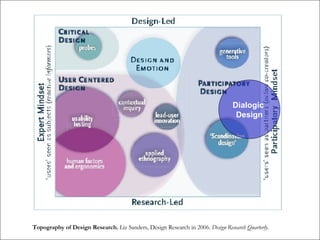
Topography of Design Research.  Liz Sanders, Design Research in 2006.  Design Research Quarterly . Dialogic  Design
How do we Dialogue? Socratic and Athenian Dialogue  Gadamer’s hermeneutics,  fusion of horizons   Buber’s dialogue with self, other, God Habermas’  Communicative Action Bohm’s  collective meaning Bakhtin’s  dialogical imagination Freire’s dialogue in education & social action Facilitated dialogue, Art of Hosting Structured Dialogue – Dialogic Design
There is  genuine dialogue  - no matter whether spoken or silent - where each of the participants really has in mind the other or others in their present and particular being and turns to them with the intention of establishing a living mutual relation between himself and them. There is  technical dialogue , which is prompted solely by the need of objective understanding. And there is  monologue disguised as dialogue  …
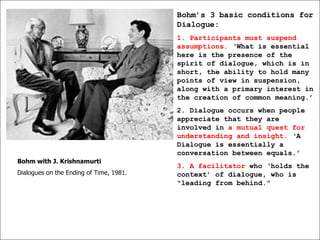
Bohm’s 3 basic conditions for Dialogue: 1. Participants must suspend assumptions.  ‘What is essential here is the presence of the spirit of dialogue, which is in short, the ability to hold many points of view in suspension, along with a primary interest in the creation of common meaning.’  2. Dialogue occurs when people appreciate that they are involved in  a mutual quest for understanding and insight.  ‘A Dialogue is essentially a conversation between equals.’  3. A facilitator  who ‘holds the context’ of dialogue, who is "leading from behind." Bohm with J. Krishnamurti Dialogues on the Ending of Time, 1981.
Christakis on Structured Dialogue: “ Given the complexity of political, social, economic, & technological issues of the Information age, & the strong linkages among those issues, is it reasonable to expect that the approach for engaging people in dialogue 2500 years ago during the Golden Age of the Athenians would work today?”
Dialogue & they will come.  Does not work in design. A self-selecting group “emerges a solution?” Magic can happen in any dialogue,  but  emergence  is not actionable. This is dialogue as “Just Listening” If we stop at  Understanding  (“feel-good phase”), there’s no carry-over to future, no accountability.
What do  we  mean by Dialogue? Complex problem or domain, unresolved by usual means Risk or complexity requires discipline & structure Committed participants seeking  understanding  &  action   Stakeholders have diverging agendas & power diffs Cannot be solved by management decision Facilitated, structured verbal examination of problem area Mixed-location, both collocated AND virtual Dialogue is  generative , constructs a shared outcome Balances power & generates agreement based on quality Dialogue is essentially democratic
Purposes & Uses of Structured Dialogue Complex (wicked) problem solving Mapping design options in complex problem spaces Organizational / Enterprise transformation Democratic large-group decision making  Public participation in policy design  Strategic planning & effective priority setting  Product feature & function allocation Problem identification & root cause analysis
Three Axioms COMPLEXITY: We live in a complex world. Problems are  interconnected . Dialogue per se does not unpack complexity.  2) PARSIMONY: Human cognition & attention is limited.  AND overloaded in group design. 3) SALIENCY: The field of options in any evaluation is complex.  “ Correct synthesis” is difficult.
Six Dialogue Laws Requisite  Variety  (Ashby) Requisite  Parsimony  (Miller, Warfield) Requisite  Saliency  (Boulding) Requisite  Meaning & Wisdom  (Peirce) Requisite  Authenticity & Autonomy  (Tsivacou) Requisite  Evolutionary Learning  (Dye)
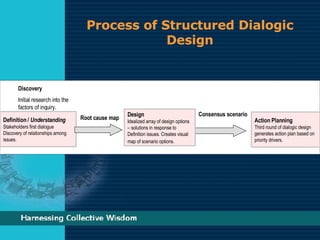
Process of Structured Dialogic Design Definition /  Understanding Stakeholders first dialogue Discovery of relationships among issues. Discovery Initial research into the factors of inquiry. Action Planning Third round of dialogic design generates action plan based on priority drivers. Root cause map Consensus scenario Design Idealized array of design options – solutions in response to Definition issues. Creates visual map of scenario options .
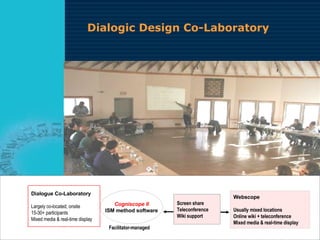
Dialogic Design Co-Laboratory    Dialogue Co-Laboratory Largely co-located, onsite 15-30+ participants Mixed media & real-time display Cogniscope II ISM method software Facilitator-managed Webscope Usually mixed locations Online wiki + teleconference Mixed media & real-time display Screen share Teleconference Wiki support
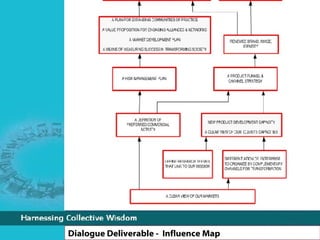
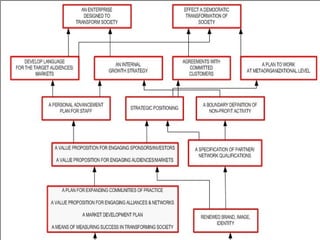
Dialogue Deliverable -  Influence Map
 
Where in the world? Peace dialogues between Greek and Turkish Cypriots (2006-2007) Transnational indigenous leaders dialogue on globalization:  40 leaders from Americas, Maoris, & invited experts.  (2004) Chronic Kidney Disease (CKD) Initiative:  48 stakeholders & 10 observers from 38 organizations defining 85 barriers to improving CKD outcomes, resulting in action plan.  (2003). Alternative Energy Future Planning for Northwest Energy Efficiency Alliance (2000-2001) National Leadership Agenda for pharmaceutical safety for the National Patient Safety Foundation (NPSF) and AMA. 1999) Food and Drug Administration, Good Practices Review dialogues
That said … We must continue to learn from experiments in “democratic design” via dialogue. We are not using SDD yet for services design. Or in Canada. We are moving SDD to a true online process, with the intent to offer worldwide access  Proposals for 2008 We are always looking for collaborations. Currently at UT, in healthcare informatics
References & Sites Dialogic Design International:   dialogicdesignllc.com Institute for Global Agoras :  globalagoras.org Dialogue websites:   The Blogora:   blogora.net   Dialogue community support wiki Design Dialogues:   designdialogue.net  My blog Book website :  Harnessingcollectivewisdom.com   Some current projects: Michigan Dept. of Education:   Universal Design for Learning  Cyprus Civil Society Dialogues National Invasive Species Council (FDA)  Conference papers & presentations
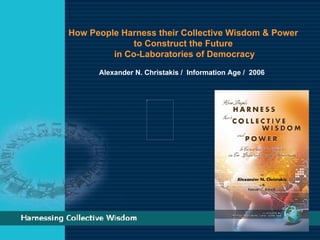
How People Harness their Collective Wisdom & Power  to Construct the Future  in Co-Laboratories of Democracy Alexander N. Christakis /  Information Age /  2006    

Dialogue as Participatory Design

  • 1.
    Dialogue as Participatory Design Peter H. Jones, PhD Redesign Research Dialogic Design International, LLC designdialogues.net
  • 2.
    Let’s start witha problem space "The human population is now so large that the amount of resources needed to sustain it exceeds what is available at current consumption patterns," Efficient use of resources and reducing waste now are "among the greatest challenges at the beginning of 21st century,"
  • 3.
    This is a design problem. "Life would be easier if we didn't have the kind of population growth rates that we have at the moment," Steiner said. "But to force people to stop having children would be a simplistic answer. The more realistic, ethical and practical issue is to accelerate human well-being and make more rational use of the resources we have on this planet." Requiring a participatory solution.
  • 4.
    Other wicked designproblems 1) Explosive population growth, escalation of social, economic, and other problems. 2) Widespread poverty throughout the world. 3) Increase in the production, destructive capacity, and accessibility of all weapons of war. 4) Uncontrolled urban spread. 5) Generalized and growing malnutrition. 6) Persistence of widespread illiteracy. 7) Expanding mechanization and bureaucratization of almost all human activity. 8) Growing inequalities in the distribution of wealth throughout the world. 9) Insufficient and irrationally organized medical care. 10) Hardening discrimination against minorities. 11) Hardening prejudices against differing cultures. 12) Affluence and its unknown consequences. 13) Anachronistic and irrelevant education. 14) Generalized environmental deterioration. 15) Generalized lack of agreed-on alternatives to present trends. 16) Widespread failure to stimulate man's creative capacity to confront the future. 17) Continuing deterioration of inner-cities or slums. 18) Growing irrelevance of traditional values & continuing failure to evolve new value systems … . 49 CCPs 49 Continuous Critical Problems : - Multifaceted, interconnected, deeply rooted - Having grown over time, socially & culturally accommodated - “Solutions” require social & political commitment - No “best way,” but democratic engagement necessary to reach consensus (What year do you think this was published?)
  • 5.
    How are wedesigning today? What do we even call this? Social Systems Design (Christakis, Ozbekhan) Transformation Design (UK Design Council,RED) Design 3.0? (NextD)
  • 6.
    Is this Participatory Design ? PD: Oriented to community & power Retrieved by UX practices as methods RED calls it design-led innovation . PD Methods support design by doing & mutual reciprocal learning: Informal user prototyping User co-design Generative design (Projective collaging) Scenario building Facilitated sessions (Future workshops) Not just input to design, but leading .
  • 7.
    Is this ParticipatoryDesign? How do we conduct PD for these enormous social problems ? (Same methods?) What does participation look like? What’s missing from our practice?
  • 8.
    Dialogue IN Design.Enormous / complex / socially-distributed problems require listening and observing No clear mandate for designers – we are not recognized as players yet Tools of “design-led PD” may not function as well in shared, public issues. A “user” has no STAKE, no power to change or decide.
  • 9.
    Dialogic Design. Notall PD involves dialogue – But dialogic design requires participation for - Whole system : All Stakeholders Democratic : Process for evening out power biases Complexity : Requisite variety
  • 10.
    Topography of DesignResearch. Liz Sanders, Design Research in 2006. Design Research Quarterly . Dialogic Design
  • 11.
    How do weDialogue? Socratic and Athenian Dialogue Gadamer’s hermeneutics, fusion of horizons Buber’s dialogue with self, other, God Habermas’ Communicative Action Bohm’s collective meaning Bakhtin’s dialogical imagination Freire’s dialogue in education & social action Facilitated dialogue, Art of Hosting Structured Dialogue – Dialogic Design
  • 12.
    There is genuine dialogue - no matter whether spoken or silent - where each of the participants really has in mind the other or others in their present and particular being and turns to them with the intention of establishing a living mutual relation between himself and them. There is technical dialogue , which is prompted solely by the need of objective understanding. And there is monologue disguised as dialogue …
  • 13.
    Bohm’s 3 basicconditions for Dialogue: 1. Participants must suspend assumptions. ‘What is essential here is the presence of the spirit of dialogue, which is in short, the ability to hold many points of view in suspension, along with a primary interest in the creation of common meaning.’ 2. Dialogue occurs when people appreciate that they are involved in a mutual quest for understanding and insight. ‘A Dialogue is essentially a conversation between equals.’ 3. A facilitator who ‘holds the context’ of dialogue, who is "leading from behind." Bohm with J. Krishnamurti Dialogues on the Ending of Time, 1981.
  • 14.
    Christakis on StructuredDialogue: “ Given the complexity of political, social, economic, & technological issues of the Information age, & the strong linkages among those issues, is it reasonable to expect that the approach for engaging people in dialogue 2500 years ago during the Golden Age of the Athenians would work today?”
  • 15.
    Dialogue & theywill come. Does not work in design. A self-selecting group “emerges a solution?” Magic can happen in any dialogue, but emergence is not actionable. This is dialogue as “Just Listening” If we stop at Understanding (“feel-good phase”), there’s no carry-over to future, no accountability.
  • 16.
    What do we mean by Dialogue? Complex problem or domain, unresolved by usual means Risk or complexity requires discipline & structure Committed participants seeking understanding & action Stakeholders have diverging agendas & power diffs Cannot be solved by management decision Facilitated, structured verbal examination of problem area Mixed-location, both collocated AND virtual Dialogue is generative , constructs a shared outcome Balances power & generates agreement based on quality Dialogue is essentially democratic
  • 17.
    Purposes & Usesof Structured Dialogue Complex (wicked) problem solving Mapping design options in complex problem spaces Organizational / Enterprise transformation Democratic large-group decision making Public participation in policy design Strategic planning & effective priority setting Product feature & function allocation Problem identification & root cause analysis
  • 18.
    Three Axioms COMPLEXITY:We live in a complex world. Problems are interconnected . Dialogue per se does not unpack complexity. 2) PARSIMONY: Human cognition & attention is limited. AND overloaded in group design. 3) SALIENCY: The field of options in any evaluation is complex. “ Correct synthesis” is difficult.
  • 19.
    Six Dialogue LawsRequisite Variety (Ashby) Requisite Parsimony (Miller, Warfield) Requisite Saliency (Boulding) Requisite Meaning & Wisdom (Peirce) Requisite Authenticity & Autonomy (Tsivacou) Requisite Evolutionary Learning (Dye)
  • 20.
    Process of StructuredDialogic Design Definition / Understanding Stakeholders first dialogue Discovery of relationships among issues. Discovery Initial research into the factors of inquiry. Action Planning Third round of dialogic design generates action plan based on priority drivers. Root cause map Consensus scenario Design Idealized array of design options – solutions in response to Definition issues. Creates visual map of scenario options .
  • 21.
    Dialogic Design Co-Laboratory   Dialogue Co-Laboratory Largely co-located, onsite 15-30+ participants Mixed media & real-time display Cogniscope II ISM method software Facilitator-managed Webscope Usually mixed locations Online wiki + teleconference Mixed media & real-time display Screen share Teleconference Wiki support
  • 22.
    Dialogue Deliverable - Influence Map
  • 23.
  • 24.
    Where in theworld? Peace dialogues between Greek and Turkish Cypriots (2006-2007) Transnational indigenous leaders dialogue on globalization: 40 leaders from Americas, Maoris, & invited experts. (2004) Chronic Kidney Disease (CKD) Initiative: 48 stakeholders & 10 observers from 38 organizations defining 85 barriers to improving CKD outcomes, resulting in action plan. (2003). Alternative Energy Future Planning for Northwest Energy Efficiency Alliance (2000-2001) National Leadership Agenda for pharmaceutical safety for the National Patient Safety Foundation (NPSF) and AMA. 1999) Food and Drug Administration, Good Practices Review dialogues
  • 25.
    That said …We must continue to learn from experiments in “democratic design” via dialogue. We are not using SDD yet for services design. Or in Canada. We are moving SDD to a true online process, with the intent to offer worldwide access Proposals for 2008 We are always looking for collaborations. Currently at UT, in healthcare informatics
  • 26.
    References & SitesDialogic Design International: dialogicdesignllc.com Institute for Global Agoras : globalagoras.org Dialogue websites: The Blogora: blogora.net Dialogue community support wiki Design Dialogues: designdialogue.net My blog Book website : Harnessingcollectivewisdom.com Some current projects: Michigan Dept. of Education: Universal Design for Learning Cyprus Civil Society Dialogues National Invasive Species Council (FDA) Conference papers & presentations
  • 27.
    How People Harnesstheir Collective Wisdom & Power to Construct the Future in Co-Laboratories of Democracy Alexander N. Christakis /  Information Age /  2006