Values Sensitive Innovation
                                          PAIN CONSULT

                       StrategicConcept design workshop conflicts
                                 interventions in value


                                                         Peter Jones
                                              Strategic Foresight & Innovation


(cc) Some rights reserved. 2011 Peter Jones
KEY ISSUES
    Systemic effects of values in innovation
    • Values in product & service design
    • Process & Practices
    • Organizational values & innovation

    Identifying values / conflicts as root cause drivers
    • We tend to observe effects – outcomes of choices
    • Values as form of tacit knowledge “know how & why”
    • Persistent, slow change cycles


(cc) Some rights reserved. 2011 Peter Jones
Where do values tensions /
              conflicts show up in everyday
                         products?


(cc) Some rights reserved. 2011 Peter Jones
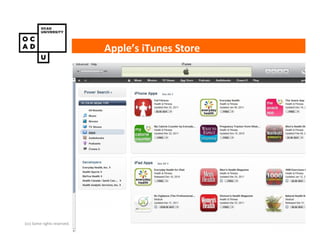
Apple’s iTunes Store


(cc) Some rights reserved. 2011 Peter Jones
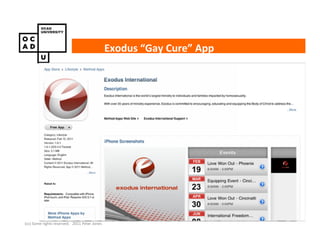
Exodus “Gay Cure” App


(cc) Some rights reserved. 2011 Peter Jones
Case 2


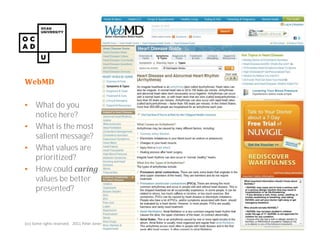
WebMD

• What do you
  notice here?
• What is the most
  salient message?
• What values are
  prioritized?
• How could caring
  values be better
  presented?


(cc) Some rights reserved. 2011 Peter Jones
How do values actually show up?

     Who says there’s a conflict?

     Can we always predict a conflict?

(cc) Some rights reserved. 2011 Peter Jones
Where & how have you
     experienced a values conflict
     in a product or service?
     (Write down, then share in pairs for 2 min each.)


(cc) Some rights reserved. 2011 Peter Jones
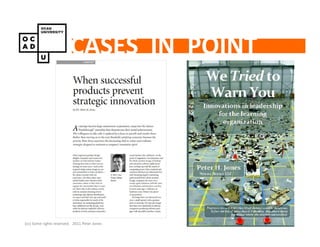
CASES IN POINT


(cc) Some rights reserved. 2011 Peter Jones
DEFINE INNOVATION
    • Significant invention with the capacity for
      transformation.
    • Strategic innovation sustains business strategy
      through significant invention, designing new or
      breakthrough products to fulfill strategic intent.
    • And user intent.

    • Strategic innovations can be internal too.


(cc) Some rights reserved. 2011 Peter Jones
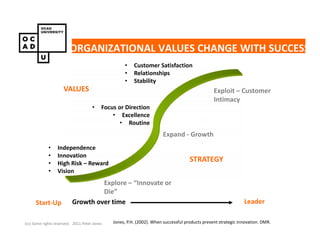
ORGANIZATIONAL VALUES CHANGE WITH SUCCESS
                                                   •    Customer Satisfaction
                                                   •    Relationships
                                                   •    Stability
                     VALUES                                                                     Exploit – Customer
                                                                                                Intimacy
                                     •    Focus or Direction
                                              • Excellence
                                                 • Routine
                                                                      Expand - Growth
             •    Independence
             •    Innovation
             •    High Risk – Reward
                                                                                    STRATEGY
             •    Vision
                                   Explore – “Innovate or
                                   Die”
      Start-Up            Growth over time                                                                     Leader

(cc) Some rights reserved. 2011 Peter Jones   Jones, P.H. (2002). When successful products prevent strategic innovation. DMR.
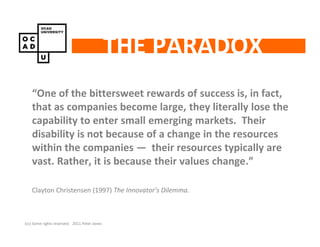
THE PARADOX
    “One of the bittersweet rewards of success is, in fact,
    that as companies become large, they literally lose the
    capability to enter small emerging markets. Their
    disability is not because of a change in the resources
    within the companies — their resources typically are
    vast. Rather, it is because their values change.”

    Clayton Christensen (1997) The Innovator’s Dilemma.


(cc) Some rights reserved. 2011 Peter Jones
What’s a current example of a
     company fitting this pattern?


(cc) Some rights reserved. 2011 Peter Jones
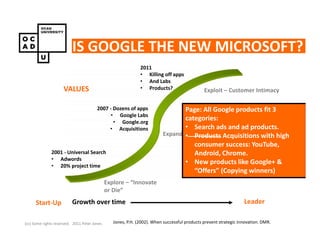
IS GOOGLE THE NEW MICROSOFT?
                                                              2011
                                                              • Killing off apps
                                                              • And Labs
                     VALUES                                   • Products?                     Exploit – Customer Intimacy

                                        2007 - Dozens of apps                    Page: All Google products fit 3
                                              • Google Labs
                                               • Google.org
                                                                                 categories:
                                             • Acquisitions                      • Search ads and ad products.
                                                                         Expand -•Growth
                                                                                    Products Acquisitions with high
                                                                                    consumer success: YouTube,
              2001 - Universal Search                                               Android, Chrome.
              • Adwords
              • 20% project time
                                                                                 • STRATEGY
                                                                                    New products like Google+ &
                                                                                    “Offers” (Copying winners)
                                              Explore – “Innovate
                                              or Die”
      Start-Up            Growth over time                                                                        Leader

(cc) Some rights reserved. 2011 Peter Jones      Jones, P.H. (2002). When successful products prevent strategic innovation. DMR.
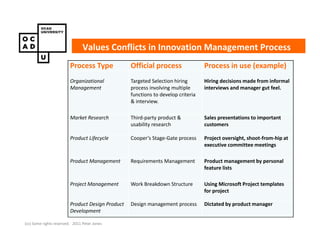
Values Conflicts in Innovation Management Process
                         Process Type             Official process                Process in use (example)
                         Organizational           Targeted Selection hiring       Hiring decisions made from informal
                         Management               process involving multiple      interviews and manager gut feel.
                                                  functions to develop criteria
                                                  & interview.

                         Market Research          Third-party product &           Sales presentations to important
                                                  usability research              customers

                         Product Lifecycle        Cooper’s Stage-Gate process     Project oversight, shoot-from-hip at
                                                                                  executive committee meetings

                         Product Management       Requirements Management         Product management by personal
                                                                                  feature lists

                         Project Management       Work Breakdown Structure        Using Microsoft Project templates
                                                                                  for project

                         Product Design Product   Design management process       Dictated by product manager
                         Development

(cc) Some rights reserved. 2011 Peter Jones
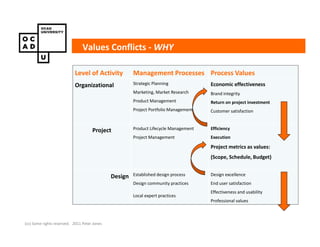
Values Conflicts - WHY

                            Level of Activity          Management Processes Process Values
                            Organizational             Strategic Planning             Economic effectiveness
                                                       Marketing, Market Research     Brand integrity
                                                       Product Management             Return on project investment
                                                       Project Portfolio Management   Customer satisfaction


                                     Project           Product Lifecycle Management   Efficiency
                                                       Project Management             Execution

                                                                                      Project metrics as values:
                                                                                      (Scope, Schedule, Budget)


                                              Design   Established design process     Design excellence
                                                       Design community practices     End user satisfaction
                                                                                      Effectiveness and usability
                                                       Local expert practices
                                                                                      Professional values


(cc) Some rights reserved. 2011 Peter Jones
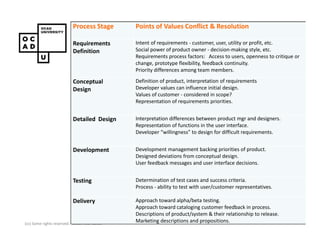
Process Stage                   Points of Values Conflict & Resolution

                          Requirements      Intent of requirements - customer, user, utility or profit, etc.
                          Definition Values Conflicts in Innovation
                                            Social power of product owner - decision-making style, etc.
                                              Management Process feedback continuity.
                                                    Requirements process factors: Access to users, openness to critique or
                                                    change, prototype flexibility,
                                                          Priority differences among team members.

                          Conceptual                      Definition of product, interpretation of requirements
                          Design                          Developer values can influence initial design.
                                                          Values of customer - considered in scope?
                                                          Representation of requirements priorities.


                          Detailed Design                 Interpretation differences between product mgr and designers.
                                                          Representation of functions in the user interface.
                                                          Developer “willingness” to design for difficult requirements.


                          Development                     Development management backing priorities of product.
                                                          Designed deviations from conceptual design.
                                                          User feedback messages and user interface decisions.


                          Testing                         Determination of test cases and success criteria.
                                                          Process - ability to test with user/customer representatives.

                          Delivery
                                 Values conflict points in a product/service design lifecycletesting.
                                                         Approach toward alpha/beta
                                                          Approach toward cataloging customer feedback in process.
                                                          Descriptions of product/system & their relationship to release.
(cc) Some rights reserved. 2011 Peter Jones
                                                          Marketing descriptions and propositions.
(cc) Some rights reserved. 2011 Peter Jones
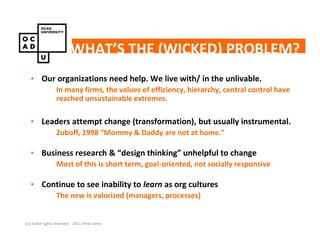
WHAT’S THE (WICKED) PROBLEM?
   • Our organizations need help. We live with/ in the unlivable.
                 In many firms, the values of efficiency, hierarchy, central control have
                 reached unsustainable extremes.

   • Leaders attempt change (transformation), but usually instrumental.
                 Zuboff, 1998 “Mommy & Daddy are not at home.”

   • Business research & “design thinking” unhelpful to change
                 Most of this is short term, goal-oriented, not socially responsive

   • Continue to see inability to learn as org cultures
                 The new is valorized (managers, processes)


(cc) Some rights reserved. 2011 Peter Jones
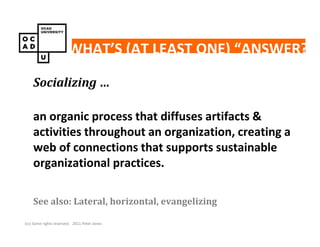
WHAT’S (AT LEAST ONE) “ANSWER?”

    Socializing …

    an organic process that diffuses artifacts &
    activities throughout an organization, creating a
    web of connections that supports sustainable
    organizational practices.

    See also: Lateral, horizontal, evangelizing

(cc) Some rights reserved. 2011 Peter Jones
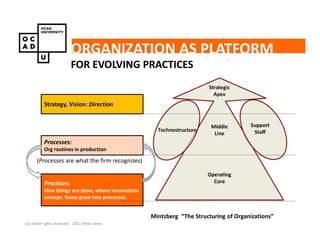
ORGANIZATION AS PLATFORM
                         FOR EVOLVING PRACTICES


          Strategy, Vision: Direction


          Processes:
          Org routines in production

      (Processes are what the firm recognizes)


          Practices:
          How things are done, where innovations
          emerge. Some grow into processes.


                                                   Mintzberg “The Structuring of Organizations”
(cc) Some rights reserved. 2011 Peter Jones
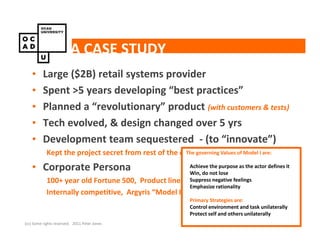
A CASE STUDY
    •     Large ($2B) retail systems provider
    •     Spent >5 years developing “best practices”
    •     Planned a “revolutionary” product (with customers & tests)
    •     Tech evolved, & design changed over 5 yrs
    •     Development team sequestered - (to “innovate”)
            Kept the project secret from rest of the company - until ready to are:
                                                       The governing Values of Model I release

    • Corporate Persona                                     Achieve the purpose as the actor defines it
                                                            Win, do not lose
            100+ year old Fortune 500, Product lines,      Traditional hierarchy
                                                            Suppress negative feelings
                                                            Emphasize rationality
            Internally competitive, Argyris “Model I” org
                                                            Primary Strategies are:
                                                            Control environment and task unilaterally
                                                            Protect self and others unilaterally
(cc) Some rights reserved. 2011 Peter Jones
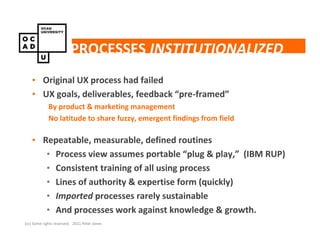
PROCESSES INSTITUTIONALIZED
    • Original UX process had failed
    • UX goals, deliverables, feedback “pre-framed”
             By product & marketing management
             No latitude to share fuzzy, emergent findings from field

    • Repeatable, measurable, defined routines
       • Process view assumes portable “plug & play,” (IBM RUP)
       • Consistent training of all using process
       • Lines of authority & expertise form (quickly)
       • Imported processes rarely sustainable
       • And processes work against knowledge & growth.
(cc) Some rights reserved. 2011 Peter Jones
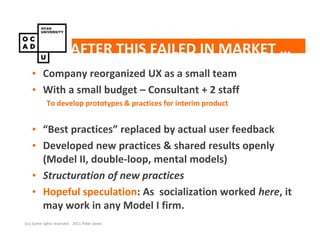
AFTER THIS FAILED IN MARKET …
    • Company reorganized UX as a small team
    • With a small budget – Consultant + 2 staff
            To develop prototypes & practices for interim product


    • “Best practices” replaced by actual user feedback
    • Developed new practices & shared results openly
      (Model II, double-loop, mental models)
    • Structuration of new practices
    • Hopeful speculation: As socialization worked here, it
      may work in any Model I firm.
(cc) Some rights reserved. 2011 Peter Jones
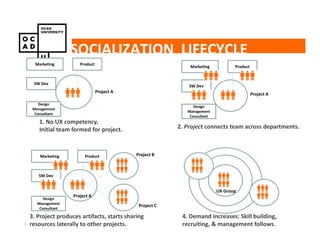
SOCIALIZATION LIFECYCLE
    Marketing              Product
                                                                  Marketing           Product


    SW Dev
                                                                  SW Dev
                                     Project A                                                  Project A

      Design
                                                                    Design
   Management
                                                                 Management
    Consultant
                                                                  Consultant
      1. No UX competency.
      Initial team formed for project.                        2. Project connects team across departments.

                 text

      Marketing              Product             Project B


      SW Dev


                                                                               UX Group
                        Project A
        Design
     Management
                                                  Project C
      Consultant

   3. Project produces artifacts, starts sharing               4. Demand increases: Skill building,
(cc) Some rights reserved. 2011 Peter Jones projects.
   resources laterally to other                                recruiting, & management follows.
PRACTICES IN A PROCESS WORLD
     • Practice development is often disrupted by well-meaning
       intervention of management
            Imposing best practices & “repeatable processes.”

     • New processes institutionalized by management are “brittle,”
       compete for resources & standing

     • Direct learning & competency development at the front lines
       become strategic competencies that grow the firm and
       sustain its competitive position. (Penrose resource theory of firm)

(cc) Some rights reserved. 2011 Peter Jones
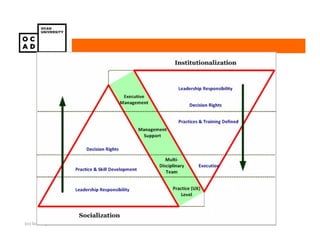
PRACTICES SOCIALIZED
    • Build an organic demand & interest in the (UX) practice.
            Consult laterally to other projects as capacity builds.


    • Collaborate with managers and other roles to integrate
      practice into business processes.
            This ensures takeup by meeting common needs across lines / processes

    • Provide awareness sessions, discussion, & education as
      needed to fit resources to the process.
                    Assessment and renewal, staffing, building competency.


(cc) Some rights reserved. 2011 Peter Jones
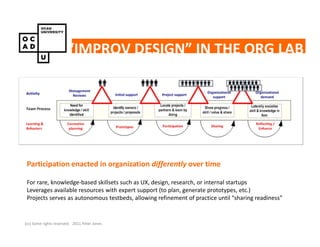
“IMPROV DESIGN” IN THE ORG LAB


 Participation enacted in organization differently over time

 For rare, knowledge-based skillsets such as UX, design, research, or internal startups
 Leverages available resources with expert support (to plan, generate prototypes, etc.)
 Projects serves as autonomous testbeds, allowing refinement of practice until “sharing readiness”


(cc) Some rights reserved. 2011 Peter Jones
CONCLUSIONS
  • Socialization a macro-method for participatory
    organizational practice design : Values shifting
        Values shifts occur from resilient cultural changes, trust, over time


  • Leverages weak ties & generates strong demand
    among resources in an org network.
          Develop “functionally similar” processes (e.g. UX) from unique, tailored knowledge

  • Follows a resource-based view of strategy:
          A firm grows from its unique competencies, not copyable processes.
          Competitive base formed from unique use of knowledge


(cc) Some rights reserved. 2011 Peter Jones

Values Sensitive Innovation

  • 1.
    Values Sensitive Innovation PAIN CONSULT StrategicConcept design workshop conflicts interventions in value Peter Jones Strategic Foresight & Innovation (cc) Some rights reserved. 2011 Peter Jones
  • 2.
    KEY ISSUES Systemic effects of values in innovation • Values in product & service design • Process & Practices • Organizational values & innovation Identifying values / conflicts as root cause drivers • We tend to observe effects – outcomes of choices • Values as form of tacit knowledge “know how & why” • Persistent, slow change cycles (cc) Some rights reserved. 2011 Peter Jones
  • 3.
    Where do valuestensions / conflicts show up in everyday products? (cc) Some rights reserved. 2011 Peter Jones
  • 4.
    Apple’s iTunes Store (cc)Some rights reserved. 2011 Peter Jones
  • 5.
    Exodus “Gay Cure”App (cc) Some rights reserved. 2011 Peter Jones
  • 6.
    Case 2 WebMD • Whatdo you notice here? • What is the most salient message? • What values are prioritized? • How could caring values be better presented? (cc) Some rights reserved. 2011 Peter Jones
  • 7.
    How do valuesactually show up? Who says there’s a conflict? Can we always predict a conflict? (cc) Some rights reserved. 2011 Peter Jones
  • 8.
    Where & howhave you experienced a values conflict in a product or service? (Write down, then share in pairs for 2 min each.) (cc) Some rights reserved. 2011 Peter Jones
  • 9.
    CASES IN POINT (cc)Some rights reserved. 2011 Peter Jones
  • 10.
    DEFINE INNOVATION • Significant invention with the capacity for transformation. • Strategic innovation sustains business strategy through significant invention, designing new or breakthrough products to fulfill strategic intent. • And user intent. • Strategic innovations can be internal too. (cc) Some rights reserved. 2011 Peter Jones
  • 11.
    ORGANIZATIONAL VALUES CHANGEWITH SUCCESS • Customer Satisfaction • Relationships • Stability VALUES Exploit – Customer Intimacy • Focus or Direction • Excellence • Routine Expand - Growth • Independence • Innovation • High Risk – Reward STRATEGY • Vision Explore – “Innovate or Die” Start-Up Growth over time Leader (cc) Some rights reserved. 2011 Peter Jones Jones, P.H. (2002). When successful products prevent strategic innovation. DMR.
  • 12.
    THE PARADOX “One of the bittersweet rewards of success is, in fact, that as companies become large, they literally lose the capability to enter small emerging markets. Their disability is not because of a change in the resources within the companies — their resources typically are vast. Rather, it is because their values change.” Clayton Christensen (1997) The Innovator’s Dilemma. (cc) Some rights reserved. 2011 Peter Jones
  • 13.
    What’s a currentexample of a company fitting this pattern? (cc) Some rights reserved. 2011 Peter Jones
  • 14.
    IS GOOGLE THENEW MICROSOFT? 2011 • Killing off apps • And Labs VALUES • Products? Exploit – Customer Intimacy 2007 - Dozens of apps Page: All Google products fit 3 • Google Labs • Google.org categories: • Acquisitions • Search ads and ad products. Expand -•Growth Products Acquisitions with high consumer success: YouTube, 2001 - Universal Search Android, Chrome. • Adwords • 20% project time • STRATEGY New products like Google+ & “Offers” (Copying winners) Explore – “Innovate or Die” Start-Up Growth over time Leader (cc) Some rights reserved. 2011 Peter Jones Jones, P.H. (2002). When successful products prevent strategic innovation. DMR.
  • 15.
    Values Conflicts inInnovation Management Process Process Type Official process Process in use (example) Organizational Targeted Selection hiring Hiring decisions made from informal Management process involving multiple interviews and manager gut feel. functions to develop criteria & interview. Market Research Third-party product & Sales presentations to important usability research customers Product Lifecycle Cooper’s Stage-Gate process Project oversight, shoot-from-hip at executive committee meetings Product Management Requirements Management Product management by personal feature lists Project Management Work Breakdown Structure Using Microsoft Project templates for project Product Design Product Design management process Dictated by product manager Development (cc) Some rights reserved. 2011 Peter Jones
  • 16.
    Values Conflicts -WHY Level of Activity Management Processes Process Values Organizational Strategic Planning Economic effectiveness Marketing, Market Research Brand integrity Product Management Return on project investment Project Portfolio Management Customer satisfaction Project Product Lifecycle Management Efficiency Project Management Execution Project metrics as values: (Scope, Schedule, Budget) Design Established design process Design excellence Design community practices End user satisfaction Effectiveness and usability Local expert practices Professional values (cc) Some rights reserved. 2011 Peter Jones
  • 17.
    Process Stage Points of Values Conflict & Resolution Requirements Intent of requirements - customer, user, utility or profit, etc. Definition Values Conflicts in Innovation Social power of product owner - decision-making style, etc. Management Process feedback continuity. Requirements process factors: Access to users, openness to critique or change, prototype flexibility, Priority differences among team members. Conceptual Definition of product, interpretation of requirements Design Developer values can influence initial design. Values of customer - considered in scope? Representation of requirements priorities. Detailed Design Interpretation differences between product mgr and designers. Representation of functions in the user interface. Developer “willingness” to design for difficult requirements. Development Development management backing priorities of product. Designed deviations from conceptual design. User feedback messages and user interface decisions. Testing Determination of test cases and success criteria. Process - ability to test with user/customer representatives. Delivery Values conflict points in a product/service design lifecycletesting. Approach toward alpha/beta Approach toward cataloging customer feedback in process. Descriptions of product/system & their relationship to release. (cc) Some rights reserved. 2011 Peter Jones Marketing descriptions and propositions.
  • 18.
    (cc) Some rightsreserved. 2011 Peter Jones
  • 19.
    WHAT’S THE (WICKED)PROBLEM? • Our organizations need help. We live with/ in the unlivable. In many firms, the values of efficiency, hierarchy, central control have reached unsustainable extremes. • Leaders attempt change (transformation), but usually instrumental. Zuboff, 1998 “Mommy & Daddy are not at home.” • Business research & “design thinking” unhelpful to change Most of this is short term, goal-oriented, not socially responsive • Continue to see inability to learn as org cultures The new is valorized (managers, processes) (cc) Some rights reserved. 2011 Peter Jones
  • 20.
    WHAT’S (AT LEASTONE) “ANSWER?” Socializing … an organic process that diffuses artifacts & activities throughout an organization, creating a web of connections that supports sustainable organizational practices. See also: Lateral, horizontal, evangelizing (cc) Some rights reserved. 2011 Peter Jones
  • 21.
    ORGANIZATION AS PLATFORM FOR EVOLVING PRACTICES Strategy, Vision: Direction Processes: Org routines in production (Processes are what the firm recognizes) Practices: How things are done, where innovations emerge. Some grow into processes. Mintzberg “The Structuring of Organizations” (cc) Some rights reserved. 2011 Peter Jones
  • 22.
    A CASE STUDY • Large ($2B) retail systems provider • Spent >5 years developing “best practices” • Planned a “revolutionary” product (with customers & tests) • Tech evolved, & design changed over 5 yrs • Development team sequestered - (to “innovate”) Kept the project secret from rest of the company - until ready to are: The governing Values of Model I release • Corporate Persona Achieve the purpose as the actor defines it Win, do not lose 100+ year old Fortune 500, Product lines, Traditional hierarchy Suppress negative feelings Emphasize rationality Internally competitive, Argyris “Model I” org Primary Strategies are: Control environment and task unilaterally Protect self and others unilaterally (cc) Some rights reserved. 2011 Peter Jones
  • 23.
    PROCESSES INSTITUTIONALIZED • Original UX process had failed • UX goals, deliverables, feedback “pre-framed” By product & marketing management No latitude to share fuzzy, emergent findings from field • Repeatable, measurable, defined routines • Process view assumes portable “plug & play,” (IBM RUP) • Consistent training of all using process • Lines of authority & expertise form (quickly) • Imported processes rarely sustainable • And processes work against knowledge & growth. (cc) Some rights reserved. 2011 Peter Jones
  • 24.
    AFTER THIS FAILEDIN MARKET … • Company reorganized UX as a small team • With a small budget – Consultant + 2 staff To develop prototypes & practices for interim product • “Best practices” replaced by actual user feedback • Developed new practices & shared results openly (Model II, double-loop, mental models) • Structuration of new practices • Hopeful speculation: As socialization worked here, it may work in any Model I firm. (cc) Some rights reserved. 2011 Peter Jones
  • 25.
    SOCIALIZATION LIFECYCLE Marketing Product Marketing Product SW Dev SW Dev Project A Project A Design Design Management Management Consultant Consultant 1. No UX competency. Initial team formed for project. 2. Project connects team across departments. text Marketing Product Project B SW Dev UX Group Project A Design Management Project C Consultant 3. Project produces artifacts, starts sharing 4. Demand increases: Skill building, (cc) Some rights reserved. 2011 Peter Jones projects. resources laterally to other recruiting, & management follows.
  • 26.
    PRACTICES IN APROCESS WORLD • Practice development is often disrupted by well-meaning intervention of management Imposing best practices & “repeatable processes.” • New processes institutionalized by management are “brittle,” compete for resources & standing • Direct learning & competency development at the front lines become strategic competencies that grow the firm and sustain its competitive position. (Penrose resource theory of firm) (cc) Some rights reserved. 2011 Peter Jones
  • 27.
    PRACTICES SOCIALIZED • Build an organic demand & interest in the (UX) practice. Consult laterally to other projects as capacity builds. • Collaborate with managers and other roles to integrate practice into business processes. This ensures takeup by meeting common needs across lines / processes • Provide awareness sessions, discussion, & education as needed to fit resources to the process. Assessment and renewal, staffing, building competency. (cc) Some rights reserved. 2011 Peter Jones
  • 28.
    “IMPROV DESIGN” INTHE ORG LAB Participation enacted in organization differently over time For rare, knowledge-based skillsets such as UX, design, research, or internal startups Leverages available resources with expert support (to plan, generate prototypes, etc.) Projects serves as autonomous testbeds, allowing refinement of practice until “sharing readiness” (cc) Some rights reserved. 2011 Peter Jones
  • 29.
    (cc) Some rightsreserved. 2011 Peter Jones
  • 30.
    CONCLUSIONS •Socialization a macro-method for participatory organizational practice design : Values shifting Values shifts occur from resilient cultural changes, trust, over time • Leverages weak ties & generates strong demand among resources in an org network. Develop “functionally similar” processes (e.g. UX) from unique, tailored knowledge • Follows a resource-based view of strategy: A firm grows from its unique competencies, not copyable processes. Competitive base formed from unique use of knowledge (cc) Some rights reserved. 2011 Peter Jones