Views on Interreligious Dialogue
and Salvation
By Robert H. Munson
Adjunct Faculty
Philippine Baptist Theological
Seminary
Goal

This presentation looks at two issues: (1)
Who can be saved, and (2) How do we
have dialogue with people of other faiths.

These two issues have a strong
relationship with each other-- in that how
many relate to other faiths is connected
with their view of who can be saved.

This presentation is developed as it relates
to the perspective(s) of those who desribe
themselves as Evangelical Christians.
Views on Salvation (from a
Christian Perspective)
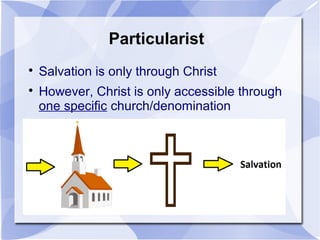
Particularist

Salvation is only through Christ

However, Christ is only accessible through
one specific church/denomination
Exclusivist

Salvation is only through Christ.

Only those who knowingly respond to
Christ are saved.

The specific church/group is not important
Note:

Some people use the terms “Particularist”
and “Exclusivist” interchangeably.

However, it is useful to consider them
separately.

Particularists, then, would go beyond
Exclusivists by adding the need for
mediation by a specific group or person to
have access to Christ.
Inclusivists

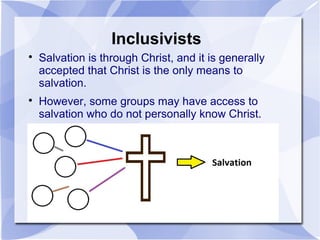
Salvation is through Christ, and it is generally
accepted that Christ is the only means to
salvation.

However, some groups may have access to
salvation who do not personally know Christ.
Pluralists

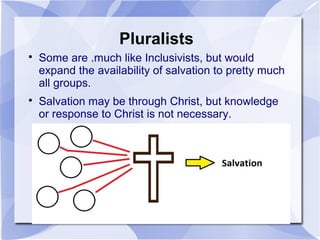
Some are .much like Inclusivists, but would
expand the availability of salvation to pretty much
all groups.

Salvation may be through Christ, but knowledge
or response to Christ is not necessary.
Pluralists

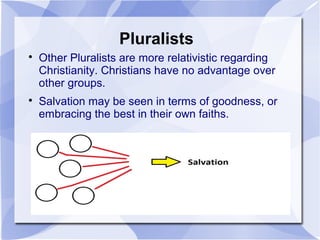
Other Pluralists are more relativistic regarding
Christianity. Christians have no advantage over
other groups.

Salvation may be seen in terms of goodness, or
embracing the best in their own faiths.
Universalists

God saves everyone regardless of their
behavior or their beliefs.

There are different variations on this as to
whether it is through Christ, or whether
their may be a time of suffering, or some
form of another chance.
Where do Evangelicals fit into this?

There are people who describe themselves
as Evangelicals in all of the above
categories.

However, some of the categories do not
really fit well with an Evangelical viewpoint
of faith and the Bible.
Evanglicals

Particularism is problematic, because it
appears to say that faith in Christ is not
enough. One must be part of a specific
group, or do a sacrament in a certain way,
or have some secondary sign.

Pluralism and Universalism downplay the
role of Jesus as the way, truth, and the
life... as well as reducing the importance of
faith for salvation.
Evangelicals

Most Evangelicals would fit somewhere in the
area where Exclusivism and Inclusivism overlap.

We must have faith in Christ, and salvation is
through Christ alone.

But many Evangelicals would say that those who
have not heard, or who are mentally retarded, or
die as infants, may be saved by the blood of
Christ, without personally know Christ. Some may
add other groups, such as devout members of
the Jewish faith.
Inter-religious Dialogue

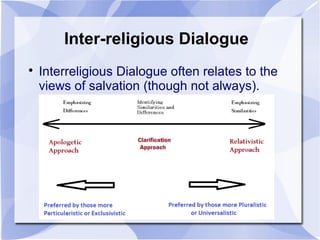
Interreligious Dialogue often relates to the
views of salvation (though not always).
Apologetic Approach

Those who are more Particularistic or
Exclusivistic tend to see other religions as
false and deceptive. Therefore, the goal is
not to learn anything from them, but to
convert them to faith in Christ, or allegiance
with one's religious group.

Therefore, there is a tendency to
emphasize differences, and to debate with
those of other faiths.
Relativistic Approach

Those who are more Pluralistic or
Universalistic, tend to take a more positive
or hopeful view of other faiths. As such,
they tend to look toward similarities
between Christianity and other faiths, and
seek to “see God” in those faiths.

As such, there is a tendency to discuss
non-judgmentally, without presuming truth
or falseness of individual beliefs.
Clarification Approach

In between the Apologetic and Relativistic
Approach, is the Clarification approach.

It seeks neither an antagonistic or
relativistic view of dialogue. Rather, it
recognizes that there are both similarities
and differences between Christianity and
other faiths.

The goal is mutual understanding.
In this course...

The presumption is that the Clarification
Approach is most often the best. The
Relativistic Approach does not promote
truth or transformation. The Apologetic
Approach is divisive and actually may
inhibit conversion.

Clarification makes the Gospel clearer to
those of other faiths... while removing
barriers of stereotypes and
misunderstandings.
Views on Interreligious Dialogue
and Salvation
By Robert H. Munson
Adjunct Faculty
Philippine Baptist Theological
Seminary
www.munsonmissions.org

Views on Interreligious Dialogue and Salvation

  • 1.
    Views on InterreligiousDialogue and Salvation By Robert H. Munson Adjunct Faculty Philippine Baptist Theological Seminary
  • 2.
    Goal  This presentation looksat two issues: (1) Who can be saved, and (2) How do we have dialogue with people of other faiths.  These two issues have a strong relationship with each other-- in that how many relate to other faiths is connected with their view of who can be saved.  This presentation is developed as it relates to the perspective(s) of those who desribe themselves as Evangelical Christians.
  • 3.
    Views on Salvation(from a Christian Perspective)
  • 4.
    Particularist  Salvation is onlythrough Christ  However, Christ is only accessible through one specific church/denomination
  • 5.
    Exclusivist  Salvation is onlythrough Christ.  Only those who knowingly respond to Christ are saved.  The specific church/group is not important
  • 6.
    Note:  Some people usethe terms “Particularist” and “Exclusivist” interchangeably.  However, it is useful to consider them separately.  Particularists, then, would go beyond Exclusivists by adding the need for mediation by a specific group or person to have access to Christ.
  • 7.
    Inclusivists  Salvation is throughChrist, and it is generally accepted that Christ is the only means to salvation.  However, some groups may have access to salvation who do not personally know Christ.
  • 8.
    Pluralists  Some are .muchlike Inclusivists, but would expand the availability of salvation to pretty much all groups.  Salvation may be through Christ, but knowledge or response to Christ is not necessary.
  • 9.
    Pluralists  Other Pluralists aremore relativistic regarding Christianity. Christians have no advantage over other groups.  Salvation may be seen in terms of goodness, or embracing the best in their own faiths.
  • 10.
    Universalists  God saves everyoneregardless of their behavior or their beliefs.  There are different variations on this as to whether it is through Christ, or whether their may be a time of suffering, or some form of another chance.
  • 11.
    Where do Evangelicalsfit into this?  There are people who describe themselves as Evangelicals in all of the above categories.  However, some of the categories do not really fit well with an Evangelical viewpoint of faith and the Bible.
  • 12.
    Evanglicals  Particularism is problematic,because it appears to say that faith in Christ is not enough. One must be part of a specific group, or do a sacrament in a certain way, or have some secondary sign.  Pluralism and Universalism downplay the role of Jesus as the way, truth, and the life... as well as reducing the importance of faith for salvation.
  • 13.
    Evangelicals  Most Evangelicals wouldfit somewhere in the area where Exclusivism and Inclusivism overlap.  We must have faith in Christ, and salvation is through Christ alone.  But many Evangelicals would say that those who have not heard, or who are mentally retarded, or die as infants, may be saved by the blood of Christ, without personally know Christ. Some may add other groups, such as devout members of the Jewish faith.
  • 14.
    Inter-religious Dialogue  Interreligious Dialogueoften relates to the views of salvation (though not always).
  • 15.
    Apologetic Approach  Those whoare more Particularistic or Exclusivistic tend to see other religions as false and deceptive. Therefore, the goal is not to learn anything from them, but to convert them to faith in Christ, or allegiance with one's religious group.  Therefore, there is a tendency to emphasize differences, and to debate with those of other faiths.
  • 16.
    Relativistic Approach  Those whoare more Pluralistic or Universalistic, tend to take a more positive or hopeful view of other faiths. As such, they tend to look toward similarities between Christianity and other faiths, and seek to “see God” in those faiths.  As such, there is a tendency to discuss non-judgmentally, without presuming truth or falseness of individual beliefs.
  • 17.
    Clarification Approach  In betweenthe Apologetic and Relativistic Approach, is the Clarification approach.  It seeks neither an antagonistic or relativistic view of dialogue. Rather, it recognizes that there are both similarities and differences between Christianity and other faiths.  The goal is mutual understanding.
  • 18.
    In this course...  Thepresumption is that the Clarification Approach is most often the best. The Relativistic Approach does not promote truth or transformation. The Apologetic Approach is divisive and actually may inhibit conversion.  Clarification makes the Gospel clearer to those of other faiths... while removing barriers of stereotypes and misunderstandings.
  • 19.
    Views on InterreligiousDialogue and Salvation By Robert H. Munson Adjunct Faculty Philippine Baptist Theological Seminary www.munsonmissions.org