
Diagnostics of a
Linux System
Understanding Your Operating System


Stephan Barth                       Sander van Vugt
Senior Technical Support Engineer   Independent Trainer and Consultant
stephan.barth@novell.com            mail@sandervanvugt.nl
Overview

      A Few Words About Us


      Basic Parts of a Linux System (theory)


      Analyzing and Debugging


      Other Important Tools and Commands


      Demo: Troubleshooting Server Issues
2   © Novell, Inc. All rights reserved.
Basic Parts of a Linux System


       Boot loader, e.g. Grub, LILO

       Kernel

       glibc

       init


4   © Novell, Inc. All rights reserved.
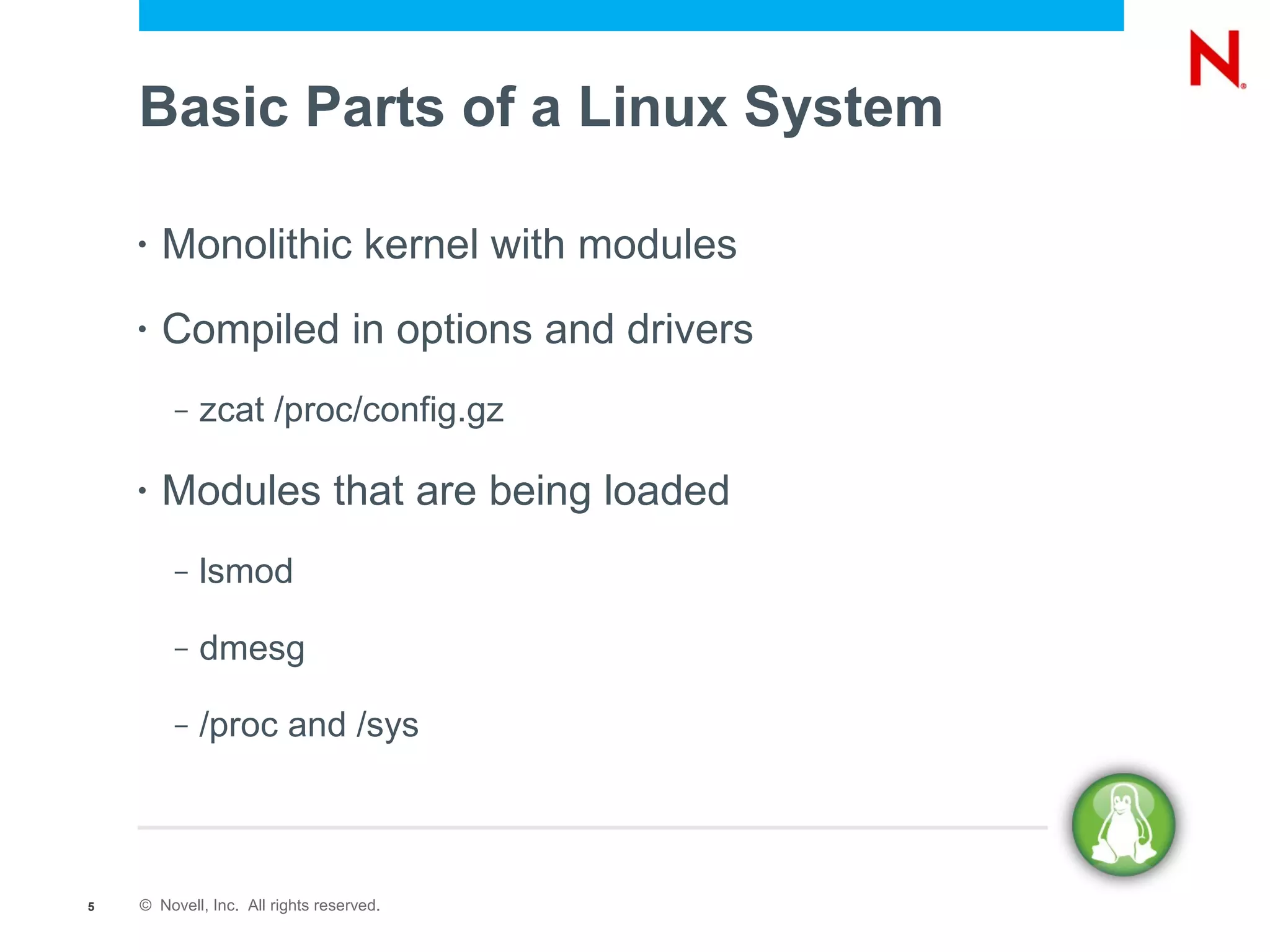
Basic Parts of a Linux System

    •   Monolithic kernel with modules
    •   Compiled in options and drivers
         –   zcat /proc/config.gz

    •   Modules that are being loaded
         –   lsmod

         –   dmesg

         –   /proc and /sys


5   © Novell, Inc. All rights reserved.
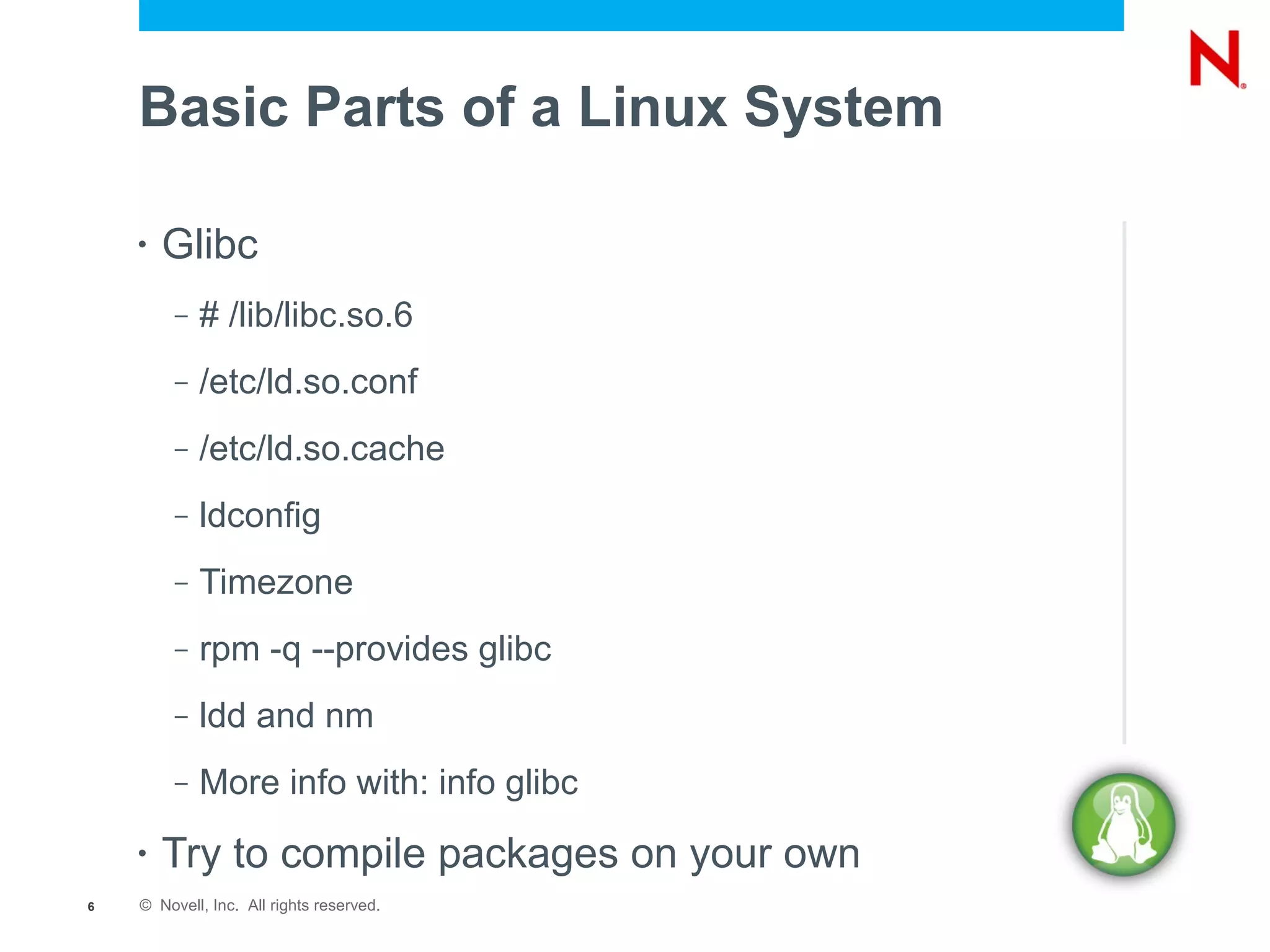
Basic Parts of a Linux System

    •   Glibc
         –   # /lib/libc.so.6
         –   /etc/ld.so.conf
         –   /etc/ld.so.cache
         –   ldconfig
         –   Timezone
         –   rpm -q --provides glibc
         –   ldd and nm
         –   More info with: info glibc
    •   Try to compile packages on your own
6   © Novell, Inc. All rights reserved.
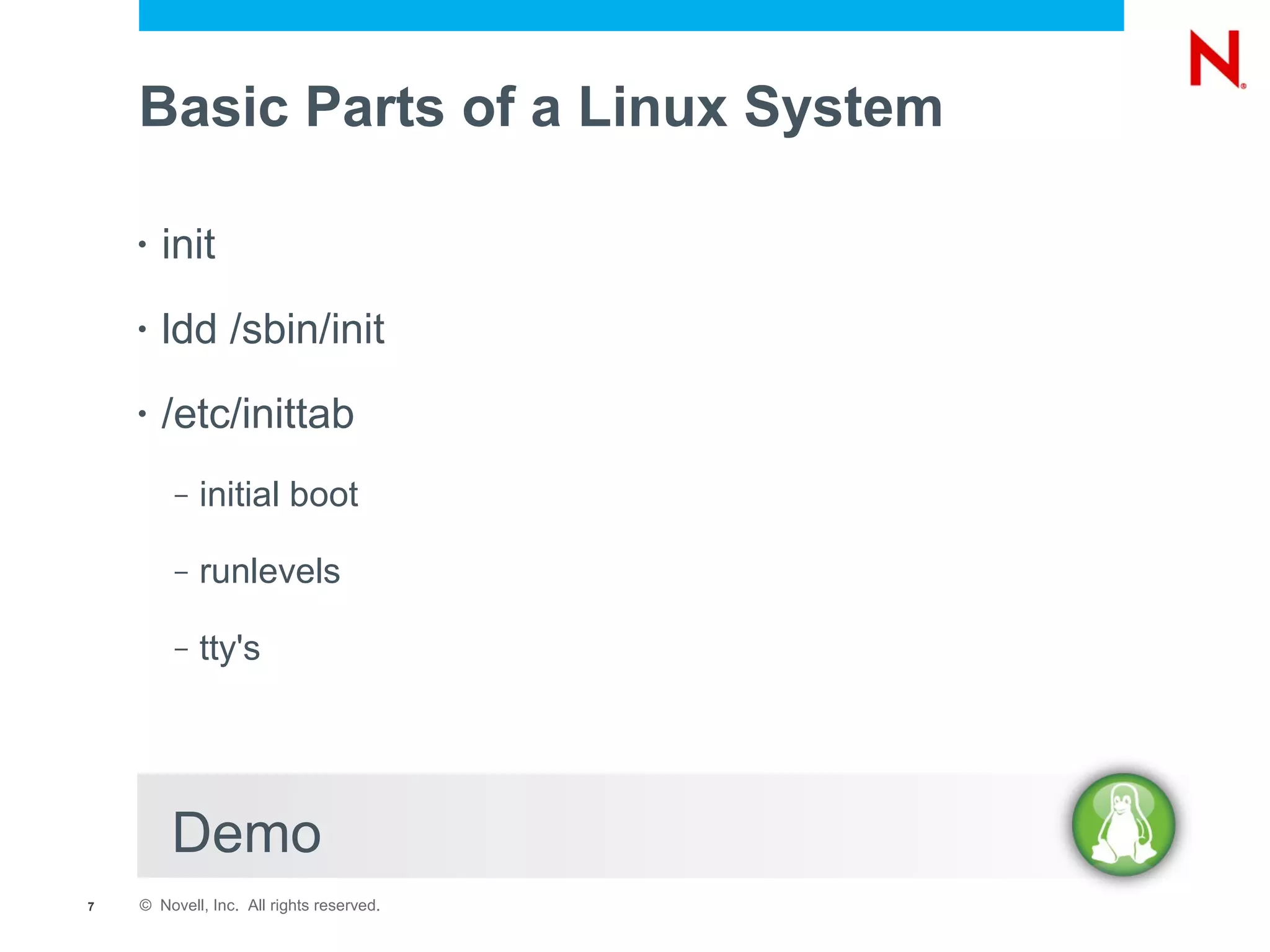
Basic Parts of a Linux System

    •   init
    •   ldd /sbin/init
    •   /etc/inittab
         –   initial boot

         –   runlevels

         –   tty's


        Demo
7   © Novell, Inc. All rights reserved.
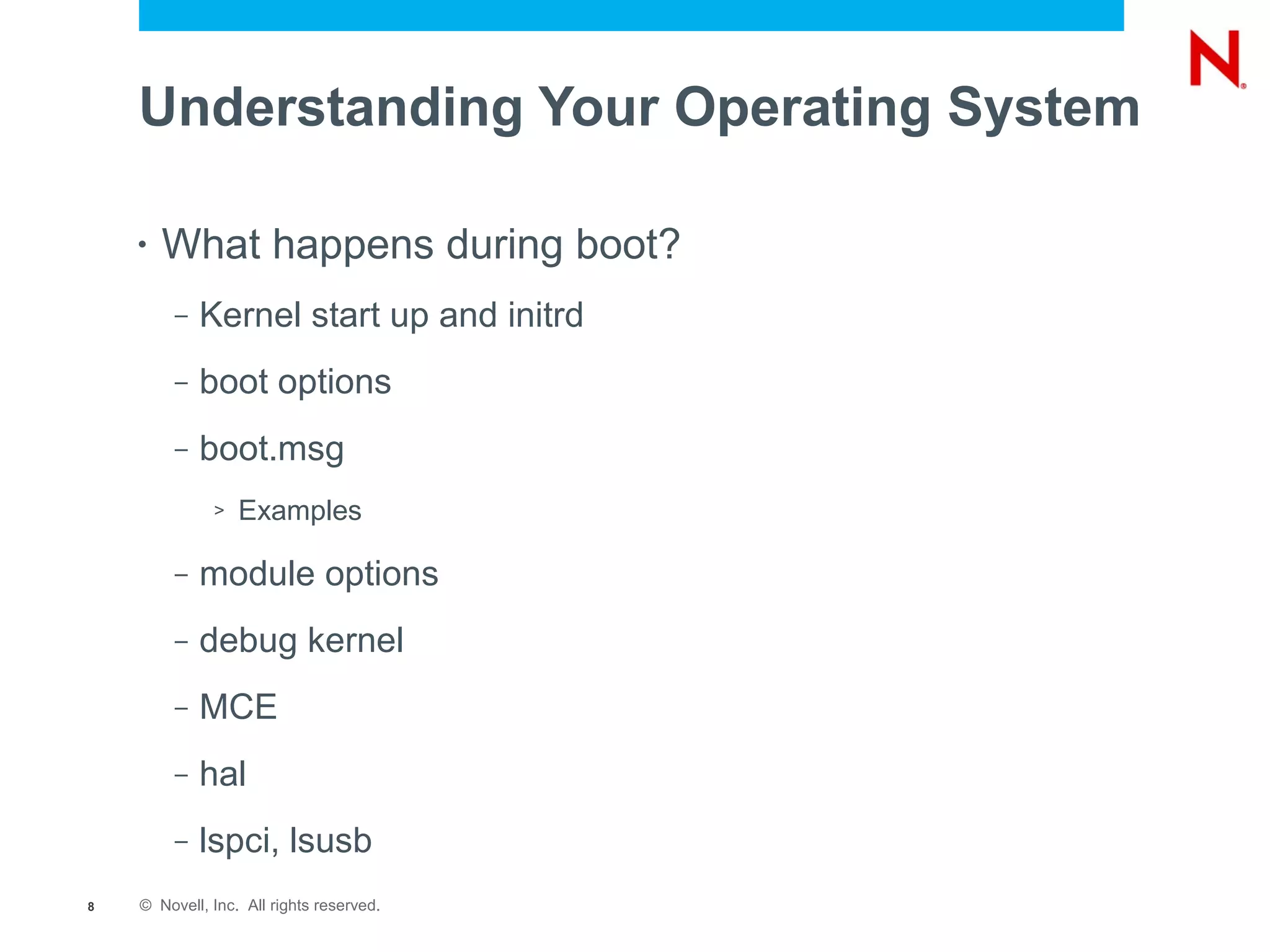
Understanding Your Operating System

    •   What happens during boot?
         –   Kernel start up and initrd
         –   boot options
         –   boot.msg
              >   Examples

         –   module options
         –   debug kernel
         –   MCE
         –   hal
         –   lspci, lsusb
8   © Novell, Inc. All rights reserved.
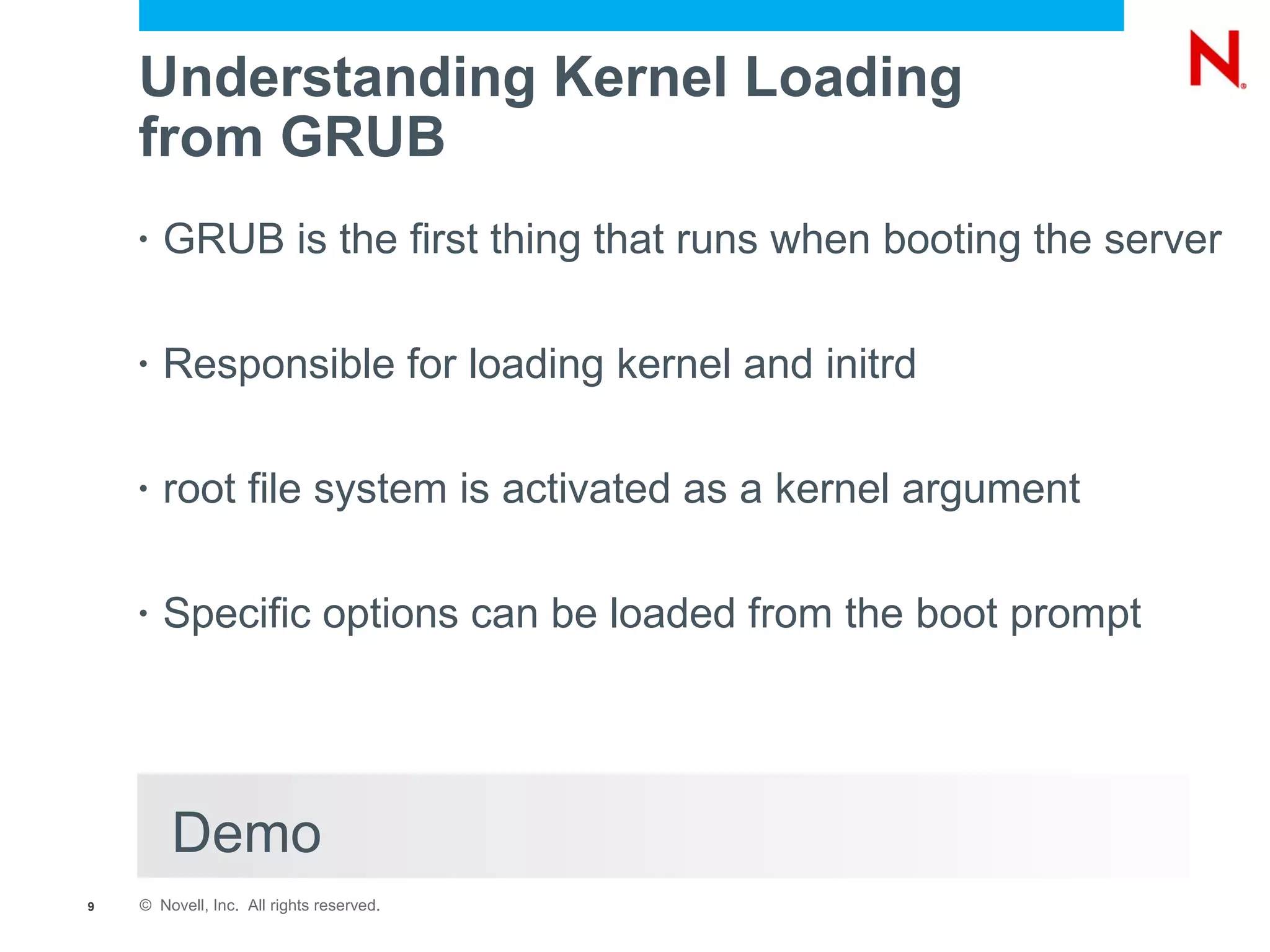
Understanding Kernel Loading
    from GRUB
    •   GRUB is the first thing that runs when booting the server

    •   Responsible for loading kernel and initrd

    •   root file system is activated as a kernel argument

    •   Specific options can be loaded from the boot prompt


        Demo
9   © Novell, Inc. All rights reserved.
Analyzing and Debugging
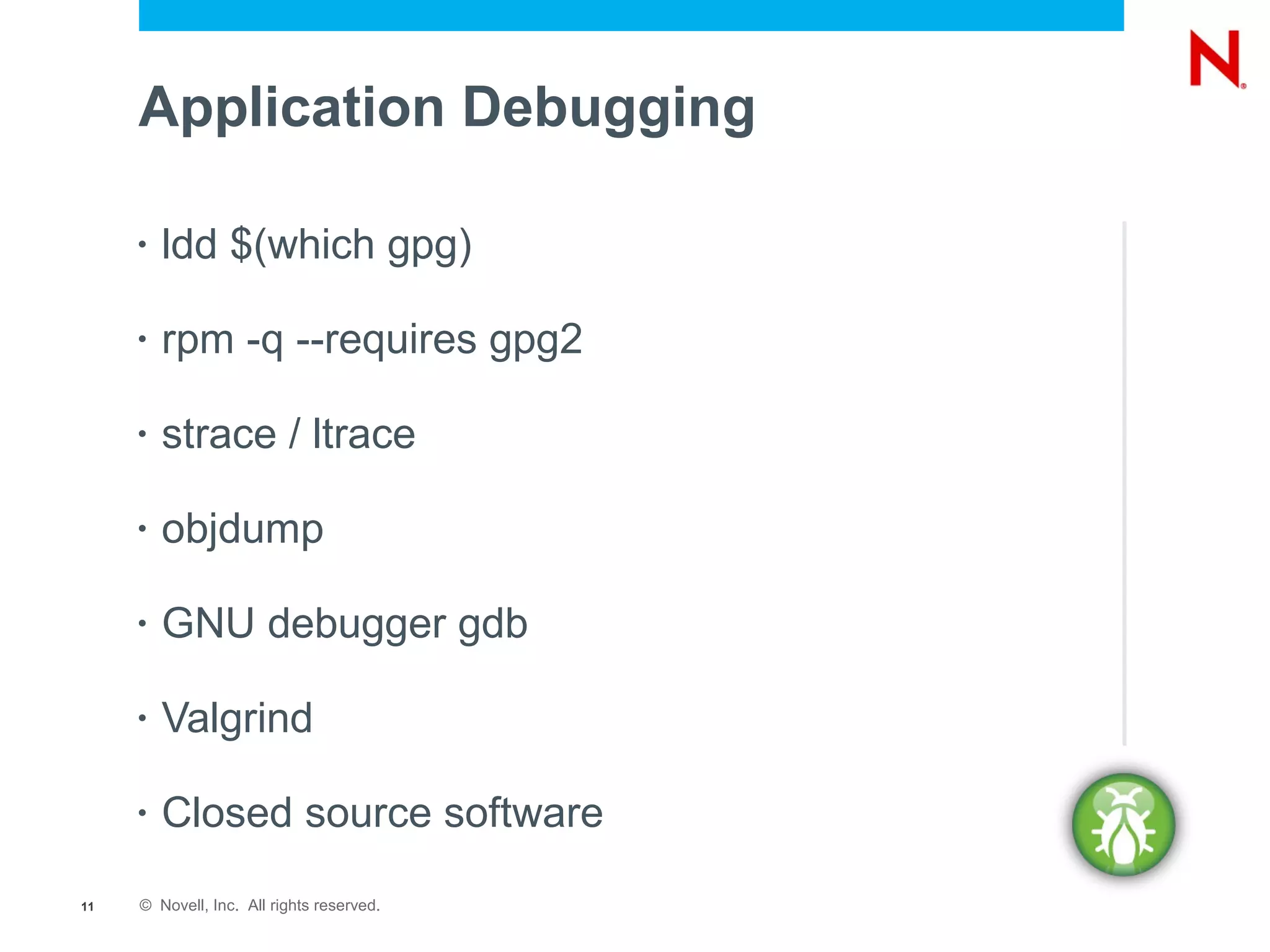
Application Debugging

     •   ldd $(which gpg)

     •   rpm -q --requires gpg2

     •   strace / ltrace

     •   objdump

     •   GNU debugger gdb

     •   Valgrind

     •   Closed source software
11   © Novell, Inc. All rights reserved.
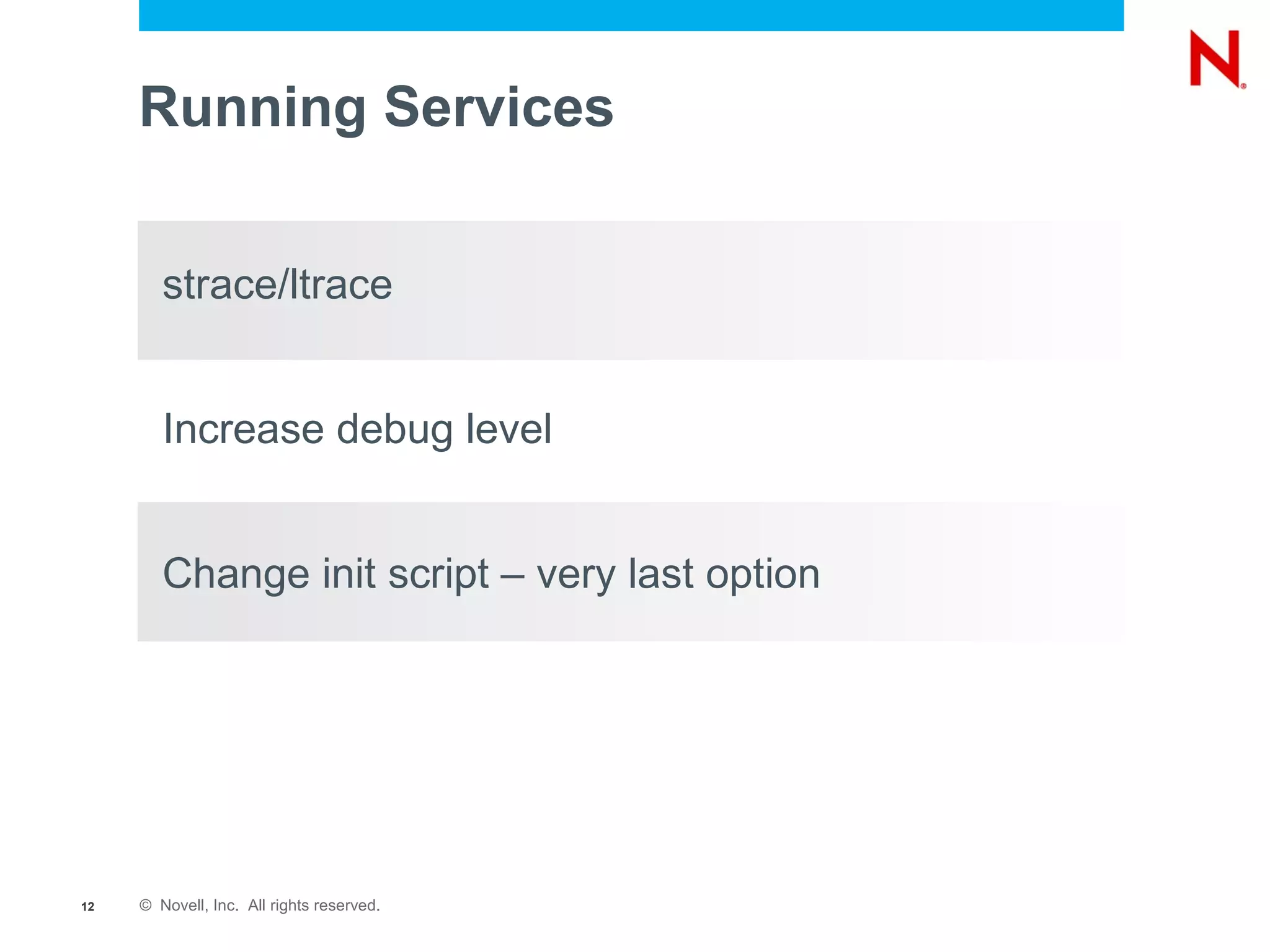
Running Services


        strace/ltrace


        Increase debug level


        Change init script – very last option


12   © Novell, Inc. All rights reserved.
Memory and Storage

     •   Memory debugging is difficult

          –   ps

          –   top

          –   sar


     •   Disk usage

          –   df vs. du


13   © Novell, Inc. All rights reserved.
Other Important Tools and Commands
Miscellaneous Tools

     •   Parted

     •   Ethtool

     •   RPM
          –   rpm -qf

          –   rpm -qa --last

          –   zypper

     •   How to find files, packages: ARCHIVES.gz, pin, distpin

15   © Novell, Inc. All rights reserved.
Looking at Startup

     •   Different stages in startup

          –   GRUB

          –   loading of kernel and initrd

          –   init taking over and doing initial boot

          –   init starting runlevels


         Demo
16   © Novell, Inc. All rights reserved.
Novell Tools            ®


         supportconfig


         Novell Support Advisor


17   © Novell, Inc. All rights reserved.
Demo: Troubleshooting Server Issues
Unpublished Work of Novell, Inc. All Rights Reserved.
This work is an unpublished work and contains confidential, proprietary, and trade secret information of Novell, Inc.
Access to this work is restricted to Novell employees who have a need to know to perform tasks within the scope
of their assignments. No part of this work may be practiced, performed, copied, distributed, revised, modified,
translated, abridged, condensed, expanded, collected, or adapted without the prior written consent of Novell, Inc.
Any use or exploitation of this work without authorization could subject the perpetrator to criminal and civil liability.


General Disclaimer
This document is not to be construed as a promise by any participating company to develop, deliver, or market a
product. It is not a commitment to deliver any material, code, or functionality, and should not be relied upon in
making purchasing decisions. Novell, Inc. makes no representations or warranties with respect to the contents
of this document, and specifically disclaims any express or implied warranties of merchantability or fitness for any
particular purpose. The development, release, and timing of features or functionality described for Novell products
remains at the sole discretion of Novell. Further, Novell, Inc. reserves the right to revise this document and to
make changes to its content, at any time, without obligation to notify any person or entity of such revisions or
changes. All Novell marks referenced in this presentation are trademarks or registered trademarks of Novell, Inc.
in the United States and other countries. All third-party trademarks are the property of their respective owners.

Diagnostics of a Linux System

  • 1.
    Diagnostics of a LinuxSystem Understanding Your Operating System Stephan Barth Sander van Vugt Senior Technical Support Engineer Independent Trainer and Consultant stephan.barth@novell.com mail@sandervanvugt.nl
  • 2.
    Overview A Few Words About Us Basic Parts of a Linux System (theory) Analyzing and Debugging Other Important Tools and Commands Demo: Troubleshooting Server Issues 2 © Novell, Inc. All rights reserved.
  • 3.
    Basic Parts ofa Linux System
  • 4.
    Basic Parts ofa Linux System Boot loader, e.g. Grub, LILO Kernel glibc init 4 © Novell, Inc. All rights reserved.
  • 5.
    Basic Parts ofa Linux System • Monolithic kernel with modules • Compiled in options and drivers – zcat /proc/config.gz • Modules that are being loaded – lsmod – dmesg – /proc and /sys 5 © Novell, Inc. All rights reserved.
  • 6.
    Basic Parts ofa Linux System • Glibc – # /lib/libc.so.6 – /etc/ld.so.conf – /etc/ld.so.cache – ldconfig – Timezone – rpm -q --provides glibc – ldd and nm – More info with: info glibc • Try to compile packages on your own 6 © Novell, Inc. All rights reserved.
  • 7.
    Basic Parts ofa Linux System • init • ldd /sbin/init • /etc/inittab – initial boot – runlevels – tty's Demo 7 © Novell, Inc. All rights reserved.
  • 8.
    Understanding Your OperatingSystem • What happens during boot? – Kernel start up and initrd – boot options – boot.msg > Examples – module options – debug kernel – MCE – hal – lspci, lsusb 8 © Novell, Inc. All rights reserved.
  • 9.
    Understanding Kernel Loading from GRUB • GRUB is the first thing that runs when booting the server • Responsible for loading kernel and initrd • root file system is activated as a kernel argument • Specific options can be loaded from the boot prompt Demo 9 © Novell, Inc. All rights reserved.
  • 10.
  • 11.
    Application Debugging • ldd $(which gpg) • rpm -q --requires gpg2 • strace / ltrace • objdump • GNU debugger gdb • Valgrind • Closed source software 11 © Novell, Inc. All rights reserved.
  • 12.
    Running Services strace/ltrace Increase debug level Change init script – very last option 12 © Novell, Inc. All rights reserved.
  • 13.
    Memory and Storage • Memory debugging is difficult – ps – top – sar • Disk usage – df vs. du 13 © Novell, Inc. All rights reserved.
  • 14.
  • 15.
    Miscellaneous Tools • Parted • Ethtool • RPM – rpm -qf – rpm -qa --last – zypper • How to find files, packages: ARCHIVES.gz, pin, distpin 15 © Novell, Inc. All rights reserved.
  • 16.
    Looking at Startup • Different stages in startup – GRUB – loading of kernel and initrd – init taking over and doing initial boot – init starting runlevels Demo 16 © Novell, Inc. All rights reserved.
  • 17.
    Novell Tools ® supportconfig Novell Support Advisor 17 © Novell, Inc. All rights reserved.
  • 18.
  • 20.
    Unpublished Work ofNovell, Inc. All Rights Reserved. This work is an unpublished work and contains confidential, proprietary, and trade secret information of Novell, Inc. Access to this work is restricted to Novell employees who have a need to know to perform tasks within the scope of their assignments. No part of this work may be practiced, performed, copied, distributed, revised, modified, translated, abridged, condensed, expanded, collected, or adapted without the prior written consent of Novell, Inc. Any use or exploitation of this work without authorization could subject the perpetrator to criminal and civil liability. General Disclaimer This document is not to be construed as a promise by any participating company to develop, deliver, or market a product. It is not a commitment to deliver any material, code, or functionality, and should not be relied upon in making purchasing decisions. Novell, Inc. makes no representations or warranties with respect to the contents of this document, and specifically disclaims any express or implied warranties of merchantability or fitness for any particular purpose. The development, release, and timing of features or functionality described for Novell products remains at the sole discretion of Novell. Further, Novell, Inc. reserves the right to revise this document and to make changes to its content, at any time, without obligation to notify any person or entity of such revisions or changes. All Novell marks referenced in this presentation are trademarks or registered trademarks of Novell, Inc. in the United States and other countries. All third-party trademarks are the property of their respective owners.