





1
A REIMPLEMENTATION OF NETBSD
BASED ON A MICROKERNEL
Andrew S. Tanenbaum
and a team of students and programmers who
actually did all the work. Three of them,
Ben Gras, Lionel Sambuc, and Arun Thomas are here!
Vrije Universiteit
Amsterdam, The Netherlands
2
GOAL OF OUR WORK: BUILD A RELIABLE OS
Tanenbaum’s definition of a reliable OS:
“An operating system is said to be reliable when a
typical user has never experienced even a single
failure in his or her lifetime and does not know
anybody who has ever experienced a failure.”
In engineering terms, this is probably
mean time to failure > 50 years
I don’t think we are there yet
3
THE TELEVISION MODEL (BEFORE SMART TVs)
1. You buy the television
2. You plug it in
3. It works perfectly for the next 10 years
4
THE COMPUTER MODEL (WINDOWS EDITION)
5
THE COMPUTER MODEL (WINDOWS EDITION)
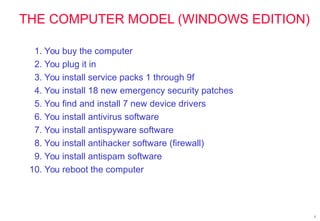
1. You buy the computer
2. You plug it in
3. You install service packs 1 through 9f
4. You install 18 new emergency security patches
5. You find and install 7 new device drivers
6. You install antivirus software
7. You install antispyware software
8. You install antihacker software (firewall)
9. You install antispam software
10. You reboot the computer
6
THE COMPUTER MODEL (2)
11. It doesn’t work
12. You call the helpdesk
13. You wait on hold for 30 minutes
14. They tell you to reinstall Windows
7
TYPICAL USER REACTION
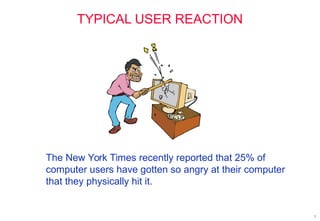
The New York Times recently reported that 25% of
computer users have gotten so angry at their computer
that they physically hit it.
IS RELIABILITY SO IMPORTANT?
• Annoying
• Lost work
• But also think about
– Industrial control systems in factories
– Power grids
– Hospital operating rooms
– Banking and e-commerce servers
– Emergency phone centers
– Control software in cars, airplanes, etc.
8
IS THIS FEASIBLE?
• We won’t find out if we don’t try
• Dutch Royal Academy gave me €2 million to try
• European Union gave me €2.5 million to give it a shot
• So, we’re trying
9
10
IS RELIABILITY ACHIEVABLE AT ALL?
• Systems can survive hardware failures!
– RAIDs can survive failed disks
– ECC memory can survive parity errors in memory
– TCP/IP can survive lost packets
– CD-ROM drives can correct many simultaneous errors
• We need to be able to survive software failures, too
11
A NEED TO RETHINK OPERATING SYSTEMS
• Operating systems research need to be refocused
– We have powerful hardware on PC-class machines
– Plenty of CPU cycles, RAM, bandwidth
– Current software has tons of (useless) features
– Consequently, the software is slow, bloated, and buggy
• To achieve the TV model, future OSes, must be
– Small
– Simple
– Modular
– Reliable
– Secure
– Self-healing
BRIEF HISTORY OF OUR WORK
• (1976) John Lions wrote a book on UNIX V6
• (1979) AT&T released V7 and forbade books on it 
• (1985) I started to write a UNIX-like OS from scratch
• (1987) MINIX 1 + book for teaching OS classes released
• (1997) MINIX 2 (POSIX) & 2nd edition of book released
• (2000) MINIX 2 license changed to BSD
• (2004) MINIX 3: start of work making a reliable OS
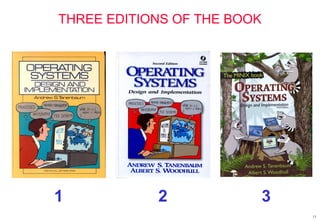
• (2006) 3rd edition of book
• (2008) European grant
• (2010) Focus moved towards embedded systems
• (2013) MINIX 3.3.0 moves to NetBSD “compatibility”
12
THREE EDITIONS OF THE BOOK
13
1 2 3
14
INTELLIGENT DESIGN
• Microkernel (13,000 LoC vs. > 15 million for Linux)
– Bugs per 1000 LoC: Most S/W (1-10)
– MINIX 3 at least 13 kernel bugs; Linux has > 15,000
– Drivers have 3-7x more bugs than rest of kernel
– About 70% of the code is drivers
• Highly modular
• OS runs as multiple user-mode server processes
AS APPLIED TO OPERATING SYSTEMS
15
STEP 1: ISOLATE COMPONENTS
• Move all loadable modules out of the kernel
– includes all device drivers, file systems, mem mgt, etc.
• Run each module as a separate process with POLA
(Principle Of Least Authority)
16
STEP 2: ISOLATE I/O
• Isolate I/O devices
• Limit access to I/O ports
• Constrain DMA (needs hardware assistance)
17
STEP 3: ISOLATE COMMUNICATION
• Limit interprocess communication
• Restrict IPC on a ‘need-to-communicate’ basis
• Restrict kernel calls on a per-component basis
• Make sure faulty receiver cannot hang sender
18
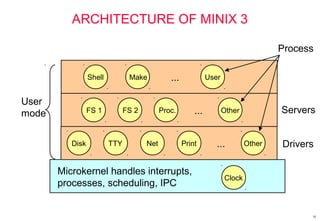
ARCHITECTURE OF MINIX 3
Microkernel handles interrupts,
processes, scheduling, IPC
Clock
FS 1 FS 2 Proc. Other... Servers
User
mode
Disk TTY Net Print Other... Drivers
Shell Make User...
Process
19
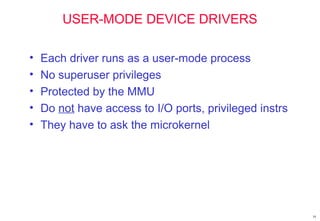
USER-MODE DEVICE DRIVERS
• Each driver runs as a user-mode process
• No superuser privileges
• Protected by the MMU
• Do not have access to I/O ports, privileged instrs
• They have to ask the microkernel
20
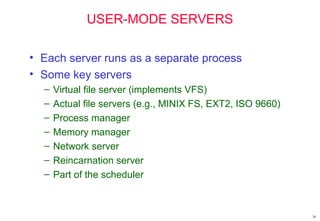
USER-MODE SERVERS
• Each server runs as a separate process
• Some key servers
– Virtual file server (implements VFS)
– Actual file servers (e.g., MINIX FS, EXT2, ISO 9660)
– Process manager
– Memory manager
– Network server
– Reincarnation server
– Part of the scheduler
21
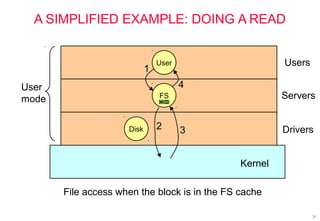
A SIMPLIFIED EXAMPLE: DOING A READ
User
mode Servers
Drivers
Users
Kernel
File access when the block is in the FS cache
1
2 3
4
User
Disk
FSFS
22
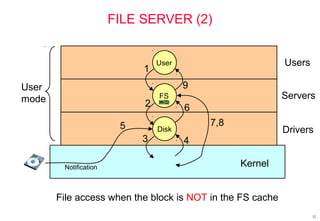
FILE SERVER (2)
File access when the block is NOT in the FS cache
Servers
User
mode
Drivers
Users
Kernel
1
2
3
9
4
6
7,85
Notification
FS
User
Disk
23
REINCARNATION SERVER
• Parent of all the drivers and servers
• When a driver or server dies, RS collects it
• RS checks a table for action to take e.g., restart it
• RS also pings drivers and servers frequently
24
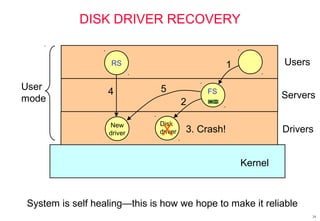
DISK DRIVER RECOVERY
Servers
User
mode
Drivers
Users
Kernel
User1
FS
2
Disk
driverX 3. Crash!
New
driver
4
RSRS
5
System is self healing—this is how we hope to make it reliable
25
KERNEL RELIABILITY/SECURITY
• Fewer LoC means fewer kernel bugs
• Small kernel (13,000 LoC) means reduced TCB
• NO foreign code (e.g., drivers) in the kernel
• Static data structures (no malloc in kernel)
• Moving bugs to user space puts them in cages
26
IPC RELIABILITY/SECURITY
• Fixed-length messages (no buffer overruns)
• Rendezvous system was simple
– No lost messages
– No buffer management
– We had to add asynchronous messages
• Interrupts and messages are unified
27
DRIVER RELIABILITY/SECURITY
• Untrusted code: heavily isolated
• Bugs, viruses cannot spread to other modules
• Cannot touch kernel data or other drivers/servers
• Bad pointers, buffer overruns crash only one driver
• Infinite loops detected and driver restarted
• Access to I/O ports is restricted
• Access to kernel calls is limited and checked
• Restricted power to do damage (not superuser)
28
OTHER ADVANTAGES OF USER COMPONENTS
• Short development cycle
• Normal programming model
• No down time for crash and reboot
• Easy debugging
• Good flexibility (applies to drivers, file systems, etc.)
29
FAULT INJECTION EXPERIMENT
• We injected 800,000 faults into each of 3 drivers
• Done on the binary drivers
• Examples, change src addr, dest addr, loop condition
• 100 faults were injected on each experiment
• Waited 1 sec to see if the driver crashed
• If no crash, inject another 100 faults and repeat
• The driver crashed in 18,038 trials
• The operating system NEVER crashed
30
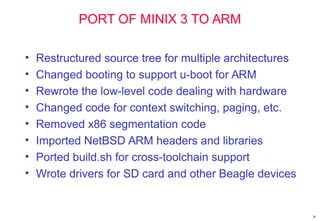
PORT OF MINIX 3 TO ARM
• Restructured source tree for multiple architectures
• Changed booting to support u-boot for ARM
• Rewrote the low-level code dealing with hardware
• Changed code for context switching, paging, etc.
• Removed x86 segmentation code
• Imported NetBSD ARM headers and libraries
• Ported build.sh for cross-toolchain support
• Wrote drivers for SD card and other Beagle devices
31
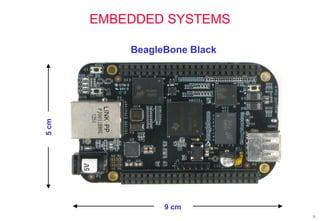
EMBEDDED SYSTEMS
9 cm
5cm BeagleBone Black
32
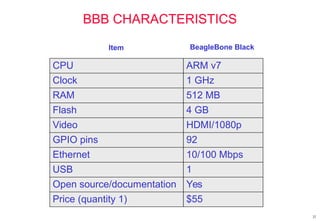
BBB CHARACTERISTICS
Item BeagleBone Black
CPU ARM v7
Clock 1 GHz
RAM 512 MB
Flash 4 GB
Video HDMI/1080p
GPIO pins 92
Ethernet 10/100 Mbps
USB 1
Open source/documentation Yes
Price (quantity 1) $55
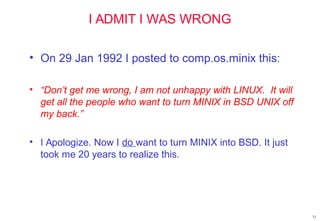
I ADMIT I WAS WRONG
• On 29 Jan 1992 I posted to comp.os.minix this:
• “Don’t get me wrong, I am not unhappy with LINUX. It will
get all the people who want to turn MINIX in BSD UNIX off
my back.”
• I Apologize. Now I do want to turn MINIX into BSD. It just
took me 20 years to realize this.
33
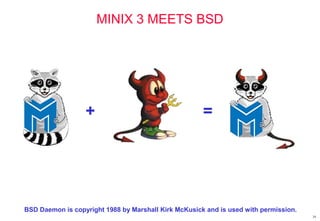
MINIX 3 MEETS BSD
34
+ =
BSD Daemon is copyright 1988 by Marshall Kirk McKusick and is used with permission.
OR MAYBE
35
WHY BSD?
• MINIX 3 didn’t have enough application software
• BSD is a proven, portable, quality product
• BSD has better code quality than Linux
• Pkgsrc handles packages better than what we had
• Thousands of excellent packages available
• Active community
• License compatibility
• Why NetBSD?
• Mostly due to its emphasis on portability
36
NETBSD FEATURES IN MINIX 3.3.0
• Clang/LLVM compiler
• NetBSD build system (build.sh)
• ELF file format
• Source code tree modeled on NetBSD
• Headers and libraries are from NetBSD
• Pkgsrc works and builds >4200 NetBSD packages
• Nevertheless, built on MINIX 3 kernel & servers
• X11 coming back soon (almost there)
37
NETBSD FEATURES MISSING IN MINIX 3.3.0
• Kernel threads (we do have userland pthreads)
• Some system calls:
– All _LWP*, MSG*, SEM* calls
– CLONE
– Some GET, IOCTL calls
– KQUEUE, KTRACE
– Job control
• Some weird socket options
• Nevertheless, we can build over 4200 packages
38
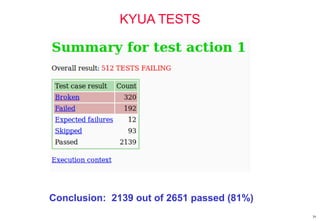
KYUA TESTS
39
Conclusion: 2139 out of 2651 passed (81%)
40
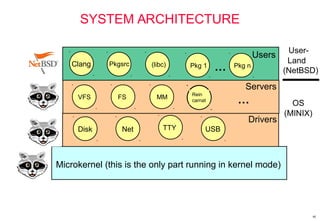
SYSTEM ARCHITECTURE
Servers
…
…
…
Drivers
Microkernel (this is the only part running in kernel mode)
Net
VFS
TTYDisk USB
FS MM Rein
carnat
OS
(MINIX)
Clang Pkgsrc (libc)
…Pkg 1 Pkg n
Users
User-
Land
(NetBSD)
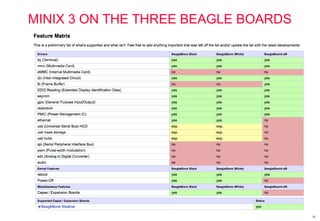
MINIX 3 ON THE THREE BEAGLE BOARDS
41
YOUR ROLE
• MINIX 3 is an open-source project
• I hope some of you will join and help us
• Things to do
– Add crucial missing system calls
– Port more packages (Java, a browser, etc.)
– Write the missing drivers for the Beagle series
– Get it running on Raspberry Pi & other platforms
– Port Rump
– Port required libraries and then port a GUI
– Much more
• Get involved!
42
43
MINIX 3 IN A NUTSHELL
• Microkernel reimplementation of NetBSD
• Fully open source with BSD license
• Highly compatible with NetBSD
• Supports both LLVM and gcc
• Uses NetBSD pkgsrc
• Over 4200 packages build
• Live update coming soon
• Good security by design (modularity, randomization)
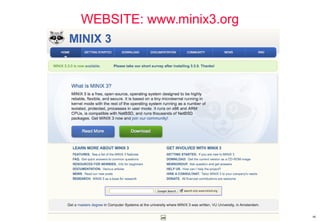
• Go get it at www.minix3.org and try it
44
POSITIONING OF MINIX
• Show that multiserver systems are
– reliable
– secure
– practical
• Demonstrate that drivers belong in user mode
• High-reliability and fault-tolerant applications
• $50 single-chip, small-RAM laptops for 3rd world
• Embedded systems
45
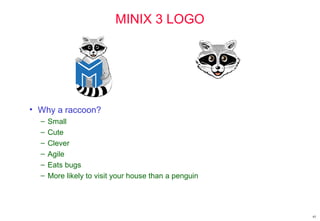
MINIX 3 LOGO
• Why a raccoon?
– Small
– Cute
– Clever
– Agile
– Eats bugs
– More likely to visit your house than a penguin
46
WEBSITE: www.minix3.org
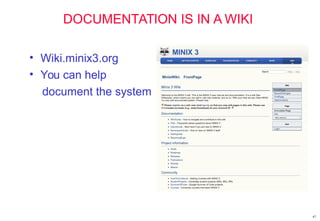
DOCUMENTATION IS IN A WIKI
• Wiki.minix3.org
• You can help
document the system
47
48
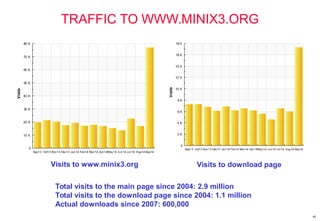
TRAFFIC TO WWW.MINIX3.ORG
Total visits to the main page since 2004: 2.9 million
Total visits to the download page since 2004: 1.1 million
Actual downloads since 2007: 600,000
Visits to download pageVisits to www.minix3.org
49
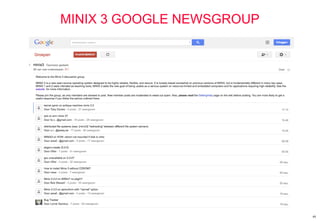
MINIX 3 GOOGLE NEWSGROUP
50
CONCLUSION
• Current OSes are bloated
• MINIX 3 is an attempt at a reliable, secure OS
• Kernel is very small (13,000 LoC)
• OS runs as a collection of user processes
• Each driver is a separate process
• Each OS component has restricted privileges
• Faulty drivers can be replaced automatically
• Live update is possible (not in current release)
• Uses NetBSD userland and packages
SURVEY
• Please download from www.minix3.org
• Give it a try
• Fill out the survey on the www.minix3.org page
• We had 14,000 downloads in Sept. but we don’t
know who they are or what they are doing
• We are trying to build an active community
51
MASTERS DEGREE AT THE VU
• If you are interested in a Masters in systems
• Google me, go to my home page
• Click on the YouTube video there
52
53
THE END
54
WEBSITE: www.minix3.org
55
56
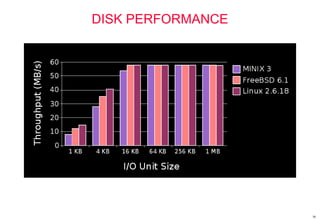
DISK PERFORMANCE
57
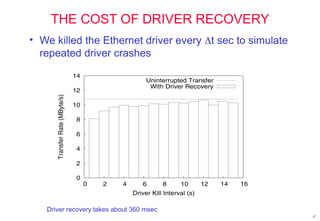
THE COST OF DRIVER RECOVERY
• We killed the Ethernet driver every t sec to simulate
repeated driver crashes
Driver recovery takes about 360 msec
58
RESEARCH: LIVE UPDATE
• We can update almost the entire system on the fly
• How: create new process (driver or server)
• New one contacts old one to get the state
• After state is transferred, third process is created
• It runs the state transfer backwards as a check
• If it is OK, connections are rerouted to the new one
• Applications don’t even notice this has happened
59
MUCH BETTER THAN KSPLICE
• KSPLICE can handle only small security patches
• SPLICE patches the running process
• Over time, crud accumulates in the process
• If the update fails, there is no recovery
60
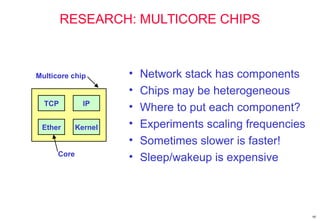
RESEARCH: MULTICORE CHIPS
• Network stack has components
• Chips may be heterogeneous
• Where to put each component?
• Experiments scaling frequencies
• Sometimes slower is faster!
• Sleep/wakeup is expensive
TCP IP
Ether Kernel
Multicore chip
Core
61
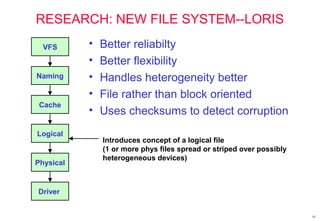
RESEARCH: NEW FILE SYSTEM--LORIS
• Better reliabilty
• Better flexibility
• Handles heterogeneity better
• File rather than block oriented
• Uses checksums to detect corruption
VFS
Naming
Cache
Logical
Physical
Driver
Introduces concept of a logical file
(1 or more phys files spread or striped over possibly
heterogeneous devices)
62
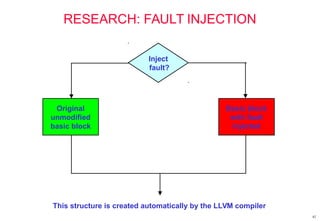
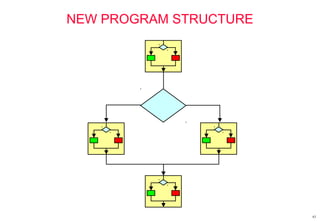
RESEARCH: FAULT INJECTION
Inject
fault?
Original
unmodified
basic block
Basic block
with fault
injected
This structure is created automatically by the LLVM compiler
63
NEW PROGRAM STRUCTURE

A Reimplementation of NetBSD Based on a Microkernel by Andrew S. Tanenbaum

  • 1.
    1 A REIMPLEMENTATION OFNETBSD BASED ON A MICROKERNEL Andrew S. Tanenbaum and a team of students and programmers who actually did all the work. Three of them, Ben Gras, Lionel Sambuc, and Arun Thomas are here! Vrije Universiteit Amsterdam, The Netherlands
  • 2.
    2 GOAL OF OURWORK: BUILD A RELIABLE OS Tanenbaum’s definition of a reliable OS: “An operating system is said to be reliable when a typical user has never experienced even a single failure in his or her lifetime and does not know anybody who has ever experienced a failure.” In engineering terms, this is probably mean time to failure > 50 years I don’t think we are there yet
  • 3.
    3 THE TELEVISION MODEL(BEFORE SMART TVs) 1. You buy the television 2. You plug it in 3. It works perfectly for the next 10 years
  • 4.
    4 THE COMPUTER MODEL(WINDOWS EDITION)
  • 5.
    5 THE COMPUTER MODEL(WINDOWS EDITION) 1. You buy the computer 2. You plug it in 3. You install service packs 1 through 9f 4. You install 18 new emergency security patches 5. You find and install 7 new device drivers 6. You install antivirus software 7. You install antispyware software 8. You install antihacker software (firewall) 9. You install antispam software 10. You reboot the computer
  • 6.
    6 THE COMPUTER MODEL(2) 11. It doesn’t work 12. You call the helpdesk 13. You wait on hold for 30 minutes 14. They tell you to reinstall Windows
  • 7.
    7 TYPICAL USER REACTION TheNew York Times recently reported that 25% of computer users have gotten so angry at their computer that they physically hit it.
  • 8.
    IS RELIABILITY SOIMPORTANT? • Annoying • Lost work • But also think about – Industrial control systems in factories – Power grids – Hospital operating rooms – Banking and e-commerce servers – Emergency phone centers – Control software in cars, airplanes, etc. 8
  • 9.
    IS THIS FEASIBLE? •We won’t find out if we don’t try • Dutch Royal Academy gave me €2 million to try • European Union gave me €2.5 million to give it a shot • So, we’re trying 9
  • 10.
    10 IS RELIABILITY ACHIEVABLEAT ALL? • Systems can survive hardware failures! – RAIDs can survive failed disks – ECC memory can survive parity errors in memory – TCP/IP can survive lost packets – CD-ROM drives can correct many simultaneous errors • We need to be able to survive software failures, too
  • 11.
    11 A NEED TORETHINK OPERATING SYSTEMS • Operating systems research need to be refocused – We have powerful hardware on PC-class machines – Plenty of CPU cycles, RAM, bandwidth – Current software has tons of (useless) features – Consequently, the software is slow, bloated, and buggy • To achieve the TV model, future OSes, must be – Small – Simple – Modular – Reliable – Secure – Self-healing
  • 12.
    BRIEF HISTORY OFOUR WORK • (1976) John Lions wrote a book on UNIX V6 • (1979) AT&T released V7 and forbade books on it  • (1985) I started to write a UNIX-like OS from scratch • (1987) MINIX 1 + book for teaching OS classes released • (1997) MINIX 2 (POSIX) & 2nd edition of book released • (2000) MINIX 2 license changed to BSD • (2004) MINIX 3: start of work making a reliable OS • (2006) 3rd edition of book • (2008) European grant • (2010) Focus moved towards embedded systems • (2013) MINIX 3.3.0 moves to NetBSD “compatibility” 12
  • 13.
    THREE EDITIONS OFTHE BOOK 13 1 2 3
  • 14.
    14 INTELLIGENT DESIGN • Microkernel(13,000 LoC vs. > 15 million for Linux) – Bugs per 1000 LoC: Most S/W (1-10) – MINIX 3 at least 13 kernel bugs; Linux has > 15,000 – Drivers have 3-7x more bugs than rest of kernel – About 70% of the code is drivers • Highly modular • OS runs as multiple user-mode server processes AS APPLIED TO OPERATING SYSTEMS
  • 15.
    15 STEP 1: ISOLATECOMPONENTS • Move all loadable modules out of the kernel – includes all device drivers, file systems, mem mgt, etc. • Run each module as a separate process with POLA (Principle Of Least Authority)
  • 16.
    16 STEP 2: ISOLATEI/O • Isolate I/O devices • Limit access to I/O ports • Constrain DMA (needs hardware assistance)
  • 17.
    17 STEP 3: ISOLATECOMMUNICATION • Limit interprocess communication • Restrict IPC on a ‘need-to-communicate’ basis • Restrict kernel calls on a per-component basis • Make sure faulty receiver cannot hang sender
  • 18.
    18 ARCHITECTURE OF MINIX3 Microkernel handles interrupts, processes, scheduling, IPC Clock FS 1 FS 2 Proc. Other... Servers User mode Disk TTY Net Print Other... Drivers Shell Make User... Process
  • 19.
    19 USER-MODE DEVICE DRIVERS •Each driver runs as a user-mode process • No superuser privileges • Protected by the MMU • Do not have access to I/O ports, privileged instrs • They have to ask the microkernel
  • 20.
    20 USER-MODE SERVERS • Eachserver runs as a separate process • Some key servers – Virtual file server (implements VFS) – Actual file servers (e.g., MINIX FS, EXT2, ISO 9660) – Process manager – Memory manager – Network server – Reincarnation server – Part of the scheduler
  • 21.
    21 A SIMPLIFIED EXAMPLE:DOING A READ User mode Servers Drivers Users Kernel File access when the block is in the FS cache 1 2 3 4 User Disk FSFS
  • 22.
    22 FILE SERVER (2) Fileaccess when the block is NOT in the FS cache Servers User mode Drivers Users Kernel 1 2 3 9 4 6 7,85 Notification FS User Disk
  • 23.
    23 REINCARNATION SERVER • Parentof all the drivers and servers • When a driver or server dies, RS collects it • RS checks a table for action to take e.g., restart it • RS also pings drivers and servers frequently
  • 24.
    24 DISK DRIVER RECOVERY Servers User mode Drivers Users Kernel User1 FS 2 Disk driverX3. Crash! New driver 4 RSRS 5 System is self healing—this is how we hope to make it reliable
  • 25.
    25 KERNEL RELIABILITY/SECURITY • FewerLoC means fewer kernel bugs • Small kernel (13,000 LoC) means reduced TCB • NO foreign code (e.g., drivers) in the kernel • Static data structures (no malloc in kernel) • Moving bugs to user space puts them in cages
  • 26.
    26 IPC RELIABILITY/SECURITY • Fixed-lengthmessages (no buffer overruns) • Rendezvous system was simple – No lost messages – No buffer management – We had to add asynchronous messages • Interrupts and messages are unified
  • 27.
    27 DRIVER RELIABILITY/SECURITY • Untrustedcode: heavily isolated • Bugs, viruses cannot spread to other modules • Cannot touch kernel data or other drivers/servers • Bad pointers, buffer overruns crash only one driver • Infinite loops detected and driver restarted • Access to I/O ports is restricted • Access to kernel calls is limited and checked • Restricted power to do damage (not superuser)
  • 28.
    28 OTHER ADVANTAGES OFUSER COMPONENTS • Short development cycle • Normal programming model • No down time for crash and reboot • Easy debugging • Good flexibility (applies to drivers, file systems, etc.)
  • 29.
    29 FAULT INJECTION EXPERIMENT •We injected 800,000 faults into each of 3 drivers • Done on the binary drivers • Examples, change src addr, dest addr, loop condition • 100 faults were injected on each experiment • Waited 1 sec to see if the driver crashed • If no crash, inject another 100 faults and repeat • The driver crashed in 18,038 trials • The operating system NEVER crashed
  • 30.
    30 PORT OF MINIX3 TO ARM • Restructured source tree for multiple architectures • Changed booting to support u-boot for ARM • Rewrote the low-level code dealing with hardware • Changed code for context switching, paging, etc. • Removed x86 segmentation code • Imported NetBSD ARM headers and libraries • Ported build.sh for cross-toolchain support • Wrote drivers for SD card and other Beagle devices
  • 31.
  • 32.
    32 BBB CHARACTERISTICS Item BeagleBoneBlack CPU ARM v7 Clock 1 GHz RAM 512 MB Flash 4 GB Video HDMI/1080p GPIO pins 92 Ethernet 10/100 Mbps USB 1 Open source/documentation Yes Price (quantity 1) $55
  • 33.
    I ADMIT IWAS WRONG • On 29 Jan 1992 I posted to comp.os.minix this: • “Don’t get me wrong, I am not unhappy with LINUX. It will get all the people who want to turn MINIX in BSD UNIX off my back.” • I Apologize. Now I do want to turn MINIX into BSD. It just took me 20 years to realize this. 33
  • 34.
    MINIX 3 MEETSBSD 34 + = BSD Daemon is copyright 1988 by Marshall Kirk McKusick and is used with permission.
  • 35.
  • 36.
    WHY BSD? • MINIX3 didn’t have enough application software • BSD is a proven, portable, quality product • BSD has better code quality than Linux • Pkgsrc handles packages better than what we had • Thousands of excellent packages available • Active community • License compatibility • Why NetBSD? • Mostly due to its emphasis on portability 36
  • 37.
    NETBSD FEATURES INMINIX 3.3.0 • Clang/LLVM compiler • NetBSD build system (build.sh) • ELF file format • Source code tree modeled on NetBSD • Headers and libraries are from NetBSD • Pkgsrc works and builds >4200 NetBSD packages • Nevertheless, built on MINIX 3 kernel & servers • X11 coming back soon (almost there) 37
  • 38.
    NETBSD FEATURES MISSINGIN MINIX 3.3.0 • Kernel threads (we do have userland pthreads) • Some system calls: – All _LWP*, MSG*, SEM* calls – CLONE – Some GET, IOCTL calls – KQUEUE, KTRACE – Job control • Some weird socket options • Nevertheless, we can build over 4200 packages 38
  • 39.
    KYUA TESTS 39 Conclusion: 2139out of 2651 passed (81%)
  • 40.
    40 SYSTEM ARCHITECTURE Servers … … … Drivers Microkernel (thisis the only part running in kernel mode) Net VFS TTYDisk USB FS MM Rein carnat OS (MINIX) Clang Pkgsrc (libc) …Pkg 1 Pkg n Users User- Land (NetBSD)
  • 41.
    MINIX 3 ONTHE THREE BEAGLE BOARDS 41
  • 42.
    YOUR ROLE • MINIX3 is an open-source project • I hope some of you will join and help us • Things to do – Add crucial missing system calls – Port more packages (Java, a browser, etc.) – Write the missing drivers for the Beagle series – Get it running on Raspberry Pi & other platforms – Port Rump – Port required libraries and then port a GUI – Much more • Get involved! 42
  • 43.
    43 MINIX 3 INA NUTSHELL • Microkernel reimplementation of NetBSD • Fully open source with BSD license • Highly compatible with NetBSD • Supports both LLVM and gcc • Uses NetBSD pkgsrc • Over 4200 packages build • Live update coming soon • Good security by design (modularity, randomization) • Go get it at www.minix3.org and try it
  • 44.
    44 POSITIONING OF MINIX •Show that multiserver systems are – reliable – secure – practical • Demonstrate that drivers belong in user mode • High-reliability and fault-tolerant applications • $50 single-chip, small-RAM laptops for 3rd world • Embedded systems
  • 45.
    45 MINIX 3 LOGO •Why a raccoon? – Small – Cute – Clever – Agile – Eats bugs – More likely to visit your house than a penguin
  • 46.
  • 47.
    DOCUMENTATION IS INA WIKI • Wiki.minix3.org • You can help document the system 47
  • 48.
    48 TRAFFIC TO WWW.MINIX3.ORG Totalvisits to the main page since 2004: 2.9 million Total visits to the download page since 2004: 1.1 million Actual downloads since 2007: 600,000 Visits to download pageVisits to www.minix3.org
  • 49.
  • 50.
    50 CONCLUSION • Current OSesare bloated • MINIX 3 is an attempt at a reliable, secure OS • Kernel is very small (13,000 LoC) • OS runs as a collection of user processes • Each driver is a separate process • Each OS component has restricted privileges • Faulty drivers can be replaced automatically • Live update is possible (not in current release) • Uses NetBSD userland and packages
  • 51.
    SURVEY • Please downloadfrom www.minix3.org • Give it a try • Fill out the survey on the www.minix3.org page • We had 14,000 downloads in Sept. but we don’t know who they are or what they are doing • We are trying to build an active community 51
  • 52.
    MASTERS DEGREE ATTHE VU • If you are interested in a Masters in systems • Google me, go to my home page • Click on the YouTube video there 52
  • 53.
  • 54.
  • 55.
  • 56.
  • 57.
    57 THE COST OFDRIVER RECOVERY • We killed the Ethernet driver every t sec to simulate repeated driver crashes Driver recovery takes about 360 msec
  • 58.
    58 RESEARCH: LIVE UPDATE •We can update almost the entire system on the fly • How: create new process (driver or server) • New one contacts old one to get the state • After state is transferred, third process is created • It runs the state transfer backwards as a check • If it is OK, connections are rerouted to the new one • Applications don’t even notice this has happened
  • 59.
    59 MUCH BETTER THANKSPLICE • KSPLICE can handle only small security patches • SPLICE patches the running process • Over time, crud accumulates in the process • If the update fails, there is no recovery
  • 60.
    60 RESEARCH: MULTICORE CHIPS •Network stack has components • Chips may be heterogeneous • Where to put each component? • Experiments scaling frequencies • Sometimes slower is faster! • Sleep/wakeup is expensive TCP IP Ether Kernel Multicore chip Core
  • 61.
    61 RESEARCH: NEW FILESYSTEM--LORIS • Better reliabilty • Better flexibility • Handles heterogeneity better • File rather than block oriented • Uses checksums to detect corruption VFS Naming Cache Logical Physical Driver Introduces concept of a logical file (1 or more phys files spread or striped over possibly heterogeneous devices)
  • 62.
    62 RESEARCH: FAULT INJECTION Inject fault? Original unmodified basicblock Basic block with fault injected This structure is created automatically by the LLVM compiler
  • 63.