DIAGNOSTIC TEST
INTRODUCTION
A test design to identify and investigate the difficulties, inadequate
and gaps of pupils in specific curriculum areas with a view to
helping them to overcome those difficulties through remedial
instruction is called diagnostic test.
The term diagnostic comprises all activities in measurement and
interpretation that help to identify the growth lags and their casual
favors for individuals or class.
Definitions
“A diagnostic test is developed to identify specific strengths and
weakness in basic skills such as reading, and arithmetic.” Stadola
and Stordahl
“Diagnostic tests are primarily concerned with the skills or
abilities that the subject matter experts believe are essential in
learning a particular subject.” Mehrens
“A diagnostic test undertakes to provide a picture of strengths and
weaknesses.” Payne
Diagnostic Test
A diagnostic test is a test designed to locate specific learning
deficiencies in case of specific individuals at a specific stage of
learning so that specific efforts could be made to overcome those
deficiencies.
It helps the teachers in identifying the status of learner at the end
of a particular lesson, unit or course of learning as to what
specific teaching or learning points have been properly grasped by
the learners.
Purposes
A diagnostic test is a means by which an individual profile is examined
and compared against certain norms or criteria.
The diagnostic test takes up where the formative test leaves off.
Diagnostic test focuses on individual’s educational weakness or learning
deficiency and identify the gaps in pupils.
Diagnostic test is more often limited to low ability students.
Diagnostic test is corrective in nature.
Diagnostic test pinpoint the specific types of error each pupil is making
and searches for underlying causes of the problem.
Diagnostic test is much more comprehensive
Steps of Construction for Educational
Diagnostic Test
Diagnostic test may be either standardized or teacher made.
Teacher-made test besides being more economical are also more
effective, as each teacher can frame it according to the specific
needs of students.
The following are the broad steps involved in the construction of
diagnostic test. Diagnostic test may be Standardized or Teacher
made and more or less followed the principles of test construction
i.e., preparation, planning, writing items, assembling the test,
preparing the scoring key and marking scheme and reviewing the
test.
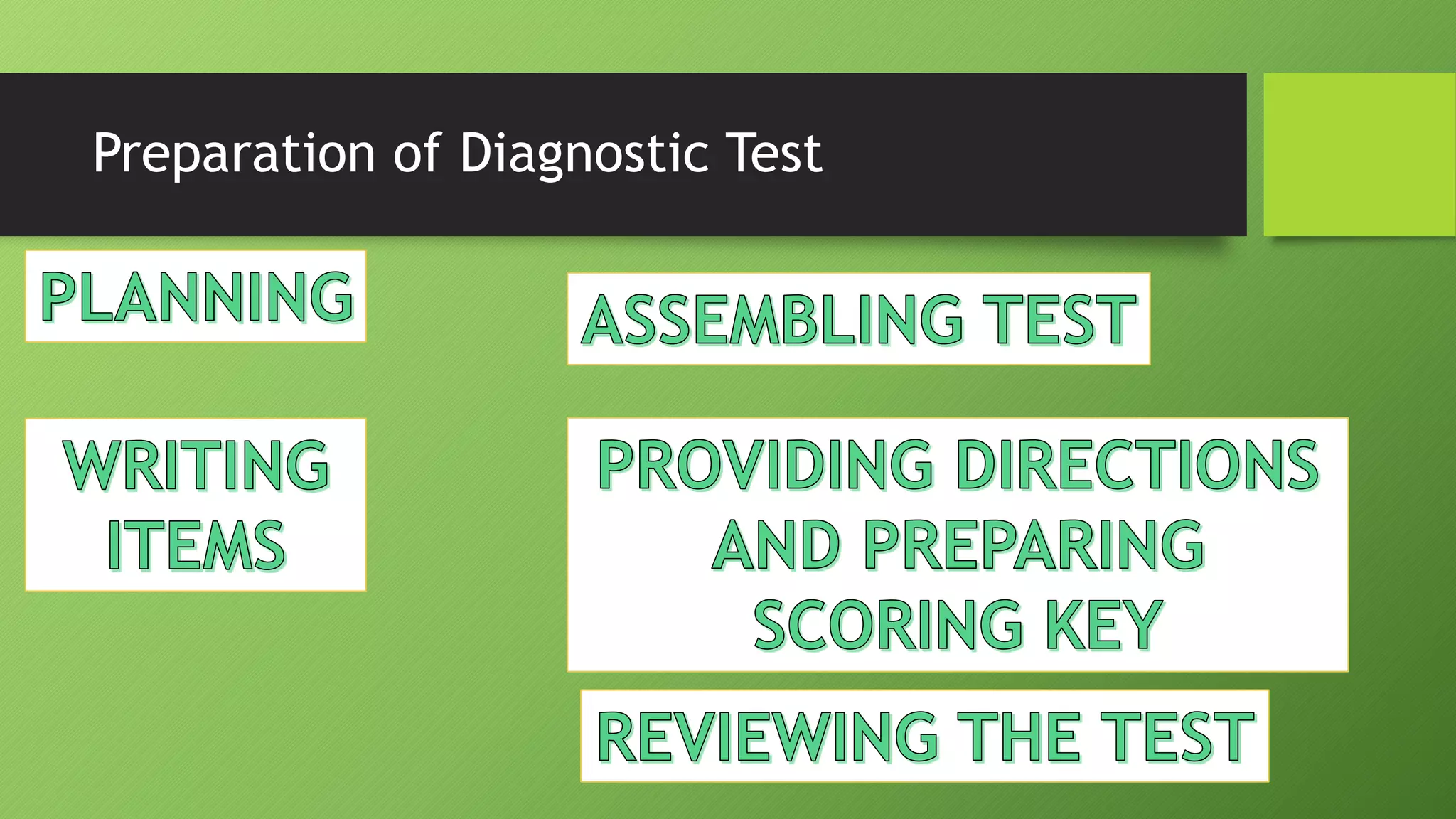
Preparation of Diagnostic Test
PLANNING
The first step in the construction of a diagnostic test is
identification of subject matter areas which are really difficult for
the pupils. After selecting areas they should be further divided in
to simple teaching point and test items may be constructed for
each points.
As for as diagnostic test is concerned is not very necessary to
know the importance of various learning points. All the learning
points have to be covered in an unbroken sequence each learning
point should have an adequate number of questions help to identify
the areas of weakness.
Writing the items
All the forms of questions, essay, short answer and objective type can be used
for testing different learning points. However it appears that for diagnostic
purpose short answer questions involving one or two steps, be used widely.
Whatever be the form of questions they should in general be easy suitable for
average students of that age or grade. The questions have to be specifically
related to the learning point and should be such as to throw eight on the
weakness of students. The questions should be written in simple language. The
scope of the expected answer should be clear to the student.
Questions are dubbed around learning point even when they are of different
forms, the learning point are arranged sequentially form simple to complex
which ensures that students not have to change their mental sets every
frequently. The mode of assembling also helps in finding out the weakness of
the student.
Assembling the Test
Preparation of blue point may at together be avoided. No rigid
time limit need to be specified through for administrative purpose
of the limit may be set.
Providing direction
A set of instructions clear and precise is drafted. It should also be
provided with a scoring key and marking scheme.
Reviewing the Test
Before printing the test, it should be carefully edited and reviewed.
This ensures that any in advert and errors are eliminated. An
analysis of the test testing down learning points with corresponding
questions may be presented for future reference.
Administration of Diagnostic Test
 Win the confidence of the students and reassure them that test is to
help them in improvement of their learning rather than for declaring
pass or fail.
 Administered in a released environment.
 Students should be seated comfortably.
 Students should not consult each other during the test.
 If any student is not able to follow something, he should be allowed to
seek clarification from the teacher.
 The teacher may ensure that the students attempt all questions.
 Time schedule should not be enforced strictly.
Uses of Diagnostic Test
The important uses of diagnostic tests are:
• Items, units or skills, which are understood by a majority of
students, can be located and teaching can be adjusted to the
situation.
• Items, units or skills which are not understood by a majority of
pupils can be located and there by special emphasis in these
aspects can be attempted.
• The causes for the difficulty in certain items can be found out, for
which remedial measures can be taken.
Uses of Diagnostic Test
• Individual weakness can be found out, which should serve as the baseline for
individual correction work and personal guidance.
• Diagnostic test may be used for prognosis. It helps to predict the possible
success in certain type of courses or vocation and therefore it helps in providing
guidance and counselling.
• Diagnostic tests can be made the basis of individualized instruction.
Differentiated teaching methods, ability grouping, individual drill,
differentiated assignments etc. can be attempted on the basis of the results of
diagnostic tests.
• Diagnostic test measures “real understanding” as opposed to superficial mastery
of subject areas measured by achievement of pupils in subject areas.
• Diagnostic tests can assist the pupil in locating one’s weakness and so they can
be corrected with maximum ease and economy.
Conclusion
In this presentation we have learnt about Diagnostic Testing which is
the most important part of the teaching-learning process. It implies a
detailed study of learning difficulties. Its aim is to analyze, not to
assess. The nature and purpose of Diagnostic Testing is to identify the
areas of difficulties where the learner commits errors.
After locating the area where the difficulty lies, as a teacher you will
devise some strategy to remove problems in learning and the causes
due to which the learner has faced the difficulties. The strategy used
by you to remove the weakness of the learner is known as remedial
teaching.
Example of test in your respective subject
Reading Difficulties Diagnostic Test
Letter identification (Visual Auditory Perception)
Recognizing the sounds, initial letter and diagraph.
1. underline the words which start with sound “k”.
Cat, Cereal, king, climb, cycle, curtain.
2. underline the words which start with the letter “b”.
beach, deep, dead, beads, beep, bread
3. underline the words which start with letter “w”.
whip, viper, where, vine, wise, vice
Sound Identification
1. Cloak-Clock
2. Sell-Sale
3. Course-Coarse
4. Foul- Fowl
5. Goat- Boat
Spelling Difficulties Diagnostic Test
Circle the correct spelling ( visual verbal association)
1. precent, present, present
2. flowor, flower, flowur
3. letter, lettar, lettor
Arithmetic Difficulties Diagnostic Test
Fundamental Mathematics – Operation tasks.
Fill up the blanks
1. 32+13= …………. [ (a) 45 (b) 33 (c) 46 (d) 41 ]
2. 56-21 = …………. [(a) 25 (b) 34 (c) 35 (d) 37 ]
3. 22 x 3 = ………… [(a) 66 (b) 33 (c) 46 (d) 62 ]
4. 266+165= …….. [(a) 331 (b) 531 (c) 431 (d) 321 ]

DIAGNOSTIC TEST PPT.pptx

  • 1.
  • 2.
    INTRODUCTION A test designto identify and investigate the difficulties, inadequate and gaps of pupils in specific curriculum areas with a view to helping them to overcome those difficulties through remedial instruction is called diagnostic test. The term diagnostic comprises all activities in measurement and interpretation that help to identify the growth lags and their casual favors for individuals or class.
  • 3.
    Definitions “A diagnostic testis developed to identify specific strengths and weakness in basic skills such as reading, and arithmetic.” Stadola and Stordahl “Diagnostic tests are primarily concerned with the skills or abilities that the subject matter experts believe are essential in learning a particular subject.” Mehrens “A diagnostic test undertakes to provide a picture of strengths and weaknesses.” Payne
  • 4.
    Diagnostic Test A diagnostictest is a test designed to locate specific learning deficiencies in case of specific individuals at a specific stage of learning so that specific efforts could be made to overcome those deficiencies. It helps the teachers in identifying the status of learner at the end of a particular lesson, unit or course of learning as to what specific teaching or learning points have been properly grasped by the learners.
  • 5.
    Purposes A diagnostic testis a means by which an individual profile is examined and compared against certain norms or criteria. The diagnostic test takes up where the formative test leaves off. Diagnostic test focuses on individual’s educational weakness or learning deficiency and identify the gaps in pupils. Diagnostic test is more often limited to low ability students. Diagnostic test is corrective in nature. Diagnostic test pinpoint the specific types of error each pupil is making and searches for underlying causes of the problem. Diagnostic test is much more comprehensive
  • 6.
    Steps of Constructionfor Educational Diagnostic Test Diagnostic test may be either standardized or teacher made. Teacher-made test besides being more economical are also more effective, as each teacher can frame it according to the specific needs of students. The following are the broad steps involved in the construction of diagnostic test. Diagnostic test may be Standardized or Teacher made and more or less followed the principles of test construction i.e., preparation, planning, writing items, assembling the test, preparing the scoring key and marking scheme and reviewing the test.
  • 7.
  • 8.
    PLANNING The first stepin the construction of a diagnostic test is identification of subject matter areas which are really difficult for the pupils. After selecting areas they should be further divided in to simple teaching point and test items may be constructed for each points. As for as diagnostic test is concerned is not very necessary to know the importance of various learning points. All the learning points have to be covered in an unbroken sequence each learning point should have an adequate number of questions help to identify the areas of weakness.
  • 9.
    Writing the items Allthe forms of questions, essay, short answer and objective type can be used for testing different learning points. However it appears that for diagnostic purpose short answer questions involving one or two steps, be used widely. Whatever be the form of questions they should in general be easy suitable for average students of that age or grade. The questions have to be specifically related to the learning point and should be such as to throw eight on the weakness of students. The questions should be written in simple language. The scope of the expected answer should be clear to the student. Questions are dubbed around learning point even when they are of different forms, the learning point are arranged sequentially form simple to complex which ensures that students not have to change their mental sets every frequently. The mode of assembling also helps in finding out the weakness of the student.
  • 10.
    Assembling the Test Preparationof blue point may at together be avoided. No rigid time limit need to be specified through for administrative purpose of the limit may be set.
  • 11.
    Providing direction A setof instructions clear and precise is drafted. It should also be provided with a scoring key and marking scheme.
  • 12.
    Reviewing the Test Beforeprinting the test, it should be carefully edited and reviewed. This ensures that any in advert and errors are eliminated. An analysis of the test testing down learning points with corresponding questions may be presented for future reference.
  • 13.
    Administration of DiagnosticTest  Win the confidence of the students and reassure them that test is to help them in improvement of their learning rather than for declaring pass or fail.  Administered in a released environment.  Students should be seated comfortably.  Students should not consult each other during the test.  If any student is not able to follow something, he should be allowed to seek clarification from the teacher.  The teacher may ensure that the students attempt all questions.  Time schedule should not be enforced strictly.
  • 14.
    Uses of DiagnosticTest The important uses of diagnostic tests are: • Items, units or skills, which are understood by a majority of students, can be located and teaching can be adjusted to the situation. • Items, units or skills which are not understood by a majority of pupils can be located and there by special emphasis in these aspects can be attempted. • The causes for the difficulty in certain items can be found out, for which remedial measures can be taken.
  • 15.
    Uses of DiagnosticTest • Individual weakness can be found out, which should serve as the baseline for individual correction work and personal guidance. • Diagnostic test may be used for prognosis. It helps to predict the possible success in certain type of courses or vocation and therefore it helps in providing guidance and counselling. • Diagnostic tests can be made the basis of individualized instruction. Differentiated teaching methods, ability grouping, individual drill, differentiated assignments etc. can be attempted on the basis of the results of diagnostic tests. • Diagnostic test measures “real understanding” as opposed to superficial mastery of subject areas measured by achievement of pupils in subject areas. • Diagnostic tests can assist the pupil in locating one’s weakness and so they can be corrected with maximum ease and economy.
  • 16.
    Conclusion In this presentationwe have learnt about Diagnostic Testing which is the most important part of the teaching-learning process. It implies a detailed study of learning difficulties. Its aim is to analyze, not to assess. The nature and purpose of Diagnostic Testing is to identify the areas of difficulties where the learner commits errors. After locating the area where the difficulty lies, as a teacher you will devise some strategy to remove problems in learning and the causes due to which the learner has faced the difficulties. The strategy used by you to remove the weakness of the learner is known as remedial teaching.
  • 17.
    Example of testin your respective subject Reading Difficulties Diagnostic Test Letter identification (Visual Auditory Perception) Recognizing the sounds, initial letter and diagraph. 1. underline the words which start with sound “k”. Cat, Cereal, king, climb, cycle, curtain. 2. underline the words which start with the letter “b”. beach, deep, dead, beads, beep, bread 3. underline the words which start with letter “w”. whip, viper, where, vine, wise, vice
  • 18.
    Sound Identification 1. Cloak-Clock 2.Sell-Sale 3. Course-Coarse 4. Foul- Fowl 5. Goat- Boat
  • 19.
    Spelling Difficulties DiagnosticTest Circle the correct spelling ( visual verbal association) 1. precent, present, present 2. flowor, flower, flowur 3. letter, lettar, lettor
  • 20.
    Arithmetic Difficulties DiagnosticTest Fundamental Mathematics – Operation tasks. Fill up the blanks 1. 32+13= …………. [ (a) 45 (b) 33 (c) 46 (d) 41 ] 2. 56-21 = …………. [(a) 25 (b) 34 (c) 35 (d) 37 ] 3. 22 x 3 = ………… [(a) 66 (b) 33 (c) 46 (d) 62 ] 4. 266+165= …….. [(a) 331 (b) 531 (c) 431 (d) 321 ]