Contrast media
Prepared By Ashenafi Abrha(MSc MRT)
6/17/2023 Prepared by Ashenafi Abrha(MSc MRT) 1
Objectives
At the end of this session you will be able to:
 Discuss about contrast agent and their effect
 Differentiate types of contrast media
 Identify the routes of administration of contrast media for various radiographic examinations
 Compare and contrast the use of ionic and nonionic iodinated contrast media
 Describe possible reactions to contrast media and categorize them according to their severity
6/17/2023 Prepared by Ashenafi Abrha(MSc MRT) 2
INTRODUCTION
 Contrast studies are those examinations in which contrast media are used to enhance
visualization of specific body structures.
 Because of the low subject contrast of the abdomen, contrast media are used to
demonstrate the anatomic structures of
 The urinary,
 Digestive, and biliary systems.
Its also used to evaluate other areas of the body, such as
 The spinal canal,
 Female reproductive system, and vasculature.
6/17/2023 Prepared by Ashenafi Abrha(MSc MRT) 3
Basic principle of contrast media
 It is a pharmaceutical agent that is administered to a patient for a radiographic
examination to enhance the contrast of a particular structure.
 It is depending on x-ray absorption and penetration that reach on the film.
 Its use allows for differentiation between a structure and surrounding tissues by
altering the density of the structure, which in turn alters the absorption of x-rays.
6/17/2023 Prepared by Ashenafi Abrha(MSc MRT) 4
Cont`d…
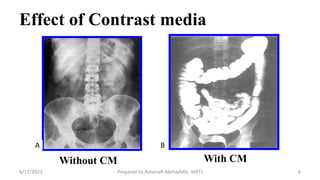
 It is a chemical substance of very high or very low atomic number or
weight, therefore it increase or decrease the density of the organ under
examination.
 A substance which when introduced into the body will increase the
radiographic contrast in an area where it was absent or low before.
6/17/2023 Prepared by Ashenafi Abrha(MSc MRT) 5
Effect of Contrast media
6/17/2023 Prepared by Ashenafi Abrha(MSc MRT) 6
Without CM With CM
B
A
6/17/2023 Prepared by Ashenafi Abrha(MSc MRT) 7
Cont`d…
 Structures & organs within the body have similarly low tissue densities.
 Tissue densities are depends on atomic number
 When x-ray pass through the structures some of the beam will be
 Absorbed (Denser structures) appear White on the radiograph
 Penetrated (lighter structures) appear dark on the radiograph
6/17/2023 Prepared by Ashenafi Abrha(MSc MRT) 8
Requirements of a Contrast Media
 Easy to administer
 No toxicity(neurotoxicity)
 Stable compound. – Will not dissociate into toxic ions
 When injected the media concentrates in the required areas.
 The agent’s physical features allow the organ to be properly
demonstrated
 even barium coating of the stomach in the presence of an acid environment.
6/17/2023 Prepared by Ashenafi Abrha(MSc MRT) 9
Requirements of a Contrast Media
 The agent should have rapid elimination.
 The agent should not be carcinogenic.
 The agent should have a viscosity appropriate to the patient when introduced.
 The agent should cause minimal distress to the patient when introduced.
 The agent should be cost-effective.
 Must possess a suitable half life for storage.
 Low or iso- osmolar to blood plasma.
6/17/2023 Prepared by Ashenafi Abrha(MSc MRT) 10
Types of contrast media
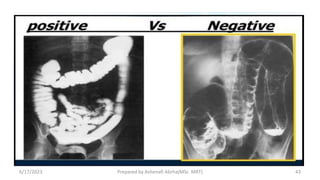
 The two basic classifications of contrast media are
1. Negative contrast agents and
2. Positive contrast agents.
6/17/2023 Prepared by Ashenafi Abrha(MSc MRT) 11
1. Negative contrast agent
 It is radiolucent,
 Has a low atomic number, and
 Allows x-rays to pass through quite easily.
 As more x-radiation reaches the film, the structure that is filled with a
negative contrast agent appears dark (black) on radiography.
6/17/2023 Prepared by Ashenafi Abrha(MSc MRT) 12
Cont`d…
 Gases, such as oxygen, carbon dioxide, and nitrous oxide, may be used as
negative contrast media, although room air is the most common agent.
 Gas crystals , the normally present gas bubble in the stomach.
 Calcium, magnesium citrate and carbonate crystals are frequently used to
produce CO2 gas.
 For example, the air in the lungs serves as a negative contrast medium on chest
radiography.
6/17/2023 Prepared by Ashenafi Abrha(MSc MRT) 13
Cont`d…
 A negative contrast medium may be used alone, as in the case of
an air arthrogram,
 It can also be combined with a positive contrast agent to produce
a double-contrast effect, such as a barium enema examination
with air.
6/17/2023 Prepared by Ashenafi Abrha(MSc MRT) 14
Cont`d…
 The uses of negative contrast media are limited, however, as
they may not provide sufficient contrast of a structure when
used singly.
 They must never be injected intravenously; doing so will
have serious, if not fatal, consequences.
6/17/2023 Prepared by Ashenafi Abrha(MSc MRT) 15
2. Positive Contrast Agent
 Is radiopaque
 Has a high atomic number.
 As it absorbs approximately three times more x-rays than bone and five times as
many x-rays as soft tissue,
 An organ filled with a positive contrast agent appears light on the resulting
radiography.
 Barium sulfate (BaSO4) and Iodinated compounds are most commonly used.
6/17/2023 Prepared by Ashenafi Abrha(MSc MRT) 16
BARIUM SULFATE
Properties
 Barium is a heavy metal having an atomic number of 56.
 It is combined with oxygen and sulfate to form the inert compound barium
sulfate (BaSO4).
 It is a white, crystalline powder that is insoluble in water.
 For use in radiography, it is mixed with water and stabilizing agents to form a
suspension.
 Barium sulfate is used for examination of the entire alimentary canal.
6/17/2023 Prepared by Ashenafi Abrha(MSc MRT) 17
Cont`d…
 High atomic number
 Not soluble in water
 Used to coat the lining of organs
 Supplied in different thicknesses
 Used
 Esophogram, UGI, Small Bowel,Lower GI or BE
6/17/2023 Prepared by Ashenafi Abrha(MSc MRT) 18
Cont`d…
 Ideally, the suspension should be dense to coat the mucosa and outline the visceral walls, yet
it must have the ability to flow smoothly through the alimentary canal.
 The products are available commercially in paste, liquid, powder, and tablet form.
 Paste, having a viscosity approximate to that of honey, may be recommended for an
esophagram.
 A liquid barium sulfate suspension can also be used for radiographic examination of the
esophagus, as well as the stomach and both small and large intestines.
6/17/2023 Prepared by Ashenafi Abrha(MSc MRT) 19
Cont`d…
 Barium sulfate tablets are helpful in evaluating foreign objects or
strictures in the esophagus.
 They dissolve in either the esophagus or stomach when mixed with
water.
6/17/2023 Prepared by Ashenafi Abrha(MSc MRT) 20
Contraindications
Because of its inability to be absorbed by the body, barium sulfate cannot be used
intravascularly or intrathecally.
Also, its use is contraindicated in the case of
 A suspected perforation in the alimentary canal.
 Recent or impending abdominal surgery.
 Obstruction of GIT.
 Mediastinal leakage.
 Aspiration.
 Peritoneal leakage and hypersensitivity.
6/17/2023 Prepared by Ashenafi Abrha(MSc MRT) 21
IODINATED COMPOUNDS
Properties
 Iodine is the element of choice for use as a contrast agent, as it forms stable
compounds and does not break down in the body. Like barium sulfate,
 It has a relatively low toxicity and
 High atomic number.
 Unlike barium sulfate, it is generally absorbed by the body and excreted by the
kidneys within 24 hours of intravascular administration.
6/17/2023 Prepared by Ashenafi Abrha(MSc MRT) 22
Cont`d…
 As iodinated contrast media have a tendency to break down in the light,
they should be shielded from bright light.
 The viscosity, or thickness, of the contrast medium is greatly determined by
the size the concentration of the molecules in the solution.
 It is recommended that the liquid iodinated contrast media be prewarmed to
body temperature prior to use.
6/17/2023 Prepared by Ashenafi Abrha(MSc MRT) 23
Cont`d…
 An iodinated contrast agent with a higher concentration is
generally used for cardiovascular studies, whereas a lower
concentration is used for urography and cholegraphy.
6/17/2023 Prepared by Ashenafi Abrha(MSc MRT) 24
Cont`d…
 Iodinated contrast media are available as either oil-based or
water-soluble agents.
 Each type of medium is selected for use based on the anatomy
to be examined.
6/17/2023 Prepared by Ashenafi Abrha(MSc MRT) 25
Oil-based Iodinated Contrast Media
 The use of oil-based iodinated contrast media in radiography is relatively limited.
 They are used primarily for studies of the lymphatic system (lymphangiography).
In the past, they were also used for studies of the
 Hysterosalpingography,
 Myelography),
 Bronchography
 Sialography, and
 Dacryocystography, but have been replaced by water-soluble iodinated nonionic contrast media.
6/17/2023 Prepared by Ashenafi Abrha(MSc MRT) 26
Cont`d…
 The oil-based iodinated contrast medium is used in hollow anatomic areas,
enhancing the radiographic contrast of the structure.
 The oily base of the contrast medium is a fatty acid, which is responsible for
making the solution viscous (thick) and insoluble in water and body fluids.
 Because it is not miscible with blood, it should never be injected intravenously
or intraarterially.
6/17/2023 Prepared by Ashenafi Abrha(MSc MRT) 27
Water-soluble iodinated contrast media
Water–Soluble (aqueous) iodinated contrast media are routinely used for
radiographic examinations of the
 Urinary,
 Biliary, and cardiovascular systems,
 as well as the digestive system if barium sulfate is contraindicated.
 It also used in special examinations of the skeletal system such as
myelography and arthrography.
6/17/2023 Prepared by Ashenafi Abrha(MSc MRT) 28
 They are available in liquid, tablet or granule form depending
on the intended use.
 The injectable liquid media can be divided in to
 Ionic and
 Nonionic contrast agents.
6/17/2023 Prepared by Ashenafi Abrha(MSc MRT) 29
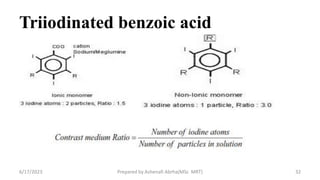
An ionic contrast agent is an organic iodine compound that has triiodinated
benzoic acid as its base.
 The compound dissociates or separates in water into two electrically
charged particles.
 One of the particles, called a cation, has a positive change; the other
particle, an anion has a negative charge.
6/17/2023 Prepared by Ashenafi Abrha(MSc MRT) 30
A nonionic contrast agent also contains iodine and is derivative of the
triiodinated benzoic acid base,
 but it does not contain an ionizing group.
 It is more soluble in water and
 Does not dissociate into changed particles;
 It has a lower osmolality than an ionic contrast agent.
6/17/2023 Prepared by Ashenafi Abrha(MSc MRT) 31
Triiodinated benzoic acid
6/17/2023 Prepared by Ashenafi Abrha(MSc MRT) 32
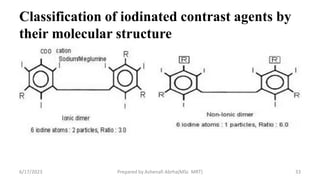
Classification of iodinated contrast agents by
their molecular structure
6/17/2023 Prepared by Ashenafi Abrha(MSc MRT) 33
 Osmolality refers to the concentration or number of particles (cations and
anions) in the solution per kilogram of water and is directly related to
occurrence of adverse patient reactions.
 It is measured in osmoles, which are units of osmotic pressure.
 A contrast agent with a high osmolality has an increased number of particles
and more osmoles in the solution.
6/17/2023 Prepared by Ashenafi Abrha(MSc MRT) 34
 Any time a foreign substance is injected into the bloodstream, the
homeostasis of the body can be affected.
 Because of their hyperosmolality, ionic contrast agents can cross the blood-
brain barrier, which is also a factor in the occurrence of adverse reactions.
 Nonionic contrast agents have a much lower level of neurotoxicity.
6/17/2023 Prepared by Ashenafi Abrha(MSc MRT) 35
 Although the osmolality of nonionic contrast agents is still
higher than that of blood plasma, it is significantly lower than
the osmolality of ionic contrast agents.
 For this reason, the use of nonionic contrast agents tends to
produce fewer physiologic reactions than use or their ionic
counter parts.
6/17/2023 Prepared by Ashenafi Abrha(MSc MRT) 36
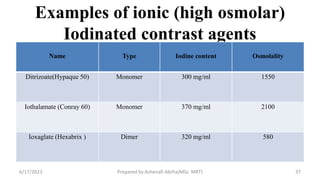
Examples of ionic (high osmolar)
Iodinated contrast agents
Name Type Iodine content Osmolality
Ditrizoate(Hypaque 50) Monomer 300 mg/ml 1550
Iothalamate (Conray 60) Monomer 370 mg/ml 2100
Ioxaglate (Hexabrix ) Dimer 320 mg/ml 580
6/17/2023 Prepared by Ashenafi Abrha(MSc MRT) 37
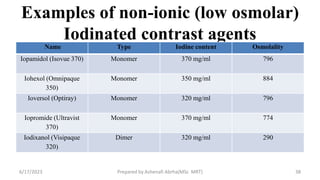
Examples of non-ionic (low osmolar)
Iodinated contrast agents
Name Type Iodine content Osmolality
Iopamidol (Isovue 370) Monomer 370 mg/ml 796
Iohexol (Omnipaque
350)
Monomer 350 mg/ml 884
Ioversol (Optiray) Monomer 320 mg/ml 796
Iopromide (Ultravist
370)
Monomer 370 mg/ml 774
Iodixanol (Visipaque
320)
Dimer 320 mg/ml 290
6/17/2023 Prepared by Ashenafi Abrha(MSc MRT) 38
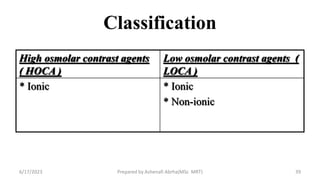
Classification
High osmolar contrast agents
( HOCA )
Low osmolar contrast agents (
LOCA )
* Ionic * Ionic
* Non-ionic
6/17/2023 Prepared by Ashenafi Abrha(MSc MRT) 39
HOCM
• HOCA are in use since the 1950.
* Urovist.
* Urogarfin
* Angiovist.
* Conray.
* Renografin.
* Renovist.
* Hypaque.
6/17/2023 Prepared by Ashenafi Abrha(MSc MRT) 40
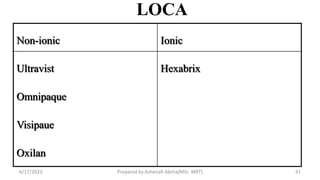
LOCA
Non-ionic Ionic
Ultravist
Omnipaque
Visipaue
Oxilan
Hexabrix
6/17/2023 Prepared by Ashenafi Abrha(MSc MRT) 41
Contraindications
The most significant contraindication to the use of iodinated contrast media is an
 Allergic history to iodine.
 Renal disease(Abnormal RFT)
 Congestive heart failure
 severe dehydration
 Asthmatic patients
 Diabetes - get a hx of medications taken
 glucophage must be stopped 48 hrs before contrast injection
 Multiple Myeloma
 Anuria (no urine production)
 Older patient age
6/17/2023 Prepared by Ashenafi Abrha(MSc MRT) 42
6/17/2023 Prepared by Ashenafi Abrha(MSc MRT) 43
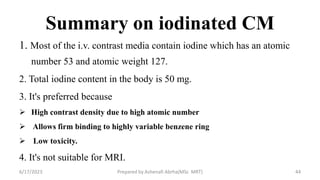
Summary on iodinated CM
1. Most of the i.v. contrast media contain iodine which has an atomic
number 53 and atomic weight 127.
2. Total iodine content in the body is 50 mg.
3. It's preferred because
 High contrast density due to high atomic number
 Allows firm binding to highly variable benzene ring
 Low toxicity.
4. It's not suitable for MRI.
6/17/2023 Prepared by Ashenafi Abrha(MSc MRT) 44
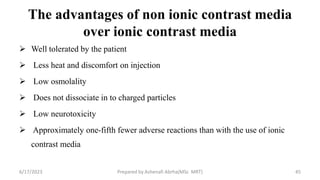
The advantages of non ionic contrast media
over ionic contrast media
 Well tolerated by the patient
 Less heat and discomfort on injection
 Low osmolality
 Does not dissociate in to charged particles
 Low neurotoxicity
 Approximately one-fifth fewer adverse reactions than with the use of ionic
contrast media
6/17/2023 Prepared by Ashenafi Abrha(MSc MRT) 45
Types of contrast media used in MRI
 MRI contrast agents are contrast agents used to improve the visibility of
internal body structures in magnetic resonance imaging (MRI).
 The most commonly used compounds for contrast enhancement are
gadolinium-based.
 Such MRI contrast agents shorten the relaxation times of nuclei within
body tissues following oral or intravenous administration.
6/17/2023 Prepared by Ashenafi Abrha(MSc MRT) 46
Cont`d…
 Most clinically used MRI contrast agents work by shortening the T1 relaxation
time of protons inside tissues via interactions with the nearby contrast agent.
 MRI contrast agents may be administered by injection into the blood stream or
orally, depending on the subject of interest.
 Oral administration is well suited to G.I. tract scans, while intravascular
administration proves more useful for most other scans.
 A variety of agents of both types enhances scans routinely.
6/17/2023 Prepared by Ashenafi Abrha(MSc MRT) 47
Cont`d…
MRI contrast agents can be classified in many ways, including by their:
 Chemical composition
 Route administration
 Magnetic properties
 Effect on the image
 Presence or absence metal atoms
 Biodistribution and applications
6/17/2023 Prepared by Ashenafi Abrha(MSc MRT) 48
Gadolinium
• Is the standard exogenous contrast agent used in clinical MR imaging.
It is T1 relaxing agent
Paramagnetic.
It belongs to lanthanide metal group with atomic no. 64.
It has a high spin contrast number which produces desirable relaxivity
contrast agents.
6/17/2023 Prepared by Ashenafi Abrha(MSc MRT) 49
Classification of MRI contrast
agents
 Extracellular fluid agents (also known as intravenous contrast agents)
 Blood pool agents (also known as intravascular contrast agents)
 Organ specific agents (i.e. gastrointestinal contrast agents and hepatobiliary
contrast agents)
 Active targeting/cell labeling agents (i.e. tumor-specific agents)
 Responsive (also known as smart or bioactivated) agents
 PH-sensitive agents
6/17/2023 Prepared by Ashenafi Abrha(MSc MRT) 50
Types by body compartment
Gadolinium(III) contrast agents can be categorized into:
Extracellular fluid agents
• gadoterate (Dotarem, Clariscan)
• gadodiamide (Omniscan)
• gadobenate (MultiHance)
• gadopentetate (Magnevist)
• gadoteridol (ProHance)
• gadoversetamide (OptiMARK)
• gadobutrol (Gadovist [EU] / Gadavist [US])
• gadopentetic acid dimeglumine (Magnetol)
6/17/2023 Prepared by Ashenafi Abrha(MSc MRT) 51
Blood pool agents
 These agents reversibly bind to plasma albumin achieving a substantial
improvement in magnitude and duration of blood pool enhancement.
EXAMPLE:
1)SPIO-super paramagnetic iron oxide crystals
2)USPIO
3)Magnetite
These cause predominant T2 shortening.
6/17/2023 Prepared by Ashenafi Abrha(MSc MRT) 52
Cont`d…
USES:
1)To image small vessels (eg:coronary artery).
2)Vessels with slow flow (eg pulmonary embolism, DVT),
3)Arteriovenous malformation
4)Perfusion studies
DISADVANTAGE:
 Overlap b/w arterial and venous structures and separation is difficult
6/17/2023 Prepared by Ashenafi Abrha(MSc MRT) 53
Cont`d…
Blood pool agents
 Albumin-binding gadolinium complexes
 Gadofosveset (Ablavar, formerly Vasovist)
 Gadocoletic acid
 Polymeric gadolinium complexes
 Gadomelitol
 Gadomer 17
6/17/2023 Prepared by Ashenafi Abrha(MSc MRT) 54
Cont`d…
• Hepatobiliary (liver) agents
 Gadoxetic acid (Primovist [EU] / Eovist [US]) is used as a
hepatobiliary agent as 50% is taken up and excreted by the
liver and 50% by the kidneys.
6/17/2023 Prepared by Ashenafi Abrha(MSc MRT) 55
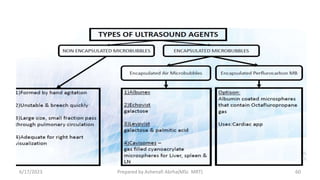
Ultrasound contrast agents
 It is Echo Enhancing Agents.
 These agents Increase The Echogenicity Of Blood, which heightens the
tissue contrast & allows better delineation of body cavities.
• Consist of Microscopic Gas Filled Bubbles.
• Their Extremely High Reflectivity(backscatter) arises from the fact that
microbubbles easily change their size, contracting in compression part of
the ultrasonic cycle & expanding in the rarefaction part.
6/17/2023 Prepared by Ashenafi Abrha(MSc MRT) 56
Ideal ultrasound contrast agents
1) Be injectable by a peripheral vein
2) Be non toxic
3) Small enough to pass through pulmonary, cardiac & capillary systems
4) Stable enough to undergo the shear forces, hydrostatic pressure changes &
diameter changes
5) Half life should be sufficient to allow complete examination
6) Should require little preparation
6/17/2023 Prepared by Ashenafi Abrha(MSc MRT) 57
Doppler rescue
 Application of ultrasound contrast agents results in
enhancement of colour, power & spectral Doppler waveform
& this improves Doppler imaging & is termed as ``Doppler
rescue ˮ
6/17/2023 Prepared by Ashenafi Abrha(MSc MRT) 58
Applications
1) Evaluating normal, increased or decrease vascularity.
2) Detecting vascular stenosis & occlusions.
3) Improving neoplasm detection.
4) Analysing & characterizing tumour neovascularity.
5) Differentiating normal variants such as renal column of bertin from neoplasm.
6) Echocardiography – cardiac cavities, valves, coronary artery & myocardial
viability
6/17/2023 Prepared by Ashenafi Abrha(MSc MRT) 59
6/17/2023 Prepared by Ashenafi Abrha(MSc MRT) 60
ROUTES OF ADMINISTRATION
 Contrast media are considered to be pharmaceuticals (drugs), and as such they must
be administered appropriately to achieve the desired effect and to avoid unwanted
complications.
The five rights of medicine administration
1. The right patient should receive
2. The right medication
3. In the right amount
4. Via the right route
5. At the right time
6/17/2023 Prepared by Ashenafi Abrha(MSc MRT) 61
Cont`d…
 The route of administration depends on the anatomy of interest, type of
examination, and particular contrast medium.
Contrast medium can be administered
 Orally,
 Rectally,
 Intravascularlly, or Intramuscularly
 Mechanically:- Introduced directly in to the intended site.
6/17/2023 Prepared by Ashenafi Abrha(MSc MRT) 62
ORAL/RECTAL ROUTE
Barium sulfate products are administered by means of the oral route for
examinations of the
 Esophagus ,stomach, and
 Small interesting.
 Iodinated contrast agents such as Gastrografin and Hypaque can also be
administered orally for these same examinations. (and also for OCG)
 It is administered rectally as an enema for an examination of the large
intestine.
6/17/2023 Prepared by Ashenafi Abrha(MSc MRT) 63
INTRAVASCULAR ROUTE
 Only water- soluble iodinated contrast media can be administered
intravascularly.
 Intravascular injection of contrast media includes both intravenous and
intra-arterial routes.
 The intravenous route is employed for excretory urography, as well as for
CT and MRI Examinations using contrast media.
6/17/2023 Prepared by Ashenafi Abrha(MSc MRT) 64
Cont`d…
 The intra-arterial route is used for special radiographic procedures of the
cardiovascular system.
 Access to the artery is accomplished via the seldinger technique which is
described in angiography.
 In lymphangiography, the contrast medium is injected intravascularly into
the lymphatic vessels.
6/17/2023 Prepared by Ashenafi Abrha(MSc MRT) 65
DIRECT ROUTE
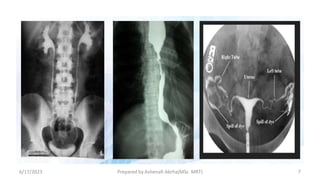
 Some radiographic examinations require that the contrast medium be introduced
directly into the anatomy of interest.
 This can be achieved by means of a catheter or needle. For example, in a
cystogram a catheter is inserted into the urinary bladder and a water-soluble
iodinated contrast medium is allowed to flow into the bladder until it is full.
6/17/2023 Prepared by Ashenafi Abrha(MSc MRT) 66
Direct route
 During a myelogram, an intrathecal injection is performed by inserting a
spinal needle into the subarachnoid space.
Examples of other examination in which contrast media are directly
administered include
 Arthrography,
 Hysterosalpingography,
 Sialography, and percutaneous transhepatic cholangiograhy.
6/17/2023 Prepared by Ashenafi Abrha(MSc MRT) 67
REACTIONS TO CONTRAST MEDIA
 The potential exists for an adverse reaction to occur when a contrast
medium is administered to a patient.
 Although reactions can take place with the use of any contrast agent, they
are more likely to occur after intravascular injection.
6/17/2023 Prepared by Ashenafi Abrha(MSc MRT) 68
Cont`d…
The technologist or radiographer should be aware of the possibility of adverse
reactions and be prepared to handle them according to the institution’s
protocol.
 An emergency drug box or crash cart should be in the examination room or
readily available.
 It is recommended that the patient’s blood pressure, pulse, and respiration be
assessed prior to contrast medium administration.
6/17/2023 Prepared by Ashenafi Abrha(MSc MRT) 69
Cont`d…
 Following any examination in which barium sulfate is
administered; the patient should be advised to drink plenty of
fluids to prevent a bowel obstruction.
6/17/2023 Prepared by Ashenafi Abrha(MSc MRT) 70
Cont`d…
The reactions seem to be directly related to the following factors.
 Degree of chemotoxicity of the contrast medium
 Concentration of iodine in the contrast medium
 Certain properties of the contrast medium including osmolality, viscosity, and
purity of the solution
 Dosage administered
 Pace of the injection
 Physical condition of the patient
6/17/2023 Prepared by Ashenafi Abrha(MSc MRT) 71
Cont`d…
 An anaphylactic reaction closely resembles a true allergic reaction in
which the patient demonstrates hypersensitivity when a foreign substance is
injected.
 Although such a reaction cannot be predicted, certain patients seem to be
predisposed to experiencing adverse reactions.
6/17/2023 Prepared by Ashenafi Abrha(MSc MRT) 72
Cont`d…
 A vasovagal reaction is one that occurs in response to anxiety or fear.
 It generally involves a vascular as well as a neurogenic response, with the
patient experiencing mild symptoms of pallor, dizziness, diaphoresis,
nausea ,and possibly bradycardia.
6/17/2023 Prepared by Ashenafi Abrha(MSc MRT) 73
Cont`d…
 Extravasations Occurs during injection if some of the contrast medium
seeps out of the vein to the surrounding tissue.
 This reaction usually involves pain and discoloration at the site of
injection.
 The technologist or radiographer should apply a warm, moist compress to
the site to decrease pain and aid in the absorption of the extravasated
contrast medium.
6/17/2023 Prepared by Ashenafi Abrha(MSc MRT) 74
Cont`d…
 Adverse reactions are usually acute, with the majority occurring 5 to 20
minutes after injection of the contrast medium.
 Although delayed reactions are possible, they are rare and typically mild
,moderate, or severe according to the symptoms experienced by the
patient and the treatment needed to alleviate them.
6/17/2023 Prepared by Ashenafi Abrha(MSc MRT) 75
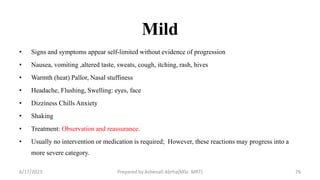
Mild
• Signs and symptoms appear self-limited without evidence of progression
• Nausea, vomiting ,altered taste, sweats, cough, itching, rash, hives
• Warmth (heat) Pallor, Nasal stuffiness
• Headache, Flushing, Swelling: eyes, face
• Dizziness Chills Anxiety
• Shaking
• Treatment: Observation and reassurance.
• Usually no intervention or medication is required; However, these reactions may progress into a
more severe category.
6/17/2023 Prepared by Ashenafi Abrha(MSc MRT) 76
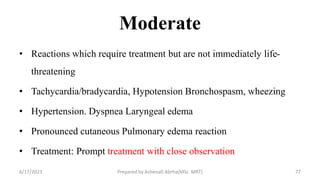
Moderate
• Reactions which require treatment but are not immediately life-
threatening
• Tachycardia/bradycardia, Hypotension Bronchospasm, wheezing
• Hypertension. Dyspnea Laryngeal edema
• Pronounced cutaneous Pulmonary edema reaction
• Treatment: Prompt treatment with close observation
6/17/2023 Prepared by Ashenafi Abrha(MSc MRT) 77
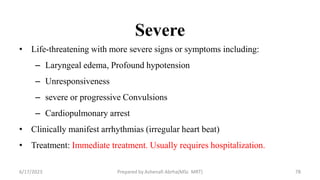
Severe
• Life-threatening with more severe signs or symptoms including:
– Laryngeal edema, Profound hypotension
– Unresponsiveness
– severe or progressive Convulsions
– Cardiopulmonary arrest
• Clinically manifest arrhythmias (irregular heart beat)
• Treatment: Immediate treatment. Usually requires hospitalization.
6/17/2023 Prepared by Ashenafi Abrha(MSc MRT) 78
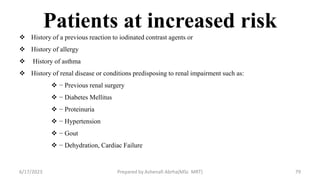
Patients at increased risk
 History of a previous reaction to iodinated contrast agents or
 History of allergy
 History of asthma
 History of renal disease or conditions predisposing to renal impairment such as:
 − Previous renal surgery
 − Diabetes Mellitus
 − Proteinuria
 − Hypertension
 − Gout
 − Dehydration, Cardiac Failure
6/17/2023 Prepared by Ashenafi Abrha(MSc MRT) 79
Patient care before administering
CM
 Hydrate the body prior to administration
 Warm CM to body temperature
 Keep emergency drugs like adrenalin
 Ask patient history
6/17/2023 Prepared by Ashenafi Abrha(MSc MRT) 80
During anaphylactic reaction
 Stop the injection immediately
 Monitor vital sign
 Observe for respiratory distress
 Call emergency team (physicians and nurses)
 Place the patient in Semi-fowler’s or sitting position (for cardiopulmonary
distress)
 If the patient becomes breath less and pulse less, administer cardiopulmonary
resuscitation
6/17/2023 Prepared by Ashenafi Abrha(MSc MRT) 81
General three principle of reaction treatment
1. Oxygen
2. Epinephrine
3. Corticosteriods
6/17/2023 Prepared by Ashenafi Abrha(MSc MRT) 82
Patient care and instruction after
receiving iodinated contrast agent
 Instruct the patient to increase fluid intake to 3000ml for at
least 24 hours to assist with the dilution and excretion of the
agent from the body.
6/17/2023 Prepared by Ashenafi Abrha(MSc MRT) 83
Summary
1. What is contrast medium
2. Define basic principle of CM
3. List and explain types of CM
4. Differentiate main advantage of oil-based and water soluble iodinated
contrast
5. Differentiate major difference between ionic and non ionic water soluble CM
6. Identify categories of CM reactions
6/17/2023 Prepared by Ashenafi Abrha(MSc MRT) 84
THANK YOU!!
6/17/2023 Prepared by Ashenafi Abrha(MSc MRT) 85

contrast media(1).pptx

  • 1.
    Contrast media Prepared ByAshenafi Abrha(MSc MRT) 6/17/2023 Prepared by Ashenafi Abrha(MSc MRT) 1
  • 2.
    Objectives At the endof this session you will be able to:  Discuss about contrast agent and their effect  Differentiate types of contrast media  Identify the routes of administration of contrast media for various radiographic examinations  Compare and contrast the use of ionic and nonionic iodinated contrast media  Describe possible reactions to contrast media and categorize them according to their severity 6/17/2023 Prepared by Ashenafi Abrha(MSc MRT) 2
  • 3.
    INTRODUCTION  Contrast studiesare those examinations in which contrast media are used to enhance visualization of specific body structures.  Because of the low subject contrast of the abdomen, contrast media are used to demonstrate the anatomic structures of  The urinary,  Digestive, and biliary systems. Its also used to evaluate other areas of the body, such as  The spinal canal,  Female reproductive system, and vasculature. 6/17/2023 Prepared by Ashenafi Abrha(MSc MRT) 3
  • 4.
    Basic principle ofcontrast media  It is a pharmaceutical agent that is administered to a patient for a radiographic examination to enhance the contrast of a particular structure.  It is depending on x-ray absorption and penetration that reach on the film.  Its use allows for differentiation between a structure and surrounding tissues by altering the density of the structure, which in turn alters the absorption of x-rays. 6/17/2023 Prepared by Ashenafi Abrha(MSc MRT) 4
  • 5.
    Cont`d…  It isa chemical substance of very high or very low atomic number or weight, therefore it increase or decrease the density of the organ under examination.  A substance which when introduced into the body will increase the radiographic contrast in an area where it was absent or low before. 6/17/2023 Prepared by Ashenafi Abrha(MSc MRT) 5
  • 6.
    Effect of Contrastmedia 6/17/2023 Prepared by Ashenafi Abrha(MSc MRT) 6 Without CM With CM B A
  • 7.
    6/17/2023 Prepared byAshenafi Abrha(MSc MRT) 7
  • 8.
    Cont`d…  Structures &organs within the body have similarly low tissue densities.  Tissue densities are depends on atomic number  When x-ray pass through the structures some of the beam will be  Absorbed (Denser structures) appear White on the radiograph  Penetrated (lighter structures) appear dark on the radiograph 6/17/2023 Prepared by Ashenafi Abrha(MSc MRT) 8
  • 9.
    Requirements of aContrast Media  Easy to administer  No toxicity(neurotoxicity)  Stable compound. – Will not dissociate into toxic ions  When injected the media concentrates in the required areas.  The agent’s physical features allow the organ to be properly demonstrated  even barium coating of the stomach in the presence of an acid environment. 6/17/2023 Prepared by Ashenafi Abrha(MSc MRT) 9
  • 10.
    Requirements of aContrast Media  The agent should have rapid elimination.  The agent should not be carcinogenic.  The agent should have a viscosity appropriate to the patient when introduced.  The agent should cause minimal distress to the patient when introduced.  The agent should be cost-effective.  Must possess a suitable half life for storage.  Low or iso- osmolar to blood plasma. 6/17/2023 Prepared by Ashenafi Abrha(MSc MRT) 10
  • 11.
    Types of contrastmedia  The two basic classifications of contrast media are 1. Negative contrast agents and 2. Positive contrast agents. 6/17/2023 Prepared by Ashenafi Abrha(MSc MRT) 11
  • 12.
    1. Negative contrastagent  It is radiolucent,  Has a low atomic number, and  Allows x-rays to pass through quite easily.  As more x-radiation reaches the film, the structure that is filled with a negative contrast agent appears dark (black) on radiography. 6/17/2023 Prepared by Ashenafi Abrha(MSc MRT) 12
  • 13.
    Cont`d…  Gases, suchas oxygen, carbon dioxide, and nitrous oxide, may be used as negative contrast media, although room air is the most common agent.  Gas crystals , the normally present gas bubble in the stomach.  Calcium, magnesium citrate and carbonate crystals are frequently used to produce CO2 gas.  For example, the air in the lungs serves as a negative contrast medium on chest radiography. 6/17/2023 Prepared by Ashenafi Abrha(MSc MRT) 13
  • 14.
    Cont`d…  A negativecontrast medium may be used alone, as in the case of an air arthrogram,  It can also be combined with a positive contrast agent to produce a double-contrast effect, such as a barium enema examination with air. 6/17/2023 Prepared by Ashenafi Abrha(MSc MRT) 14
  • 15.
    Cont`d…  The usesof negative contrast media are limited, however, as they may not provide sufficient contrast of a structure when used singly.  They must never be injected intravenously; doing so will have serious, if not fatal, consequences. 6/17/2023 Prepared by Ashenafi Abrha(MSc MRT) 15
  • 16.
    2. Positive ContrastAgent  Is radiopaque  Has a high atomic number.  As it absorbs approximately three times more x-rays than bone and five times as many x-rays as soft tissue,  An organ filled with a positive contrast agent appears light on the resulting radiography.  Barium sulfate (BaSO4) and Iodinated compounds are most commonly used. 6/17/2023 Prepared by Ashenafi Abrha(MSc MRT) 16
  • 17.
    BARIUM SULFATE Properties  Bariumis a heavy metal having an atomic number of 56.  It is combined with oxygen and sulfate to form the inert compound barium sulfate (BaSO4).  It is a white, crystalline powder that is insoluble in water.  For use in radiography, it is mixed with water and stabilizing agents to form a suspension.  Barium sulfate is used for examination of the entire alimentary canal. 6/17/2023 Prepared by Ashenafi Abrha(MSc MRT) 17
  • 18.
    Cont`d…  High atomicnumber  Not soluble in water  Used to coat the lining of organs  Supplied in different thicknesses  Used  Esophogram, UGI, Small Bowel,Lower GI or BE 6/17/2023 Prepared by Ashenafi Abrha(MSc MRT) 18
  • 19.
    Cont`d…  Ideally, thesuspension should be dense to coat the mucosa and outline the visceral walls, yet it must have the ability to flow smoothly through the alimentary canal.  The products are available commercially in paste, liquid, powder, and tablet form.  Paste, having a viscosity approximate to that of honey, may be recommended for an esophagram.  A liquid barium sulfate suspension can also be used for radiographic examination of the esophagus, as well as the stomach and both small and large intestines. 6/17/2023 Prepared by Ashenafi Abrha(MSc MRT) 19
  • 20.
    Cont`d…  Barium sulfatetablets are helpful in evaluating foreign objects or strictures in the esophagus.  They dissolve in either the esophagus or stomach when mixed with water. 6/17/2023 Prepared by Ashenafi Abrha(MSc MRT) 20
  • 21.
    Contraindications Because of itsinability to be absorbed by the body, barium sulfate cannot be used intravascularly or intrathecally. Also, its use is contraindicated in the case of  A suspected perforation in the alimentary canal.  Recent or impending abdominal surgery.  Obstruction of GIT.  Mediastinal leakage.  Aspiration.  Peritoneal leakage and hypersensitivity. 6/17/2023 Prepared by Ashenafi Abrha(MSc MRT) 21
  • 22.
    IODINATED COMPOUNDS Properties  Iodineis the element of choice for use as a contrast agent, as it forms stable compounds and does not break down in the body. Like barium sulfate,  It has a relatively low toxicity and  High atomic number.  Unlike barium sulfate, it is generally absorbed by the body and excreted by the kidneys within 24 hours of intravascular administration. 6/17/2023 Prepared by Ashenafi Abrha(MSc MRT) 22
  • 23.
    Cont`d…  As iodinatedcontrast media have a tendency to break down in the light, they should be shielded from bright light.  The viscosity, or thickness, of the contrast medium is greatly determined by the size the concentration of the molecules in the solution.  It is recommended that the liquid iodinated contrast media be prewarmed to body temperature prior to use. 6/17/2023 Prepared by Ashenafi Abrha(MSc MRT) 23
  • 24.
    Cont`d…  An iodinatedcontrast agent with a higher concentration is generally used for cardiovascular studies, whereas a lower concentration is used for urography and cholegraphy. 6/17/2023 Prepared by Ashenafi Abrha(MSc MRT) 24
  • 25.
    Cont`d…  Iodinated contrastmedia are available as either oil-based or water-soluble agents.  Each type of medium is selected for use based on the anatomy to be examined. 6/17/2023 Prepared by Ashenafi Abrha(MSc MRT) 25
  • 26.
    Oil-based Iodinated ContrastMedia  The use of oil-based iodinated contrast media in radiography is relatively limited.  They are used primarily for studies of the lymphatic system (lymphangiography). In the past, they were also used for studies of the  Hysterosalpingography,  Myelography),  Bronchography  Sialography, and  Dacryocystography, but have been replaced by water-soluble iodinated nonionic contrast media. 6/17/2023 Prepared by Ashenafi Abrha(MSc MRT) 26
  • 27.
    Cont`d…  The oil-basediodinated contrast medium is used in hollow anatomic areas, enhancing the radiographic contrast of the structure.  The oily base of the contrast medium is a fatty acid, which is responsible for making the solution viscous (thick) and insoluble in water and body fluids.  Because it is not miscible with blood, it should never be injected intravenously or intraarterially. 6/17/2023 Prepared by Ashenafi Abrha(MSc MRT) 27
  • 28.
    Water-soluble iodinated contrastmedia Water–Soluble (aqueous) iodinated contrast media are routinely used for radiographic examinations of the  Urinary,  Biliary, and cardiovascular systems,  as well as the digestive system if barium sulfate is contraindicated.  It also used in special examinations of the skeletal system such as myelography and arthrography. 6/17/2023 Prepared by Ashenafi Abrha(MSc MRT) 28
  • 29.
     They areavailable in liquid, tablet or granule form depending on the intended use.  The injectable liquid media can be divided in to  Ionic and  Nonionic contrast agents. 6/17/2023 Prepared by Ashenafi Abrha(MSc MRT) 29
  • 30.
    An ionic contrastagent is an organic iodine compound that has triiodinated benzoic acid as its base.  The compound dissociates or separates in water into two electrically charged particles.  One of the particles, called a cation, has a positive change; the other particle, an anion has a negative charge. 6/17/2023 Prepared by Ashenafi Abrha(MSc MRT) 30
  • 31.
    A nonionic contrastagent also contains iodine and is derivative of the triiodinated benzoic acid base,  but it does not contain an ionizing group.  It is more soluble in water and  Does not dissociate into changed particles;  It has a lower osmolality than an ionic contrast agent. 6/17/2023 Prepared by Ashenafi Abrha(MSc MRT) 31
  • 32.
    Triiodinated benzoic acid 6/17/2023Prepared by Ashenafi Abrha(MSc MRT) 32
  • 33.
    Classification of iodinatedcontrast agents by their molecular structure 6/17/2023 Prepared by Ashenafi Abrha(MSc MRT) 33
  • 34.
     Osmolality refersto the concentration or number of particles (cations and anions) in the solution per kilogram of water and is directly related to occurrence of adverse patient reactions.  It is measured in osmoles, which are units of osmotic pressure.  A contrast agent with a high osmolality has an increased number of particles and more osmoles in the solution. 6/17/2023 Prepared by Ashenafi Abrha(MSc MRT) 34
  • 35.
     Any timea foreign substance is injected into the bloodstream, the homeostasis of the body can be affected.  Because of their hyperosmolality, ionic contrast agents can cross the blood- brain barrier, which is also a factor in the occurrence of adverse reactions.  Nonionic contrast agents have a much lower level of neurotoxicity. 6/17/2023 Prepared by Ashenafi Abrha(MSc MRT) 35
  • 36.
     Although theosmolality of nonionic contrast agents is still higher than that of blood plasma, it is significantly lower than the osmolality of ionic contrast agents.  For this reason, the use of nonionic contrast agents tends to produce fewer physiologic reactions than use or their ionic counter parts. 6/17/2023 Prepared by Ashenafi Abrha(MSc MRT) 36
  • 37.
    Examples of ionic(high osmolar) Iodinated contrast agents Name Type Iodine content Osmolality Ditrizoate(Hypaque 50) Monomer 300 mg/ml 1550 Iothalamate (Conray 60) Monomer 370 mg/ml 2100 Ioxaglate (Hexabrix ) Dimer 320 mg/ml 580 6/17/2023 Prepared by Ashenafi Abrha(MSc MRT) 37
  • 38.
    Examples of non-ionic(low osmolar) Iodinated contrast agents Name Type Iodine content Osmolality Iopamidol (Isovue 370) Monomer 370 mg/ml 796 Iohexol (Omnipaque 350) Monomer 350 mg/ml 884 Ioversol (Optiray) Monomer 320 mg/ml 796 Iopromide (Ultravist 370) Monomer 370 mg/ml 774 Iodixanol (Visipaque 320) Dimer 320 mg/ml 290 6/17/2023 Prepared by Ashenafi Abrha(MSc MRT) 38
  • 39.
    Classification High osmolar contrastagents ( HOCA ) Low osmolar contrast agents ( LOCA ) * Ionic * Ionic * Non-ionic 6/17/2023 Prepared by Ashenafi Abrha(MSc MRT) 39
  • 40.
    HOCM • HOCA arein use since the 1950. * Urovist. * Urogarfin * Angiovist. * Conray. * Renografin. * Renovist. * Hypaque. 6/17/2023 Prepared by Ashenafi Abrha(MSc MRT) 40
  • 41.
  • 42.
    Contraindications The most significantcontraindication to the use of iodinated contrast media is an  Allergic history to iodine.  Renal disease(Abnormal RFT)  Congestive heart failure  severe dehydration  Asthmatic patients  Diabetes - get a hx of medications taken  glucophage must be stopped 48 hrs before contrast injection  Multiple Myeloma  Anuria (no urine production)  Older patient age 6/17/2023 Prepared by Ashenafi Abrha(MSc MRT) 42
  • 43.
    6/17/2023 Prepared byAshenafi Abrha(MSc MRT) 43
  • 44.
    Summary on iodinatedCM 1. Most of the i.v. contrast media contain iodine which has an atomic number 53 and atomic weight 127. 2. Total iodine content in the body is 50 mg. 3. It's preferred because  High contrast density due to high atomic number  Allows firm binding to highly variable benzene ring  Low toxicity. 4. It's not suitable for MRI. 6/17/2023 Prepared by Ashenafi Abrha(MSc MRT) 44
  • 45.
    The advantages ofnon ionic contrast media over ionic contrast media  Well tolerated by the patient  Less heat and discomfort on injection  Low osmolality  Does not dissociate in to charged particles  Low neurotoxicity  Approximately one-fifth fewer adverse reactions than with the use of ionic contrast media 6/17/2023 Prepared by Ashenafi Abrha(MSc MRT) 45
  • 46.
    Types of contrastmedia used in MRI  MRI contrast agents are contrast agents used to improve the visibility of internal body structures in magnetic resonance imaging (MRI).  The most commonly used compounds for contrast enhancement are gadolinium-based.  Such MRI contrast agents shorten the relaxation times of nuclei within body tissues following oral or intravenous administration. 6/17/2023 Prepared by Ashenafi Abrha(MSc MRT) 46
  • 47.
    Cont`d…  Most clinicallyused MRI contrast agents work by shortening the T1 relaxation time of protons inside tissues via interactions with the nearby contrast agent.  MRI contrast agents may be administered by injection into the blood stream or orally, depending on the subject of interest.  Oral administration is well suited to G.I. tract scans, while intravascular administration proves more useful for most other scans.  A variety of agents of both types enhances scans routinely. 6/17/2023 Prepared by Ashenafi Abrha(MSc MRT) 47
  • 48.
    Cont`d… MRI contrast agentscan be classified in many ways, including by their:  Chemical composition  Route administration  Magnetic properties  Effect on the image  Presence or absence metal atoms  Biodistribution and applications 6/17/2023 Prepared by Ashenafi Abrha(MSc MRT) 48
  • 49.
    Gadolinium • Is thestandard exogenous contrast agent used in clinical MR imaging. It is T1 relaxing agent Paramagnetic. It belongs to lanthanide metal group with atomic no. 64. It has a high spin contrast number which produces desirable relaxivity contrast agents. 6/17/2023 Prepared by Ashenafi Abrha(MSc MRT) 49
  • 50.
    Classification of MRIcontrast agents  Extracellular fluid agents (also known as intravenous contrast agents)  Blood pool agents (also known as intravascular contrast agents)  Organ specific agents (i.e. gastrointestinal contrast agents and hepatobiliary contrast agents)  Active targeting/cell labeling agents (i.e. tumor-specific agents)  Responsive (also known as smart or bioactivated) agents  PH-sensitive agents 6/17/2023 Prepared by Ashenafi Abrha(MSc MRT) 50
  • 51.
    Types by bodycompartment Gadolinium(III) contrast agents can be categorized into: Extracellular fluid agents • gadoterate (Dotarem, Clariscan) • gadodiamide (Omniscan) • gadobenate (MultiHance) • gadopentetate (Magnevist) • gadoteridol (ProHance) • gadoversetamide (OptiMARK) • gadobutrol (Gadovist [EU] / Gadavist [US]) • gadopentetic acid dimeglumine (Magnetol) 6/17/2023 Prepared by Ashenafi Abrha(MSc MRT) 51
  • 52.
    Blood pool agents These agents reversibly bind to plasma albumin achieving a substantial improvement in magnitude and duration of blood pool enhancement. EXAMPLE: 1)SPIO-super paramagnetic iron oxide crystals 2)USPIO 3)Magnetite These cause predominant T2 shortening. 6/17/2023 Prepared by Ashenafi Abrha(MSc MRT) 52
  • 53.
    Cont`d… USES: 1)To image smallvessels (eg:coronary artery). 2)Vessels with slow flow (eg pulmonary embolism, DVT), 3)Arteriovenous malformation 4)Perfusion studies DISADVANTAGE:  Overlap b/w arterial and venous structures and separation is difficult 6/17/2023 Prepared by Ashenafi Abrha(MSc MRT) 53
  • 54.
    Cont`d… Blood pool agents Albumin-binding gadolinium complexes  Gadofosveset (Ablavar, formerly Vasovist)  Gadocoletic acid  Polymeric gadolinium complexes  Gadomelitol  Gadomer 17 6/17/2023 Prepared by Ashenafi Abrha(MSc MRT) 54
  • 55.
    Cont`d… • Hepatobiliary (liver)agents  Gadoxetic acid (Primovist [EU] / Eovist [US]) is used as a hepatobiliary agent as 50% is taken up and excreted by the liver and 50% by the kidneys. 6/17/2023 Prepared by Ashenafi Abrha(MSc MRT) 55
  • 56.
    Ultrasound contrast agents It is Echo Enhancing Agents.  These agents Increase The Echogenicity Of Blood, which heightens the tissue contrast & allows better delineation of body cavities. • Consist of Microscopic Gas Filled Bubbles. • Their Extremely High Reflectivity(backscatter) arises from the fact that microbubbles easily change their size, contracting in compression part of the ultrasonic cycle & expanding in the rarefaction part. 6/17/2023 Prepared by Ashenafi Abrha(MSc MRT) 56
  • 57.
    Ideal ultrasound contrastagents 1) Be injectable by a peripheral vein 2) Be non toxic 3) Small enough to pass through pulmonary, cardiac & capillary systems 4) Stable enough to undergo the shear forces, hydrostatic pressure changes & diameter changes 5) Half life should be sufficient to allow complete examination 6) Should require little preparation 6/17/2023 Prepared by Ashenafi Abrha(MSc MRT) 57
  • 58.
    Doppler rescue  Applicationof ultrasound contrast agents results in enhancement of colour, power & spectral Doppler waveform & this improves Doppler imaging & is termed as ``Doppler rescue ˮ 6/17/2023 Prepared by Ashenafi Abrha(MSc MRT) 58
  • 59.
    Applications 1) Evaluating normal,increased or decrease vascularity. 2) Detecting vascular stenosis & occlusions. 3) Improving neoplasm detection. 4) Analysing & characterizing tumour neovascularity. 5) Differentiating normal variants such as renal column of bertin from neoplasm. 6) Echocardiography – cardiac cavities, valves, coronary artery & myocardial viability 6/17/2023 Prepared by Ashenafi Abrha(MSc MRT) 59
  • 60.
    6/17/2023 Prepared byAshenafi Abrha(MSc MRT) 60
  • 61.
    ROUTES OF ADMINISTRATION Contrast media are considered to be pharmaceuticals (drugs), and as such they must be administered appropriately to achieve the desired effect and to avoid unwanted complications. The five rights of medicine administration 1. The right patient should receive 2. The right medication 3. In the right amount 4. Via the right route 5. At the right time 6/17/2023 Prepared by Ashenafi Abrha(MSc MRT) 61
  • 62.
    Cont`d…  The routeof administration depends on the anatomy of interest, type of examination, and particular contrast medium. Contrast medium can be administered  Orally,  Rectally,  Intravascularlly, or Intramuscularly  Mechanically:- Introduced directly in to the intended site. 6/17/2023 Prepared by Ashenafi Abrha(MSc MRT) 62
  • 63.
    ORAL/RECTAL ROUTE Barium sulfateproducts are administered by means of the oral route for examinations of the  Esophagus ,stomach, and  Small interesting.  Iodinated contrast agents such as Gastrografin and Hypaque can also be administered orally for these same examinations. (and also for OCG)  It is administered rectally as an enema for an examination of the large intestine. 6/17/2023 Prepared by Ashenafi Abrha(MSc MRT) 63
  • 64.
    INTRAVASCULAR ROUTE  Onlywater- soluble iodinated contrast media can be administered intravascularly.  Intravascular injection of contrast media includes both intravenous and intra-arterial routes.  The intravenous route is employed for excretory urography, as well as for CT and MRI Examinations using contrast media. 6/17/2023 Prepared by Ashenafi Abrha(MSc MRT) 64
  • 65.
    Cont`d…  The intra-arterialroute is used for special radiographic procedures of the cardiovascular system.  Access to the artery is accomplished via the seldinger technique which is described in angiography.  In lymphangiography, the contrast medium is injected intravascularly into the lymphatic vessels. 6/17/2023 Prepared by Ashenafi Abrha(MSc MRT) 65
  • 66.
    DIRECT ROUTE  Someradiographic examinations require that the contrast medium be introduced directly into the anatomy of interest.  This can be achieved by means of a catheter or needle. For example, in a cystogram a catheter is inserted into the urinary bladder and a water-soluble iodinated contrast medium is allowed to flow into the bladder until it is full. 6/17/2023 Prepared by Ashenafi Abrha(MSc MRT) 66
  • 67.
    Direct route  Duringa myelogram, an intrathecal injection is performed by inserting a spinal needle into the subarachnoid space. Examples of other examination in which contrast media are directly administered include  Arthrography,  Hysterosalpingography,  Sialography, and percutaneous transhepatic cholangiograhy. 6/17/2023 Prepared by Ashenafi Abrha(MSc MRT) 67
  • 68.
    REACTIONS TO CONTRASTMEDIA  The potential exists for an adverse reaction to occur when a contrast medium is administered to a patient.  Although reactions can take place with the use of any contrast agent, they are more likely to occur after intravascular injection. 6/17/2023 Prepared by Ashenafi Abrha(MSc MRT) 68
  • 69.
    Cont`d… The technologist orradiographer should be aware of the possibility of adverse reactions and be prepared to handle them according to the institution’s protocol.  An emergency drug box or crash cart should be in the examination room or readily available.  It is recommended that the patient’s blood pressure, pulse, and respiration be assessed prior to contrast medium administration. 6/17/2023 Prepared by Ashenafi Abrha(MSc MRT) 69
  • 70.
    Cont`d…  Following anyexamination in which barium sulfate is administered; the patient should be advised to drink plenty of fluids to prevent a bowel obstruction. 6/17/2023 Prepared by Ashenafi Abrha(MSc MRT) 70
  • 71.
    Cont`d… The reactions seemto be directly related to the following factors.  Degree of chemotoxicity of the contrast medium  Concentration of iodine in the contrast medium  Certain properties of the contrast medium including osmolality, viscosity, and purity of the solution  Dosage administered  Pace of the injection  Physical condition of the patient 6/17/2023 Prepared by Ashenafi Abrha(MSc MRT) 71
  • 72.
    Cont`d…  An anaphylacticreaction closely resembles a true allergic reaction in which the patient demonstrates hypersensitivity when a foreign substance is injected.  Although such a reaction cannot be predicted, certain patients seem to be predisposed to experiencing adverse reactions. 6/17/2023 Prepared by Ashenafi Abrha(MSc MRT) 72
  • 73.
    Cont`d…  A vasovagalreaction is one that occurs in response to anxiety or fear.  It generally involves a vascular as well as a neurogenic response, with the patient experiencing mild symptoms of pallor, dizziness, diaphoresis, nausea ,and possibly bradycardia. 6/17/2023 Prepared by Ashenafi Abrha(MSc MRT) 73
  • 74.
    Cont`d…  Extravasations Occursduring injection if some of the contrast medium seeps out of the vein to the surrounding tissue.  This reaction usually involves pain and discoloration at the site of injection.  The technologist or radiographer should apply a warm, moist compress to the site to decrease pain and aid in the absorption of the extravasated contrast medium. 6/17/2023 Prepared by Ashenafi Abrha(MSc MRT) 74
  • 75.
    Cont`d…  Adverse reactionsare usually acute, with the majority occurring 5 to 20 minutes after injection of the contrast medium.  Although delayed reactions are possible, they are rare and typically mild ,moderate, or severe according to the symptoms experienced by the patient and the treatment needed to alleviate them. 6/17/2023 Prepared by Ashenafi Abrha(MSc MRT) 75
  • 76.
    Mild • Signs andsymptoms appear self-limited without evidence of progression • Nausea, vomiting ,altered taste, sweats, cough, itching, rash, hives • Warmth (heat) Pallor, Nasal stuffiness • Headache, Flushing, Swelling: eyes, face • Dizziness Chills Anxiety • Shaking • Treatment: Observation and reassurance. • Usually no intervention or medication is required; However, these reactions may progress into a more severe category. 6/17/2023 Prepared by Ashenafi Abrha(MSc MRT) 76
  • 77.
    Moderate • Reactions whichrequire treatment but are not immediately life- threatening • Tachycardia/bradycardia, Hypotension Bronchospasm, wheezing • Hypertension. Dyspnea Laryngeal edema • Pronounced cutaneous Pulmonary edema reaction • Treatment: Prompt treatment with close observation 6/17/2023 Prepared by Ashenafi Abrha(MSc MRT) 77
  • 78.
    Severe • Life-threatening withmore severe signs or symptoms including: – Laryngeal edema, Profound hypotension – Unresponsiveness – severe or progressive Convulsions – Cardiopulmonary arrest • Clinically manifest arrhythmias (irregular heart beat) • Treatment: Immediate treatment. Usually requires hospitalization. 6/17/2023 Prepared by Ashenafi Abrha(MSc MRT) 78
  • 79.
    Patients at increasedrisk  History of a previous reaction to iodinated contrast agents or  History of allergy  History of asthma  History of renal disease or conditions predisposing to renal impairment such as:  − Previous renal surgery  − Diabetes Mellitus  − Proteinuria  − Hypertension  − Gout  − Dehydration, Cardiac Failure 6/17/2023 Prepared by Ashenafi Abrha(MSc MRT) 79
  • 80.
    Patient care beforeadministering CM  Hydrate the body prior to administration  Warm CM to body temperature  Keep emergency drugs like adrenalin  Ask patient history 6/17/2023 Prepared by Ashenafi Abrha(MSc MRT) 80
  • 81.
    During anaphylactic reaction Stop the injection immediately  Monitor vital sign  Observe for respiratory distress  Call emergency team (physicians and nurses)  Place the patient in Semi-fowler’s or sitting position (for cardiopulmonary distress)  If the patient becomes breath less and pulse less, administer cardiopulmonary resuscitation 6/17/2023 Prepared by Ashenafi Abrha(MSc MRT) 81
  • 82.
    General three principleof reaction treatment 1. Oxygen 2. Epinephrine 3. Corticosteriods 6/17/2023 Prepared by Ashenafi Abrha(MSc MRT) 82
  • 83.
    Patient care andinstruction after receiving iodinated contrast agent  Instruct the patient to increase fluid intake to 3000ml for at least 24 hours to assist with the dilution and excretion of the agent from the body. 6/17/2023 Prepared by Ashenafi Abrha(MSc MRT) 83
  • 84.
    Summary 1. What iscontrast medium 2. Define basic principle of CM 3. List and explain types of CM 4. Differentiate main advantage of oil-based and water soluble iodinated contrast 5. Differentiate major difference between ionic and non ionic water soluble CM 6. Identify categories of CM reactions 6/17/2023 Prepared by Ashenafi Abrha(MSc MRT) 84
  • 85.
    THANK YOU!! 6/17/2023 Preparedby Ashenafi Abrha(MSc MRT) 85