PHARMACOECONOMICS
Dr. Siddhartha Dutta
MAMC, New Delhi
OUTLINE
• Introduction
• Need of Pharmacoeconomics
• Goals
• Costs and types
• Perspectives of Pharmacoeconomics
• Types of Pharmacoeconomic studies
• Applications
• Conclusion
INTRODUCTION
• Term coined by Townsend in 1986
• Branch of health economics
Making choices between options, when there is
scarcity of resources
Fundamentally comparative, weighing the costs and
benefits of 2 options- 󱁋 Most efficient
PHARMACOECONOMICS
• The description & analysis of the costs of
drug therapy to health care system &
society
• Pharmacoeconomics research identifies, measures
& compares the costs( i.e. resources consumed ) &
consequences (i.e. clinical, economic , humanistic)
of pharmaceutical products & services
• PE analysis
• Efficient allocation of limited resources among
competing alternative medications and services
• Biggest bang for your buck, using a quantitative
measure
• To make the best use of limited resources
WHY STUDY
PHARMACOECONOMICS ??
• Helps to decide which drug to develop
• To estimate and understand the full impact of new
therapy
• To make an informed decision regarding appropriate
use of drug which have been developed
• To make the best use of limited resources
GOALS:
 To determine which healthcare alternatives
provide the best healthcare outcome in terms
of money spent
 To improve the allocation of resources for
pharmaceutical products and services
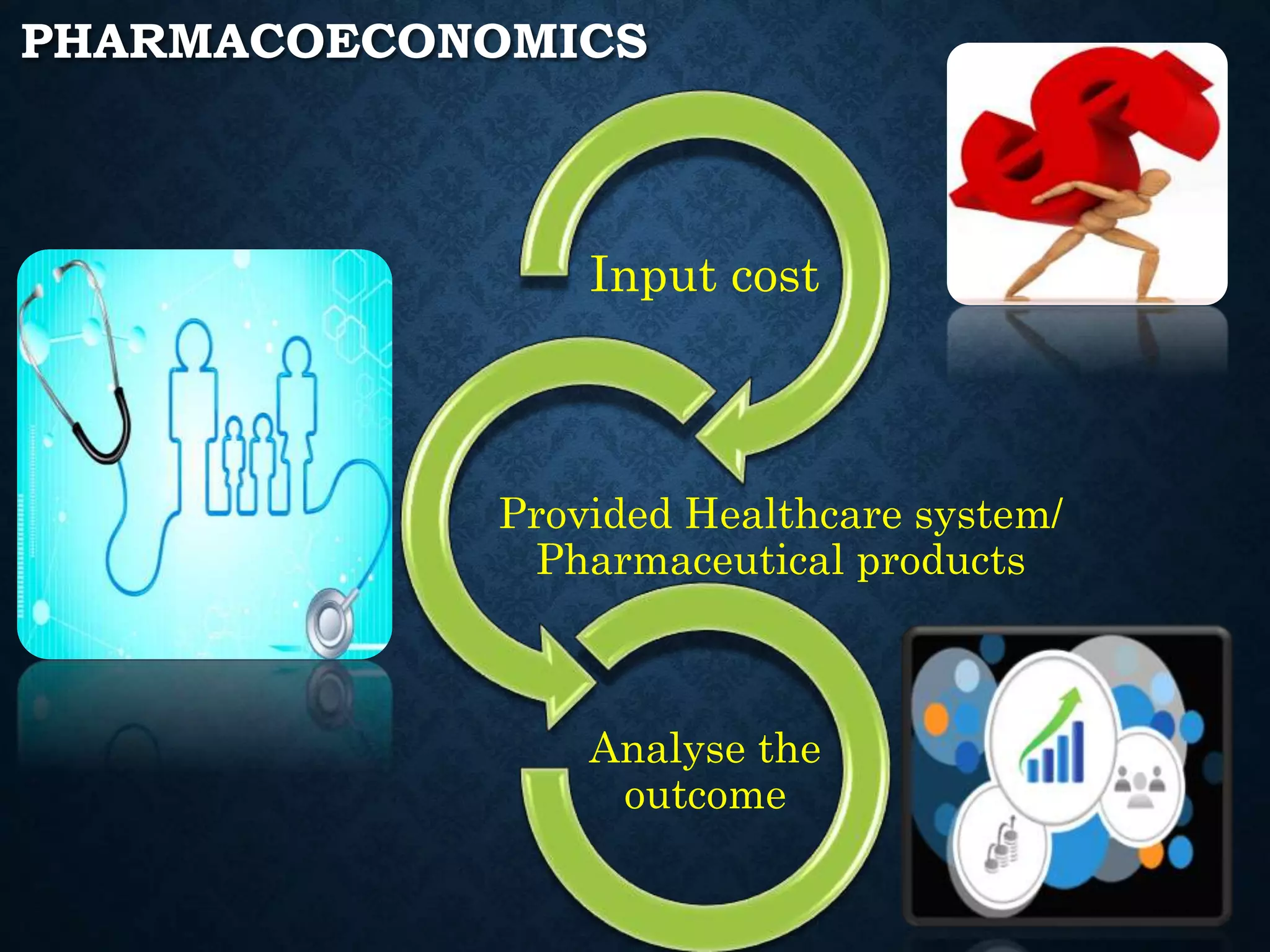
PHARMACOECONOMICS
Input cost
Provided Healthcare system/
Pharmaceutical products
Analyse the
outcome
COSTS
 Cost vs. Price ??
 Cost involves all the resources that are used to
produce and deliver a particular drug therapy
Types of Costs
• Direct costs
Medical vs Nonmedical
• Indirect costs
• Intangible costs
• Opportunity costs
• Direct Medical Costs: Costs of medical service
These include:
• Fixed costs or costs that do not vary immediately
with the number of patients treated. E.g. capital
costs of hospital building or equipment etc.
• Variable costs or costs that vary immediately with
number of patients treated. E.g. costs of drugs,
syringes, needles etc.
• Direct non-medical costs:
• Costs incurred by the patient in receiving medical
care. E.g. transportation to and from hospital.
• Indirect cost: e.g. income lost because of
absenteeism, loss of productivity
• Intangible costs
• Costs of pain, worry and other suffering which a
patient or his family might suffer
• Opportunity costs:
• The amount lost by not using economic resources
in its best alternative use (labour, capital,
building, management etc.)
• Resources invested in one area will be at expense
of loss of another opportunity
PERSPECTIVES OF PHARMACOECONOMICS
• Patient perspective
• Provider perspective
• Payer perspective
• Societal perspective
After selection of
perspective next step cost
related measurements
1. Direct medical costs
2. Direct non medical costs
3. Indirect nonmedical costs
4. Intangible costs
5. Opportunity costs
PATIENT PERSPECTIVE
All the relevant cost and consequences experienced
by the patient
Included costs:
Direct
Indirect
Intangible
PROVIDER PERSPECTIVE
Concerned with the expenses of providing
products or services
Included costs:
-Direct costs only
PAYER PERSPECTIVE
Social Security/Government, third party payers
eg. private insurance companies and employers
Included costs:
-Direct costs
-Indirect costs
relevant to employers
lost workdays
lost productivity at work
SOCIETAL PERSPECTIVE
 The broadest of all perspectives that
comprehensively evaluates all costs and
consequences
 Considers the benefits to society as a whole
Included costs:
- Direct; overall cost of providing care
- Indirect; loss of productivity
ECHO MODEL
Humanistic
Outcomes
Clinical
Outcomes
Economic
Outcomes
OUTCOME PARAMETERS
Clinical- As a result of disease or treatment
-survival / mortality
-morbidity
Economic- Direct, indirect and intangible costs
Humanistic
-Patient preferences / Utilities
-Quality of life
TYPES OF STUDY
• Cost Minimization Analysis
• Cost Effectiveness Analysis
• Cost Benefit Analysis
• Cost Utility Analysis
COST MINIMIZATION ANALYSIS (CMA)
Compares the costs of two or more alternatives that
have a demonstrated equivalence in therapeutic outcome
 Relatively straight forward and simple method
 Least cost alternative is chosen
• Examples:
Brand vs. Generic products
Different antibiotic therapies
Different route of administration of the same drug
COST-MINIMIZATION ANALYSIS (CMA):
IN DRUG THERAPY
Cost of therapies (₹)
COSTS Drug A Drug B
Acquisition cost 250 350
OUTCOMES
Antibiotic effectiveness 90% 90%
COST-MINIMIZATION ANALYSIS (CMA): IN
DRUG THERAPY
Cost of therapies (₹)
COSTS Drug A Drug B
Acquisition cost 250 350
Administration 75 0
Monitoring 75 25
Adverse effects 100 25
Subtotal 500 400
OUTCOMES
Antibiotic effectiveness 90% 90%
COST-EFFECTIVENESS ANALYSIS
(CEA)
Form of economic evaluation whose goal is to identify,
examine, and compare the relevant costs and consequences of
competing drug regimens and interventions
 Costs are expressed in monetary terms
 Consequences are measure in their natural units, such as:
- Cases cured
- Lives saved
- Hospitalization prevented
Decision maker in identifying a preferred choice among
possible alternatives
 Result expressed as: cost per unit of success
CER = cost / Effectiveness
 Choice is that of lower ratio
CEA IN DRUG THERAPY
Cost of therapies (₹)
COSTS Drug A Drug B
Acquisition cost 300 400
Administration 50 0
Monitoring 50 0
Adverse effects 100 0
Subtotal 500 400
CEA IN DRUG THERAPY
Cost of therapies (₹)
COSTS Drug A Drug B
Acquisition cost 300 400
Administration 50 0
Monitoring 50 0
Adverse effects 100 0
Subtotal 500 400
OUTPUTS
Extra years of life 2.22 1.6
Cost-effectiveness ratio 500/2.2 = ₹ 225 400/1.6 = ₹ 250
Per extra year of life
COST-BENEFIT ANALYSIS (CBA)
All costs (inputs) and benefits (consequences) of
alternatives expressed in monetary terms
Results are often expressed as:
• Ratio of benefit to cost
• Net cost or benefit = benefit – cost
CBA allows uniform comparison of programs or
interventions with entirely different outcomes
Useful when resources are limited and only one
program can be implemented
COST-BENEFIT ANALYSIS (CBA)
Cost of therapies (₹)
COSTS Drug A Drug B
Acquisition cost 300 400
Administration 50 0
Monitoring 50 0
Adverse effects 100 0
Subtotal 500 400
BENEFITS(₹)
Days at work (₹) 1000 1000
Extra months of life (₹) 2000 3000
Subtotal (₹) 3000 4000
Benefit to cost ratio 3000/500=6:1 4000/400=10:1
Net benefit (₹) 3000-500 =2500 4000-400 =3600
COST-UTILITY ANALYSIS (CUA)
Method to compare treatment alternatives or
programs where costs are measured in monetary
terms and outcomes is expressed in terms of patient
preferences or quality of life
CUR = Cost / QALY
Least cost preferred
• Example:
• Evaluating arthritis treatment
• Chemotherapy that increases survival but
decreases patient well-being
COST-UTILITY ANALYSIS
Cost of therapies (₹)
COSTS Drug A Drug B
Acquisition cost
Administration
Monitoring
Adverse effects
Subtotal
UTILITIES
Extra years of life (yrs)
Quality of life index
QALYs
Cost-to-utility ratio
300
50
50
100
500
2.22
0.33
0.73
500/0.73=₹ 685 Per
extra quality of life
year
400
0
0
0
400
1.6
0.41
0.66
400/0.66= ₹ 606
Per extra quality of
life year
PHARMACOECONOMIC METHODS
Cost minimization analysis (CMA)
-assumes equal outcomes
Cost effectiveness analysis (CEA)
-measures outcome in natural or physical units
Cost Benefit analysis (CBA)
-measures both benefit and cost in monetary terms
Cost Utility analysis (CUA)
- measures outcomes in QALY
APPLICATIONS
 Assist in decision making and allocating scarce resources
 Assessing the value of a new agent
 Formulary decision making
 Drug policy decisions, treatment guidelines & Justify the
addition of new clinical service
 Pricing in pharmaceutical industry
 Decision on reimbursement
 Third-party; payers use such information to decide
whether to pay for a particular treatment, or to determine
what price they are willing to pay
CONCLUSION
Time and money can
only be spent once-
choice is inevitable
Pharmacoeconomics can
enhance the quality of
practice by
strengthening
evaluation process and
increasing the
probability that deliver
better value in patient
care
THANK YOU

Pharmacoeconomics

  • 1.
  • 2.
    OUTLINE • Introduction • Needof Pharmacoeconomics • Goals • Costs and types • Perspectives of Pharmacoeconomics • Types of Pharmacoeconomic studies • Applications • Conclusion
  • 4.
    INTRODUCTION • Term coinedby Townsend in 1986 • Branch of health economics Making choices between options, when there is scarcity of resources Fundamentally comparative, weighing the costs and benefits of 2 options- 󱁋 Most efficient
  • 5.
    PHARMACOECONOMICS • The description& analysis of the costs of drug therapy to health care system & society
  • 6.
    • Pharmacoeconomics researchidentifies, measures & compares the costs( i.e. resources consumed ) & consequences (i.e. clinical, economic , humanistic) of pharmaceutical products & services • PE analysis • Efficient allocation of limited resources among competing alternative medications and services • Biggest bang for your buck, using a quantitative measure • To make the best use of limited resources
  • 7.
    WHY STUDY PHARMACOECONOMICS ?? •Helps to decide which drug to develop • To estimate and understand the full impact of new therapy • To make an informed decision regarding appropriate use of drug which have been developed • To make the best use of limited resources
  • 8.
    GOALS:  To determinewhich healthcare alternatives provide the best healthcare outcome in terms of money spent  To improve the allocation of resources for pharmaceutical products and services
  • 9.
    PHARMACOECONOMICS Input cost Provided Healthcaresystem/ Pharmaceutical products Analyse the outcome
  • 10.
    COSTS  Cost vs.Price ??  Cost involves all the resources that are used to produce and deliver a particular drug therapy Types of Costs • Direct costs Medical vs Nonmedical • Indirect costs • Intangible costs • Opportunity costs
  • 11.
    • Direct MedicalCosts: Costs of medical service These include: • Fixed costs or costs that do not vary immediately with the number of patients treated. E.g. capital costs of hospital building or equipment etc. • Variable costs or costs that vary immediately with number of patients treated. E.g. costs of drugs, syringes, needles etc. • Direct non-medical costs: • Costs incurred by the patient in receiving medical care. E.g. transportation to and from hospital.
  • 12.
    • Indirect cost:e.g. income lost because of absenteeism, loss of productivity • Intangible costs • Costs of pain, worry and other suffering which a patient or his family might suffer • Opportunity costs: • The amount lost by not using economic resources in its best alternative use (labour, capital, building, management etc.) • Resources invested in one area will be at expense of loss of another opportunity
  • 13.
    PERSPECTIVES OF PHARMACOECONOMICS •Patient perspective • Provider perspective • Payer perspective • Societal perspective After selection of perspective next step cost related measurements 1. Direct medical costs 2. Direct non medical costs 3. Indirect nonmedical costs 4. Intangible costs 5. Opportunity costs
  • 14.
    PATIENT PERSPECTIVE All therelevant cost and consequences experienced by the patient Included costs: Direct Indirect Intangible
  • 15.
    PROVIDER PERSPECTIVE Concerned withthe expenses of providing products or services Included costs: -Direct costs only
  • 16.
    PAYER PERSPECTIVE Social Security/Government,third party payers eg. private insurance companies and employers Included costs: -Direct costs -Indirect costs relevant to employers lost workdays lost productivity at work
  • 17.
    SOCIETAL PERSPECTIVE  Thebroadest of all perspectives that comprehensively evaluates all costs and consequences  Considers the benefits to society as a whole Included costs: - Direct; overall cost of providing care - Indirect; loss of productivity
  • 18.
  • 19.
    OUTCOME PARAMETERS Clinical- Asa result of disease or treatment -survival / mortality -morbidity Economic- Direct, indirect and intangible costs Humanistic -Patient preferences / Utilities -Quality of life
  • 20.
    TYPES OF STUDY •Cost Minimization Analysis • Cost Effectiveness Analysis • Cost Benefit Analysis • Cost Utility Analysis
  • 21.
    COST MINIMIZATION ANALYSIS(CMA) Compares the costs of two or more alternatives that have a demonstrated equivalence in therapeutic outcome  Relatively straight forward and simple method  Least cost alternative is chosen • Examples: Brand vs. Generic products Different antibiotic therapies Different route of administration of the same drug
  • 22.
    COST-MINIMIZATION ANALYSIS (CMA): INDRUG THERAPY Cost of therapies (₹) COSTS Drug A Drug B Acquisition cost 250 350 OUTCOMES Antibiotic effectiveness 90% 90%
  • 23.
    COST-MINIMIZATION ANALYSIS (CMA):IN DRUG THERAPY Cost of therapies (₹) COSTS Drug A Drug B Acquisition cost 250 350 Administration 75 0 Monitoring 75 25 Adverse effects 100 25 Subtotal 500 400 OUTCOMES Antibiotic effectiveness 90% 90%
  • 24.
    COST-EFFECTIVENESS ANALYSIS (CEA) Form ofeconomic evaluation whose goal is to identify, examine, and compare the relevant costs and consequences of competing drug regimens and interventions  Costs are expressed in monetary terms  Consequences are measure in their natural units, such as: - Cases cured - Lives saved - Hospitalization prevented Decision maker in identifying a preferred choice among possible alternatives
  • 25.
     Result expressedas: cost per unit of success CER = cost / Effectiveness  Choice is that of lower ratio
  • 26.
    CEA IN DRUGTHERAPY Cost of therapies (₹) COSTS Drug A Drug B Acquisition cost 300 400 Administration 50 0 Monitoring 50 0 Adverse effects 100 0 Subtotal 500 400
  • 27.
    CEA IN DRUGTHERAPY Cost of therapies (₹) COSTS Drug A Drug B Acquisition cost 300 400 Administration 50 0 Monitoring 50 0 Adverse effects 100 0 Subtotal 500 400 OUTPUTS Extra years of life 2.22 1.6 Cost-effectiveness ratio 500/2.2 = ₹ 225 400/1.6 = ₹ 250 Per extra year of life
  • 28.
    COST-BENEFIT ANALYSIS (CBA) Allcosts (inputs) and benefits (consequences) of alternatives expressed in monetary terms Results are often expressed as: • Ratio of benefit to cost • Net cost or benefit = benefit – cost CBA allows uniform comparison of programs or interventions with entirely different outcomes Useful when resources are limited and only one program can be implemented
  • 29.
    COST-BENEFIT ANALYSIS (CBA) Costof therapies (₹) COSTS Drug A Drug B Acquisition cost 300 400 Administration 50 0 Monitoring 50 0 Adverse effects 100 0 Subtotal 500 400 BENEFITS(₹) Days at work (₹) 1000 1000 Extra months of life (₹) 2000 3000 Subtotal (₹) 3000 4000 Benefit to cost ratio 3000/500=6:1 4000/400=10:1 Net benefit (₹) 3000-500 =2500 4000-400 =3600
  • 30.
    COST-UTILITY ANALYSIS (CUA) Methodto compare treatment alternatives or programs where costs are measured in monetary terms and outcomes is expressed in terms of patient preferences or quality of life CUR = Cost / QALY Least cost preferred • Example: • Evaluating arthritis treatment • Chemotherapy that increases survival but decreases patient well-being
  • 31.
    COST-UTILITY ANALYSIS Cost oftherapies (₹) COSTS Drug A Drug B Acquisition cost Administration Monitoring Adverse effects Subtotal UTILITIES Extra years of life (yrs) Quality of life index QALYs Cost-to-utility ratio 300 50 50 100 500 2.22 0.33 0.73 500/0.73=₹ 685 Per extra quality of life year 400 0 0 0 400 1.6 0.41 0.66 400/0.66= ₹ 606 Per extra quality of life year
  • 32.
    PHARMACOECONOMIC METHODS Cost minimizationanalysis (CMA) -assumes equal outcomes Cost effectiveness analysis (CEA) -measures outcome in natural or physical units Cost Benefit analysis (CBA) -measures both benefit and cost in monetary terms Cost Utility analysis (CUA) - measures outcomes in QALY
  • 33.
    APPLICATIONS  Assist indecision making and allocating scarce resources  Assessing the value of a new agent  Formulary decision making  Drug policy decisions, treatment guidelines & Justify the addition of new clinical service  Pricing in pharmaceutical industry  Decision on reimbursement  Third-party; payers use such information to decide whether to pay for a particular treatment, or to determine what price they are willing to pay
  • 34.
    CONCLUSION Time and moneycan only be spent once- choice is inevitable Pharmacoeconomics can enhance the quality of practice by strengthening evaluation process and increasing the probability that deliver better value in patient care
  • 35.

Editor's Notes

  • #5 Eg- new drug and previous best therapy Traditional medical evaluation focused only on the benefits to determine the most efficient way to use our resources
  • #8 Rising costs of health care Limited resources Is the drug/intervention providing benefit at a reasonable cost?
  • #13 Intangible – immposible to measure in monetary terms but sometimes captured in QOL
  • #14  a point of view Individual interpretation
  • #20 Utility is a economist word for satisfaction or sense of well being An attempt to assess the quality of state of health and not just the quantity
  • #22 2 generically equivalent drugs- Outcome proven to be equal but acquisition and administration cost may be significantly different
  • #29 Decision making process in allocation of funds to healthcare programme Compares the cost involved in implementing a programme with the value of outcome Surgical procedure vs medical intervention, endpoints can be different
  • #34 Assist physician, hospitals, insurers, patients and hcps to chose best & efficacious therapy in least cost- optimizing the outcome to the patients and decrease the costs to the society Formulary- which drug to be included in the formulary by choosing most effective treatment in lowest price Pharmaceutical companies use it to evaluate pricing of a drug and also to make decisions to pursue or not to pursue particular development program