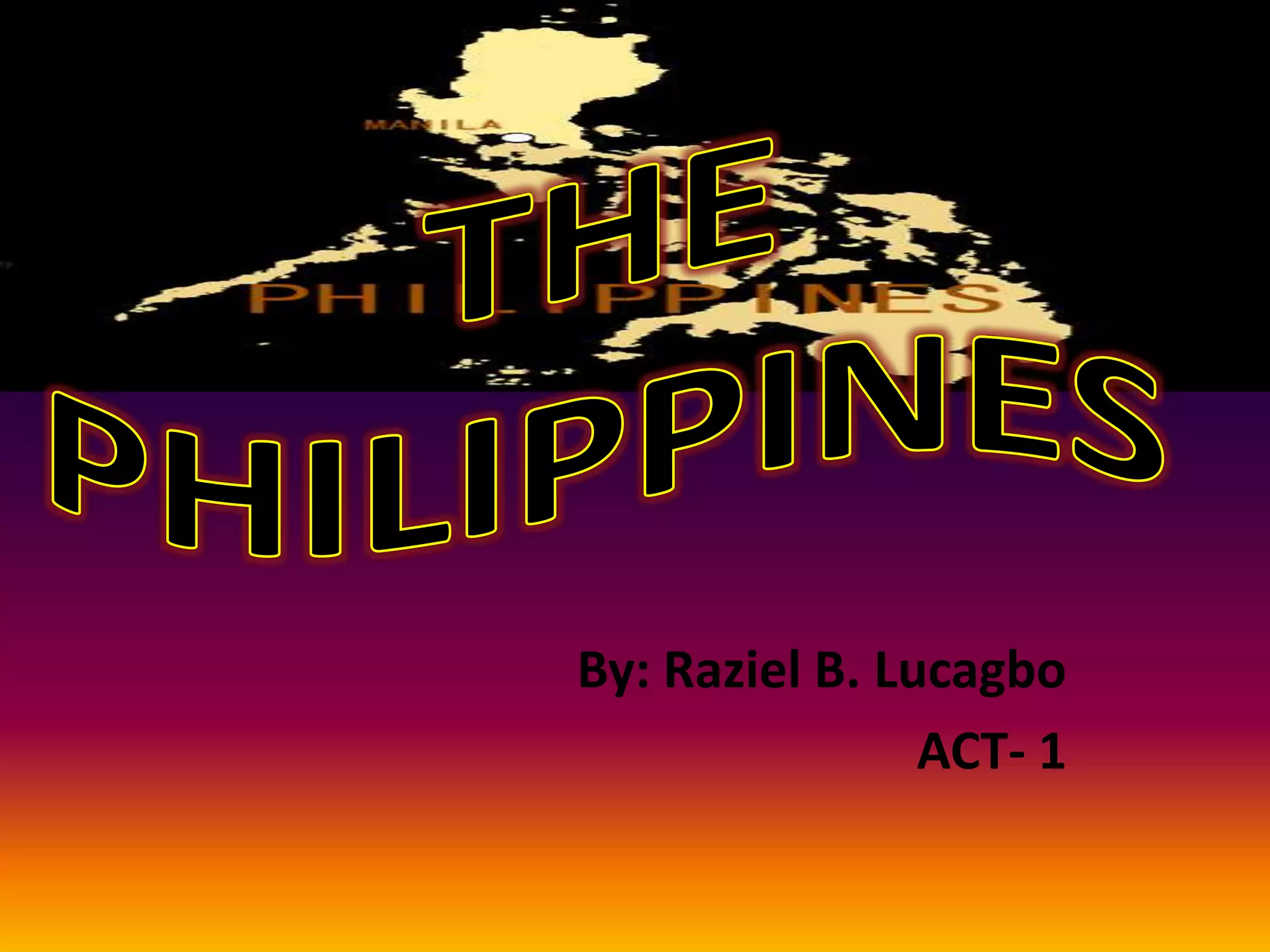
PHILIPPINES“The Pride of Filipino People”
PHILIPPINE GOVERNMENT    The Politics of the Philippines takes place in an organized framework of a presedential,representative, and democratic republic whereby the president is both the head of state and the head of government within a pluriform multi-party system. This system revolves around three separate and sovereign yet interdependent branches: the legislative branch (the law-making body), the executive branch (the law-enforcing body), and the judicial branch (the law-interpreting body). Executive power is exercised by the government under the leadership of the president. Legislative power is vested in both the government and the two-chamber congress—the Senate(the upper chamber) and the House of Representatives (the lower chamber). Judicial power is vested in the courts with the Supreme Court of the Philippines as the highest judicial body.
President of the PhilippinesBenigno Simeon Cojuangco Aquino III,           Known as Noynoy Aquino or Pnoy, born on February 8, 1960. A Filipino politician who has been the 15th and the current President of the Philippines since June 2010.        Born in Manila, Aquino graduated from  Ateneo de Manila University in 1981 and joined his family in their exile in       the United States shortly thereafter. He returned to the Philippines in 1983 shortly after the assassination of his father and held several positions working in the private sector. In 1998, he was elected to the House of Representatives as Representative of the 2nd district of  Tarlac province. He was subsequently re-elected to the House in 2001 and 2004.[3] In 2007, having been barred from running for re-election to the House due to term limits, he was elected to the Senate in the 14th Congress of the Philippines.         Following the death of his mother on August 1, 2009, many people began calling on Aquino to run for president.[3] On September 9, 2009, Aquino officially announced he would be a candidate in the 2010 presidential election, held on May 10, 2010.
Philippine Culture   This is the one thing that separates us         from the rest of the world - our colorful and lively culture that makes us distinctly Filipino. This includes traditions, language, arts, etc. which are found in museums, churches and galleries, found within the heart of the key cities.       Most provinces have their own identifying folk dances too wherein they showcase the elegance and beauty of the way we do things, the way we dress, the way we see things as shown in different paintings, as we have been influenced by events that happened in our history.That’s not all. When you have lived in the Philippines long enough, you’ll know that it’s not an exaggeration to say there is a town that’s celebrating its fiesta every single day.
Philippine - ClimateThe Philippines has a tropical marine climate dominated by a rainy season and a dry season. The summer monsoon brings heavy rains to most of the archipelago from May to October, whereas the winter monsoon brings cooler and drier air from December to February. Manila and most of the lowland areas are hot and dusty from March to May. Even at this time, however, temperatures rarely rise above 37° C. Mean annual sea-level temperatures rarely fall below 27° C. Annual rainfall measures as much as 5,000 millimeters in the mountainous east coast section of the country, but less than 1,000 millimeters in some of the sheltered valleys.              Monsoon rains, although hard and drenching, are not normally associated with high winds and waves. But the Philippines does sit astride the typhoon belt, and it suffers an annual onslaught of dangerous storms from July through October. These are especially hazardous for northern and eastern Luzon and the Bicol and Eastern Visayas regions, but Manila gets devastated periodically as well.

Presentation1

  • 1.
    PHILIPPINES“The Pride ofFilipino People”
  • 2.
    PHILIPPINE GOVERNMENT The Politics of the Philippines takes place in an organized framework of a presedential,representative, and democratic republic whereby the president is both the head of state and the head of government within a pluriform multi-party system. This system revolves around three separate and sovereign yet interdependent branches: the legislative branch (the law-making body), the executive branch (the law-enforcing body), and the judicial branch (the law-interpreting body). Executive power is exercised by the government under the leadership of the president. Legislative power is vested in both the government and the two-chamber congress—the Senate(the upper chamber) and the House of Representatives (the lower chamber). Judicial power is vested in the courts with the Supreme Court of the Philippines as the highest judicial body.
  • 3.
    President of thePhilippinesBenigno Simeon Cojuangco Aquino III, Known as Noynoy Aquino or Pnoy, born on February 8, 1960. A Filipino politician who has been the 15th and the current President of the Philippines since June 2010. Born in Manila, Aquino graduated from  Ateneo de Manila University in 1981 and joined his family in their exile in the United States shortly thereafter. He returned to the Philippines in 1983 shortly after the assassination of his father and held several positions working in the private sector. In 1998, he was elected to the House of Representatives as Representative of the 2nd district of  Tarlac province. He was subsequently re-elected to the House in 2001 and 2004.[3] In 2007, having been barred from running for re-election to the House due to term limits, he was elected to the Senate in the 14th Congress of the Philippines. Following the death of his mother on August 1, 2009, many people began calling on Aquino to run for president.[3] On September 9, 2009, Aquino officially announced he would be a candidate in the 2010 presidential election, held on May 10, 2010.
  • 4.
    Philippine Culture  This is the one thing that separates us from the rest of the world - our colorful and lively culture that makes us distinctly Filipino. This includes traditions, language, arts, etc. which are found in museums, churches and galleries, found within the heart of the key cities. Most provinces have their own identifying folk dances too wherein they showcase the elegance and beauty of the way we do things, the way we dress, the way we see things as shown in different paintings, as we have been influenced by events that happened in our history.That’s not all. When you have lived in the Philippines long enough, you’ll know that it’s not an exaggeration to say there is a town that’s celebrating its fiesta every single day.
  • 5.
    Philippine - ClimateThePhilippines has a tropical marine climate dominated by a rainy season and a dry season. The summer monsoon brings heavy rains to most of the archipelago from May to October, whereas the winter monsoon brings cooler and drier air from December to February. Manila and most of the lowland areas are hot and dusty from March to May. Even at this time, however, temperatures rarely rise above 37° C. Mean annual sea-level temperatures rarely fall below 27° C. Annual rainfall measures as much as 5,000 millimeters in the mountainous east coast section of the country, but less than 1,000 millimeters in some of the sheltered valleys. Monsoon rains, although hard and drenching, are not normally associated with high winds and waves. But the Philippines does sit astride the typhoon belt, and it suffers an annual onslaught of dangerous storms from July through October. These are especially hazardous for northern and eastern Luzon and the Bicol and Eastern Visayas regions, but Manila gets devastated periodically as well.