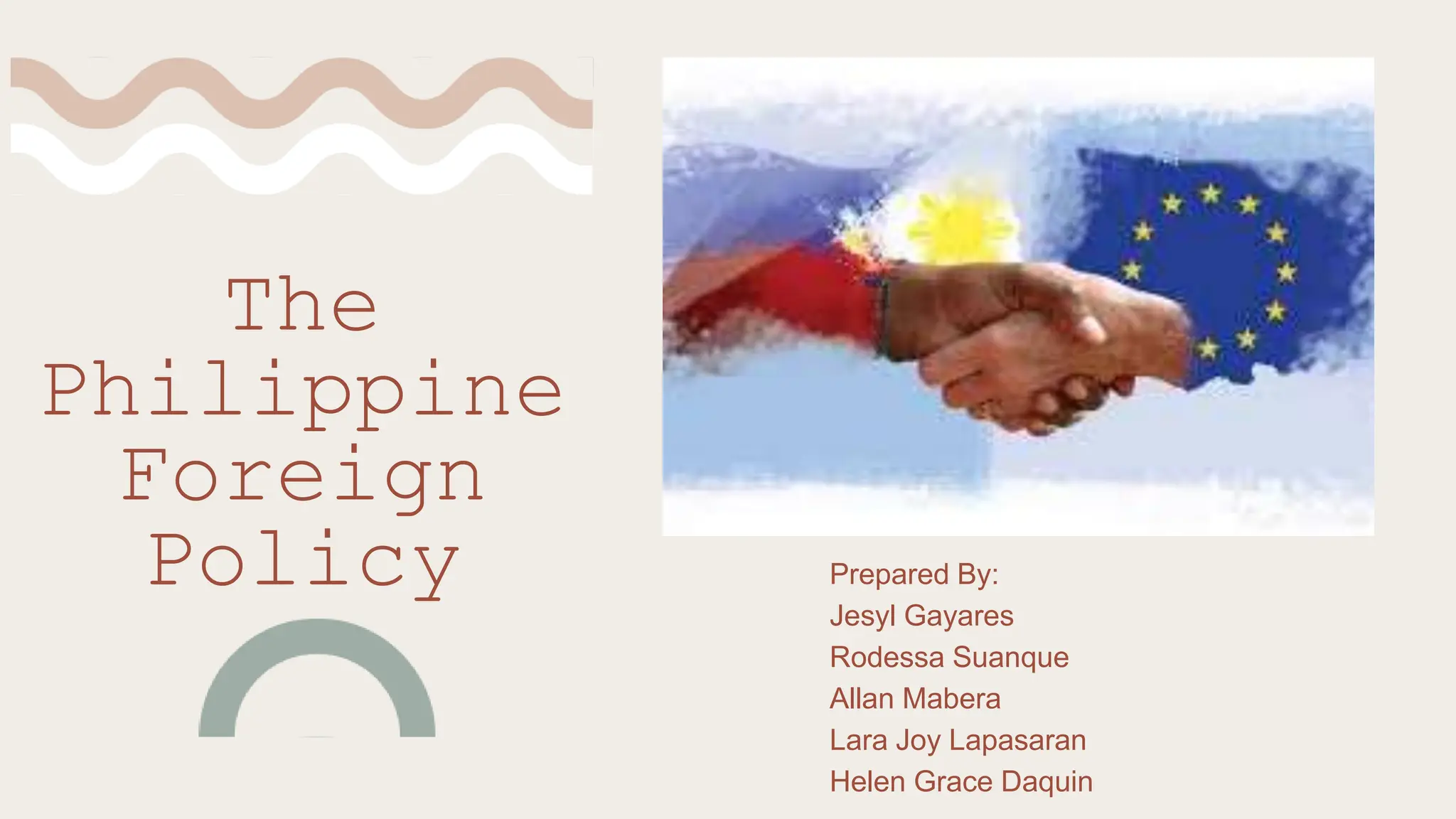
The
Philippine
Foreign
Policy Prepared By:
Jesyl Gayares
Rodessa Suanque
Allan Mabera
Lara Joy Lapasaran
Helen Grace Daquin
OBJECTIVES
• Familiarized with the Philippine Foreign Policy.
• Explained how the government conduct its foreign
relations.
• Discussed what practices govern the admission to and the
exclusion or deportation of Aliens from the Philippines.
• Explained how international disputes be solved.
• Described how foreign relations be conducted in time of
disagreement.
Philippine Foreign Policy
Reporter: Jesyl S. Sanogal
INTRODUCTION
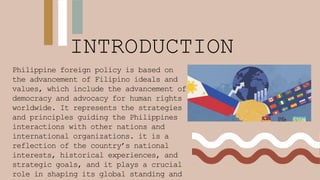
Philippine foreign policy is based on
the advancement of Filipino ideals and
values, which include the advancement of
democracy and advocacy for human rights
worldwide. It represents the strategies
and principles guiding the Philippines
interactions with other nations and
international organizations. it is a
reflection of the country’s national
interests, historical experiences, and
strategic goals, and it plays a crucial
role in shaping its global standing and
Philippine foreign policy refers to the set of principles
and strategies the Philippines employs to manage its
relationships with other countries and international
organizations. The policy aims to advance the country’s
national interests, ensure security, promote economic
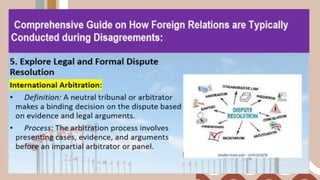
growth, and foster diplomatic and cultural ties on the
global stage. It shaped by historical legacies, regional
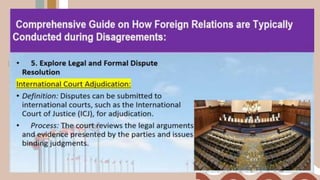
dynamics, and global trends.
Philippine Foreign Policy
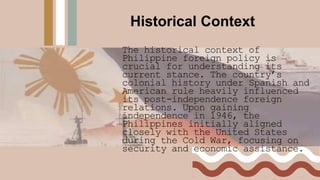
The historical context of
Philippine foreign policy is
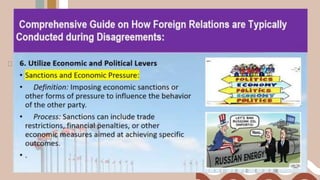
crucial for understanding its
current stance. The country’s
colonial history under Spanish and
American rule heavily influenced
its post-independence foreign
relations. Upon gaining
independence in 1946, the
Philippines initially aligned
closely with the United States
during the Cold War, focusing on
security and economic assistance.
Historical Context
Framing of Philippine Foreign Policy
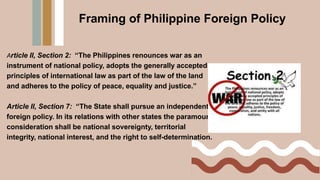
Article II, Section 2: “The Philippines renounces war as an
instrument of national policy, adopts the generally accepted
principles of international law as part of the law of the land
and adheres to the policy of peace, equality and justice.”
Article II, Section 7: “The State shall pursue an independent
foreign policy. In its relations with other states the paramount
consideration shall be national sovereignty, territorial
integrity, national interest, and the right to self-determination.
Framing of Philippine Foreign Policy
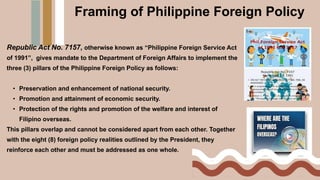
Republic Act No. 7157, otherwise known as “Philippine Foreign Service Act
of 1991”, gives mandate to the Department of Foreign Affairs to implement the
three (3) pillars of the Philippine Foreign Policy as follows:
• Preservation and enhancement of national security.
• Promotion and attainment of economic security.
• Protection of the rights and promotion of the welfare and interest of
Filipino overseas.
This pillars overlap and cannot be considered apart from each other. Together
with the eight (8) foreign policy realities outlined by the President, they
reinforce each other and must be addressed as one whole.
Framing of Philippine Foreign Policy
The Eight Foreign Policy Realities
1. China, Japan and the United States and their relationship will be a determining influence
in the security situation and economic evolution of East Asia.
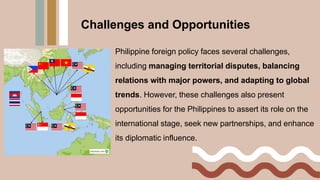
2. Philippine Foreign policy decisions have to be made in context of ASEAN.
3. The international Islamic community will continue to be important for the Philippines.
4. The coming years will see the growing importance of multilateral and inter- regional
organizations to promote common interests.
Framing of Philippine Foreign Policy
The Eight Foreign Policy Realities
5. As an archipelagic state, the defense of the nation’s sovereignty and the protection of
its environment and natural resources can be carried out only to the extent that it asserts
its rights over the maritime territory and gets others to respect those rights.
6. The country’s economic policy will continue to be friendly to both domestic and foreign
direct investments.
7. The Philippines cab benefit most quickly from international tourism.
8. Overseas Filipinos will continue to be recognize for their critical role in the country’s
economic and social stability.
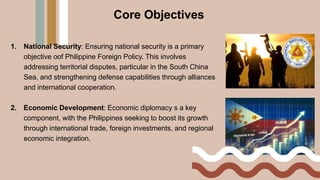
Core Objectives
1. National Security: Ensuring national security is a primary
objective oof Philippine Foreign Policy. This involves
addressing territorial disputes, particular in the South China
Sea, and strengthening defense capabilities through alliances
and international cooperation.
2. Economic Development: Economic diplomacy s a key
component, with the Philippines seeking to boost its growth
through international trade, foreign investments, and regional
economic integration.
Core Objectives
3. Diplomatic Relations: Building and maintaining
diplomatic relationships with other nations and participating in
international organizations help the Philippines navigate global
and regional challenges and promote its interests.
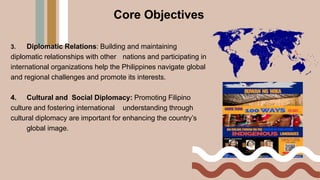
4. Cultural and Social Diplomacy: Promoting Filipino
culture and fostering international understanding through
cultural diplomacy are important for enhancing the country’s
global image.
Key Policies and Strategies
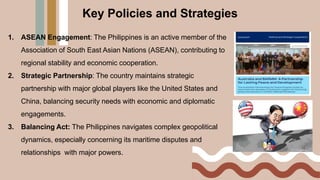
1. ASEAN Engagement: The Philippines is an active member of the
Association of South East Asian Nations (ASEAN), contributing to
regional stability and economic cooperation.
2. Strategic Partnership: The country maintains strategic
partnership with major global players like the United States and
China, balancing security needs with economic and diplomatic
engagements.
3. Balancing Act: The Philippines navigates complex geopolitical
dynamics, especially concerning its maritime disputes and
relationships with major powers.
Recent Developments
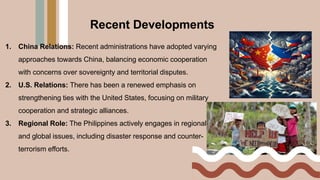
1. China Relations: Recent administrations have adopted varying
approaches towards China, balancing economic cooperation
with concerns over sovereignty and territorial disputes.
2. U.S. Relations: There has been a renewed emphasis on
strengthening ties with the United States, focusing on military
cooperation and strategic alliances.
3. Regional Role: The Philippines actively engages in regional
and global issues, including disaster response and counter-
terrorism efforts.
Philippine foreign policy faces several challenges,
including managing territorial disputes, balancing
relations with major powers, and adapting to global
trends. However, these challenges also present
opportunities for the Philippines to assert its role on the
international stage, seek new partnerships, and enhance
its diplomatic influence.
Challenges and Opportunities
HOW THE GOVERNMENT CONDUCT
ITS FOREIGN RELATION
Reporter: Rodessa L. Suanque
Governments conduct their foreign relations through a combination of diplomatic,
economic, and strategic practices aimed at advancing their national interests,
ensuring security, and promoting international cooperation. The methods and
approaches can vary based on a country's geopolitical context, historical
background, and current leadership. Here's an overview of how governments
typically manage their foreign relations:
HOW THE GOVERNMENT CONDUCT ITS
FOREIGN RELATION
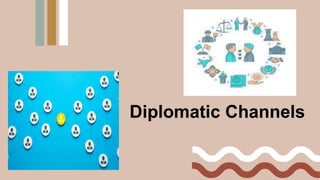
Diplomatic Channels
Bilateral Relations: Governments establish and maintain formal relationships with
other countries through embassies, consulates, and high-level visits. Diplomatic
negotiations and dialogues are conducted to address issues, form alliances, and
resolve conflicts.
Multilateral Organizations: Participation in international organizations (e.g., the
United Nations, World Trade Organization) allows governments to address global
issues, influence international norms, and collaborate on collective goals.
Diplomatic Engagement
Trade Agreements and Economic
Partnerships:
Free Trade Agreements (FTAs):
Governments negotiate FTAs to enhance
trade relations, reduce tariffs, and foster
economic cooperation with other
countries.
Economic Diplomacy
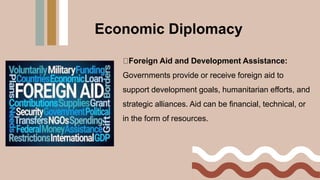
Foreign Aid and Development Assistance:
Governments provide or receive foreign aid to
support development goals, humanitarian efforts, and
strategic alliances. Aid can be financial, technical, or
in the form of resources.
Economic Diplomacy
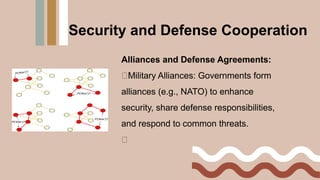
Alliances and Defense Agreements:
Military Alliances: Governments form
alliances (e.g., NATO) to enhance
security, share defense responsibilities,
and respond to common threats.
Security and Defense Cooperation
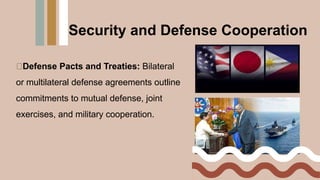
Defense Pacts and Treaties: Bilateral
or multilateral defense agreements outline
commitments to mutual defense, joint
exercises, and military cooperation.
Security and Defense Cooperation
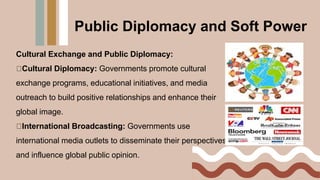
Cultural Exchange and Public Diplomacy:
Cultural Diplomacy: Governments promote cultural
exchange programs, educational initiatives, and media
outreach to build positive relationships and enhance their
global image.
International Broadcasting: Governments use
international media outlets to disseminate their perspectives
and influence global public opinion.
Public Diplomacy and Soft Power
Diplomatic Mediation and Conflict Resolution:
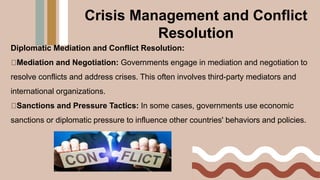
Mediation and Negotiation: Governments engage in mediation and negotiation to
resolve conflicts and address crises. This often involves third-party mediators and
international organizations.
Sanctions and Pressure Tactics: In some cases, governments use economic
sanctions or diplomatic pressure to influence other countries' behaviors and policies.
Crisis Management and Conflict
Resolution
Legislative Oversight and Public Opinion:
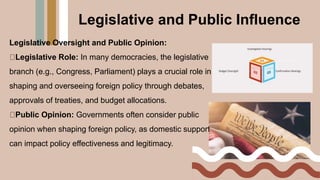
Legislative Role: In many democracies, the legislative
branch (e.g., Congress, Parliament) plays a crucial role in
shaping and overseeing foreign policy through debates,
approvals of treaties, and budget allocations.
Public Opinion: Governments often consider public
opinion when shaping foreign policy, as domestic support
can impact policy effectiveness and legitimacy.
Legislative and Public Influence
PRACTICES GOVERN THE ADMISSION
TO AND THE EXCLUSION OR
DEPORTATION OF ALIENS FROM THE
PHILIPPINES
Reporter: Allan P
. Mabera
In the Philippines, the practices governing the admission
to, exclusion, and deportation of aliens are primarily
regulated by laws and regulations established to manage
immigration and maintain national security. These
practices are enforced through various legal frameworks
and administrative procedures.
Here’s an overview of the key practices:
PRACTICES GOVERN THE ADMISSION TO AND
THE EXCLUSION OR DEPORTATION OF
ALIENS FROM THE PHILIPPINES
Legal Framework:
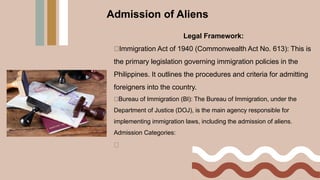
Immigration Act of 1940 (Commonwealth Act No. 613): This is
the primary legislation governing immigration policies in the
Philippines. It outlines the procedures and criteria for admitting
foreigners into the country.
Bureau of Immigration (BI): The Bureau of Immigration, under the
Department of Justice (DOJ), is the main agency responsible for
implementing immigration laws, including the admission of aliens.
Admission Categories:
Admission of Aliens
Legal Framework:
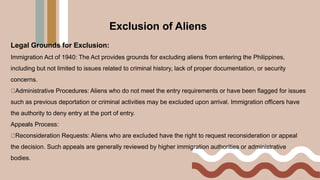
Visas and Permits: Foreign nationals wishing to enter
the Philippines typically require a visa. Different types of
visas include tourist, business, student, and working
visas. The issuance of these visas is subject to approval
based on the applicant’s purpose and compliance with
immigration laws.
oReference:
Entry Requirements: Foreigners must present valid
travel documents, such as passports, and may need to
satisfy health, financial, and security requirements to
gain entry into the Philippines.
Admission of Aliens
Legal Grounds for Exclusion:
Immigration Act of 1940: The Act provides grounds for excluding aliens from entering the Philippines,
including but not limited to issues related to criminal history, lack of proper documentation, or security
concerns.
Administrative Procedures: Aliens who do not meet the entry requirements or have been flagged for issues
such as previous deportation or criminal activities may be excluded upon arrival. Immigration officers have
the authority to deny entry at the port of entry.
Appeals Process:
Reconsideration Requests: Aliens who are excluded have the right to request reconsideration or appeal
the decision. Such appeals are generally reviewed by higher immigration authorities or administrative
bodies.
Exclusion of Aliens
Legal Grounds for Deportation:
Immigration Act of 1940: The Act provides specific grounds for the deportation of
aliens, including violation of visa conditions, illegal entry, criminal activities, or
actions detrimental to national security.
Administrative Orders and Rules: The Bureau of Immigration issues administrative
orders and regulations that outline the procedures for deportation, including due
process and the handling of deportation cases.
Deportation of Aliens
Deportation Procedures:
Detention and Proceedings: Aliens subject to deportation may be detained while deportation proceedings
are underway. They are given the opportunity to contest their deportation through legal representation and
hearings.
Removal and Repatriation: Once a deportation order is finalized, the alien is removed from the country,
typically at their own expense or at the expense of the government if specified under applicable agreements.
Legal Recourse and Appeals:
Judicial Review: Aliens have the right to seek judicial review of deportation orders through the Philippine
courts if they believe their rights have been violated or if procedural errors have occurred.
Deportation of Aliens
HOW INTERNATIONAL DISPUTES BE
RESOLVED
Reporter: Lara Joy C. Lapasaran
HOW INTERNATIONAL DISPUTES BE
RESOLVED
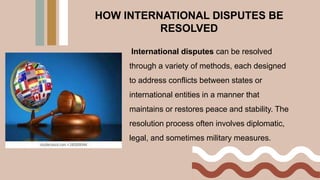
International disputes can be resolved
through a variety of methods, each designed
to address conflicts between states or
international entities in a manner that
maintains or restores peace and stability. The
resolution process often involves diplomatic,
legal, and sometimes military measures.
Diplomatic Negotiation
Direct Negotiations:
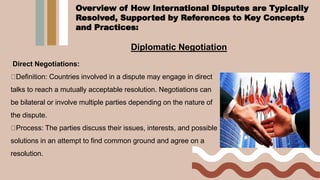
Definition: Countries involved in a dispute may engage in direct
talks to reach a mutually acceptable resolution. Negotiations can
be bilateral or involve multiple parties depending on the nature of
the dispute.
Process: The parties discuss their issues, interests, and possible
solutions in an attempt to find common ground and agree on a
resolution.
Overview of How International Disputes are Typically
Resolved, Supported by References to Key Concepts
and Practices:
Diplomatic Negotiation
Mediation:
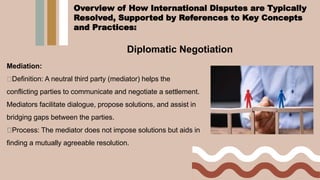
Definition: A neutral third party (mediator) helps the
conflicting parties to communicate and negotiate a settlement.
Mediators facilitate dialogue, propose solutions, and assist in
bridging gaps between the parties.
Process: The mediator does not impose solutions but aids in
finding a mutually agreeable resolution.
Overview of How International Disputes are Typically
Resolved, Supported by References to Key Concepts
and Practices:
Diplomatic Negotiation
Arbitration
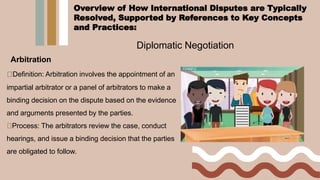
Definition: Arbitration involves the appointment of an
impartial arbitrator or a panel of arbitrators to make a
binding decision on the dispute based on the evidence
and arguments presented by the parties.
Process: The arbitrators review the case, conduct
hearings, and issue a binding decision that the parties
are obligated to follow.
Overview of How International Disputes are Typically
Resolved, Supported by References to Key Concepts
and Practices:
Diplomatic Negotiation
Institutional Arbitration:
Definition: Disputes can also be submitted to established
arbitration institutions like the International Court of Arbitration
(ICA) or the Permanent Court of Arbitration (PCA).
Process: These institutions provide a structured framework
and rules for conducting arbitration.
Overview of How International Disputes are Typically
Resolved, Supported by References to Key Concepts
and Practices:
Diplomatic Negotiation
Adjudication by International Courts
International Court of Justice (ICJ):
Definition: The ICJ, based in The Hague, is the principal
judicial organ of the United Nations and adjudicates disputes
between states based on international law.
Process: States submit cases to the ICJ, which reviews the
arguments, conducts hearings, and issues advisory opinions
or binding judgments.
Overview of How International Disputes are Typically
Resolved, Supported by References to Key Concepts
and Practices:
Diplomatic Negotiation
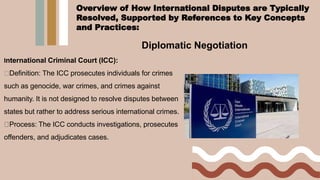
International Criminal Court (ICC):
Definition: The ICC prosecutes individuals for crimes
such as genocide, war crimes, and crimes against
humanity. It is not designed to resolve disputes between
states but rather to address serious international crimes.
Process: The ICC conducts investigations, prosecutes
offenders, and adjudicates cases.
Overview of How International Disputes are Typically
Resolved, Supported by References to Key Concepts
and Practices:
Diplomatic Negotiation
Peacekeeping and Intervention
United Nations Peacekeeping:
Definition: The UN deploys peacekeeping missions to conflict
zones to monitor ceasefires, protect civilians, and support the
implementation of peace agreements.
Process: Peacekeepers operate under a mandate from the
UN Security Council and work to stabilize situations and foster
conditions for peace.
Military Intervention:
Overview of How International Disputes are Typically
Resolved, Supported by References to Key Concepts
and Practices:
Diplomatic Negotiation
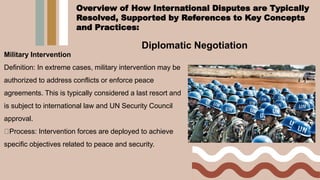
Military Intervention
Definition: In extreme cases, military intervention may be
authorized to address conflicts or enforce peace
agreements. This is typically considered a last resort and
is subject to international law and UN Security Council
approval.
Process: Intervention forces are deployed to achieve
specific objectives related to peace and security.
Overview of How International Disputes are Typically
Resolved, Supported by References to Key Concepts
and Practices:
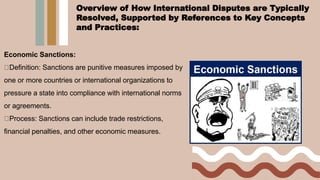
Economic Sanctions:
Definition: Sanctions are punitive measures imposed by
one or more countries or international organizations to
pressure a state into compliance with international norms
or agreements.
Process: Sanctions can include trade restrictions,
financial penalties, and other economic measures.
Overview of How International Disputes are Typically
Resolved, Supported by References to Key Concepts
and Practices:
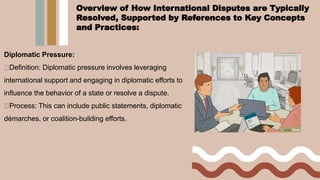
Diplomatic Pressure:
Definition: Diplomatic pressure involves leveraging
international support and engaging in diplomatic efforts to
influence the behavior of a state or resolve a dispute.
Process: This can include public statements, diplomatic
démarches, or coalition-building efforts.
Overview of How International Disputes are Typically
Resolved, Supported by References to Key Concepts
and Practices:
Conflict Resolution Frameworks
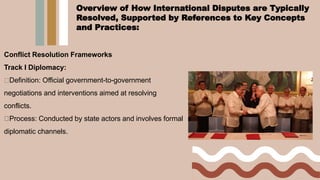
Track I Diplomacy:
Definition: Official government-to-government
negotiations and interventions aimed at resolving
conflicts.
Process: Conducted by state actors and involves formal
diplomatic channels.
Overview of How International Disputes are Typically
Resolved, Supported by References to Key Concepts
and Practices:
Diplomatic Negotiation
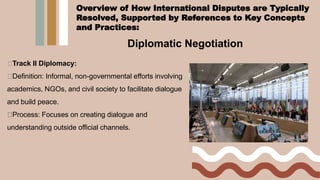
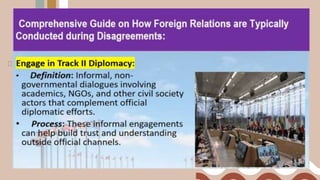
Track II Diplomacy:
Definition: Informal, non-governmental efforts involving
academics, NGOs, and civil society to facilitate dialogue
and build peace.
Process: Focuses on creating dialogue and
understanding outside official channels.
Overview of How International Disputes are Typically
Resolved, Supported by References to Key Concepts
and Practices:
HOW FOREIGN RELATIONS BE
CONDUCTED IN TIMES OF
DISAGREEMENTS
Reporter: Helen Grace D. Daquin
PRESENTORS:
Jesyl Gayares
Rodessa Suanque
Allan Mabera
Lara Joy Lapasaran
Helen Grace Daquin
Thank You!
Reach us through our socials

PFPR (1).pptx Philippine Foreign Policy.

  • 1.
    The Philippine Foreign Policy Prepared By: JesylGayares Rodessa Suanque Allan Mabera Lara Joy Lapasaran Helen Grace Daquin
  • 2.
    OBJECTIVES • Familiarized withthe Philippine Foreign Policy. • Explained how the government conduct its foreign relations. • Discussed what practices govern the admission to and the exclusion or deportation of Aliens from the Philippines. • Explained how international disputes be solved. • Described how foreign relations be conducted in time of disagreement.
  • 3.
  • 4.
    INTRODUCTION Philippine foreign policyis based on the advancement of Filipino ideals and values, which include the advancement of democracy and advocacy for human rights worldwide. It represents the strategies and principles guiding the Philippines interactions with other nations and international organizations. it is a reflection of the country’s national interests, historical experiences, and strategic goals, and it plays a crucial role in shaping its global standing and
  • 5.
    Philippine foreign policyrefers to the set of principles and strategies the Philippines employs to manage its relationships with other countries and international organizations. The policy aims to advance the country’s national interests, ensure security, promote economic growth, and foster diplomatic and cultural ties on the global stage. It shaped by historical legacies, regional dynamics, and global trends. Philippine Foreign Policy
  • 6.
    The historical contextof Philippine foreign policy is crucial for understanding its current stance. The country’s colonial history under Spanish and American rule heavily influenced its post-independence foreign relations. Upon gaining independence in 1946, the Philippines initially aligned closely with the United States during the Cold War, focusing on security and economic assistance. Historical Context
  • 7.
    Framing of PhilippineForeign Policy Article II, Section 2: “The Philippines renounces war as an instrument of national policy, adopts the generally accepted principles of international law as part of the law of the land and adheres to the policy of peace, equality and justice.” Article II, Section 7: “The State shall pursue an independent foreign policy. In its relations with other states the paramount consideration shall be national sovereignty, territorial integrity, national interest, and the right to self-determination.
  • 8.
    Framing of PhilippineForeign Policy Republic Act No. 7157, otherwise known as “Philippine Foreign Service Act of 1991”, gives mandate to the Department of Foreign Affairs to implement the three (3) pillars of the Philippine Foreign Policy as follows: • Preservation and enhancement of national security. • Promotion and attainment of economic security. • Protection of the rights and promotion of the welfare and interest of Filipino overseas. This pillars overlap and cannot be considered apart from each other. Together with the eight (8) foreign policy realities outlined by the President, they reinforce each other and must be addressed as one whole.
  • 9.
    Framing of PhilippineForeign Policy The Eight Foreign Policy Realities 1. China, Japan and the United States and their relationship will be a determining influence in the security situation and economic evolution of East Asia. 2. Philippine Foreign policy decisions have to be made in context of ASEAN. 3. The international Islamic community will continue to be important for the Philippines. 4. The coming years will see the growing importance of multilateral and inter- regional organizations to promote common interests.
  • 10.
    Framing of PhilippineForeign Policy The Eight Foreign Policy Realities 5. As an archipelagic state, the defense of the nation’s sovereignty and the protection of its environment and natural resources can be carried out only to the extent that it asserts its rights over the maritime territory and gets others to respect those rights. 6. The country’s economic policy will continue to be friendly to both domestic and foreign direct investments. 7. The Philippines cab benefit most quickly from international tourism. 8. Overseas Filipinos will continue to be recognize for their critical role in the country’s economic and social stability.
  • 11.
    Core Objectives 1. NationalSecurity: Ensuring national security is a primary objective oof Philippine Foreign Policy. This involves addressing territorial disputes, particular in the South China Sea, and strengthening defense capabilities through alliances and international cooperation. 2. Economic Development: Economic diplomacy s a key component, with the Philippines seeking to boost its growth through international trade, foreign investments, and regional economic integration.
  • 12.
    Core Objectives 3. DiplomaticRelations: Building and maintaining diplomatic relationships with other nations and participating in international organizations help the Philippines navigate global and regional challenges and promote its interests. 4. Cultural and Social Diplomacy: Promoting Filipino culture and fostering international understanding through cultural diplomacy are important for enhancing the country’s global image.
  • 13.
    Key Policies andStrategies 1. ASEAN Engagement: The Philippines is an active member of the Association of South East Asian Nations (ASEAN), contributing to regional stability and economic cooperation. 2. Strategic Partnership: The country maintains strategic partnership with major global players like the United States and China, balancing security needs with economic and diplomatic engagements. 3. Balancing Act: The Philippines navigates complex geopolitical dynamics, especially concerning its maritime disputes and relationships with major powers.
  • 14.
    Recent Developments 1. ChinaRelations: Recent administrations have adopted varying approaches towards China, balancing economic cooperation with concerns over sovereignty and territorial disputes. 2. U.S. Relations: There has been a renewed emphasis on strengthening ties with the United States, focusing on military cooperation and strategic alliances. 3. Regional Role: The Philippines actively engages in regional and global issues, including disaster response and counter- terrorism efforts.
  • 15.
    Philippine foreign policyfaces several challenges, including managing territorial disputes, balancing relations with major powers, and adapting to global trends. However, these challenges also present opportunities for the Philippines to assert its role on the international stage, seek new partnerships, and enhance its diplomatic influence. Challenges and Opportunities
  • 16.
    HOW THE GOVERNMENTCONDUCT ITS FOREIGN RELATION Reporter: Rodessa L. Suanque
  • 17.
    Governments conduct theirforeign relations through a combination of diplomatic, economic, and strategic practices aimed at advancing their national interests, ensuring security, and promoting international cooperation. The methods and approaches can vary based on a country's geopolitical context, historical background, and current leadership. Here's an overview of how governments typically manage their foreign relations: HOW THE GOVERNMENT CONDUCT ITS FOREIGN RELATION
  • 18.
  • 19.
    Bilateral Relations: Governmentsestablish and maintain formal relationships with other countries through embassies, consulates, and high-level visits. Diplomatic negotiations and dialogues are conducted to address issues, form alliances, and resolve conflicts. Multilateral Organizations: Participation in international organizations (e.g., the United Nations, World Trade Organization) allows governments to address global issues, influence international norms, and collaborate on collective goals. Diplomatic Engagement
  • 20.
    Trade Agreements andEconomic Partnerships: Free Trade Agreements (FTAs): Governments negotiate FTAs to enhance trade relations, reduce tariffs, and foster economic cooperation with other countries. Economic Diplomacy
  • 21.
    Foreign Aid andDevelopment Assistance: Governments provide or receive foreign aid to support development goals, humanitarian efforts, and strategic alliances. Aid can be financial, technical, or in the form of resources. Economic Diplomacy
  • 22.
    Alliances and DefenseAgreements: Military Alliances: Governments form alliances (e.g., NATO) to enhance security, share defense responsibilities, and respond to common threats. Security and Defense Cooperation
  • 23.
    Defense Pacts andTreaties: Bilateral or multilateral defense agreements outline commitments to mutual defense, joint exercises, and military cooperation. Security and Defense Cooperation
  • 24.
    Cultural Exchange andPublic Diplomacy: Cultural Diplomacy: Governments promote cultural exchange programs, educational initiatives, and media outreach to build positive relationships and enhance their global image. International Broadcasting: Governments use international media outlets to disseminate their perspectives and influence global public opinion. Public Diplomacy and Soft Power
  • 25.
    Diplomatic Mediation andConflict Resolution: Mediation and Negotiation: Governments engage in mediation and negotiation to resolve conflicts and address crises. This often involves third-party mediators and international organizations. Sanctions and Pressure Tactics: In some cases, governments use economic sanctions or diplomatic pressure to influence other countries' behaviors and policies. Crisis Management and Conflict Resolution
  • 26.
    Legislative Oversight andPublic Opinion: Legislative Role: In many democracies, the legislative branch (e.g., Congress, Parliament) plays a crucial role in shaping and overseeing foreign policy through debates, approvals of treaties, and budget allocations. Public Opinion: Governments often consider public opinion when shaping foreign policy, as domestic support can impact policy effectiveness and legitimacy. Legislative and Public Influence
  • 27.
    PRACTICES GOVERN THEADMISSION TO AND THE EXCLUSION OR DEPORTATION OF ALIENS FROM THE PHILIPPINES Reporter: Allan P . Mabera
  • 28.
    In the Philippines,the practices governing the admission to, exclusion, and deportation of aliens are primarily regulated by laws and regulations established to manage immigration and maintain national security. These practices are enforced through various legal frameworks and administrative procedures. Here’s an overview of the key practices: PRACTICES GOVERN THE ADMISSION TO AND THE EXCLUSION OR DEPORTATION OF ALIENS FROM THE PHILIPPINES
  • 29.
    Legal Framework: Immigration Actof 1940 (Commonwealth Act No. 613): This is the primary legislation governing immigration policies in the Philippines. It outlines the procedures and criteria for admitting foreigners into the country. Bureau of Immigration (BI): The Bureau of Immigration, under the Department of Justice (DOJ), is the main agency responsible for implementing immigration laws, including the admission of aliens. Admission Categories: Admission of Aliens
  • 30.
    Legal Framework: Visas andPermits: Foreign nationals wishing to enter the Philippines typically require a visa. Different types of visas include tourist, business, student, and working visas. The issuance of these visas is subject to approval based on the applicant’s purpose and compliance with immigration laws. oReference: Entry Requirements: Foreigners must present valid travel documents, such as passports, and may need to satisfy health, financial, and security requirements to gain entry into the Philippines. Admission of Aliens
  • 31.
    Legal Grounds forExclusion: Immigration Act of 1940: The Act provides grounds for excluding aliens from entering the Philippines, including but not limited to issues related to criminal history, lack of proper documentation, or security concerns. Administrative Procedures: Aliens who do not meet the entry requirements or have been flagged for issues such as previous deportation or criminal activities may be excluded upon arrival. Immigration officers have the authority to deny entry at the port of entry. Appeals Process: Reconsideration Requests: Aliens who are excluded have the right to request reconsideration or appeal the decision. Such appeals are generally reviewed by higher immigration authorities or administrative bodies. Exclusion of Aliens
  • 32.
    Legal Grounds forDeportation: Immigration Act of 1940: The Act provides specific grounds for the deportation of aliens, including violation of visa conditions, illegal entry, criminal activities, or actions detrimental to national security. Administrative Orders and Rules: The Bureau of Immigration issues administrative orders and regulations that outline the procedures for deportation, including due process and the handling of deportation cases. Deportation of Aliens
  • 33.
    Deportation Procedures: Detention andProceedings: Aliens subject to deportation may be detained while deportation proceedings are underway. They are given the opportunity to contest their deportation through legal representation and hearings. Removal and Repatriation: Once a deportation order is finalized, the alien is removed from the country, typically at their own expense or at the expense of the government if specified under applicable agreements. Legal Recourse and Appeals: Judicial Review: Aliens have the right to seek judicial review of deportation orders through the Philippine courts if they believe their rights have been violated or if procedural errors have occurred. Deportation of Aliens
  • 34.
    HOW INTERNATIONAL DISPUTESBE RESOLVED Reporter: Lara Joy C. Lapasaran
  • 35.
    HOW INTERNATIONAL DISPUTESBE RESOLVED International disputes can be resolved through a variety of methods, each designed to address conflicts between states or international entities in a manner that maintains or restores peace and stability. The resolution process often involves diplomatic, legal, and sometimes military measures.
  • 36.
    Diplomatic Negotiation Direct Negotiations: Definition:Countries involved in a dispute may engage in direct talks to reach a mutually acceptable resolution. Negotiations can be bilateral or involve multiple parties depending on the nature of the dispute. Process: The parties discuss their issues, interests, and possible solutions in an attempt to find common ground and agree on a resolution. Overview of How International Disputes are Typically Resolved, Supported by References to Key Concepts and Practices:
  • 37.
    Diplomatic Negotiation Mediation: Definition: Aneutral third party (mediator) helps the conflicting parties to communicate and negotiate a settlement. Mediators facilitate dialogue, propose solutions, and assist in bridging gaps between the parties. Process: The mediator does not impose solutions but aids in finding a mutually agreeable resolution. Overview of How International Disputes are Typically Resolved, Supported by References to Key Concepts and Practices:
  • 38.
    Diplomatic Negotiation Arbitration Definition: Arbitrationinvolves the appointment of an impartial arbitrator or a panel of arbitrators to make a binding decision on the dispute based on the evidence and arguments presented by the parties. Process: The arbitrators review the case, conduct hearings, and issue a binding decision that the parties are obligated to follow. Overview of How International Disputes are Typically Resolved, Supported by References to Key Concepts and Practices:
  • 39.
    Diplomatic Negotiation Institutional Arbitration: Definition:Disputes can also be submitted to established arbitration institutions like the International Court of Arbitration (ICA) or the Permanent Court of Arbitration (PCA). Process: These institutions provide a structured framework and rules for conducting arbitration. Overview of How International Disputes are Typically Resolved, Supported by References to Key Concepts and Practices:
  • 40.
    Diplomatic Negotiation Adjudication byInternational Courts International Court of Justice (ICJ): Definition: The ICJ, based in The Hague, is the principal judicial organ of the United Nations and adjudicates disputes between states based on international law. Process: States submit cases to the ICJ, which reviews the arguments, conducts hearings, and issues advisory opinions or binding judgments. Overview of How International Disputes are Typically Resolved, Supported by References to Key Concepts and Practices:
  • 41.
    Diplomatic Negotiation International CriminalCourt (ICC): Definition: The ICC prosecutes individuals for crimes such as genocide, war crimes, and crimes against humanity. It is not designed to resolve disputes between states but rather to address serious international crimes. Process: The ICC conducts investigations, prosecutes offenders, and adjudicates cases. Overview of How International Disputes are Typically Resolved, Supported by References to Key Concepts and Practices:
  • 42.
    Diplomatic Negotiation Peacekeeping andIntervention United Nations Peacekeeping: Definition: The UN deploys peacekeeping missions to conflict zones to monitor ceasefires, protect civilians, and support the implementation of peace agreements. Process: Peacekeepers operate under a mandate from the UN Security Council and work to stabilize situations and foster conditions for peace. Military Intervention: Overview of How International Disputes are Typically Resolved, Supported by References to Key Concepts and Practices:
  • 43.
    Diplomatic Negotiation Military Intervention Definition:In extreme cases, military intervention may be authorized to address conflicts or enforce peace agreements. This is typically considered a last resort and is subject to international law and UN Security Council approval. Process: Intervention forces are deployed to achieve specific objectives related to peace and security. Overview of How International Disputes are Typically Resolved, Supported by References to Key Concepts and Practices:
  • 44.
    Economic Sanctions: Definition: Sanctionsare punitive measures imposed by one or more countries or international organizations to pressure a state into compliance with international norms or agreements. Process: Sanctions can include trade restrictions, financial penalties, and other economic measures. Overview of How International Disputes are Typically Resolved, Supported by References to Key Concepts and Practices:
  • 45.
    Diplomatic Pressure: Definition: Diplomaticpressure involves leveraging international support and engaging in diplomatic efforts to influence the behavior of a state or resolve a dispute. Process: This can include public statements, diplomatic démarches, or coalition-building efforts. Overview of How International Disputes are Typically Resolved, Supported by References to Key Concepts and Practices:
  • 46.
    Conflict Resolution Frameworks TrackI Diplomacy: Definition: Official government-to-government negotiations and interventions aimed at resolving conflicts. Process: Conducted by state actors and involves formal diplomatic channels. Overview of How International Disputes are Typically Resolved, Supported by References to Key Concepts and Practices:
  • 47.
    Diplomatic Negotiation Track IIDiplomacy: Definition: Informal, non-governmental efforts involving academics, NGOs, and civil society to facilitate dialogue and build peace. Process: Focuses on creating dialogue and understanding outside official channels. Overview of How International Disputes are Typically Resolved, Supported by References to Key Concepts and Practices:
  • 48.
    HOW FOREIGN RELATIONSBE CONDUCTED IN TIMES OF DISAGREEMENTS Reporter: Helen Grace D. Daquin
  • 62.
    PRESENTORS: Jesyl Gayares Rodessa Suanque AllanMabera Lara Joy Lapasaran Helen Grace Daquin
  • 63.
    Thank You! Reach usthrough our socials