Differences in Central Nervous
System Tuberculosis in Children Vs
Adults
CNS TUBERCULOSIS
• Dr Ashwani K Sood
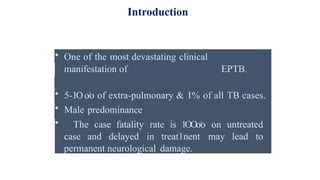
• One of the most devastating clinical
manifestation of EPTB.
• 5-1Oo/o of extra-pulmonary & I% of all TB cases.
• Male predominance
• The case fatality rate is 1OOo/o on untreated
case and delayed in treat1nent may lead to
permanent neurological damage.
Introduction
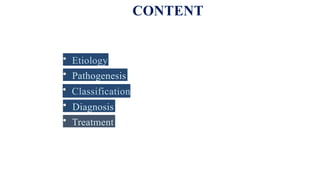
CONTENT
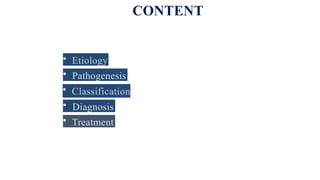
• Etiology
• Pathogenesis
• Classification
• Diagnosis
• Treatment
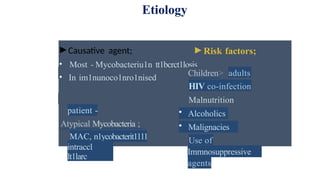
Etiology
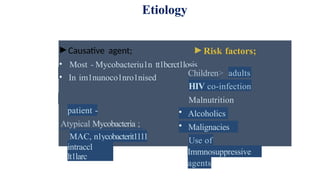
►Causative agent;
• Most - Mycobacteriu1n tt1bcrct1losis
• In im1nunoco1nro1nised
patient -
Atypical Mycobacteria ;
MAC, n1ycobacterit1111
intraccl
lt1larc
►Risk factors;
Children> adults
HIV co-infection
Malnutrition
• Alcoholics
• Malignacies
Use of
• •
Immnosuppressive
agents
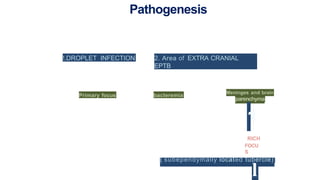
Pathogenesis
!.DROPLET INFECTION 2. Area of EXTRA CRANIAL
EPTB
Primary focus bacteremia
Meninges and brain
parenchyma
1
RICH
FOCU
S
( subependymally located tubercle)
l
lntracranial
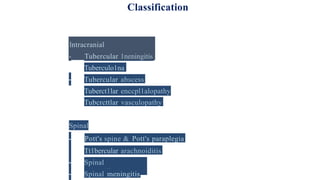
- Tubercular 1neningitis
Tuberculo1na
- Tubercular abscess
Tuberct1lar enccpl1alopathy
Tubcrcttlar vasculopathy
Spinal
-
-
-
Pott's spine & Pott's paraplegia
Tt1bercular arachnoiditis
Spinal
tt1berc1lion1a
Spinal meningitis
Classification
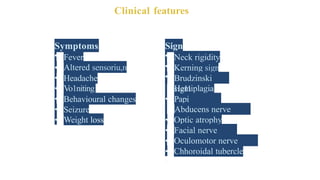
Symptoms
• Fever
Sign
• Neck rigidity
• Kerning sign
Altered sensoriu,n
Headache
Vo1niting Hemiplagia
Behavioural changes Papi
IIoedema
Seizure Abducens nerve
palsy
•
•
•
•
•
• Weight loss Optic atrophy
Facial nerve
palsy
Oculomotor nerve
palsy
• Brudzinski
sig11
•
•
•
•
•
•
Chhoroidal tubercle
Clinical features
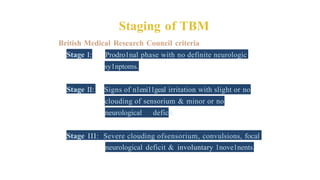
Staging of TBM
British Medical Research Council criteria
Stage I: Prodro1nal phase with no definite neurologic
sy1nptoms.
Stage II: Signs of n1eni11geal irritation with slight or no
clouding of sensorium & minor or no
neurological deficit.
Stage III: Severe clouding ofsensorium, convulsions, focal
neurological deficit & involuntary 1nove1nents.
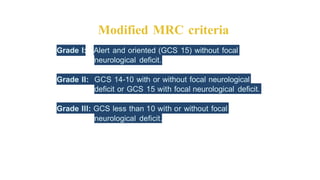
Modified MRC criteria
Grade I: Alert and oriented (GCS 15) without focal
neurological deficit.
Grade II: GCS 14-10 with or without focal neurological
deficit or GCS 15 with focal neurological deficit.
Grade Ill: GCS less than 10 with or without focal
neurological deficit.
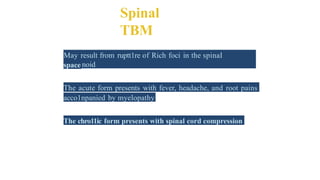
Spinal
TBM
May result from ruptt1re of Rich foci in the spinal
aracl1noid
space
The acute form presents with fever, headache, and root pains
acco1npanied by myelopathy
The chro11ic form presents with spinal cord compression
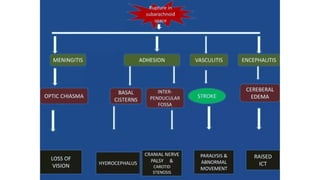
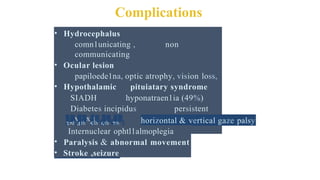
Complications
• Hydrocephalus
comn1unicating , non
communicating
• Ocular lesion
papiloede1na, optic atrophy, vision loss,
• Hypothalamic pituiatary syndrome
SIADH hyponatraen1ia (49%)
Diabetes incipidus persistent
pyrexia
• Cranial nerve palsies
3rd 4th, 5th 6th 7th horizontal & vertical gaze palsy
' ' ' '
Internuclear ophtl1almoplegia
• Paralysis & abnormal movement
• Stroke ,seizure
CNS TUBERCULOSIS
• Dr Ashwani K Sood
• One of the most devastating clinical
manifestation of EPTB.
• 5-1Oo/o of extra-pulmonary & I% of all TB cases.
• Male predominance
• The case fatality rate is 1OOo/o on untreated
case and delayed in treat1nent may lead to
permanent neurological damage.
Introduction
CONTENT
• Etiology
• Pathogenesis
• Classification
• Diagnosis
• Treatment
Etiology
►Causative agent;
• Most - Mycobacteriu1n tt1bcrct1losis
• In im1nunoco1nro1nised
patient -
Atypical Mycobacteria ;
MAC, n1ycobacterit1111
intraccl
lt1larc
►Risk factors;
Children> adults
HIV co-infection
Malnutrition
• Alcoholics
• Malignacies
Use of
• •
Immnosuppressive
agents

Differences in Central Nervous System Tuberculosis in Children.pptx

  • 1.
    Differences in CentralNervous System Tuberculosis in Children Vs Adults
  • 2.
  • 3.
    • One ofthe most devastating clinical manifestation of EPTB. • 5-1Oo/o of extra-pulmonary & I% of all TB cases. • Male predominance • The case fatality rate is 1OOo/o on untreated case and delayed in treat1nent may lead to permanent neurological damage. Introduction
  • 4.
    CONTENT • Etiology • Pathogenesis •Classification • Diagnosis • Treatment
  • 5.
    Etiology ►Causative agent; • Most- Mycobacteriu1n tt1bcrct1losis • In im1nunoco1nro1nised patient - Atypical Mycobacteria ; MAC, n1ycobacterit1111 intraccl lt1larc ►Risk factors; Children> adults HIV co-infection Malnutrition • Alcoholics • Malignacies Use of • • Immnosuppressive agents
  • 7.
    Pathogenesis !.DROPLET INFECTION 2.Area of EXTRA CRANIAL EPTB Primary focus bacteremia Meninges and brain parenchyma 1 RICH FOCU S ( subependymally located tubercle) l
  • 9.
    lntracranial - Tubercular 1neningitis Tuberculo1na -Tubercular abscess Tuberct1lar enccpl1alopathy Tubcrcttlar vasculopathy Spinal - - - Pott's spine & Pott's paraplegia Tt1bercular arachnoiditis Spinal tt1berc1lion1a Spinal meningitis Classification
  • 11.
    Symptoms • Fever Sign • Neckrigidity • Kerning sign Altered sensoriu,n Headache Vo1niting Hemiplagia Behavioural changes Papi IIoedema Seizure Abducens nerve palsy • • • • • • Weight loss Optic atrophy Facial nerve palsy Oculomotor nerve palsy • Brudzinski sig11 • • • • • • Chhoroidal tubercle Clinical features
  • 12.
    Staging of TBM BritishMedical Research Council criteria Stage I: Prodro1nal phase with no definite neurologic sy1nptoms. Stage II: Signs of n1eni11geal irritation with slight or no clouding of sensorium & minor or no neurological deficit. Stage III: Severe clouding ofsensorium, convulsions, focal neurological deficit & involuntary 1nove1nents.
  • 13.
    Modified MRC criteria GradeI: Alert and oriented (GCS 15) without focal neurological deficit. Grade II: GCS 14-10 with or without focal neurological deficit or GCS 15 with focal neurological deficit. Grade Ill: GCS less than 10 with or without focal neurological deficit.
  • 14.
    Spinal TBM May result fromruptt1re of Rich foci in the spinal aracl1noid space The acute form presents with fever, headache, and root pains acco1npanied by myelopathy The chro11ic form presents with spinal cord compression
  • 15.
    Complications • Hydrocephalus comn1unicating ,non communicating • Ocular lesion papiloede1na, optic atrophy, vision loss, • Hypothalamic pituiatary syndrome SIADH hyponatraen1ia (49%) Diabetes incipidus persistent pyrexia • Cranial nerve palsies 3rd 4th, 5th 6th 7th horizontal & vertical gaze palsy ' ' ' ' Internuclear ophtl1almoplegia • Paralysis & abnormal movement • Stroke ,seizure
  • 16.
  • 17.
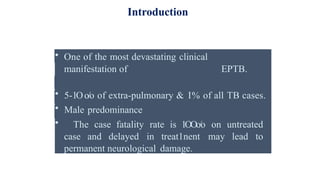
    • One ofthe most devastating clinical manifestation of EPTB. • 5-1Oo/o of extra-pulmonary & I% of all TB cases. • Male predominance • The case fatality rate is 1OOo/o on untreated case and delayed in treat1nent may lead to permanent neurological damage. Introduction
  • 18.
    CONTENT • Etiology • Pathogenesis •Classification • Diagnosis • Treatment
  • 19.
    Etiology ►Causative agent; • Most- Mycobacteriu1n tt1bcrct1losis • In im1nunoco1nro1nised patient - Atypical Mycobacteria ; MAC, n1ycobacterit1111 intraccl lt1larc ►Risk factors; Children> adults HIV co-infection Malnutrition • Alcoholics • Malignacies Use of • • Immnosuppressive agents