
Done By Dr. Mohammed Alkoum
Developmental assessment
• Developmental Assessment - Is The Process Of Mapping A
Child's Performance Compared With Children Of Similar
Age.
• It Is Acquisition Of Qualitative And Quantitative Skills In A
Social Environment
Developmental assessment
• Assessing A Young Child’s Development Consider The
Four Fields Of Developmental Skills:
• A) Gross Motor.
• B) Fine Motor & Vision.
• C) Hearing, Speech And Language .
• D) Social, Emotional & Behavior
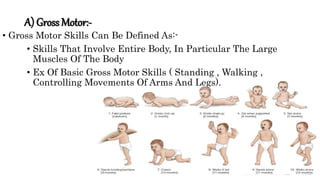
A) Gross Motor:-
• Gross Motor Skills Can Be Defined As:-
• Skills That Involve Entire Body, In Particular The Large
Muscles Of The Body
• Ex Of Basic Gross Motor Skills ( Standing , Walking ,
Controlling Movements Of Arms And Legs).
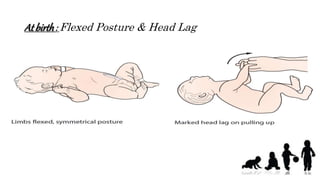
At birth: Flexed Posture & Head Lag
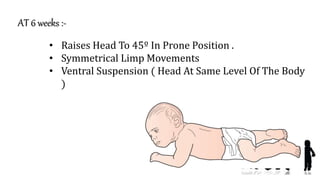
AT 6 weeks :-
• Raises Head To 45º In Prone Position .
• Symmetrical Limp Movements
• Ventral Suspension ( Head At Same Level Of The Body
)
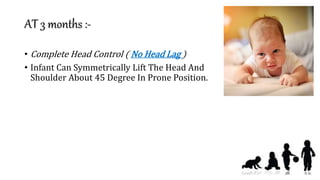
AT 3 months :-
• Complete Head Control ( No Head Lag )
• Infant Can Symmetrically Lift The Head And
Shoulder About 45 Degree In Prone Position.
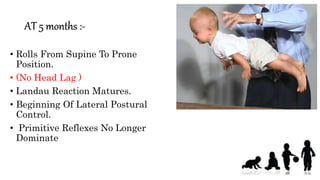
AT 5 months :-
• Rolls From Supine To Prone
Position.
• (No Head Lag )
• Landau Reaction Matures.
• Beginning Of Lateral Postural
Control.
• Primitive Reflexes No Longer
Dominate
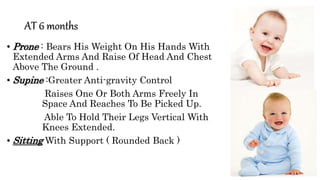
AT 6 months
• Prone : Bears His Weight On His Hands With
Extended Arms And Raise Of Head And Chest
Above The Ground .
• Supine :Greater Anti-gravity Control
Raises One Or Both Arms Freely In
Space And Reaches To Be Picked Up.
Able To Hold Their Legs Vertical With
Knees Extended.
• Sitting With Support ( Rounded Back )
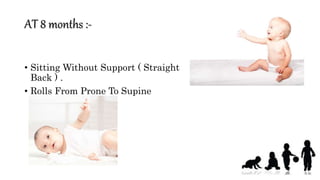
AT 8 months :-
• Sitting Without Support ( Straight
Back ) .
• Rolls From Prone To Supine
Position .
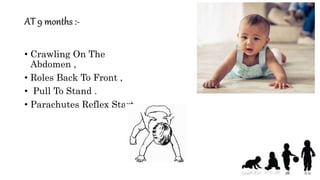
AT 9 months :-
• Crawling On The
Abdomen ,
• Roles Back To Front ,
• Pull To Stand .
• Parachutes Reflex Start.
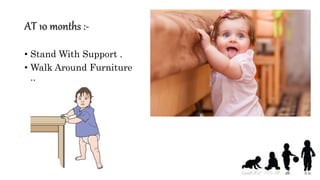
AT 10 months :-
• Stand With Support .
• Walk Around Furniture
..
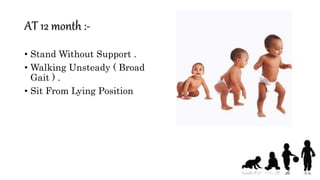
AT 12 month :-
• Stand Without Support .
• Walking Unsteady ( Broad
Gait ) .
• Sit From Lying Position
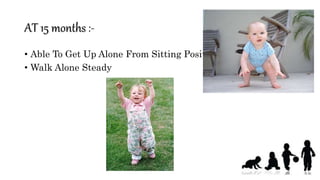
AT 15 months :-
• Able To Get Up Alone From Sitting Position .
• Walk Alone Steady
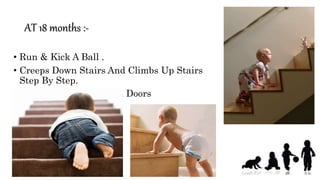
AT 18 months :-
• Run & Kick A Ball .
• Creeps Down Stairs And Climbs Up Stairs
Step By Step.
• Push And Pull Toys And Doors
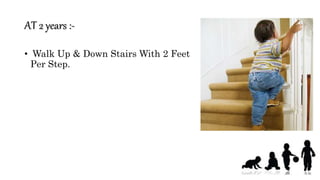
AT 2 years :-
• Walk Up & Down Stairs With 2 Feet
Per Step.
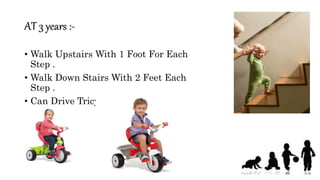
AT 3 years :-
• Walk Upstairs With 1 Foot For Each
Step .
• Walk Down Stairs With 2 Feet Each
Step .
• Can Drive Tricycle.
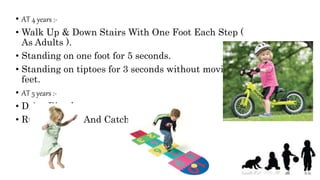
• AT 4 years :-
• Walk Up & Down Stairs With One Foot Each Step (
As Adults ).
• Standing on one foot for 5 seconds.
• Standing on tiptoes for 3 seconds without moving
feet.
• AT 5 years :-
• Drive Bicycle.
• Runs On Toys And Catch Ball
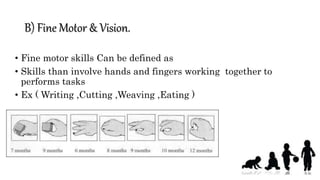
B) Fine Motor & Vision.
• Fine motor skills Can be defined as
• Skills than involve hands and fingers working together to
performs tasks
• Ex ( Writing ,Cutting ,Weaving ,Eating )
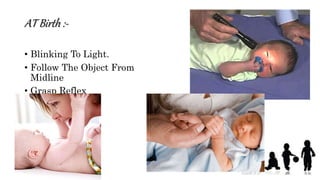
AT Birth :-
• Blinking To Light.
• Follow The Object From
Midline
• Grasp Reflex
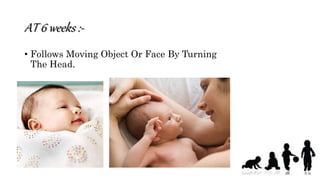
AT 6 weeks :-
• Follows Moving Object Or Face By Turning
The Head.
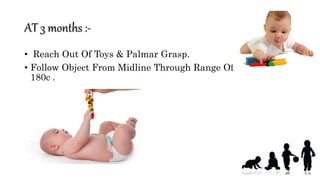
AT 3 months :-
• Reach Out Of Toys & Palmar Grasp.
• Follow Object From Midline Through Range Of
180c .
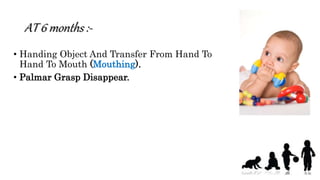
AT 6 months :-
• Handing Object And Transfer From Hand To
Hand To Mouth (Mouthing).
• Palmar Grasp Disappear.
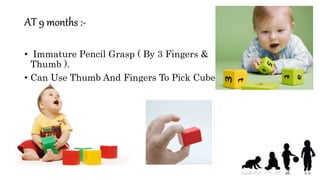
AT 9 months :-
• Immature Pencil Grasp ( By 3 Fingers &
Thumb ).
• Can Use Thumb And Fingers To Pick Cubes .
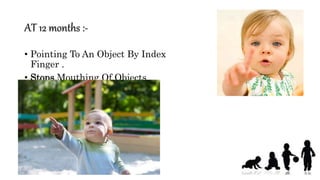
AT 12 months :-
• Pointing To An Object By Index
Finger .
• Stops Mouthing Of Objects
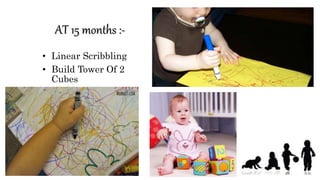
AT 15 months :-
• Linear Scribbling
• Build Tower Of 2
Cubes
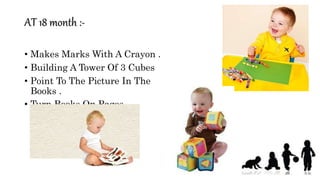
AT 18 month :-
• Makes Marks With A Crayon .
• Building A Tower Of 3 Cubes
• Point To The Picture In The
Books .
• Turn Books On Pages
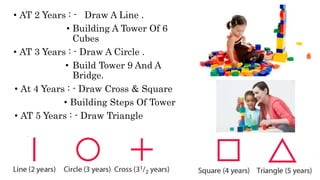
• AT 2 Years : - Draw A Line .
• Building A Tower Of 6
Cubes
• AT 3 Years : - Draw A Circle .
• Build Tower 9 And A
Bridge.
• At 4 Years : - Draw Cross & Square
• Building Steps Of Tower
• AT 5 Years : - Draw Triangle
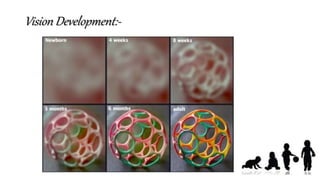
Vision Development:-
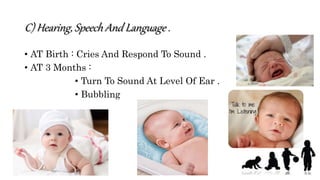
C) Hearing, Speech And Language .
• AT Birth : Cries And Respond To Sound .
• AT 3 Months :
• Turn To Sound At Level Of Ear .
• Bubbling
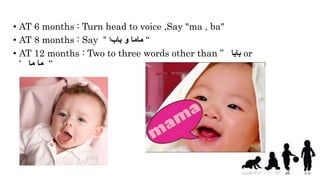
• AT 6 months : Turn head to voice ,Say "ma , ba"
• AT 8 months : Say ‫باب‬ ‫و‬ ‫ماما‬‫ا‬“ “
• AT 12 months : Two to three words other than ” ‫بابا‬ or
' ‫ما‬‫ما‬ “
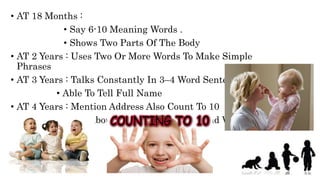
• AT 18 Months :
• Say 6-10 Meaning Words .
• Shows Two Parts Of The Body
• AT 2 Years : Uses Two Or More Words To Make Simple
Phrases
• AT 3 Years : Talks Constantly In 3–4 Word Sentences
• Able To Tell Full Name
• AT 4 Years : Mention Address Also Count To 10
• AT 5 Years : Ask About Of Words And Who And When .
D) Social, Emotional & Behavior
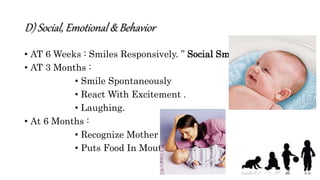
• AT 6 Weeks : Smiles Responsively. ” Social Smiling “
• AT 3 Months :
• Smile Spontaneously
• React With Excitement .
• Laughing.
• At 6 Months :
• Recognize Mother .
• Puts Food In Mouth
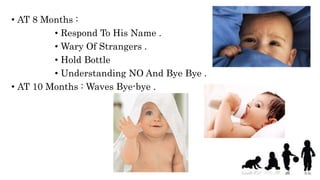
• AT 8 Months :
• Respond To His Name .
• Wary Of Strangers .
• Hold Bottle
• Understanding NO And Bye Bye .
• AT 10 Months : Waves Bye-bye .
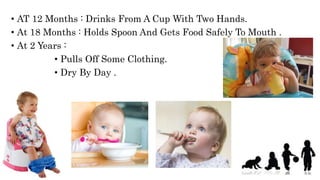
• AT 12 Months : Drinks From A Cup With Two Hands.
• At 18 Months : Holds Spoon And Gets Food Safely To Mouth .
• At 2 Years :
• Pulls Off Some Clothing.
• Dry By Day .
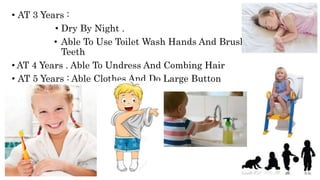
• AT 3 Years :
• Dry By Night .
• Able To Use Toilet Wash Hands And Brush
Teeth
• AT 4 Years . Able To Undress And Combing Hair
• AT 5 Years : Able Clothes And Do Large Button
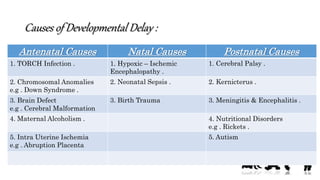
Causes of Developmental Delay :
Postnatal CausesNatal CausesAntenatal Causes
1. Cerebral Palsy .1. Hypoxic – Ischemic
Encephalopathy .
1. TORCH Infection .
2. Kernicterus .2. Neonatal Sepsis .2. Chromosomal Anomalies
e.g . Down Syndrome .
3. Meningitis & Encephalitis .3. Birth Trauma3. Brain Defect
e.g . Cerebral Malformation
4. Nutritional Disorders
e.g . Rickets .
4. Maternal Alcoholism .
5. Autism5. Intra Uterine Ischemia
e.g . Abruption Placenta
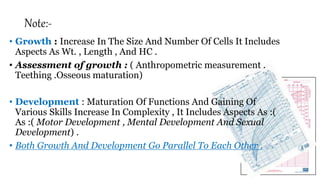
Note:-
• Growth : Increase In The Size And Number Of Cells It Includes
Aspects As Wt. , Length , And HC .
• Assessment of growth : ( Anthropometric measurement .
Teething .Osseous maturation)
• Development : Maturation Of Functions And Gaining Of
Various Skills Increase In Complexity , It Includes Aspects As :(
As :( Motor Development , Mental Development And Sexual
Development) .
• Both Growth And Development Go Parallel To Each Other .
Pediatric Developmental Assessment

Pediatric Developmental Assessment

  • 1.
    Done By Dr.Mohammed Alkoum
  • 2.
    Developmental assessment • DevelopmentalAssessment - Is The Process Of Mapping A Child's Performance Compared With Children Of Similar Age. • It Is Acquisition Of Qualitative And Quantitative Skills In A Social Environment
  • 3.
    Developmental assessment • AssessingA Young Child’s Development Consider The Four Fields Of Developmental Skills: • A) Gross Motor. • B) Fine Motor & Vision. • C) Hearing, Speech And Language . • D) Social, Emotional & Behavior
  • 6.
    A) Gross Motor:- •Gross Motor Skills Can Be Defined As:- • Skills That Involve Entire Body, In Particular The Large Muscles Of The Body • Ex Of Basic Gross Motor Skills ( Standing , Walking , Controlling Movements Of Arms And Legs).
  • 7.
    At birth: FlexedPosture & Head Lag
  • 8.
    AT 6 weeks:- • Raises Head To 45º In Prone Position . • Symmetrical Limp Movements • Ventral Suspension ( Head At Same Level Of The Body )
  • 9.
    AT 3 months:- • Complete Head Control ( No Head Lag ) • Infant Can Symmetrically Lift The Head And Shoulder About 45 Degree In Prone Position.
  • 10.
    AT 5 months:- • Rolls From Supine To Prone Position. • (No Head Lag ) • Landau Reaction Matures. • Beginning Of Lateral Postural Control. • Primitive Reflexes No Longer Dominate
  • 11.
    AT 6 months •Prone : Bears His Weight On His Hands With Extended Arms And Raise Of Head And Chest Above The Ground . • Supine :Greater Anti-gravity Control Raises One Or Both Arms Freely In Space And Reaches To Be Picked Up. Able To Hold Their Legs Vertical With Knees Extended. • Sitting With Support ( Rounded Back )
  • 12.
    AT 8 months:- • Sitting Without Support ( Straight Back ) . • Rolls From Prone To Supine Position .
  • 13.
    AT 9 months:- • Crawling On The Abdomen , • Roles Back To Front , • Pull To Stand . • Parachutes Reflex Start.
  • 14.
    AT 10 months:- • Stand With Support . • Walk Around Furniture ..
  • 15.
    AT 12 month:- • Stand Without Support . • Walking Unsteady ( Broad Gait ) . • Sit From Lying Position
  • 16.
    AT 15 months:- • Able To Get Up Alone From Sitting Position . • Walk Alone Steady
  • 17.
    AT 18 months:- • Run & Kick A Ball . • Creeps Down Stairs And Climbs Up Stairs Step By Step. • Push And Pull Toys And Doors
  • 18.
    AT 2 years:- • Walk Up & Down Stairs With 2 Feet Per Step.
  • 19.
    AT 3 years:- • Walk Upstairs With 1 Foot For Each Step . • Walk Down Stairs With 2 Feet Each Step . • Can Drive Tricycle.
  • 20.
    • AT 4years :- • Walk Up & Down Stairs With One Foot Each Step ( As Adults ). • Standing on one foot for 5 seconds. • Standing on tiptoes for 3 seconds without moving feet. • AT 5 years :- • Drive Bicycle. • Runs On Toys And Catch Ball
  • 21.
    B) Fine Motor& Vision. • Fine motor skills Can be defined as • Skills than involve hands and fingers working together to performs tasks • Ex ( Writing ,Cutting ,Weaving ,Eating )
  • 22.
    AT Birth :- •Blinking To Light. • Follow The Object From Midline • Grasp Reflex
  • 23.
    AT 6 weeks:- • Follows Moving Object Or Face By Turning The Head.
  • 24.
    AT 3 months:- • Reach Out Of Toys & Palmar Grasp. • Follow Object From Midline Through Range Of 180c .
  • 25.
    AT 6 months:- • Handing Object And Transfer From Hand To Hand To Mouth (Mouthing). • Palmar Grasp Disappear.
  • 26.
    AT 9 months:- • Immature Pencil Grasp ( By 3 Fingers & Thumb ). • Can Use Thumb And Fingers To Pick Cubes .
  • 27.
    AT 12 months:- • Pointing To An Object By Index Finger . • Stops Mouthing Of Objects
  • 28.
    AT 15 months:- • Linear Scribbling • Build Tower Of 2 Cubes
  • 29.
    AT 18 month:- • Makes Marks With A Crayon . • Building A Tower Of 3 Cubes • Point To The Picture In The Books . • Turn Books On Pages
  • 30.
    • AT 2Years : - Draw A Line . • Building A Tower Of 6 Cubes • AT 3 Years : - Draw A Circle . • Build Tower 9 And A Bridge. • At 4 Years : - Draw Cross & Square • Building Steps Of Tower • AT 5 Years : - Draw Triangle
  • 31.
  • 32.
    C) Hearing, SpeechAnd Language . • AT Birth : Cries And Respond To Sound . • AT 3 Months : • Turn To Sound At Level Of Ear . • Bubbling
  • 33.
    • AT 6months : Turn head to voice ,Say "ma , ba" • AT 8 months : Say ‫باب‬ ‫و‬ ‫ماما‬‫ا‬“ “ • AT 12 months : Two to three words other than ” ‫بابا‬ or ' ‫ما‬‫ما‬ “
  • 34.
    • AT 18Months : • Say 6-10 Meaning Words . • Shows Two Parts Of The Body • AT 2 Years : Uses Two Or More Words To Make Simple Phrases • AT 3 Years : Talks Constantly In 3–4 Word Sentences • Able To Tell Full Name • AT 4 Years : Mention Address Also Count To 10 • AT 5 Years : Ask About Of Words And Who And When .
  • 35.
    D) Social, Emotional& Behavior • AT 6 Weeks : Smiles Responsively. ” Social Smiling “ • AT 3 Months : • Smile Spontaneously • React With Excitement . • Laughing. • At 6 Months : • Recognize Mother . • Puts Food In Mouth
  • 36.
    • AT 8Months : • Respond To His Name . • Wary Of Strangers . • Hold Bottle • Understanding NO And Bye Bye . • AT 10 Months : Waves Bye-bye .
  • 37.
    • AT 12Months : Drinks From A Cup With Two Hands. • At 18 Months : Holds Spoon And Gets Food Safely To Mouth . • At 2 Years : • Pulls Off Some Clothing. • Dry By Day .
  • 38.
    • AT 3Years : • Dry By Night . • Able To Use Toilet Wash Hands And Brush Teeth • AT 4 Years . Able To Undress And Combing Hair • AT 5 Years : Able Clothes And Do Large Button
  • 39.
    Causes of DevelopmentalDelay : Postnatal CausesNatal CausesAntenatal Causes 1. Cerebral Palsy .1. Hypoxic – Ischemic Encephalopathy . 1. TORCH Infection . 2. Kernicterus .2. Neonatal Sepsis .2. Chromosomal Anomalies e.g . Down Syndrome . 3. Meningitis & Encephalitis .3. Birth Trauma3. Brain Defect e.g . Cerebral Malformation 4. Nutritional Disorders e.g . Rickets . 4. Maternal Alcoholism . 5. Autism5. Intra Uterine Ischemia e.g . Abruption Placenta
  • 40.
    Note:- • Growth :Increase In The Size And Number Of Cells It Includes Aspects As Wt. , Length , And HC . • Assessment of growth : ( Anthropometric measurement . Teething .Osseous maturation) • Development : Maturation Of Functions And Gaining Of Various Skills Increase In Complexity , It Includes Aspects As :( As :( Motor Development , Mental Development And Sexual Development) . • Both Growth And Development Go Parallel To Each Other .