Development of
inbred lines
Submitted to : Prepared by :
Dr. Kalpana Jaggi
Jeetendra yadav
Kamal timsina
Introduction :
Inbred line means a relatively stable and pure
breeding strain resulting from :
 Four or more successive generations of controlled self-
pollination.
In short :
Inbred lines are those sorts of breeding line that
have been crossed with a very closely related stain.
Contd....
An inbred line is a homozygous breeding line developed
and maintained by self pollination.
For the development of inbreds, Varieties or hybrids
serve as the initial materials.
For this,
Succeeding generations are culled until the
necessary homogeneity is attained, (usually in the
sixth generation).
 .In culling, special attention is paid to the
combining ability of the inbred.
 Only inbreds that with cross pollination produce
high yields are selected.
The highest yield are obtained from hybrids from
lines, which are widely used. Eg: corn production.
 .
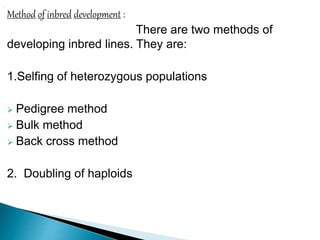
Method of inbred development :
There are two methods of
developing inbred lines. They are:
1.Selfing of heterozygous populations
 Pedigree method
 Bulk method
 Back cross method
2. Doubling of haploids
1.Selfing of heterozygous populations :
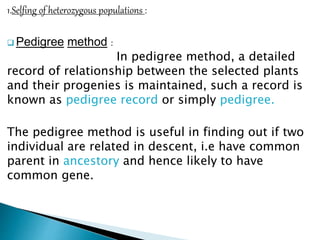
 Pedigree method :
In pedigree method, a detailed
record of relationship between the selected plants
and their progenies is maintained, such a record is
known as pedigree record or simply pedigree.
The pedigree method is useful in finding out if two
individual are related in descent, i.e have common
parent in ancestory and hence likely to have
common gene.
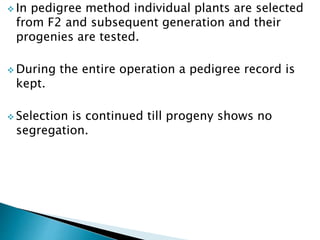
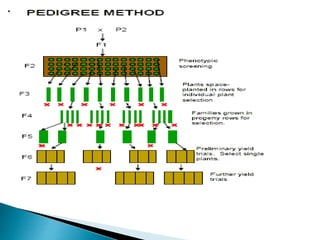
 In pedigree method individual plants are selected
from F2 and subsequent generation and their
progenies are tested.
 During the entire operation a pedigree record is
kept.
 Selection is continued till progeny shows no
segregation.
.
 Bulk Method :
 Term used by : Nilsson-Ehle (1908)
This method is also known as mass method or
population ,method of breeding.
In bulk method, F2
and subsequent generations are harvested in mass
or as bulk to raise next generation.
At the end of bulking period, individual plants are
selected and evaluated in a similar manner as in the
pedigree method of breeding.
The duration of bulking may vary from 6-7 to 30 or
more generations during which artificial selection
may or may not be practised.
The main difference between bulk and pedigree
method therefore lies in manner in which
segregating generation are handled.
In pedigree method individual plant progenies are
grown and evaluated in F3 and subsequent
generations, while in bulk method these generation
are grown as bulk.
A cross between a
hybrid and one of its parents.
In backcross method, the hybrid and the progenies
in the subsequent generations are repeatedly
backcrossed to one of the parents of the F1.
The objective of backcross method is to improve
one or two specific defects of a high yielding variety
which is well adapted to the area and has other
desirable characteristics.
 Requirements for backcrossing
1. Suitable recurrent parent which lack one or two
characteristics
2. Suitable donor plant that has intense form the
characters
3. The character s to be transferred must have high
heritability and should be govern by one or two
genes.
4. Sufficient number of backcrosses should be made
 Applications of Inbreds in Crop Improvement :
 Inbred lines are genotypes that are developed to be
used as parents in the production of hybrid
cultivars and synthetic cultivars in the breeding of
cross-pollinated species.
 The success of a crop breeding program relies on
choice of the best parents possessing
complementary and desired traits.
 Inbreds are highly desirable in comparison to
openpollinated varieties or other populations with
a broad genetic base due to following reasons :
 Inbreds can be maintained indefinitely without a
change in their genotype, while the genetic
makeup of populations like open-pollinated
varieties is likely to be modified by the
evolutionary forces.
 The hybrids derived from inbreds are
homogeneous or nearly so, year after year, while
those produced from open-pollinated varieties
are likely to be variable & hence their
performance can't be accurately predicted.
 The uniformity of inbred-derived hybrids is also
desirable from the viewpoint of uniform quality of
the produce as well as.
 From the view point of seed certification.
 The inbred lines are identified by numbers, letters or
combination of both. In India inbred lines are developed
and released through coordinate maize improvement
scheme and are designated as CM (Co-ordinate maize),
CS (Co-ordinate sorghum) etc.
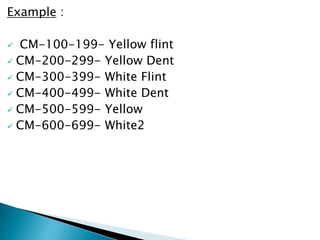
Example :
 CM-100-199- Yellow flint
 CM-200-299- Yellow Dent
 CM-300-399- White Flint
 CM-400-499- White Dent
 CM-500-599- Yellow
 CM-600-699- White2
.

Plant breeding ppt

  • 1.
    Development of inbred lines Submittedto : Prepared by : Dr. Kalpana Jaggi Jeetendra yadav Kamal timsina
  • 2.
    Introduction : Inbred linemeans a relatively stable and pure breeding strain resulting from :  Four or more successive generations of controlled self- pollination. In short : Inbred lines are those sorts of breeding line that have been crossed with a very closely related stain.
  • 3.
    Contd.... An inbred lineis a homozygous breeding line developed and maintained by self pollination. For the development of inbreds, Varieties or hybrids serve as the initial materials. For this, Succeeding generations are culled until the necessary homogeneity is attained, (usually in the sixth generation).
  • 4.
     .In culling,special attention is paid to the combining ability of the inbred.  Only inbreds that with cross pollination produce high yields are selected. The highest yield are obtained from hybrids from lines, which are widely used. Eg: corn production.
  • 5.
  • 6.
    Method of inbreddevelopment : There are two methods of developing inbred lines. They are: 1.Selfing of heterozygous populations  Pedigree method  Bulk method  Back cross method 2. Doubling of haploids
  • 7.
    1.Selfing of heterozygouspopulations :  Pedigree method : In pedigree method, a detailed record of relationship between the selected plants and their progenies is maintained, such a record is known as pedigree record or simply pedigree. The pedigree method is useful in finding out if two individual are related in descent, i.e have common parent in ancestory and hence likely to have common gene.
  • 8.
     In pedigreemethod individual plants are selected from F2 and subsequent generation and their progenies are tested.  During the entire operation a pedigree record is kept.  Selection is continued till progeny shows no segregation.
  • 9.
  • 10.
     Bulk Method:  Term used by : Nilsson-Ehle (1908) This method is also known as mass method or population ,method of breeding. In bulk method, F2 and subsequent generations are harvested in mass or as bulk to raise next generation. At the end of bulking period, individual plants are selected and evaluated in a similar manner as in the pedigree method of breeding.
  • 11.
    The duration ofbulking may vary from 6-7 to 30 or more generations during which artificial selection may or may not be practised. The main difference between bulk and pedigree method therefore lies in manner in which segregating generation are handled. In pedigree method individual plant progenies are grown and evaluated in F3 and subsequent generations, while in bulk method these generation are grown as bulk.
  • 12.
    A cross betweena hybrid and one of its parents. In backcross method, the hybrid and the progenies in the subsequent generations are repeatedly backcrossed to one of the parents of the F1. The objective of backcross method is to improve one or two specific defects of a high yielding variety which is well adapted to the area and has other desirable characteristics.
  • 13.
     Requirements forbackcrossing 1. Suitable recurrent parent which lack one or two characteristics 2. Suitable donor plant that has intense form the characters 3. The character s to be transferred must have high heritability and should be govern by one or two genes. 4. Sufficient number of backcrosses should be made
  • 14.
     Applications ofInbreds in Crop Improvement :  Inbred lines are genotypes that are developed to be used as parents in the production of hybrid cultivars and synthetic cultivars in the breeding of cross-pollinated species.  The success of a crop breeding program relies on choice of the best parents possessing complementary and desired traits.
  • 15.
     Inbreds arehighly desirable in comparison to openpollinated varieties or other populations with a broad genetic base due to following reasons :  Inbreds can be maintained indefinitely without a change in their genotype, while the genetic makeup of populations like open-pollinated varieties is likely to be modified by the evolutionary forces.  The hybrids derived from inbreds are homogeneous or nearly so, year after year, while those produced from open-pollinated varieties are likely to be variable & hence their performance can't be accurately predicted.
  • 16.
     The uniformityof inbred-derived hybrids is also desirable from the viewpoint of uniform quality of the produce as well as.  From the view point of seed certification.  The inbred lines are identified by numbers, letters or combination of both. In India inbred lines are developed and released through coordinate maize improvement scheme and are designated as CM (Co-ordinate maize), CS (Co-ordinate sorghum) etc.
  • 17.
    Example :  CM-100-199-Yellow flint  CM-200-299- Yellow Dent  CM-300-399- White Flint  CM-400-499- White Dent  CM-500-599- Yellow  CM-600-699- White2
  • 18.